Lecture 1 Biochem
Study these flashcardsFree · spaced repetition · iPhone, Android, Mac & web
All cards
1
What is the significance of water in biochemical systems?
It is the solvent used by living things and has important properties
2
What are four anomalous properties of water and what explains these properties?
(1) High boiling point (2) High freezing point (3) High heat capacity (4) High cohesive properties. The polarity of water and its hydrogen bonding explain these features.
3
What happens when water dissociates?
The proton reacts with another water molecule and forms a hydronium ion
4
What is the basic structure of a micelle?
It involves the hydrophobic tails facing inward and the hydrphillic head facing outward. It forms a hydrophobic core in the middle.
5
How does electrolyte solvation work?
Positive ions interact with the negative dipole of the water (the oxygen) and negative ions interact with the positive dipole of the water (the hydrogen)
6
How is Keq calculated?
Keq= [products]/[reactants]
7
What percentage of the human body is water?
60-64%
8
What percentage of the brain is water?
73-80%
9
Within the cell, what percentage is water?
62%
10
What role does water play in the development of a protein core?
Water causes non polar amino acids to become buried in protein folding
11
What role does water play in helix formation?
Influences base stacking in helix formation. The nucleic acids have hydrophobic nitrogenous bases but the phosphate is hydrophilic and will face the outside
12
What role does water play in the generation of a lipid membrane?
It develops lipid membranes with a hydrophoic tail region
13
What role does water play in the developement of macromolecule complexes?
1. Allows multimeric proteins to form 2. Allows for protein-nucleic interactions to occur 3. Allows for membrane-protein interactions
14
What are the 4 endogenous influences of H+ concentration?
(1) Enzyme catalytic rates (2) Membrane permeability of molecules (3) Conformation and stability of nucleic acids/proteins (4) Rate of molecules (charged or uncharged) passing through the membrane
15
What are the 2 exogenous influences of H+ concentration?
1. How hydrophilic or hydrophobic a drug is 2. The “ad me” pharmacological principle of drugs (absorption, distribution, metabolism, and elimination)
16
What is the pKa?
The dissociation constant
17
pH of lysosome
5.5
18
pH of neutral water
6.81
19
pH of cytosol
7.2
20
pH of cerebrospinal fluid
7.3
21
pH of arterial blood from plasma
7.35-7.45
22
pH of mitochondrial inner matrix
7.5
23
pH of stomach before and after digestion
2 before, 4 after
24
What is the Henderson-Hasselbach equation?
pH=pKa+[A-]/[HA]
25
What happens to pH when the concentration of conjugate acid is equal to conjugate base?
pH=pKa
26
When pH=pKa, what is this point called?
The isoelectric point
27
What is an example of an intrinsic property of a buffer?
Its pKa
28
When does a buffer work the best?
When the when the pH scale of pKa is +/- 1
29
What is an example of an extrinsic property of a buffer?
The buffer capacity, which is dependent on the total concentration of buffer
30
When the pKa is higher, is it more or less difficult to remove a proton?
More difficult
31
How do nucleotides and side chains of amino acids function in buffering systems?
Side chains serve as weak acids or bases. Nucelotides undergo dissociation and form buffers.
32
What is the major buffer inside of the cell?
Phosphate (pH 6.4 to 7.4)
33
What is the major buffer inside of the blood?
Bicarbonate (ideally 7.4, but 7.36 to 7.44)
34
Why is dihydrogen phosphate used as a buffer for the kidney?
Because the pKa of 6.8 is similar to the physiologic range
35
What is Le Chatelier’s Principle?
A change in a system at equilibrium produces a shift in the position of the equilibrium that counteracts the effect of this change.
36
What is the concentration of carbonic acid and bicarbonate in the blood?
1 mM of carbonic acid, 20 mM of bicarbonate
37
What is isohydria? Isovolumia? Isoosmolarity? Isoionia?
Stable pH, stable volume, stable tonicity, stable ion levels
38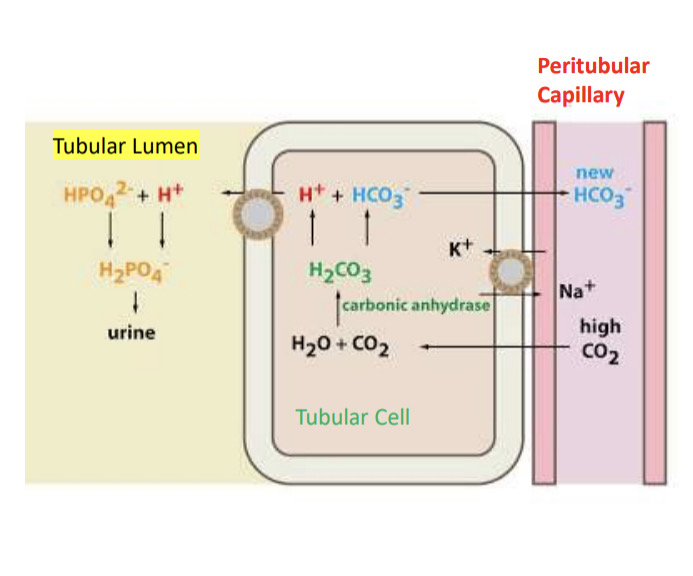
Draw our bicarbonate and phosphate buffer system
39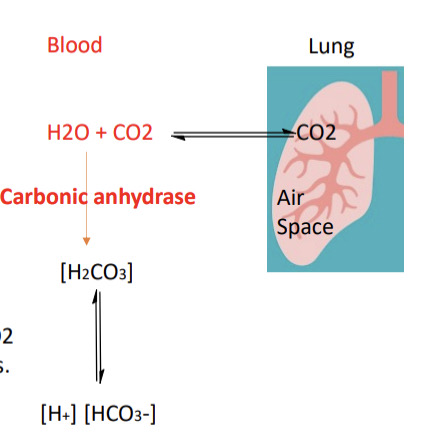
Draw out blood pH diagram
40
What is respiratory acidosis?
-Poor ventilation or pulmonary obstruction leads to increase in partial pressure of CO2 and increase in H+ (decrease in pH). - The kidney reabsorbs Na+ and releases HCO3- into the blood
41
What is pulmonary alkalosis? What is lost?
-With hyperventilation (pulmonary embolism or hepatic failure), the kidney absorbs HCO3- from blood to decrease pH. -You loose water, Na+, and Cl-
42
What causes diabetic ketoacidosis?
accumulation of beta hydroxy butyric acid acid and acetoacetic acid
43
What causes metabolic alkalosis?
urea cycle enzyme defect
44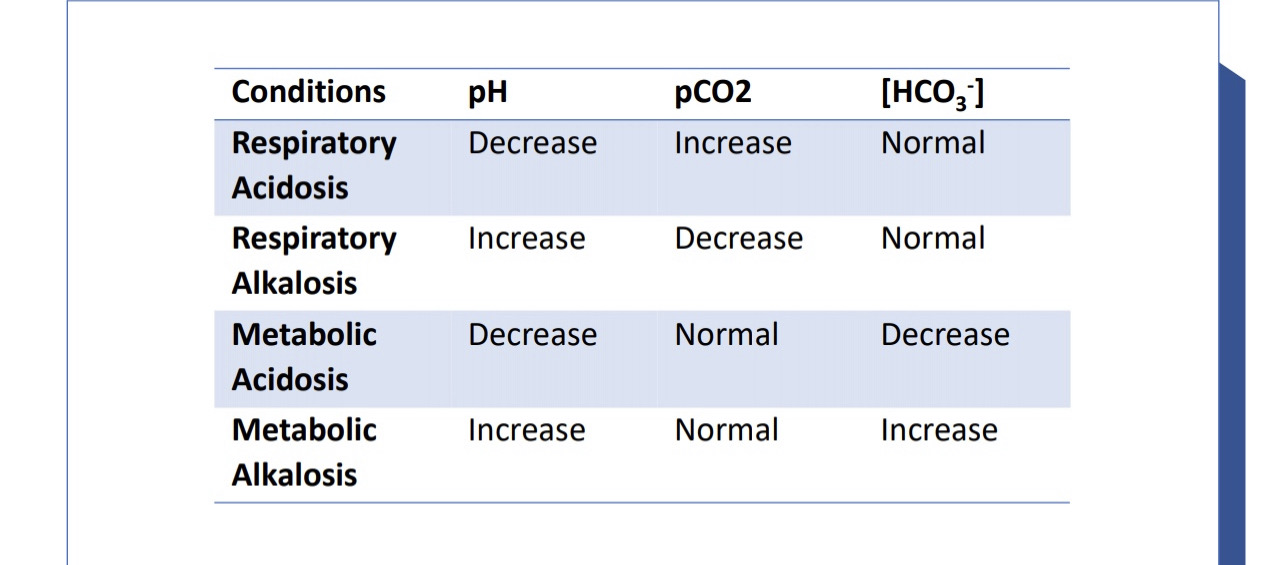
Acidosis v. Alkalosis chart with pH, pCO2, and HCO3-
45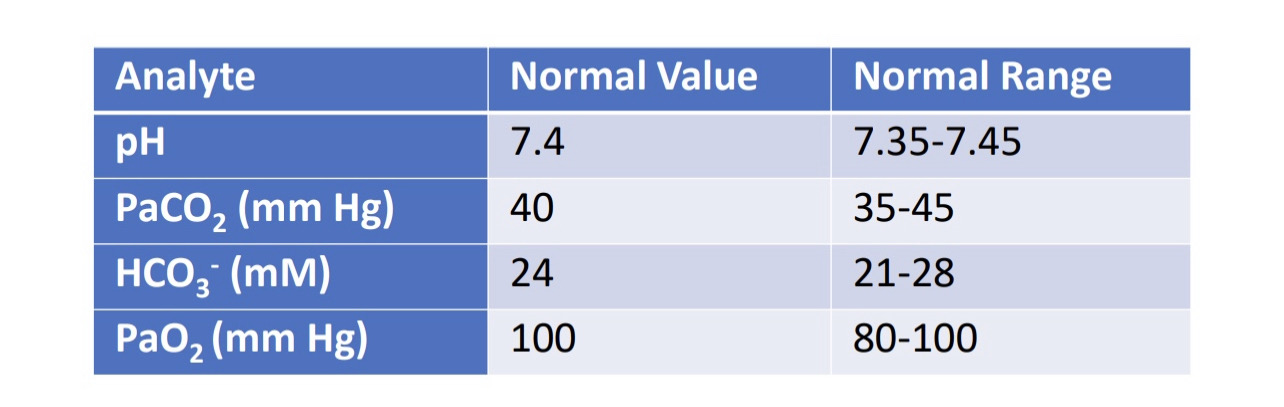
Normal Values Chart with Normal ranges for pH, PCO2, HCO3-, and PaO2
46
What makes albumin a good buffer in the kidney?
It has a pKa of around 6 which is close to neutrality=