Lecture 3 Biochem
Study these flashcardsFree · spaced repetition · iPhone, Android, Mac & web
All cards
1
How are lipids different from other biomolecules?
-Not characterized by molecular structure
-Have a shared property of being extremely hydrophobic
-Have a shared property of being extremely hydrophobic
2
What are the 5 classes of lipids?
1. Triglycerides
2. Sphingosines
3. Steroids
4. Eicosanoids
5. Fat-soluble vitamins
2. Sphingosines
3. Steroids
4. Eicosanoids
5. Fat-soluble vitamins
3
What are 3 important features of lipids?
(1) Not soluble in water
(2) soluble in organic solvents (benzene, carbon tetrachloride, and trichloroethylene)
(3) high proportion of hydrocarbons relative to other polar groups. ARE AMPHIPHILIC.
(2) soluble in organic solvents (benzene, carbon tetrachloride, and trichloroethylene)
(3) high proportion of hydrocarbons relative to other polar groups. ARE AMPHIPHILIC.
4
What are the 8 general functions of lipids?
1. Fuel (i.e. gasoline)
2. Cell membranes
3. Steroid hormones
4. Bile acids
5. Prostoglandins
6. Fat-soluble vitamins
7. Glycolipids
8. Waxes
2. Cell membranes
3. Steroid hormones
4. Bile acids
5. Prostoglandins
6. Fat-soluble vitamins
7. Glycolipids
8. Waxes
5
What are the 4 main biological functions of lipids?
1. Energy (fat)
2. Metabolism cofactors (vitamins)
3. Structural components of membrane (phospholipids)
4. Cell signaling mediators (cholesterol-derived steroid hormones, cholesterol)
2. Metabolism cofactors (vitamins)
3. Structural components of membrane (phospholipids)
4. Cell signaling mediators (cholesterol-derived steroid hormones, cholesterol)
6
What is the general structure of a fatty acid?
Has a polar head (carboxylic acid) and a nonpolar tail
7
What does saturated fatty acid mean? Are these solid or liquid at room temperature?
-All carbon are linked by single covalent bond C-C
-Solid at room temperature
-Solid at room temperature
8
What does unsaturated fatty acid mean? Are these solid or liquid at room temperature?
-Means that there is one or more double bond C=C
-Tend to be liquid at room temperature
-Tend to be liquid at room temperature
9
Which type of unsaturated fatty acid or more dangerous to health?
Trans because they are formed from synthetic processes (we don't make these) and can lead to disease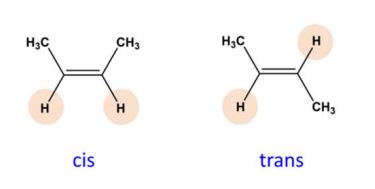
10
Why do fatty acids differ by 2 carbons (i.e. lauric acid 12 C, Myristic acid 14 C, Palmitic acid 16 C... etc)?
-Because the enzyme that makes these fatty acids adds two carbons at a time
11
How are unsaturated fatty acids numbered?
-The delta and omega numbering system
-Omega is numbered starting at methyl end of fatty acid
-Delta is numbered starting at the carboxyl end (think organic chem!)
-Omega is numbered starting at methyl end of fatty acid
-Delta is numbered starting at the carboxyl end (think organic chem!)
12
How are essential fatty acids identified?
Using the delta numbering system. Essential fatty acids have a delta greater than 9.
13
What is an example of a unsaturated fat made by animals? What is an example of two unsaturated fats that cannot be made by animals?
Animals can make oleic acids, but cannot make linoleic and linolenic acids (polyunsaturated)
14
How are lipids different from other biomolecules?
-Not characterized by molecular structure
-Have a shared property of being extremely hydrophobic
-Have a shared property of being extremely hydrophobic
15
Where are triglycerides stored?
Adipose tissue
16
What is the relationship between fatty acid length and saturation to melting point?
The more carbons, the higher the melting point. The more double bonds (more unsaturated), the lower the melting point (van der Waals)
17
Where is fat found?
Both subcutaneously and viscerally
18
What are the three purposes of fat in adipose tissue?
1. Reserve of lipids
2. Make energy when body low in glucose
3. Store glucose when glucose levels are high
2. Make energy when body low in glucose
3. Store glucose when glucose levels are high
19
Why type of organ is adipose? Why is it classified that way?
-produces multiple bioactive peptides called adipokine that influence adipocyte function and other metabolic cells (like those in liver)
20
What are the two most abundant lipids in the cell membrane (in order)?
1. Glycerophospholipids
2. Sphingolipids
2. Sphingolipids
21
What three things are membranes comprised of?
(1) Phospholipids (25%)
(2) Cholesterol (13%)
(3) Other lipids
(2) Cholesterol (13%)
(3) Other lipids
22
What are the 3 types of lipids in the membrane? What is their role?
(1) Phospholipids: Make a bilayer
(2) Glycolipids: Make protein anchors
(3) Cholesterol/sphingomyelin: Make lipid rafts
(2) Glycolipids: Make protein anchors
(3) Cholesterol/sphingomyelin: Make lipid rafts
23
How do membranes assemble?
The lipids form membranes through spontaneous self-assembly
24
What are three examples of spontaneous membrane assembly?
1. Micelles
2. Lipid bilayers
3. Liposomes
2. Lipid bilayers
3. Liposomes
25
How are liposomes formed? What is their function? Example?
-Formed from spontaneous self-assembly when lipids are place in aqueous environment
-Liposomes can be used to deliver their contents into cells by membrane fusion (i.e. mRNA COVID vaccine, transinfection of cells in lab)
-Liposomes can be used to deliver their contents into cells by membrane fusion (i.e. mRNA COVID vaccine, transinfection of cells in lab)
26
What cell signaling molecules are steroids a precursor to?
Glucocorticoids, androgens, estrogen
27
What is the difference between passive and active transport
-Passive transport: Done by diffusion, no energy spent. Either with a transport protein or without.
-Active transport: Needs energy. Molecules move AGAINST gradient.
-Active transport: Needs energy. Molecules move AGAINST gradient.
28
Does more unsaturated fats make something more or less fluid?
More fluid 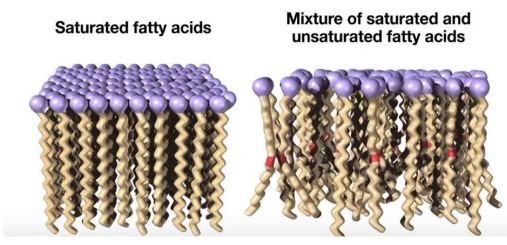
29
What is lateral lipid movement? How was this determined?
They move within within one layer. Photobleaching experiments. 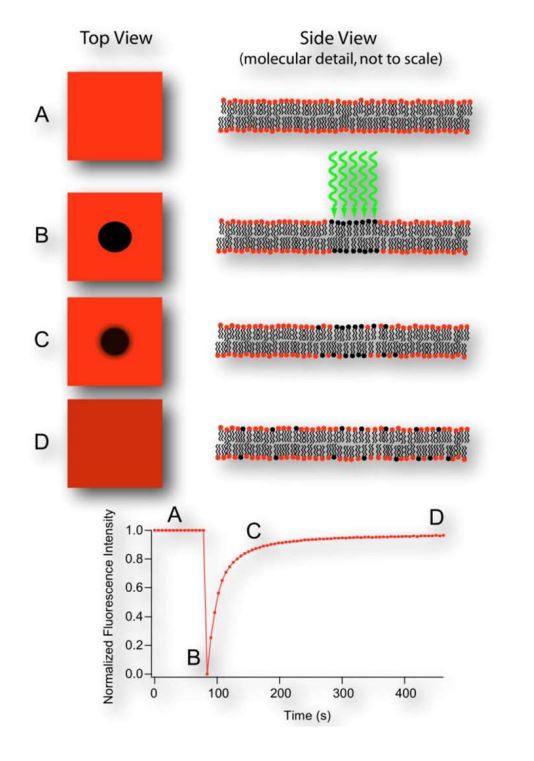
30
What is transverse lipid movement? How is this done?
Movement from one side of the lipid bilayer to the other. Done with enzymes flippase, floppase, and scramblase.
31
How does cholesterol influence membrane stability?
-Cholesterol is stored within or near membrane
-Makes the membrane more fluid if hot, less fluid if cold. More rigid if hot, less rigid if cold.
-Makes the membrane more fluid if hot, less fluid if cold. More rigid if hot, less rigid if cold.
32
What is the function of short chain fatty acids? How are they formed/ Which three are the most abundant?
-Act as signaling molecules
-Produce by gut bacteria and feed on dietary fibers
-Acetate, propionate, and butyrate (all play a role in maintaining gut health)
-Produce by gut bacteria and feed on dietary fibers
-Acetate, propionate, and butyrate (all play a role in maintaining gut health)
33
What is the role of the propionate and butyrate?
-They are both short chain fatty acids involved in gut-brain axis communication
-Inhibit activity of enzymes involved in neuropsychiatric disorders
-Inhibit activity of enzymes involved in neuropsychiatric disorders
34
How are sterols formed? What do sterols form?
-Sterols are made from 5-carbon units called isoprene
-Multiple copies of isoprene form one long molecule that gets cyclized and forms cholesterol
-Multiple copies of isoprene form one long molecule that gets cyclized and forms cholesterol
35
What role do isoprenoids play in the formation of fat soluble vitamins?
They are the precursors to vitamin A, D, E, and K
36
How are vitamin A, D, E, and K derived?
• A -> derived from retinol and carotenoids
• D -> cholesterol derived, calcium regulation
• E -> from soybean oil, antioxidant properties
• K -> from green plants and gut bacteria
• D -> cholesterol derived, calcium regulation
• E -> from soybean oil, antioxidant properties
• K -> from green plants and gut bacteria
37
When lipid signaling is dysregulated, what can occur?
Inflammation, cancer, metabolic, caridovascular, and degenerative disease
38
What 3 cell signaling molecules are eicosanoids a precursor to?
Protacyclins, prostaglandins, thromboxane
39
How are eicosanoids made?
Oxidation of fatty acids
40
What 3 signaling molecules are steroids a precursor to?
Glucocorticoids, androgens, estrogen
41
What are 4 signaling lipids control important cellular processes, including cell proliferation, apoptosis, metabolism and migration?
1. Eicosanoids
2. Phosphoinositides
3. Sphingolipids
4. Fatty acids
2. Phosphoinositides
3. Sphingolipids
4. Fatty acids
42
What is the difference between the extrinsic and intrinsic apoptotic pathway?
Extrinsic: signaling on cell membrane causes signal transduction that activates caspases, apoptosome, and nucleases
Intrinsic: Loss of mitochondrial cytochrome C activates apoptosomes
Intrinsic: Loss of mitochondrial cytochrome C activates apoptosomes
43
What can issues with lipid membrane permeability lead to?
Can lead to the formation of reactive oxygen species that can cause lipid peroxidation and membrane damage