Resenting Membrane and Action Potential
Study these flashcardsFree · spaced repetition · iPhone, Android, Mac & web
All cards
1
Which 4 ions are found in greater amounts in the extracellular env? What is the net charge of the extracellular env?
Na+, Cl-, HCO3-, Ca2+ (Net charge is positive)
2
Which 4 ions are found in greater amounts in teh intracellular env? What is the net charge of the extracellular env?
K+, HPO4-, Mg2+, Protein (Net charge is negative)
3
What are the two primary contributers of the electrochemical gradient?
K+ and Na+
4
Membrane potential is - to mV
Membrane potential is -60 to -85 mV
5
3 Ion Functions – (1) (2) (3)
3 Ion Functions – (1) Action potential (2) Cellular communication (3) Cellular homeostasis
6
Ion movement is by and gradient. Ions in cell don’t function in isolation.
Ion movement is by electrical and concentration gradient. Ions in cell don’t function in isolation.
Ion movement is by and gradient. Ions in cell don’t function in isolation.
Ion movement is by electrical and concentration gradient. Ions in cell don’t function in isolation.
7
Sodium has a driving force in directions that does not necessitate
Sodium has a driving force in both directions that does not necessitate ATP
8
Cell reaches when there is no further movement of the ion, the membrane potential at this point is the
Cell reaches equilibrium when there is no further movement of the ion, the membrane potential at this point is the equilibrium gradient
9
Nerst equilibrium tells you if you have only one ion entering the cell, where it will entering the cell due to reaching or (in reality, does not exists in a vacuum, but the equation helps to explain the concept).
Nerst equilibrium tells you if you have only one ion entering the cell, where it will stop entering the cell due to reaching equilibrium or Nernst potential (in reality, does not exists in a vacuum, but the equation helps to explain the concept).
10
Core Concept: Equilibrium potential is dependent on inside versus outside of the cell
Core Concept: Equilibrium potential is dependent on concentration inside versus outside of the cell 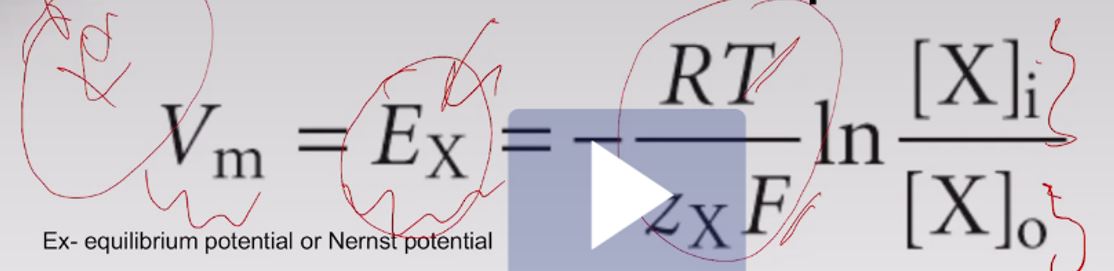
11
mV Nerst Equilibrium for sodium if sodium is the only ion (it is never really reached because it does not really exist in isolation)
+61 mV Nerst Equilibrium for sodium if sodium is the only ion (it is never really reached because it does not really exist in isolation)
12
Driving force = efflux vs. influx determined by and gradient.
Driving force = efflux vs. influx determined by electrochemical and chemical gradient.
13
For Na+, the driving force for the equilibrium potential are both in the direction.
For Na+, the driving force for the equilibrium potential are both in the SAME direction.
14
For K+, the chemical gradient goes and electrical gradient goes .
For K+, the chemical gradient goes out and electrical gradient goes in.
15
Cl- and not , and driving force is very small. Electrical and Chemical are in the direction
Cl- modulates and not excites, and driving force is very small. Electrical and Chemical are in the same direction
16
Ca2+ has a large driving force with electrical and chemical inside ( for depolarization, but in other areas of the body.)
Ca2+ has a large driving force with both electrical and chemical inside (not for depolarization, but in other areas of the body.)
17
Cell depolarizes cell by letting sodium and switches it off to repolarize by removing positive charge if
Cell depolarizes cell by letting sodium in and switches it off to repolarize by removing positive charge if potassium
18
for each ion is based on normal cellular concentrations of each ion
Equilibrium potential for each ion is based on normal cellular concentrations of each ion
19
Depolzarization occurs by letting in and removing positive charges in (used in acid-base balance, RMP maintaine adsorption, secretion, and receptor activation)
Depolzarization occurs by letting NA+ in and removing positive charges in K+ (used in acid-base balance, RMP maintaine adsorption, secretion, and receptor activation)
20
Driving force = –
(if negative, . If positive, )
(if negative, . If positive, )
Driving force = electrical force (equilibrium pot) – chemical force (intracellular concen)
(if negative, influx. If positive, efflux)
(if negative, influx. If positive, efflux)
21
Driving force of Cl- changes depending on whether or not it is in the m. or most cells.
Sodium is the , K+ is the
Sodium is the , K+ is the
Driving force of Cl- changes depending on whether or not it is in the skeletal m. or most cells.
Sodium is the depolarizer, K+ is the repolarizer
Sodium is the depolarizer, K+ is the repolarizer
22
An ischemic cell has resting potentials that are more and are therefore more excitable and are more likely to experience and can contribute to
An ischemic cell has resting potentials that are more positive and are therefore more excitable and are more likely to experience arrhythmia and can contribute to ischemia