CH. 33 Nucleotide Syn 2
Study these flashcardsFree · spaced repetition · iPhone, Android, Mac & web
All cards
1
Metabolism -> incudes and
Metabolism -> incudes synthesis and breakdown
2
When cells proliferate, nucleotide
synthesisis needed for DNA replication and
RNA transcription to make proteins.
synthesisis needed for DNA replication and
RNA transcription to make proteins.
When cells proliferate, increased nucleotide
synthesisis needed for DNA replication and
RNA transcription to make proteins.
synthesisis needed for DNA replication and
RNA transcription to make proteins.
3
**** TEST QUESTION
Glutamine is precursor for and biosynthesis
Glutamine is precursor for and biosynthesis
**** TEST QUESTION
Glutamine is precursor for adenine and guanine biosynthesis
Glutamine is precursor for adenine and guanine biosynthesis
4
De novo synthesis -> primary in the
Done using phosphoribosyl pyrophosphate (PRPP, a ribose sugar with
pyrophosphates attached) with
Done using phosphoribosyl pyrophosphate (PRPP, a ribose sugar with
pyrophosphates attached) with
De novo synthesis -> primary in the liver
Done using phosphoribosyl pyrophosphate (PRPP, a ribose sugar with
pyrophosphates attached) with glutamine
Done using phosphoribosyl pyrophosphate (PRPP, a ribose sugar with
pyrophosphates attached) with glutamine
5
De novo synthesis is catalyzed by enzyme and is an reaction
De novo synthesis is catalyzed by amidoPRT enzyme and is an irreveserible reaction
6
Denovo synthesis is activated by of PRPP. Low levels rate of synthesis.
Denovo synthesis is activated by high levels of PRPP. Low levels decrease rate of synthesis.
7
PRPP is both and
PRPP is both substrate and activator
8
PRPP is produced by pyrophosphorylation of ribose 5-phosphate by
PRPP is produced by pyrophosphorylation of ribose 5-phosphate by PRPP-synthetase
9
Ribose 5-phosphate (R5P)
• Produced by intermediate of the and
• Produced by intermediate of the and
Ribose 5-phosphate (R5P)
• Produced by intermediate of the pentose phosphate pathway and glycolysis
• Produced by intermediate of the pentose phosphate pathway and glycolysis
10
High PRPP leads to higher plasma concentrations
High PRPP leads to higher plasma uric acid concentrations
11
Regulation of PRPP synthetase by and feedback inhibition
Regulation of PRPP synthetase by ADP and GDP feedback inhibition
12
In the salavge pathway,
enzyme phosphorylates and ribosylates dietary adenine and
guanine forming the purine nucleotides (ATP and GTP) used
for DNA and RNA synthesis
enzyme phosphorylates and ribosylates dietary adenine and
guanine forming the purine nucleotides (ATP and GTP) used
for DNA and RNA synthesis
In the salavge pathway, HGPRT (hypoxanthine-guanine phosphoribosyltransferase)
enzyme phosphorylates and ribosylates dietary adenine and
guanine forming the purine nucleotides (ATP and GTP) used
for DNA and RNA synthesis
enzyme phosphorylates and ribosylates dietary adenine and
guanine forming the purine nucleotides (ATP and GTP) used
for DNA and RNA synthesis
13
In the salvage pathway, the nitrogenous bases of degraded nucleic acids are available for . is needed here too!
In the salvage pathway, the nitrogenous bases of degraded nucleic acids are available for recycling . PRPP is needed here too!
14
What are the two important enzymes of the salavge pathway?
- Hypoxanthine+PRPP->IMP
Guanine+PRPP-> GMP
- ) Adenine+PRPP->AMP
- Hypoxanthine+PRPP->IMP
Guanine+PRPP-> GMP
- ) Adenine+PRPP->AMP
What are the two important enzymes of the salavge pathway?
-HGPRTHypoxanthine+PRPP->IMP
Guanine+PRPP-> GMP
-APRT) Adenine+PRPP->AMP
-HGPRTHypoxanthine+PRPP->IMP
Guanine+PRPP-> GMP
-APRT) Adenine+PRPP->AMP
15
HGPRT:This enzyme is exceptionally important,and it is inhibited by both and (feed back inhibition).
HGPRT:This enzyme is exceptionally important,and it is inhibited by both IMP and GMP (feed back inhibition).
16
What are the two functions of HGPRT?
1. Transfer guanine to PRPP
2. Transfer hypoxanthine to PRPP
2. Transfer hypoxanthine to PRPP
17
Thermodynamically, the reactions are pushed forward by removal of PPi product by the enzyme:
Thermodynamically, the reactions are pushed forward by removal of PPi product by the enzyme: pyrophosphatase
18
Salvage pathway ->
• can add adenine to PRPP to make and
• can add adenine to PRPP to make and
Salvage pathway -> APRT
• APRT can add adenine to PRPP to make AMP and PPi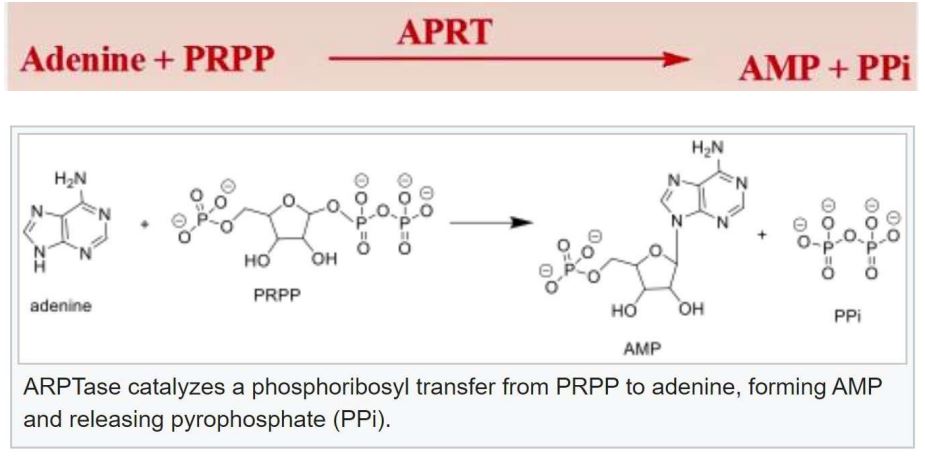
• APRT can add adenine to PRPP to make AMP and PPi
19
Degradation converts purines and purine nucleotides to
Degradation converts purines and purine nucleotides to
hypoxanthine
hypoxanthine
20
******TEST QUESTION converts hypoxanthine to xanthine
and ultimately to uric acid.
and ultimately to uric acid.
******TEST QUESTION xanthine oxidase converts hypoxanthine to xanthine
and ultimately to uric acid.
and ultimately to uric acid.
21
Degradation of Purines
1. Degradation starts with the , so the nucleotides become nucleosides (adenosine or inosine) by the action of nucleotidases.
2. Adenosine is converted to inosine by adenosine deaminase (ADA) with the removal .
3. Purine nucleoside phosphorylase (PNP) can then
remove ribose from inosine as . This the reaction that yields .
1. Degradation starts with the , so the nucleotides become nucleosides (adenosine or inosine) by the action of nucleotidases.
2. Adenosine is converted to inosine by adenosine deaminase (ADA) with the removal .
3. Purine nucleoside phosphorylase (PNP) can then
remove ribose from inosine as . This the reaction that yields .
Degradation of Purines
1. Degradation starts with the hydrolytic removal of phosphate, so the nucleotides become nucleosides (adenosine or inosine) by the action of nucleotidases.
2. Adenosine is converted to inosine by adenosine deaminase (ADA) with the removal of the amino group.
3. Purine nucleoside phosphorylase (PNP) can then
remove ribose from inosine as ribose-1-P. This the reaction that yields hypoxantine.
1. Degradation starts with the hydrolytic removal of phosphate, so the nucleotides become nucleosides (adenosine or inosine) by the action of nucleotidases.
2. Adenosine is converted to inosine by adenosine deaminase (ADA) with the removal of the amino group.
3. Purine nucleoside phosphorylase (PNP) can then
remove ribose from inosine as ribose-1-P. This the reaction that yields hypoxantine.
22
For AMP degradation the important enzyme from AMP side
For AMP degradation the important enzyme from AMP side
Adenosine deaminase
Adenosine deaminase
23
For GMP degradation, the important enzyme is
For GMP degradation, the important enzyme is Guanine deaminase
24
Both AMP and GMP degradation need and
Both AMP and GMP degradation need Purine nucleoside phosphorylase (PNP) and Xanthine oxidase
25
Increase in salvage pathway depletes levels and
de novo synthesis
de novo synthesis
Increase in salvage pathway depletes PRPP levels and
decreases de novo synthesis
decreases de novo synthesis
26
Salvage pathway leads to more and production
Salvage pathway leads to more ATP and GTP production
27
De novo generates more breakdown products
De novo generates more purine breakdown products
28
High de novo activity increases turnover, resulting in
higher concentrations
higher concentrations
High de novo activity increases purine turnover, resulting in
higher plasma uric acid concentrations
higher plasma uric acid concentrations
29
Higher salvage pathway activity leads to de novo
synthesis and reduces plasma uric acid
synthesis and reduces plasma uric acid
Higher salvage pathway activity leads to decreased de novo
synthesis and reduces plasma uric acid
synthesis and reduces plasma uric acid
30
Increased plasma levels leads disease; gout
Increased plasma uric acid levels leads disease; gout
31
Plasma becomes saturated if urate levels exceed 6.8 mg/dL.
• Levels over for men or for women is considered
hyperuricemia. (too much uric acid in the blood)
• Levels over for men or for women is considered
hyperuricemia. (too much uric acid in the blood)
Plasma becomes saturated if urate levels exceed 6.8 mg/dL.
• Levels over 7.0 mg/dL for men or 6.0 mg/dL for women is considered
hyperuricemia. (too much uric acid in the blood)
• Levels over 7.0 mg/dL for men or 6.0 mg/dL for women is considered
hyperuricemia. (too much uric acid in the blood)
32
High plasma levels of uric acid can lead to deposition of uric acid crystals in
joints
• Crystals of uric acid gather in areas with slow blood flow ( and
) and higher gravitational pull ( )
joints
• Crystals of uric acid gather in areas with slow blood flow ( and
) and higher gravitational pull ( )
High plasma levels of uric acid can lead to deposition of uric acid crystals in
joints
• Crystals of uric acid gather in areas with slow blood flow (joints and
kidney tubules) and higher gravitational pull (big toe)
joints
• Crystals of uric acid gather in areas with slow blood flow (joints and
kidney tubules) and higher gravitational pull (big toe)
33
In gout, synovial fluid favors the
In gout, synovial fluid favors the precipitate
34
Secondary gout
• Increased uric acid associated with turnover
• From leukemias, lymphomas, and after chemotherapy.
• Increased uric acid associated with turnover
• From leukemias, lymphomas, and after chemotherapy.
Secondary gout
• Increased uric acid associated with increased nucleic acid turnover
• From leukemias, lymphomas, and after chemotherapy.
• Increased uric acid associated with increased nucleic acid turnover
• From leukemias, lymphomas, and after chemotherapy.
35
In secondary gout, increase in can lead to overproduction of uric acid
• occurs in storage diseases and tissue hypoxia
• occurs in storage diseases and tissue hypoxia
In secondary gout, increase in ATP degradation can lead to overproduction of uric acid
• occurs in glycogen storage diseases and tissue hypoxia
• occurs in glycogen storage diseases and tissue hypoxia
36
In secondary gout, intake can cause accelerated ATP catabolism and decreased renal excretion of uric acid.
In secondary gout, Ethanol intake can cause accelerated ATP catabolism and decreased renal excretion of uric acid.
37
Saturnine gout; from exposure
• 18th-century England, prevalent among the upper classes with
• The Romans because they drank from vessels containing .
• Caused lead
• 18th-century England, prevalent among the upper classes with
• The Romans because they drank from vessels containing .
• Caused lead
Saturnine gout; from lead exposure
• 18th-century England, prevalent among the upper classes with lead plumbing
• The Romans because they drank from vessels containing lead.
• Caused lead nephropathy.
• 18th-century England, prevalent among the upper classes with lead plumbing
• The Romans because they drank from vessels containing lead.
• Caused lead nephropathy.
38
of uric acid gather in areas with slow blood flow joints and kidney tubules
• occurs when your kidneys don't eliminate uric acid efficiently
• Uric acid crystals can form in some people.
• occurs when your kidneys don't eliminate uric acid efficiently
• Uric acid crystals can form in some people.
Crystals of uric acid gather in areas with slow blood flow joints and kidney tubules
• occurs when your kidneys don't eliminate uric acid efficiently
• Uric acid crystals can form kidney stones in some people.
• occurs when your kidneys don't eliminate uric acid efficiently
• Uric acid crystals can form kidney stones in some people.
39
What are the 3 causes of hyperuricemia?
1. Underexcretion of uric acid by kidneys
2. Overproduction of purines -> Increased purine degradation
3. Von Gierke's disease
2. Overproduction of purines -> Increased purine degradation
3. Von Gierke's disease
40
Overproduction of purines -> increased degradation
• Consumption of foods (animal origin)
• Consumption of foods (animal origin)
Overproduction of purines -> increased purine degradation
• Consumption of purine-rich foods (animal origin)
• Consumption of purine-rich foods (animal origin)
41
Von Gierke disease
• Can’t break down -> leads to lactic acidosis. Lactic acid competes for excretion with
-> build- up of
• Can’t break down -> leads to lactic acidosis. Lactic acid competes for excretion with
-> build- up of
Von Gierke disease
• Can’t break down glycogen -> leads to lactic acidosis. Lactic acid competes for excretion with uric acid
-> build- up of uric acid
• Can’t break down glycogen -> leads to lactic acidosis. Lactic acid competes for excretion with uric acid
-> build- up of uric acid
42
Causes 8 of underexcretion by uric acid in kidneys
idiopathic
• renal failure
• Medication
• Dehydration
• Alcohol consumption
• Obesity/diabetes
• High fructose corn syrup
• Chemotherapy/ radiation
• renal failure
• Medication
• Dehydration
• Alcohol consumption
• Obesity/diabetes
• High fructose corn syrup
• Chemotherapy/ radiation
43
What are the 4 things to be avoided on a low purine diet?
1. Sugary foods
2. Seafood
3. Meat
4. Alcholoic berveages
2. Seafood
3. Meat
4. Alcholoic berveages
44
inhibits xanthine oxidase.
-xanthine oxidase converts hypoxanthine to
xanthine and ultimately to
-Inhibition stops formation.
-xanthine oxidase converts hypoxanthine to
xanthine and ultimately to
-Inhibition stops formation.
Allopurinol inhibits xanthine oxidase.
-xanthine oxidase converts hypoxanthine to
xanthine and ultimately to uric acid.
-Inhibition stops uric acid formation.
-xanthine oxidase converts hypoxanthine to
xanthine and ultimately to uric acid.
-Inhibition stops uric acid formation.
45
Alluprinol causes of hypoxanthine, but that's okay because it gets recycled back into the purine salavge pathway by
Alluprinol causes high levels of hypoxanthine, but that's okay because it gets recycled back into the purine salavge pathway by HGPRT
46
Decrease in activity results in increased levels of in Lesch-Nyhan syndrome
. • Self- mutilation
• Mental retardation
• Hyperuricemia
. • Self- mutilation
• Mental retardation
• Hyperuricemia
Decrease in HGPRT activity results in increased levels of PRPP in Lesch-Nyhan syndrome
. • Self- mutilation
• Mental retardation
• Hyperuricemia
. • Self- mutilation
• Mental retardation
• Hyperuricemia
47
With Lesch-Nyhan syndrome, polymorphisms in HGPRT lead to decreased enzyme activity and ( )
With Lesch-Nyhan syndrome, polymorphisms in HGPRT lead to decreased enzyme activity and hereditary gout (x-linked)
48
In Lesh-Nyhan syndrome Decreased nucleotide production
→ dopamine production
→ in striatal dopaminergic pathways
→ dopamine production
→ in striatal dopaminergic pathways
In Lesh-Nyhan syndrome Decreased nucleotide production
→ decreased dopamine production
→ lesions in striatal dopaminergic pathways
→ decreased dopamine production
→ lesions in striatal dopaminergic pathways
49
SCID: Adenosine Deaminase (ADA) -> one of the key enzymes of metabolism
SCID: Adenosine Deaminase (ADA) -> one of the key enzymes of purine metabolism
50
SCID: Primarily, is involved in the development and maintenance of the , although isozymes are also in the brain, gastrointestinal tract and extracellularly.
SCID: Primarily, ADA1 is involved in the development and maintenance of the immune
system, although isozymes are also in the brain, gastrointestinal tract and extracellularly.
system, although isozymes are also in the brain, gastrointestinal tract and extracellularly.
51
SCID: Adenosine Deaminase Deficiency -> (autosomal recessive) that causes
.
.
SCID: Adenosine Deaminase Deficiency -> metabolic disorder (autosomal recessive) that causes
primary immunodeficiency.
primary immunodeficiency.
52
SCID is characterized by the lack of both and function, thereby allowing multiple
infections (bacterial, viral and fungal) to take place.
infections (bacterial, viral and fungal) to take place.
SCID is characterized by the lack of both B-cell and T-cell function, thereby allowing multiple
infections (bacterial, viral and fungal) to take place.
infections (bacterial, viral and fungal) to take place.
53
The pyrimidine ring is formed from simple molecules
• , , ,
• , , ,
The pyrimidine ring is formed from simple molecules
• Gln,HCO3,H2O,ATP
• Gln,HCO3,H2O,ATP
54
What are the 4 steps of pyrimidine biosynthesis?
Part 1:Formation of
Part 2: conversion to
Part 3: combination with to form
Part 4: Formation of
Part 1:Formation of
Part 2: conversion to
Part 3: combination with to form
Part 4: Formation of
What are the 4 steps of pyrimidine biosynthesis?
Part 1:Formation of carbamoyl phosphate
Part 2:Carbamoyl conversion to orotate
Part 3: Orotate combination with PRPP to form OMP
Part 4: Formation of Uracil base (UMP)
Part 1:Formation of carbamoyl phosphate
Part 2:Carbamoyl conversion to orotate
Part 3: Orotate combination with PRPP to form OMP
Part 4: Formation of Uracil base (UMP)
55
Part 1 Pyramidine Synth: Formation of de novo synthesis of a pyrimidine
•Requires-> , and [derived from hydrolysis].
•Requires-> , and [derived from hydrolysis].
Part 1 Pyramidine Synth: Formation of carbamoyl phosphate de novo synthesis of a pyrimidine
•Requires-> 2ATP, Bicarbonate(HCO3-)and Ammonia (NH3) [derived from glutamine hydrolysis].
•Requires-> 2ATP, Bicarbonate(HCO3-)and Ammonia (NH3) [derived from glutamine hydrolysis].
56
Nucleotide production happens in the liver because it is best able to handle formation
Nucleotide production happens in the liver because it is best able to handle ammonia formation
57
From the formation of Carbamoylphosphate
• and a are released in the reaction.
•Carbamoyl phosphate synthetase II catalyzes the reaction
(in the ).
(CPSI acts within )
• and a are released in the reaction.
•Carbamoyl phosphate synthetase II catalyzes the reaction
(in the ).
(CPSI acts within )
From the formation of Carbamoylphosphate
•2 ADP and a phosphate are released in the reaction.
•Carbamoyl phosphate synthetase II catalyzes the reaction
(in the cytosol).
(CPSI acts within mitochondria)
•2 ADP and a phosphate are released in the reaction.
•Carbamoyl phosphate synthetase II catalyzes the reaction
(in the cytosol).
(CPSI acts within mitochondria)
58
Part 2: Carbamoyl conversion to
• joins through aspartate transcarbamoylase
(ATCase)to make carbamoylaspartate
• After a couple of reactions makes-> Orotate,
which has the basic pyrimidine ring shape.
• joins through aspartate transcarbamoylase
(ATCase)to make carbamoylaspartate
• After a couple of reactions makes-> Orotate,
which has the basic pyrimidine ring shape.
Part 2: Carbamoyl conversion to orotate
• Asp joins through aspartate transcarbamoylase
(ATCase)to make carbamoylaspartate
• After a couple of reactions Dihydroorotase makes-> Orotate,
which has the basic pyrimidine ring shape.
• Asp joins through aspartate transcarbamoylase
(ATCase)to make carbamoylaspartate
• After a couple of reactions Dihydroorotase makes-> Orotate,
which has the basic pyrimidine ring shape.
59
Clinical correlation:Oroticaciduria
• Autosomal recessive condition characterized by excessive
excretion of orotic acid in urine (deficiency of ) in the presence of normal levels of
• Autosomal recessive condition characterized by excessive
excretion of orotic acid in urine (deficiency of ) in the presence of normal levels of
Clinical correlation:Oroticaciduria
• Autosomal recessive condition characterized by excessive
excretion of orotic acid in urine (deficiency of UMP
synthase) in the presence of normal levels of ammonia.
• Autosomal recessive condition characterized by excessive
excretion of orotic acid in urine (deficiency of UMP
synthase) in the presence of normal levels of ammonia.
60
Part 3: Orotate combination with PRPP to form orotidylate(OMP)
• in the combination, the is released and
is formed.
• in the combination, the is released and
is formed.
Part 3: Orotate combination with PRPP to form orotidylate(OMP)
• in the combination, the pyrophosphate is released and
orotidylate (OMP)is formed.
• in the combination, the pyrophosphate is released and
orotidylate (OMP)is formed.
61
Part 4: Formation of
• Orotidylateis decarboxylated via orotidylatedecarboxylase
to form . Without this enzyme, this reaction would take
~ 78 M years for this reaction to occur.
• Orotidylateis decarboxylated via orotidylatedecarboxylase
to form . Without this enzyme, this reaction would take
~ 78 M years for this reaction to occur.
Part 4: Formation of Uracil base (UMP)
• Orotidylateis decarboxylated via orotidylatedecarboxylase
to form UMP. Without this enzyme, this reaction would take
~ 78 M years for this reaction to occur.
• Orotidylateis decarboxylated via orotidylatedecarboxylase
to form UMP. Without this enzyme, this reaction would take
~ 78 M years for this reaction to occur.
62
The main product of pyrimidine synthesis is
The main product of pyrimidine synthesis is UMP.
63
In the conversion of UMP to dTMP, three important
enzymes are , , and .
enzymes are , , and .
In the conversion of UMP to dTMP, three important
enzymes are ribonucleotide reductase (RNR), thymidylate
synthase, and dihydrofolate reductase (DHFR).
enzymes are ribonucleotide reductase (RNR), thymidylate
synthase, and dihydrofolate reductase (DHFR).
64
is required for the formation of
the deoxyribonucleotides for DNA synthesis.
the deoxyribonucleotides for DNA synthesis.
Ribonucleotide Reductase is required for the formation of
the deoxyribonucleotides for DNA synthesis.
the deoxyribonucleotides for DNA synthesis.