Lecture 2 Biochem
Study these flashcardsFree · spaced repetition · iPhone, Android, Mac & web
All cards
1
What are the four major types of cellular molecules and what are their functions?
1. Amino acids: make proteins 2. Fatty acids: make phospholipids 3. Nucleobases: Make DNA/RNA 4. Carbohydrates: Make phospholipids, saccharides, DNA/RNA
2
What two things are all organic molecules make of?
1. hydrocarbon chains (hydrogen and carbon)
2. Functional groups (responsible for the characteristics of a compound)
2. Functional groups (responsible for the characteristics of a compound)
3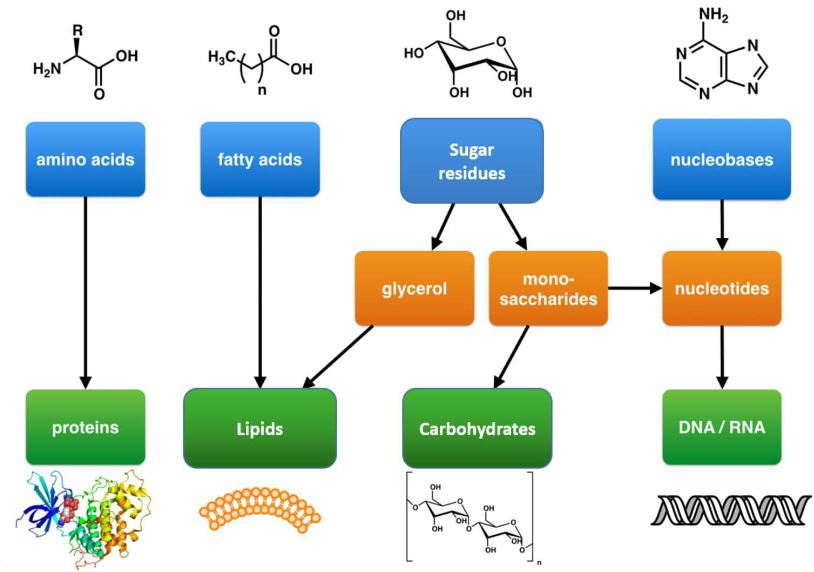
Chart with biomolecules and what they become
4
What are the three components of an amino acid?
1. Amino group
2. Carboxyl group
3. Variant group (responsible for the characteristic polar/nonpolar, positive and negative features)
2. Carboxyl group
3. Variant group (responsible for the characteristic polar/nonpolar, positive and negative features)
5
How are amino acids linked together?
Peptide bonds
6
What are the 3 components of a phospholipid?
1. 2 fatty acids
2. glycerol
3. phosphate
2. glycerol
3. phosphate
7
How are the fatty acids and glycerol linked in a phospholipid?
Ester bond
8
What are two structure that are made of phospholipids?
Cellular membranes (bilayers) and micelles
9
What are carbohydrates? What is their general formula? Why are they important to the body?
-Naturally occuring organic compounds that mainly are composed of carbons
-General formula is CxHxOx
-They are important because they are one of the main sources of energy
-General formula is CxHxOx
-They are important because they are one of the main sources of energy
10
What is glycogen?
Extra sugar that is stored in the liver and muscles
11
How are sugars linked together?
Glycosidic bond
12
What are monosaccharides? Oligosaccharides? Polysaccharides?
What are monosaccharides? Oligosaccharides? Polysaccharides?
One sugar, few sugars, many sugars
13
What is the difference between simple and complex sugars? What are 4 examples of simple sugars and 3 examples of complex sugars?
Simple sugars have 1 to 2 saccharides: glucose, fructose, lactose, and sucrose
Complex sugars have poly saccharides: starches, fibers, and glycogen
Complex sugars have poly saccharides: starches, fibers, and glycogen
14
What are the four major types of cellular molecules and what are their functions?
1. Amino acids: make proteins 2. Fatty acids: make phospholipids 3. Nucleobases: Make DNA/RNA 4. Carbohydrates: Make phospholipids, saccharides, DNA/RNA
15
What does a glucose + fructose make?
-Sucrose (a non-reducing table sugar)
-alpha-D-glucose (1,2) -alpha-fructuose
-alpha-D-glucose (1,2) -alpha-fructuose
16
What does a glucose + galactose make?
-Lactose (milk sugar)
-Beta-D-Galactose (1,4) -Glucose
-Beta-D-Galactose (1,4) -Glucose
17
What does a glucose + glucose make?
-Maltose (beer sugar)
-Alpha-D-glucose (1,4) -glucose
-Formed by splitting starch
-Alpha-D-glucose (1,4) -glucose
-Formed by splitting starch
18
What is a reducing sugar?
Sugars where the anomeric carbon has an OH group attached that can reduce other compounds (must have a free anomeric carbon)
19
What is an aldose? Ketose? What suffix is used?
Aldoses have aldehyde. Uses -ose.
Ketoses have ketone. Uses -ulose.
Ketoses have ketone. Uses -ulose.
20
What is the simplest aldose and ketose?
Simplest aldose is glyceraldehyde, simplest ketose is dihydroxyacetone
21
How large are carbohydrate monosaccharides?
3-6 carbons
22
What are the 5 most important sugars for biochem?
1. glyceraldehyde (3 C)
2. Erythrose (4 C, intermediate for metabolism)
3. Pentoses (5 C)
4. Hexoses (6 C)
5. Sedoheptulose (7 C intermediate for metabolism)
2. Erythrose (4 C, intermediate for metabolism)
3. Pentoses (5 C)
4. Hexoses (6 C)
5. Sedoheptulose (7 C intermediate for metabolism)
23
What does the D and L nomenclature refer to?
Refers to second to last carbon from the bottom of the Fisher projection.
If -OH is to the left, it is L
If -OH is to the right, it is D
If -OH is to the left, it is L
If -OH is to the right, it is D
24
What is an enantiomer? Important example?
Non-superimposible mirror image. Important example is D and L enantiomers.
25
What is a stereoisomer? How does this relate to hexoses?
Different combinations of the same number of carbons, hydrogens, and oxygen. 3/4 of the most important hexoses are isomers.
26
What is one way that sugars can be modifed that allows for the formation of important intermediates in metabolic pathways?
Phosphorylation
27
What is an epimer?
Only one chrial center with a different arrangement
28
What is a chiral center?
A carbon attached to 4 different groups
29
What are two features that are different between enantiomers?
1. Affect rotation of plane polarized light
2. Interact with other chiral centers than each other
2. Interact with other chiral centers than each other
30
What percentage of sugars are in their open, free form?
1%, most are in their closed ring form
31
What is the reaction to form cyclic molecules called? Linear?
Hemiacetylation, hemiketylation
32
Inside of the cells aqueous environment, which ring (beta or alpha) is more stable?
Beta (anomeric -OH facing up)
33
What causes the formation of the alpha and beta isomeric forms?
The anomeric carbon being attacked from either the front or back
34
What is cyclization?
AKA "ring-chain tautomerism". Has the same formula, but exist in different forms
35
What is a furanose ring? Pyranose?
Furanose (5 membered ring), Pyranose (6 membered ring)
36
Which conformation is the most energetically stable?
Chair conformation
37
Where is the anomeric carbon of aldose? Ketose?
Anomeric carbon of aldose is C1, ketose C2.
38
What is the significance of ribose? How is it always found?
It is an important structure of nucleotides because it can be converted to deoxyribose (has no oxygen on C2). It is always found in beta confirmation.
39
What is one way that sugars can be modifed that allows for the formation of important intermediates in metabolic pathways?
Phosphorylation
40
What happens when the hydroxyl group of C2 in galactose is sub with amino group?
Formation of galactosamine
41
What happens when the hydroxyl on C2 of glucose is subbed by amine plus N-acetyl group?
N-acetylglucosamine
42
How is glucuronic acid formed? What is the charge at physiological pH?
Derived from glucose by oxidizing the C6 from an alcohol to a carboxyl group, gives negative charge at physiological pH
43
What is produced by modifying the fructose C1 and C5 in sucrose by CI substitution?
Makes sucralose sweetener
44
How are glycosidic bonds formed?
By condensation/dehydration (removal of a water)
45
Why do sugars form bonds with each other?
Disaccharides and polysaccharides allow for easier transport
46
How is lactose broken down?
-It is broken down into galactose and glucose through a hydrolysis reaction (water is needed to break the bond)
-The beta glycosidic bond of lactose is the only beta glycosidic bond naturally split by lactase
-The beta glycosidic bond of lactose is the only beta glycosidic bond naturally split by lactase
47
What causes lactose intolerance?
Individual is no longer able to split the b-glycosidic bond between galactose and glucose
48
What are the 3 symptoms of lactose intolerance? Why do these symptoms occur?
1. diarrhea (due to lactose in intestinal lumen through osmotic absorption)
2. Bloating and abdominal plain (because gas producing bacteria use it for food and thrive in large intestine)
3. Flatulence (because of thriving gas producing bateria in the large intestine)
2. Bloating and abdominal plain (because gas producing bacteria use it for food and thrive in large intestine)
3. Flatulence (because of thriving gas producing bateria in the large intestine)
49
What are the three main categories of hetero-polysaccharides?
1. Mucopolysaccharides
2. Proteoglycans
3. Glycoproteins
2. Proteoglycans
3. Glycoproteins
50
What is the general structure of a mucopolysaccharide (glycosaminoglycan or GAG)? Where are they present? What do they do? What two things do they form?
-Long unbranched and repeating disaccharide monomers with modified sugars
-Present in extracellular matrix and support water binding capacity
-Form biofilms
-Form hyaluronic acid which is important compoenent of synovial fluid
-Present in extracellular matrix and support water binding capacity
-Form biofilms
-Form hyaluronic acid which is important compoenent of synovial fluid
51
What are the disaccharide components of mucopolysaccharide or GAG?
1. Amino sugar (N-acetylgalactosamine or N-acetylglucosamine)
2. Uronic acid (glucuronate or iduronate)
2. Uronic acid (glucuronate or iduronate)
52
What type of charge do GAGs have and why?
They have a strong negative charge because of the sulfate and -OH groups
53
What is the relationship between GAGS and proteoglycans?
GAGs can covalently bind to proteins to form proteoglycans
54
What are two important qualities of proteoglycans and why?
They serve as excellent lubricants and shock absorbers due to water retention, great volume, and strength
55
What three syndromes are caused by deficiencies of enzymes particpating in metabolism of mucopolysacharides?
Hurler syndrome, Hunter syndrome, and Morquio syndrome
56
What are the 5 physiologically important GAGs?
1. Hyaluronic acid 2. Dermatan sulfate 3. Chondroitin 4. Heparan sulfate 5. Keratan sulfate
57
What 3 things do proteoglycans do?
1. They organize the saccharide chains and prevent them from scattering in the extracellular matrix
2. The regulate the movement of molecules throughout the extracellular matrix
3. They impact signaling molecules
2. The regulate the movement of molecules throughout the extracellular matrix
3. They impact signaling molecules
58
What are glycoproteins? How are they formed and where in the cell does this occur?
-They are saccharides bound to proteins
-Form through glycosylation by attaching oligosaccharides to protein (done during post translational modification in Golgi apparatus)
-Form through glycosylation by attaching oligosaccharides to protein (done during post translational modification in Golgi apparatus)
59
What are three important functions of glycoproteins?
1. Almost all blood cells are glycosylated
2. Immune defense in form of IGG
3. Surface/excreted glycoproteins carry sugars
2. Immune defense in form of IGG
3. Surface/excreted glycoproteins carry sugars
60
How are glycoproteins attached in eukaryotic cells?
N linked to Asn or O linked to Ser or Thr
61
What is Hurler's syndrome?
-Autosomal recessive disorder that causes the lack of enzyme alpha-L-iduronidase that is needed to digest sugar and break down GAGs dermatan and heparan sulfate
-Also called lysosomal storage diseases: mucopolysaccharidoses type 1 or gargoylism
-Also called lysosomal storage diseases: mucopolysaccharidoses type 1 or gargoylism
62
What 4 impacts does Hurler's syndrome have on the body?
-Undigested sugars build up, causing damage to brain, heart, and other organs
-Build up of heparan sulfate and dermatan sulfate occurs
-Build up of mucopolysaccharide leads to coarse face features
-Corneal clouding *defining feature *
-Build up of heparan sulfate and dermatan sulfate occurs
-Build up of mucopolysaccharide leads to coarse face features
-Corneal clouding *defining feature *
63
What are 4 features of Hunter’s syndrome?
-Less severe than Hurler's syndrome
-Also called mucopolysaccharidoses type II
-It is X-linked and is a chronic progressive metabolic disorder -Defect in iduronate-2-sulfatase enzyme
-Also called mucopolysaccharidoses type II
-It is X-linked and is a chronic progressive metabolic disorder -Defect in iduronate-2-sulfatase enzyme
64
What are the symptoms of Hunter’s syndrome?
1. In early life, chronic runny nose, ear infection, hernia
2. 2-4 yeards old, cognitive delay and unusual face features
3. Large liver and spleen from GAG storage, umbilical hernia, airway obstruction, thick nasal secretions
4. Stiff joints, behavoiral problems, hyperactivity
5. Shorter than non-affected sibilings, scoliosis, hearing loss, heart conditions
2. 2-4 yeards old, cognitive delay and unusual face features
3. Large liver and spleen from GAG storage, umbilical hernia, airway obstruction, thick nasal secretions
4. Stiff joints, behavoiral problems, hyperactivity
5. Shorter than non-affected sibilings, scoliosis, hearing loss, heart conditions
65
What is the relationship between blood grouping and glycoproteins?
-Glycoproteins determine blood grouping A, B, O (with O being silent)
-If you don't make A or B, body will attack
-If you don't make A or B, body will attack
66
What is diabetic cataractogenesis?
-Enzyme aldose reductase catalyzes reduction of glucose into sorbitol
-High glucose activates this enzyme
-Sorbitol dehydrogenase turns sorbitol into fructose (which can then be used to make pyruvate to break down glucose)
-Too much glucose favors production of sorbitol
-Eye has low sorbitol dehydrogenase activity leading to glycation of proteins and formation of cateracts
-High glucose activates this enzyme
-Sorbitol dehydrogenase turns sorbitol into fructose (which can then be used to make pyruvate to break down glucose)
-Too much glucose favors production of sorbitol
-Eye has low sorbitol dehydrogenase activity leading to glycation of proteins and formation of cateracts