Protein Trafficking
Study these flashcardsFree · spaced repetition · iPhone, Android, Mac & web
All cards
1
Organelles have – part of what creates the identity of each organelle and how reactions
are compartmentalized
are compartmentalized
Organelles have their own proteins – part of what creates the identity of each organelle and how reactions
are compartmentalized
are compartmentalized
2
nvolves methods in which proteins reach their target organelles
Protein sorting involves methods in which proteins reach their target organelles
3
Test Question Protein translated in cytosol are transported to different sites than those translated on the surface
of ER – location of is important
of ER – location of is important
Test Question Protein translated in cytosol are transported to different sites than those translated on the surface
of ER – location of translation is important
of ER – location of translation is important
4
3 mechanisms of protein sorting
1.
2.
3.
1.
2.
3.
3 mechanisms of protein sorting
1. Transport through nuclear more
2. Transport across memebrane
3. Transport by vesicles
1. Transport through nuclear more
2. Transport across memebrane
3. Transport by vesicles
5
Proteins made in the cytosol enter the nucleus through
the (function: )
the (function: )
Proteins made in the cytosol enter the nucleus through
the nuclear pore complex (function: selective access)
the nuclear pore complex (function: selective access)
6
Proteins can be transported across the organelle
membrane by (primarily for chloroplasts,
mitochondria, peroxisomes and ER)
membrane by (primarily for chloroplasts,
mitochondria, peroxisomes and ER)
Proteins can be transported across the organelle
membrane by translocators (primarily for chloroplasts,
mitochondria, peroxisomes and ER)
membrane by translocators (primarily for chloroplasts,
mitochondria, peroxisomes and ER)
7
Proteins translated into the ER are redistributed to other
organelles by
organelles by
Proteins translated into the ER are redistributed to other
organelles by transport vesicles
organelles by transport vesicles
8
Proteins contain (a stretch of specific amino acid sequences)
Proteins contain signal sequences (a stretch of specific amino acid sequences)
9
Proteins lacking signal sequences are
Proteins lacking signal sequences are not transported
10
The signal sequences can be “swapped” through genetic engineering to make a protein end up in a different cell
location (
location (
The signal sequences can be “swapped” through genetic engineering to make a protein end up in a different cell
location (knock sideways)
location (knock sideways)
11
TEST QUESTION Nuclear envelope has pores that are highly regulated –
TEST QUESTION Nuclear envelope has pores that are highly regulated – nuclear
pore complexes (NPC)
pore complexes (NPC)
12
Test Question This is the only way in which molecules can enter or exit the
Test Question This is the only way in which molecules can enter or exit the
nucleus
nucleus
13
Macromolecules require to cross the
Macromolecules require signal sequences to cross the NPC (entry or exit)
14
Protein import requires ‐‐‐Pro‐Lys‐Lys‐Lys‐Arg‐Lys‐‐ (most well known)
Protein import requires nuclear localization signals (NLS) ‐‐‐Pro‐Lys‐Lys‐Lys‐Arg‐Lys‐‐ (most well known)
15
Test Question: (similar to ) bind to “cargo” protein
Test Question: Karyopherins (similar to importin Beta) bind to “cargo” protein
16
Nucleus and cytoplasm are connected by a channel filled
with flexible, mobile filamentous proteins termed
with flexible, mobile filamentous proteins termed
Nucleus and cytoplasm are connected by a channel filled
with flexible, mobile filamentous proteins termed FG (phe‐
gly) nups
with flexible, mobile filamentous proteins termed FG (phe‐
gly) nups
17
‐cargo enter from the cytoplasm and hop
between the binding sites on until they reach the
nuclear side of the (unknown mechanism)
between the binding sites on until they reach the
nuclear side of the (unknown mechanism)
Karyopherins‐cargo enter from the cytoplasm and hop
between the binding sites on FG nups until they reach the
nuclear side of the NPC (unknown mechanism)
between the binding sites on FG nups until they reach the
nuclear side of the NPC (unknown mechanism)
18
Cargo released from karyopherin by action of
Cargo released from karyopherin by action of RanGTP
19
divided into five families: Ras, Rho, Rab,
Arf, Ran
Arf, Ran
GTPase superfamily divided into five families: Ras, Rho, Rab,
Arf, Ran
Arf, Ran
20
When = GTPases are active (ON) and interact
with GAP to promote signaling by P (phosphate) transfer
(GTP hydrolysis)
with GAP to promote signaling by P (phosphate) transfer
(GTP hydrolysis)
When GTP bound = GTPases are active (ON) and interact
with GAP to promote signaling by P (phosphate) transfer
(GTP hydrolysis)
with GAP to promote signaling by P (phosphate) transfer
(GTP hydrolysis)
21
When = GTPases are inactive (OFF) and no
signals generated – bound to GDP
signals generated – bound to GDP
When GDP bound = GTPases are inactive (OFF) and no
signals generated – bound to GDP
signals generated – bound to GDP
22
removes GDP and replaces with GTP on GTPases
GEF removes GDP and replaces with GTP on GTPases
23
stimulates GTP hydrolysis by GTPases
GAP stimulates GTP hydrolysis by GTPases
24
Test Question
RanGAP
• Localized of NPC
• Stimulates
• Ran in = ‐
RanGAP
• Localized of NPC
• Stimulates
• Ran in = ‐
Test Question
RanGAP
• Localized cytoplasmic side of NPC
• Stimulates GTP hydrolysis
• Ran in cytoplasm = Ran‐GDP
RanGAP
• Localized cytoplasmic side of NPC
• Stimulates GTP hydrolysis
• Ran in cytoplasm = Ran‐GDP
25
Test Question
RanGEF
• Localized in
• Exchanges for
• Ran in = ‐
RanGEF
• Localized in
• Exchanges for
• Ran in = ‐
Test Question
RanGEF
• Localized in nucleoplasm
• Exchanges GTP for GDP
• Ran in nucleus = Ran‐GTP
RanGEF
• Localized in nucleoplasm
• Exchanges GTP for GDP
• Ran in nucleus = Ran‐GTP
26
Nuclear import of proteins (To get IN)
• Importins (karyopherins) binds to of protein cargo
• Importins attach to
• Importin‐protein move through
• Importins (karyopherins) binds to of protein cargo
• Importins attach to
• Importin‐protein move through
Nuclear import of proteins (To get IN)
• Importins (karyopherins) binds to NLS of protein cargo
• Importins attach to cytosolic fibrils
• Importin‐protein move through FG nups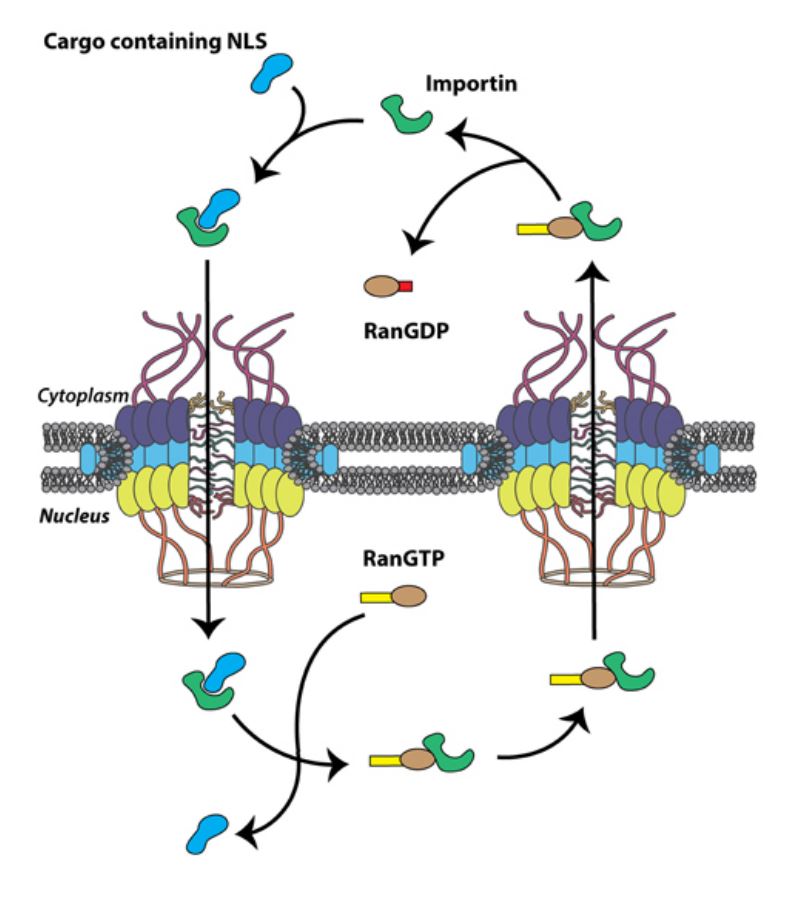
• Importins (karyopherins) binds to NLS of protein cargo
• Importins attach to cytosolic fibrils
• Importin‐protein move through FG nups
27
• At the nuclear interface – binds to importin
• It destabilizes importin‐protein interaction
• Protein released
• It destabilizes importin‐protein interaction
• Protein released
• At the nuclear interface –RanGTP binds to importin
• It destabilizes importin‐protein interaction
• Protein released
• It destabilizes importin‐protein interaction
• Protein released
28
• ‐importin can transport back through the NPC. stimulates of to +
• RanGTP‐importin can transport back through the NPC. RanGAP stimulates hydrolysis of RanGTP to RanGDP +
importin
importin
29
Nuclear export of proteins
• Protein cargo must have a
• Exportin binds to the of cargo protein
• Protein cargo must have a
• Exportin binds to the of cargo protein
Nuclear export of proteins
• Protein cargo must have a nuclear export sequence (NES)
• Exportin binds to the NES of cargo protein
• Protein cargo must have a nuclear export sequence (NES)
• Exportin binds to the NES of cargo protein
30
• stabilizes exportin‐cargo protein interaction
• Exportin functions similar to importins through the NPC
• At the cytoplasmic interface – RanGAP stimulates hydrolysis
of
• Exportin and cargo protein are released
• A transporter for exportins returns the molecules to the
nucleus
• Exportin functions similar to importins through the NPC
• At the cytoplasmic interface – RanGAP stimulates hydrolysis
of
• Exportin and cargo protein are released
• A transporter for exportins returns the molecules to the
nucleus
• RanGTP stabilizes exportin‐cargo protein interaction
• Exportin functions similar to importins through the NPC
• At the cytoplasmic interface – RanGAP stimulates hydrolysis
of RanGTP
• Exportin and cargo protein are released
• A transporter for exportins returns the molecules to the
nucleus
• Exportin functions similar to importins through the NPC
• At the cytoplasmic interface – RanGAP stimulates hydrolysis
of RanGTP
• Exportin and cargo protein are released
• A transporter for exportins returns the molecules to the
nucleus
31
• ****RanGDP adds to the in the cytoplasm or is
transported by back into the nucleus where
converts it into (dissociates )
transported by back into the nucleus where
converts it into (dissociates )
• ****RanGDP adds to the concentration in the cytoplasm or is
transported by Ntf2 back into the nucleus where RanGEF
converts it into RanGTP (dissociates Ntf2)
transported by Ntf2 back into the nucleus where RanGEF
converts it into RanGTP (dissociates Ntf2)
32
Test Question Entry into mitochondria requires transactors because they have an outer and inner membrane
Test Question Entry into mitochondria requires two transactors because they have an outer and inner membrane
33
Transport into mitochondria is and requires a cleavable ‐terminal signal sequence
Transport into mitochondria is ATP‐dependent and requires a cleavable N‐terminal signal sequence
34
TEST QUESTION
Occurs through protein translocators:
• ‐> translocase of the outer membrane
• ‐> translocase of the inner membrane
Occurs through protein translocators:
• ‐> translocase of the outer membrane
• ‐> translocase of the inner membrane
TEST QUESTION
Occurs through protein translocators:
• TOM ‐> translocase of the outer membrane
• TIM ‐> translocase of the inner membrane
Occurs through protein translocators:
• TOM ‐> translocase of the outer membrane
• TIM ‐> translocase of the inner membrane
35
goes to and the proteins can be unfolded with
TOM goes to TIM and the proteins can be unfolded with heat shock protein
36
– end up either being secreted or on the
inside of an organelle
– end up in all different
membranes
inside of an organelle
– end up in all different
membranes
Water soluble – end up either being secreted or on the
inside of an organelle
Transmembrane proteins – end up in all different
membranes
inside of an organelle
Transmembrane proteins – end up in all different
membranes
37
TEST QUESTION Proteins generally enter the while being synthesized
called
called
TEST QUESTION Proteins generally enter the ER while being synthesized
called co‐translational transport
called co‐translational transport
38
ER signal sequence is directed to the ER membrane with the help of:
• – a cytosolic protein that binds to the ER signal sequence
• receptor – a receptor bound to the ER membrane that binds
• – a cytosolic protein that binds to the ER signal sequence
• receptor – a receptor bound to the ER membrane that binds
ER signal sequence is directed to the ER membrane with the help of:
• Signal recognition particle (SRP) – a cytosolic protein that binds to the ER signal sequence
• SRP receptor – a receptor bound to the ER membrane that binds SRP
• Signal recognition particle (SRP) – a cytosolic protein that binds to the ER signal sequence
• SRP receptor – a receptor bound to the ER membrane that binds SRP
39
TEST QUESTION Binding of the to the signal sequence directs the new protein and ribosome complex to attach to the at the receptor
TEST QUESTION Binding of the SRP to the signal sequence directs the new protein and ribosome complex to attach to the ER membrane at the SRP receptor
40
signal sequence causes the protein translocator to (protein is still being made)
signal sequence causes the protein translocator to open (protein is still being made)
41
A signal peptidase cleaves the sequence of the protein
A signal peptidase cleaves the N‐terminal signal sequence of the protein
42
Once the of the protein passes through
the protein translocator it is not free
the protein translocator it is not free
Once the C‐terminus of the protein passes through
the protein translocator it is not free
the protein translocator it is not free
43
capture the protein and fold it into the
proper conformation as it is essential to function
proper conformation as it is essential to function
Chaperones capture the protein and fold it into the
proper conformation as it is essential to function
proper conformation as it is essential to function
44
Membrane protein have start and stop sequences for insertion into ER membrane
Membrane protein mRNA have start and stop sequences for insertion into ER membrane
45
TEST QUESTION (Co-translational import) A has a single
transmembrane region with the in the ER
lumen and the in the cytosol
transmembrane region with the in the ER
lumen and the in the cytosol
TEST QUESTION (Co-translational import) A simple membrane protein has a single
transmembrane region with the N‐terminus in the ER
lumen and the C‐terminus in the cytosol
transmembrane region with the N‐terminus in the ER
lumen and the C‐terminus in the cytosol
46
WHen there are mulitople transmembrane regions, internal is used to initiate translocation – but it is not cleaved off (hydrophobic
sequences form an )
sequences form an )
WHen there are mulitople transmembrane regions, internal start‐transfer signal is used to initiate translocation – but it is not cleaved off (hydrophobic
sequences form an alpha helix)
sequences form an alpha helix)
47
WHen there are mulitople transmembrane regions, Translocation continues until a signal is reached
WHen there are mulitople transmembrane regions, Translocation continues until a stop‐transfer signal is reached
48
TEST QUESTION Once translocation initiates it
so the protein must enter the organelles correctly –
importance of proper start‐transfer signals and
signal sequences
so the protein must enter the organelles correctly –
importance of proper start‐transfer signals and
signal sequences
TEST QUESTION Once translocation initiates it cannot be reversed
so the protein must enter the organelles correctly –
importance of proper start‐transfer signals and
signal sequences
so the protein must enter the organelles correctly –
importance of proper start‐transfer signals and
signal sequences
49
TEST QUESTION that are retained in the lumen of the ER
contain the sequence Lys‐Asp‐Glu‐Leu ( ) on their ‐
terminus –called an
contain the sequence Lys‐Asp‐Glu‐Leu ( ) on their ‐
terminus –called an
TEST QUESTION Soluble proteins that are retained in the lumen of the ER
contain the sequence Lys‐Asp‐Glu‐Leu (KDEL) on their C‐
terminus –called an ER retention signal
contain the sequence Lys‐Asp‐Glu‐Leu (KDEL) on their C‐
terminus –called an ER retention signal
50
If the proteins are not retained, the proteins (and membrane lipids) are
transported via vesicles to other parts of the
transported via vesicles to other parts of the
If the proteins are not retained, the proteins (and membrane lipids) are
transported via vesicles to other parts of the
endomembrane system
transported via vesicles to other parts of the
endomembrane system
51
The endomembrane system include , , and
• All make up the since their functions are coordinated
• Each surrounded and defined by a
• All make up the since their functions are coordinated
• Each surrounded and defined by a
The endomembrane system include endoplasmic reticulum (ER), golgi complex, lysosomes and vacuoles
• All make up the endomembrane system since their functions are coordinated
• Each surrounded and defined by a single membrane
• All make up the endomembrane system since their functions are coordinated
• Each surrounded and defined by a single membrane
52
TEST QUESTION transport is a major cellular activity, responsible for molecular traffic between a variety of specific compartments.
TEST QUESTION Vesicular transport is a major cellular activity, responsible for molecular traffic between a variety of specific membrane‐enclosed compartments.
53
Vesicular transport is a process
Vesicular transport is a highly selective process
54
is responsible for protein synthesis, folding and quality
control
control
rough ER is responsible for protein synthesis, folding and quality
control
control
55
is responsible for lipid and cholesterol synthesis,
steroid hormone secretion, metabolism of carbohydrates and
store/ release of calcium ions.
steroid hormone secretion, metabolism of carbohydrates and
store/ release of calcium ions.
smooth ER is responsible for lipid and cholesterol synthesis,
steroid hormone secretion, metabolism of carbohydrates and
store/ release of calcium ions.
steroid hormone secretion, metabolism of carbohydrates and
store/ release of calcium ions.
56
‐> responsible for protein packaging and
secretion
secretion
Golgi complex ‐> responsible for protein packaging and
secretion
secretion
57
‐> responsible for the breakdown of different
biomolecules, contains enzymes for molecule breakdown
(nuclease, protease, lipase) and is liable for intra and extra
cellular absorption.
biomolecules, contains enzymes for molecule breakdown
(nuclease, protease, lipase) and is liable for intra and extra
cellular absorption.
Lysosomes ‐> responsible for the breakdown of different
biomolecules, contains enzymes for molecule breakdown
(nuclease, protease, lipase) and is liable for intra and extra
cellular absorption.
biomolecules, contains enzymes for molecule breakdown
(nuclease, protease, lipase) and is liable for intra and extra
cellular absorption.
58
‐> responsible for the transportation of molecules
across the membrane.
across the membrane.
Vesicles ‐> responsible for the transportation of molecules
across the membrane.
across the membrane.
59
TEST QUESTION Vesicles that bud from membranes are coated with specific
TEST QUESTION Vesicles that bud from membranes are coated with specific proteins – coated vesicles
60
TEST QUESTION The best studied vesicles are coated with
TEST QUESTION The best studied vesicles are coated with clathrin – clathrin coated vesicles (CCV
61
TEST QUESTION: CCVs bud from the on their way to the cell membrane or from the plasma membrane
TEST QUESTION: CCVs bud from the Golgi apparatus on their way to the cell membrane or from the plasma membrane inward
62
TEST QUESTION binds to adaptin to initiate budding
TEST QUESTION Clathrin binds to adaptin to initiate budding
63
bind and cause the neck of the bud to constrict and pinch off ( hydrolysis required for the
process)
process)
Dynamin proteins bind and cause the neck of the bud to constrict and pinch off (GTP hydrolysis required for the
process)
process)
64
TEST QUESTION Newly formed vesicles are ( and are removed) and free to be carried to a target organelle by motor proteins
TEST QUESTION Newly formed vesicles are uncoated (adaptins and clathrin are removed) and free to be carried to a target organelle by motor proteins
65
After uncoating – motor proteins transport vesicles along or to an organelle
destination
destination
After uncoating – motor proteins transport vesicles along microtubules or actin filaments to an organelle
destination
destination
66
TEST QUESTION
on the vesicle and organelle membrane form a complex that drives membrane fusion thereby delivering
the proteins to the organelle ( mediated vesicle fusion)
on the vesicle and organelle membrane form a complex that drives membrane fusion thereby delivering
the proteins to the organelle ( mediated vesicle fusion)
TEST QUESTION
SNAREs on the vesicle and organelle membrane form a complex that drives membrane fusion thereby delivering
the proteins to the organelle (SNAREs mediated vesicle fusion)
SNAREs on the vesicle and organelle membrane form a complex that drives membrane fusion thereby delivering
the proteins to the organelle (SNAREs mediated vesicle fusion)
67
1. Secreted proteins enter as they are being
synthesized by ribosome.
2. Protein exits in vesicle.
3. Protein travels through the cisternae of the
4. Protein enters a that fuses with the
cell membrane.
5. Protein is secreted from the cell.
synthesized by ribosome.
2. Protein exits in vesicle.
3. Protein travels through the cisternae of the
4. Protein enters a that fuses with the
cell membrane.
5. Protein is secreted from the cell.
1. Secreted proteins enter ER as they are being
synthesized by ribosome.
2. Protein exits ER in vesicle.
3. Protein travels through the cisternae of the Golgi
apparatus.
4. Protein enters a secretory vesicle that fuses with the
cell membrane.
5. Protein is secreted from the cell.
synthesized by ribosome.
2. Protein exits ER in vesicle.
3. Protein travels through the cisternae of the Golgi
apparatus.
4. Protein enters a secretory vesicle that fuses with the
cell membrane.
5. Protein is secreted from the cell.