CH. 32 Nucleotide Syn I
Study these flashcardsFree · spaced repetition · iPhone, Android, Mac & web
All cards
1
Pyrimidine synthesis is a processes
Pyrimidine synthesis is a five phase processes
2
Purine synthesis is a process
Purine synthesis is a ten-step process
3
While are easy for the body to metabolize and excrete, are not
While pyrimidines are easy for the body to metabolize and excrete, purines are not
4
Purine synthesis involves intermediates that are to some cells.
Purine synthesis involves intermediates that are toxic to some cells.
5
The final product of purine synthesis is
The final product of purine synthesis is uric acid
6
At brush border there are cells that break down nuceleotides in the and
At brush border there are cells that break down nuceleotides in the duodenum and jejunum
7
Enzymes that break down nucleotides are , , , and
Enzymes that break down nucleotides are ribonucleases, deoxyribonucleases, nucleosides, and phosphatases
8
First, and
dissociate nucleotides from the
phosphodiester backbones
dissociate nucleotides from the
phosphodiester backbones
First, ribonucleases and deoxyribonucleases
dissociate nucleotides from the
phosphodiester backbones
dissociate nucleotides from the
phosphodiester backbones
9
Then dissociate the Phosphate
(--P) from the nucleoside
(--P) from the nucleoside
Then phosphatases dissociate the Phosphate
(--P) from the nucleoside
(--P) from the nucleoside
10
Finally, further break down
the nucleosides into and
.
the nucleosides into and
.
Finally, nucleosidases further break down
the nucleosides into pentose sugars and
nitrogenous bases.
the nucleosides into pentose sugars and
nitrogenous bases.
11
Membrane transport proteins carry the products of nucleotide digestion into epithelial cells from the lumen via and transport
Membrane transport proteins carry the products of nucleotide digestion into epithelial cells from the lumen via active and secondary active transport
12
The products are transported into the and then into the .
The products are transported into the interstitial fluid and then into the capillaries.
13
The products are transported to the and other tissues wherethey undergo further metabolic processes
The products are transported to the liver and other tissues wherethey undergo further metabolic processes
14
Nucleotides are the building blocks for what 3 important things?
1. Electron carriers FAD, NAD+, NADP+
2. Coenzyme A
3. cAMP
2. Coenzyme A
3. cAMP
15
NADP+ (used in processes -> high energy) is a phosphorylated form of NAD+ (used in processes)
NADP+ (used in anabolic processes -> high energy) is a phosphorylated form of NAD+ (used in catabolic processes)
16
Coenzyme A, which feeds the TCA and is a cofactor in and
Coenzyme A, which feeds the TCA and is a cofactor in lipid synthesis and oxidation
17
The salvage pathway involves activated ribose . The denovo pathway involves activated ribose
The salvage pathway involves activated ribose (PRPP) + base. The denovo pathway involves activated ribose (PRPP) + Amino Acid + ATP+CO2...
18
If you ingest substances that have nitrogenous bases, then you can use those as building blocks for your nucleotides via pathway (saves energy).
If you ingest substances that have nitrogenous bases, then you can use those as building blocks for your nucleotides via salvage pathway (saves energy).
19
If you do not have enough nitrogenous bases around, you can build your own nucleotides from scratch using very simple molecules ( ).
If you do not have enough nitrogenous bases around, you can build your own nucleotides from scratch using very simple molecules (de novo).
20
Ribose 5-phosphate (R5P)-> Produced as an
intermediate of the and
intermediate of the and
Ribose 5-phosphate (R5P)-> Produced as an
intermediate of the pentose phosphate pathway and
glycolysis
intermediate of the pentose phosphate pathway and
glycolysis
21
PRPP is produced by the of
ribose 5-phosphate by enzyme It involves the addition of that come from ATP
ribose 5-phosphate by enzyme It involves the addition of that come from ATP
PRPP is produced by the pyrophosphorylation of
ribose 5-phosphate by enzyme PRPP-synthetase It involves the addition of pyrophosphates that come from ATP
ribose 5-phosphate by enzyme PRPP-synthetase It involves the addition of pyrophosphates that come from ATP
22
PRPP is allosterically controlled. It is activated by and as . It is inhibited by and feedback inhibition.
PRPP is allosterically controlled. It is activated by Pi and MG2+ as cofactor. It is inhibited by ADP and GDP feedback inhibition.
23
PRPP is used in purine and pyrimidine synthesis in salvage and de novo pathways.
PRPP is used in BOTH purine and pyrimidine synthesis in BOTH salvage and de novo pathways.
24
are synthesized one at a time (or few at a time) directly onto the ring. Enzymes are present in larges complexes or
Purines are synthesized one at a time (or few at a time) directly onto the ring. Enzymes are present in larges complexes or metabolons
25
The intermediate of purine synthesis is
The intermediate of purine synthesis is inosine monophosphate
26
In the synthesis of pyrimidines, the ring is synthesized as and gets attached to ribose phosphate. It the gets converted to the pyrimidine nucleotides.
In the synthesis of pyrimidines, the ring is synthesized as orotate and gets attached to ribose phosphate. It the gets converted to the pyrimidine nucleotides.
27
The is the primary organ that
produces nucleic acids.
produces nucleic acids.
The liver is the primary organ that
produces nucleic acids.
produces nucleic acids.
28
The liver manages , which is a key
component of purine biosynthesis
component of purine biosynthesis
The liver manages ammonia, which is a key
component of purine biosynthesis
component of purine biosynthesis
29
For de-novo purine synthesis, you need:
, , , ,
.
, , , ,
.
For de-novo purine synthesis, you need:
Glutamine, aspartate, glycine, CO2,
formate.
Glutamine, aspartate, glycine, CO2,
formate.
30
TEST QUESTION!!!! Starting with PRPP, the first committed step
in the production of IMP is the addition of
an amino group from by the enzyme
to make
.
in the production of IMP is the addition of
an amino group from by the enzyme
to make
.
TEST QUESTION!!!! Starting with PRPP, the first committed step
in the production of IMP is the addition of
an amino group from Gln by the enzyme
PRPP glutamine amidotransferase to make
5-Phosphoribosyl-1-amine.
in the production of IMP is the addition of
an amino group from Gln by the enzyme
PRPP glutamine amidotransferase to make
5-Phosphoribosyl-1-amine.
31
There are steps from PRPP to formation of IMP
There are 11 steps from PRPP to formation of IMP
32
After attachment of amino group from , is committed to go forward towards de novosynthesis of purines
After attachment of amino group from Gln, phosphoribosylamine is committed to go forward towards de novosynthesis of purines
33
PRPP glutamine amidotransferase -> controlled and regulated
PRPP glutamine amidotransferase -> allosterically controlled and highly regulated
34
PRPP is an allosteric FEED-FORWARD activator of
PRPP is an allosteric FEED-FORWARD activator of PRPP glutamine amidotransferase.
35
PRPP is an allosteric activator of PRPP glutamine amidotransferase.
PRPP is an allosteric FEED-FORWARD activator of PRPP glutamine amidotransferase. 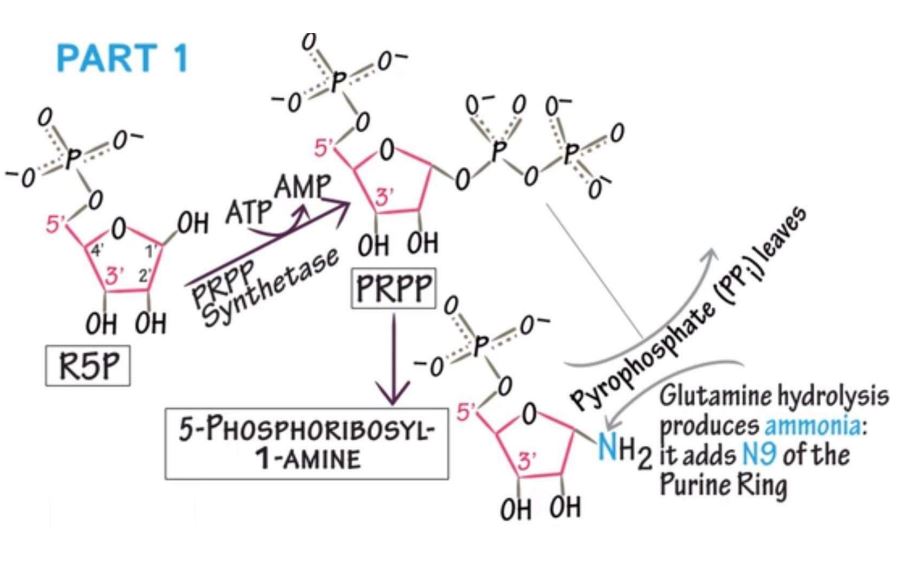
36
PRPP glutamine amidotransferase is allosterically inhibited by end-products -> , and
PRPP glutamine amidotransferase is allosterically inhibited by end-products -> IMP, AMP and GMP
37
A chemotherapeutic drug, , also inhibits PRPP amidotransferase. It blocks purine synthesisand DNA synthesis.
A chemotherapeutic drug, 6-Mercaptopurine, also inhibits PRPP amidotransferase. It blocks purine synthesisand DNA synthesis.
38
Once is formed, the path is committed to purine synthesis and there are 9 morereactions to form .
Once phosphoribosylamine is formed, the path is committed to purine synthesis and there are 9 morereactions to form IMP. 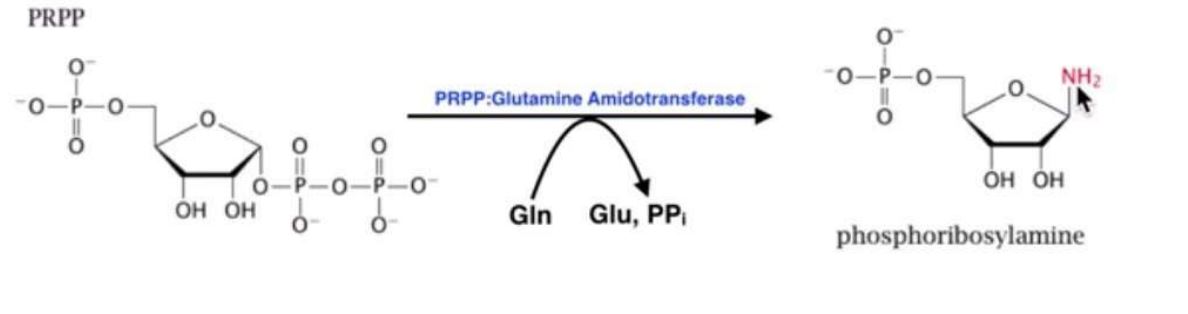
39
The catalzying process of purine biosynthesis in by channeling to increase and
The catalzying process of purine biosynthesis in by channeling to increase biosynthesis efficiency and prevent degradation
40
In the first step of the formation of IMP, ribose phosphate pyrophosphokinase converts ribose 5 phosphate to PRPP. This process is inhibited by
In the first step of the formation of IMP, ribose phosphate pyrophosphokinase converts ribose 5 phosphate to PRPP. This process is inhibited by ADP. 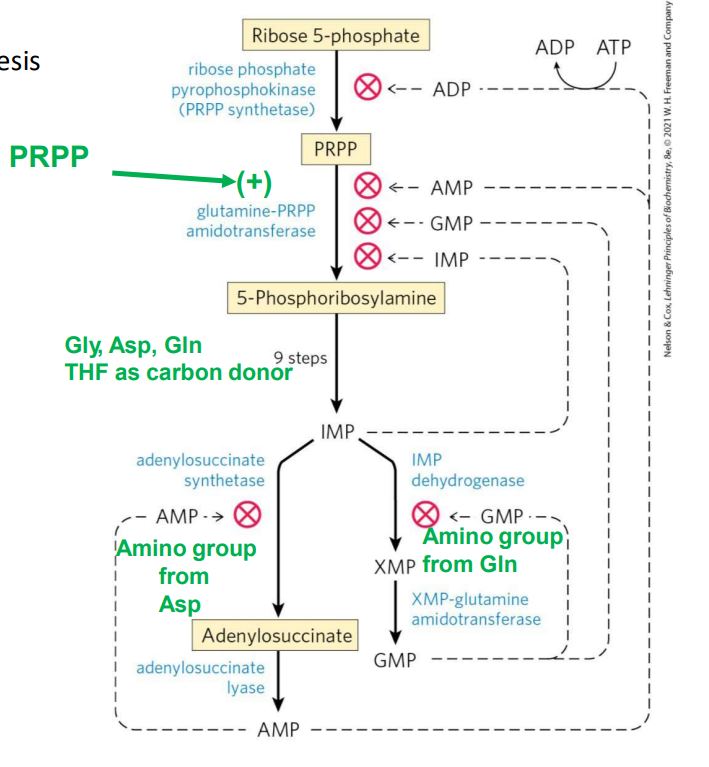
41
In the second step of the formation of IMP, glutamine-PRPP-amidotransferase converts PRPP into 5-phosphoribosylamine. This process is activated by (feed-forward) and inhibited by , , and .
In the second step of the formation of IMP, glutamine-PRPP-amidotransferase converts PRPP into 5-phosphoribosylamine. This process is activated by PRPP (feed-forward) and inhibited by AMP, GMP, and IMP. 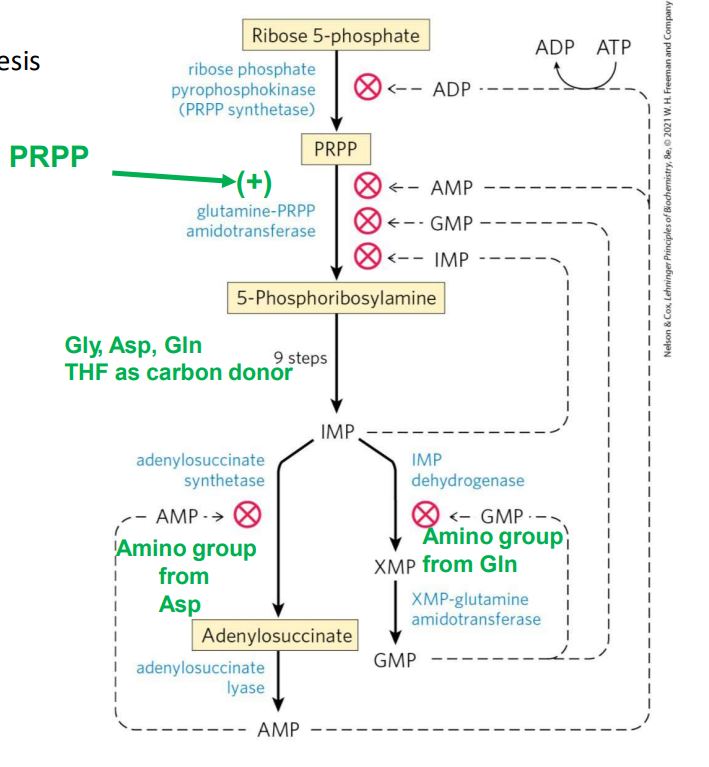
42
5-phosphoribosylamine is converted to IMP in 9 steps using , , , and as carbon donor
5-phosphoribosylamine is converted to IMP in 9 steps using Gly, Asp, Gln, and THF as carbon donor 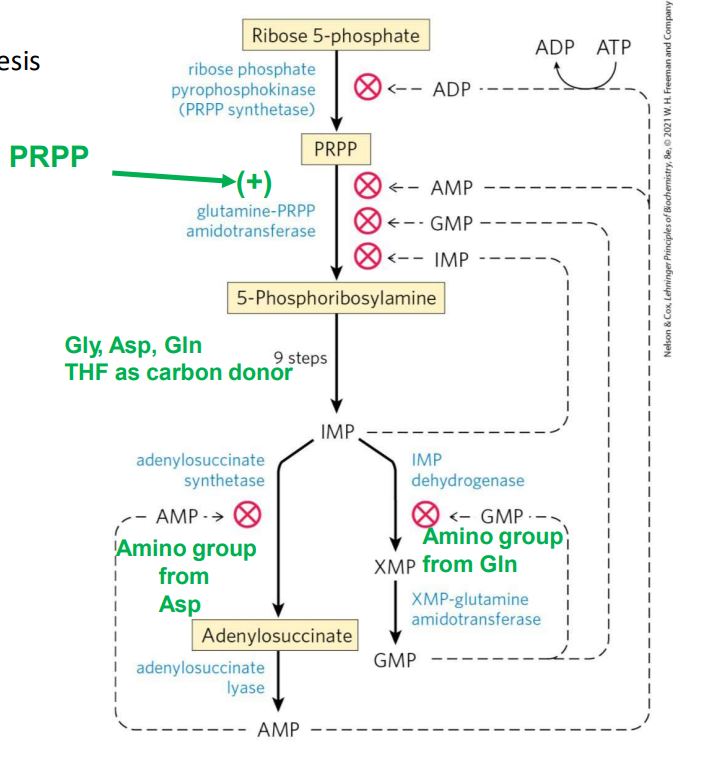
43
From IMP, and can be formed
From IMP, AMP and GMP can be formed 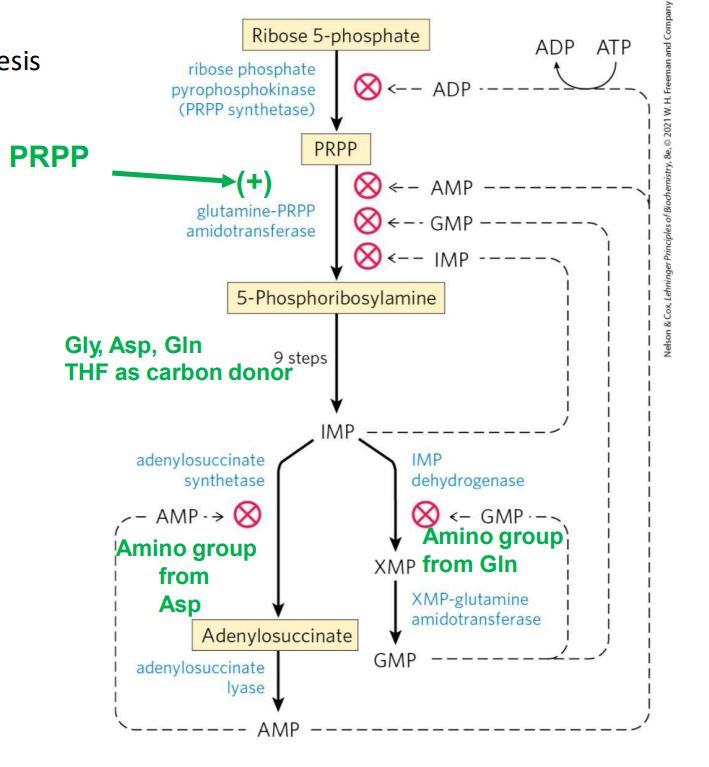
44
IMP is converted to andeylosuccinate and then to AMP using an amino group from . Process is inhibited by (feedback)
IMP is converted to andeylosuccinate and then to AMP using an amino group from ASP . Process is inhibited by AMP (feedback) 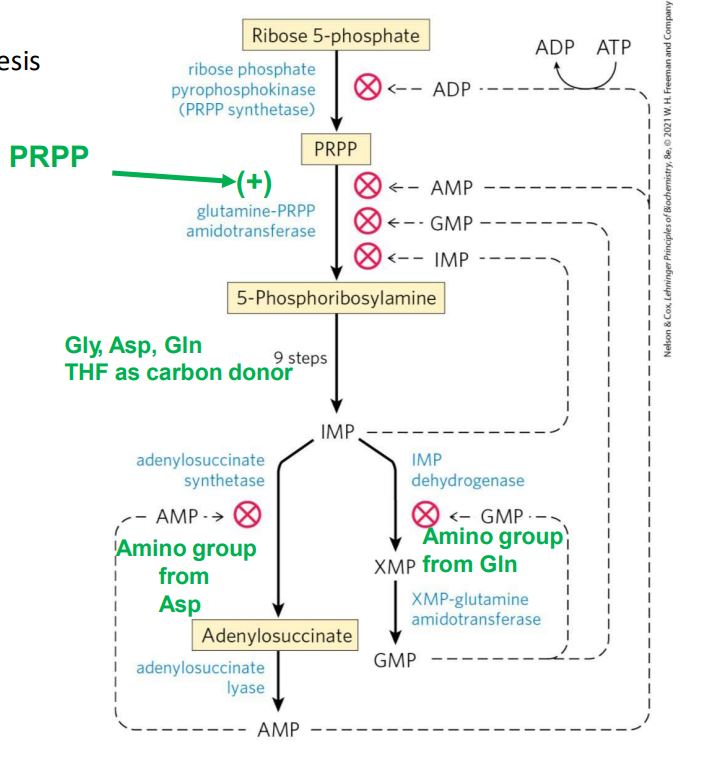
45
IMP is converted to XMP and then to GMP using an amino group from . Process is inhibited by (feedback).
IMP is converted to XMP and then to GMP using an amino group from Gln . Process is inhibited by GMP (feedback). 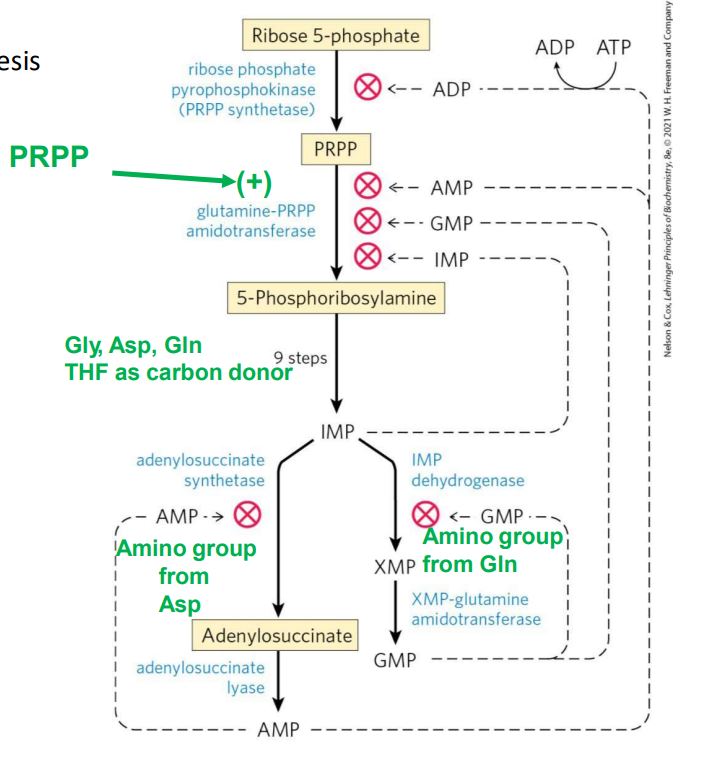
46
In purine synthesis, and are used via
to start building the ring on the ribose.
to start building the ring on the ribose.
In purine synthesis, Gly and (ATP) are used via glycinamide ribotide (GAR) Synthease
to start building the purine ring on the ribose.
to start building the purine ring on the ribose.
47
With GAR synthetase, reactions use charged to deliver
groups to the structure. That is a one-carbon transfer with a carbonyl group at and another at .
groups to the structure. That is a one-carbon transfer with a carbonyl group at and another at .
With GAR synthetase, reactions use charged tetra hydrofolate (THF) to deliver formyl
groups to the structure. That is a one-carbon transfer with a carbonyl group at (C8) and another at (C2).
groups to the structure. That is a one-carbon transfer with a carbonyl group at (C8) and another at (C2).
48
The synthesis of AMP requires
The synthesis of AMP requires GTP
49
In AMP synthesis, the carbonyl group is replaced by an
In AMP synthesis, the carbonyl group is replaced by an amino group
50
The synthesis of GMP requires
The synthesis of GMP requires ATP
51
In GMP synthesis, the H in the is replaced by an group
In GMP synthesis, the H in the second ring is replaced by an amino group
52
The formation of AMP energy! If you want to make AMP and you’re low in energy levels, it’s not a good idea to use up !
The formation of AMP uses energy! If you want to make AMP and you’re low in energy levels, it’s not a good idea to use up GTP!
53
First, the carbonyl oxygen is activated by using energy of GTP and plugging in an -> makes .
First, the carbonyl oxygen is activated by using energy of GTP and plugging in an aspartate -> makes adenylosuccinate.
54
GTP is a for Adenylosuccinate Synthetase -> pushes the reaction forward. Second, the carbon skeleton of aspartate is cut off, releasing and forming
GTP is a positive effector for Adenylosuccinate Synthetase -> pushes the reaction forward. Second, the carbon skeleton of aspartate is cut off, releasing fumarate and forming AMP.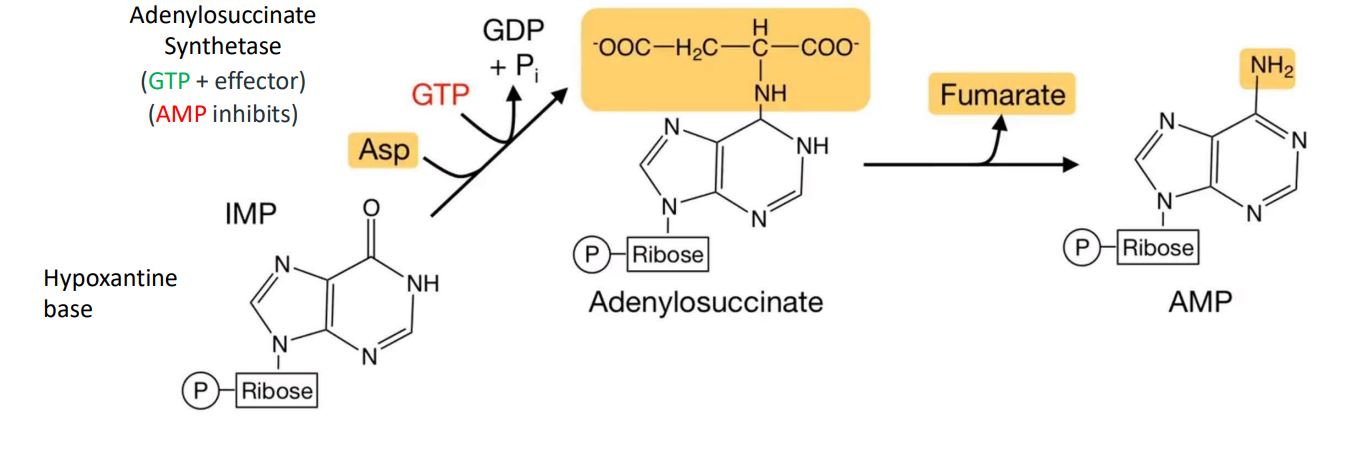
55
The formation of process uses energy! If you want to make GMP and you’re low in energy levels, it’s not a good idea to
use-up
use-up
The formation of GMP process uses energy! If you want to make GMP and you’re low in energy levels, it’s not a good idea to
use-up ATP
use-up ATP
56
In the first step of GMP synthesis, the enzyme oxidizes IMP to form . This reaction is coupled with the reduction of
In the first step of GMP synthesis, the enzyme IMP dehydrogenase oxidizes IMP to form xantilate monophosphate (XMP). This reaction is coupled with the reduction of NAD+
57
In the second step of GMP synthesis, the carbonyl just created is activated by and there’s the transfer of an amino group from .
In the second step of GMP synthesis, the carbonyl just created is activated by ATP and there’s the transfer of an amino group from glutamine.
58
Cannot be stressed enough! AMP uses , GMP uses (what AA?)
Cannot be stressed enough! AMP uses ASP, GMP uses GLN (what AA?)
59
The need of one type of to the other type is important for maintaining a proper balance
The need of one type of purine to produce the other type is important for maintaining a proper balance
60
GTP is a positive effector of
GTP is a positive effector of adenylosuccinate synthetase
61
is an essential water-soluble vitamin (absorbed in duodenum))
Folate (Vit B9) is an essential water-soluble vitamin (absorbed in duodenum))
62
Folate mainly comes from , nuts, meats
Folate mainly comes from leafy green vegtables, nuts, meats
63
What is the precursor for vit B9 synth?
THF
64
is a biproduct of methanol (toxic), so folate can
help to detoxify from methanol poisoning
help to detoxify from methanol poisoning
Formic acid is a biproduct of methanol (toxic), so folate can
help to detoxify from methanol poisoning
help to detoxify from methanol poisoning
65
B9 is needed for and synthesis. It is also involved in amino acid snthesis, nuceloprotein synthesis, catecholamine synthesis, and formic acid.
B9 is needed for purine and pyrimindine synthesis. It is also involved in amino acid snthesis, nuceloprotein synthesis, catecholamine synthesis, and formic acid.
66
Microorganisms convert pteridine precursors and para-aminobenzoic acid into folic acid. Folic acid
synthesis is inhibited by
synthesis is inhibited by
Microorganisms convert pteridine precursors and para-aminobenzoic acid into folic acid. Folic acid
synthesis is inhibited by sulfonamides antibiotics.
synthesis is inhibited by sulfonamides antibiotics.
67
Folate is converted to dihydrofolate (DHF) by
Folate is converted to dihydrofolate (DHF) by dihydrofolate reductase (DHFR)
68
The antibiotic trimethoprim inhibits Perfers bacterial to human.
The antibiotic trimethoprim inhibits DHFR Perfers bacterial DHFR to human.
69
groups carried by THF
One-carbon groups carried by THF
70
THF is a 6-methylpterin derivative linked in sequence to and
residues (n= 1 –6)
residues (n= 1 –6)
THF is a 6-methylpterin derivative linked in sequence to p-aminobenzoic acid (PABA) and Glutamate (Glu)
residues (n= 1 –6)
residues (n= 1 –6)
71
Sufonamides (sulfa drugs) are antibiotics that are analogs to and competitively inhibit bacterial
synthesis of THF at the PABA incorporation step.
synthesis of THF at the PABA incorporation step.
Sufonamides (sulfa drugs) are antibiotics that are analogs to PABA and competitively inhibit bacterial
synthesis of THF at the PABA incorporation step.
synthesis of THF at the PABA incorporation step.
72
THF is important in the transfer of units.
THF is important in the transfer of 1C units.
73
THF is derived from , a doubly oxidized form
that must be enzymatically reduced before it becomes an
active coenzyme.
that must be enzymatically reduced before it becomes an
active coenzyme.
THF is derived from folic acid (Vit B9), a doubly oxidized form
that must be enzymatically reduced before it becomes an
active coenzyme.
that must be enzymatically reduced before it becomes an
active coenzyme.
74
Both reactions that form tetrahydrolate from folate are catalyzed by
Both reactions that form tetrahydrolate from folate are catalyzed by Dihydrofolate reductase
(DHFR)
(DHFR)
75
C1 units are covalently attached to THF at positions ,
or both and .
or both and .
C1 units are covalently attached to THF at positions N5,
N10 or both N5 and N10.
N10 or both N5 and N10.
76
Folate is involved in and is sometimes called
Folate is involved in single carbon transfer reactions and is sometimes called B9
77
Deficiency in can result in megaloblastic anemia, cardiovascular disease, and birth defects
Deficiency in folate metabolism can result in megaloblastic anemia, cardiovascular disease, and birth defects
78
IMP biosynthesis is an energetically consuming process that
requires the hydrolysis of ATPs.
requires the hydrolysis of ATPs.
IMP biosynthesis is an energetically consuming process that
requires the hydrolysis of 6 ATPs.
requires the hydrolysis of 6 ATPs.
79
in purine rings are from glutamine
N9 in purine rings are from glutamine
80
Everything starts with
Metabolic contribution of
to the purine biosynthesis and
other anabolic pathways
Metabolic contribution of
to the purine biosynthesis and
other anabolic pathways
Everything starts with PRPP
Metabolic contribution of PRPP
to the purine biosynthesis and
other anabolic pathways
Metabolic contribution of PRPP
to the purine biosynthesis and
other anabolic pathways
81
The activity of PRPP synthetase varies with the
concentrations of several metabolites, including and
, which are activators, and and , which
are inhibitors.
concentrations of several metabolites, including and
, which are activators, and and , which
are inhibitors.
The activity of PRPP synthetase varies with the
concentrations of several metabolites, including PPi and
2,3-BPG, which are activators, and ADP and GDP, which
are inhibitors.
concentrations of several metabolites, including PPi and
2,3-BPG, which are activators, and ADP and GDP, which
are inhibitors.
82
***Test Question
The pathways synthesizing , , and are
regulated in most cells -> control the total amounts of
purines produced and also coordinate the relative
amounts of and .
The pathways synthesizing , , and are
regulated in most cells -> control the total amounts of
purines produced and also coordinate the relative
amounts of and .
***Test Question
The pathways synthesizing IMP, ATP, and GTP are
regulated in most cells -> control the total amounts of
purines produced and also coordinate the relative
amounts of ATP and GTP.
The pathways synthesizing IMP, ATP, and GTP are
regulated in most cells -> control the total amounts of
purines produced and also coordinate the relative
amounts of ATP and GTP.
83
-Gln-PRPP-amidotransferase is controlled by feedback
inhibition ( , , ).
inhibition ( , , ).
-Gln-PRPP-amidotransferase is controlled by feedback
inhibition (AMP, GMP, IMP).
inhibition (AMP, GMP, IMP).
84
-The branched portion of the pathway from IMP: inhibition
- High inhibits adenylosuccinatesynthase;
- Similarly, high inhibits IMP
dehydrogenase.
- High inhibits adenylosuccinatesynthase;
- Similarly, high inhibits IMP
dehydrogenase.
-The branched portion of the pathway from IMP: feedback inhibition
- High [AMP] inhibits adenylosuccinatesynthase;
- Similarly, high [GMP] inhibits IMP
dehydrogenase.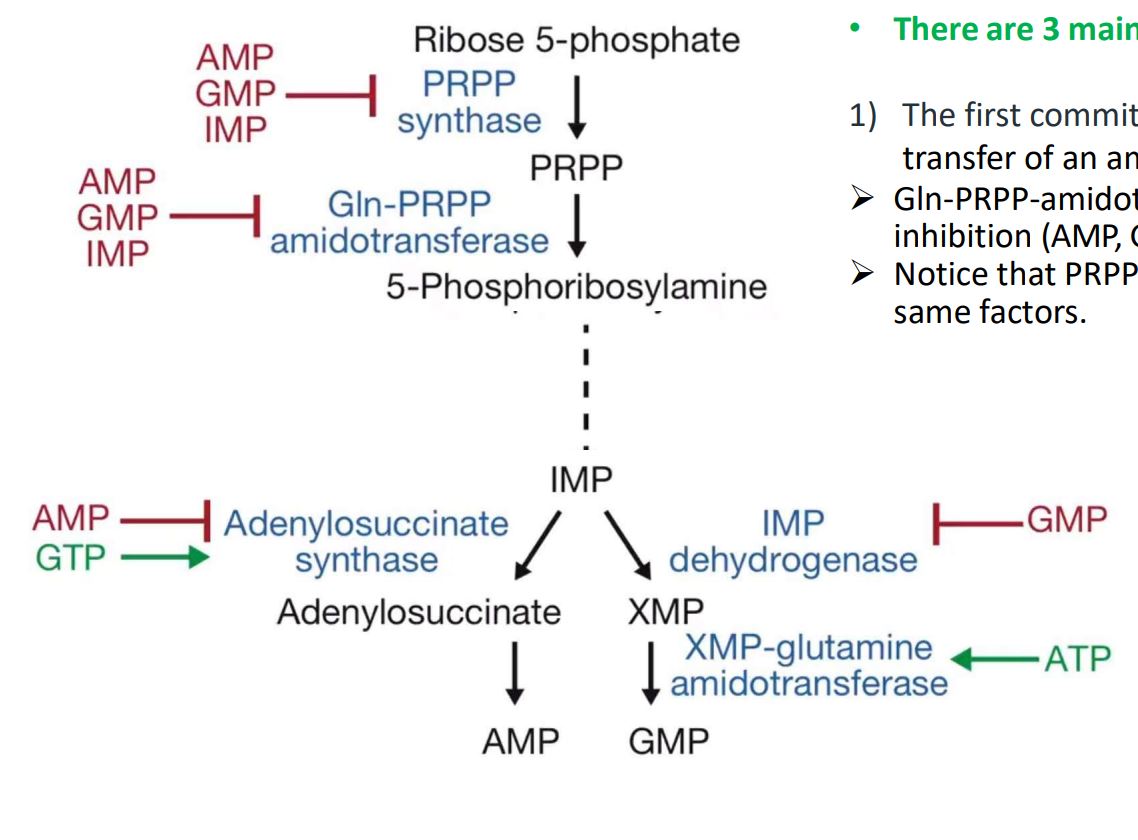
- High [AMP] inhibits adenylosuccinatesynthase;
- Similarly, high [GMP] inhibits IMP
dehydrogenase.
85
Reciprocal regulation via GTP and ATP:
- stimulates adenylosuccinate
synthase.
- stimulates XMP-glutamine
amidotransferase.
- stimulates adenylosuccinate
synthase.
- stimulates XMP-glutamine
amidotransferase.
Reciprocal regulation via GTP and ATP:
- GTP stimulates adenylosuccinate
synthase.
-ATP stimulates XMP-glutamine
amidotransferase.
- GTP stimulates adenylosuccinate
synthase.
-ATP stimulates XMP-glutamine
amidotransferase.
86
The monophosphates are converted to
using respective specific
kinases (Adenylate kinase, Guanylate
kinase)
using respective specific
kinases (Adenylate kinase, Guanylate
kinase)
The monophosphates are converted to
diphosphates using respective specific
kinases (Adenylate kinase, Guanylate
kinase)
diphosphates using respective specific
kinases (Adenylate kinase, Guanylate
kinase)
87
Purine diphosphates are converted
to triphosphates in reactions
catalyzed by
to triphosphates in reactions
catalyzed by
Purine diphosphates are converted
to triphosphates in reactions
catalyzed by nucleoside
diphosphokinase (NDPK).
to triphosphates in reactions
catalyzed by nucleoside
diphosphokinase (NDPK).
88
catalyzes conversion of all
nucleoside diphosphates to
nucleoside triphosphates.
nucleoside diphosphates to
nucleoside triphosphates.
NDPK catalyzes conversion of all
nucleoside diphosphates to
nucleoside triphosphates.
nucleoside diphosphates to
nucleoside triphosphates.