Biochem Lecture 7
Study these flashcardsFree · spaced repetition · iPhone, Android, Mac & web
All cards
1
Hill coefficient, nh
1. nh >1
2. nh < 1
3. nh = 1
1. nh >1
2. nh < 1
3. nh = 1
Hill coefficient, nh
1. Positive cooperativity: nh >1
2. Negative cooperativity: nh < 1
3. Non-cooperative: nh = 1
1. Positive cooperativity: nh >1
2. Negative cooperativity: nh < 1
3. Non-cooperative: nh = 1
2
is present in the vertebrae striated muscle.
Myoglobin is present in the vertebrae striated muscle.
3
Myglobin has amino acids, is alpha helix, and belongs to the family.
Myglobin has 153 amino acids, is 70% alpha helix, and belongs to the Globin family.
4
Myoglobin binds/holds oxygen much more tightly in .
Myoglobin binds/holds oxygen much more tightly in muscle cell.
5
is normal heme, is abnormal
Fe2+ is normal heme, Fe3+ is abnormal
6
Hemoglobin is an alpha -chain monomer contains and β−chain monomer has .
Hemoglobin is an alpha -chain monomer contains 141 amino acids and β−chain monomer has 146 amino acid.
7
Because hemoglobin has 2 alpha subunits and 2 beta subunits, it is called a .
Because hemoglobin has 2 alpha subunits and 2 beta subunits, it is called a hetero-tetramer.
8
What are the two things necessary to produce a heme?
1. Glycine 2. Succinyl CoA
9
Is heme hydrophobic or hydrophilic?
Hydrophobic
10
Myoglobin requires oxygen to be saturated.
Myoglobin requires less oxygen to be saturated.
11
Explain the graph. 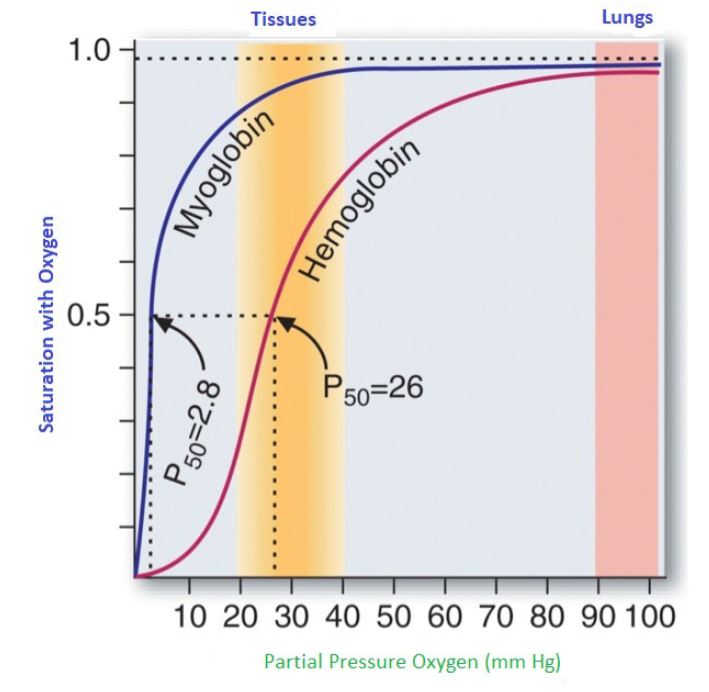
In the lungs, both myoglobin and hemoglobin are saturated. In the tissues, the hemoglobin releases the oxygen and becomes less saturated with oxygen. Myglobin still remain saturated in the tissues.
12
In what way does hemoglobin bind cooperatively?
When one subunit becomes bound to an oxygen, it becomes progressively easier to bind
13
2, 3 bisphosphoglycerate is formed from , which is involved in
2, 3 bisphosphoglycerate is formed from 1,3 bisphosphoglycerate, which is involved in glycolysis
14
negative charges of neutralized by positive charges of hemoglobin which stabilizes the taut Form that disfavors
Six negative charges of 2,3 BPG neutralized by 6 positive charges of hemoglobin which stabilizes the taut Form that disfavors oxygen binding/"holding"
15
What is the function of 2,3 BPG?
Allows for better delivery of oxygen in tissues
16
Which subunit does 2,3 BPG bind to?
The beta subunits
17
What is the function of 2,3 BPG?
Allows for better delivery of oxygen
18
What enzyme converts 1,3 BPG to 2,3 BPG?
Bisphosphoglycerate mutase
19
What type of enzymes are mutases?
Isomerase
20
What type of shift to the hemoglobin binding curve does 2,3 BPG cause?
A rightward shift
21
In what conditions would you want to increase 2,3 BPG?
In high altitude to better unload it
22
In metabolizing tissues, the H+ concentration increases and H+ binds to hemoglobin that allows the unloading of O2. This is called the .
In metabolizing tissues, the H+ concentration increases and H+ binds to hemoglobin that allows the unloading of O2. This is called the Bohr effect.
23
The O2 that is unloaded (deoxy form) has a greater affinity for binding CO2. This is called the .
The O2 that is unloaded (deoxy form) has a greater affinity for binding CO2. This is called the Haldane effect.
24
CO2 is tied by the reaction with the group of hemoglobin.
CO2 is tied by the reaction with the amino terminal group of hemoglobin.
25
What are the 4 outcomes for CO2 (4 ways CO2 is removed)?
1. CO2 is carried in the form of carbamino-Hba
2. Binds to HbA (deoxy form) of RBC and is carried to lung
3. Dissolved in blood plasma
4. Coverted into bicarbonate
2. Binds to HbA (deoxy form) of RBC and is carried to lung
3. Dissolved in blood plasma
4. Coverted into bicarbonate
26
A significant amount of carbamino-Hb means that conditions are probably
A significant amount of carbamino-Hb means that conditions are probably hypoxic
27
What happens in sickle cell anemia?
Single point mutation of the 6th amino acid. Changes from glutamic acid to valine (hydrophillic to hydrophobic) and leads to a distored structure.
28
What are the four things that lead to a left shift of the hemoglobin curve?
Decreased pCO2, decrease H+ (higher pH), decreased 2,3 DPG, decreased temp
29
What are the four things that lead to a right shift of the hemoglobin curve?
Increased pCO2, increased H+ (lower pH), increased 2,3 DPG, and increased temp
30
In the embroyonic period, what type of Hb is present?
zeta-epsilon chain , alpha-chain
31
RIght before birth, what type of Hb is present?
gamma chain and alpha chain
32
3 months after birth, what type of Hb is present?
alpha chain, beta chain, gamma chain, and delta chain HbA2
33
What types of hemoglobin do adults have?
alpha chain, beta chain, and delta chain hemoglobin HbA2
34
What does high HbA1C indicate?
Diabetes
35
Fetal hemoglobin has a affinity towards oygen (a shift in the hemoglobin curve)
Fetal hemoglobin has a higher affinity towards oygen (a left shift in the hemoglobin curve)
36
S-nitrosylated HbA is a powerful . This helps to explain the effect of nitric oxide.
S-nitrosylated HbA is a powerful vasodilator . This helps to explain the effect of nitric oxide.
37
HbA beta chain has a residue at position 93 which reacts with nitric oxide to form . This is why we are impacted by nitric oxide.
HbA beta chain has a cysteine residue at position 93 which reacts with nitric oxide to form nitrosothiol. This is why we are impacted by nitric oxide.