Body Fluids 7
Study these flashcardsFree · spaced repetition · iPhone, Android, Mac & web
All cards
1
is the concentration of osmotically active particles per liter of solution
Osmolarity is the concentration of osmotically active particles per liter of solution
2
is the flow of water between two solutions separated by an
semipermeable membrane
semipermeable membrane
Osmosis is the flow of water between two solutions separated by an
semipermeable membrane
semipermeable membrane
3
is the driving force for osmosis is caused by the presence of a
solute
solute
Osmotic pressure is the driving force for osmosis is caused by the presence of a
solute
solute
4
a measure of the number of osmotically active particles per
kilogram of H 2 O
kilogram of H 2 O
Osmolality: a measure of the number of osmotically active particles per
kilogram of H 2 O
kilogram of H 2 O
5
*** The extent to which a particular solute crosses a
particular membrane is expressed by a dimensionless factor
particular membrane is expressed by a dimensionless factor
***Reflection coefficient (σ): The extent to which a particular solute crosses a
particular membrane is expressed by a dimensionless factor
particular membrane is expressed by a dimensionless factor
6
: The number of particles that a solute dissociates to
Osmotic coefficient: (g): The number of particles that a solute dissociates to
7
the effect of a solution on a cell
Tonicity the effect of a solution on a cell
8
Steady state must be maintained for
Steady state must be maintained for homeostasis
9
Steady State is a set point “Set point mOsm/kg H 2 O” body osmolarity ( osmolarity =
osmolarity)"
osmolarity)"
Steady State is a set point “Set point 280-295 mOsm/kg H 2 O” body osmolarity (ICF osmolarity =
ECF osmolarity)"
ECF osmolarity)"
10
Water input= water
Water input= water output
11
Water input : /
Water Output: , , ,
Water Output: , , ,
Water input : Ingested/Generated
Water Output: Kidneys, GI, Skin, Lungs
Water Output: Kidneys, GI, Skin, Lungs
12
While and are present in the extracellular fluid, and are not found in high quantities the extracellular fluid. Glucose is most found extracellularly in
While Na and Cl are present in the extracellular fluid, K and Ca are not found in high quantities the extracellular fluid. Glucose is most found extracellularly in plasma
13
of body is made up of water and is made up of intracellular fluid and is made up intracellular fluid (percentages).
60% of body is made up of water and 40% is made up of intracellular fluid and 20% is made up intracellular fluid (percentages).
14
Of the total body Water (TBW), is intracellular fluid and is extracellular fluis
Of the total body Water (TBW), 2/3 is intracellular fluid and 1/3 is extracellular fluis 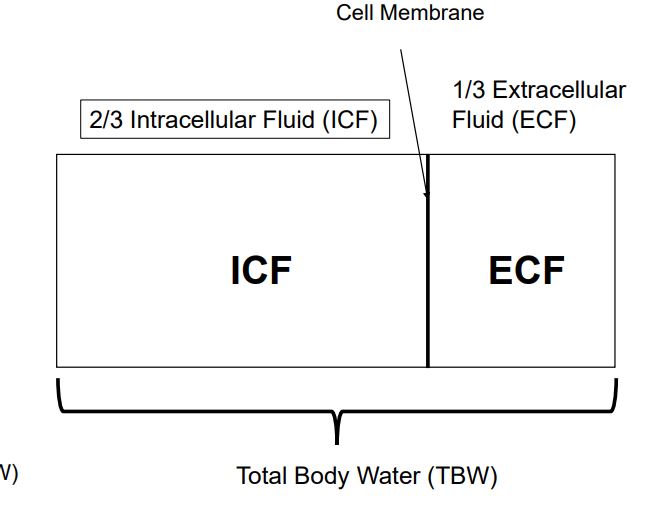
15
Extracellular fluid is divided into and . These spaces are divided by the The part with the plasma is also referred to as intravascular volume.
Extracellular fluid is divided into (3/4) intersitial fluid (ISF) and plasma (1/4) . These spaces are divided by the capillary wall. The part with the plasma is also referred to as intravascular volume. 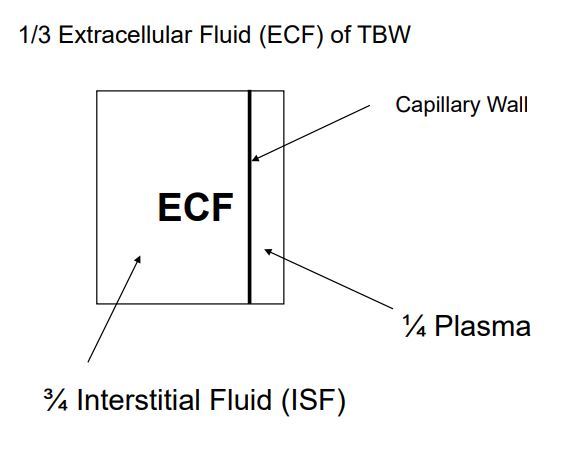
16
Movement of Fluid in the Extracellular Fluid
Depends on
1. capillary type
(sinusoidal, fenestrated or
continuous)
2. Movement between and ( forces)
3. pressure and
pressure difference
between ISF and Plasma is
what regulates
absorption/filtration
Depends on
1. capillary type
(sinusoidal, fenestrated or
continuous)
2. Movement between and ( forces)
3. pressure and
pressure difference
between ISF and Plasma is
what regulates
absorption/filtration
Movement of Fluid in the Extracellular Fluid
Depends on
1. capillary type
(sinusoidal, fenestrated or
continuous)
2. Movement between ISF and plasma (Starling forces)
3. Hydrostatic pressure and
oncotic pressure difference
between ISF and Plasma is
what regulates
absorption/filtration
Depends on
1. capillary type
(sinusoidal, fenestrated or
continuous)
2. Movement between ISF and plasma (Starling forces)
3. Hydrostatic pressure and
oncotic pressure difference
between ISF and Plasma is
what regulates
absorption/filtration
17
The two important factors that impact movement across a capillary are and .
The two important factors that impact movement across a capillary are hydrostatic pressure and oncotic pressure. 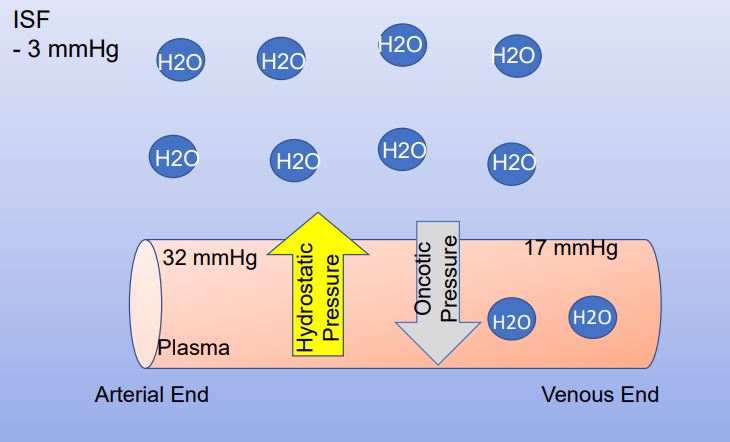
18
Osmotic pressure is created by the presence of in solution
Osmotic pressure is created by the presence of glucose in solution
19
law tells us that osmotic pressure is determined by the number of solute molecules
van Hoff's law tells us that osmotic pressure is determined by the number of solute molecules
20
Osmolarity = x
Osmolarity = concentration x number of dissociable particles
21
While is the concentration of osmoles per kg H2O, is the concentration of osmoles per L H20
While osmolality is the concentration of osmoles per kg H2O, osmolarity is the concentration of osmoles per L H20
22
Osmolarity vs Osmolality
Roughly equivalent because 1 L of pure H2O weighs 1 Kg
In practice <
Roughly equivalent because 1 L of pure H2O weighs 1 Kg
In practice <
Osmolarity vs Osmolality
Roughly equivalent because 1 L of pure H2O weighs 1 Kg
In practice osmolality < osmolarity
Roughly equivalent because 1 L of pure H2O weighs 1 Kg
In practice osmolality < osmolarity
23
Tonicity refers to the effect of a solution on a cell, therefore it depends on “ osmoles”
Tonicity refers to the effect of a solution on a cell, therefore it depends on “effective osmoles”
24
solutions: have a higher effective osmotic pressure
Hypertonic solutions: have a higher effective osmotic pressure 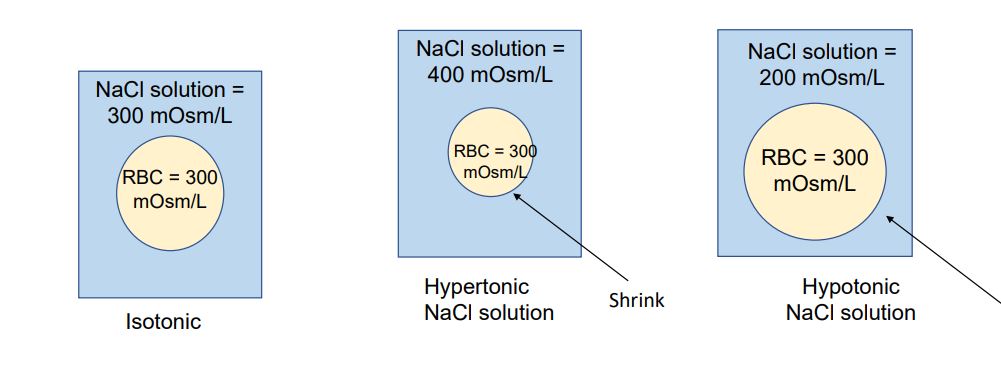
25
solutions: have same effective osmotic pressure
Isotonic solutions: have same effective osmotic pressure 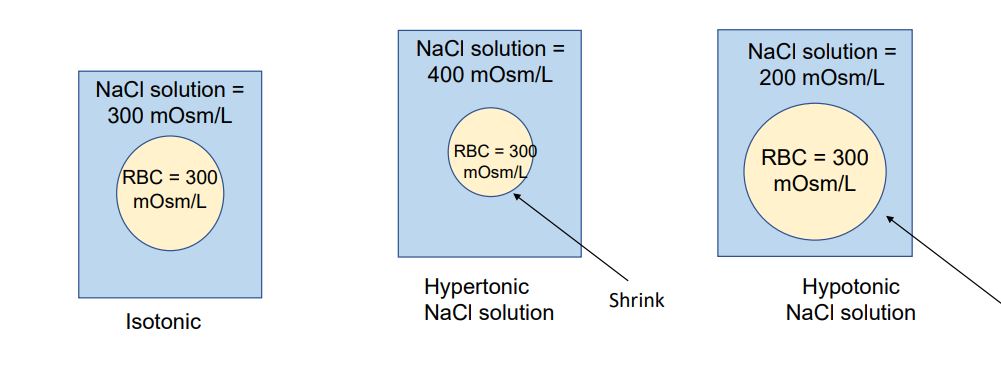
26
solutions: lower effective osmotic pressure
Hypotonic solutions: lower effective osmotic pressure 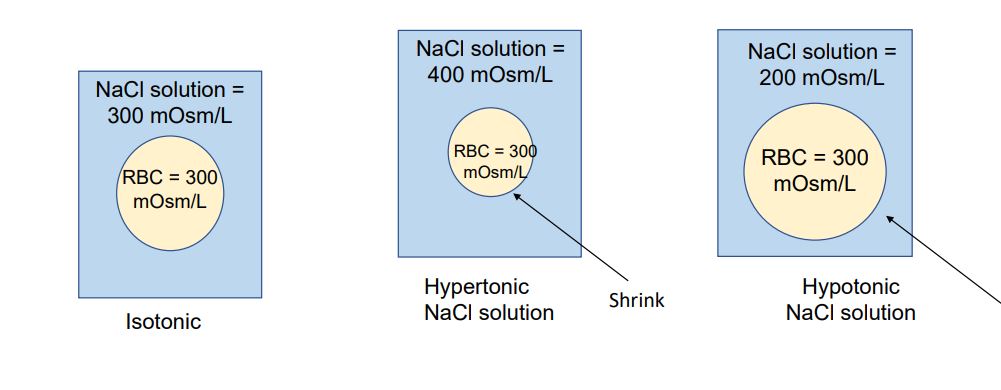
27
Effective osmoles produce osmotic pressure due
to their inability to
to their inability to
Effective osmoles produce osmotic pressure due
to their inability to cross membranes
to their inability to cross membranes
28
Isotonic = , Hypertonic = , Hypotonic =
Isotonic = normal size, Hypertonic = cell shrinks, Hypotonic = cell swells
29
****Effectuve versus ineffective osmole is measure by the
****Effectuve versus ineffective osmole is measure by the reflecton coefficient sigma
30
If something is able to distrubute easily, it is an osmole. If something is imperable to the substance, then it will raise osmotic pressure and is called the osmole.
If something is able to distrubute easily, it is an ineffective osmole. If something is imperable to the substance, then it will raise osmotic pressure and is called the effective osmole.
31
Most molecules have a sigma of (1= impermeable and 0=permeable). If sigma is zero = osmole (effective or ineffective)
Most molecules have a sigma of 0-1 (1= impermeable and 0=permeable). If sigma is zero = ineffective osmole (effective or ineffective) 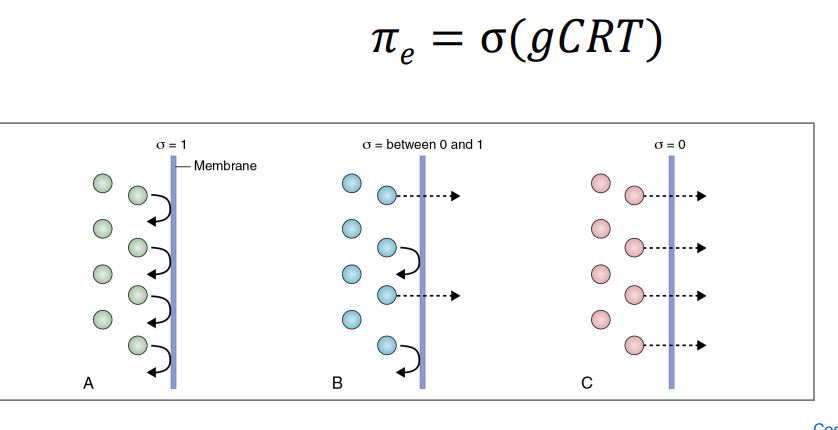
32
Tonicity is by
EFFECTIVE osmotic pressure
EFFECTIVE osmotic pressure
Tonicity is determined by
EFFECTIVE osmotic pressure
EFFECTIVE osmotic pressure
33
Dashed line indicates the following changes: a
decreased ECF & and
increased ICF & decreased ICF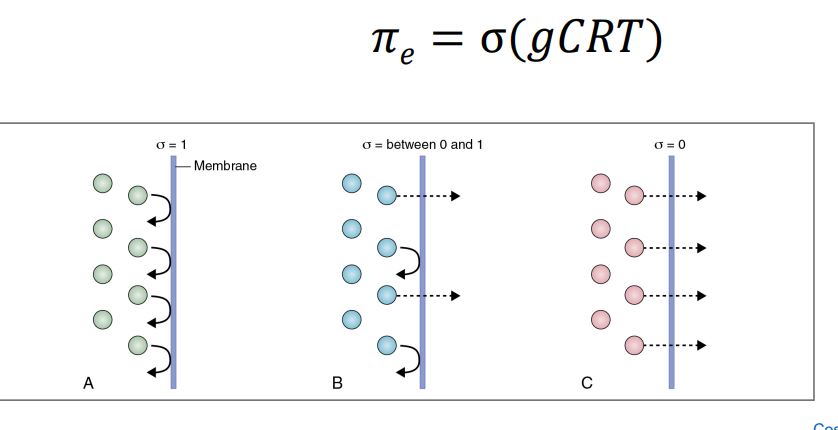
decreased ECF & and
increased ICF & decreased ICF
Dashed line indicates the following changes: a
decreased ECF volume & osmolarity and
increased ICF volume & decreased ICF osmolarity
decreased ECF volume & osmolarity and
increased ICF volume & decreased ICF osmolarity
34
Fluid Shifts: Isotonic NaCl addition to ECF
-Adding to equivalent to amount administered
When fluid lost, add in form of solution
-Adding to equivalent to amount administered
When fluid lost, add in form of solution
Fluid Shifts: Isotonic NaCl addition to ECF
-Adding volume to ECF equivalent to amount administered
When fluid lost, add fluid in form of isotonic solution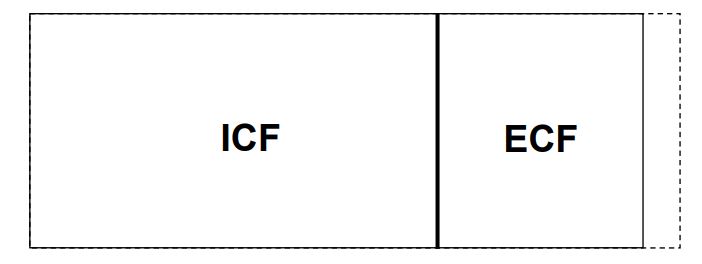
-Adding volume to ECF equivalent to amount administered
When fluid lost, add fluid in form of isotonic solution
35
Fluid Shifts: Hypotonic NaCl addition to ECF
New lowered
of
both
compartments. Add NaCl
solution.
New lowered
of
both
compartments. Add NaCl
solution.
Fluid Shifts: Hypotonic NaCl addition to ECF
New lowered
osmolarity of
both
compartments. Add hypotonic NaCl
solution.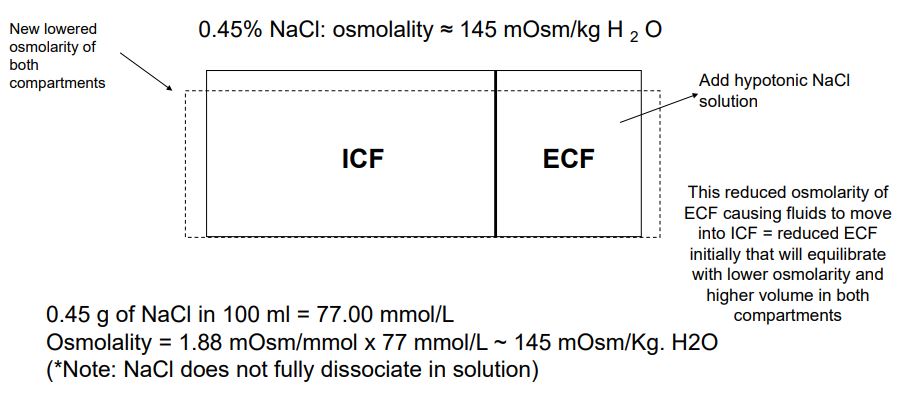
New lowered
osmolarity of
both
compartments. Add hypotonic NaCl
solution.
36
Fluid Shifts: Hypotonic NaCl addition to ECF
New lowered of both
compartments, this reduced osmolarity of
ECF causing fluids to move
into = reduced
initially that will equilibrate
with and
in both.
New lowered of both
compartments, this reduced osmolarity of
ECF causing fluids to move
into = reduced
initially that will equilibrate
with and
in both.
Fluid Shifts: Hypotonic NaCl addition to ECF
New lowered osmolarity of both
compartments, this reduced osmolarity of
ECF causing fluids to move
into ICF = reduced ECF
initially that will equilibrate
with lower osmolarity and
higher volume in both.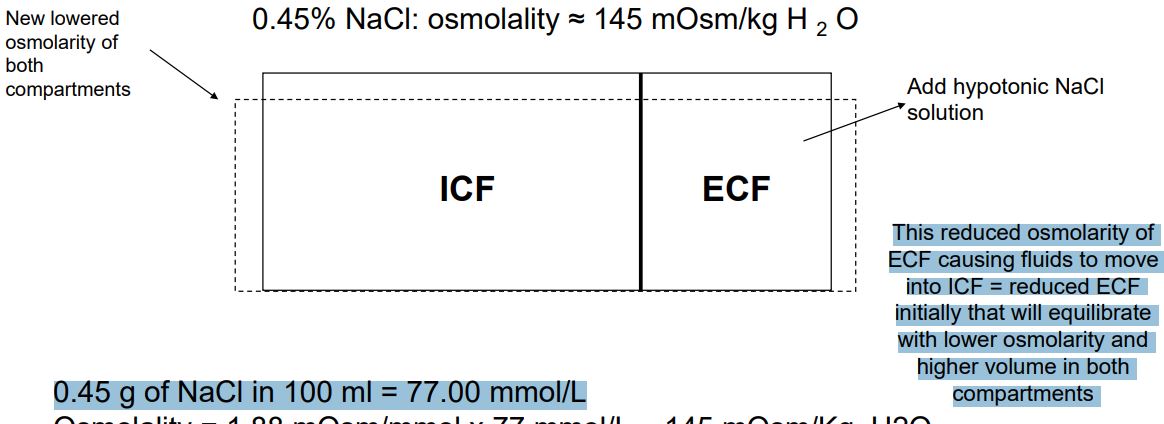
New lowered osmolarity of both
compartments, this reduced osmolarity of
ECF causing fluids to move
into ICF = reduced ECF
initially that will equilibrate
with lower osmolarity and
higher volume in both.
37
Fluid Shifts: Hypertonic NaCl addition to ECF
-New
osmolarity of
both
compartments
-This increased
of ECF will pull fluids out
from ICF = increased
and decreased
at osmotic equilibrium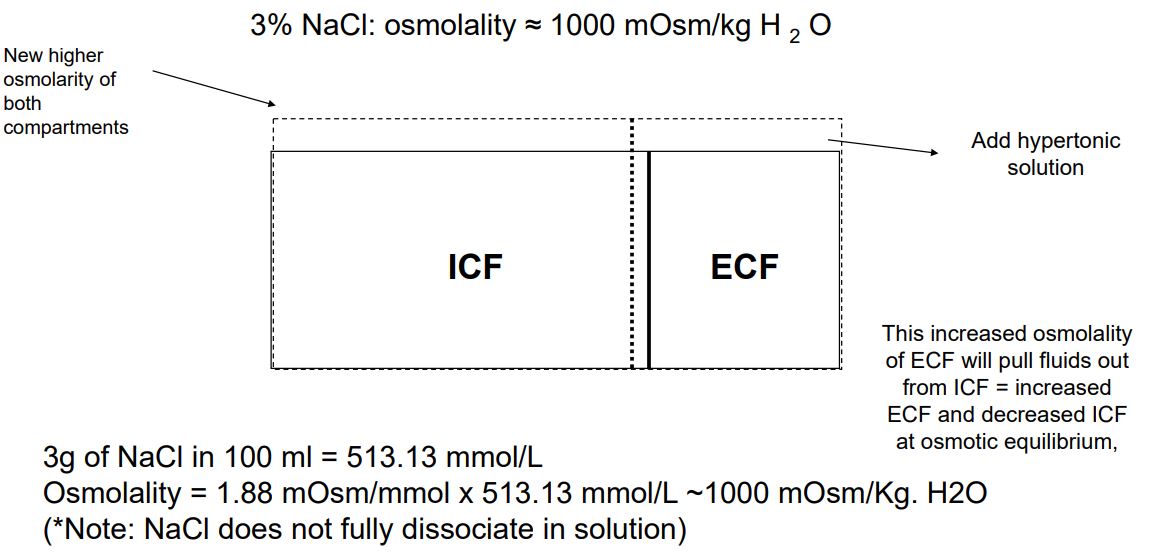
-New
osmolarity of
both
compartments
-This increased
of ECF will pull fluids out
from ICF = increased
and decreased
at osmotic equilibrium
Fluid Shifts: Hypertonic NaCl addition to ECF
-New higher
osmolarity of
both
compartments
-This increased osmolality
of ECF will pull fluids out
from ICF = increased
ECF and decreased ICF
at osmotic equilibrium
-New higher
osmolarity of
both
compartments
-This increased osmolality
of ECF will pull fluids out
from ICF = increased
ECF and decreased ICF
at osmotic equilibrium
38
Isomitic volume contraction occurs when body fluids like are lost
Isomitic volume contraction occurs when body fluids like GI fluids are lost
39
A decrease in ECF volume is due to
A decrease in ECF volume is due to isosmotic volume contraction 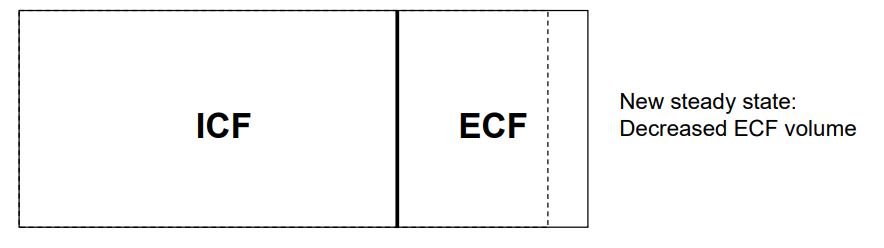
40
What happens to a person with diarrhea for 24 hours?
Step 1: What changes are occurring in the ECF? solution loss
Step 2: What changes are happening to ECF osmolarity?
Step 3: If there is a change is ECF osmolarity, what direction is the shift?
Step 1: What changes are occurring in the ECF? solution loss
Step 2: What changes are happening to ECF osmolarity?
Step 3: If there is a change is ECF osmolarity, what direction is the shift?
What happens to a person with diarrhea for 24 hours?
Step 1: What changes are occurring in the ECF? Isotonic solution loss
Step 2: What changes are happening to ECF osmolarity? No change
Step 3: If there is a change is ECF osmolarity, what direction is the shift? N/A
Step 1: What changes are occurring in the ECF? Isotonic solution loss
Step 2: What changes are happening to ECF osmolarity? No change
Step 3: If there is a change is ECF osmolarity, what direction is the shift? N/A
41
A hyperosmotic volume contaction occurs if there is
A hyperosmotic volume contaction occurs if there is water deprevation/dehydration
42
Dehydration
Step 1: What changes are occurring in the ECF? solution loss
Step 2: What changes are happening to ECF osmolarity?
Step 3: If there is a change is ECF osmolarity, what direction is the shift? will
decrease because osmolarity increased
Step 1: What changes are occurring in the ECF? solution loss
Step 2: What changes are happening to ECF osmolarity?
Step 3: If there is a change is ECF osmolarity, what direction is the shift? will
decrease because osmolarity increased
Dehydration
Step 1: What changes are occurring in the ECF? Hypotonic solution loss
Step 2: What changes are happening to ECF osmolarity? hypertonic
Step 3: If there is a change is ECF osmolarity, what direction is the shift? ICF will
decrease because ECF osmolarity increased
Step 1: What changes are occurring in the ECF? Hypotonic solution loss
Step 2: What changes are happening to ECF osmolarity? hypertonic
Step 3: If there is a change is ECF osmolarity, what direction is the shift? ICF will
decrease because ECF osmolarity increased
43
In hypersomotic volume contraction, the ECF and ICF volume decrease and the and
In hypersomotic volume contraction, the ECF and ICF volume decrease and the ECF and ICF osmolarities increase 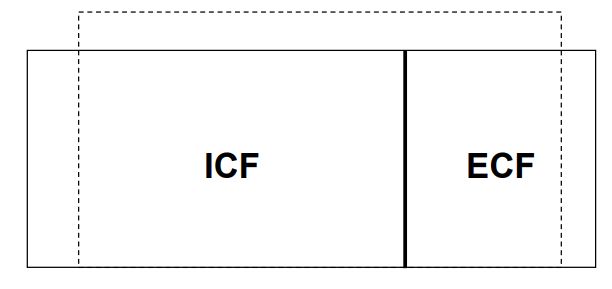
44
Hyposomotic conditions are created if a person has a condition that decreases in the ECF ( ) and decreases ( )
Hyposomotic conditions are created if a person has a condition that decreases sodium in the ECF (hyponatremia) and decreases water (hypovolemia)
45
Volume Contraction Hypoosmotic
Step 1: What changes are occurring in the ECF? Loss of a
Step 2: What changes are happening to ECF osmolarity?
Step 3: If there is a change is ECF osmolarity, what direction is the shift? will
increase because osmolarity decreased
Step 1: What changes are occurring in the ECF? Loss of a
Step 2: What changes are happening to ECF osmolarity?
Step 3: If there is a change is ECF osmolarity, what direction is the shift? will
increase because osmolarity decreased
Volume Contraction Hypoosmotic
Step 1: What changes are occurring in the ECF? Loss of a hypertonic solution
Step 2: What changes are happening to ECF osmolarity? Hypotonic
Step 3: If there is a change is ECF osmolarity, what direction is the shift? ICF will
increase because ECF osmolarity decreased
Step 1: What changes are occurring in the ECF? Loss of a hypertonic solution
Step 2: What changes are happening to ECF osmolarity? Hypotonic
Step 3: If there is a change is ECF osmolarity, what direction is the shift? ICF will
increase because ECF osmolarity decreased
46
Volume Expansion: Isomotic
-Done by adding to normal person
Step 1: What changes are occurring in the ECF? Adding an solution
Step 2: What changes are happening to ECF osmolarity?
Step 3: If there is a change is ECF osmolarity, what direction is the shift? N/A
-Done by adding to normal person
Step 1: What changes are occurring in the ECF? Adding an solution
Step 2: What changes are happening to ECF osmolarity?
Step 3: If there is a change is ECF osmolarity, what direction is the shift? N/A
Volume Expansion: Isomotic
-Done by adding isotonic saline to normal person
Step 1: What changes are occurring in the ECF? Adding an isotonic solution
Step 2: What changes are happening to ECF osmolarity? No change
Step 3: If there is a change is ECF osmolarity, what direction is the shift? N/A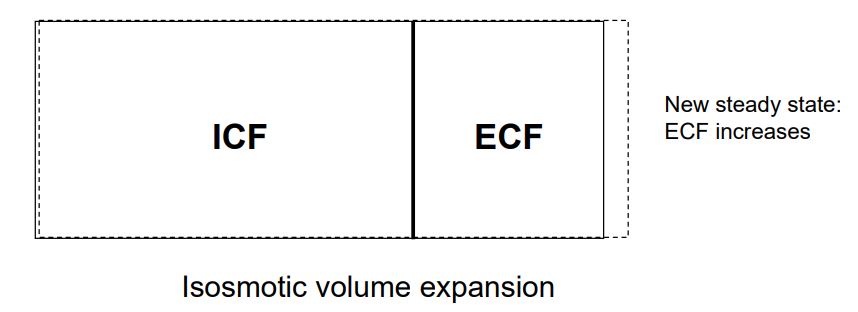
-Done by adding isotonic saline to normal person
Step 1: What changes are occurring in the ECF? Adding an isotonic solution
Step 2: What changes are happening to ECF osmolarity? No change
Step 3: If there is a change is ECF osmolarity, what direction is the shift? N/A
47
Volume Expanision:
-Occurs when a person has a hyndrome with inappropriate
Step 1: What changes are occurring in the ECF?
Step 2: What changes are happening to ECF osmolarity?
Step 3: If there is a change is ECF osmolarity, what direction is the shift? will
increase because of the decrease in osmolarity
-Occurs when a person has a hyndrome with inappropriate
Step 1: What changes are occurring in the ECF?
Step 2: What changes are happening to ECF osmolarity?
Step 3: If there is a change is ECF osmolarity, what direction is the shift? will
increase because of the decrease in osmolarity
Volume Expanision: Hypoosmotic
-Occurs when a person has a hyndrome with inappropriate diuretic hormone (SIDH)
Step 1: What changes are occurring in the ECF? increase
Step 2: What changes are happening to ECF osmolarity? decrease
Step 3: If there is a change is ECF osmolarity, what direction is the shift? ICF will
increase because of the decrease in ECF osmolarity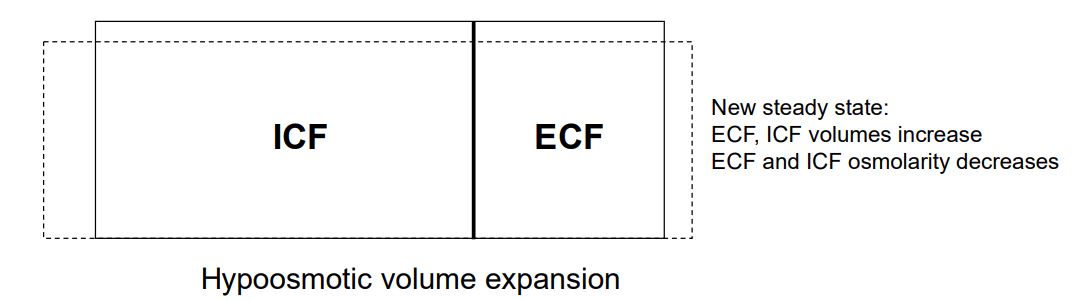
-Occurs when a person has a hyndrome with inappropriate diuretic hormone (SIDH)
Step 1: What changes are occurring in the ECF? increase
Step 2: What changes are happening to ECF osmolarity? decrease
Step 3: If there is a change is ECF osmolarity, what direction is the shift? ICF will
increase because of the decrease in ECF osmolarity
48
A hyperosmotic patient will need a fluid replacement to
restore volume (0.45% NaCl or 5% dextrose in water)- )-
following appropriate algorithms.
restore volume (0.45% NaCl or 5% dextrose in water)- )-
following appropriate algorithms.
A hyperosmotic patient will need a hypotonic fluid replacement to
restore ECF/ICF volume (0.45% NaCl or 5% dextrose in water)- )-
following appropriate algorithms.
restore ECF/ICF volume (0.45% NaCl or 5% dextrose in water)- )-
following appropriate algorithms.
49
A person who lost fluid, will only need equal isotonic fluid
replacement
replacement
A person who lost isotonic fluid, will only need equal isotonic fluid
replacement
replacement
50
A hypoosmotic patient will need a solution to replace
contracted volume. (3% or 5% NaCl)- following appropriate
algorithms.
contracted volume. (3% or 5% NaCl)- following appropriate
algorithms.
A hypoosmotic patient will need a hypertonic solution to replace
contracted volume. (3% or 5% NaCl)- following appropriate
algorithms.
contracted volume. (3% or 5% NaCl)- following appropriate
algorithms.
51
If you attempt to correct body fluid with just water, what happens?
RBC rupture 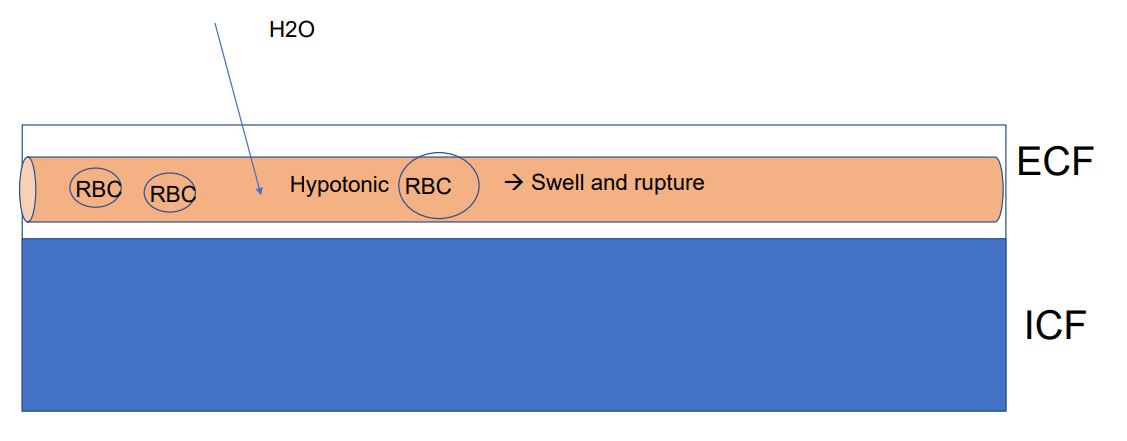
52
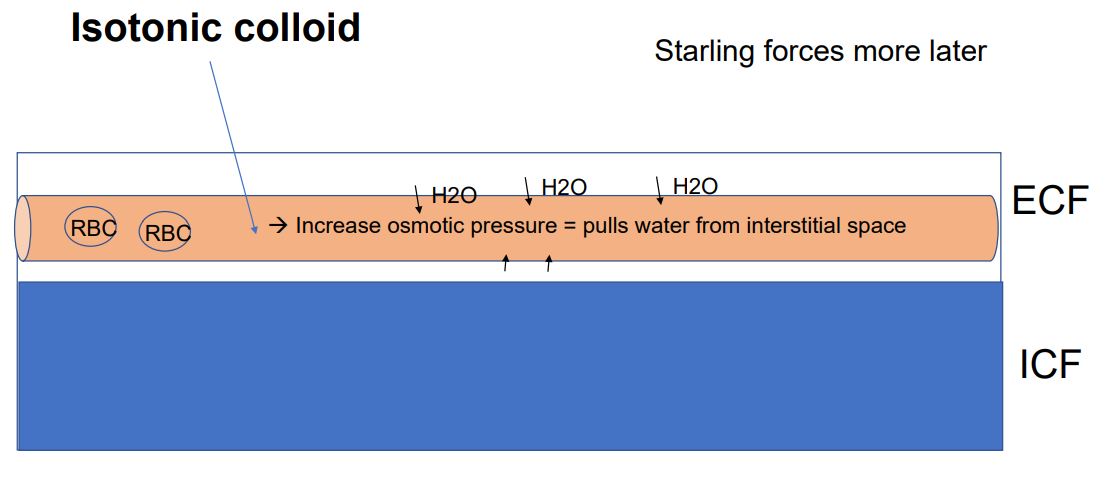
Colloids correct intravascular volume by increasing osmotic pressure by pulling water from intersittial space ( forces)
Colloids correct intravascular volume by increasing osmotic pressure by pulling water from intersittial space (Starling forces)