All cards
1
Great saphenous vein formed by
the dorsal venous arch of the foot, and the dorsal vein of the great toe
2
Path of great saphenous vein
Dorsal vein of great toe → dorsal venous arch → great saphenous vein
3
What does the great saphenous vein pass
Ascends up the medial side of the leg, passing anteriorly to the medial malleolus at the
ankle, and posteriorly to the medial condyle at the knee
ankle, and posteriorly to the medial condyle at the knee
4
What nerve runs with saphenous vein?
saphenous nerve
5
Where does the great saphenous vein terminate? What does it drain?
Terminates by draining into the femoral vein immediately inferior to the inguinal
ligament via saphenous opening. Drains superficial structures of medial thigh
ligament via saphenous opening. Drains superficial structures of medial thigh
6
Clinical relevance of great saphenous vein?
surgically, the great saphenous vein can be harvested & used as a
vessel in coronary artery bypass (CABGs)
vessel in coronary artery bypass (CABGs)
7
connects the great saphenous vein to the small saphenous vein
Dorsal venous arch connects the great saphenous vein to the small saphenous vein
8
What makes up the small saphenous vein?
Dorsal vein of metatarsal 5 → dorsal venous arch → small saphenous vein
9
What is the course of the small saphenous vein?
Extends from the lateral margin of the foot, posterior to the lateral malleolus – it
ascends along the posterior surface of the leg & passes between two heads of the
gastrocnemius
ascends along the posterior surface of the leg & passes between two heads of the
gastrocnemius
10
What nerve runs with the small spahenous vein?
Runs with the sural nerve along its course in the posterior aspect of the leg
11
What makes up the sural nerve?
Sensory cutaneous nerve made up of common fibular (ventral rami of L4-S2) and tibial (ventral rami of L4-S3) branches of the sciatic nerve (ventral rami of L4-S3)
12
Where does the small saphenous vein drain?
v. Drains the lateral surface of the leg & runs up the posterior surface of the leg to drain
into the popliteal vein at popliteal fossa
into the popliteal vein at popliteal fossa
13
What is the cutaneous innervation of the thigh? (Anterior, Medial, Lateral, Posterior)
i. Anterior – anterior femoral cutaneous nerve (origin = femoral nerve)
ii. Medial – obturator nerve
iii. Lateral – lateral femoral cutaneous nerve
iv. Posterior – posterior femoral cutaneous nerv
ii. Medial – obturator nerve
iii. Lateral – lateral femoral cutaneous nerve
iv. Posterior – posterior femoral cutaneous nerv
14
What is the cutaneous innervation of the lower leg? (Anterior, Lateral upper, Lateral Lower, Posterior/Lateral)?
i. Anterior/medial – saphenous nerve (origin = femoral nerve)
ii. Lateral upper ½ – lateral sural cutaneous nerve (origin = common fibular nerve)
iii. Lateral lower ½ – superficial fibular (peroneal) nerve (origin = common fibular nerve)
iv. Posterior/lateral – sural nerve (origin = common fibular & tibial nerve)
ii. Lateral upper ½ – lateral sural cutaneous nerve (origin = common fibular nerve)
iii. Lateral lower ½ – superficial fibular (peroneal) nerve (origin = common fibular nerve)
iv. Posterior/lateral – sural nerve (origin = common fibular & tibial nerve)
15
What is the innervation of the lateral foot, medial plantar, lateral planatar, arch of foot, 1st webspace, heel, and resting foot?
i. Lateral – sural nerve (origin = tibial + common fibular nerve)
ii. Medial plantar – medial plantar nerve (origin = tibial nerve)
iii. Lateral plantar – lateral plantar nerve (origin = tibial nerve)
iv. Arch of foot (medial) – saphenous nerve (origin = femoral nerve)
v. 1st webspace – deep fibular nerve (origin = common fibular nerve)
vi. Heel – medial calcaneal nerve (origin = tibial nerve)
vii. Rest of foot – superficial fibular nerve (origin = common fibular nerve)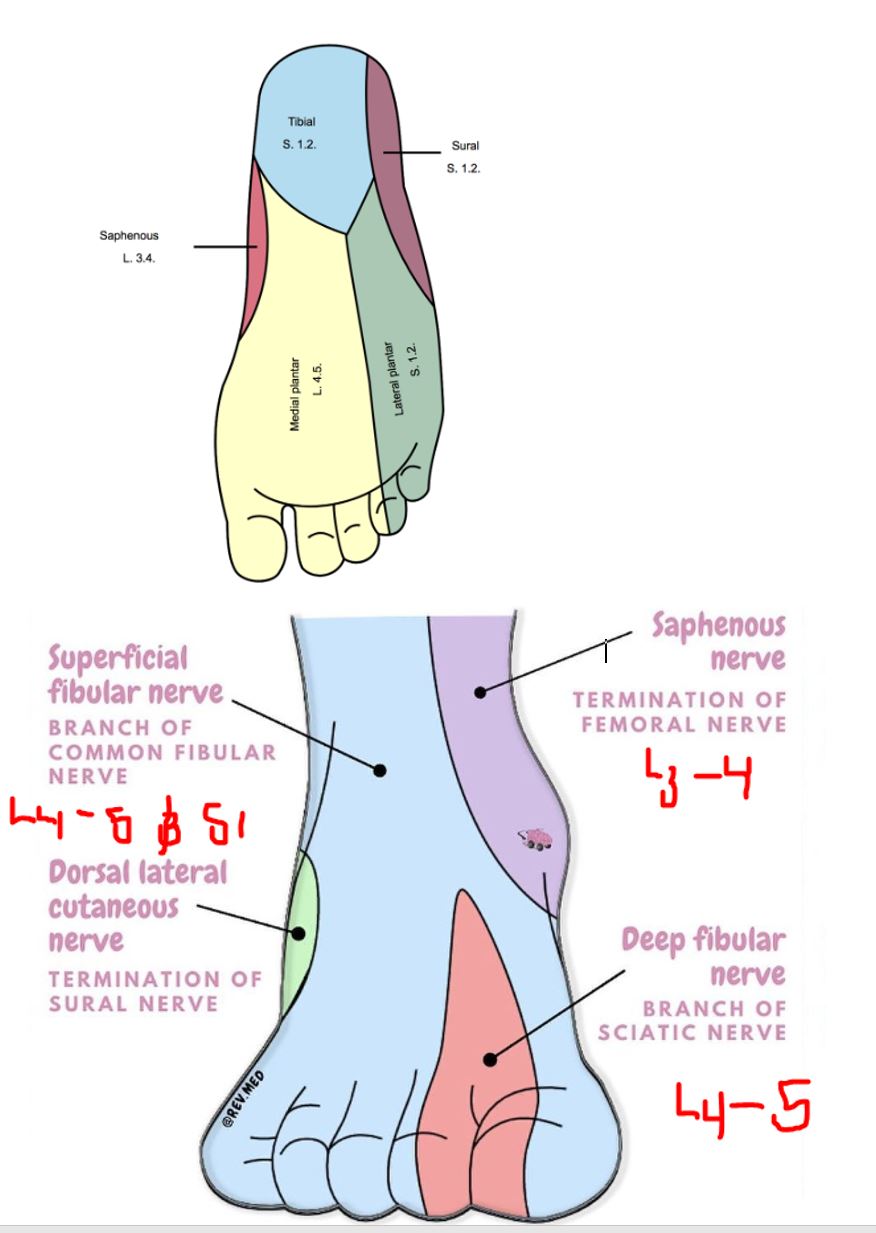
ii. Medial plantar – medial plantar nerve (origin = tibial nerve)
iii. Lateral plantar – lateral plantar nerve (origin = tibial nerve)
iv. Arch of foot (medial) – saphenous nerve (origin = femoral nerve)
v. 1st webspace – deep fibular nerve (origin = common fibular nerve)
vi. Heel – medial calcaneal nerve (origin = tibial nerve)
vii. Rest of foot – superficial fibular nerve (origin = common fibular nerve)
16
What are the dermatones of the lower extremity?
Anterior side of hip → L2 & L3
c. Anterior side of knee → L3 & L4
d. Anterior side of ankle → L4 & L5
e. Posterior side of hip → L4 & L5
f. Posterior side of knee → L5 & S1
g. Posterior side of ankle → S1 & S2
c. Anterior side of knee → L3 & L4
d. Anterior side of ankle → L4 & L5
e. Posterior side of hip → L4 & L5
f. Posterior side of knee → L5 & S1
g. Posterior side of ankle → S1 & S2
17
What is the general action of the anterior thigh muscles?
Flexion of hip
18
What is the general action of medial thigh muscles?
Adduction of hip
19
What is the general action of posterior thigh muscles?
Action – extension of hip & flexion of knee
20
What is the general action of anterior leg muscles?
Action – dorsiflexion
21
What is the general action of the posterior leg muscles?
Plantar flexion
22
What is the general action of the lateral leg muscles?
Plantar flexion and eversion
23
What is the general action of the superficial gluteal?
Abduction of hip
24
What is the general action of deep gluteal muscles?
Lateral rotation of hip and abduction
25
What are the three muscles that do Eversion?
-pEroneus longus
-pEroneus brevis
-pEroneus tertius
-pEroneus brevis
-pEroneus tertius
26
Which muscles does inversion?
Tibialis anterior and tibialis anterior
27
Which of the muscles do toe flexion?
-Flexor hallucis longus + brevis
-Flexor digitorum longus + brevis
-Flexor digit minimi
- Opponens digiti minimi
-Flexor digitorum longus + brevis
-Flexor digit minimi
- Opponens digiti minimi
28
Which muscles do toe extension?
-Extensor digitorum longus + brevis
-Extensor hallucis longus + brevis
-Extensor hallucis longus + brevis
29
and are prime plantar flexors
Soleus and Gastrocnemius are prime plantar flexors
30
Muscles of superficial gluteal?
1. Gluteus maximus
2. Gluteus medius
3. Gluteus minimus
4. Tensor fascia lata
2. Gluteus medius
3. Gluteus minimus
4. Tensor fascia lata
31
Muscles of the deep gluteal?
1. Piriformis
2. Superior gemellus
3. Obturator internus
4. Obturator externus
5. Inferior gemellus
6. Quadratus femoris
2. Superior gemellus
3. Obturator internus
4. Obturator externus
5. Inferior gemellus
6. Quadratus femoris
32
Muscles of the anterior thigh?
i. Psoas major
ii. Iliopsoas
iii. Iliacus
iv. Sartorius
v. Quadriceps femoris
1. Rectus femoris
2. Vastus lateralis
3. Vastus medialis
4. Vastus intermedius
ii. Iliopsoas
iii. Iliacus
iv. Sartorius
v. Quadriceps femoris
1. Rectus femoris
2. Vastus lateralis
3. Vastus medialis
4. Vastus intermedius
33
Muscles of the medial thigh?
Medial thigh muscles
i. Pectineus
ii. Gracilis
iii. Adductor longus
iv. Adductor brevis
v. Adductor magnus
i. Pectineus
ii. Gracilis
iii. Adductor longus
iv. Adductor brevis
v. Adductor magnus
34
Muscles of the posterior thigh?
i. Biceps femoris (long & short head)
ii. Semitendinosus
iii. Semimembranosus
ii. Semitendinosus
iii. Semimembranosus
35
Muscles of the anterior leg?
i. Tibialis anterior
ii. Extensor digitorum longus
iii. Fibularis (peroneus) tertius
iv. Extensor hallucis longus
ii. Extensor digitorum longus
iii. Fibularis (peroneus) tertius
iv. Extensor hallucis longus
36
Muscles of the superficial posterior leg?
1. Gastrocnemius
2. Plantaris
3. Soleus
2. Plantaris
3. Soleus
37
Muscles of the deep posterior leg?
1. Popliteus
2. Flexor digitorum longus
3. Flexor hallucis longus
4. Tibialis posterior
2. Flexor digitorum longus
3. Flexor hallucis longus
4. Tibialis posterior
38
Femoral nerve injury would result in , and – and sensory loss to (anterior cutaneous branches of femoral nerve) &
Femoral nerve injury would result in weakness of hip flexion, and knee extension (can’t kick) – and sensory loss to anteromedial thigh (anterior cutaneous branches of femoral nerve) & medial side of leg & foot 5th tarsal joint (saphenous nerve)
39
Obturator nerve injury would result in weakness with – & sensory loss to
Obturator nerve injury would result in weakness with hip ADduction – & sensory loss to medial thigh
40
What are the 4 muscles that make up the hamstrings?
1. Biceps femoris
2. Semitendinosus
3. Semimembranosus
4. Adductor magnus part of hamstring
2. Semitendinosus
3. Semimembranosus
4. Adductor magnus part of hamstring
41
tibial nerve injury would prevent you from performing , , and –
and sensory loss to the , , and – no sensory loss to
and sensory loss to the , , and – no sensory loss to
tibial nerve injury would prevent you from performing knee flexion, plantar flexion, and inversion –
and sensory loss to the posterolateral leg, lateral foot, and sole of foot – no sensory loss to medial side of leg
and sensory loss to the posterolateral leg, lateral foot, and sole of foot – no sensory loss to medial side of leg
42
Femoral pulse location
can be optimally palpated a few centimeters inferior to the
midpoint of the inguinal ligament in the femoral triangle
midpoint of the inguinal ligament in the femoral triangle
43
Popliteal pulse location
inferior part of the popliteal fossa – the
patient is normally in prone position (lying flat with chest down and back up) with the knee flexed
in order to relax the popliteal fascia and the hamstrings
patient is normally in prone position (lying flat with chest down and back up) with the knee flexed
in order to relax the popliteal fascia and the hamstrings
44
Posterior tibial pulse location
inferoposteriorly to medial
malleolus where the artery turns to enter the foot – aka between the posterior surface of the medial
malleolus and the calcaneal tendon
malleolus where the artery turns to enter the foot – aka between the posterior surface of the medial
malleolus and the calcaneal tendon
45
Where is the dorsal pedis pulse palpated?
dorsum of foot, palpable lateral to the tendon of the extensor hallucis
longus and inferior to the extensor retinaculum, with the foot slightly dorsiflexed
longus and inferior to the extensor retinaculum, with the foot slightly dorsiflexed
46
What does posterior hip dislocation or hi replacement cause damage to? What are the symptoms?
-Damage to siatic nerve or compression of piriformis
-Pain radiating down posterior leg and thigh
-Numbness over posterior foot
-Loss of foot and ankle control
-FOOT DROP
-Pain radiating down posterior leg and thigh
-Numbness over posterior foot
-Loss of foot and ankle control
-FOOT DROP
47
What does anterior hip dislocation damage?
-Obturator nerve
-Causes loss of adduction of thigh and medial rotation
-Loss of sensation to medial thigh
-Causes loss of adduction of thigh and medial rotation
-Loss of sensation to medial thigh
48
What does a fracture to the neck of the fibula damage? What are the symptoms?
-Damage to common peroneal nerve
-Decreased sensation or numbness in top of doot or lateral outer portion of upper or lower leg
-Weakness in dorsiflexion and extension of digits
-FOOT DROP ****** THIS IS THE ONE SHE SAID WOULD BE ON EXAM
-Decreased sensation or numbness in top of doot or lateral outer portion of upper or lower leg
-Weakness in dorsiflexion and extension of digits
-FOOT DROP ****** THIS IS THE ONE SHE SAID WOULD BE ON EXAM
49
What does a plevic fracture damage? Symptoms
femoral nerve
i. Weakened hip flexion & extension of knee
ii. Sensory loss on anterior thigh, medial leg, and medial foot
i. Weakened hip flexion & extension of knee
ii. Sensory loss on anterior thigh, medial leg, and medial foot
50
What does knee dislocation damage? Symptoms?
common peroneal nerve
i. FOOT DROP
ii. Numbness over back of the foot
i. FOOT DROP
ii. Numbness over back of the foot
51
What does tibial fracture at medial malleolus damage? Symptoms?
-Damage to tibial nerve
i. Entrapment in tarsal tunnel syndrome
ii. Pain and numbness in sole of foot & heel
i. Entrapment in tarsal tunnel syndrome
ii. Pain and numbness in sole of foot & heel
52
What does damage of the lateral malleolus cause? Symptoms?
i. Pain in posterior aspect of leg
ii. Numbness in distal foot
ii. Numbness in distal foot
53
What does fibular fracture damage? What are the symptoms?
damage to superficial peroneal nerve
i. Loss of eversion
ii. Sensory loss to dorsum of foot EXCEPT first webspace
i. Loss of eversion
ii. Sensory loss to dorsum of foot EXCEPT first webspace
54
What nerve does ankle surgery damage ? Symptoms?
– superficial peroneal nerve
i. Numbness & pain over back of foot
i. Numbness & pain over back of foot
55
What nerve does lesser trochanter damage cause? Symptoms
-sciatic nerve (posterior) & femoral nerve (anterior)
i. Sciatic nerve – leads to sciatic nerve palsy = sciatica
1. Pain in lower back, glutes, and posterior leg
i. Sciatic nerve – leads to sciatic nerve palsy = sciatica
1. Pain in lower back, glutes, and posterior leg
56
What does tibial shaft fracture damage? Symptoms?
Tibial shaft fracture – anterior & posterior tibial arteries
i. Laceration of the arteries produces either anterior or posterior compartment syndrome
i. Laceration of the arteries produces either anterior or posterior compartment syndrome
57
What nerve does fracture of head of femur cause damage to? Symptoms
.-Can lead to AVN
ii. NOTE: increased steroid use may cause AVN around head of the femur
ii. NOTE: increased steroid use may cause AVN around head of the femur
58
What is trendelenburg's gait?
-Gluteus medius (and some minimis) provides stability to the pelvis when lifting the opposite leg
-If muscles supplied by the superior gluteal nerve (gluteus medius > minimus) are weak (aka
weak ABduction of hip), it results in Trendelenburg gait
-Abnormal gait in which the person
cannot keep their pelvis leveled (sways side to side) when standing on one leg or walking –
damage of nerve will cause a contralateral hemipelvis drop
-If muscles supplied by the superior gluteal nerve (gluteus medius > minimus) are weak (aka
weak ABduction of hip), it results in Trendelenburg gait
-Abnormal gait in which the person
cannot keep their pelvis leveled (sways side to side) when standing on one leg or walking –
damage of nerve will cause a contralateral hemipelvis drop
59
Whic three conditions leads to foot drop? What would be the MOST correct answer for exam?
1. Common fibular nerve injury
2. Deep fibular nerve injury
3. Siatic nerve injury
2. Deep fibular nerve injury
3. Siatic nerve injury
60
What does common fibular nerve injury cause? What is the most common cause of damage? What sensory loss would be present?
-Would result in inability to dorsiflex the ankle, resulting in FOOT DROP, and inability
to evert the foot
-FIBULAR NECK
FRACTURE
-Lateral leg and dorsal foot senesory loss
to evert the foot
-FIBULAR NECK
FRACTURE
-Lateral leg and dorsal foot senesory loss
61
What does deep fibular nerve injury cause? What sensory loss would be present?
-inability to dorsiflex, resulting in FOOT DROP – there would also be
weakness in inversion & loss of extension of toes
-. Sensory loss would be present over the first webspace
weakness in inversion & loss of extension of toes
-. Sensory loss would be present over the first webspace
62
What does siatic nerve injury cause? What would happen if there was a complete lesion? Where is pain present? What sensory loss would be present?
-Weakness with hip extension & knee flexion
-If there’s a complete lesion of the nerve ALL sensory and motor function in the
posterior compartment of the thigh & all functions below the knee would be
impaired – FOOT DROP
-Shooting electric pain down POSTERIOR THIGH
-Sensory loss to leg (EXCEPT MEDIAL SURFACE OF FOOT)
-If there’s a complete lesion of the nerve ALL sensory and motor function in the
posterior compartment of the thigh & all functions below the knee would be
impaired – FOOT DROP
-Shooting electric pain down POSTERIOR THIGH
-Sensory loss to leg (EXCEPT MEDIAL SURFACE OF FOOT)