All cards
1
What type of tissue is blood?
A connective tissue
2
Blood has a lot of but can form when it clots
Blood has a lot of extracellular fluid but can form fibers when it clots
3
What are the three formed elements of blood?
Platelets, erythrocytes, and leukocytes
4
What is the fluid element of blood?
Plasma
5
What is in the buffy coat?
White blood cells and platelets
6
Hematocrit is the percentage of
Hematocrit is the percentage of red blood cells
7
If no anticoagulant is added, what is formed?
Serum
8
What percentage of whole blood is buffy coat?
1% (only need to know relative numbers)
9
What percentage of whole blood is plasma?
55%
10
What percentage of blood is erythrocyte?
44%
11
What are the components of plasma?
Water (90%), the proteins, then other solutes
12
Most abundant to least abundant WBC
Neutrophils, lymphocytes, monocytes, eosinophils, basophils
*"Never Let Monkeys Eat Bananas"
*"Never Let Monkeys Eat Bananas"
13
What does a blood smear tell you?
Morphology, type, and number of cells
14
What is blood stained with?
Combination of acid and basic dyes like wright or giemsa
15
What are the granulocytes?
1. Neutrophils
2. Eosinophils
3. Basophils
*NEB
2. Eosinophils
3. Basophils
*NEB
16
What are the agranulocytes?
1. Lymphocytes
2. Monocytes
2. Monocytes
17
Describe the nucleus and cytoplasm of RBC?
No nucleus, cytoplasm is acidophilic. No organelles, essentially a "bag" of hemoglobin
18
The only blood cell whose function does not require them to leave the vasculature?
RBC
19
WHat is the lifespan of a RBC
120 days
20
What is responsible for the lighter staining middle region of RBC? Why does it have this feature
-The light middle is because of the biconcave shape of the RBC
-It allows for increased surface area for gas exhange and ability to deform readily
-It allows for increased surface area for gas exhange and ability to deform readily
21
What is the structure of a platelets nucleus and cytoplasm?
-No nucleus
-Tiny cell fragments with pale blue cytoplasm with basophillic granules
-Tiny cell fragments with pale blue cytoplasm with basophillic granules
22
What is the function of platelets?
Form blood clots, vessel repair
23
What do platelets come from?
Megakaryocytes
24
How long are platelets active?
10 days
25
What is another name for a platelet?
Thrombocytes
26
What are the two parts of a platelet?
Hyalomere -outer lighter zome with cytoskeletal elements
Granulomere - inner zone with membrane bound granules
Granulomere - inner zone with membrane bound granules
27
What type of system do platelets have? What does this system do?
-Open canalicular or tubular system
-Helps with rapid degranulation/activation
-Helps with rapid degranulation/activation
28
What triggers platelet aggregation/clot formation?
Exposure of collagen under endothelium
29
What is firbin?
Makes up scaffold of clot
30
During clot formation, become trapped in a loose mesh of fibrin fibers
During clot formation, RBC become trapped in a loose mesh of fibrin fibers
31
All leukocytes
All leukocytes need to exit blood vessels to reach there site of action in the connective tissue
32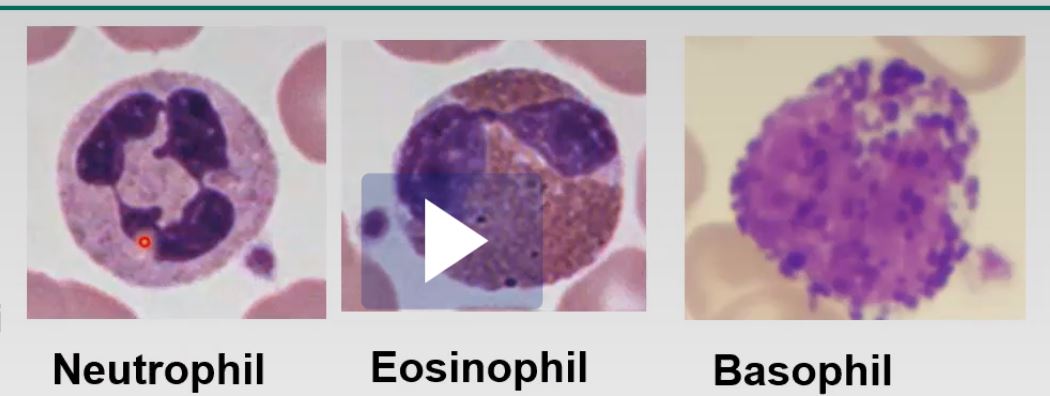
Image occlusion: name the hidden labels
33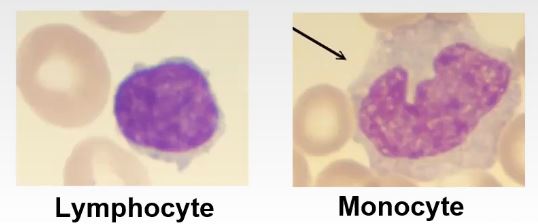
Image occlusion: name the hidden labels
34
Granulocytes have what 2 features?
1. Granules
2. Multilobed nuclei
2. Multilobed nuclei
35
How is differential count calculated?
# of specific type of leukocyte / total number of leukocytes * 100 = % of cells
36
All granulocytes have a primary or non-specific granule which are mostly
All granulocytes have a primary or non-specific granule which are mostly lysosomes
37
Each type of granulocyte also has granules
Each type of granulocyte also has SPECIFIC granules
38
Are mature granulocytes capable of replication or terminally differentiated?
Terminally differentiated
39
Describe the nucleus and cytoplasm of neutrophils?
-Neucleus is segmented (3-5 lobes)
-Cytoplasm has small azurophilic granules
-Cytoplasm has small azurophilic granules
40
What is the the function of neutrophils?
-Kills bacteria and fungi, first responders
41
What is another name for a neutrophil?
PMN polymorphonucelar neutrophils
42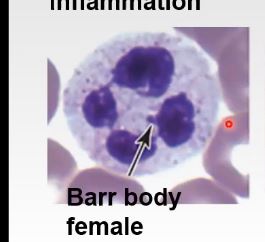
Image occlusion: name the hidden labels
43
How long can neutrophils survive?
6-12 hours in blood, 1-4 days in CT
44
What 3 things do granules of neutrophils contain?
-Lysosomes, protease,and antibacterial proteins
45
How do neutrophils enter the connective tissue?
The postcapillary venule
46
How are neutrophils recruited?
By moving margins of vessels and loosing attaching to endothelial and squeezing between to enter CT
47
What is the fancy word for the neutrophils squeezing through endothelial?
Transendothelial migration/diapedesis
48
What is the word used to describe how neutrophils get to their site?
Chemotaxsis
49
What cell type activates the nuetrophils?
Activated macrophage
50
When is neutrophilia seen?
When there is a bacterial infection with acute inflammation
51
Describe the nucelus and cytoplasm of eosinophils
Bilobed nucelus, cytoplasm has ACIDOPHILIC granules with crystaline cores
52
What are the 4 functions of eosinophils?
1. Kills parasitic worms
2. Removes antigen-antibody complex
3. Chronic inflammation (asthma)
4. Counteract the basophils
2. Removes antigen-antibody complex
3. Chronic inflammation (asthma)
4. Counteract the basophils
53
What is responsible for the strong eosinophillic staining of eosinophils?
Major Basic protein (MBP)
54
*Potential Test Question* Which of the cells has a flattened crystaline core?
Eosinophils
55
What two conditions is eosinophillia associated with?
1. Allergic reaction
2. Parasitic worm infection
2. Parasitic worm infection
56
Describe the nucleus and cytoplasm of basophils?
Bilobed with large blue and black granules that obsure nucleus
57
What are the 3 function of basophils?
-Contain histamine, heparain, serotonin
-Augments mast cell action
-Functions in allergic reaction and IgE mediated response and increses Vascular permeability
-Augments mast cell action
-Functions in allergic reaction and IgE mediated response and increses Vascular permeability
58
What role do basophils have in vascular permeability?
They increase it
59
Describe the nucelus and cytoplasm of the lymphocyte?
-Round, intensely dark nucleus
-Light and small blue rim of cytoplasm
-Light and small blue rim of cytoplasm
60
What is the function of a lymphocyte?
-Mediates cellular (T) and humoral immuntiy (B) (i.e. plasma cells)
-Main functional cell of immune system
-Main functional cell of immune system
61
What are the 3 main divisions of the immune system?
1. T lymphocytes
2. B lymphocytes
3. Natural killer cells (kill viruses and cancer cells)
2. B lymphocytes
3. Natural killer cells (kill viruses and cancer cells)
62
What do B lymphocytes become?
Plasma cells
63
Describe the appearance of the nucleus and cytoplasm of monocytes?
-Indented C shaped nucleus (With ALOT of variability) with pale blue-grey cytoplasm
64
What is the function of a monocytes?
-Differeniates into macrophages
-Antigen presenters
-Antigen presenters
65
What are 3 things that monocytes give rise to?
1. Macrophage
2. Microglia
3. Osteoclasts
2. Microglia
3. Osteoclasts
66
Where do we made red blood cells?
Bone marrow
67
When does hematopoisesis begin?
Week 3 of development
68
Where does hematopoisesis begin? What forms?
In the yolk sac "blood islands" are formed
69
What are the 3 steps of hematopoesis?
1. Formation of blood islands from mesenchyme
2. Cells flatten to form lining of blood vessel
3. Cells differentiate into primative blood cells
2. Cells flatten to form lining of blood vessel
3. Cells differentiate into primative blood cells
70
What is the progression of where hematopoiesis occurs?
Yolk sac to liver/spleen to bone marrow
71
All bones, liver, and spleen retain the potential to revert
All bones, liver, and spleen retain the potential to revert to red, active marrow
72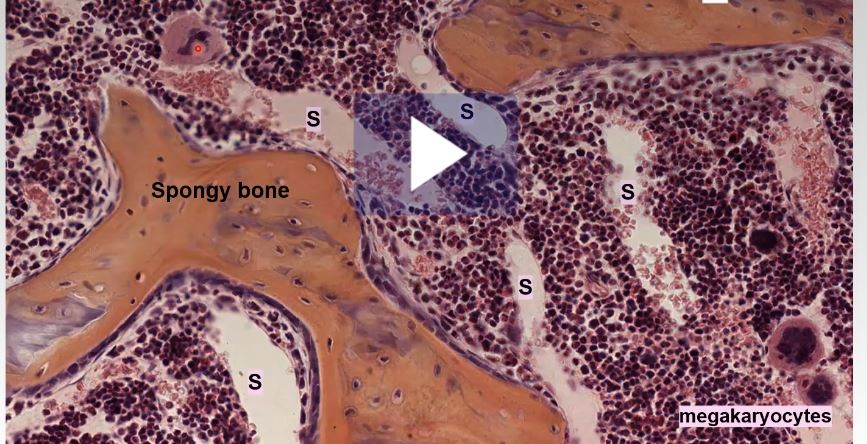
Image occlusion: name the hidden labels
73
What are the 5 components of red bone marrow?
1. Stroma with recticular fibers/fibroblasts
2. Cords or hemopoietic islands
3. Mekgakaryocytes
4. Sinusoidal capillaries (leaky/large)
5. Adipose with many macrophages
2. Cords or hemopoietic islands
3. Mekgakaryocytes
4. Sinusoidal capillaries (leaky/large)
5. Adipose with many macrophages
74
What is red marrow? What does it contain?
Active!
Developing in RBC and WBC and sinusodial capillaries
Developing in RBC and WBC and sinusodial capillaries
75
What is yellow marrow? What does it contain!
Fat marrow!
Has adipose
Has adipose
76
How are platelets formed?
Forms from megakaryoctes
77
Describe megakaryoctes. What do they become?
-Polyploid nucleus with 30x DNA of normal cell
-Mature pieces break off and become platelets
-Mature pieces break off and become platelets
78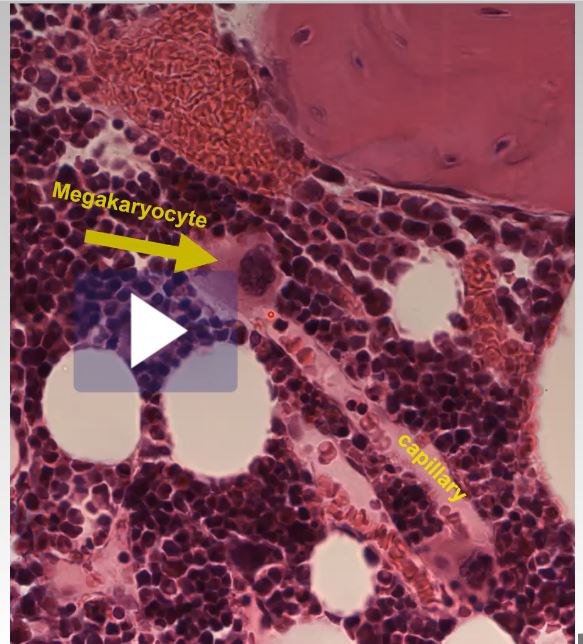
Image occlusion: name the hidden labels
79
Megakaryocytes extend their cellular projections into . Small cytoplasmic pieces pinch off into blood, forming
Megakaryocytes extend their cellular projections into sinusoidal capillaries . Small cytoplasmic pieces pinch off into blood, forming platelets
80
What are the three erythroposiesis stages?
1. Basocphillic
2. Polychromatic
3. Orthochromatic
2. Polychromatic
3. Orthochromatic
81
What are the three granulopoiesis stages?
1. Myelocyte
2. Metamyelocyte
3. Band
2. Metamyelocyte
3. Band
82
Identify this developing cell 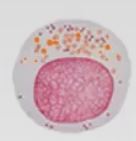
Eosinophillic myelocyte
83
Identify this developing cell 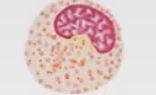
Eosinophillic metamyelocyte
84
Identify this developing cell 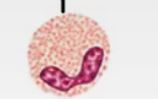
Esosinophillic band cell
85
Identify this developing cell 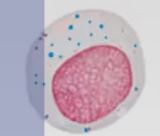
Neutrophillic myelocyte
86
Identify this developing cell 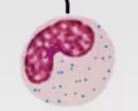
Neutrophillic metamyelocyte
87
Identify this developing cell 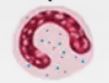
Neutrophilic band cell
88
Identify this developing cell 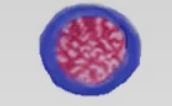
Basophilic erythroblast
89
Identify this developing cell 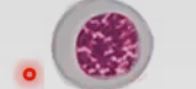
Polychromatic erythroblast
90
Identify this developing cell 
Orthochromatic normoblast
91
As the cell matures, what is the general trend?
The nucelus gets smaller and darker
92
Why do developing erythrocytes change over time?
They start off looking blue (RNA) and then end up red (hemoglobin)
93
Developing circular cells are most likely....
RBC
94
What is the last immature form of RBC? What does it contain?
Reticulocyte, retains ribosome
95
Recticulocytes are examined for what disease?
Anemia
96
What is chronic myelogenous leukemia?
Increased proliferation of all 3 granulocytes