Lecture 3
Study these flashcardsFree · spaced repetition · iPhone, Android, Mac & web
All cards
1
T cells have that can only sucessfully bind to an antigen if it is held in a very stable manner.
T cells have T cell receptors that can only sucessfully bind to an antigen if it is held in a very stable manner.
2
= any substance that can induce a specific immune response
Antigen = any substance that can induce a specific immune response
3
Everyone has MHC receotors so technically they are . Some cells are professional antigen presenting cells, like , , and
Everyone has MHC receotors so technically they are antigen presenting cells. Some cells are professional antigen presenting cells, like dendritic cells, macrophages, and B cells
4
T cells are in
T cells are in lymph nodes
5
The dendritic cells bring antigens to lymph node and displau them to
The dendritic cells bring antigens to lymph node and displau them to active T cells
6
leave the lymph node and access the blood cirulation to traffick to tissues
Activated T cells leave the lymph node and access the blood cirulation to traffick to tissues
7
MHC class I
( , , )
( , , )
MHC class I
(HLA-A, HLA-B, HLA-C)
(HLA-A, HLA-B, HLA-C)
8
MHC Class One are expressed by all
Presents peptides derived from sources
Presents peptides derived from sources
MHC Class One are expressed by all nucleated cells
Presents peptides derived from endogenous sources
Presents peptides derived from endogenous sources
9
MHC Class Two are expressed by and select others. Presents peptides derived from sources.
MHC Class Two are expressed by professional APC and select others. Presents peptides derived from exogenous sources.
10
MHC Class II
( , , )
( , , )
MHC Class II
(HLA-DQ, HLA-DP, HLA-DQ)
(HLA-DQ, HLA-DP, HLA-DQ)
11
Only professional antigen presenting cells will bind antigens from of the body and fuse with a phagosome.
Only professional antigen presenting cells will bind antigens from outside of the body and fuse with a phagosome.
12
CD8 + T cells
• T (Tc) cells
• TCR can only recognize peptides when bound to
• Cytotoxic functions to eliminate or
cells and cells
• T (Tc) cells
• TCR can only recognize peptides when bound to
• Cytotoxic functions to eliminate or
cells and cells
CD8 + T cells
• T cytotoxic (Tc) cells
• TCR can only recognize peptides when bound to
MHC class I molecules
• Cytotoxic functions to eliminate infected or
damaged cells and cancer cells
• T cytotoxic (Tc) cells
• TCR can only recognize peptides when bound to
MHC class I molecules
• Cytotoxic functions to eliminate infected or
damaged cells and cancer cells
13
CD4+ T cells
• T cells
• TCR can only recognize peptides when bound to
• Produce cytokines to direct activities of other
and cells
• T cells
• TCR can only recognize peptides when bound to
• Produce cytokines to direct activities of other
and cells
CD4+ T cells
• T helper (Th) cells
• TCR can only recognize peptides when bound to
MHC class II molecules
• Produce cytokines to direct activities of other
immune cells and tissue cells
• T helper (Th) cells
• TCR can only recognize peptides when bound to
MHC class II molecules
• Produce cytokines to direct activities of other
immune cells and tissue cells
14
Dendritic cells can capture viruses take them in and put them extenally on molecules. This is called cross-presentation and only cells can do this.
Dendritic cells can capture viruses take them in and put them extenally on MHC class 1 molecules. This is called cross-presentation and only dendritic cells can do this.
15
T cells are until activated by antigens. When they get activated, they multiply by c . They end up getting stimulated to differeniate. The become T cells and T cells.
T cells are naive until activated by antigens. When they get activated, they multiply by clonal expanision. They end up getting stimulated to differeniate. The become effector T cells and memory T cells.
16
3 signal method of T cell activation
Step 1: Peptide recognized by
Step 1: Peptide recognized by
3 signal method of T cell activation
Step 1: Peptide recognized by TCR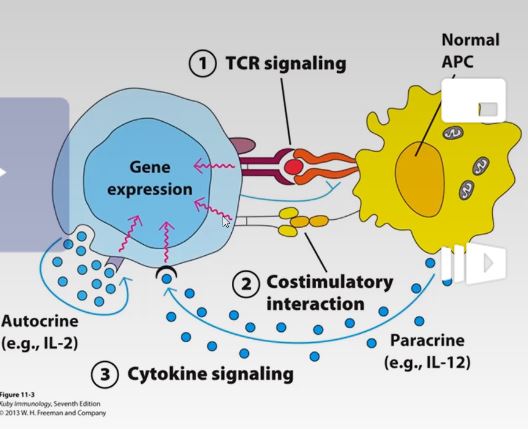
Step 1: Peptide recognized by TCR
17
3 signal method of T Cell activation
Step 2: Costimulation
DC expresses ligans CD and CD that bind to receptor CD on T cells that provide enhancement of signals
Step 2: Costimulation
DC expresses ligans CD and CD that bind to receptor CD on T cells that provide enhancement of signals
3 signal method of T Cell activation
Step 2: Costimulation
DC expresses ligans CD80 and CD86 that bind to receptor CD28 on T cells that provide enhancement of TCR signals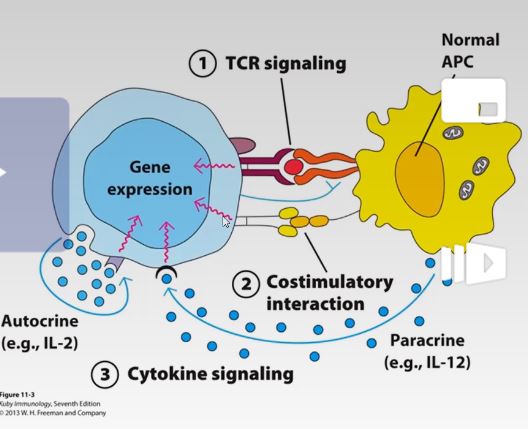
Step 2: Costimulation
DC expresses ligans CD80 and CD86 that bind to receptor CD28 on T cells that provide enhancement of TCR signals
18
3 signal method of T Cell activation
Step 3
produces cytokines that bind to receptors on to direct gene expression. Produces specific subtypes of to respond to specific microbes
Step 3
produces cytokines that bind to receptors on to direct gene expression. Produces specific subtypes of to respond to specific microbes
3 signal method of T Cell activation
Step 3
Dendritic cells produces cytokines that bind to receptors on T cells to direct gene expression. Produces specific subtypes of T cells to respond to specific microbes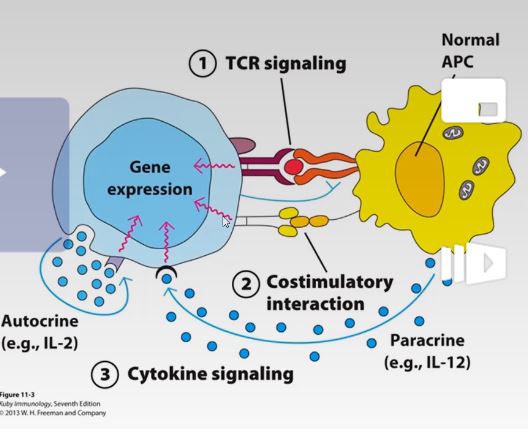
Step 3
Dendritic cells produces cytokines that bind to receptors on T cells to direct gene expression. Produces specific subtypes of T cells to respond to specific microbes
19
Naïve T cells are activated to differentiate
into T cells. Polarizing are provided by that turns on induced by cytokines. This produces specific T cell subtypes.
into T cells. Polarizing are provided by that turns on induced by cytokines. This produces specific T cell subtypes.
Naïve T cells are activated to differentiate
into effector T cells. Polarizing cytokines are provided by antigen protein complex that turns on transcription factors induced by cytokines. This produces specific T cell subtypes.
into effector T cells. Polarizing cytokines are provided by antigen protein complex that turns on transcription factors induced by cytokines. This produces specific T cell subtypes.
20
IL-6 and TGF-B produce cell that makes which produces
IL-6 and TGF-B produce TH17 cell that makes IL-17 which produces inflammation 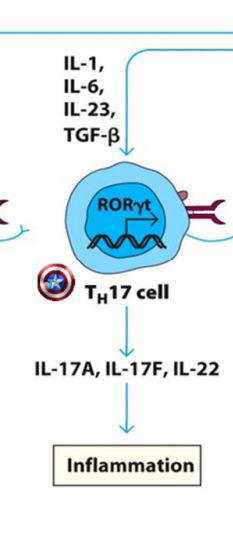
21
IL-4 produces which makes , , and that is responsible for and response
IL-4 produces TH2 which makes IL-4, IL-5, and IL-13 that is responsible for allergic and anti-helminth response 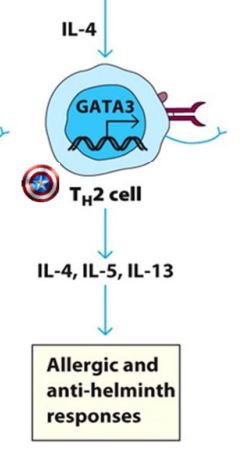
22
, , makes cell that produces and which is responsible for cell-mediated , actuvation, and
IL-12, INF gamma, IL-18 makes TH1 cell that produces IFN-gamma and TNF which is responsible for cell-mediated immunity, macrophage actuvation, and inflammation 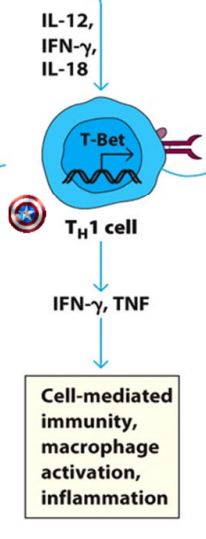
23
T cells from the blood circulation enter the lymph nodes
through and
localize in the
through and
localize in the
T cells from the blood circulation enter the lymph nodes
through HEV (high endothelial venules) and
localize in the T cell zone
through HEV (high endothelial venules) and
localize in the T cell zone
24
Effector Tc cells or cytotoxic T lymphocytes
(CTL) release cytotoxins to induce
(CTL) release cytotoxins to induce
Effector Tc cells or cytotoxic T lymphocytes
(CTL) release cytotoxins to induce apoptosis
(CTL) release cytotoxins to induce apoptosis
25
Cytotoxic T lymphocytes finds target cells by binding peptide with the
This is sufficient to induce release of the
cytotoxins ( and )
This is sufficient to induce release of the
cytotoxins ( and )
Cytotoxic T lymphocytes finds target cells by binding MHC I peptide with the TCR
This is sufficient to induce release of the
cytotoxins (perforin and granzyme)
This is sufficient to induce release of the
cytotoxins (perforin and granzyme)
26
forms pores that allows the to slide through
Perforin forms pores that allows the granzyme to slide through
27
Granzymes activate which degrade DNA
Granzymes activate capases which degrade DNA
28
B cells in the lymph nodes do
not need presented but
can directly bind to it as the
flows into the organ
not need presented but
can directly bind to it as the
flows into the organ
B cells in the lymph nodes do
not need antigen presented but
can directly bind to it as the
lymph flows into the organ
not need antigen presented but
can directly bind to it as the
lymph flows into the organ
29
THf cells are activated to produce
and express
required for the production of
and express
required for the production of
THf cells are activated to produce
cytokines and express ligands
required for the production of
antibodies
cytokines and express ligands
required for the production of
antibodies
30
Activated B cells
differentiate into
cells which produce
differentiate into
cells which produce
Activated B cells
differentiate into plasma
cells which produce
antibodies
differentiate into plasma
cells which produce
antibodies
31
***** are proteins that can
bind directly to antigens to
prevent microbe spread and
promote elimination
Also called
bind directly to antigens to
prevent microbe spread and
promote elimination
Also called
*****Antibodies are proteins that can
bind directly to antigens to
prevent microbe spread and
promote elimination
Also called
immunoglobulins (Ig)
bind directly to antigens to
prevent microbe spread and
promote elimination
Also called
immunoglobulins (Ig)
32
B cells engage antigen
and become activated if
the
recognizes the antigen. The antigen is also taken
up and processed –
peptides are displayed on
and become activated if
the
recognizes the antigen. The antigen is also taken
up and processed –
peptides are displayed on
B cells engage antigen
and become activated if
the B cell receptor (BCR)
recognizes the antigen. The antigen is also taken
up and processed –
peptides are displayed on
MHC class II
and become activated if
the B cell receptor (BCR)
recognizes the antigen. The antigen is also taken
up and processed –
peptides are displayed on
MHC class II
33
Dendritic cells present antigen to and induce activation
if the TCR recognizes the
antigen
if the TCR recognizes the
antigen
Dendritic cells present antigen to Tf
cells and induce activation
if the TCR recognizes the
antigen
cells and induce activation
if the TCR recognizes the
antigen
34
The activated Tf cells
interact with the activated
in the area
between the T and B cell
zones
interact with the activated
in the area
between the T and B cell
zones
The activated Tf cells
interact with the activated
B cells in the area
between the T and B cell
zones
interact with the activated
B cells in the area
between the T and B cell
zones
35
Some of the activated B
cells receive signals from
the to differentiate
into to
produce the first amount
of antibody ( ) (IG type?)
cells receive signals from
the to differentiate
into to
produce the first amount
of antibody ( ) (IG type?)
Some of the activated B
cells receive signals from
the Tf cells to differentiate
into short-lived
plasma cells to
produce the first amount
of antibody (IgM) (IG type?)
cells receive signals from
the Tf cells to differentiate
into short-lived
plasma cells to
produce the first amount
of antibody (IgM) (IG type?)
36
Others of the activated B
cells return to the to undergo
expansion and
differentiation into
cells return to the to undergo
expansion and
differentiation into
Others of the activated B
cells return to the B cell
zone to undergo
expansion and
differentiation into long-lived plasma cells
cells return to the B cell
zone to undergo
expansion and
differentiation into long-lived plasma cells
37
Long-lived plasma cells
leave the lymph node and
traffick to the affected
tissues to produce
leave the lymph node and
traffick to the affected
tissues to produce
Long-lived plasma cells
leave the lymph node and
traffick to the affected
tissues to produce local
antibodies
leave the lymph node and
traffick to the affected
tissues to produce local
antibodies
38
Other activated B cells
differentiate into and some longlived plasma cells that
reside in the
differentiate into and some longlived plasma cells that
reside in the
Other activated B cells
differentiate into memory
B cells and some longlived plasma cells that
reside in the bone marrow
differentiate into memory
B cells and some longlived plasma cells that
reside in the bone marrow
39
(type of antibody) is most commonly found in oral mucosa, esophagus, and gut
IgA (type of antibody) is most commonly found in oral mucosa, esophagus, and gut
40
is the highest level of opsonization and neutralization activties.
IgG is the highest level of opsonization and neutralization activties.
41
is produced first upon antigen invasion. Increases transiently.
IgM is produced first upon antigen invasion. Increases transiently.
42
is expressed in muscoal tissues and forms dimers after secretion
IgA is expressed in muscoal tissues and forms dimers after secretion
43
has an unknown function
IgD has an unknown function
44
is involved with allergy
IgE is involved with allergy
45
The portion of the antibody has the effector function
The Fc (tail) portion of the antibody has the effector function
46
Ig are composed of two and two
Ig are composed of two light chains and two heavy chains
47
Each H chain gene encodes for a specific
Each H chain gene encodes for a specific isotype
48
Isotypes provide antibodies with different effector functions based on interations with different proteins and cells
Isotypes provide antibodies with different effector functions based on Fc mediated interations with different proteins and cells
49
The genes make the different antibodies
The H chain genes make the different antibodies
50
is always the antibody involved in first response
IgM is always the antibody involved in first response
51
DARK ZONE
Activated B cells entering the B cell zone
( center) undergo robust
proliferation
Mutate the antigen-binding site to improve
binding =
Once completed – the B cells then interact
with the in the light zone
Activated B cells entering the B cell zone
( center) undergo robust
proliferation
Mutate the antigen-binding site to improve
binding =
Once completed – the B cells then interact
with the in the light zone
DARK ZONE
Activated B cells entering the B cell zone
(germinal center) undergo robust
proliferation
Mutate the antigen-binding site to improve
binding = somatic hypermutation
Once completed – the B cells then interact
with the follicular DC in the light zone
Activated B cells entering the B cell zone
(germinal center) undergo robust
proliferation
Mutate the antigen-binding site to improve
binding = somatic hypermutation
Once completed – the B cells then interact
with the follicular DC in the light zone
52
LIGHT ZONE
B cells expressing with strong binding
to the particular antigen outcompetes other
B cells and remains attached follicular DC =
All of the low affinity BCR B cells undergo
(disadvantageous mutations)
Survival B cells differentiate into plasma
cells; later others change out H chains =
class switching
B cells expressing with strong binding
to the particular antigen outcompetes other
B cells and remains attached follicular DC =
All of the low affinity BCR B cells undergo
(disadvantageous mutations)
Survival B cells differentiate into plasma
cells; later others change out H chains =
class switching
LIGHT ZONE
B cells expressing B cell receptors with strong binding
to the particular antigen outcompetes other
B cells and remains attached follicular DC =
affinity maturation
All of the low affinity BCR B cells undergo
apoptosis (disadvantageous mutations)
Survival B cells differentiate into plasma
cells; later others change out H chains =
class switching
B cells expressing B cell receptors with strong binding
to the particular antigen outcompetes other
B cells and remains attached follicular DC =
affinity maturation
All of the low affinity BCR B cells undergo
apoptosis (disadvantageous mutations)
Survival B cells differentiate into plasma
cells; later others change out H chains =
class switching
53
THf cell cytokines help direct generation of
the different isotype
the different isotype
THf cell cytokines help direct generation of
the different B cell antibody isotype
the different B cell antibody isotype
54
IFN-y makes (type of antibody)
IFN-y makes IgG 1-3 (type of antibody)
55
TGF-B makes (type of antibody)
TGF-B makes IgA (type of antibody)
56
IL-4 makes and (type of antibodies)
IL-4 makes IgE and IgG4 (type of antibodies)
57
IL-2, IL-4, and IL5 make (type of antibody)
IL-2, IL-4, and IL5 make IgM (type of antibody)
58
, , and are involved in proliferation of cytokines
IL-2, IL-4, and IL-5 are involved in proliferation of cytokines
59
, , , , and do the differentiation of cytokines
IL-2, IL-4, IL-5, IFN gamma, and TGF B do the differentiation of cytokines
60
Late time after administration Naive B vs. Memory B (time in days)
Naive B = 4-7 days
Memory B cells = 1-3 days
Memory B cells = 1-3 days
61
Time of peak response Naive B versus Memory B
Naive B = 7-10 days
Memory B = 3-5 days
Memory B = 3-5 days
62
Antibody isotype produced
Naive B = IgM predominates
Memory B = IgG predominates
Memory B = IgG predominates
63
IgG is able to trigger the release of and to induce apoptosis
IgG is able to trigger the release of perforin and granzyme to induce apoptosis
64
is able to bind to an infected cell, which allows for cell to find and results in the killing of the antobody coated cell. The Fc receptor only recognizes IgG! Process is called
IgG is able to bind to an infected cell, which allows for low-affinity FcyRII NK cell to find and results in the killing of the antobody coated cell. The Fc receptor only recognizes IgG! Process is called antibody dependent cell cytotoxicity ADCC
65
Phagocytes (neutrophils and macrophages) express receptors that bind to the of
Triggers phagocytosis (
Triggers phagocytosis (
Phagocytes (neutrophils and macrophages) express Fc receptors that bind to the Fc
portion of IgG
Triggers phagocytosis (FcR-mediated)
portion of IgG
Triggers phagocytosis (FcR-mediated)
66
Cleaved components can also bind to microbes/antigens (triggers phagocytosis)
o Phagocytes express complement receptors for these components
o EX – bound by
o Phagocytes express complement receptors for these components
o EX – bound by
Cleaved complement components can also bind to microbes/antigens (triggers phagocytosis)
o Phagocytes express complement receptors for these components
o EX – C3b bound by complement receptor 1 (CR1)
o Phagocytes express complement receptors for these components
o EX – C3b bound by complement receptor 1 (CR1)
67
Complement components serve as (enhance
phagocytic uptake)
phagocytic uptake)
Complement components serve as opsonins (enhance
phagocytic uptake)
phagocytic uptake)
68
IgM can bind to the surface of microbes
Recruits a
Recruits a
IgM can bind to the surface of microbes
Recruits a serum factor C1
Recruits a serum factor C1
69
C1 binding triggers a enzymatic cascade
resulting in creation of the
MAC forms pores in the membranes of
microbes resulting in
resulting in creation of the
MAC forms pores in the membranes of
microbes resulting in
C1 binding triggers a enzymatic cascade
resulting in creation of the membrane
attack complex (MAC)
MAC forms pores in the membranes of
microbes resulting in lysis
resulting in creation of the membrane
attack complex (MAC)
MAC forms pores in the membranes of
microbes resulting in lysis
70
MAC permits resulting in
cell lysis
cell lysis
MAC permits fluid movement resulting in
cell lysis
cell lysis
71
IgG and IgA can bind to expressed by
microbes required for contact with the host
cells
The antibodies with host cell receptor preventing
either colonization or invasion
microbes required for contact with the host
cells
The antibodies with host cell receptor preventing
either colonization or invasion
IgG and IgA can bind to antigens expressed by
microbes required for contact with the host
cells
The antibodies prevent microbe ligand
interaction with host cell receptor preventing
either colonization or invasion
microbes required for contact with the host
cells
The antibodies prevent microbe ligand
interaction with host cell receptor preventing
either colonization or invasion
72
The goal of vaccine development –
generate a population of cells to
secrete neutralizing to block or minimize
infection of cells by a specific microbe
generate a population of cells to
secrete neutralizing to block or minimize
infection of cells by a specific microbe
The goal of vaccine development –
generate a population of memory B cells to
secrete neutralizing Ig to block or minimize
infection of cells by a specific microbe
generate a population of memory B cells to
secrete neutralizing Ig to block or minimize
infection of cells by a specific microbe
73
Anti-toxins also use neutralizing to block
toxin binding to target receptors
toxin binding to target receptors
Anti-toxins also use neutralizing Ig to block
toxin binding to target receptors
toxin binding to target receptors
74
IgE is produced during a response ( influence)
IgE is produced during a Th2 response (IL-4 influence)
75
IgE binds to antigens on
IgE binds to antigens on parasitic worms
76
Eosinophils express ( ) that bind to the region of
Triggers release of granule contents that destroy the microbes
Triggers release of granule contents that destroy the microbes
Eosinophils express Fc receptors (Fc epsilon receptor) that bind to the Fc region of IgE
Triggers release of granule contents that destroy the microbes
Triggers release of granule contents that destroy the microbes
77
IgE can be produced in response to certain
IgE can be produced in response to certain
allergens
allergens
78
IgE is captured by receptors on
mast cells in the tissues (initial exposure site)
mast cells in the tissues (initial exposure site)
IgE is captured by Fc epsilon receptors on
mast cells in the tissues (initial exposure site)
mast cells in the tissues (initial exposure site)
79
First exposure = no symptoms but generation
of
held binds to allergens upon reexposure
of
held binds to allergens upon reexposure
First exposure = no symptoms but generation
of IgE
FcR held IgE binds to allergens upon reexposure
of IgE
FcR held IgE binds to allergens upon reexposure
80
On rexposure from allergen, triggers pre-made release by producing a rapid inflammatory response. Mast cells release
and to promote
inflammation
and to promote
inflammation
On rexposure from allergen, triggers pre-made granule release by mast
cells producing a rapid inflammatory response. Mast cells release
cytokines and mediators to promote
inflammation
cells producing a rapid inflammatory response. Mast cells release
cytokines and mediators to promote
inflammation