CH. 35 DNA, RNA, REP
Study these flashcardsFree · spaced repetition · iPhone, Android, Mac & web
All cards
1
Each nucleotide contains
• a 5-carbon sugar called
• for DNA or for RNA
• a group
• one of 5
• a 5-carbon sugar called
• for DNA or for RNA
• a group
• one of 5
Each nucleotide contains
• a 5-carbon sugar called pentose sugar
• deoxyribose for DNA or ribose for RNA
• a phosphate group
• one of 5 nitrogen-containing bases
• a 5-carbon sugar called pentose sugar
• deoxyribose for DNA or ribose for RNA
• a phosphate group
• one of 5 nitrogen-containing bases
2
Number of Rings:
A and G each have -> Purines
T and C each have -> Pyrimidine
A and G each have -> Purines
T and C each have -> Pyrimidine
Number of Rings:
A and G each have 2 RINGS -> Purines
T and C each have 1 RING -> Pyrimidine
A and G each have 2 RINGS -> Purines
T and C each have 1 RING -> Pyrimidine
3
Nucleotides are connected via a
- Between 'phosphate group of 1 nucleotide and the ' of a second nucleotide
->Each phosphate is connected to
- Between 'phosphate group of 1 nucleotide and the ' of a second nucleotide
->Each phosphate is connected to
Nucleotides are connected via a phosphodiester bond
- Between 5 'phosphate group of 1 nucleotide and the 3 OH group' of a second nucleotide
->Each phosphate is connected to 2 sugars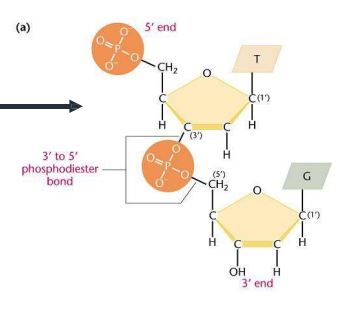
- Between 5 'phosphate group of 1 nucleotide and the 3 OH group' of a second nucleotide
->Each phosphate is connected to 2 sugars
4
DNA is a double-stranded polynucleotide that adopts a helix
- The two strands are
- 5' end of one interacts with 3' of the other
- The two strands are
- 5' end of one interacts with 3' of the other
DNA is a double-stranded polynucleotide that adopts a righthanded helix
- The two strands are antiparallel (opposite directions)
- 5' end of one interacts with 3' of the other
- The two strands are antiparallel (opposite directions)
- 5' end of one interacts with 3' of the other
5
Bases lie in 3-D ( to axis)
Bases lie flat in 3-D (perpendicular to axis)
6
The bases face the inside and form the with the
bases from the opposite strand.
- Hydrogen bonds only form between and
bases from the opposite strand.
- Hydrogen bonds only form between and
The bases face the inside and form the hydrogen bonds with the
bases from the opposite strand.
- Hydrogen bonds only form between A-T (2) and C-G (3)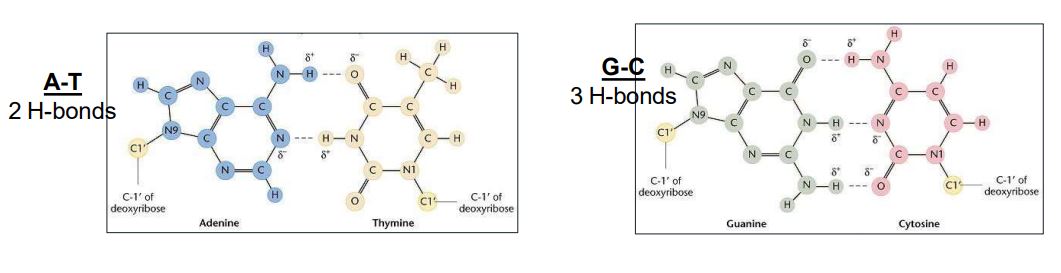
bases from the opposite strand.
- Hydrogen bonds only form between A-T (2) and C-G (3)
7
Most common type of DNA found in most cells is
Most common type of DNA found in most cells is B-DNA
8
**** Test Question
– Observed when water is removed from the DNA
(dehydration/high-salt)
-It is more that B DNA
-It is -handed
-Bases are tilited and grooves are and
– Observed when water is removed from the DNA
(dehydration/high-salt)
-It is more that B DNA
-It is -handed
-Bases are tilited and grooves are and
**** Test Question
A-DNA – Observed when water is removed from the DNA
(dehydration/high-salt)
-It is more compact that B DNA
-It is right-handed
-Bases are tilited upwards and grooves are deeper and narrower
A-DNA – Observed when water is removed from the DNA
(dehydration/high-salt)
-It is more compact that B DNA
-It is right-handed
-Bases are tilited upwards and grooves are deeper and narrower
9
Z-DNA – Observed when DNA is constructed to have mostly
base pairs
- Has a spread-out, shape
- handed helix
- Major groove is present
base pairs
- Has a spread-out, shape
- handed helix
- Major groove is present
Z-DNA – Observed when DNA is constructed to have mostly
C-G base pairs
- Has a spread-out, zig-zag shape
- Left-handed helix
- Major groove is not present
C-G base pairs
- Has a spread-out, zig-zag shape
- Left-handed helix
- Major groove is not present
10
Test Question:
- is found in some bacteria species (Gram ) form
protective when environmental
conditions become too harsh
-It the DNA and protects it from damaging agents (e.g. light)
- is found in some bacteria species (Gram ) form
protective when environmental
conditions become too harsh
-It the DNA and protects it from damaging agents (e.g. light)
Test Question:
-Alpha DNA is found in some bacteria species (Gram positive) form
protective endospores when environmental
conditions become too harsh
-It tightens the DNA and protects it from damaging agents (e.g. UV light)
-Alpha DNA is found in some bacteria species (Gram positive) form
protective endospores when environmental
conditions become too harsh
-It tightens the DNA and protects it from damaging agents (e.g. UV light)
11
Z-DNA and the that bind to them
- Scientists have discovered cellular and viral proteins that have the ability to
bind tightly to (but not or )
- Scientists have discovered cellular and viral proteins that have the ability to
bind tightly to (but not or )
Z-DNA and the proteins that bind to them
- Scientists have discovered cellular and viral proteins that have the ability to
bind tightly to Z DNA (but not A or B DNA)
- Scientists have discovered cellular and viral proteins that have the ability to
bind tightly to Z DNA (but not A or B DNA)
12
: in single strands of nucleotides, when
sequences of nucleotides on the same strand are inverted
complements
sequences of nucleotides on the same strand are inverted
complements
Hairpin structure: in single strands of nucleotides, when
sequences of nucleotides on the same strand are inverted
complements
sequences of nucleotides on the same strand are inverted
complements
13
When the complementary sequences are contiguous,
the hairpin has a stem but
the hairpin has a stem but
When the complementary sequences are contiguous,
the hairpin has a stem but no loop.
the hairpin has a stem but no loop.
14
Where are hairpin structures most commonly found?
RNA
15
• RNA/DNA similarities
- Helical-shaped, polynucleotide chain that is composed of of nucleotides
- Nucleotides are attached via
- Helical-shaped, polynucleotide chain that is composed of of nucleotides
- Nucleotides are attached via
• RNA/DNA similarities
- Helical-shaped, polynucleotide chain that is composed of 4 types of nucleotides
- Nucleotides are attached via phosphodiester bonds
- Helical-shaped, polynucleotide chain that is composed of 4 types of nucleotides
- Nucleotides are attached via phosphodiester bonds
16
RNA is mostly (but can fold back on itself
and form double-stranded regions)
and form double-stranded regions)
RNA is mostly single-stranded (but can fold back on itself
and form double-stranded regions)
and form double-stranded regions)
17
- RNA does not contain the base . Instead, it
contains a different pyrimidine called (A-U hydrogen bond)
contains a different pyrimidine called (A-U hydrogen bond)
- RNA does not contain the base thymine. Instead, it
contains a different pyrimidine called uracil (A-U hydrogen bond)
contains a different pyrimidine called uracil (A-U hydrogen bond)
18
The sugar in the RNA nucleotides is
(not deoxyribose)
(not deoxyribose)
The sugar in the RNA nucleotides is
ribose (not deoxyribose)
ribose (not deoxyribose)
19
Each chromosome is made up of DNA tightly
coiled many times around proteins called
that support its structure
coiled many times around proteins called
that support its structure
Each chromosome is made up of DNA tightly
coiled many times around proteins called
histones that support its structure
coiled many times around proteins called
histones that support its structure
20
DNA -> -> ->
DNA -> nucleosome -> chromatin fiber -> chromosome
21
Histone proteins: Charged proteins that stick to
charged DNA and form
charged DNA and form
Histone proteins: (+) Charged proteins that stick to (-)
charged DNA and form nucleosomes
charged DNA and form nucleosomes
22
: can be transcribed and cleaved
: never gets transcribed or cleaved
: never gets transcribed or cleaved
Euchromatin: can be transcribed and cleaved
Heterochromatin: never gets transcribed or cleaved
Heterochromatin: never gets transcribed or cleaved
23
break the phosphodiester
bond in DNA or RNA
DNase-> cleaves
RNase -> cleave
bond in DNA or RNA
DNase-> cleaves
RNase -> cleave
Nucleases break the phosphodiester
bond in DNA or RNA
DNase-> cleaves dsDNA
RNase -> cleave ssRNA
bond in DNA or RNA
DNase-> cleaves dsDNA
RNase -> cleave ssRNA
24
Chromatin has thought to represent transcription
Chromatin has chromosomal puffs thought to represent transcription
25
sensitivity correlates with gene activity
DNase I sensitivity correlates with gene activity
26
• changes: methylation; capable of being reversed
and often due to environmental factors.
and often due to environmental factors.
• Epigenetic changes: methylation; capable of being reversed
and often due to environmental factors.
and often due to environmental factors.
27
Telomeres protect the ends of the DNA from
degradation via (from-> end).
degradation via (from-> end).
Telomeres protect the ends of the DNA from
degradation via exonucleases (from-> 5’ or 3’ end).
degradation via exonucleases (from-> 5’ or 3’ end).
28
Telomere sequences are rich in and
Telomere sequences are rich in Cs and Gs
29
The single-stranded overhang of telomeres inserts
itself into the double helix and forms a
structure, stabilizing the DNA as
if it had a circular shape.
itself into the double helix and forms a
structure, stabilizing the DNA as
if it had a circular shape.
The G-rich single-stranded overhang of telomeres inserts
itself into the double helix and forms a
triple- helix structure, stabilizing the DNA as
if it had a circular shape.
itself into the double helix and forms a
triple- helix structure, stabilizing the DNA as
if it had a circular shape.
30
** TEST QUESTION
Nucleases are enzymes capable of cleaving the between of nucleic acids
Nucleases are enzymes capable of cleaving the between of nucleic acids
** TEST QUESTION
Nucleases are enzymes capable of cleaving the phosphodiester bonds between nucleotides of nucleic acids
Nucleases are enzymes capable of cleaving the phosphodiester bonds between nucleotides of nucleic acids
31
Nucleases that exhibit specificity for are
referred to as
referred to as
Nucleases that exhibit specificity for DNA are
referred to as deoxyribonucleases.
referred to as deoxyribonucleases.
32
Those nucleases that specifically hydrolyze RNA are
Those nucleases that specifically hydrolyze RNA are
ribonucleases.
ribonucleases.
33
Nucleases that cut at the end of NT chain:
• Nucleases that cut in the middle of NT chain:
• Nucleases that cut in the middle of NT chain:
Nucleases that cut at the end of NT chain: exonuclease
• Nucleases that cut in the middle of NT chain: endonuclease
• Nucleases that cut in the middle of NT chain: endonuclease
34
Nucleases
• Cleave or
• Optimum activity is dependent
• Yield different
• Cleave or
• Optimum activity is dependent
• Yield different
Nucleases
• Cleave specific sequences or templates (DNA vs RNA)
• Optimum activity is pH dependent
• Yield different overhangs
• Cleave specific sequences or templates (DNA vs RNA)
• Optimum activity is pH dependent
• Yield different overhangs
35
Phosphodiester bond is broken by hydrolysis using a nuclease to generate a
and . Corrdinated with , , .
and . Corrdinated with , , .
Phosphodiester bond is broken by hydrolysis using a nuclease to generate a 5’-phosphate
and 3’ OH terminus . Corrdinated with Ca2+, Mg2+, Mn2+.
and 3’ OH terminus . Corrdinated with Ca2+, Mg2+, Mn2+.
36
Enzyme amino acids are usually the
Enzyme amino acids are usually the charged amino acids
37
TEST QUESTION
Topoisomerases are enzymes that participate in
Topoisomerases are enzymes that participate in
TEST QUESTION
Topoisomerases are enzymes that participate in the
overwinding or underwinding of DNA.
Topoisomerases are enzymes that participate in the
overwinding or underwinding of DNA.
38
Topoisomerase I helps with
movement and relaxes associated with
movement and relaxes associated with
Topoisomerase I helps with replication fork
movement and relaxes supercoils associated with transcription
movement and relaxes supercoils associated with transcription
39
Topoisomerase
-They bind to DNA and cut the of either one or both strands
-This intermediate break allows the DNA to be
, and then the DNA backbone is
.
-They bind to DNA and cut the of either one or both strands
-This intermediate break allows the DNA to be
, and then the DNA backbone is
.
Topoisomerase
-They bind to DNA and cut the phosphate
backbone of either one or both strands
-This intermediate break allows the DNA to be
unwound, and then the DNA backbone is
resealed.
-They bind to DNA and cut the phosphate
backbone of either one or both strands
-This intermediate break allows the DNA to be
unwound, and then the DNA backbone is
resealed.
40
TEST QUESTION
are motor proteins that move directionally along a
nucleic acid phosphodiester backbone, separating two by breaking the hydrogen bonds between
complementary bases (use as energy source)
are motor proteins that move directionally along a
nucleic acid phosphodiester backbone, separating two by breaking the hydrogen bonds between
complementary bases (use as energy source)
TEST QUESTION
Helicases are motor proteins that move directionally along a
nucleic acid phosphodiester backbone, separating two annealed
nucleic acid strands by breaking the hydrogen bonds between
complementary bases (use ATP hydrolysis as energy source)
Helicases are motor proteins that move directionally along a
nucleic acid phosphodiester backbone, separating two annealed
nucleic acid strands by breaking the hydrogen bonds between
complementary bases (use ATP hydrolysis as energy source)
41
TEST QUESTION
( '- ') belong to the group of
helicases, which help to maintain of the genome and
suppress inappropriate recombination
( '- ') belong to the group of
helicases, which help to maintain of the genome and
suppress inappropriate recombination
TEST QUESTION
RecQ helicases (3'-5') belong to the Superfamily 2 group of
helicases, which help to maintain stability of the genome and
suppress inappropriate recombination
RecQ helicases (3'-5') belong to the Superfamily 2 group of
helicases, which help to maintain stability of the genome and
suppress inappropriate recombination
42
Clinical Correlation: X-linked-alpha-thalassaemia-mental retardation
• (AKA XH2 and XNP) of the , is involved in
chromatin remodeling, gene regulation, and DNA methylation
• (AKA XH2 and XNP) of the , is involved in
chromatin remodeling, gene regulation, and DNA methylation
Clinical Correlation: X-linked-alpha-thalassaemia-mental retardation
• ATRX (AKA XH2 and XNP) of the Superfamily 2 subgroup (SF2), is involved in
chromatin remodeling, gene regulation, and DNA methylation
• ATRX (AKA XH2 and XNP) of the Superfamily 2 subgroup (SF2), is involved in
chromatin remodeling, gene regulation, and DNA methylation
43
•Structure of the bacterial chromosome
- Single, chromosome
- Adopts a state (which makes it more compact)
- Single, chromosome
- Adopts a state (which makes it more compact)
•Structure of the bacterial chromosome
- Single, circular chromosome
- Adopts a supercoiled state (which makes it more compact)
- Single, circular chromosome
- Adopts a supercoiled state (which makes it more compact)
44
Bacterial DNA replication (also called replication)
Bacterial DNA replication (also called Theta replication)
45
Initiation Steps of Prokaryotic DNA Replication
1. Bacteria have origin of replication
2. A complex of proteins bind to the chromosome at origin of replication
and causes a ” to be introduced
1. Bacteria have origin of replication
2. A complex of proteins bind to the chromosome at origin of replication
and causes a ” to be introduced
Initiation Steps of Prokaryotic DNA Replication
1. Bacteria have single origin of replication
2. A complex of DnaA proteins bind to the chromosome at origin of replication
and causes a slight “bend” to be introduced
1. Bacteria have single origin of replication
2. A complex of DnaA proteins bind to the chromosome at origin of replication
and causes a slight “bend” to be introduced
46
Unwinding Steps of DNA replication
1. Bending of the DNA creates tension and causes a small
to form -> small region of strand separation
2. The serves as a binding site for 2 other proteins
called and
3. Proteins called
bind to the individual strands and keep them apart.
4. Unwinding the strands at oriC produces
supercoiling ahead of the replication fork
1. Bending of the DNA creates tension and causes a small
to form -> small region of strand separation
2. The serves as a binding site for 2 other proteins
called and
3. Proteins called
bind to the individual strands and keep them apart.
4. Unwinding the strands at oriC produces
supercoiling ahead of the replication fork
Unwinding Steps of DNA replication
1. Bending of the DNA creates tension and causes a small
replication “bubble” to form -> small region of strand separation
2. The bubble serves as a binding site for 2 other proteins
called DnaB and DnaC
3. Proteins called single-strand-binding proteins (SSB proteins)
bind to the individual strands and keep them apart.
4. Unwinding the strands at oriC produces tighter
supercoiling ahead of the replication fork
1. Bending of the DNA creates tension and causes a small
replication “bubble” to form -> small region of strand separation
2. The bubble serves as a binding site for 2 other proteins
called DnaB and DnaC
3. Proteins called single-strand-binding proteins (SSB proteins)
bind to the individual strands and keep them apart.
4. Unwinding the strands at oriC produces tighter
supercoiling ahead of the replication fork
47
How is tension at the replication fork relived?
Enzyme called binds ahead of the fork and makes small cuts in strands
Enzyme called binds ahead of the fork and makes small cuts in strands
How is tension at the replication fork relived?
Enzyme called DNA gyrase binds ahead of the fork and makes small cuts in strands
Enzyme called DNA gyrase binds ahead of the fork and makes small cuts in strands
48
Primer Synthesis Steps of Prokaryotic DNA replication
1. Nucelotides can only be added to group
2. Once strands are separated, enzyme called makes short RNA chains ( to the template)
3. can then come in and create a
new strand by extending from the primer (called
elongation)
1. Nucelotides can only be added to group
2. Once strands are separated, enzyme called makes short RNA chains ( to the template)
3. can then come in and create a
new strand by extending from the primer (called
elongation)
Primer Synthesis Steps of Prokaryotic DNA replication
1. Nucelotides can only be added to 3' OH group
2. Once strands are separated, enzyme called primase makes short RNA chains (complimentary to the template)
3. DNA polymerase III can then come in and create a
new strand by extending from the primer (called
elongation)
1. Nucelotides can only be added to 3' OH group
2. Once strands are separated, enzyme called primase makes short RNA chains (complimentary to the template)
3. DNA polymerase III can then come in and create a
new strand by extending from the primer (called
elongation)
49
TEST QUESTION Elongation Steps of Prokaryotic DNA Division
1. can only add nucelotides to end and makes DNA in the direction
2. IMPORTANTLY, had endonuclease activity which gives it the ability to
1. can only add nucelotides to end and makes DNA in the direction
2. IMPORTANTLY, had endonuclease activity which gives it the ability to
TEST QUESTION Elongation Steps of Prokaryotic DNA Division
1. DNA polymerase III can only add nucelotides to 3' end and makes DNA in the 5' to 3' direction
2. IMPORTANTLY, DNA polymerase III had 3' to 5' endonuclease activity which gives it the ability to PROOFREAD
1. DNA polymerase III can only add nucelotides to 3' end and makes DNA in the 5' to 3' direction
2. IMPORTANTLY, DNA polymerase III had 3' to 5' endonuclease activity which gives it the ability to PROOFREAD
50
TEST QUESTION
– Sliding clamp ( charged) structure that locks the whole
complex onto the strands
-> Prevents the above core enzyme from
-> Increases the of the -subunit
– Sliding clamp ( charged) structure that locks the whole
complex onto the strands
-> Prevents the above core enzyme from
-> Increases the of the -subunit
TEST QUESTION
β clamp – Sliding clamp (++++ charged) structure that locks the whole
complex onto the ssDNA strands
-> Prevents the above core enzyme from falling off
-> Increases the processivity of the alpha-subunit
β clamp – Sliding clamp (++++ charged) structure that locks the whole
complex onto the ssDNA strands
-> Prevents the above core enzyme from falling off
-> Increases the processivity of the alpha-subunit
51
One strand is being made continuously as DNA pol III moves
towards the replication fork (this is called the
towards the replication fork (this is called the
One strand is being made continuously as DNA pol III moves
towards the replication fork (this is called the LEADING STRAND)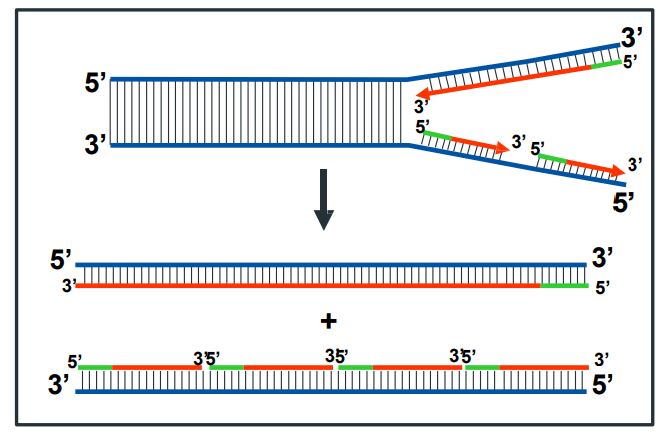
towards the replication fork (this is called the LEADING STRAND)
52
The other strand is made discontinuously (moving away from the replication
fork) and is initially composed of
small fragments called (this is called the
)
fork) and is initially composed of
small fragments called (this is called the
)
The other strand is made discontinuously (moving away from the replication
fork) and is initially composed of
small fragments called Okazaki
fragments (this is called the
LAGGING STRAND)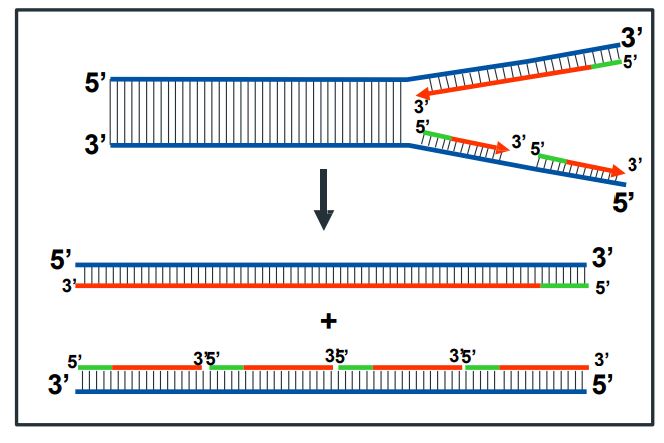
fork) and is initially composed of
small fragments called Okazaki
fragments (this is called the
LAGGING STRAND)
53
Another type of DNA polymerase (DNA ) comes in and removes the from both the leading and lagging strands (it has exonuclease activity) and fills in the gaps with (it also has polymerization ability)
Another type of DNA polymerase (DNA polymerase I) comes in and removes the RNA primers from both the leading and lagging strands (it has 5’-> 3’ exonuclease activity) and fills in the gaps with DNA (it also has 5’-> 3’ polymerization ability)
54
uses the end of each Okazaki fragment as a starting point
DNA polymerase I uses the end of each Okazaki fragment as a starting point
55
The enzyme then seals the
spaces between each Okazaki fragment
on the lagging strand
spaces between each Okazaki fragment
on the lagging strand
The enzyme DNA ligase then seals the
spaces between each Okazaki fragment
on the lagging strand
spaces between each Okazaki fragment
on the lagging strand
56
Test Question
Bacteria: , chromosome (Avg size: 4.6 x 10⁶ base pairs)
Humans: , chromosomes (Total size: 3.3 x 10⁹ base pairs)
Bacteria: , chromosome (Avg size: 4.6 x 10⁶ base pairs)
Humans: , chromosomes (Total size: 3.3 x 10⁹ base pairs)
Test Question
Bacteria: Single, circular chromosome (Avg size: 4.6 x 10⁶ base pairs)
Humans: Multiple, linear chromosomes (Total size: 3.3 x 10⁹ base pairs)
Bacteria: Single, circular chromosome (Avg size: 4.6 x 10⁶ base pairs)
Humans: Multiple, linear chromosomes (Total size: 3.3 x 10⁹ base pairs)
57
TEST QUESTION
Eukaryotic chromosomes have of replication
a. origins must be approved for replication by
Eukaryotic chromosomes have of replication
a. origins must be approved for replication by
TEST QUESTION
Eukaryotic chromosomes have multiple origins of replication
a. origins must be approved for replication by
origin recognition complexes (ORCs)
Eukaryotic chromosomes have multiple origins of replication
a. origins must be approved for replication by
origin recognition complexes (ORCs)
58
TEST QUESTION
Unreplicated DNA is coated with (which are )
- No proteins, no
Unreplicated DNA is coated with (which are )
- No proteins, no
TEST QUESTION
Unreplicated DNA is coated with MCM proteins (which are helicases)
- No MCM proteins, no replication
Unreplicated DNA is coated with MCM proteins (which are helicases)
- No MCM proteins, no replication
59
Eukaryotes have DNA polymerases that prokaryotes
Eukaryotes have more DNA polymerases that prokaryotes
60
Once removes the
primer at the absolute end of the
chromosome on the lagging strand, there is
ahead of it
- In theory, our chromosomes should
shorten each time they are replicated, which would lead to loss of gene and death (we need !)
primer at the absolute end of the
chromosome on the lagging strand, there is
ahead of it
- In theory, our chromosomes should
shorten each time they are replicated, which would lead to loss of gene and death (we need !)
Once DNA pol I removes the
primer at the absolute end of the
chromosome on the lagging strand, there is
no free 3’ end ahead of it
- In theory, our chromosomes should
shorten each time they are replicated, which would lead to loss of gene and death (we need telomeres!)
primer at the absolute end of the
chromosome on the lagging strand, there is
no free 3’ end ahead of it
- In theory, our chromosomes should
shorten each time they are replicated, which would lead to loss of gene and death (we need telomeres!)
61
-An enzyme called is activated and adds >1,000 copies of a
repeated sequence (e.g. ) onto the ends of each chromosome
- It is only active in gametes, embryos, and stem cells
-It has an in a pocket that binds to the
chromosome end
repeated sequence (e.g. ) onto the ends of each chromosome
- It is only active in gametes, embryos, and stem cells
-It has an in a pocket that binds to the
chromosome end
-An enzyme called telomerase is activated and adds >1,000 copies of a
repeated sequence (e.g. TTAGGG) onto the ends of each chromosome
- It is only active in gametes, embryos, and stem cells
-It has an RNA template in a pocket that binds to the
chromosome end
repeated sequence (e.g. TTAGGG) onto the ends of each chromosome
- It is only active in gametes, embryos, and stem cells
-It has an RNA template in a pocket that binds to the
chromosome end
62
Mitochondria are passed from to
Mitochondria are passed from mother to child
63
Mitochondrial have 2 origins of replication: and . The functions to replicate .
Mitochondrial have 2 origins of replication: OH and OL. The Poly Y functions to replicate mitochondrial DNA.
64
How do 2'deoxycytidine and cytarabine stop DNA replication?
Look similar to nucleotides and compete (decoy)
65
How do guanosine and acyclovir inhibit DNA replication?
Nucleoside analogs that look like nucelotides but don't have a 3' OH. They get incorporated and then you cannot add anything.
66
How does Foscarnet inhibit DNA replication?
Drugs compete with DNA poly for their binding site