Chapter 20
Study these flashcardsFree · spaced repetition · iPhone, Android, Mac & web
All cards
1
Essential fatty acids must come from the
Essential fatty acids must come from the diet
2
Anything beyond carbon cannot be saturated by the human body
Anything beyond carbon 9-10 cannot be saturated by the human body
3
Energy yield of carbohydrate?
Around 4 kcal / gm
4
Every yield of protein
Around 4 kcal / gm
5
Energy yeild for fat
Around 9 kcal m
6
When blood glucose levels are high,
of pancreas triggers the secretion of
.
of pancreas triggers the secretion of
.
When blood glucose levels are high, B-cells
of pancreas triggers the secretion of
insulin.
of pancreas triggers the secretion of
insulin.
7
Insulin stimulates
Insulin stimulates fatty
acid synthesis.
acid synthesis.
8
Fatty acid synthesis occurs in the
Fatty acid synthesis occurs in the
cytosol
cytosol
9
Two key compounds that are
required for fatty acid synthesis
are: and
required for fatty acid synthesis
are: and
Two key compounds that are
required for fatty acid synthesis
are: Acetyl CoA (substrate) and NADPH (reductant)
required for fatty acid synthesis
are: Acetyl CoA (substrate) and NADPH (reductant)
10
Acetyl CoA is produced in the
by the
.
by the
.
Acetyl CoA is produced in the
mitochondrial matrix by the
pyruvate dehydrogenase complex.
mitochondrial matrix by the
pyruvate dehydrogenase complex.
11
Fatty acid synthesis occurs in the
Fatty acid synthesis occurs in the
cytosol.
cytosol.
12
No Direct Transporter
Available for
Available for
No Direct Transporter
Available for OAA
Available for OAA
13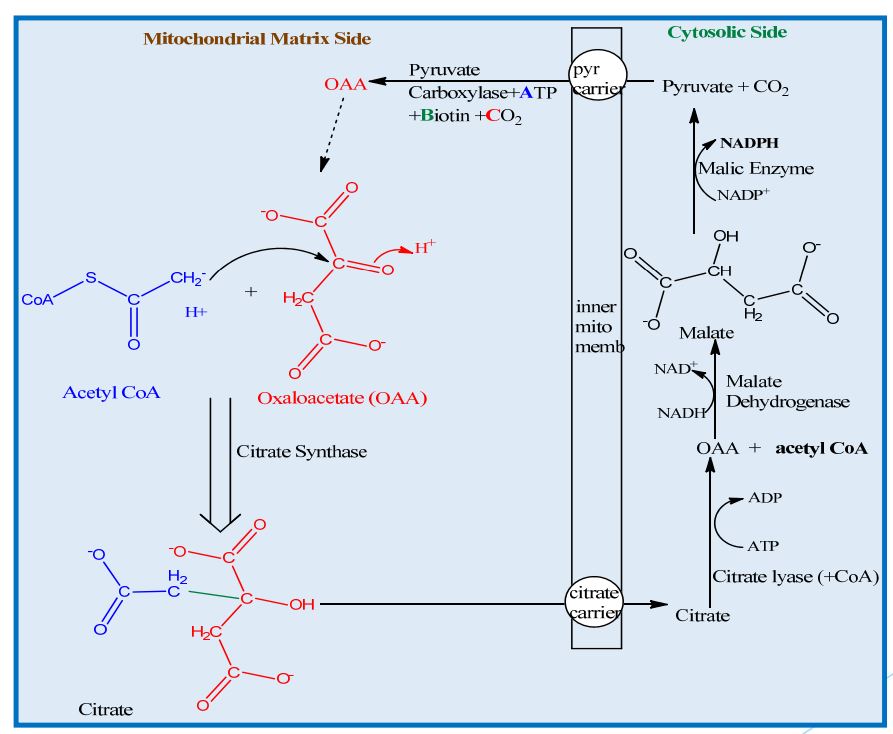
Draw out schematic for how acetyl CoA made available in the cytosol
14
What are the compounds that are made available in the cytosol?
1. Acetyl CoA
2. NADPH
2. NADPH
15
Acetyl CoA is converted into by .
Acetyl CoA is converted into malonyl CoA by acetyl CoA carboxylase (ACC).
16
Acetyl CoA carboxylase has a covalently bound (a vitamin derivative) that serves as a .
Acetyl CoA carboxylase has a covalently bound biotin (a vitamin B7 derivative) that serves as a coenzyme.
17
Using , and , malonyl CoA is synthesized in steps
Using HCO3-, ATP and Acetyl CoA, malonyl CoA is synthesized in two steps
18
What are the two steps of malonyl CoA synthesis? What is the product?
1. Carboxylation of biotin
HCO3- + ATP + Biotin -> Carboxy Biotin
2. Carboxylation of acetyl CoA
Carboxy biotin + Acetyl CoA -> Malonyl CoA + biotin
HCO3- + ATP + Biotin -> Carboxy Biotin
2. Carboxylation of acetyl CoA
Carboxy biotin + Acetyl CoA -> Malonyl CoA + biotin
19
Consumption of raw egg is not recommended, since raw egg contains a protein called , which can tie up the .
Consumption of raw egg is not recommended, since raw egg contains a protein called avidin, which can tie up the biotin.
20
is a committed metabolite that enters only fatty acid synthesis
Malonyl CoA is a committed metabolite that enters only fatty acid synthesis
21
Fatty acid synthase is a multifunctional enzyme (contains catalytic activities).
Fatty acid synthase is a multifunctional enzyme (contains 7 catalytic activities).
22
Using malonyl CoA and acetyl CoA a is synthesized.
Using 7 malonyl CoA and 1 acetyl CoA a C-16 palmitic acid is synthesized.
23
Why are fats higher in energy?
They are more reduced
24
What is AT (enzyme domian)?
Acetyl transferase
25
What is MT (enzyme domain)?
Malonyl transferase
26
What is CE? (enzyme domain)
Condensing enzyme CE
27
What is KR?(enzyme domain) What does it require?
b-Ketoacyl reductase. Uses NADPH.
28
What is DH? (enzyme domain) What does it do?
Dehydrogenase (removes H2O)
29
What is ER? (enzyme domain) What does it use?
Enoyl Reductase
(ER) (uses
NADPH)
(ER) (uses
NADPH)
30
What is TE? What does it do?
-Thioesterase
-Releases palmitate from palmitoyl –ACP
-Releases palmitate from palmitoyl –ACP
31
What is a special enzyme in cytosolic acetyl coA synthesis? Why
-Malic enzyme does decarboxylation and produces NADPH (this enzyme is induced during fatty acid synthesis)
-Only Glucose 6 phosphate dehydrogenase and Malic enzyme produce NADPH
-Only Glucose 6 phosphate dehydrogenase and Malic enzyme produce NADPH
32
What are the steps of the fatty acid synthase complex?
1. CONDENSATION - Malonyl group with ACP attacks acetyl group with CE, producing CO2, free CE, and acteoacetyl-ACP
2. FIRST ROUND (Butyryl-ACP formation) - Acetyl-ACP undergoes a reductive cycle and produces Butyryl-ACP
3. SECOND ROUND (C-6 formation) - An acetyl transferace and a malonyl CoA leads to the production of b-keto-hexanoic ACP that undergoes a reductive cycle to make C6 reduced
2. FIRST ROUND (Butyryl-ACP formation) - Acetyl-ACP undergoes a reductive cycle and produces Butyryl-ACP
3. SECOND ROUND (C-6 formation) - An acetyl transferace and a malonyl CoA leads to the production of b-keto-hexanoic ACP that undergoes a reductive cycle to make C6 reduced
33
What are the reactants of palmitic acid synthesis?
Acetyl CoA + 7 Malonyl CoA + 14 NADPH + 14 H+
34
The fatty acid synthase works as a
The fatty acid synthase works as a dimer
35
What are the products of palmitic acid synthesis?
Palmitate + 7 CO2 + 14 NADP+ + 8 CoASH + 6 H2O
36
Phosphopantetheine (a
derivative of the ) is the
that
anchors the growing
during
synthesis.
derivative of the ) is the
that
anchors the growing
during
synthesis.
Phosphopantetheine (a
derivative of the vitamin
pantothenate) is the
prosthetic group that
anchors the growing
fatty acyl chain during
synthesis.
derivative of the vitamin
pantothenate) is the
prosthetic group that
anchors the growing
fatty acyl chain during
synthesis.
37
5’-Phosphopantetheine is
covalently attached to
covalently attached to
5’-Phosphopantetheine is
covalently attached to
ACP protein.
covalently attached to
ACP protein.
38
Thioesterase I domain of fatty acid synthase
cleaves off the final product , from
the .
cleaves off the final product , from
the .
Thioesterase I domain of fatty acid synthase
cleaves off the final product palmitate, from
the fatty acid synthase enzyme complex.
cleaves off the final product palmitate, from
the fatty acid synthase enzyme complex.
39
In mammals during lactation, mammary
glands express
glands express
In mammals during lactation, mammary
glands express Thioesterase II.
glands express Thioesterase II.
40
Thioesterase II an independent protein
which interacts with the and causes the
premature release of .
which interacts with the and causes the
premature release of .
Thioesterase II an independent protein
which interacts with the fatty acid
synthase complex and causes the
premature release of short chain fatty
acids.
which interacts with the fatty acid
synthase complex and causes the
premature release of short chain fatty
acids.
41
Humans do not have
enzymes that can
introduce double
bonds beyond
enzymes that can
introduce double
bonds beyond
Humans do not have
enzymes that can
introduce cis double
bonds beyond carbon 9
to 10.
enzymes that can
introduce cis double
bonds beyond carbon 9
to 10.
42
and
are therefore essential
fatty acid that must be
supplied in the diet.
are therefore essential
fatty acid that must be
supplied in the diet.
Linoleic 18:2 (9,12) and
linolenic 18:3 (9, 12,15)
are therefore essential
fatty acid that must be
supplied in the diet.
linolenic 18:3 (9, 12,15)
are therefore essential
fatty acid that must be
supplied in the diet.
43
the
end product of fatty
acid synthase can be
elongated and/or
desaturated by separate
enzymes.
end product of fatty
acid synthase can be
elongated and/or
desaturated by separate
enzymes.
Palmitate (16:0) the
end product of fatty
acid synthase can be
elongated and/or
desaturated by separate
enzymes.
end product of fatty
acid synthase can be
elongated and/or
desaturated by separate
enzymes.
44
Palmitoleic acid is C-16,
with one double bond
between and
.
with one double bond
between and
.
Palmitoleic acid is C-16,
with one double bond
between carbon 9 and
10.
with one double bond
between carbon 9 and
10.
45
Oleic acid is C-18, with
one double bond
between and
.
one double bond
between and
.
Oleic acid is C-18, with
one double bond
between carbon 9 and
10.
one double bond
between carbon 9 and
10.
46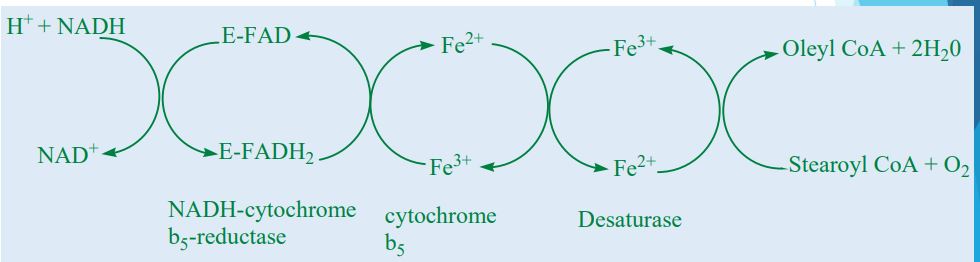
Draw the schematic for the elongation and desaturation of palmitate
47
, , and
are short chain fatty acids that easy to digest (compared to palmitate) by
the .
are short chain fatty acids that easy to digest (compared to palmitate) by
the .
capric (C10), lauric (C-12), and myristic (C14)
are short chain fatty acids that easy to digest (compared to palmitate) by
the suckling infants.
are short chain fatty acids that easy to digest (compared to palmitate) by
the suckling infants.
48
are the
synthesized form of fatty acids in adipose
tissue.
synthesized form of fatty acids in adipose
tissue.
Triglycerides (triacylglycerol) are the
synthesized form of fatty acids in adipose
tissue.
synthesized form of fatty acids in adipose
tissue.
49
Triglycerides are stored in
Triglycerides are stored in adipose
tissues
tissues
50
During energy requirements the stored
triglycerides from adipose tissues are
into and
.
triglycerides from adipose tissues are
into and
.
During energy requirements the stored
triglycerides from adipose tissues are
hydrolyzed into free fatty acids and
glycerol.
triglycerides from adipose tissues are
hydrolyzed into free fatty acids and
glycerol.
51
Free fatty acids are for e.g. thru
(b-oxidation) to produce , and
(b-oxidation) to produce , and
Free fatty acids are oxidized for e.g. thru
(b-oxidation) to produce NADH, FADH2 and
acetyl CoA
(b-oxidation) to produce NADH, FADH2 and
acetyl CoA
52
Through diet you can get . Dietary fat is taken in through the and packaged to form that enter the through the portal vein. They are converted into in liver and release that are then stored in adipose. The release of these triglycerides is triggered by . The fatty acid binds and fatty acid gets sent to liver for .
Through diet you can get fatty acids. Dietary fat is taken in through the intestine and packaged to form Chylomicrons that enter the liver through the portal vein. They are converted into VLDL in liver and release triglycerides that are then stored in adipose. The release of these triglycerides is triggered by hormone sensitive lipase. The fatty acid binds albumin and fatty acid gets sent to liver for B oxidation.
53
Glycerol can be by placing of acyl coA using acetyl coa transferase to make fatty acids from .
Glycerol can be esterified by placing 3 moles of acyl coA using acetyl coa transferase to make fatty acids from glycerol 3-P.