Lecture 1 +2
Study these flashcardsFree · spaced repetition · iPhone, Android, Mac & web
All cards
1
Diseases like cholera and malaria were thought to be caused by “ ” or
Diseases like cholera and malaria were thought to be caused by “bad
air” or miasma
air” or miasma
2
Louis Pasteur (1862)
• Proposed that were responsible for diseases
(…but he had no direct evidence at the time)
• Theory based upon observations he made while
fermenting wine:
o Bacteria + fungal yeasts leads
o Bacteria is always in
o Removal of the yeast leads to no fermentation
• He concluded if these microbes can spoil wine, they
likely can also cause
• Proposed that were responsible for diseases
(…but he had no direct evidence at the time)
• Theory based upon observations he made while
fermenting wine:
o Bacteria + fungal yeasts leads
o Bacteria is always in
o Removal of the yeast leads to no fermentation
• He concluded if these microbes can spoil wine, they
likely can also cause
Louis Pasteur (1862)
• Proposed that microbes were responsible for diseases
(…but he had no direct evidence at the time)
• Theory based upon observations he made while
fermenting wine:
o Bacteria + fungal yeasts leads soured wines
o Bacteria is always in soured wines
o Removal of the yeast leads to no fermentation
• He concluded if these microbes can spoil wine, they
likely can also cause disease
• Proposed that microbes were responsible for diseases
(…but he had no direct evidence at the time)
• Theory based upon observations he made while
fermenting wine:
o Bacteria + fungal yeasts leads soured wines
o Bacteria is always in soured wines
o Removal of the yeast leads to no fermentation
• He concluded if these microbes can spoil wine, they
likely can also cause disease
3
Robert Koch (1881)
• Developed (gelatin in a glass Petri dish) to
grow bacterial cultures
• Developed (gelatin in a glass Petri dish) to
grow bacterial cultures
Robert Koch (1881)
• Developed solid growth medias (gelatin in a glass Petri dish) to
grow bacterial cultures
• Developed solid growth medias (gelatin in a glass Petri dish) to
grow bacterial cultures
4
Koch demonstrated that demonstrated that a specific disease was caused by a
Koch demonstrated that demonstrated that a specific disease was caused by a microbe
5
Koch's procedures linked spore in soil to in cows + human disease. He also dicovered
Koch's procedures linked anthrax spore in soil to anthrax in cows + human disease. He also dicovered TB.
6
Koch's postulates
(1) The microorganism must be found in diseased but not
(2) The microorganism must be from the
(3) Inoculation of a healthy individual with the cultured microorganism must the disease
(4) The microorganism must be from the , diseased individual and matched to the .
(1) The microorganism must be found in diseased but not
(2) The microorganism must be from the
(3) Inoculation of a healthy individual with the cultured microorganism must the disease
(4) The microorganism must be from the , diseased individual and matched to the .
Koch's postulates
(1) The microorganism must be found in diseased but not healthy individuals
(2) The microorganism must be cultured from the diseased individual
(3) Inoculation of a healthy individual with the cultured microorganism must recapitulated the disease
(4) The microorganism must be re-isolated from the inoculated, diseased individual and matched to the original microorganism.
(1) The microorganism must be found in diseased but not healthy individuals
(2) The microorganism must be cultured from the diseased individual
(3) Inoculation of a healthy individual with the cultured microorganism must recapitulated the disease
(4) The microorganism must be re-isolated from the inoculated, diseased individual and matched to the original microorganism.
7
Bacteria are classified as prokaryotes. They have no . Nucelic acid intemingles with . Lacks with membrane bound compartments.
Bacteria are classified as prokaryotes. They have no nucleus. Nucelic acid intemingles with cytoplasms. Lacks organelles with membrane bound compartments.
8
Names are bionomial. is capitlized and in lowercase. You can abbreviate but not . Both are
Names are bionomial. Genus is capitlized and species in lowercase. You can abbreviate genus but not species. Both are italizaed.
9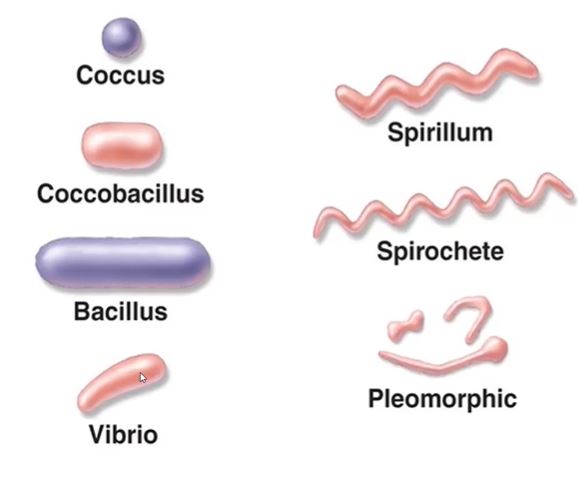
Classify shapes 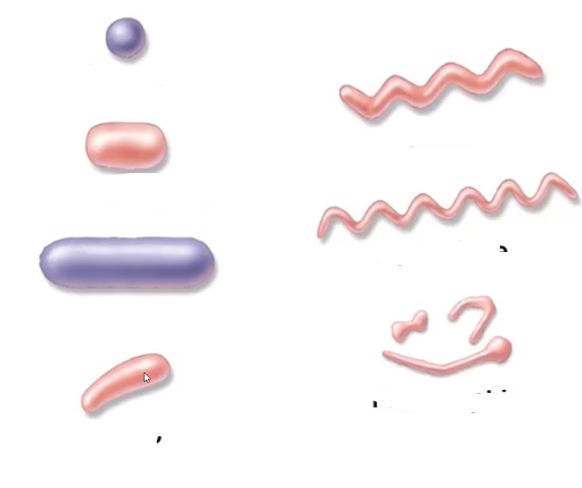
10
Spirochetes are different than spirllium because they have an . Sprillum will and will not.
Spirochetes are different than spirllium because they have an internal flagella. Sprillum will gram stain and sphirochetes will not.
11
Chains of coccus =
Chains of coccus = steptococcus
12
Clusters of coccus =
Clusters of coccus = staphylococcus
13
Diplococcus =
Diplococcus = 2 coccus
14
Tetrad =
Tetrad = 4 coccus
15
Sarcina=
Sarcina= 2 tetrads stacked
16
Most medically important bacteria tend to
express in the cell wall
express in the cell wall
Most medically important bacteria tend to
express peptidoglycan in the cell wall
express peptidoglycan in the cell wall
17
Gram = thick PTG, gram = thin PTG
Gram positive = thick PTG, gram negative = thin PTG
18
Antibotics are more effective against gram than gram
Antibotics are more effective against gram positive than gram negative
19
Peptidoglycan is a disaccharide of and
Peptidoglycan is a disaccharide of NAG and NAM
20
captures NAM in the cytoplasmic membrane
Bactoprenol captures NAM in the cytoplasmic membrane
21
moves NAG and NAM disaccharides from the inner membrane to the outer membrane.
Flipase moves NAG and NAM disaccharides from the inner membrane to the outer membrane.
22
combines NAG and NAM units
Transglycosylation combines NAG and NAM units
23
combines the connected NAG and NAM units to form an even larger structure
Transpeptidation combines the connected NAG and NAM units to form an even larger structure
24
TQ
Transpeptidase is also known as because penicillin prevents the cross-brides from binding
Transpeptidase is also known as because penicillin prevents the cross-brides from binding
TQ
Transpeptidase is also known as penicillin binding protein because penicillin prevents the cross-brides from binding
Transpeptidase is also known as penicillin binding protein because penicillin prevents the cross-brides from binding
25
bacteria are a variation from Gram-positive
and -negative bacteria
and -negative bacteria
Acid-fast bacteria are a variation from Gram-positive
and -negative bacteria
and -negative bacteria
26
Acid-fast bacteria contain a waxy material in the cell
wall ( acid). It prevents staining.
wall ( acid). It prevents staining.
Acid-fast bacteria contain a waxy material in the cell
wall (mycolic acid). It prevents Gram staining.
wall (mycolic acid). It prevents Gram staining.
27
2 examples of acid fast are expressed by and
2 examples of acid fast are expressed by Mycobacterium and Nocardia
28
Acid-fast cells take up an initial stain ( ) while other bacteria decolorize upon alcohol
treatment and then counterstain with methylene blue. They are . (color)
treatment and then counterstain with methylene blue. They are . (color)
Acid-fast cells take up an initial stain (carbol
fuchsin) while other bacteria decolorize upon alcohol
treatment and then counterstain with methylene blue. They are bright pink. (color)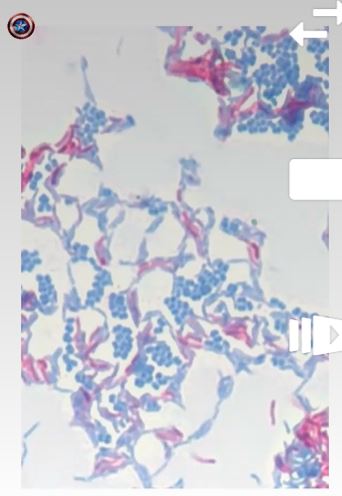
fuchsin) while other bacteria decolorize upon alcohol
treatment and then counterstain with methylene blue. They are bright pink. (color)
29
Smallest known bacteria and agent of atypical
pneumonia is
• does not express a cell wall
pneumonia is
• does not express a cell wall
Smallest known bacteria and agent of atypical
pneumonia is Mycoplasma
• Mycoplasma does not express a cell wall
pneumonia is Mycoplasma
• Mycoplasma does not express a cell wall
30
The tetracyclines (tetracycline, doxycycline, demeclocycline, minocycline, etc.) block bacterial
translation by binding reversibly to the rRNA in the
subunit and distorting it in such a way that the
anticodons of the charged tRNAs cannot align properly
with the codons of the mRNA.
translation by binding reversibly to the rRNA in the
subunit and distorting it in such a way that the
anticodons of the charged tRNAs cannot align properly
with the codons of the mRNA.
The tetracyclines (tetracycline, doxycycline, demeclocycline, minocycline, etc.) block bacterial
translation by binding reversibly to the 16S rRNA in the
30S subunit and distorting it in such a way that the
anticodons of the charged tRNAs cannot align properly
with the codons of the mRNA.
translation by binding reversibly to the 16S rRNA in the
30S subunit and distorting it in such a way that the
anticodons of the charged tRNAs cannot align properly
with the codons of the mRNA.
31
Eukaryotes are ( and )
Eukaryotes are 80s (60s and 40s)
32
Prokaryotes are ( and )
Prokaryotes are 70s (50s and 30s)
33
Flagella is made of
Flagella is made of flagellin
34
One flagella on one end =
Many flagella all spread put =
Many flagella all on one end =
Many flagella all spread put =
Many flagella all on one end =
One flagella on one end = montrichous
Many flagella all spread put = peritchous
Many flagella all on one end = lophotrichous
Many flagella all spread put = peritchous
Many flagella all on one end = lophotrichous
35
Prokaryotes have and
Prokaryotes have P-Pili and F-pili
36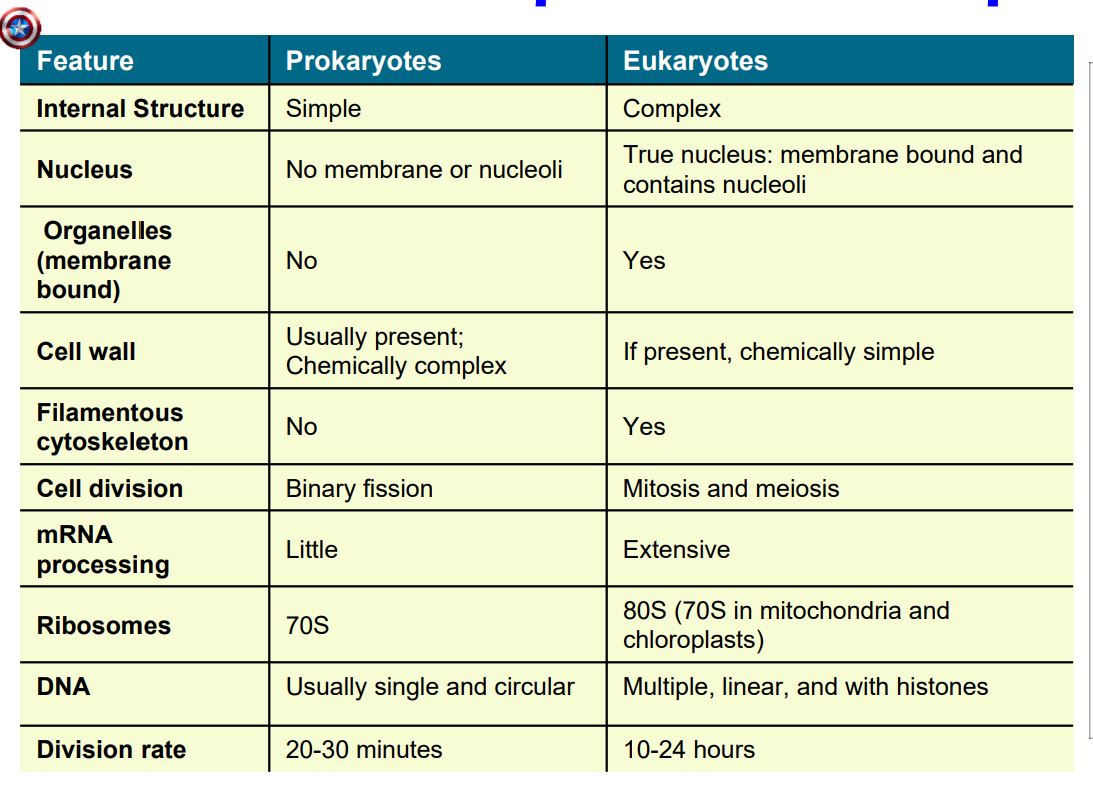
Look at the chart 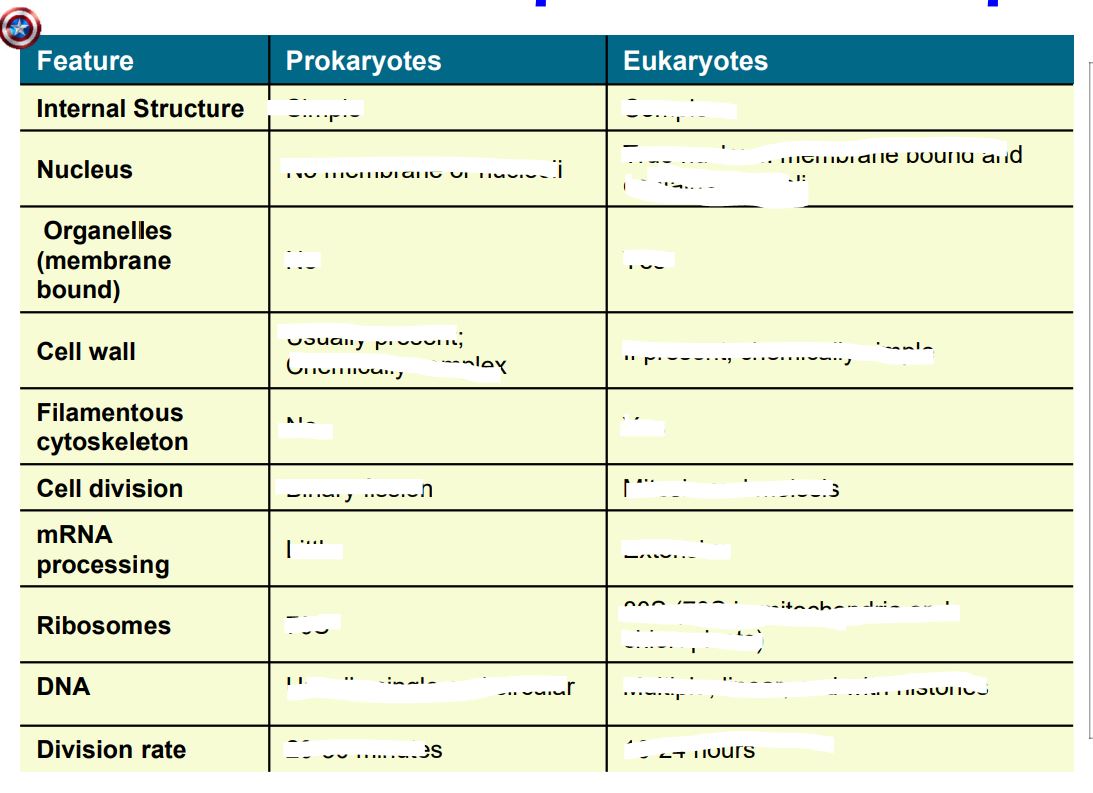
37
viruses stay on surfaces for longer. Causes infection.
Non-enveloped viruses stay on surfaces for longer. Causes GI infection.
38
Viruses are (unstable outside of host cells)
Viruses are intracellular parasites (unstable outside of host cells)
39
Viruses cannot proteins without host proteins and enzymes
Viruses cannot synthesize proteins without host proteins and enzymes
40
Genome of virus can be or (single- or double-stranded).
Genome of virus can be DNA or RNA (single- or double-stranded).
41
Some viruses have envelopes surrounding the structural proteins ( ) and others do
not ( )
not ( )
Some viruses have envelopes surrounding the structural proteins (capsids) and others do
not (nonenveloped or naked)
not (nonenveloped or naked)
42
Enveloped viruses are suspectible to
Enveloped viruses are suspectible to GI acid change
43
Virus has a narrow range of host
specificity probably because access of the virus to
the host cell is receptor-mediated (viruses
express , to
bind to host receptors for colonization and
infection)
specificity probably because access of the virus to
the host cell is receptor-mediated (viruses
express , to
bind to host receptors for colonization and
infection)
Virus has a narrow range of host
specificity probably because access of the virus to
the host cell is receptor-mediated (viruses
express viral attachment proteins, VAP, to
bind to host receptors for colonization and
infection)
specificity probably because access of the virus to
the host cell is receptor-mediated (viruses
express viral attachment proteins, VAP, to
bind to host receptors for colonization and
infection)
44
About of hospital-acquired infections are of fungal
origin
origin
About 40% of hospital-acquired infections are of fungal
origin
origin
45
Fungi are eukaryotes but not
Fungi are eukaryotes but not photosynthetic
46
Fungi are … (external digestion)
Fungi are chemotrophic…saprophytes (external digestion)
47
Fungi 2 Morphologies
Two morphologies:
- and ( cells)
- ( cells)
Two morphologies:
- and ( cells)
- ( cells)
Fungi 2 Morphologies
Two morphologies:
-Mold and Hyphae (filamentous cells)
-Yeast (ovoid cells)
Two morphologies:
-Mold and Hyphae (filamentous cells)
-Yeast (ovoid cells)
48
Fungual isease due to and destruction (few
toxins) as well as damage from the inflammatory immune
response
toxins) as well as damage from the inflammatory immune
response
Fungual isease due to colonization/invasion and destruction (few
toxins) as well as damage from the inflammatory immune
response
toxins) as well as damage from the inflammatory immune
response
49
Fungi cell walls are composed of 3 things
1. 2. 3.
1. 2. 3.
Fungi cell walls are composed of 3 things
1. Chitin 2. Mannans 3. Glucans
1. Chitin 2. Mannans 3. Glucans
50
Cell membranes of fungi are made of (not )
Cell membranes of fungi are made of ergosterol (not cholesterol)
51
Most species of fungi are multicellular composed of (slender
filament of cytoplasm and nuclei enclosed by a cell wall)
filament of cytoplasm and nuclei enclosed by a cell wall)
Most species of fungi are multicellular composed of hyphae (slender
filament of cytoplasm and nuclei enclosed by a cell wall)
filament of cytoplasm and nuclei enclosed by a cell wall)
52
Mass of hyphae make up an individual organism, collectively
called a
called a
Mass of hyphae make up an individual organism, collectively
called a mycelium
called a mycelium
53
Mycelium can permeate , or
Mycelium can permeate soil, water or living tissue
54
Hyphae of the great majority of disease-causing fungi have
cross-walls called that separate cytoplasm and nuclei
into cells
cross-walls called that separate cytoplasm and nuclei
into cells
Hyphae of the great majority of disease-causing fungi have
cross-walls called septa that separate cytoplasm and nuclei
into cells
cross-walls called septa that separate cytoplasm and nuclei
into cells
55
Hyphae of some species have incomplete or no septa (i.e. are
aseptate) and thus are (multinucleated)
aseptate) and thus are (multinucleated)
Hyphae of some species have incomplete or no septa (i.e. are
aseptate) and thus are coenocytic (multinucleated)
aseptate) and thus are coenocytic (multinucleated)
56
Hyphae grow from the (apical growth)
Hyphae grow from the tips (apical growth)
57
Yeast
• Single-celled fungi, generally round to shaped
• They reproduce by (blastoconidia)
• Single-celled fungi, generally round to shaped
• They reproduce by (blastoconidia)
Yeast
• Single-celled fungi, generally round to oval shaped
• They reproduce by budding (blastoconidia)
• Single-celled fungi, generally round to oval shaped
• They reproduce by budding (blastoconidia)
58
Pseudohyphae
• Hyphae with constrictions at
septations
• Formed by some yeasts when they elongate but
remain attached to each other
• Hyphae with constrictions at
septations
• Formed by some yeasts when they elongate but
remain attached to each other
Pseudohyphae
• Hyphae with “sausage-like” constrictions at
septations
• Formed by some yeasts when they elongate but
remain attached to each other
• Hyphae with “sausage-like” constrictions at
septations
• Formed by some yeasts when they elongate but
remain attached to each other
59
is notable for developing into
pseudohyphae and true hyphae when it invades
tissues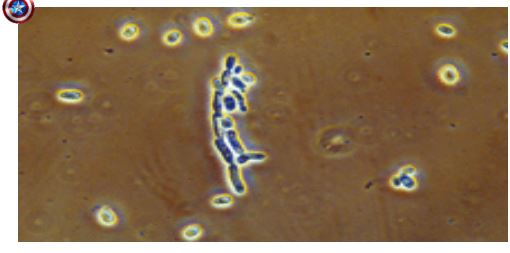
pseudohyphae and true hyphae when it invades
tissues
Candida albicans is notable for developing into
pseudohyphae and true hyphae when it invades
tissues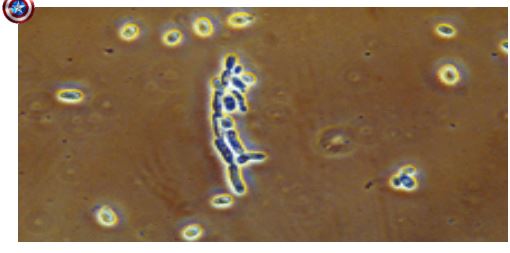
pseudohyphae and true hyphae when it invades
tissues
60
are fungal infections.
Mycoses are fungal infections.
61
Most fungi are …natural habitats being water,
soil and organic debris
soil and organic debris
Most fungi are exogenous…natural habitats being water,
soil and organic debris
soil and organic debris
62
Mycoses with highest incidence (part of flora or highly
adapted):
(1)
(2)
adapted):
(1)
(2)
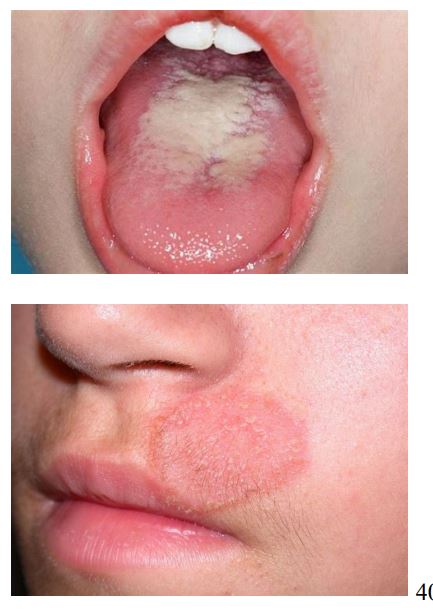
Mycoses with highest incidence (part of flora or highly
adapted):
(1) Candidiasis
(2) Dermatophytosis
adapted):
(1) Candidiasis
(2) Dermatophytosis
63
Most leathal fungus are . In environment, they growth as hypae. They are at room temp and at body temp
Most leathal fungus are dimorphic. In environment, they growth as saprophytic hypae. They are mycelia at room temp and yeast at body temp
64
results when a virulent
microbe (pathogen) invades and
begins growing (colonization)
within a host
microbe (pathogen) invades and
begins growing (colonization)
within a host
Infection results when a virulent
microbe (pathogen) invades and
begins growing (colonization)
within a host
microbe (pathogen) invades and
begins growing (colonization)
within a host
65
results when, as a
consequence of colonization,
tissue or cellular function is
impaired
consequence of colonization,
tissue or cellular function is
impaired
Disease results when, as a
consequence of colonization,
tissue or cellular function is
impaired
consequence of colonization,
tissue or cellular function is
impaired
66
Some colonizations do not result in
disease ( ; can
transmit)
disease ( ; can
transmit)
Some colonizations do not result in
disease (carrier state; can
transmit)
disease (carrier state; can
transmit)
67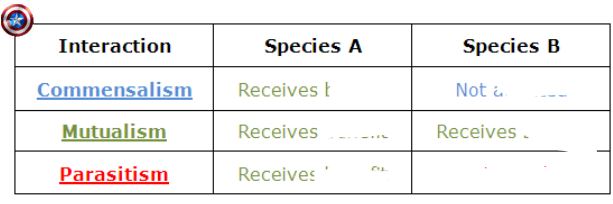
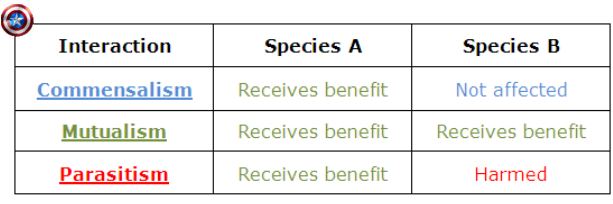
68
Some parasites have evolved to avoid the hosts in order to
survive and complete their life cycle
survive and complete their life cycle
Some parasites have evolved to avoid killing the hosts in order to
survive and complete their life cycle
survive and complete their life cycle
69
Disease is often the consequence of:
(1) infection
(2) infection
(3) Unusually infection
(1) infection
(2) infection
(3) Unusually infection
Disease is often the consequence of:
(1) Prolonged infection
(2) Repeated infection
(3) Unusually burdensome infection
(1) Prolonged infection
(2) Repeated infection
(3) Unusually burdensome infection
70
In most cases, is asymptomatic although
this is not always the case:
(1) Certain parasites kill the host ( )
(2) Parasitic infections of patients
this is not always the case:
(1) Certain parasites kill the host ( )
(2) Parasitic infections of patients
In most cases, infection is asymptomatic although
this is not always the case:
(1) Certain parasites kill the host (Plasmodium)
(2) Parasitic infections of immunodeficient patients
this is not always the case:
(1) Certain parasites kill the host (Plasmodium)
(2) Parasitic infections of immunodeficient patients
71
Protozons disease consequence of of
parasites in large number in host.
parasites in large number in host.
Protozons disease consequence of replication of
parasites in large number in host.
parasites in large number in host.
72
Protozoans can be (plasmodium) or (giardia)
Protozoans can be intracellular (plasmodium) or extracellular (giardia)
73
Transmission of protozans requires a vector and there are two stages: the and
Transmission of protozans requires a vector and there are two stages: the trophiozite and cyst
74
Amoebas
Formless cells that move by
“ parasites”
Alternate between &
Formless cells that move by
“ parasites”
Alternate between &
Amoebas
Formless cells that move by pseudopods
“Intestinal parasites”
Alternate between trophs & cysts
Formless cells that move by pseudopods
“Intestinal parasites”
Alternate between trophs & cysts
75
Flagellates
Use one or more for motility
“ & parasites”
Usually transmitted by
Use one or more for motility
“ & parasites”
Usually transmitted by
Flagellates
Use one or more flagella for motility
“Intestinal & Blood parasites”
Usually transmitted by arthropods
Use one or more flagella for motility
“Intestinal & Blood parasites”
Usually transmitted by arthropods
76
Ciliates
Covered by for locomotion
Few involved in disease
Covered by for locomotion
Few involved in disease
Ciliates
Covered by cilia for locomotion
Few involved in disease
Covered by cilia for locomotion
Few involved in disease
77
Apicomplexans (Sporozoa)
Intracellular replication
“ & parasites”
which scans host cell
surfaces for ligands; and upon engagement,
invasion
Intracellular replication
“ & parasites”
which scans host cell
surfaces for ligands; and upon engagement,
invasion
Apicomplexans (Sporozoa)
Intracellular replication
“Blood & Tissue parasites”
Gliding motility which scans host cell
surfaces for ligands; and upon engagement,
invasion
Intracellular replication
“Blood & Tissue parasites”
Gliding motility which scans host cell
surfaces for ligands; and upon engagement,
invasion
78
Helminths are multicellular animals that are sexually reproductive (usually-some hermaphroditic) are are either (eggs) or (live larvae)
Helminths are multicellular animals that are sexually reproductive (usually-some hermaphroditic) are are either oviparous (eggs) or viviparous (live larvae)
79
Helmiths cannot complete lifecycle without . Pathology due to l of parasites.
Helmiths cannot complete lifecycle without host. Pathology due to large number of parasites.
80
Roundworms (Nematodes)
in cross section
Adult worms = 1 – 20 cm
No visible (although look
similar to earthworms)
in cross section
Adult worms = 1 – 20 cm
No visible (although look
similar to earthworms)
Roundworms (Nematodes)
Circular in cross section
Adult worms = 1 – 20 cm
No visible body segments (although look
similar to earthworms)
Circular in cross section
Adult worms = 1 – 20 cm
No visible body segments (although look
similar to earthworms)
81
Flatworms
-Asymmetric in cross section
- Two types:
(1) Flukes ( )
(2) Short flatworms w/ nonsegmented
bodies ( )
-Asymmetric in cross section
- Two types:
(1) Flukes ( )
(2) Short flatworms w/ nonsegmented
bodies ( )
Flatworms
-Asymmetric in cross section
- Two types:
(1) Flukes (Trematodes)
(2) Short flatworms w/ nonsegmented
bodies (cestodes)
-Asymmetric in cross section
- Two types:
(1) Flukes (Trematodes)
(2) Short flatworms w/ nonsegmented
bodies (cestodes)
82
mmune system (working with what you got)
immune system (works against pathognes - Humoral + Cellular immunity)
immune system (works against pathognes - Humoral + Cellular immunity)
Innate immune system (working with what you got)
Adaptive immune system (works against pathognes - Humoral + Cellular immunity)
Adaptive immune system (works against pathognes - Humoral + Cellular immunity)
83
Microbes often gain access to the
tissues through breaks in the or
breakdown of the
tissues through breaks in the or
breakdown of the
Microbes often gain access to the
tissues through breaks in the skin or
breakdown of the mucus membranes
tissues through breaks in the skin or
breakdown of the mucus membranes
84
Lysozyme
Cleaves bonds of
Cleaves bonds of
Lysozyme
Cleaves glycosidic bonds of peptidoglycans
Cleaves glycosidic bonds of peptidoglycans
85
Lactoferrin
Binds sequesters , limiting growth of and disrupts membrane
Binds sequesters , limiting growth of and disrupts membrane
Lactoferrin
Binds sequesters iron, limiting growth of bacteria and fungi, disrupts microbial membrane
Binds sequesters iron, limiting growth of bacteria and fungi, disrupts microbial membrane
86
( and ) distrupt membranes of bacteria, fungi, protozoan, parasites, and viruses additional toaci effects intracellular, kills cells and disables virguses
Defensis (alpha and beta) distrupt membranes of bacteria, fungi, protozoan, parasites, and viruses additional toaci effects intracellular, kills cells and disables virguses
87
Should the physical and chemical barriers be breached – innate immune
receptors called can bind to
the microbe and alert the body to microbe’s presence
receptors called can bind to
the microbe and alert the body to microbe’s presence
Should the physical and chemical barriers be breached – innate immune
receptors called pathogen recognition receptors (PRR) can bind to
the microbe and alert the body to microbe’s presence
receptors called pathogen recognition receptors (PRR) can bind to
the microbe and alert the body to microbe’s presence
88
PRR bind to conserved microbial components or (Ex. Toll-like receptor 4)
PRR bind to conserved microbial components or pathogen-associated
molecular patterns (PAMPs) (Ex. Toll-like receptor 4)
molecular patterns (PAMPs) (Ex. Toll-like receptor 4)
89
Some TLRs expressed on the cell
to detect extracellular microbes
to detect extracellular microbes
Some TLRs expressed on the cell
surface to detect extracellular microbes
surface to detect extracellular microbes
90
Other TLRs incorporated into the
membranes of and
to bind to intracellular
microbes
membranes of and
to bind to intracellular
microbes
Other TLRs incorporated into the
membranes of endosomes and
phagosomes to bind to intracellular
microbes
membranes of endosomes and
phagosomes to bind to intracellular
microbes
91
HIGH YIELD
TLR4 =
TLR 7 = -inside endosome
TLR9= -inside endosome
TLR4 =
TLR 7 = -inside endosome
TLR9= -inside endosome
HIGH YIELD
TLR4 = LPS
TLR 7 = ssRNA -inside endosome
TLR9= CpG DNA -inside endosome
TLR4 = LPS
TLR 7 = ssRNA -inside endosome
TLR9= CpG DNA -inside endosome
92
Binding of microbial PAMPs to TLRs
triggers cell signaling leading to
production of tumor necrosis factor
, and
to promote inflammation
triggers cell signaling leading to
production of tumor necrosis factor
, and
to promote inflammation
Binding of microbial PAMPs to TLRs
triggers cell signaling leading to
production of tumor necrosis factor
alpha (TNF-alpha), interleukin-1 (IL-1) and
IL-6 to promote inflammation
triggers cell signaling leading to
production of tumor necrosis factor
alpha (TNF-alpha), interleukin-1 (IL-1) and
IL-6 to promote inflammation
93
) is also released
to block microbial replication (most
effective against viruses)
to block microbial replication (most
effective against viruses)
Type I interferon (IFN) is also released
to block microbial replication (most
effective against viruses)
to block microbial replication (most
effective against viruses)
94
receptors
Recogizes viral RNA triggering release of
type I interferons
Recogizes viral RNA triggering release of
type I interferons
RIG-I-like receptors
Recogizes viral RNA triggering release of
type I interferons
Recogizes viral RNA triggering release of
type I interferons
95
receptors
• Recogizes bacterial cell wall components
(peptidoglycan) triggering release of
and
• Recogizes bacterial cell wall components
(peptidoglycan) triggering release of
and
NOD-like receptors
• Recogizes bacterial cell wall components
(peptidoglycan) triggering release of IL-1
and IL-18
• Recogizes bacterial cell wall components
(peptidoglycan) triggering release of IL-1
and IL-18
96
(lyse bacteria)
Antimicrobial peptides (lyse bacteria)
97
(block viral replication)
Type I interferons (block viral replication)
98
(activate endothelial cells for immune cell adhesion and
stimulate immune reactivity of responding cells)
stimulate immune reactivity of responding cells)
Cytokines (activate endothelial cells for immune cell adhesion and
stimulate immune reactivity of responding cells)
stimulate immune reactivity of responding cells)
99
(recruit activated immune cells to site of infection)
Chemokines (recruit activated immune cells to site of infection)
100
(digests engulfed microbes within phagocytes
Enzymes (digests engulfed microbes within phagocytes
101
Macrophages can become or
Macrophages can become M1 (inflammatory) or M2
102
Microbial activation of
macrophages leads to M1
polarization resulting in
production of , and
to promote inflammation
macrophages leads to M1
polarization resulting in
production of , and
to promote inflammation
Microbial activation of
macrophages leads to M1
polarization resulting in
production of IL-1, IL-6 and
TNF-alpha to promote inflammation
macrophages leads to M1
polarization resulting in
production of IL-1, IL-6 and
TNF-alpha to promote inflammation
103
Cytokines and chemokines promote
Cytokines and chemokines promote inflammation
104
, and
increase vascular permeability
increase vascular permeability
IL-1, IL-6 and
TNF-alpha increase vascular permeability
TNF-alpha increase vascular permeability
105
in tissue produce type 1 interferon (type 1 IFN)
Plasmacytoid dendritic cells in tissue produce type 1 interferon (type 1 IFN)
106
and are important for T cells.
IL-12 and IL-18 are important for T cells.
107
TQ
Type 1 interferon
1. Inhibits
2. does mRNA
3. Inhibits virus +
Type 1 interferon
1. Inhibits
2. does mRNA
3. Inhibits virus +
TQ
Type 1 interferon
1. Inhibits translation
2. does mRNA degredation
3. Inhibits virus transcription +assembly
Type 1 interferon
1. Inhibits translation
2. does mRNA degredation
3. Inhibits virus transcription +assembly
108
Complement proteins are synthesized in the
primarily ( and as well). They circulate in an form in the blood.
primarily ( and as well). They circulate in an form in the blood.
Complement proteins are synthesized in the liver
primarily (GI and GU as well). They circulate in an inactive form in the blood.
primarily (GI and GU as well). They circulate in an inactive form in the blood.
109
Complement cells combined covalently to the and bound to microbe surface
Complement cells combined covalently to the microbe surface and antibodies bound to microbe surface
110
(TNF, IL-1) trigger endothelial activation to
capture circulating immune cells
capture circulating immune cells
Cytokines (TNF, IL-1) trigger endothelial activation to
capture circulating immune cells
capture circulating immune cells
111
ligands on leukocutes bind to surface of epithelia. interactions then occur that make the cell flatten out. then help the cell to "slide" into the tissue
Selectin ligands on leukocutes bind to surface of epithelia. Integrin interactions then occur that make the cell flatten out. Chemokines then help the cell to "slide" into the tissue
112
• First cells to infiltrate inflamed tissues
• First cells to infiltrate inflamed tissues
Polymorphonuclear leukocyte (PML) AKA Nuetrophils
• First cells to infiltrate inflamed tissues
• First cells to infiltrate inflamed tissues
113
Neutrophils contain , and
which degrades cell membranes,
DNA and RNA
which degrades cell membranes,
DNA and RNA
Neutrophils contain antimicrobial peptides, lysozyme and
myeloperoxidase which degrades cell membranes,
DNA and RNA
myeloperoxidase which degrades cell membranes,
DNA and RNA
114
Most granules of neutrophils fuse with the and
spill out contents into the environment (near the
microbe)
spill out contents into the environment (near the
microbe)
Most granules of neutrophils fuse with the neutrophil membrane and
spill out contents into the environment (near the
microbe)
spill out contents into the environment (near the
microbe)
115
Some granules of neutrophils fuse with the phagosome and spill
contents into it (
contents into it (
Some granules of neutrophils fuse with the phagosome and spill
contents into it (azurophilic)
contents into it (azurophilic)
116
The two main phagocytes are and
The two main phagocytes are neutrophils and macrophages
117
Macropgages
- and of materials such as
microbes for their clearance and destruction
- and of materials such as
microbes for their clearance and destruction
Macropgages
- Engulfment and internalization of materials such as
microbes for their clearance and destruction
- Engulfment and internalization of materials such as
microbes for their clearance and destruction
118
Lysosome containing digestive enzymes fuses with
the forming the process
the forming the process
Lysosome containing digestive enzymes fuses with
the phagosome forming the phagolysosome –
digestion process
the phagosome forming the phagolysosome –
digestion process
119
from lysosome
spill into the phagolysosome to
degrade microbes
spill into the phagolysosome to
degrade microbes
Acid hydrolases from lysosome
spill into the phagolysosome to
degrade microbes
spill into the phagolysosome to
degrade microbes
120
produces
nitric oxide (NO) and derivatives
which oxidizes DNA bases
generating strand breaks and
mutations preventing DNA
replication and gene expression –
nitric oxide (NO) and derivatives
which oxidizes DNA bases
generating strand breaks and
mutations preventing DNA
replication and gene expression –
iNOS (inducible nitric
oxide synthase) produces
nitric oxide (NO) and derivatives
which oxidizes DNA bases
generating strand breaks and
mutations preventing DNA
replication and gene expression –
reactive nitrogen species (RNS)
oxide synthase) produces
nitric oxide (NO) and derivatives
which oxidizes DNA bases
generating strand breaks and
mutations preventing DNA
replication and gene expression –
reactive nitrogen species (RNS)
121
) and
subsequent enzymes generate
hydroxyl radicals, hydrogen
peroxide and hypochlorous acid
with same action as NO –
subsequent enzymes generate
hydroxyl radicals, hydrogen
peroxide and hypochlorous acid
with same action as NO –
Phagocyte oxidase produces
superoxides (O2-) and
subsequent enzymes generate
hydroxyl radicals, hydrogen
peroxide and hypochlorous acid
with same action as NO –
reactive oxygen species (ROS)
superoxides (O2-) and
subsequent enzymes generate
hydroxyl radicals, hydrogen
peroxide and hypochlorous acid
with same action as NO –
reactive oxygen species (ROS)
122
Natural killer cells have receptors (expressed by cancer cells and stressed cells) and receotors (healthy cells- consitutive expression)
Natural killer cells have activating receptors (expressed by cancer cells and stressed cells) and inhibitory receotors (healthy cells- consitutive expression)
123
NK cells are by default (active or inactive?)
NK cells are by default active (active or inactive?)
124
Healthy cells also express that binds to inhibitory
receptors = inhibitory signaling overrides activation signaling
receptors = inhibitory signaling overrides activation signaling
Healthy cells also express MHC class I that binds to inhibitory
receptors = inhibitory signaling overrides activation signaling
receptors = inhibitory signaling overrides activation signaling
125
Healthy cells constitutively express activation ligands to bind
to = NK cell defaulted to be
active
to = NK cell defaulted to be
active
Healthy cells constitutively express activation ligands to bind
to NK cell activation receptors = NK cell defaulted to be
active
to NK cell activation receptors = NK cell defaulted to be
active
126
Activated NK cells produce
Activated NK cells produce
interferon-gamma (IFN-
gamma)
interferon-gamma (IFN-
gamma)
127
IFN-gamma stimulates to
polarize into
producing cytokines (IL-12, TNF-
alpha),
phagocytic compounds (ROS),
chemokines (CXCL10, CXCL11), and
presentation molecules to help
activate T cells
polarize into
producing cytokines (IL-12, TNF-
alpha),
phagocytic compounds (ROS),
chemokines (CXCL10, CXCL11), and
presentation molecules to help
activate T cells
IFN-gamma stimulates macrophages to
polarize into M1 macrophages
producing cytokines (IL-12, TNF-
alpha),
phagocytic compounds (ROS),
chemokines (CXCL10, CXCL11), and
presentation molecules to help
activate T cells
polarize into M1 macrophages
producing cytokines (IL-12, TNF-
alpha),
phagocytic compounds (ROS),
chemokines (CXCL10, CXCL11), and
presentation molecules to help
activate T cells
128
Activated macrophages produce , , and
Activated macrophages produce IL12, IL-15, IL-18 and IL-1 Beta
129
Cytokines can activate NK cells
promoting expansion, expression of
(aids binding to target cells),
production of ( )
and increased cytotoxicity against
targets
promoting expansion, expression of
(aids binding to target cells),
production of ( )
and increased cytotoxicity against
targets
Cytokines can activate NK cells
promoting expansion, expression of
CD69 (aids binding to target cells),
production of cytotoxins (granzyme)
and increased cytotoxicity against
targets
promoting expansion, expression of
CD69 (aids binding to target cells),
production of cytotoxins (granzyme)
and increased cytotoxicity against
targets
130
Acute phase response develops as a
consequence of cytokines ( ,
and )
consequence of cytokines ( ,
and )
Acute phase response develops as a
consequence of cytokines (IL-1, IL-6
and TNF-alpha)
consequence of cytokines (IL-1, IL-6
and TNF-alpha)
131
is the primary antibody driving this
response
response
IL-6 is the primary antibody driving this
response
response
132
IL6 increases (1) (2) (3)
IL6 increases (1) Mannone binding lectin (2) CRP (3) Complement proteins
133
Acute phase response leads to
increased phagocytosis by coating
microbes with as well as
lysis of microbes (complement)
increased phagocytosis by coating
microbes with as well as
lysis of microbes (complement)
Acute phase response leads to
increased phagocytosis by coating
microbes with opsonins as well as
lysis of microbes (complement)
increased phagocytosis by coating
microbes with opsonins as well as
lysis of microbes (complement)
134
(DC) are cells that capture
microbes or components and digest them (i.e. antigen
processing) (chew up into little bits and pieces so that they can be displayed)
microbes or components and digest them (i.e. antigen
processing) (chew up into little bits and pieces so that they can be displayed)
Dendritic cells (DC) are cells that capture
microbes or components and digest them (i.e. antigen
processing) (chew up into little bits and pieces so that they can be displayed)
microbes or components and digest them (i.e. antigen
processing) (chew up into little bits and pieces so that they can be displayed)
135
DC undergo a maturation process as they
migrate to the local
migrate to the local
DC undergo a maturation process as they
migrate to the local lymph nodes
migrate to the local lymph nodes
136
Antigen (Ag) derived from the microbes
are loaded onto molecules
and displayed on the surface
are loaded onto molecules
and displayed on the surface
Antigen (Ag) derived from the microbes
are loaded onto MHC molecules
and displayed on the DC surface
are loaded onto MHC molecules
and displayed on the DC surface
137
T cells in the lymph node express a receptor
(TCR) which recognizes
(TCR) which recognizes
T cells in the lymph node express a T cell receptor
(TCR) which recognizes SPECIFIC Ag
(TCR) which recognizes SPECIFIC Ag
138
T cells recognizing Ag are activated – leave the and migrate through to site of inflammation
T cells recognizing Ag are activated – leave the lymph
node and migrate through circulation to site of inflammation
node and migrate through circulation to site of inflammation