Physics Paper 2
Study these flashcardsFree · spaced repetition · iPhone, Android, Mac & web
All cards
1
What is a force?
a push or pull that acts on an object due to the interaction with another object
2
Contact forces (4)
friction, air resistance, tension, normal contact
3
Non-contact forces (3)
gravitational force, electrostatic force, magnetic
4
Weight
force acting on an object due to gravity
5
Centre of mass
- weight of an object acts at a single point
- can change (higher/lower) - lower gives more stability
- can change (higher/lower) - lower gives more stability
6
Weight and mass of an object
directly proportional
7
How is weight measured?
calibrated spring balance (newton meter)
8
What can a single force be resolved into?
two components acting at right angles to each other - have the same effect as the single force
9
1 Newton metre =
1 Joule
10
Moment of a force
turning effect of it
11
Balanced object
- total clockwise moment about pivot = total anticlockwise moment about it
- resultant moment is zero
- resultant moment is zero
12
Long lever
when applying a range of forces, allows a greater range of moments
13
Newton's 1st law
- if the resultant force acting on an object is zero and the object is stationary, it remains stationary
- if the object is moving, it continues at the same speed and in the same direction
- if the object is moving, it continues at the same speed and in the same direction
14
Intertia
tendency of objects to continue in their state of rest / uniform motion
15
Newton's 3rd law
whenever 2 objects interact, they exert equal and opposite forces on each other
16
Low gear (3)
- small gear turns a large gear
- low speed because, with each turn of the small gear, the large doesn't turn as much
- high turning effect because distance from line of action is greater
- low speed because, with each turn of the small gear, the large doesn't turn as much
- high turning effect because distance from line of action is greater
17
High gear (3)
- large gear turning small gear
- high speed because, with each turn of the large gear, the small turns several times
- low turning effect because distance from line of action is smaller
- high speed because, with each turn of the large gear, the small turns several times
- low turning effect because distance from line of action is smaller
18
Displacement
distance in a given direction
19
Driving force
the force that makes an object move
20
Free-body force diagram
shows the forces acting on an object without showing any other objects or forces
21
Walking speed
1.5 m/s
22
Running speed
3 m/s
23
Cycling
6 m/s
24
Speed of sound
- 330 m/s but can vary
- speed of sound waves in air increases with temperature
- speed of sound waves in air increases with temperature
25
Acceleration
rate of change of velocity
26
How can an accelerating object's speed by found?
its speed at any particular time can be determined by drawing a tangent and measuring its gradient on a distance-time graph
27
Gradient of a velocity-time graph
acceleration
28
Terminal velocity
reached by an object when drag force is equal and opposite to the force making it move
29
Newton's 2nd law
- acceleration of an object is proportional to the resultant force acting on it
- and inversely proportional to the mass of the object
- and inversely proportional to the mass of the object
30
Inertial mass
- how difficult it is to change the velocity of an object
- the ratio of force / acceleration
- the ratio of force / acceleration
31
~
indicates an approximate value
32
Large deceleration dangers
brake overheating and loss of control
33
Conservation of momentum
in a closed system, the total momentum before and after an event is the same
34
Reason for wearing a helmet
- increases impact time
- which reduces the rate of change of momentum per second
- which reduces the force of the impact
$F=\frac{\triangle momentum}{t}$
- which reduces the rate of change of momentum per second
- which reduces the force of the impact
$F=\frac{\triangle momentum}{t}$
35
How to tell if an object is elastic
returns to its original shape when the forces deforming it are removed
36
Hooke's law
- extension of an elastic object is directly proportional to the force applied, provided that the limit of proportionality is not exceeded
- so the work done on the spring and the elastic potential energy stored are equal
- so the work done on the spring and the elastic potential energy stored are equal
37
What has to be applied when stretching, bending or compressing an object?
more than one force - there has to be an opposing force keeping one end / side stationary
38
Seat belts
- time taken to stop is longer - decelerating force reduced
- acts across chest so spreads force out
- acts across chest so spreads force out
39
Fluid
either a liquid or a gas
40
Liquid flows until...
the pressure along the same horizontal level is constant
41
Why does atmospheric pressure decrease with altitude? (2)
- air molecules colliding with a surface create atmospheric pressure
- number of air colecules (so weight of air) above a surface decreases as the height increases
- number of air colecules (so weight of air) above a surface decreases as the height increases
42
Rubber suction cap pressed onto wall tile (3)
- pressing cup onto wall squeezes any air trapped between cap and wall out
- atmospheric pressure only acts on outside of cap
- force due to atmospheric pressure keeps the cap on the wall
- atmospheric pressure only acts on outside of cap
- force due to atmospheric pressure keeps the cap on the wall
43
Drinking straw (2)
- air sucked out of straw
- atmospheric pressure acting on the liquid surface outside the straw pushes the liquid up
- atmospheric pressure acting on the liquid surface outside the straw pushes the liquid up
44
Upthrust (4)
- a partially (or totally) submerged object experiences a greater pressure on the bottom surface than on the top surface
- this creates a resultant force upwards - upthrust
- when an object in a water container is fully immersed, volume of water displaced = volume of object
- the bigger the volume of water displaced, the greater the upthrust
- this creates a resultant force upwards - upthrust
- when an object in a water container is fully immersed, volume of water displaced = volume of object
- the bigger the volume of water displaced, the greater the upthrust
45
Objects that float (2)
- weight equal to upthrust
- density lower than water
- density lower than water
46
Objects that sink (2)
- density greater than water - so weight of object is greater than weight of water displaced
- so weight is greater than upthrust
- so weight is greater than upthrust
47
What can waves transfer?
energy / info without transferring matter
48
Mechanical waves (3)
- vibrations that travel through a medium (substance)
- sound, water, waves on springs and ropes, seismic waves caused by earthquakes
- can be transverse or longitudinal
- sound, water, waves on springs and ropes, seismic waves caused by earthquakes
- can be transverse or longitudinal
49
Do EM waves need a medium?
no
50
Transverse waves (3)
- oscillations are perpendicular to the direction of energy transfer
- can move up and down or from side to side
- waves on a rope, water ripples, all EM waves
- can move up and down or from side to side
- waves on a rope, water ripples, all EM waves
51
Longitudinal waves (3)
- oscillations are parallel to the direction of energy transfer
- show areas of compression and rarefaction
- sound waves
- show areas of compression and rarefaction
- sound waves
52
Compressions in waves
regions where the vibrating particles are closest together
53
Rarefactions in waves
regions where particles are furthest apart
54
Amplitude (2)
- max displacement of a point on a wave away from its undisturbed position
- the bigger the amplitude, the more energy the waves carry
- the bigger the amplitude, the more energy the waves carry
55
Wavelength
distance from a point on a wave to the equivalent position on the adjacent wave
56
Frequency
number of waves passing a point each second
57
Time period
time for each wave to pass a fixed point
58
Plane waves (2)
- aka straight waves
- waves all move at same speed and stay same distance apart
- waves all move at same speed and stay same distance apart
59
Wavespeed (2)
- distance travelled by a wave every second through a medium
- energy is transferred by the wave at this speed
- energy is transferred by the wave at this speed
60
How can plane waves be created?
repeatedly dipping the long edge of a ruler in water
61
Plane wave reflection (2)
- plane waves in a ripple tank are reflected from a straight barrier at the same angle to the barrier as the incident waves
- this is because their speed and wavelength don't change on reflection
- this is because their speed and wavelength don't change on reflection
62
Plane wave refraction (4)
- plane waves crossing a boundary between 2 different materials are refracted unless they cross the boundary at normal incidence
- refracted and incident waves have same frequency but travel at different speeds
- this means they have different wavelengths, so change direction
- can be observed in a ripple tank when water waves cross a boundary between deep and shallow
- refracted and incident waves have same frequency but travel at different speeds
- this means they have different wavelengths, so change direction
- can be observed in a ripple tank when water waves cross a boundary between deep and shallow
63
What happens when waves are directed at a substance?
some or all of the wave may be reflected at the surface
64
Waves absorbed by a substance (3)
- results in the substance gaining energy from the waves
- eg. when food is heated in a microwave, it absorbs the microwaves
- as waves travel through a substance, amplitude gradually decreases as the substance absorbs some of the waves' energy
- eg. when food is heated in a microwave, it absorbs the microwaves
- as waves travel through a substance, amplitude gradually decreases as the substance absorbs some of the waves' energy
65
Waves not absorbed by a substance
- transmitted
- eg. light is mostly transmitted by normal glass but almost completely absorbed by darkened glass
- eg. light is mostly transmitted by normal glass but almost completely absorbed by darkened glass
66
How does hearing work?
sound waves make the eardrums vibrate in and out
67
Sound waves in a vacuum
- can't travel through
- can be tested by listening to an electric bell in a bell jar
- can be tested by listening to an electric bell in a bell jar
68
Echo
sound waves reflect from smooth hard surfaces
69
Investigating waves (3)
- ripple tank for water waves
- stretched spring for waves in a solid
- signal generator and loudspeaker for sound waves
- stretched spring for waves in a solid
- signal generator and loudspeaker for sound waves
70
Human hearing range (7)
- 20 Hz - 20 kHz
- sound waves entering a solid are converted to vibrations - only works over a limited frequency range
- frequency doesn't change - when sound waves travel from one substance to another, only speed and wavelength can change
- intensity of sounds the ear can just about detect varies with frequency
- the cochlea is only stimulated by a limited range of frequencies
- the hairs in the human cochlea have different lengths and vibrate at different sound frequencies
- old age - shorter hairs that respond to higher frequencies stop working
- sound waves entering a solid are converted to vibrations - only works over a limited frequency range
- frequency doesn't change - when sound waves travel from one substance to another, only speed and wavelength can change
- intensity of sounds the ear can just about detect varies with frequency
- the cochlea is only stimulated by a limited range of frequencies
- the hairs in the human cochlea have different lengths and vibrate at different sound frequencies
- old age - shorter hairs that respond to higher frequencies stop working
71
In what medium do sound waves travel the fastest?
solid - particles are more densely packed so vibrations travel faster
72
Echo sounding
pulses of high frequency sound waves used to detect objects in deep water and measure depth below a ship
73
Ultrasound scanning (4)
- transducer produces and detects pulses of ultrasound waves
- each wave is partially reflected from the different tissue boundaries in its path
- wave then returns to transducer as a sequence of waves reflected by the tissue boundaries, arriving back at different times
- this builds up an image on a screen of the internal tissue boundaries in the body
- each wave is partially reflected from the different tissue boundaries in its path
- wave then returns to transducer as a sequence of waves reflected by the tissue boundaries, arriving back at different times
- this builds up an image on a screen of the internal tissue boundaries in the body
74
Ultrasound advatages compared to x-rays (2)
- scan organs and soft tissues
- waves don't have enough energy to remove electrons (ionise)
- waves don't have enough energy to remove electrons (ionise)
75
Ultrasound in metal industry
detect flaws or internal cracks in metal castings - internal crack creates a boundary inside the metal
76
Seismic waves
waves that travel through the Earth
77
Focus of an earthquake
point where it originates from
78
Epicentre of an earthquake
nearest point on the surface to the focus
79
How are seismic waves displayed?
seismometers
80
Primary waves (2)
- longitudinal - push and pull on material as they move through the earth
- cause initial tremors
- cause initial tremors
81
Secondary waves (2)
- transverse - shake material that they pass through inside the earth from side to side
- slower than P-waves
- slower than P-waves
82
L-waves (4)
- arrive last
- cause violent movement on the surface up and down, and backwards and forwards
- travel more slowly than p-waves and s-waves
- only happen in earth's crust
- cause violent movement on the surface up and down, and backwards and forwards
- travel more slowly than p-waves and s-waves
- only happen in earth's crust
83
Shadow zone
area on Earth's surface where no p-waves or s-waves are recorded
84
Evidence for liquid outer core (4)
- p-waves are refracted at boundary between mantle and outer core when waves enter and leave
- this is due to speed changing abruptly at the boundary
- because the 2nd refraction is further around, the waves can't reach the shadow zone
- s-waves are transverse, so can't travel through liquid
- this is due to speed changing abruptly at the boundary
- because the 2nd refraction is further around, the waves can't reach the shadow zone
- s-waves are transverse, so can't travel through liquid
85
Evidence for solid inner core
weak p-waves detected in shadow zone show that there is a solid inner part that refracts p-waves at the boundary between inner and outer core into the shadow zone
86
How was the boundary between crust and mantle discovered?
speed of seismic waves changed at a certain depth below the surface
87
EM wave velocity
all types travel at the same velocity through a vacuum or air
88
Wavelength and frequency patterns in EM waves
- wavelength decreases after radio
- frequency (and energy) increases after radio
- frequency (and energy) increases after radio
89
White light
contains all the colours of visible light
90
Infrared
- emitted by all objects
- the hotter an object, the more infrared it emits
- the hotter an object, the more infrared it emits
91
Infrared danger
can be absorbed by the skin - heats up skin cells - can damage, burn or kill
92
Infrared uses (5)
- optical fibres in communcations systems
- remote controls (send out a sequence of infrared pulses)
- infrared scanners in medicine (detect infrared emitted from hot spots on the body surface - can indicate that tissue underneath is unhealthy)
- infrared cameras
- electric heater and cookers (heat up objects quickly)
- remote controls (send out a sequence of infrared pulses)
- infrared scanners in medicine (detect infrared emitted from hot spots on the body surface - can indicate that tissue underneath is unhealthy)
- infrared cameras
- electric heater and cookers (heat up objects quickly)
93
Radiowave use (long wavelength)
communication signals - can pass through atmosphere and reach satellites above Earth
94
Microwave ovens (3)
- heat food faster than normal ovens
- microwaves penetrate food and are absorbed by water molecules in the food, heating it
- oven itself doesn't contain water molecules so doesn't become hot
- microwaves penetrate food and are absorbed by water molecules in the food, heating it
- oven itself doesn't contain water molecules so doesn't become hot
95
Radio wave use
instead of cables - connect electronic devices eg. bluetooth
96
Microwave and radiowave danger
penetrate people's bodies and can heat internal parts
97
Carrier waves
used to carry any type of signal
98
Shorter wavelength characteristics (3)
- can carry more info (more pulses of wave)
- shorter range (due to increasing absorption by atmosphere)
- spread out less
- shorter range (due to increasing absorption by atmosphere)
- spread out less
99
Mobile phones
send out radio signal when used - concerns about effects on health - more research needed
100
Optical fibres (3)
- very thin glass fibres used to transmit signals carried by light / infrared
- light rays can't escape - when they reach the surface of the fibre, they are reflected back into it (more secure)
- carry much more info than radiowaves due to short wavelength - can carry more pulses of wave
- light rays can't escape - when they reach the surface of the fibre, they are reflected back into it (more secure)
- carry much more info than radiowaves due to short wavelength - can carry more pulses of wave
101
UV use
some chemicals emit light as a result of absorbing UV waves - posters and inks that glow in UV light
102
UV dangers (2)
- harmful to eyes and can cause blindness (special goggles in sunbeds)
- in excess can cause sunburn and skin cancer
- in excess can cause sunburn and skin cancer
103
How are x-rays produced?
produced when electrons / other high speed particles are stopped - produced using x-ray tubes
104
X-rays in metal industry
detect internal cracks in metal objects - the more dense a substance is, the more x-rays it absorbs
105
Gamma uses (3)
- kill pathogens in food
- kill bacteria on surgical instruments
- narrow beam of gamma directed at a tumour
- kill bacteria on surgical instruments
- narrow beam of gamma directed at a tumour
106
X-rays in medicine (5)
- pass through soft tissue but are absorbed by bones and teeth
- parts of the film / detector that the x-rays reach become darker - negative image of bones created
- organs consisting of soft tissue can be filled with a contrast medium that absorbs x-rays easily
- lead plates between tube and patient stop x-rays reaching other parts of the body
- longer wavelength and lower energy rays used - absorbed by bones but pass through gaps
- parts of the film / detector that the x-rays reach become darker - negative image of bones created
- organs consisting of soft tissue can be filled with a contrast medium that absorbs x-rays easily
- lead plates between tube and patient stop x-rays reaching other parts of the body
- longer wavelength and lower energy rays used - absorbed by bones but pass through gaps
107
X-ray therapy (2)
- x-rays reach the cancerous tumour through a gap in the plates between the tube and the body
- shorter wavelength used - have enough energy to destroy the tumour
- shorter wavelength used - have enough energy to destroy the tumour
108
Light reflection (4)
- when plane waves reflect from a flat barrier, reflected waves are at the same angle as the incident waves
- when each point on the wavefront reaches the barrier, it creates a wavelet moving away from the barrier
- this wavelet lines up with the previous reflected wavelets to form a reflected wavefront moving away from the barrier
- all parts of the wavefront move at same speed, so reflected wavefront at same angle to barrier as incident wavefront
- when each point on the wavefront reaches the barrier, it creates a wavelet moving away from the barrier
- this wavelet lines up with the previous reflected wavelets to form a reflected wavefront moving away from the barrier
- all parts of the wavefront move at same speed, so reflected wavefront at same angle to barrier as incident wavefront
109
Specular reflection
reflection from a smooth surface - parallel light rays reflected in a single direction
110
Diffuse reflection
from a rough surface - parallel light rays are scattered in different directions
111
When light enters a more dense medium
refracted towards the normal
112
When light enters a less dense medium
refracted away from the normal
113
Partial reflection
waves that cross the boundary lose energy, so have a smaller amplitude than the incident waves - faint mirror image
114
White light directed at red filter
filter absorbs all parts of the white light spectrum, apart from red
115
Colour of an opaque object surface
- depends on pigment chemicals and range of wavelengths in incident light
- pigments absorb light of specific wavelengths only and strongly reflect other wavelengths
- pigments absorb light of specific wavelengths only and strongly reflect other wavelengths
116
Transparent objects
transmit all the incident light that enters them
117
Translucent objects
- let light pass through them, but it is scattered / refracted
- because material of object has lots of internal boundaries that change the direction of the light rays repeatedly
- because material of object has lots of internal boundaries that change the direction of the light rays repeatedly
118
Opaque objects
light is either scattered at surface, reflected, or absorbed - none is allowed to travel through
119
Focal length
distance from centre of lens to principal focus
120
Convex lens (4)
- an incident ray parallel to the axis refracts through the lens and passes through the principal focus on the other side
- an incident ray passing through the principal focus refracts through the lens and travels parallel to the axis
- incident ray passing through the centre of the lens carries on in same direction
- used in magnifying glasses and in cameras
- an incident ray passing through the principal focus refracts through the lens and travels parallel to the axis
- incident ray passing through the centre of the lens carries on in same direction
- used in magnifying glasses and in cameras
121
Concave lens (4)
- incident ray parallel to axis reracts through the lens and travels in line with principal focus (so it appears to have come from it)
- incident ray passing through the lens towards the principal focus refracts through the lens and travels parallel to the axis
- incident ray passing through centre of lens carries on in same direction
- used to correct short-sightedness
- incident ray passing through the lens towards the principal focus refracts through the lens and travels parallel to the axis
- incident ray passing through centre of lens carries on in same direction
- used to correct short-sightedness
122
Principal focus (2)
- convex lens - where rays hitting the lens parallel to axis all meet
- concave lens - where rays hitting lens parallel to axis appear to all come from
- concave lens - where rays hitting lens parallel to axis appear to all come from
123
Real image
light from object comes together to form an image on a screen eg. retina
124
Virtual image (3)
- rays are diverging, so the light from the object appears to be coming from a completely different place
- eg. mirror and magnifying lens
- can't be projected onto a screen
- eg. mirror and magnifying lens
- can't be projected onto a screen
125
Convex lens type of image
real or virtual
126
Concave lens type of image
always virtual (always right way up, smaller than the object and on the same side of the lens as the object)
127
Cameras (4)
- convex lens used to produce a real image of an object on a film / array of pixels
- position of lens is adjusted to focus the image on the film
- distant object - distance from lens to the film must be equal to the focal length of the lens
- the nearer an object is to the lens, the bigger the distance from the lens to the film
- position of lens is adjusted to focus the image on the film
- distant object - distance from lens to the film must be equal to the focal length of the lens
- the nearer an object is to the lens, the bigger the distance from the lens to the film
128
Magnetic materials
iron, steel, cobalt, nickel
129
Permanent magnets usually made of...
steel - doesn't lose its magnetism easily
130
Induced magnetism (3)
- unmagnetised magnetic material is magnetised by placing in a magnetic field
- nearest poles of the induced material and the bar magnet always have opposite polarity
- so always a force of attraction
- nearest poles of the induced material and the bar magnet always have opposite polarity
- so always a force of attraction
131
Permanent magnet field
creates its own
132
Magnetic field lines caused by straight current-carrying wire
series of concentric circles perpendicular to wire
133
Solenoid
long coil of insulated wire - used in devices where a strong magnetic field is needed
134
How does solenoid magnetic field depend on current?
- increases in strength if current increases
- reverses its direction if current is reversed
- reverses its direction if current is reversed
135
Magnetic field inside a solenoid (3)
- strong and uniform
- field lines are parallel to the axis of the solenoid and all in the same direction
- much stronger than if the wire was straight
- field lines are parallel to the axis of the solenoid and all in the same direction
- much stronger than if the wire was straight
136
Magnetic field outside solenoid
like a bar magnet, except each field line is a complete loop because it passes through the inside
137
Electromagnet (3)
- solenoid in which the insulated wire is wrapped around an iron core
- magnetic field of the wire magnetises the iron bar
- when the current is switched off, the iron bar loses most of its magnetism
- magnetic field of the wire magnetises the iron bar
- when the current is switched off, the iron bar loses most of its magnetism
138
Circuit breaker (3)
- switch in series with an electromagnet
- switch is held closed by a spring
- when current is too large, switch is pulled open by the electromagnet and stays open until it's reset manually
- switch is held closed by a spring
- when current is too large, switch is pulled open by the electromagnet and stays open until it's reset manually
139
Electric bell (4)
- when an electric bell is connected to a battery, the iron armature is pulled onto the electromagnet
- this opens the switch and the electromagnet is switched off
- because of this, the armature springs back and the switch closes again
- this is repeated in a cycle
- this opens the switch and the electromagnet is switched off
- because of this, the armature springs back and the switch closes again
- this is repeated in a cycle
140
Relay (3)
- used to switch an electrical machine on / off
- small current used to magnetise iron core and pull armature onto electromagnet
- this closes the switch gap and switches the machine on
- small current used to magnetise iron core and pull armature onto electromagnet
- this closes the switch gap and switches the machine on
141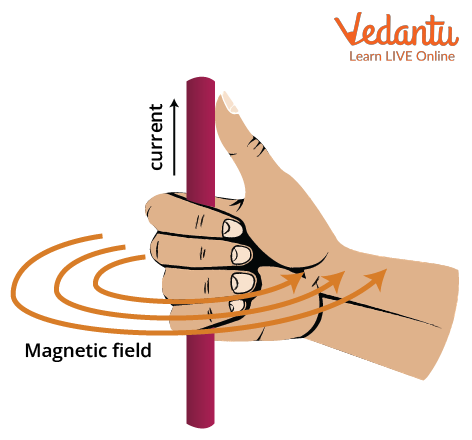
Right hand thumb rule
142
The closer together field lines are...
the stronger the field
143
Motor effect (4)
- current carrying wire put between magnetic poles
- magnetic field around the wire interacts with magnetic field it has been placed in
- so the magnet and wire exert a force on each other - causes the wire to move
- a coil of current-carrying wire in a magnetic field tends to rotate - basis of an electric motor
- magnetic field around the wire interacts with magnetic field it has been placed in
- so the magnet and wire exert a force on each other - causes the wire to move
- a coil of current-carrying wire in a magnetic field tends to rotate - basis of an electric motor
144
Motor effect force (5)
- wire has to be at $90\degree$ to the magnetic field to experience the full force
- if wire runs parallel to the magnetic field, it won't experience any force at all
- direction of the force is always at right angles to the wire and the field lines
- direction of the force reversed if either the current or the magnetic field is reversed
- size of force can be increased by increasing current or using a stronger magnet
- if wire runs parallel to the magnetic field, it won't experience any force at all
- direction of the force is always at right angles to the wire and the field lines
- direction of the force reversed if either the current or the magnetic field is reversed
- size of force can be increased by increasing current or using a stronger magnet
145
Magnetic flux density
shows strength of magnetic field - how many field (flux) lines there are in a region (Tesla, T)
146
Simple motor (6)
- current in one part of the rectangular coil causes a downward force
- current in the other part of the coil causes an upwards force
- these forces make the coil rotate
- when the coil is vertical, it moves parallel to the magnetic field, producing no force
- the momentum of the coil carries it on round a little
- split ring commutator changes the current direction every half turn, meaning each side of the coil is now near the opposite magnetic field
- current in the other part of the coil causes an upwards force
- these forces make the coil rotate
- when the coil is vertical, it moves parallel to the magnetic field, producing no force
- the momentum of the coil carries it on round a little
- split ring commutator changes the current direction every half turn, meaning each side of the coil is now near the opposite magnetic field
147
Split-ring commutator (4)
- swaps the positive and negative connections every half turn
- so direction of current through coil reverses every half turn
- this means forces acting on the coil will always be acting in the same direction
- this causes the coil to rotate continuously in one direction
- so direction of current through coil reverses every half turn
- this means forces acting on the coil will always be acting in the same direction
- this causes the coil to rotate continuously in one direction
148
Graphite brushes +ve
cause very little friction when in contact with the rotating commutator
149
Generator effect (2)
- creates a pd in a conductor and a current if the conductor is part of a complete circuit
- achieved by moving a magnet in a coil of wire or moving a conductor (wire) in a magnetic field (cutting the field lines)
- achieved by moving a magnet in a coil of wire or moving a conductor (wire) in a magnetic field (cutting the field lines)
150
How to create AC (2)
- if you move the magnet / conductor in the opposite direction / reverse the polarity of the magnet, the pd / current will be reversed
- if you keep the magnet / coil moving backwards and forwards, you produce a pd that keeps swapping direction - AC
- if you keep the magnet / coil moving backwards and forwards, you produce a pd that keeps swapping direction - AC
151
Turning a magnet in a coil (4)
- as a magnet turns, the magnetic field through the coil changes
- this change in magnetic field induces a pd, which can made a current flow
- once the magnet has been turned through half a turn, the direction of the magnetic field reverses the pd, making the current flow in the opposite direction
- if the magnet keeps turning in the same direction, the pd will keep reversing every half turn - AC
- this change in magnetic field induces a pd, which can made a current flow
- once the magnet has been turned through half a turn, the direction of the magnetic field reverses the pd, making the current flow in the opposite direction
- if the magnet keeps turning in the same direction, the pd will keep reversing every half turn - AC
152
For pd to be induced, there must be...
a changing magnetic field
153
What does induced current do to the change that made it?
opposes it - second magnetic field is created around the wire
154
How to increase the size of an induced pd? (3)
- increase the rate at which the magnetic field is changing:
- increase strength of magnetic field (so there are more field lines that can be cut)
- increase speed of the movement (to cut more field lines in a given time)
- increase strength of magnetic field (so there are more field lines that can be cut)
- increase speed of the movement (to cut more field lines in a given time)
155
Alternator (4)
- rectangular coil is forced to spin in a uniform magnetic field
- coil is connected to a centre-reading meter by metal brushes that press on 2 metal slip rings
- slip rings and brushes provide a continuous connection between the coil and the meter
- when the coil turns steadily in one direction, the current in the circuit repeatedly changes direction
- coil is connected to a centre-reading meter by metal brushes that press on 2 metal slip rings
- slip rings and brushes provide a continuous connection between the coil and the meter
- when the coil turns steadily in one direction, the current in the circuit repeatedly changes direction
156
When is size of induced pd greatest?
when plane of coil is parallel to the direction of the magnetic field - sides of coil cross directly through the magnetic field lines so induced pd is at peak value
157
When is size of induced pd zero? (2)
- when plane of coil is perpendicular to the magnetic field lines
- sides of the coil move parallel to the field lines and don't cross them
- sides of the coil move parallel to the field lines and don't cross them
158
How to increase AC frequency
make the coil rotate faster - each full cycle of the alternating pd takes the same time as one full rotation of the coil
159
How to increase AC peak value (3)
- make the coil rotate faster - sides of the coil cross through the magnetic field lines at a faster rate
- use a magnet with a stronger magnetic field
- use a coil with a bigger area and more turns of wire on it
- use a magnet with a stronger magnetic field
- use a coil with a bigger area and more turns of wire on it
160
Dynamos (2)
- same as alternators but have split-ring commutators instead of slip rings
- this swaps the connection every half turn to keep the current flowing in the same direction
- this swaps the connection every half turn to keep the current flowing in the same direction
161
Oscilloscopes (3)
- show how pd generated in a coil changes over time
- height of the line = pd
- increasing frequency of revolutions increases overall pd but also creates more peaks
- height of the line = pd
- increasing frequency of revolutions increases overall pd but also creates more peaks
162
Microphones (5)
- work by the generator effect
- soundwaves hit a flexible diaphragm that is attached to a coil of wire wrapped around a magnet
- this makes the coil of wire move in the magnetic field, which generates current
- movement of the coil depends on the properties of the soudwave (loud sounds make the diaphragm move further)
- pressure variations in the soundwave are converted into variations in current in an electric current
- soundwaves hit a flexible diaphragm that is attached to a coil of wire wrapped around a magnet
- this makes the coil of wire move in the magnetic field, which generates current
- movement of the coil depends on the properties of the soudwave (loud sounds make the diaphragm move further)
- pressure variations in the soundwave are converted into variations in current in an electric current
163
Loudspeakers and headphones (7)
- work by motor effect
- AC sent through a coil of wire attached to the base of a paper cone
- coil is surrounded by one pole of a permanent magnet and surround the other pole
- the current causes a force on the coil, making the coil move
- when the current reverses, the force acts in the opposite direction, making the cone move in the opposite direction as well
- variation in the current make the cone vibrate, making the air around the cone vibrate
- this creates variations in pressure and produces a sound wave
- AC sent through a coil of wire attached to the base of a paper cone
- coil is surrounded by one pole of a permanent magnet and surround the other pole
- the current causes a force on the coil, making the coil move
- when the current reverses, the force acts in the opposite direction, making the cone move in the opposite direction as well
- variation in the current make the cone vibrate, making the air around the cone vibrate
- this creates variations in pressure and produces a sound wave
164
Frequency of a sound wave in a loudspeaker =
frequency of the AC
165
Transformers (3)
- alternating pd applied across primary coil, so the iron core magnetises and demagnetises quickly
- this changing magnetic field induces an alternating pd in the secondary coil
- if the secondary coil is part of a circuit, a current is induced
- this changing magnetic field induces an alternating pd in the secondary coil
- if the secondary coil is part of a circuit, a current is induced
166
Ratio between primary and secondary pds
equal to ratio between their number of turns
167
Step up transformer
more turns on secondary coil
168
Why is iron used in transformers?
easily magnetised and demagnetised
169
Transformer efficiency
full efficiency assumed in GCSE calculations
170
Formation of a protostar (3)
- nebula (cloud of dust and gas) particles are pulled together by their own gravitational attraction
- this makes particles speed up
- clouds merge together and become more and more concentrated to form a protostar
- this makes particles speed up
- clouds merge together and become more and more concentrated to form a protostar
171
Protostar ---> Main sequence (4)
- protostar becomes denser - particles speed up and collide more
- temperature increases - process transfers energy from the protostar's gravitational potential store to its thermal store
- when temperature gets high enough, hydrogen nuclei undergo fusion to form helium nuclei
- this gives out lots of energy, keeping the core hot
- temperature increases - process transfers energy from the protostar's gravitational potential store to its thermal store
- when temperature gets high enough, hydrogen nuclei undergo fusion to form helium nuclei
- this gives out lots of energy, keeping the core hot
172
Formation of planets
objects too small to be stars can be attracted by a protostar to become planets orbiting the star
173
Main sequence star (2)
- energy released in core keeps it hot, so fusion continues
- radiation (eg. gamma) flows out steadily from the core in all directions
- radiation (eg. gamma) flows out steadily from the core in all directions
174
Why are stars stable? (3)
- gravity acts inwards, trying to make the star contract
- force of radiation from nuclear fusion in the core acts outwards, trying to make the star expand
- these forces stay in equilibrium until most of the hydrogen nuclei in the core have been fused together
- force of radiation from nuclear fusion in the core acts outwards, trying to make the star expand
- these forces stay in equilibrium until most of the hydrogen nuclei in the core have been fused together
175
What happens when a star runs out of hydrogen?
core collapses
176
Small star death (6)
- swell out, cool down and turn red - red giants
- helium and other light elements in the core fuse to form heavier elements
- when there are no more light elements in the core, fusion stops and no more radiation is released
- star collapses in on itself due to its own gravity
- heats up as it collapses and turns into a white dwarf
- white dwarf fades out, goes cold and becomes a black dwarf
- helium and other light elements in the core fuse to form heavier elements
- when there are no more light elements in the core, fusion stops and no more radiation is released
- star collapses in on itself due to its own gravity
- heats up as it collapses and turns into a white dwarf
- white dwarf fades out, goes cold and becomes a black dwarf
177
Big star death (5)
- swell out to red supergiants, then collapse
- in the collapse, the matter surrounding the core compresses the core more and more
- compression suddenly reverses in a supernova explosion - can outshine an entire galaxy for several weeks
- explosion compresses the core into a neutron star - extremely dense object only made up of neutrons
- if the star is big enough, it becomes a black hole - gravitational field so strong that nothing can escape from it
- in the collapse, the matter surrounding the core compresses the core more and more
- compression suddenly reverses in a supernova explosion - can outshine an entire galaxy for several weeks
- explosion compresses the core into a neutron star - extremely dense object only made up of neutrons
- if the star is big enough, it becomes a black hole - gravitational field so strong that nothing can escape from it
178
Wavelengths of light
increase across the spectrum from blue to red
179
Object moving away from Earth (2)
- light waves are stretched out and wavelengths are increased
- makes the spectrum of light switch towards the red part of the spectrum - red shift
- makes the spectrum of light switch towards the red part of the spectrum - red shift
180
Object moving towards Earth (2)
- light waves are squashed together and wavelengths are reduced
- this makes the spectrum of light shift towards the blue part of the spectrum - blue shift
- this makes the spectrum of light shift towards the blue part of the spectrum - blue shift
181
Identifying red / blue shift
- dark spectral lines are caused by absorption of light by specific atoms such as hydrogen
- position of these lines shows if there is a shift and what type of shift it is
- position of these lines shows if there is a shift and what type of shift it is
182
The faster an object is moving (relative to the earth)...
the bigger the shift - so the more squashed together / stretched out the waves are
183
Edwin Hubble discovery (2)
- light from distant galaxies is red-shifted
- the further a galaxy is from the Earth, the bigger its red-shift
- the further a galaxy is from the Earth, the bigger its red-shift
184
Edwin Hubble conclusion (3)
- distant galaxies are receding from Earth
- the greater the distance of a galaxy from Earth, the greater the speed at which it is moving away
- so the universe is expanding
- the greater the distance of a galaxy from Earth, the greater the speed at which it is moving away
- so the universe is expanding
185
Birthplace of light elements (3)
- formed from fusion in stars - hydrogen nuclei fused into helium and other small nuclei
- red giants fuse helium and other small nuclei into larger nuclei
- nuclei larger than iron can't be formed in this way - too much energy needed
- red giants fuse helium and other small nuclei into larger nuclei
- nuclei larger than iron can't be formed in this way - too much energy needed
186
Birthplace of heavy elements (4)
- formed when a massive star collapses and then explodes as a supernova
- enormous force of collapse fuses small nuclei into nuclei larger than iron
- explosion scatters elements throughout universe
- debris contains all known elements - new stars and planets form from this
- enormous force of collapse fuses small nuclei into nuclei larger than iron
- explosion scatters elements throughout universe
- debris contains all known elements - new stars and planets form from this
187
Centripetal force in orbits (2)
- force of gravity on a planet from the sun acts towards the centre of the sun
- thsi is the resultant force on the planet because no other forces act on it
- thsi is the resultant force on the planet because no other forces act on it
188
Circular orbit (6)
- centripetal force would cause the planet to just fall towards the sun, but as the planet is already moving, it just changes direction
- planet moves in a circle so has a constantly changing velocity
- so constantly accelerating (acceleration = change in v per second)
- force on the planet is at right angles to its direction of motion
- so no work is done on the planet - kinetic energy and speed don't change
- planet keeps accelerating towards the sun but instantaneous velocity keeps it travelling in a circle
- planet moves in a circle so has a constantly changing velocity
- so constantly accelerating (acceleration = change in v per second)
- force on the planet is at right angles to its direction of motion
- so no work is done on the planet - kinetic energy and speed don't change
- planet keeps accelerating towards the sun but instantaneous velocity keeps it travelling in a circle
189
Orbit definition
the curved path of one celestial object or spacecraft around another
190
The closer a satellite is to the earth... (3)
- the stronger the gravitational force
- so satellites need to move faster to stay in orbit
- shorter amount of time to move around the orbit once (circumference is smaller and speed is greater)
- so satellites need to move faster to stay in orbit
- shorter amount of time to move around the orbit once (circumference is smaller and speed is greater)
191
To stay in orbit at a particular distance...
a small body must move at a particular speed around a larger body
192
Satellite too close to Earth (2)
- gradually lose speed due to atmospheric drag when satellite's orbit is in the upper atmosphere
- if a satellite loses speed, it gradually spirals inwards until it hits the Earth's surface
- if a satellite loses speed, it gradually spirals inwards until it hits the Earth's surface
193
Geostationary satellites (2)
- they orbit the Earth in the same direction as the Earth's spin, with a period of 24 hours
- communications satellites
- communications satellites
194
Monitoring satellites (2)
- much lower orbits than geostationary - once every 2 /3 hours
- weather forecasting and environment monitoring
- weather forecasting and environment monitoring
195
Big bang theory (2)
- universe is expanding after exploding suddenly from a very small and extremely hot and dense region
- space, time and matter were created in the Big Bang
- space, time and matter were created in the Big Bang
196
Steady state theory
galaxies are being pushed apart by matter entering the universe through 'white holes' - opposite of black holes
197
Big Bang evidence (4)
- if the universe started with the Big Bang, then high-energy radiation must have been produced shortly after
- this would have stretched as the universe expanded and become lower-energy radiation
- cosmic microwave background radiation (CMBR) discovered coming from every direction in space
- this used to be gamma but wavelengths got longer until it was microwaves
- this would have stretched as the universe expanded and become lower-energy radiation
- cosmic microwave background radiation (CMBR) discovered coming from every direction in space
- this used to be gamma but wavelengths got longer until it was microwaves
198
Dark matter (3)
- astronomers think that the stars in a galaxy account for only a small percentage of its total mass
- galaxies would spin much faster if their stars were the only matter
- missing mass = dark matter
- galaxies would spin much faster if their stars were the only matter
- missing mass = dark matter
199
Dark matter and density
dark matter means that the average density of the universe is much bigger than if it didn't exist
200
Big yawn
if the density of the universe is less than a particular amount, it will expand forever and stars will die out
201
Big crunch
if the density of the universe is more than a particular amount, it will stop expanding and go into reverse
202
Dark energy (2)
- distant galaxies are accelerating
- gravity is the only known force on the distant galaxies but can't be used to explain dark energy because it's an attractive force
- gravity is the only known force on the distant galaxies but can't be used to explain dark energy because it's an attractive force
203
Perfect black body (2)
- object that absorbs all the radiation that hits it - none is reflected or transmitted
- since a good absorber is also a good emitter, a perfect black body would be the best possible emitter
- since a good absorber is also a good emitter, a perfect black body would be the best possible emitter
204
Objects emitting EM radiation (2)
- all objects emit EM radiation due to the energy in their thermal stores
- this is not just infrared - covers a range of wavelengths and frequencies
- this is not just infrared - covers a range of wavelengths and frequencies
205
Wavelengths emitted by an object in relation to temperature (5)
- intensity and distribution of wavelengths emitted by an object depend on its temperature
- intensity is the power per unit area - how much energy is transferred to a given area in a given amount of time
- as the temperature of an object increases, the intensity of every emitted wavelength increases
- intensity increases more rapidly for shorter wavelengths
- this causes the peak wavelength (with the highest intensity) to decrease / be of a shorter wavelength
- intensity is the power per unit area - how much energy is transferred to a given area in a given amount of time
- as the temperature of an object increases, the intensity of every emitted wavelength increases
- intensity increases more rapidly for shorter wavelengths
- this causes the peak wavelength (with the highest intensity) to decrease / be of a shorter wavelength
206
Radiation and Earth's temperature (4)
- in the day, lots of radiation (like light) is transferred to Earth from the Sun and absorbed - increase in local temperature
- at night, less radiation is being absorbed than is being emitted, which decreases the local temperature
- overall Earth temperature remains fairly constant
- if atmosphere starts to absorb more radiation without emitting the same amount, the overall temperature will rise until absorption and emission are equal again
- at night, less radiation is being absorbed than is being emitted, which decreases the local temperature
- overall Earth temperature remains fairly constant
- if atmosphere starts to absorb more radiation without emitting the same amount, the overall temperature will rise until absorption and emission are equal again