CIVE 321 Exam 2
Study these flashcardsFree · spaced repetition · iPhone, Android, Mac & web
All cards
1
State the general goals of wastewater treatment.
1. Protect people and ecosystems from toxic materials in wastewater.
2. Remove suspended solids and pollutants before the effluent returns to the environment.
3. Preserve the water quality of natural water resources such as rivers and lakes.
4. Make wastewater usable for other purposes
2. Remove suspended solids and pollutants before the effluent returns to the environment.
3. Preserve the water quality of natural water resources such as rivers and lakes.
4. Make wastewater usable for other purposes
2
Identify the different levels/categories of wastewater treatment
pre-, primary, secondary, and tertiary treatment
3
Describe the general processes associated with primary treatment.
Bar rack, grit chamber, equalization basin, primary settling. Removes pollutants that will either settle or float.
4
Describe the general processes associated with secondary treatment.
Bar rack, grit chamber, equalization basin, primary settling, biological treatment, secondary settling. Achieved by using biological processes to break down organic pollutants and remove more than 85% of BOD and suspended solids.
5
Describe the general processes associated with advanced/tertiary treatment.
Bar rack, grit chamber, equalization basin, primary settling, biological treatment, secondary settling, tertiary wastewater treatement. Used when secondary treatment is not adequate and involves chemical treatment and filtration of wastewater.
6
Describe the purpose, possible unit operations, and typical layout for a wastewater treatment plant. In other words, what are the main processes one might see for the water to pass through, and what is the typical order?Terms
Raw sewage, bar rack, grit chamber, equalization basin, primary settling, biological treatment, secondary settling, tertiary wastewater treatment, receiving body.
7
Describe the components of a completely mixed activated sludge treatment system.
(Influent) -> (Aeration Basin) -> (Secondary Clarifier) -> (Effluent, Waste Sludge, Return Sludge)
8
Explain the overall idea for biological treatment - what three things are we converting the soluble and colloidal pollutants to?
To convert soluble and colloidal pollutants to microbes (solids), gases (CO2, CH4, N2), and water
9
3 Metabolic Characterizations of Microorganisms
Respiration. carbon sources, energy sources
10
Terms typically used for respiration
aerobic, anaerobic, obligate anaerobes, facultative, photosynthesis
11
Terms typically used for carbon sources
organic carbon, inorganic carbon
12
Terms typically used for energy sources
light (photosynthesis), organic chemicals, inorganic chemicals
13
Aerobic microorganisms
require O2 for cell production
14
Anaerobic microorganisms
use something other than O2 for cell production
15
Obligate Anaerobes
require complete absense of O2 because it is toxic to them
16
Facultative microorganisms
can grow without O2 or in low O2 environments, but will use O2 for metabolism when present
17
What are the ideal temperature preferences of microorganisms?
Cryphilic (10-20), Mesophilic (25-40), Thermophilic (50-65) (Degrees Celsius)
18
What are the three important things that microorganisms do that we model with biological kinetics?
Growth, use substrate (pollutants/what the bacteria is treating), die/decay
19
Describe what provided air and oxygen to a trickling filter system.
natural air flow through an underdrain system
20
Different types of oxidation ponds
Facultative, Aerated (Aerobic), Anaerobic, Complete Retention (or "no discharge")
21
How does a facultative pond work?
Sludge is removed periodically; up to 95% BOD removed in summer, none removed in winter except sedimentation
22
How does an aerobic pond work?
Like a CMR; mechnaical aeration used to maintain a high oxygen content throughout the pond
23
How does an anaerobic pond work?
Very deep, unmixed basin, usually used as pretreatment for strong industrial wastes
24
How does a complete retention pond work?
No discharge/outlet, avoids significant seepage from bottom, designed large to avoid overflow
25
What are the primary purposes of sludge treatment?
1. Reduce the volume of water so that sludge behaves as a solid and not a liquid
2. Reduce the mass of the solids
3. Reduce the concentration of pathogens (wastewater sludges)
2. Reduce the mass of the solids
3. Reduce the concentration of pathogens (wastewater sludges)
26
List possible treatment processes for sludge.
Aerobic Digestion, Anaerobic Digestion, Thickening, Dewatering
27
List the three key steps for anaerobic digestion.
i. Hydrolysis and Fermentation
ii. Acid Formation
iii. Methane Formation
ii. Acid Formation
iii. Methane Formation
28
List common methods of disposing of sludge and the ultimate disposal options.
1. Land Application
2. Fertilizer and Soil Conditioner
3. Ocean Disposal
4. Disposal in Landfills
5. Incineration of sludge
2. Fertilizer and Soil Conditioner
3. Ocean Disposal
4. Disposal in Landfills
5. Incineration of sludge
29
Recognize key water quality contaminants of concern for drinking water.
Total coliform, Fecal coliform, E. Coli
30
Define what a pathogen is.
a disease-causing microorganism
31
Provide examples of water borne diseases.
cholera, typhoid, polio
32
Explain what the objective of coagulation is.
To coagulate particles together so that they grow in size and are less stable, and can be removed by sedimentation and filtration processes
33
Explain why colloids (very small particles) are difficult to remove using settling.
As particle size decreases, the settling velocity decreases. So, small colloids may not be removed by sedimentation alone.
34
Explain what a jar test is and why it is performed.
A 6 beaker test where water is mixed and flocculated with the same dose of alum and varying pHs, then holding the pH constant and varying the alum dosage. It is used to determine the efficiency of coagulants in wastewater treatment.
35
Be able to identify on Jar test data where each destabilization method may be responsible.
Adsorption-destabilization: dose-turbidity curve shows charge-reversal (steep at higher doses).
Sweep coagulation: dose-turbidity curve does not show charge reversal (relatively flat at higher doses).
Sweep coagulation: dose-turbidity curve does not show charge reversal (relatively flat at higher doses).
36
List what the different destabilization methods for particles are.
Compression of Double Layer, Adsorption and Charge Neutralization, Enmeshment in a precipitate ("Sweep Floc"), Adsorption and Interparticle Bridging
37
Explain "Compression of Double Layer" for destablization.
Concentration of ions in solution increases, and volume surrounding the particle to balance the surface charge is reduced. This makes it easier for particles to collide and form a new larger particle.
38
Explain "Adsorption and Charge Neutralization" for destabilization.
Chemical coagulants attach themselves to the surface of particles, and if the surface has charge opposite to that of the coagulant, the charge on the surface is reduced or eliminated.
39
Explain "Enmeshment in a Precipitate ("Sweep Floc") for destabilization.
Like a snow globe; coagulant is added in large enough quantities to cause precipitate to form. Particles in the water are trapped within the precipitate as it forms or captured as floc particles settle.
40
Explain "Adsorption and Interparticle Bridging" for destabilization.
Applies to coagulants that are synthetic organic polymers of large molecular weight with mutliple charges along a chain of carbon atoms. Polymers attach to surface of two or more particles to tie them together.
41
Define flocculation and explain how it is applied at a treatment plant.
Flocculation is slow mixing (stirring) to encourage floc formation during coagulation to grow larger in size to create larger solids that can easily settle or be filtered. It is typically applied at a treatment in basins with large paddles that mix slowly.
42
Explain the decisions made concerning flocculation design.
1. Duration of Mixing (hydraulic residence time in flocculation tank)
2. Intensity of Mixing (G)
2. Intensity of Mixing (G)
43
Define sedimentation.
A process where "heavy" solids are removed by gravity settling
44
State where sedimentation is relevant in water (and wastewater) treatment (where used in a plant flow process diagram as drawn in class).
Sedimentation basin, settling basin, clarifier
45
List the key assumptions typically used for sedimentation basin design.
For Type I Design:
1. Plug-flow reactor
2. Particle introduced at top of reactor (tank)
3. Particle settling velocity such that particle just hits the bottom at the end of the tank
1. Plug-flow reactor
2. Particle introduced at top of reactor (tank)
3. Particle settling velocity such that particle just hits the bottom at the end of the tank
46
Explain why electrostatic charge is important for the removal of particles in water and air for filtration.
Particles tend to have a surface charge that attracts ions of opposite charge, forming an electrical double layer. The diffuse layers of particles repel as they get close to one another, preventing coagulation. But, Van der Waals forces cause attraction at very close distances, so it is important that particles collide in order to coagulate for removal.
47
Explain why airborne viral particles may settle more slowly in indoor air in the winter than in the summer.
Relative humidity is lower, so evaporation is faster, making the size of particles smaller.
48
Explain how a filter works and why particles are not typically removed by straining in granular gravity filtration.
Solids are separated from the water by passing the water through a porous bed that retains the solids. Particles attach onto other particles in media. Particles are not typically removed by straining in granular gravity filtration because particples must get stuck in the pore space between media in order to be strained.
49
Explain filter operation and backwashing.
Colloids become trapped in the media and pore spaces between media become smaller, increasing the change of particple contact with media or other particles. Water flows through filters until solids accumulation is large. The filter is then backwashed to remove the accumulated solids if filtrate quality is not good enough or is head loss is too great.
50
Define ripening and explain why it occurs.
Ripening is the period of time that shows a spike in the number of particles once particles first begin to start to adhere to the filter after a backwash cycle.
51
Explain why multiple media sizes are used.
Multiple media sizes are used because these are able to remove a wider range of particle sizes and types.
52
Explain which mechanisms are most important for the removal of small particles (e.g., viruses) in water.
Straining (particles get stuck in pore space), Sedimentation (settle out of water onto media), Interception (hits media and sticks while moving through filter), Brownian Motion (random motion of small particles)
53
Explain the "requirements" for disinfectants.
1. Must deactivate the pathogens in the water
2. Meet possible fluctations in composition and concentration in the water
3. Are neither toxic to humans and domestic animals nor unpalatable or objectionable in required concentrations
4. Must be dispensable at a reasonable cost and safe/easy to store, transport, handle, and apply
5. Strength and concentration must be determined easily in treated water.
6. Must persist within disinfected water with sufficient concentration to provide protection against recontamination.
2. Meet possible fluctations in composition and concentration in the water
3. Are neither toxic to humans and domestic animals nor unpalatable or objectionable in required concentrations
4. Must be dispensable at a reasonable cost and safe/easy to store, transport, handle, and apply
5. Strength and concentration must be determined easily in treated water.
6. Must persist within disinfected water with sufficient concentration to provide protection against recontamination.
54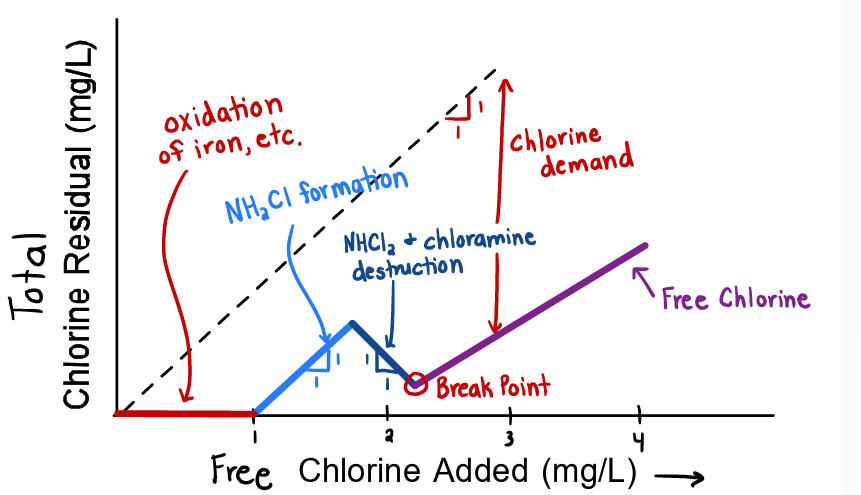
Identify chlorine demand and explain the key pieces of the breakpoint chlorination figure.
55
Define DBP.
Disinfection by-products; organic chemicals formed during disinfection using chlorine.
56
List two alternative disinfectants.
Chloramines, Ozone, or Ultraviolet Radiation
57
Explain UV disinfection and its pros and cons.
UV disinfection causes the DNA of pathogenic organisms to over-absorb ultraviolet light (between 200-300 nanometers), which renders the organisms incapable of reproducing. Pros: smaller footprint, minimized pollution from airborne material, minimal personnel exposure to UV during drinking water treatment, modular design makes installation simple. Cons: no residual, dark repair of microbial DNA.
58
Define anion and canion.
An anion is a negatively charged ion, and a canion is a positively charged ion.
59
Identify the carbonate system and explain why it is a very important system in natural waters.
The carbonate system is a natural buffer against large pH changes produced by carbon dioxide (CO2) via the chemical equation:
CO2 + H2O --> H2CO3 --> H(+) + HCO3(-) --> 2H(+) + CO3(2-)
When CO3(2-) reacts with Ca(2+), which occurs naturally as limestone, it creates a calcium carbonate precipitate (CaCO3). This is the fundamental reaction used in water softening.
Screenshot 2023-11-20 at 9.20.38 PM.png
CO2 + H2O --> H2CO3 --> H(+) + HCO3(-) --> 2H(+) + CO3(2-)
When CO3(2-) reacts with Ca(2+), which occurs naturally as limestone, it creates a calcium carbonate precipitate (CaCO3). This is the fundamental reaction used in water softening.
Screenshot 2023-11-20 at 9.20.38 PM.png
60
Define water hardness (what it is, and what ions contribute).
Hard water is water that does not lather well, causes scum in bath tubs, and leaves scale deposits on water heaters and pots. It is characterized by the amount of calcium, Ca(2+), and magnesium, Mg(2+), dissolved in water.
61
Draw a bar diagram and identify the concentration of each type of hardness for a given water.
Carbonate hardness: Lesser of total hardness or approximate alkalinity, often Conc. of HCO3(-) as CaCO3 + 2•Conc. of CO3(2-) as CaCO3
Non-carbonate hardness: Total hardness - carbonate hardness, Conc. of Ca(2+) as CaCO3 + Conc. of Mg(2+) as CaCO3 - [Conc. of HCO3(-) as CaCO3 + 2•Conc. of CO3(2-) as CaCO3]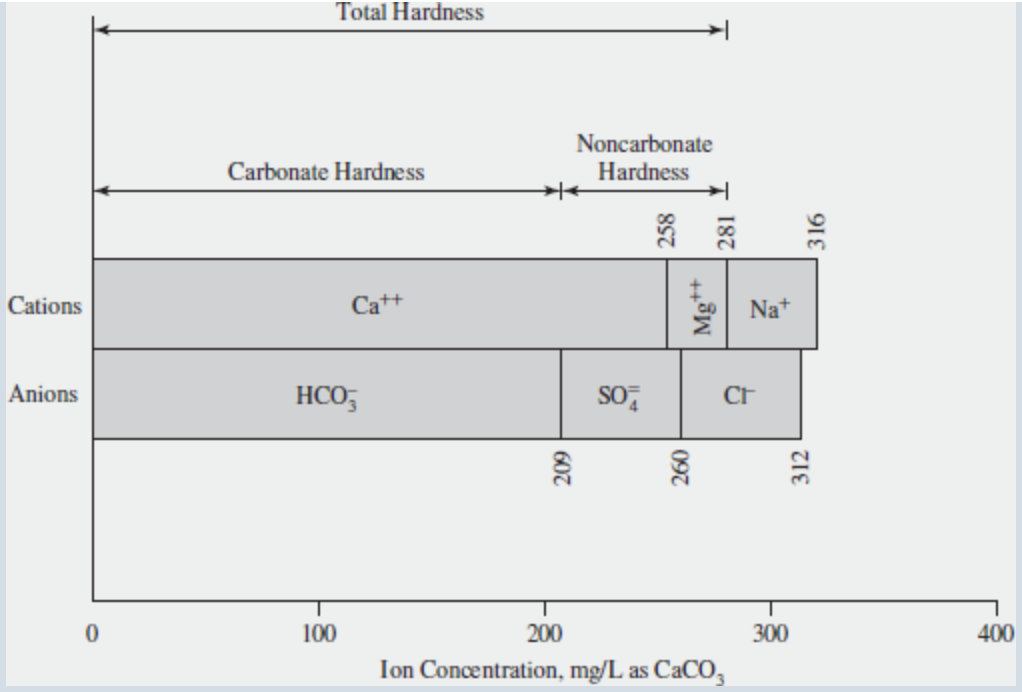
Non-carbonate hardness: Total hardness - carbonate hardness, Conc. of Ca(2+) as CaCO3 + Conc. of Mg(2+) as CaCO3 - [Conc. of HCO3(-) as CaCO3 + 2•Conc. of CO3(2-) as CaCO3]
62
Define softening and identify the different methods used to soften water.
Softening is the process of removing Ca(+2) and Mg(+2) from water.
Chemical precipitation: Using a base, often lime - Ca(OH)2, to form a precipitate containing hardness ions
Ca(OH)2 + Ca(HCO3(-)) --> 2 CaCO3 + H2O
Ca(OH)2 + Mg(HCO3(-)) --> 2 CaCO3 + Mg(OH)2 + H2O
Ion exchange: Using an ion exchange resin to exchange Ca(+2) & Mg(+2) for ions of similar charge, often Na(+), attached to the resin surface
CaCl2 + R-(Na)2 --> R-Ca + 2 NaCl
Chemical precipitation: Using a base, often lime - Ca(OH)2, to form a precipitate containing hardness ions
Ca(OH)2 + Ca(HCO3(-)) --> 2 CaCO3 + H2O
Ca(OH)2 + Mg(HCO3(-)) --> 2 CaCO3 + Mg(OH)2 + H2O
Ion exchange: Using an ion exchange resin to exchange Ca(+2) & Mg(+2) for ions of similar charge, often Na(+), attached to the resin surface
CaCl2 + R-(Na)2 --> R-Ca + 2 NaCl