Biology Test 1
Study these flashcardsFree · spaced repetition · iPhone, Android, Mac & web
All cards
1
Classification Hierarchy
KPCOFGS
2
How many named species?
1.8 million
3
How many estimated species?
10-100 million
4
Defining features of living things
Order, regulation, energy processing, evolutionary adaptatin, response to environment, reproduction, growth and development
5
Binomial nomenclature
Genus species, italicized or underlined
6
Discovery science
Approach to science that is based on observations and data analysis, then makes conclusions
7
Hypothesis-based science
Hypothesis used to predict results
8
Hypothesis
Testable/falsifiable, alternatives available, cannot be "proved" - can only fail to falsify
9
experimental group
test group; receives treatment
10
Control group
not affected by experimental factors
11
Hardy-Weinberg Equilibrium
Large, closed population, random mating, lots of resources/no competition, few predators --> little selection of specific traits
12
Peppered moth experiment
Looked at the adaptation of moths in England over time (peppered vs darker look)l Kettlewell and Majerus; showed natural selection's outcome isn't specific to one outcome
13
Guppy fish experiment
Showed that certain traits (such as bright spots) can increase in both habitats with no predators and light predators, whereas they will decrease in habitats with strong predators
14
Natural selection
Shifts population towards traits with better survival rates; predator preference, camouflage, color/mating preferences, reproductive success; no specific direction
15
Unity
Cell structures (cilia), DNA
16
Morphological species
Species that have similar traits; not accurate because one can find similarities and diversification within the same species
17
Biological species
Individuals that can reproduce in nature to produce viable/fertile offspring
18
phylogenetic species
individuals that share same features (morphological, genetic, chemical) that point towards common ancestor
19
phylogenetic tree
diagram that shows hypothetical evolutionary relationships
20
nodes
place where two branches meet
21
sister taxa
two branches that descend from the same immediate ancestor; interchangeable
22
cladistics
study of shared traits with extant species and ancestral species
23
clade
a group of species that includes an ancestral species and all of its descendents (monophyletic taxon)
24
monophyletic group
a group that includes an ancester and ALL of its descendents
25
paraphyletic taxon
a group that starts with a common ancestor and includes some (but not all) the descendents
26
polyphyletic group
organisms classified using common traits but that aren't based on common ancestors
27
Classification Hierarchy
KPCOFGS
28
Classification Hierarchy
KPCOFGS
29
allopatric speciation
Type of speciation where geographic isolation stops gene flow
30
gene flow
mix of genes from separate populations
31
Process of allopatric speciation
Geographic isolation -> natural selection and genetic drift -> reproductive isolation -> speciation
32
Fruit fly experiment
Separated fruit flies of different colors to show allopatric speciation
33
Sympatric speciation
origin of new species without geographic isolation
34
polyploidization
random genetic mutations
35
ecological speciation
type of sympatric speciation where ecologically-based factors cause barriers to gene flow between populations (ecological/food/mating preferences)
36
Pre-zygotic barriers
temporal, habitat, behavioral, mechanical, gametic
37
temporal barrier
animals reproduce at different times
38
habitat isolation
barrier to reproduction because animals live in separate habitats (ex - crickets living in grass or sand)
39
behavioral isolation
barrier to reprod because behaviors only attract certain animals (ex - Bowerbird decorating nest or dancing)
40
mechanical isolation
barrier to reproduction because male genitalia doesn't work with all females (ex - Damselfly)
41
gametic isolation
barrier to reproduction because the gametes are not compatible
42
gamete
sex sells aka haploids
43
zygote
fertilized egg, fused sex cells
44
post-zygotic barriers
reduced hybrid viability, reduced hybrid fertility, hybrid breakdown
45
reduced hybird viability
post-zygotic barrier where offspring isn't well-suited to surviving in the environment
46
reduced hybrid fertility
post-zygotic barrier where offspring can't produce sex cells
47
hybrid breakdown
post-zygotic barrier where hybrid is viable but second generation isn't (mostly found in plants like cotton)
48
Prokaryote characteristics
Unicellular, small, no membrane-bound structures, cell wall of peptidoglycan or pseudomurin or s-layer made of 1 molecule, cell membrane, spherical-rod-spiral)
49
How big are most prokaryotes?
0.5-5 micrometers
50
How big are most eukaryotic cells?
10-100 micrometers
51
coccus/cocci
spherical prokarya
52
bacillus-bacilli
rod-shaped prokarya
53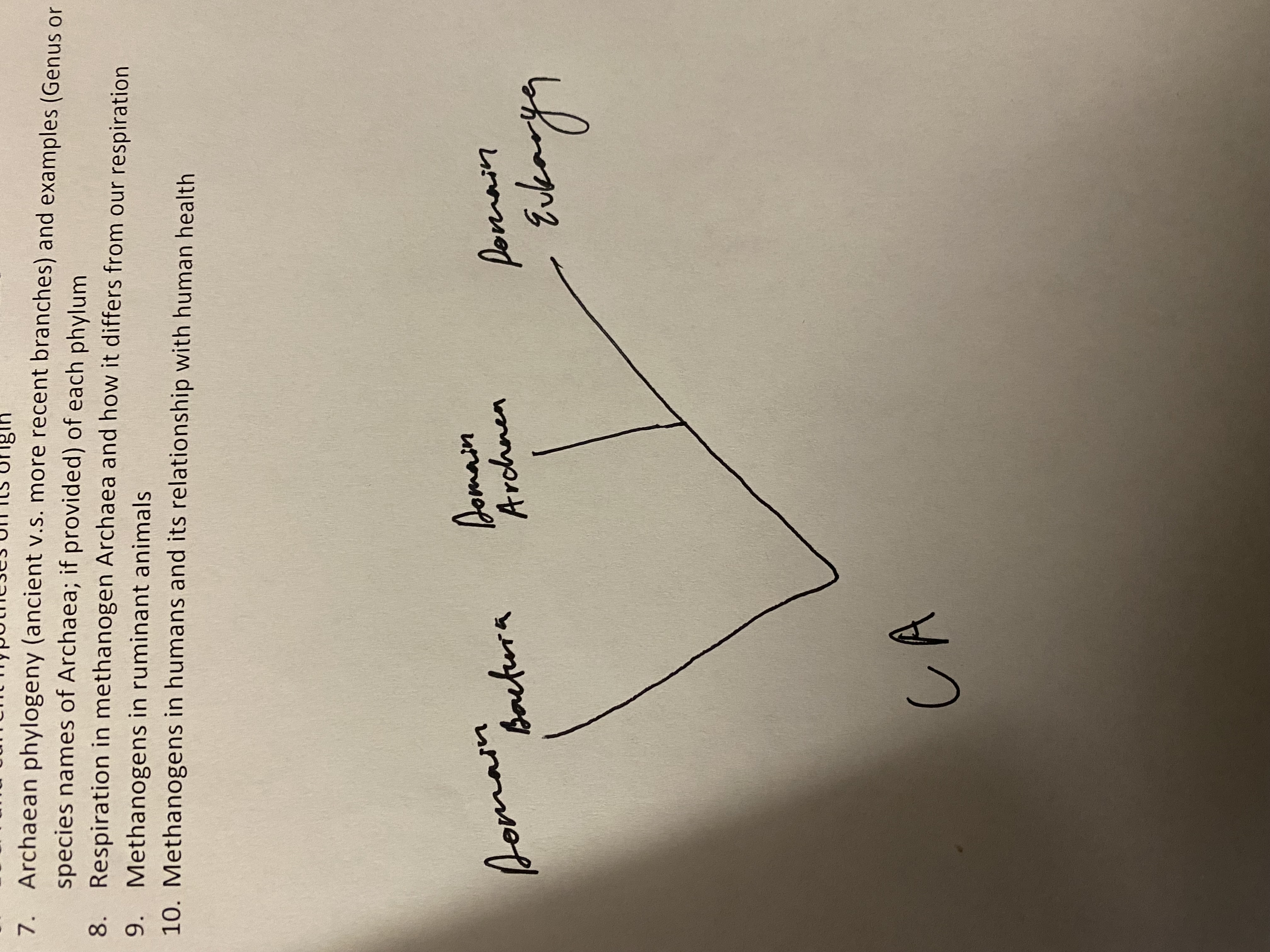
Image occlusion: name the hidden labels
54
cell wall of archaea
cell wall that has pseudomurin, s-layer
55
s-layer
a part of cell wall that is thin and made of only one molecule
56
cell membrane of bacteria
cell membrane that is similar to eukarya and made of a lipid bilayer and fatty acids
57
cell membrane of archaea
cell membrane that is made up of a lipid bilayer or monolayer and phytanyl groups
58
ribosomes
cell part that synthesize proteins, has no membrane in prokaryotic cells
59
structures of prokaryotes
capsule, ribosomes, DNA, chromosomes/plasmid, flagellum, pilli
60
plasmid
prokaryotic DNA that is exchanged in sexual reproduction
61
capsule
external structure of prokaryotic cells that is made of poly-saccharide; allows bacteria to attach to surfaces and communicate with other cells; outside cell wall
62
flagellum
external structure of prokaryotic cells that is used for movement or secretion
63
exaptation
different from adaptation but similar; when a function is co-opted from structures/chemicals/molecules that are meant for other purposes (ex - feathers originally for temperature regulation but also used for flight)
64
pilli
external structures on capsule of prokaryotic cells that are used to exchange plasmid and attach to surfaces
65
Asexual (binary fission) and sexual (conjugation)
2 types of reproduction for prokaryotic cells
66
Binary fission
asexual reproduction of prokaryotic cells; no exchange of genetic material; duplication of DNA followed by division into two cells
67
Conjugation
sexual reproduction of prokaryotic cells; exchange of genetic material among individuals; beneficial to survival because genetic variation increases suitability to the environment
68
chemosynthesis
energy production from chemicals such as hydrogen sulfide (performed by archaea)
69
extremophiles
Name for archaea that live in extreme environments
70
Habitats of archaea
High saline, high acidity, high temperature, deep ocean hydrothermal vent, anaerobic environments, soil, water, guts
71
Archaea features
Circular chromosome, no organelles; cell walls but no true peptidoglycan; hard to culture
72
Similarities between Archaea and Bacteria
Unicellular, Cell Wall
73
Similarities between Archaea and Eukarya
DNA/RNA synthesizing, chromosome replicating, DNA with histone
74
LUCA
Last Universal Common Ancestor, determined by shared genese
75
Look at DNA sequences
Method to study non-culturable prokaryotes
76
primordial soup hypothesis
Theory that life started on Earth's surface with UV light/lightning for energy
77
hydrothermal vent hypothesis
Theory that life started in Earth's vents with chemicals for energy
78
Image occlusion: name the hidden labels
79
Image occlusion: name the hidden labels
80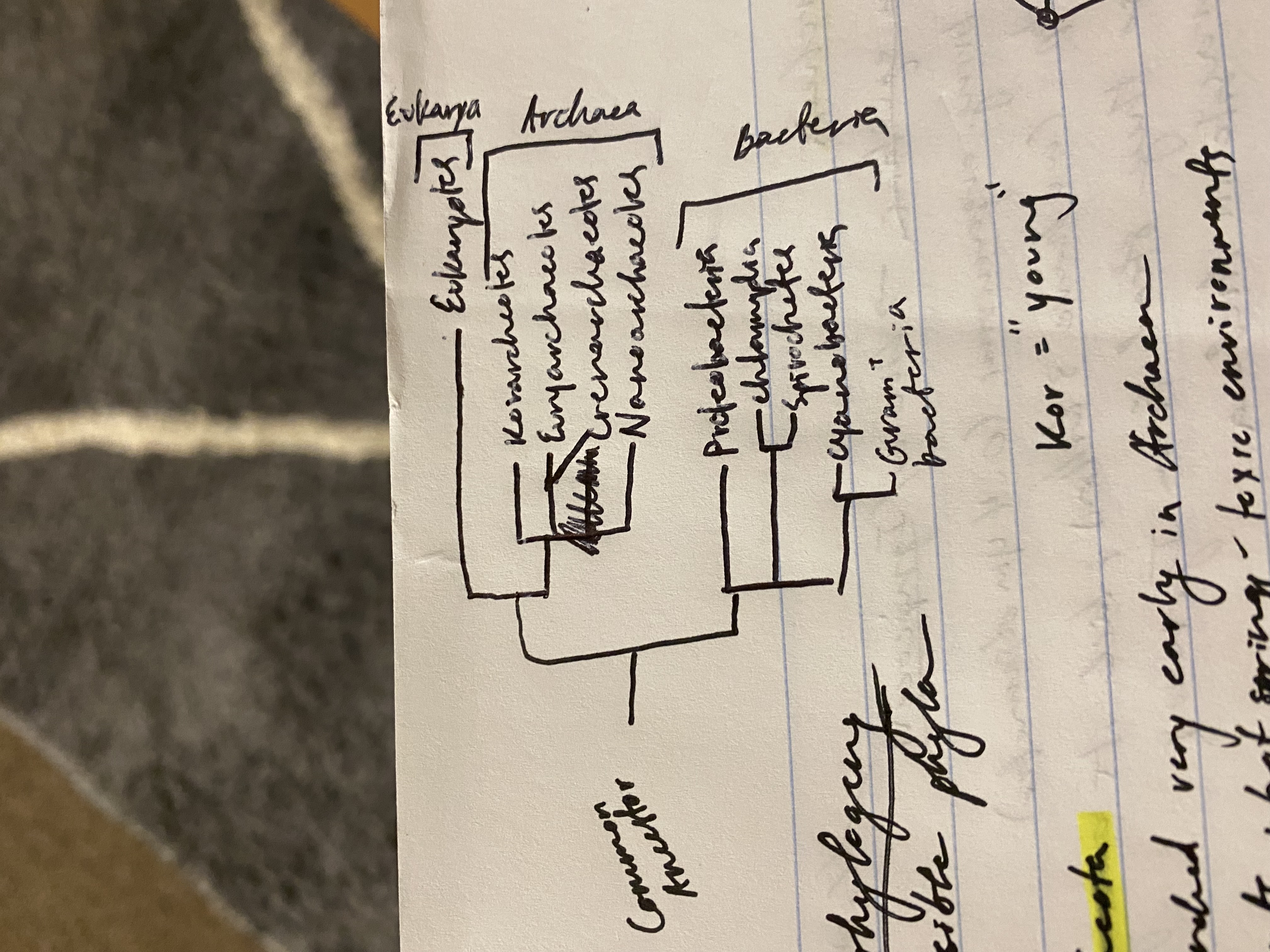
Image occlusion: name the hidden labels
81
Korarcheota
Phylum branched very early in Archaea; name means "young", found in vents and hot springs (ex - Candidatus Korarcheum cryptofilum)
82
Euryarcheota
Archaea phylym that includes methanogens and halophiles
83
Methanogens
Archaea that live in anaerobic habitats (sediments, guts); don't need O2 to make energy
84
ruminates
Cows, goats, sheep, camels, deer, bison, etc - cud-chewing animals
85
Respiration in methanogen archaea
CO2 + H2 --> CH4 + H2O
86
Methanopyrus kandleri
methanogen species; hyperthermophile
87
Methanobrevibactor smithii
methanogen species found in 96% of human guts
88
How do methanogens affect human health?
Lack of methanogens to use up H2 can cause IBS/IBD
89
Crenarchaeota
Phylym of archaea that live in hot springs, hydrothermal vents, acidic places, and ocean; thermo(acido)philes; chemosynthetic (sulfur)
90
Nanoarcheota
Phylum of archaea that is known for being really small and parasitic
91
Nanoarchaeum equitans
Example of an archaean nanoarcheota species
92
Ignococcus
A type of Crenarcheote that is often a victim of nanoarcheota
93
basal taxon
taxon where the most ancestral traits are shared