biomechanical movements
Study these flashcardsFree · spaced repetition · iPhone, Android, Mac & web
All cards
1
linear motion
motion in a straight or curved line with all body parts moving at the same distance, at the same speed and in the same direction
2
what do newtons laws describe
the relationship between a body and the forces acting on it, and the bodys motion in responce to these forces
3
what are newtons 3 laws of motion
1.law of inertia, 2.law of acceleration, 3. law of action / reaction
4
newtons first law of motion (inertia)
a force is required to change the state of motion. if an object is at rest it will remain still; simularly if its moving it will continue to do so at the same velocity until another force is exerted upon it.
5
what causes a greater inertia
a greater mass
6
inertia
the resistance an object has to change its state of motion
7
what does newtons first law state
"every body continues in its state of rest or motion in a straight line, unless compelled to change that state by external forces exerted upon it"
8
newtons second law of motion (acceleration)
the magnitude (size) and direction of the force determins the magnitude and direction of the acceleration givern to a body
9
what does newtons second law state
"the rate of momentum of a body (or acceleration for a body of constant mass) is proportional to the force causing it and change that takes place in the direction at which the force acts"
10
what is a basic definition of newtons 2nd law
the magnitude and direction of the force determins the magnitude and direction of acceleration
11
equation used to calculate the size of force
force = mass X acceleration
12
how does force applied affect acceleration
the greater the force applied the greater the acceleration
13
newtons third law of motion (action / reaction)
for every action there is an equal and opposite reaction. describes what happeneds when 2 bodies exert force on one another. action acts on one body and the reaction to this action acts on the other body
14
what is ground reaction force
the force exerted on the ground by the body
15
what are the measurments used in linear motion
scalar and vector
16
what is a scalar quntitiy and examples
has magnitude. e.g speed, distance, mass, temperature
17
what is a vector quantity and examples
has both magnitude and direction e.g. displacement, velocity, acceleration
18
Speed definition
the rate of change of a position
19
speed equation
speed m/s = distance covered (m) / time taken (s)
20
distance definition
the length of the path a body follows when moving from one position to another
21
Distance equation
distance = speed X time
22
what is center of mass
the point of concentration of mass
23
why do men carry a higher CoM
they carry more weight in their shoulders and upper body
24
why do females carry a lower CoM
they carry more weight in their hips
25
what are 4 mechanical principals that need to be considered when increasing stability
1. height of CoM, 2.position of line of gravity. 3.area of support base. 4. mass of performer
26
how does the fosbury flop in High jump affect CoM
the technique enables CoM to pass under the bar while the body goes over the bar.
27
how does the fosbury flop in High jump benifit CoM
this is benificial as the performer doesnt have to lift their center of mass a great distance to clear the bar
28
what do bones act as
leavers
29
in leavers what do the joints act as
fulcrum
30
in leavers what do the muscles provide
the effort
31
in leavers what is the weight to be moved knownt as
Load/ resistance
32
what shape is the fulcrum and where is it always drawn
triangle and its always below the line
33
what shape is the load and where is it always drawn
triangle always above the line and pointing down
34
what shape is the effort and where is it always drawn
Triangle. in 1st class its above the line pointing down. in 2nd and 3rd class its bellow the line pointing up
35
what are the 3 types of leaver system
1st class, 2nd class, 3rd class
36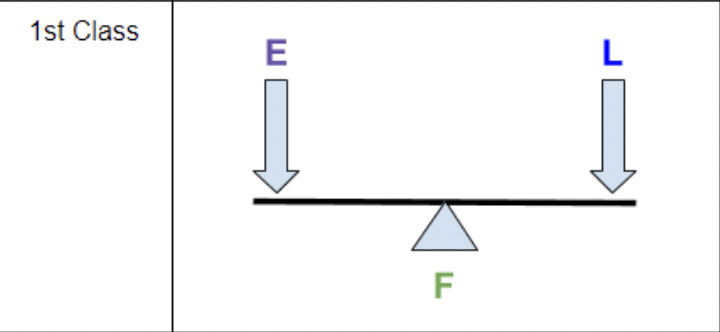
1st class leaver system
37
example of a first class leaver system
bicep curl
38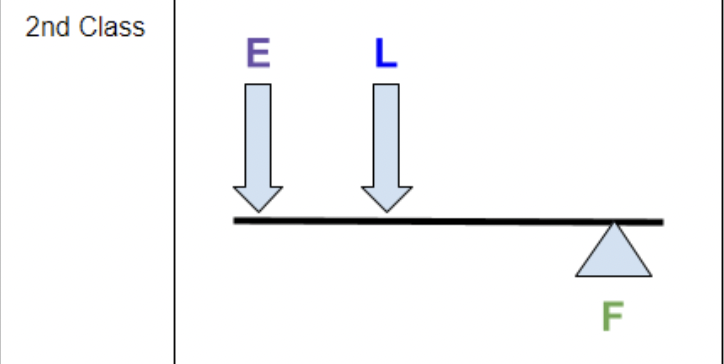
2nd class leaver system
39
example of 2nd class leaver system
plantar flexion at the ankle
40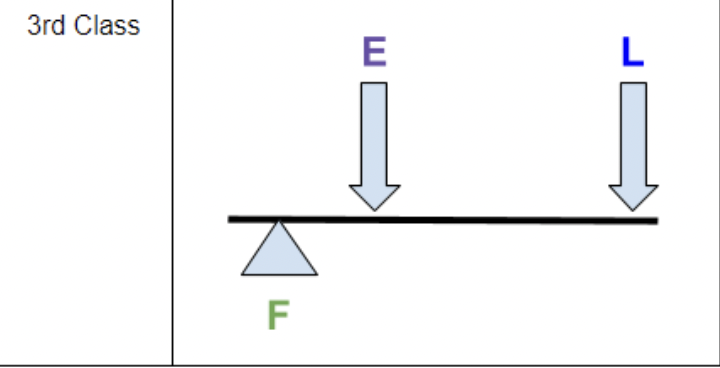
3rd class leaver system
41
example of a 3rd class leaver system
hip flexion
42
what does mechanical adantage and disadvantage depend on
the length of the effort arm, and resistance arm
43
what is the effort arm
the shortest perpendicular distance between fulcrum and effort
44
what is the resistance arm
the shortest perpendicular distance between fulcrum and resistance
45
what is the mechanical advantage of a 2nd class leaver
they can generate much larger force. they can overcome a heavy load
46
what is the mechanical disadvantage of a 2nd class leaver
slow, limited range of movement
47
what is the mechanical advantage of a 1/3rd class leaver
larger range of movement. resistance can be moved quickly
48
what is the mechanical disadvantage of a 1/3rd class leaver
can not apply much force to move. harder to overcome a heavy load