Aspects of personality
Study these flashcardsFree · spaced repetition · iPhone, Android, Mac & web
All cards
1
Personality
a persons unique psychological makeup
2
Trait theory
a theory that suggeste that innate characteristics produce consistent behaviour in most sporting situations. it attempts to predict behaviour because if sports people always behave in the same way there is a good chance we can predict the same behaviour
3
problems with the predictability of trait theory
doesnt take into account personality changes. personality and behaviour can change in different situations
4
Extrovert
Someone with a loud and bright personality
5
advantages of trait theory
it can help to predict a sports performers behaviour because sports performers are always going to behave in the same way most of the time
6
disadvantages of trait theory
behaviour cant always be predicted, it doesnt take into account the a persons behaviour can change. specific situations can change a persons behaviour and personality. a footballer can be agressive after a wreckless foul but calm and appologetic after the match. it doesnt consider our personalities can be formed by experience
7
social learning approach
this theory suggests that behaviour is learned from significant others by socialisation. it offers explanations as to how our personalities develop
8
what is more likely to reinforce and copy behaviour in the social learning approach
if the behaviour is seen as successful, and powerful it is more likely to be reinforced. behaviour is more likely to be copied if it is witnessed at a live event
9
what is the process that we learn our behaviour through in social learning approach
--> observe-->identify-->reinforce-->copy
10
interactionist perspective
a theory which combines trait and social learning theory to predict behaviour in a specific situation
11
the lewin approach to personality - interactionist perspective
the lewin approach to personality - interactionist perspective
suggests traits we are born with are adapted and used according to the situation so that a player who has the traits of being assertive or well-motivated and dominant would use these trait in a game situation when there is a need to impose a presence on the play
12
what does the ineteractionis approach account for and suggest
it accounts for behaviour change and suggests behaviour is adapted to suit the situation
13
lewins formular
B f(PxE) behaviour is a function of personality and environment
14
how does the interactionist theory attempt to help coaches
by predicting how a player will react in a specific sporting situation. consistent traits can be adapted to the situation, thoes traits will produce a typical responce
15
the hollander approach to interactionist theory
supported the idea that behaviour can be predicted. he suggested personality is made up of 3 features, the core, the typical responce and the role-related behaviour. this suggests that the more the environmebt has an influence, the more likely behaviour is to change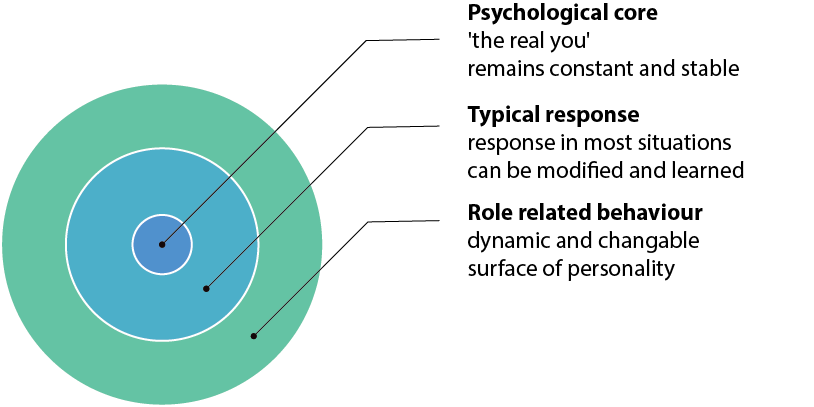
16
hollander approach - the core
-represents the values and beliefs of the individual, such as benifits of playing a team sport, are underlying
-stable and solid, unlikely to change
-stable and solid, unlikely to change
17
hollander approach - typical responce
-the use of inherent traits displayed to specific situations- usual responces
18
hollander approach- role-related behaviour
implies that further change to behaviour may be necessary as the situation demands
19
how knowledge of interactionist perspective improve performance
1. coach can predic any potential unacceptable behaviour and remove the player from that situation, which could avoid further consequences e.g red card
2.coach could identify situations that cause bad actions and create them in training so the player can learn to cope
3. coach could encorage a player to adapt to specific circumstances. e.g. if a player is anxious about a penalty the coach could offer advice
2.coach could identify situations that cause bad actions and create them in training so the player can learn to cope
3. coach could encorage a player to adapt to specific circumstances. e.g. if a player is anxious about a penalty the coach could offer advice