principals and theories of learning and performace
Study these flashcardsFree · spaced repetition · iPhone, Android, Mac & web
All cards
1
what are the 3 stages of learning
-cognative, associative and autonomous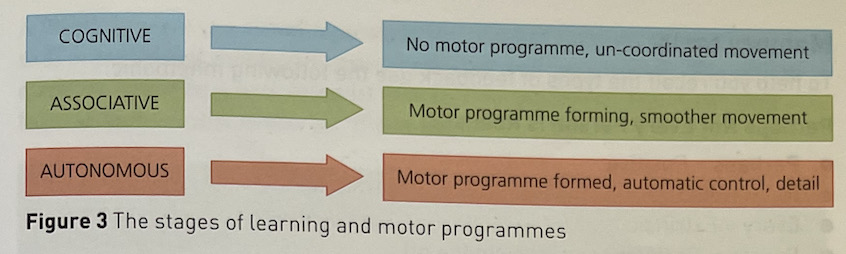
2
cognative stage of learning
the first stage of learning used by a novice. understanding and subroutines are explored by trial and error. performer may use extrinsic feedback to help them. motor programmes arent yet developed and performer may use trial+error.
3
motor programmes
the components of a skill that can be stored in the memory
4
associative stage
2nd stage, -motor programmes are developed and performance is smoother.- longer duration that the cognative stage as player moves from beginner to acomplished performer. -to make this progress performer has to continually practice. -may still use trial and error a bit. -feedback has become more internal.-may compare performance to that of an accomplished athlete and alter practice to reach the top. -movement is smoother and more coordinated.
5
the autonomous stage
-final stage of learning used by an expert when movement is detailed and specific. - actions are fluent, efficient and automatically undertaken. -performer can focus on fine detail of the task as basics are performed without thought. -motor programme is fully developed and can help with fine control of actions.-in this stage the performer is classified as expert
6
Feedback
information to aid error correction
7
Types of feedback
positive, negative, extrinsic, intrinsic, knowledge of result, knowledge of performance
8
positive feedback
-information about what was good. -tells player whats going well and offers motivation to maintain effort. -may oftern be combined with praise
9
Negative feedback
-error correction. -gives performer info about whats going wrong to correct errors and eliminate bad habits.-as the player gains more experience, negative feedback can be appretiated as it gives clarity about what to improve
10
Extrinsic feedback
-from an outside source e.g coach. -performer gains view of what they need to improve, or which aspects they need to maintain. -advice on types of training and methods need to improve may be givern.
11
intrinsic feedback
-from within. -as a player gains experience, the feedback they use will come from within. -performer may have developed a feel for the task, using kinaesthesis and can use this to know when they have hit a bad shot
12
knowledge of results
-concerns the outcome. -feedback that gives an indication of wheater or no the skill has been successful. -successful outcomes need to be maintained and unsucessful outcomes need to be eliminated
13
what is knowledge of performance
-gives the reasons why a shot went in or not . -concerned with technique and how it can be improved and developed to produce a better performance than last time.
14
how can a coach make feedback effective
they should consider the stage of learning that the player is in
15
what feedback should a cognative performer recieve and why
they will benifit from encoragement and external advice. this is because they have little existing knowledge of the skill and positive encoragement will motivate them to continue learning the task
16
what feedback should a autonomous performer recieve and why
performer requires detailed feedback on how to control their performance. they can benifit from error correction and would use their existing knowledge to make internal adjustments
17
what feedback should a associative performer recieve and why
can be a long phase inwhich a performer makes steady progress. early in this phase external info would be used to refine movements as this stage develops the use of more intrinsic feedback is control the performance
18
what is a learning plateau
a period of time when there are no signs of improvement:performer doesnt seem to be getting any better
19
what is a learning curve
a visual representation of what happens when a closed skill is performed repeatedly over a time period by a novice
20
learning curve
21
stage 1 of a learning curve
rate of learning is slow and performance level is poor because the performer is new to the task and is in the cogantive stage of learning, working out the required subroutines required and possible using trial and error
22
stage 2 of a learning curve
there is a rapid acceleration in the rate of learning because the performer has begun to master the the task and gain some success providing reinforcement and motivation
23
stage 3 of a learning curve
there is no improvement in the rate of learning and the performance has reaced a plateau. performance has remained at the same level
24
stage 4 of a learning curve
a period towards the end of the task when performance may deteriorate
25
what is a drive reduction
an end of task period where performance may get worse. this may occur because a performer has gained success on the task and the initial drive to succeed has been lost
26
6 causes of a learning plateau
lack of motivation, boredom, coaching, limit ability, targets set too low, fatigue
27
causes of a learning plateau - lack of motivation
lack on incentives or extrinsic rewards causes the performer to loose drive and energy for the task.
28
causes of a learning plateau - boredom
repetitive nature of a closed skill may cause boredom
29
causes of a learning plateau - coaching
coach may issue incorrect instructions or use incorrect practice methods so that the skill isnt done correctly
30
causes of a learning plateau - limit of ability
performer may not improve because they have reached the full extent to ther ability. they cant improve because they dont have the underlying skill level
31
causes of a learning plateau - targets set too low
the task may not allow the performer to use their full range of skills - they cant improve because the limits of the task dont allow them to
32
causes of a learning plateau - fatigue
continued action over an extended period of time would cause tiredness especially if the same muscles are being used over and over
33
solutions to a learning plateau
-set new challenges and extensions when they are met. -player could find a new coach to raise performance levels.- a coach could offer more praise and positive reinforcement to provide motivation -take a rest to avoid fatigue. -add more variety to avoid boredom. -explain the concept of the plateau so they dont take responsibility for the inability to improve. -player could get feedback to help improve performance and motivation.
34
4 methods of guidance
visual, verbal, mechanical and manual
35
what is visual guidance and why is it used
a demonstration of the required task. it is used to help create mental images that can be used to reference to during future practice
36
who and how can visual guidance be givern
it can be givern by a coach or fellow player in the form of a demostration. or it could be givern using social media sites, books, charts or videos
37
how should a coach maintain confidence and motivation when using visual guidance
ensure the demonstartion is givern by a fellow player or peer, the it will be seen as within the players capabilities
38
advantages of visual guidance
it can be used to highlight a specific weakness. visual guidance aims to show what the skill should look like as a resul of practice. it creates a mental image and its nearly always used in conjunction with verbal guidance
39
disavantages of visual guidance
demonstrations must be completely accurate. if too much info is givern the player may be confused and experience information overload
40
what is verbal guidance and why is it used
verbal guidance is an explanation of the task and its used to highlight points being made during a demo
41
when can verbal guidance be used by a more experienced player
when technical and detailed advice is givern to complement their actions in practice, or when tactical advice is givern during a performance
42
problems and considerations when using verbal guidance
if too much info is givern it could be forgetten or cause infomation overload. performer may loose concentration unless coach makes info breif, meaning full and relevant. language used by coach should be understandable. coach should ensure the correct form of feedback is givern based on stage of learning
43
manual guidance
involves physical support e.g holding a gymnast of a vualt or in a handstand. it can involve a type of forced responce
44
advantages of manual guidance
-helps to eliminate danger. -helps to build confidence of a performer who may not be able to gain a feel of the whole task without help. -fear and anxiety associated with dangerous tasks will be reduced with help; when a task is complex it can be into stages to help with physical support
45
Disadvantages of manual guidance
-it can have detrimental effects on performance if overused. -once initial feel of task is established, too much reliance on physical support could begin to interfear with the feel of the task and the performer could develop bad habbits. performer may become dependent on support. -coach should control and restrict the use to prevent over-reliance
46
Mechanical guidance
a device used to help a performer e.g armbands in swimming
47
advantages of mechanical guidance
builds confidence when successfull completed a task. eliminates danger and prevent injury. gives an early feel for the whole skill. it can be used by disables athletes or thoes recovering from injury
48
problems associated with mechanical guidance
if oversued it can interfere with the feel of the task. performer may become dependent so could loose confidence. motivation can be lost if performer thinks the skill is still not being performed independently
49
4 theories of learning
operant conditioning, observational learning, social development theory and insight learning
50
what is operant conditioning
the use of reinforcement to ensure a correct responce is repeated - skinners rats
51
behaviouris theory
aka operant conditioning, attempts to explain how actions can be linked to a stimuli
52
what features are operant conditioning characterised by
-based on trial and error learning, coach may manipulate the environment when using it. shapes behaviour by using reinforcement
53
what principal does operant conditioning work on
reinforced actions are strengthened and incorrect actions can be weakened. success acts as a satisfier to strengthen correct actions. unsuccessful responces may be an annoyer
54
satisfier
an action that promotes a plesent feeling so that responce is repeated
55
annoyer
an action that creates unease to premote the avoidance of incorrect responces
56
stimulus responce bond
by linking an appropriet responce to a stimulus allows actions to be learned. a coach can link the stimulus to the responce through positive reinforcement, negative reinforcement and punishment
57
ways to shape behaviour
positive reinforcement, negative reinforcement and punishment
58
positive reinforcement
when a plesent stimulus is givern to increase the likelyhood of a correct responce occuring again e.g praise
59
negative reinforcement
promotes correct actions occuring to a stimulus by taking away the unplesent stimulus when a performer does it right e.g withdraing negative criticism
60
punishment
when a coach gives an unplesent stimulus to prevent incorrect actions happening again
61
how can whole-part-whole practice and mental practice be used during operant conditioning
whole-part-whole can be used to isolate the key aspects of the task, another means of manipulating the environment. mental practice can be used to go over the correct aspects of the task in the mind to shape behaviour
62
who proposed the idea of observational learning
Bandura
63
what does observational learning suggets
both good and bad behaviour can be learned through watching others and copying them
64
how can a coach use observational learning to their advantage
by ensuring demonstrations and role models used to show skills in practice are successfully copied
65
4 stages of observational learning
Attention, Retention, Motor reproduction, Motivation
66
Attention, observational learning
making sure the payer is taking notes of relevant cues. the more attractive the demo the higher the likelyhood its repeated
67
how can a coach grap the ATTENTION of a learner
-point out why they are learning this. make the model stand out by making it bright, loud or attractive, so that its more memorable. the demonstration should be accurate and correct
68
Retention, observational learning
the ability to remember important information and recall it
69
how to ensure RETENTION
breaking information into chunks. make sure the demostration is accurate and clear. use a role model. the learner should practice the skill as quick as possible
70
Motor reproduction, observational learning
making sure the player is physically capable of copying the demonstration
71
Motivation, observational learning
the drive needed to copy a demonstration
72
model demonstrations and behaviours are more likely to be copied if : --observational learning
performed by a player of simular ability, they are reinforced, powerfull visually and physically, they are consistent, and they are relevant
73
who proposed social developent theory
vygotsky
74
what is social development theory
interaction with others plays a vital role in learning. in sport it can be learning through coaches, teachers or MKO
75
what should a coach or MKO do during development - social development theory
not only give direct examples and advice but also influence the learner by demonstraiting values and actions e.g high degree of effort, a healthy lifestyle and clear communication that can be adopted by the learner
76
during learning what is the process that are skill learned from the coach called
inter-psychological learning
77
what is inter-psychological learning
when a learner uses an MKO to get advice feedback and tactical knowledge
78
what is intra-psychological learning
learning from within after gaining knowledge from others
79
who proposed constructivism
Vygotsky
80
what is constructivism
Building up learning in stages based on what you already know
81
what are the 3 stages of constructivism
1. what can i do alone, 2. what can i do with help, 3.what can i not do yet
82
who proposed the idea of insight learning
Gestaltist theory (a group of german men)
83
what is insight learning
using experience and understanding to solve problems relating to the whole skill. when a player is presented with a problem, sporting knowledge is used to work out a solution and then that solution is tried. if this tactic works then it will be used again
84
features of insight learning theory
it concentrates on the whole taks so it good for use in realistic situations. as the athlete works out the solution, it can provide self satisfaction and give intrinsic motivation