Energy systems
Study these flashcardsFree · spaced repetition · iPhone, Android, Mac & web
All cards
1
adenosine Triphosphate
the only usable form of energy in the body
2
What does ATPase do
it breaks down ATP into ADP and PI
ADP + Pi + Energy
ADP + Pi + Energy
3
what are the 3 energy systems
- The aerobic system
- The ATP-PC system
- The anaerobic glycolitic system
- The ATP-PC system
- The anaerobic glycolitic system
4
what is the role of the aerobic system
when intensity is low and oxygen supply is high, the aerobic system is the perfered energy pathway. the aerobic system breaks glucose into carbon dioxide and water, which is more efficient in the presence of oxygen
5
how many atp does the completion of glucose oxidation produce
38
6
how do fats and proteins aid
fats are broken down into fatty acids and proteins into amino acids. the products of fats and protein metabolism are reduced to produce acetyl-coA that enters the krebs cycle
7
3 stages of the aerobic system
- glycolysis - krebs cycle - electron transport chain
8
what is Glycolysis
takes place in the sarcoplasm, it breaks glucose into pyruvic acid. net ATP 2. before pyruvic acid can enter the krebs cycle its oxidised in to 2 acetyl groups and then carried in by coA
9
Krebs cycle
2 acetyl groups diffuse into the matrix of the mitochondria. a complete cycle of reactions occur. acetyl combines with oxaloacetic acid, forming citric acid. hydrogen is removed from citric acid and rearranged form undergoes 'oxidative carboxylation' meaning carbon and hydrogen are givern off. carbon forms c02 and is taken to the lungs and breathed out and hydrogen is taken to the electron transport chain. 2ATP produced
10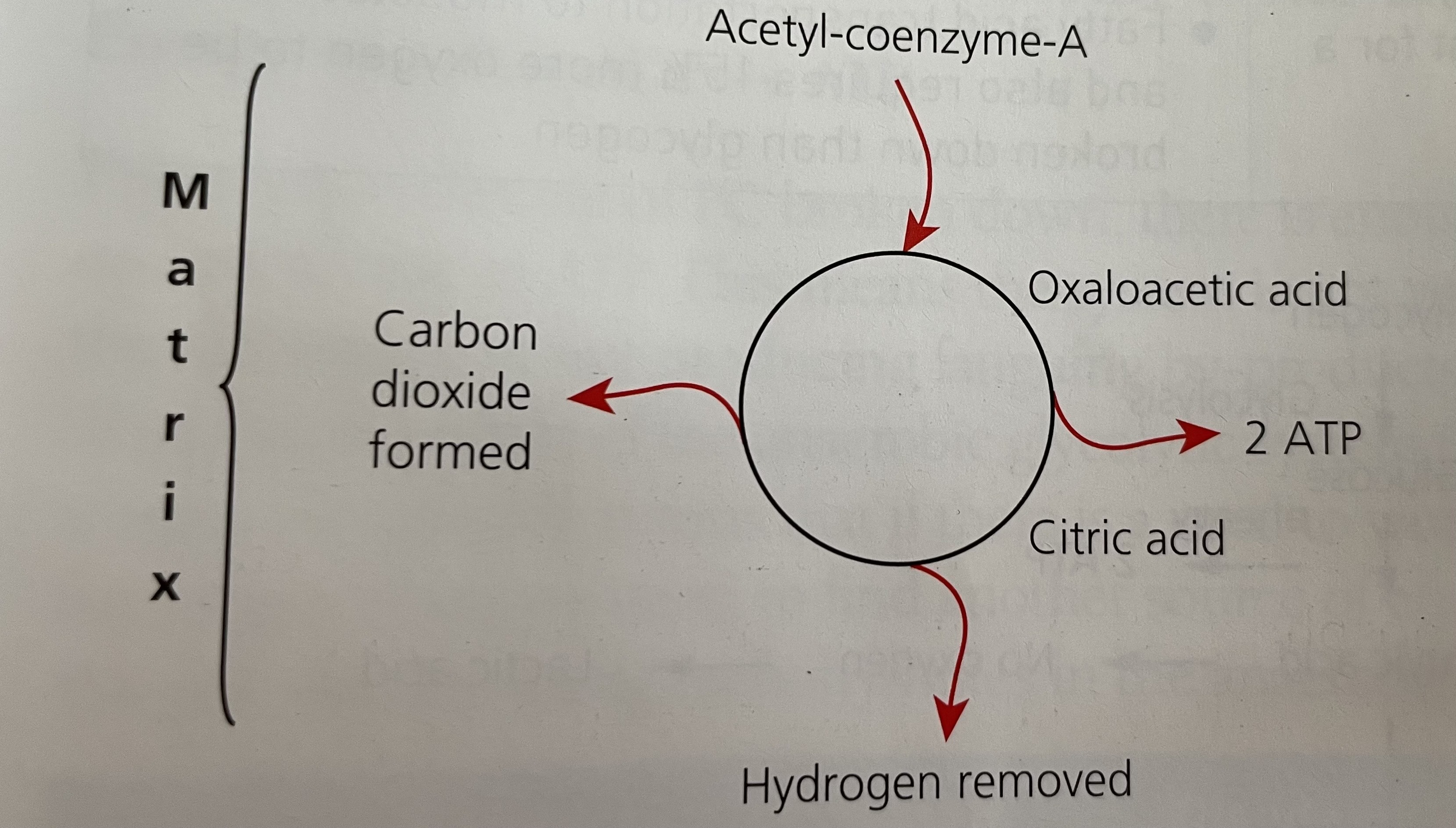
draw the krebs cycle
11
electron transport chain
hydrogen is carried hereby hydrogen carriers. occurs in the cristae of mitochondria. hydrogen splits into hydrogen ions and are charged with potential energy. H ions are oxidised to form water why the hydrogen electrons provide energy to resynthesise ATP. 34 ATP are formed
12
what happens during Beta oxidation
stored fat undergoes beta oxidation, where they are converted into acetyl coA which is the entry molecule for the krebs cycle.
13
advantages of the aerobic system
- 36 more ATP can be produced. No fatiguing biproducts. lots of glycogen and triglycceride stores, so exercise can last for a long time
14
disadvantages of the aerobic system
- complecated system so cant be used straight away. it takes a while for enough oxygen to become avalible to meet the demand of activity and ensure glycogen and fatty acids are broken down. - Fatty acid transportation to the muscles is low and also requires 15% more oxygen to be broken down than glycogen
15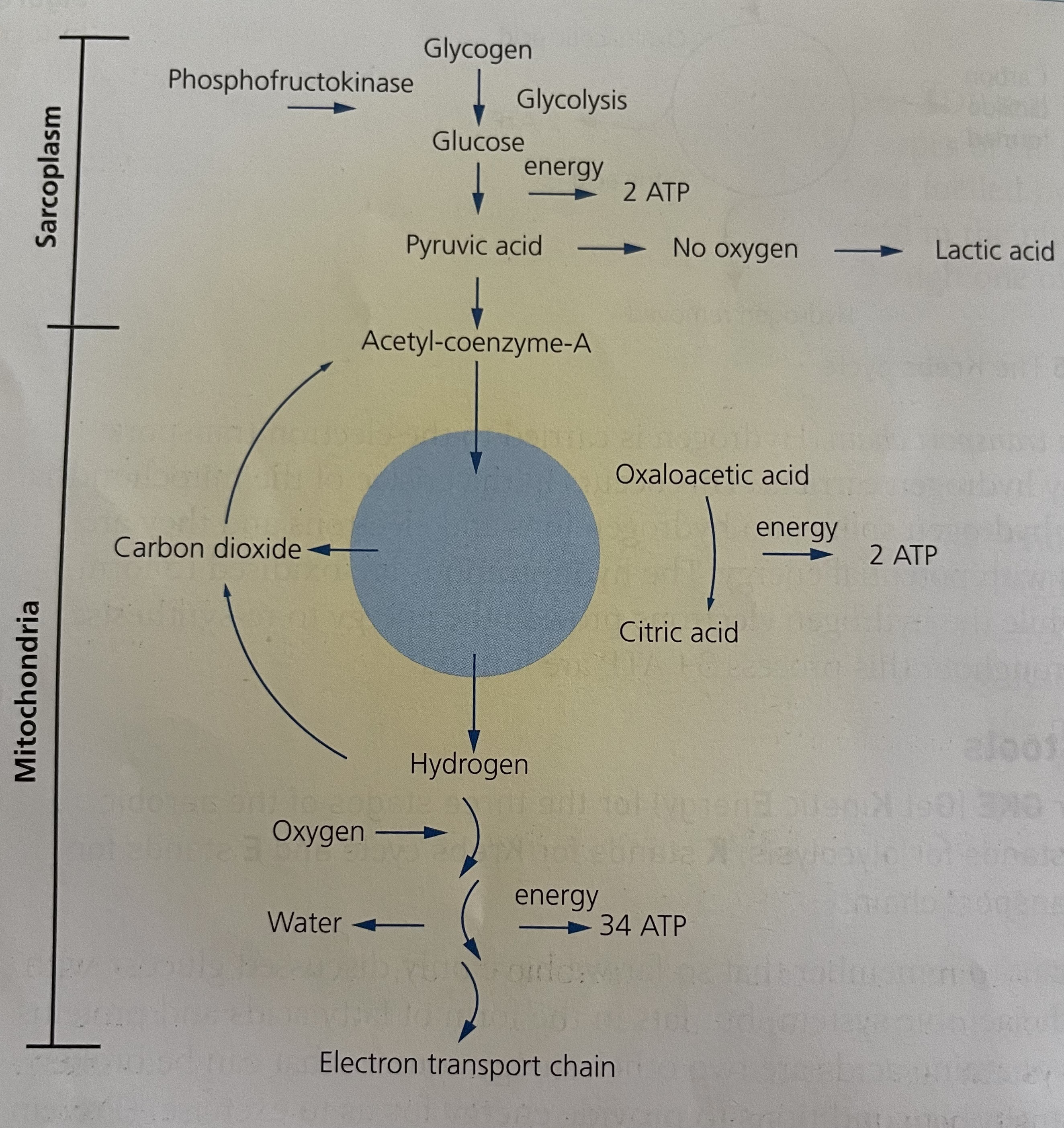
Draw the aerobic system
16
ATP-PC system
energy system using phosphocreatine as its fule. PC can be broken down quickly and is easy to release energy to resynthesise ATP. rapid avalibilty is good for a simple maximal movement e.g shot put. but the disadvantage is that stores are limited as theres only enough PC stores to last 5-8 secs, and can only be replenished when oxygen is avalible
17
How does the ATP-PC system work to provide energy. and equation
Anaerobic process and resynthesis ATP when the enzyme creatine kinase detects high levels of ADP. PC-->Pi+C+energy. this energy is then used to convert ADP to ATP in a coupled reaction: Energy-->+Pi+ADP-->ATP
18
coupled reaction
when energy required by one process is supplied by another process
19
For every molecule of PC broken down ...
theres enough energy released to create one molecule of ATP this.
20
Advantages of the ATP-PC system
- ATP can be used re-synthesised rapidly using the ATP-PC system. -PC stores can be resynthesised quickly (30s=50% 3min=100%). - no fatiguing biproducts. -its possible to extend the time the ATP-PC system can be utilised through the use of creatine suppliment
21
Disadvantages of the ATP-PC system
-there is only a limited supply PC in the muscle cells. -only one molecule of ATP can be resynthasised for every mole of PC. -PC re-synthesis can only take place in the presence of oxygen
22
short-term lactate anaerobic system - anaerobic glycolitic system
produces high powered energy for high intensity effort events e.g 400m
23
what does the Anaerobic glycolitic system provide energy for
high intensity, longer exercise than the ATP-PC system does
24
how long does the anaerobic glycolitic system last, and what effects this?
it lasts up to 2-3 minutes at a reduced intensity and is dependent on the fitness of the individual, and the intensity of the exercise. working flat out of exaustion will mean the system lasts alot shorter time as the demand for energy is high
25
where does the aerobic glycolitic system resynthesise ATP from
the breakdown of the fuel glucose
26
how does the Anaerobic glycolitic system work to provide energy
When the PC stores are low, glycogen phosphorylase is activated
to break down glycogen into glucose, which is then further broken down to
pyruvic acid by the phosphofructokinase. This is called anaerobic
glycolysis and takes place in the sarcoplasm of the muscle cell where oxygen is
not available. Since this is an anaerobic process,
to break down glycogen into glucose, which is then further broken down to
pyruvic acid by the phosphofructokinase. This is called anaerobic
glycolysis and takes place in the sarcoplasm of the muscle cell where oxygen is
not available. Since this is an anaerobic process,
27
advantages of the anaerobic glycolitic system
- ATP can be resynthesised quickly and it lasts longer than the ATP-PC system. - in the presence of oxygen, lactic acid can be converted back into liver glycogen or used as a fule through oxidation into co2 and h2o. - it can be used for a sprint finish (extra burst of energy)
28
Disadvantages of the anaerobic glycolitic system
- lactic acid is a bi-product. - only a small amount of energy can be released from glycogen under anaerobic conditions (5% as opposed to 95%)
29
energy continuum
a term which describes they type of respiration used by a physical activity. whether its aerobic or anaaerobic depends on the intensity and duration.
30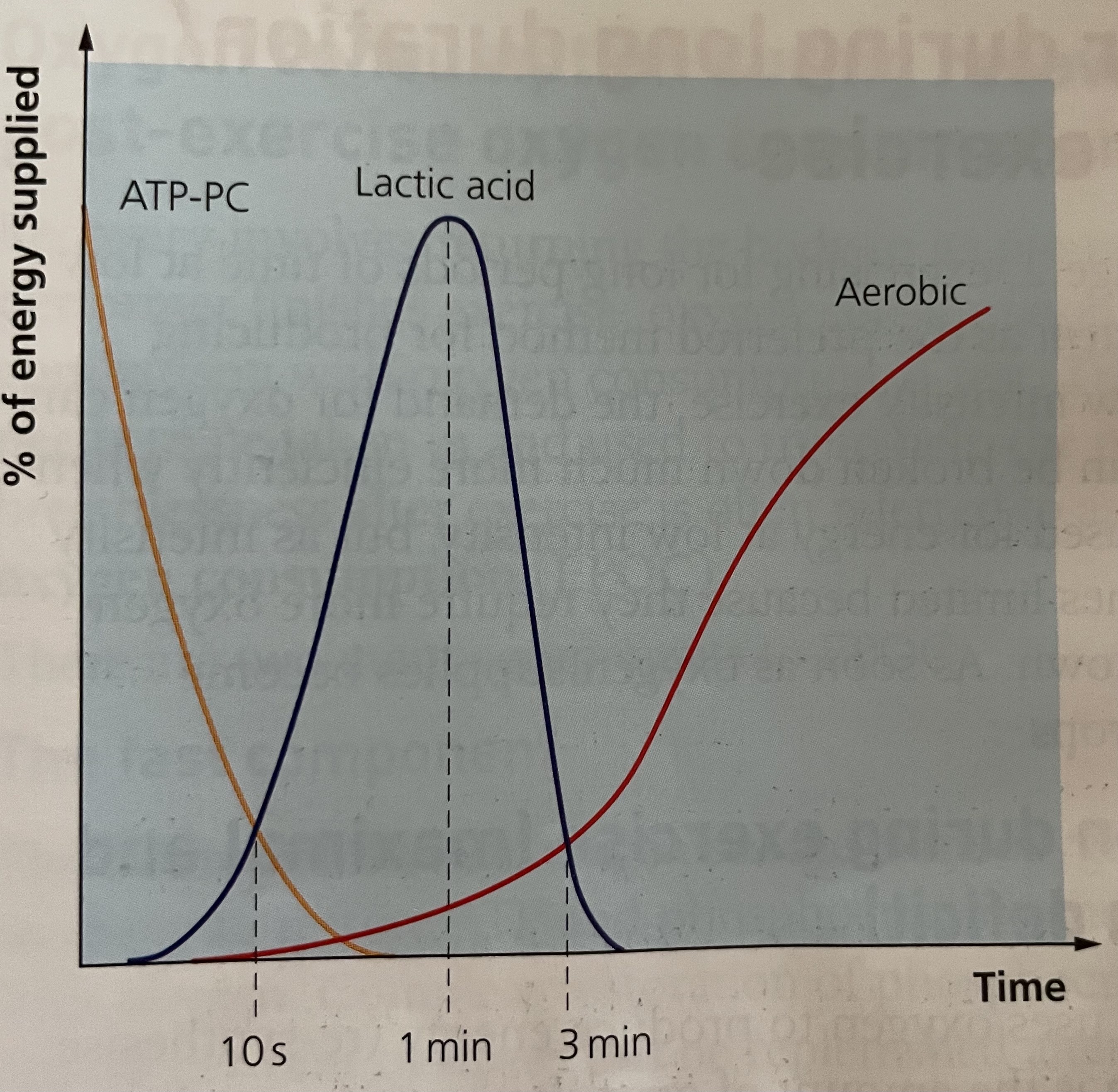
how long does each energy system las and graph:
31
ATP generation in type 1 slow twich muscle fibers
- main pathway for ATP production is in the aerobic system. - produces the maximum amount of ATP avalible from each glucose molecule (up to 36 ATP). -production is slow but these fibers are more endurance based so are less likey to fatigue.
32
ATP generation in type 2x fast twich
- main path is via the lactate anaerobic energy system. -ATP production in the absence of oxygen isnt efficient. -production of ATP is fact but cant last long as they will fatigue
33
how much oxygen do we consume at rest and during exercise (liters/min)
rest 0.3-0.4l. during exercise 3-6l
34
What is sub-maximal oxygen deficit
when theres not enough oxygen avalible at the start of exercise to provide all the energy aerobically
35
Excess post exercise oxygen consumption (EPOC)
the amount of oxygen consumed during recovery above that which would have been consumed at rest during the same time
36
what are the 2 components of EPOC
Fast component and slow component
37
fast component of EPOC
restoration of ATP and phosphocreatine stores and the re-saturation of myoglobin with oxygen
38
slow component (EPOC)
oxygen consumed during this stage has several functions: - removal of lactic acid, -maintanence of breathing and heart rates, glycogen replenishment, increase in body temperature
39
removal of lactic acid - slow EPOC
lactic acid can be removed in the following ways: - in the presence of oxygen lactic acid can be converted back into pyruvate and oxidised into c02 +water, eventaully used for energy. -transported i the blood to the liver where it is converted to blood glucose and glycogen (cori cycle). -converted into protein. -removed in sweat and urine. Most lactic acid can be oxidised in the mitochondria, so a cool down can accelerate its removal as the boy is flushed with oxygen rich blood
40
Maintenance of breathing and heart rate - slow EPOC
maintaining BR and HR requires extra oxygen to provide energy needed for respiritory and heart muscles. assists recovery as extra oxygen is used to replenish ATP and PC stores, resaturate myoglobi and remove lactic acid, returning the body to pre-exercised state
41
Glycogen replenishment - slow EPOC
Glycogen replenishment depends on type of exercise and how much carbohydrate is consumed after exercise. it may take several days to complete the restoration of glycogen after a marathon, but after half an hour a significant amount is restored as lactic acid is converted to blood glucose and glycogen via the cori cycle. eating a high carb meal will accelerate restoration .
42
increase body temp - slow EPOC
when temp remains high respiritory rate remains high so willhelp performer take in more oxygen during recovery. extra oxygen is needed to fule this increased temp until the body returns to normal.
43
lactate accumulation
lactic acid breaks down creating lactate. as lactate accumulates, more H ions are present, this increases acidity. this increase in acidity denatures enzymes. glycogen cant be broken down as effectively and fatigue sets in. Lactate moves from the muscle to blood. blood lactate can be measured
44
Onset blood lactate accumulation - OBLA
the point when lactate levels go above 4 milimoles per liter
45
lactate threshold
the point that lactic acid quickly accumulates in the blood during exercise
46
what is lactate threshold exprressed as
a percentage of VO2 max
47
how does fitness affect lactate threshold
as fitness increases the lactate threshold becomes delayed.
48
what is the average lactate threshold for an averange performer and an elite performer
average 50-60% of their vo2 max and elite is 70, 80 or sometimes 90 % of their vo2 max, training has limited effect on vo2 max as its mainly genetic
49
how does lactate threshold change with fitness
the fitter we are the higher the lactate threshold
50
factors affecting the rate of lactate accumulation
exercise intensity, muscle fiber type, rate of blood lactate removal, the respiritory exchange ratio, and the fitness of the performer
51
factors affecting the rate of lactate accumulation - exercise intensity
the higher the intensity of exercise, the greater the demand for atp and so the faster obla occurs
52
factors affecting the rate of lactate accumulation - muscle fiber type
slow twitch muscle fibers produce less lactate than fast twitch. when slow twitch muscle fibers use glycogen as a fule, due to the presence of oxygen, the glycogen can be broken down much more effectivley and with little lactate production
53
factors affecting the rate of lactate accumulation - rate of blood lactate removal
rate of lactate removal is equivilent to the rate of lactate production, then the concentration of lactate in the blood is remains constant. If lactate production increases, then lactate will start to accumulate in the blood until obla is reached
54
factors affecting. the rate of lactate accumulation - respiritory exchange ratio
the ratio of carbon dioxide produced to oxygen consumed. as the the ratio has a value close to 1:0, glycogen becomes perfered fule and there is a greater change of the accumulation of lactate
55
factors affecting the rate of lactate accumulation - fitness of performer
a person who trains regularly will be in a better position to delay obla, increased myoglobin and mitochondria, together with an increased capillary density, improve the capacity for aerobic respiration and so avoid the use of lactate anaerobic system
56
lactate producing capacity and sprint/ power performance
elite sprinters and power atheletes will have much better anaerobic endurance, as the body has adapted to cope with higher levels of lactate. also through buffering they will be able to increase the rate of lactate removal and so they will have lower lactate levels. this means that athletes will be able to work at higher intensities for longer before fatigue sets in.
57
buffering
buffering is a process which aids the removal of lactate and maintains acidity levels in the blood and muscle
58
factors affecting VO2 max
physiological, lifestyle, training, genetics, gender, body composition, and differences in age
59
factors affecting VO2 max - physiological
increased: max CO, greater HR range, less oxygen being used by the heart muscle, so more avalible to the muscles
60
factors affecting VO2 max - lifestyle
smoking, sedentry lifestyles, poor diet and fitness. all can reduce VO2 max
61
factors affecting VO2 max - training
can be improved by upto 20% following a period of aerobic training
62
factors affecting VO2 max - genetics
inherited factors of physiology limit possible improvement
63
factors affecting VO2 max - gender
men have aprox 20% higher than women
64
factors affecting V02 max - body composition
a higher percentage of body fat decreased VO2 max
65
factors affecting VO2 max - differences in age
as we get older our VO2 max declines as our body systems become less efficient
66
4 measurements of energy expenditure
indirect calorimetry, lactate sampling, VO2 max text and Respiritory Exchange Ratio (RER)
67
its a technique that provides an accurate estimate of energy expediture through gas exchange
68
what does indirect calorimetry measure
measures the production of CO2 and/ or the consumption of O2. it measures how much carbon dioxide is produced and how much is produced both at rest and during aerobic exercise.
69
what does calculating gas volumes enable - indirect calorimetry
calculating the gas volumes also enables us to find out the main substance being used (fat or carbohydrates). the test is very reliable as it give a precise calculation of VO2 and VO2 max
70
lactate sampling
lactate sampling involves taking a tiney blood sample and a handheld device analyses the blood and indicates how much lactate is present. it is accurate and objective. it can also be used to measure exercise intensity. the higher the exercise intensity that lactate threshold occurs, the fitter the performer is thought to be.
71
what does a lower lactate level at the same intensity of exercise indicate
the performer has an increase in peak power/speed, an increased time to exaustion, improved recovery heart rate and a higher lactate threshold.
72
ways to study VO2 max
multi stage fitness tests including:bleep test, cooper run, harvard step test. these results get compared against a standardised resuls table, however they only give an indication of VO2 max. sports scientists use more valid and reliale including direct gas analysis and cycle ergometer
73
vo2 max tets
74
Respiritory exchange ratio
the ratio of carbon dioxide produced compared to oxygen consumed
75
what does the Respiritory exchange ration provide information about
fule usage during exercise. energy stores such as carbohydrates, fats and proteincan all be oxidised to produce energy. calculation the RER will indicate which of these is being oxidised to produce energy, and hence wether the performer is respiering aerobically and anaerobically
76
equation to calculate the RER
RER = carbon dioxide expired per minute (VCO2) / oxygen consumed per minute (Vo2)
77
what RER values indicate if a performer is using Carbohyrates, Fats, or respiering anaerobically
A RER close to 1 = performer is using carbohydrates
A RER aprox 0.7 = a performer is using fats
A RER greater than 1 = anaerobic respiration
A RER aprox 0.7 = a performer is using fats
A RER greater than 1 = anaerobic respiration
78
specialist training methods that can be used to impact energy systems
Altitude training, HIIT, Speed, agility, quickness, and plyometrics
79
what is altitude training
typically completed at 2500+ above sea level where the partial pressure of oxygen is lower.
80
how does training at high altitudes affect oxygen consumption
the partial pressure of oxygen drops, so there is a Reduced diffusion gradient between the air and the lungs and between the alveoli and the blood. so the haemoglobin isnt fully saturated with oxygen, resulting in the blood having a lower O2 carrying capacity. so less O2 is delivered to the working muscles, aerobic performance and VO2 max is reduced and there is a quicker onset of anaerobic respiration
81
why do elite endurance athletes train at high altitudes for several weeks
many performance benifits. it is also completed to acclimatise players to a lower level of oxygen avalibility in the atmosphere e.g if they are going to performe in countries with low oxygen levels like south africa
82
disadvantages of altitude training
- when an athlete first experiences altitude it can be difficult to train at the same intensity due to the reduction in partial pressure.
-also altitude sickness can be detrimental.
-benifits gained from altitude training can be lost very quickly once returned to sea level, and the body can only produce a limited abount of EPO
-finally, living away from home can cause homesickness
-also altitude sickness can be detrimental.
-benifits gained from altitude training can be lost very quickly once returned to sea level, and the body can only produce a limited abount of EPO
-finally, living away from home can cause homesickness
83
what is HIIT
High intensity interval training
it can be used for both aerobic and anaerobic training
its a form of training in which periods of work are broken up by periods of recovery
it can be used for both aerobic and anaerobic training
its a form of training in which periods of work are broken up by periods of recovery
84
what are the 4 main variables used to insure HIIT is specific
-duration of work interval
-intensity/speed of the work interval
-duration of the recovery interval
-number of work intervals and recovery
-intensity/speed of the work interval
-duration of the recovery interval
-number of work intervals and recovery
85
what does HIIT involve
short intervals of maximum intensity exercise followed by a recovery period of low intensity exercise. the work interval in anaerobic and the rest interval is aerobic
86
what can HIIT improve
fat burning potential, glucose metabolism, and both aerobic and anaerobic indurance
87
what do different variations of HIIT involve
-different numbers of high intensity work intervals and low intensity recovery intervals.
-different lengths of time for work and recovery intervals
-different exercise intensity for the recovery interval
-different lengths of time for work and recovery intervals
-different exercise intensity for the recovery interval
88
what is plyometrics training
training which uses high intensity explosive activities such as hopping, bounding, depth jumping, and medicine ball work
it uses fast twitch fibers
it uses fast twitch fibers
89
when is plyometrics training used
if a greater anaerobic capacity is necessary e.g speed for 100m, or power for long jump then p
90
what concept does plyometrics work on
muscles can generate more force if they have previously been streached. if the eccentric contraction occurs first, followed by the concentric contraction, then the force generated can be dramatically increased. this is called the streach shortening cycle
91
what are the 3 phases of the streach shortening cycle - plyometrics
eccentric phase/ preloading phase/ prestreaching phase
Amortisation phase
concentric or muscle contraction phase
Amortisation phase
concentric or muscle contraction phase
92
Eccentric phase - plyometrics
upon landing the muscle performs an eccentric contraction where it lengthens under tension
93
Amortisation phase - plyometrics
the time between the eccentric and concentric phase. this time needs to be as short as possible so the energy from the eccentric contraction isnt lost (lots is lost as heat)
94
concentric phase - plyometrics
uses the stored energy to increase the force of contraction
95
what is Speed Agility Quickness
how fast a person can move or how quicly a body part can be put into motion
96
when is SAQ effective
its effective in most sports but mostly in games when combined with agility, which is the ability to move and position the body quickly and effectivley whilst under control
97
what does good agility require - SAQ
a combination of speed, co-ordination, balance and flexibility. these can all be develope through SAQ
98
What does SAQ aim to improve
multi-directional movement through developing the neuromuscular system
99
what energy system provides energy for SAQ
the anaerobic system