Cardiovascular system
Study these flashcardsFree · spaced repetition · iPhone, Android, Mac & web
All cards
1
Starlings law
increased venous return --> greater diastolic filling of the heart --> cardiac muscle is streached --> increase force of contraction --> increased ejaction fraction
2
state the cardiac conduction system in order
SAN, Atrial sytole, AVN, Bundle of his< purkunji fibers, ventricular systole
3
venous return
return of blood to the right side of the heart via the vena cava
4
Blood pressure and equation
Force exerted by blood against the blood vessel wall. Bloodflow x Resistance
5
Cardiovascular drift
progressive decrease in stroke volume and arterial blood pressure. with a progressive rise inheart rate. this occurs after 10 minutes of exercise
6
Ejaction fraction and the equation
percentage of blood pumped out of the left ventricle per beat. Ejaction fraction = Stroke volume/end diastolic volume
7
Venous return mechanisms
Skeletal muscle pump-muscle pressure on veins squeeze blood towards the heart. Respiritory pump - pressure changes compress veins assisting blood flow. Valves prevent the backflow of blood
8
5 different Blood vessels function and order
carry blood to the body from the heart and from the body to the heart. Heart --> arteries --> arterioles --> capillaries -->venules --> veins --> heart
9
redistribution of blood: vascular shunt mechanism
redistribution of cardiac output
10
vascular shunt mechanism and types of circulation
made of blood vessels which deliver oxygen and nutrients to body tissues and take waste products away. 2 types of circulation 1.pulminary - deoxygenated blood from the heart to the lungs and back to the heart. 2.systemic oxygenated blood from the heart to the body then back to the heart.
11
cardiac hypertrophy
thickening of muscular walls of the heart
12
impact of blood pressure on venous return
when systolic blood pressure increases, venous return increases. and opposite
13
steady state
when an athlete can meet the oxygen demand with the oxygen supply
14
oxyhaemoglobin dissasociation curve - Bohr shift
the relationship between oxygen and haemoglobin. Bohr shift- when there is an increase in CO2 in the blood and a decrease in PH of the blood = reduction of haemoglobins affinity for oxygen
15
Heart rate range in responce to exercise
Heart rate increases, the amount depends on the intensity. higher intensity = higher heart rate until max
16
systolic and diastolic pressure
systolic, artery pressure when ventricles contract. Diastolic, pressure in the arterys when the ventricles relax
17
Cardiac output and the equation
volume of blood pumped out of the heart ventricles per minute. CO = SV x HR
18
Heart rate and max equation
Number of beats per minute. 220 - age = max HR
19
How is oxygen transported around the body
oxygen combines with haemoglobin forming oxyhaemoglobin. travels to the muscles. oxygen is dissociated to myoglobin at the muscles because myoglobin has a higher affinity for oxygen
20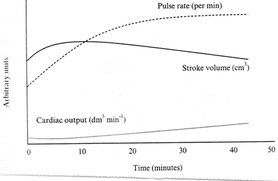
Cardiovascular drift graph
21
control of bloodflow - vasodilation and vasoconstriction
vasodilation, the widening of blood vessels allowing increased flow of blood to the capillarys. vasoconstriction, narrowing of the blood vessels reducing bloodflow to the capillaries
22
Heart disease
when coronary arterys (supply heart with oxygenated blood) get blocked or start to narrow by a gradual build up of fatty deposits (atherosclerosis)
23
Stroke volume in responce to exercise
stroke volume increases only up to 40 - 60%. stroke volume then plateus because ventricles dont have time to fill so pump less blood out
24
cardiac output in responce to exercise
during exercise, cardiac output increases because heart rate and stroke volume increases until max intensity is reached, then it plateus
25
Diastolic phase
Heart relaxes to fill with blood
26
Venous return
Volume of blood returning to the heart via the veins
27
Stroke volume
Volume of blood pumped out the ventricle per contraction
28
Chemoreceptors, baroreceptors, proprioceptors
chemo, increase in co2 leads to increase HR. Baro, increase BP leads to increase HR. proprio, increased muscle movement leads to increased HR
29
Sympathetic and parasympathetic nervous system
Sympathetic causes HR to rise. Parasympathetic causes HR to return to resting level
30
A-vo2 diff
difference between oxygen content in the arterial blood arriving at the muscle and venous blood leaving
31
Bradycardia
Decrease in Resting HR to bellow 60bpm