F2 Long Term Finance
Study these flashcardsFree · spaced repetition · iPhone, Android, Mac & web
All cards
1
What are cumulative preference shares
less risky. If no payment made in one year, 2 made following year
2
What are non cumultive preference shares
3
What are participating preference shares
4
What are convertible preference shares
5
What is the difference between ordinary shares and preference shares?
Ordinary shares offer ownership and voting rights but non-guaranteed dividends, while preference shares provide fixed dividends (often cumulative) but no voting rights.
6
In the event of liquidation, who gets paid first ordinary shareholders, preference shareholders, or debt holders?
Debt holders get paid first, then preference shareholders, and ordinary shareholders are last.
7
What does it mean if preference shares are "cumulative"?
Unpaid dividends accumulate and must be paid before ordinary dividends in future years.
8
What is a convertible preference share?
A preference share that can be converted into ordinary shares at a future date.
9
What are the primary and secondary functions of capital markets?
The primary function is to raise new medium to long-term finance by issuing shares or debt; the secondary function is to allow investors to buy and sell existing securities.
10
What is a debt covenant?
A condition or clause imposed by lenders, like limits on gearing or requirements for interest cover, which must be met by the borrowing company
11
What is underwriting in the context of a new share issue?
Having a financial institution guarantee to buy any unsold shares in exchange for a fee.
12
What are the main types of debt finance
* Bank Borrowing
* Bonds aka debentures/loan notes
* Bonds aka debentures/loan notes
13
What are the 3 main ways a company can issue shares
* Offer for sale
* Placing
* Rights issue
* Placing
* Rights issue
14
What is an offer for sale
15
What is a placing
16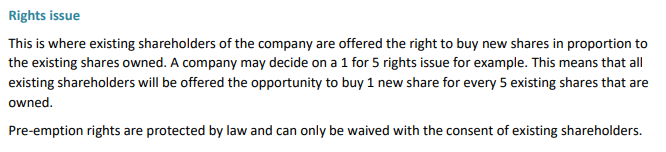
What is a rights issue
17
What is obtaining a listing on a stock exchange also know as
* flotation
* Initial public offering (IPO)
* Initial public offering (IPO)
18
What must a company do to obtain a listing on a stock market
19
What are the 2 ways an offer for sale can be made
* Fixed price
* Tender
* Tender
20
Does interest paid on debt give a tax benefit to companies?
Yes, interest payments on debt attract tax relief, unlike preference dividends.
21
What is a secured debt?
Debt backed by collateral, with “fixed charge” on specific assets or “floating charge” on general assets.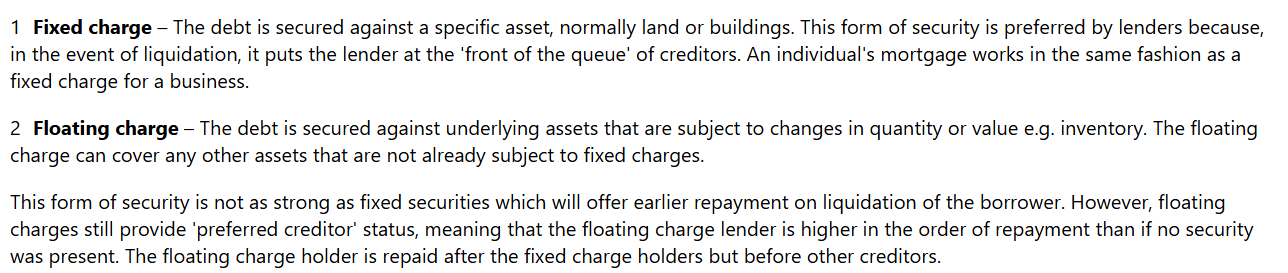
22
Why are pre-emption rights important in rights issues?
They protect existing shareholders from having their ownership diluted.
23
What is a participating preference share?
It gives the holder a fixed dividend and possibly extra dividends if profits are high.
24
Do preference share dividends attract tax relief
No, they are paid out of post tax profits so there is no tax benefit to the company in paying preference share dividends
25
What are redeemable preference shares
26
What are irredeemable preference shares
27
How can companies choose which type of share issue is best