E2 Building, leading and managing teams
Study these flashcardsFree · spaced repetition · iPhone, Android, Mac & web
All cards
1
What is a team?
A formal group.
geared towards a final result
reason for working together
need each others talent and skills
geared towards a final result
reason for working together
need each others talent and skills
2
What are the types of group (4)
Reference - others are going to be aspiring to join
Informal - voluntary membership
Formal - team set up by an organisation
Self directed - Work without supervision
Informal - voluntary membership
Formal - team set up by an organisation
Self directed - Work without supervision
3
What is a multi disciplinary team?
People from across departments or functions, pooling the skills of specialists
4
What is a multi skilled team?
Team contains people who have more than one skill
5
What are the benefits of a team?
* Increased productivity - appropriate skills for the job, tasks can be linked
* Synergy - Outputs of the group better than individuals 2+2 = 5
* Improved problem solving and creativity - diversity, better decision making
* Increased satisfaction & motivation - sense of belonging, collective responsibility
* Improved information flows - more effective communication through participation in group discussions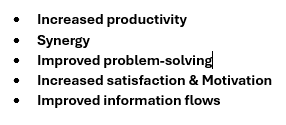
* Synergy - Outputs of the group better than individuals 2+2 = 5
* Improved problem solving and creativity - diversity, better decision making
* Increased satisfaction & motivation - sense of belonging, collective responsibility
* Improved information flows - more effective communication through participation in group discussions
6
What are the problems with teams?
* Conformity - individuals may feel pressure to agree when they know a decision is wrong
* The Abilene paradox - Group will go along with outcomes that none of the individuals wanted
* Risky shift - Riskier decisions can be taken by the team than they would otherwise make on an individual basis
* Group think - the group will try to minimise conflict by reaching a concensus rather than challenge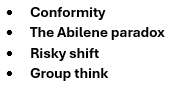
* The Abilene paradox - Group will go along with outcomes that none of the individuals wanted
* Risky shift - Riskier decisions can be taken by the team than they would otherwise make on an individual basis
* Group think - the group will try to minimise conflict by reaching a concensus rather than challenge
7
What did Tuckman suggest are the four stages of group development?
* Forming - gain awareness of each other - clear direction is needed
* Storming - can be constructive, can generate ideas, but if not resolved will not be constructive in the long term
* Norming - Cooperation, agree on worksharing, leadership style needs to be less autocratic & allow team members to be involved in decision making
* Performing - productivity at peak, cohesive team, operating to full potential, progress towards organisational goals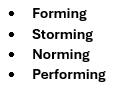
* Storming - can be constructive, can generate ideas, but if not resolved will not be constructive in the long term
* Norming - Cooperation, agree on worksharing, leadership style needs to be less autocratic & allow team members to be involved in decision making
* Performing - productivity at peak, cohesive team, operating to full potential, progress towards organisational goals
8
What is Belbin's theory on teams?
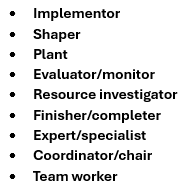
Belbin believed that if you have all 9 of the following roles then the team ISPERFECT
9
In Belbins team theory what is the IMPLEMENTOR
Company worker, disciplined, reliable, turns ideas into practical action
10
In Belbins team theory what is the SHAPER
Define the tasks, challenging, dynamic, thrive on pressure, drive & courage to overcome obstacles, can provoke others
11
In Belbins team theory what is the PLANT
Generate ideas, creative, imaginative, solve difficult problems, not good communicators
12
In Belbins team theory what is the EVALUATOR/MONITOR
Evaluating ideas, sees all the options, judges accurately, criticises others & brings team back down to earth
13
In Belbins team theory what is the RESOURCE INVESTIGATOR
Seeking out resources, extrovert, explore opportunities, develop contacts outside work
14
In Belbins team theory what is the FINISHER/COMPLETER
Ensures deadlines are met, painstakingly conscientious, search out errors & omissions, delivers on time, anxious, introverts
15
In Belbins team theory what is the EXPERT/SPECIALIST
Technical, single minded, specialist knowledge or skills, may overlook the bigger picture
16
In Belbins team theory what is the COORDINATOR/CHAIR
Setting agenda, mature, confident, clarify goals, promote decision making
17
In Belbins team theory what is the TEAMWORKER
Maintaining group cohesion, diplomatic, diffuse conflict
18
What is role theory
19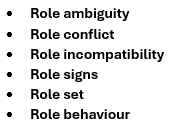
What are the 6 terms associated with role theory
20
What is role ambiguity
21
What is role conflict
22
What is role incompatibility
23
What is role signs
24
What is role set
25
What is role behaviour
26
What is Vaill's theory on high performance teams
Valli said that high performing teams may be defined as human systems that are doing dramatically better than other systems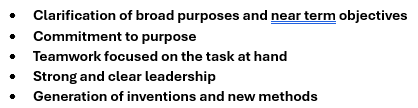
27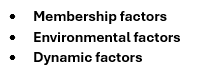
What are the 3 types of factors affecting group cohesiveness?
28
What are the MEMBERSHIP factors affecting group cohesiveness?
* Homogeneity - of status both internally or externally leads to a more cohesive group
* Alternatives - if the member has alternatives then dependance on the group is reduced, also high turnover of group members will mean the group lacks cohesion
* Size of the group - as the size of the group goes up productivity of individual members goes down, less opportunity to contribute, cliques can form, less work is done
* membership in other groups - this may detract from the cohesion and effectiveness of the original group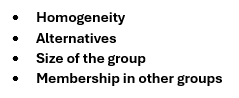
* Alternatives - if the member has alternatives then dependance on the group is reduced, also high turnover of group members will mean the group lacks cohesion
* Size of the group - as the size of the group goes up productivity of individual members goes down, less opportunity to contribute, cliques can form, less work is done
* membership in other groups - this may detract from the cohesion and effectiveness of the original group
29
What are the ENVIRONMENTAL factors affecting group cohesiveness?
* Task - the nature of the task and its organisation must be compatible
* isolation of the group - external threats and incentives are lower the omre isolated the group is
* the climate of management and leadership - the leadership style adopted shoul dbe appropriate to the task.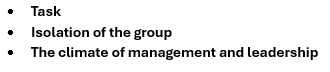
* isolation of the group - external threats and incentives are lower the omre isolated the group is
* the climate of management and leadership - the leadership style adopted shoul dbe appropriate to the task.
30
What are the DYNAMIC factors affecting group cohesiveness?
* Groups are continually changing - not just in membership but also understading of the task and each other
* Success and failure - there can be a tendancy for a groups to persist in failure
* Success and failure - there can be a tendancy for a groups to persist in failure
31
What are Peters and Watermans 5 key aspects of a successful team?
* Small - gives everyone an ability to contribute
* Limited duration - only there to acheive a particular task
* Voluntary - should choose to be a member
* Communication informal and unstructured - no status barriers
* Action oriented - the team should create a plan for action not just a form of words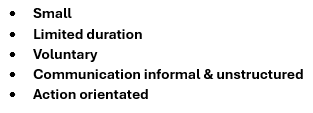
* Limited duration - only there to acheive a particular task
* Voluntary - should choose to be a member
* Communication informal and unstructured - no status barriers
* Action oriented - the team should create a plan for action not just a form of words
32
What is distributed leadership?
Also known as shared, or collective leadership and involves the sharing of the power base between a number of individuals
33
What are the 3 dimensions Carson et al suggested facilitated shared leadership?
34
What is intra group conflict?
35
What is inter group conflict?
36
Inter group conflicts require what 3 ingredients?
37
What methods can be used to manage inter group conflicts?