Snap shot notes
Study these flashcardsFree · spaced repetition · iPhone, Android, Mac & web
All cards
1
ABC costing
Process
1. Group produciton overheads into activities, based on how they are driven
2. Identify cost drivers for each activity
3. Calculate cost driver rate for each activity
4. Absorb the activity costs into the product.
5. Calculate full production cost.
Relevant for
1. Overheads are high compared to direct costs
2. Products/services complex
3. Products are tailored to customer needs
4. some products sold in large numbers others in small numbers
Advantages
1. Better cost allocation
2. Better accuracy in product cost
3. Better understanding of overheads
4. Facilitates better cost control
5. Can be used in complex situations and beyond production
6. Can be used in service and digital industries
Disadvantages
1. Not always relevant
2. Still need arbitrary cost allocations
3. Need tochoose appropriate drivers and activities
4. Complex
5. Expensive
6. Not allowed under IAS 2, have to covert to absorbtion for financial statements
Cost drivers should be
1. Relevant
2. Easy to measure
Types of activities
1. Logistial
2. Balancing
3. Quality
4. Change
Types of cost driver
1. Duration
2. Transaction
3. Intensity
1. Group produciton overheads into activities, based on how they are driven
2. Identify cost drivers for each activity
3. Calculate cost driver rate for each activity
4. Absorb the activity costs into the product.
5. Calculate full production cost.
Relevant for
1. Overheads are high compared to direct costs
2. Products/services complex
3. Products are tailored to customer needs
4. some products sold in large numbers others in small numbers
Advantages
1. Better cost allocation
2. Better accuracy in product cost
3. Better understanding of overheads
4. Facilitates better cost control
5. Can be used in complex situations and beyond production
6. Can be used in service and digital industries
Disadvantages
1. Not always relevant
2. Still need arbitrary cost allocations
3. Need tochoose appropriate drivers and activities
4. Complex
5. Expensive
6. Not allowed under IAS 2, have to covert to absorbtion for financial statements
Cost drivers should be
1. Relevant
2. Easy to measure
Types of activities
1. Logistial
2. Balancing
3. Quality
4. Change
Types of cost driver
1. Duration
2. Transaction
3. Intensity
2
Time series analysis
1. Trend - long term - basic direction of graph over time
2. Seasonal variations - Short term fluctuations due to different circumstances
3. Cyclical variations - Medium to long term - rarely consistent length - usually associated with economy
4. Residual variations - short term - random - due to chance events ie pandemic, floods
linear regression is used to identify the trend
Y = a +bx
a = the point you started recording the data
b = the period
X = increase in sales per period
WRITE MORE
2. Seasonal variations - Short term fluctuations due to different circumstances
3. Cyclical variations - Medium to long term - rarely consistent length - usually associated with economy
4. Residual variations - short term - random - due to chance events ie pandemic, floods
linear regression is used to identify the trend
Y = a +bx
a = the point you started recording the data
b = the period
X = increase in sales per period
WRITE MORE
3
Sustainability
:~ Environmental Sustainability
- Efficient use of resources (energy, materials, water)
- Minimising waste and emmissions
- Complying with regulations and reducing climate risks
:~ Social Sustainability
- Fair labour practices and diversity
- Community engagement
- Employee well-being and stakeholder trust
:~ Economic Sustainability
- Ensuring long term profitability
- Investing in innovation
- Managing financial and non-financial risks
- Efficient use of resources (energy, materials, water)
- Minimising waste and emmissions
- Complying with regulations and reducing climate risks
:~ Social Sustainability
- Fair labour practices and diversity
- Community engagement
- Employee well-being and stakeholder trust
:~ Economic Sustainability
- Ensuring long term profitability
- Investing in innovation
- Managing financial and non-financial risks
4
Short term finance
Trade payables
Factoring - debt collection, Financing (advance on funds), credit insurance (factor takes responsibility for irrecoverable debt, known as without recourse)
Invoice discounting - provided by factorer, select invoices used as security against which funds can be borrowed ( confidential as you still do credit control)
Bank over draft
Short term loan
Financing exports
Factoring - debt collection, Financing (advance on funds), credit insurance (factor takes responsibility for irrecoverable debt, known as without recourse)
Invoice discounting - provided by factorer, select invoices used as security against which funds can be borrowed ( confidential as you still do credit control)
Bank over draft
Short term loan
Financing exports
5
Financing exports
Documentary credits
Issued by bank on behalf of customer, authorising exporter to draw money once conditions set out in document are met
Bills of exchange
Similar to post dated cheque, written agreement for one party to pay a set amount of money on a set date. Can be resold
Export Factoring
Similar to factoring but for overseas
Forfaiting
SAme as export factoring except the seller will receive 100% of the receivable as a lump sum from the forfaiter. Seller draws bill of exchange from buyer which is then purchased by forfaiter (bank)
Issued by bank on behalf of customer, authorising exporter to draw money once conditions set out in document are met
Bills of exchange
Similar to post dated cheque, written agreement for one party to pay a set amount of money on a set date. Can be resold
Export Factoring
Similar to factoring but for overseas
Forfaiting
SAme as export factoring except the seller will receive 100% of the receivable as a lump sum from the forfaiter. Seller draws bill of exchange from buyer which is then purchased by forfaiter (bank)
6
Digital costing systems
Use technology to understand and 'read' product designs in order to find the best components to achieve product goals. They gather and feed information into manufacturing times to make the entire operation more efficient, flexible and effective
Features
~ Real time up to date information - gathers info from internet, links systems from suppliers and market places, compares prices and suppliers.
~Access to wider variety of resources - access to more suppliers, can give better lead times and more variety
~ Reduced operationl costs - Although expensive to implement, low operational costs and save time for management accountants
~ Better understanding of costs - built in analytics and intelligence capabilities, understand changing nature of cost, more detailed split of semi variable costs, cost per customer, location etc
~ More accurate costing - better knowledge of drivers and absorption of costs to products
~ More detailed breakdown of overheads with more personalised cost drivers
~ Target costing can be used - This system is used when the selling price is less controllable so that profit is very much dependent on meeting a target cost rather than adjusting selling prices
~ Improved communication - can use micro services to compute lead times, inform factory to make provisions for delivery, tell finance who & when to pay
~ Faster decision making - real time information
~ Improved cost control - standards regularly updated, reflect current market conditions, should result in no planning variances
Features
~ Real time up to date information - gathers info from internet, links systems from suppliers and market places, compares prices and suppliers.
~Access to wider variety of resources - access to more suppliers, can give better lead times and more variety
~ Reduced operationl costs - Although expensive to implement, low operational costs and save time for management accountants
~ Better understanding of costs - built in analytics and intelligence capabilities, understand changing nature of cost, more detailed split of semi variable costs, cost per customer, location etc
~ More accurate costing - better knowledge of drivers and absorption of costs to products
~ More detailed breakdown of overheads with more personalised cost drivers
~ Target costing can be used - This system is used when the selling price is less controllable so that profit is very much dependent on meeting a target cost rather than adjusting selling prices
~ Improved communication - can use micro services to compute lead times, inform factory to make provisions for delivery, tell finance who & when to pay
~ Faster decision making - real time information
~ Improved cost control - standards regularly updated, reflect current market conditions, should result in no planning variances
7
Costing Digital Products
Difficult because :~
1) Marginal costs can be virtually zero
2) Often no standard time or cost
3) Drivers for overheads difficult to determine
4) Timings of costs difficult to determine - may cover multiple periods, lots of upfront development costs
5) Lifespan of products can vary greatly, rapid changes in technology
6) features may be shared amoungst a number of products, finance must determine how to absorb costs into each one
Types of costs :~
1) Staff - mostly for development, some needed for ongoing support & updates
2) Infrastrucure, platform & payment types - web hosting, data storage, how data is delivered, servers, content delivery network (CDN)
3) Functionality - push notifications, social media and chat, SMS & email messaging
4) Design & Development - mostly upfront and large proportion of the costs
5) Marketing - Mostly post launch but could be pre launch market testing & previews
6) IT support services and testing - technical support, maintenance, updates, application programming interfaces (API's), bug fixes
7) Royalty & Liscense costs - variable costs
8) Administration - Admin dashboard allows organisation to manage content and functional services, update apps, manage user profiles, collect and analyse user behaviour, control access and enable data or user segmentation
1) Marginal costs can be virtually zero
2) Often no standard time or cost
3) Drivers for overheads difficult to determine
4) Timings of costs difficult to determine - may cover multiple periods, lots of upfront development costs
5) Lifespan of products can vary greatly, rapid changes in technology
6) features may be shared amoungst a number of products, finance must determine how to absorb costs into each one
Types of costs :~
1) Staff - mostly for development, some needed for ongoing support & updates
2) Infrastrucure, platform & payment types - web hosting, data storage, how data is delivered, servers, content delivery network (CDN)
3) Functionality - push notifications, social media and chat, SMS & email messaging
4) Design & Development - mostly upfront and large proportion of the costs
5) Marketing - Mostly post launch but could be pre launch market testing & previews
6) IT support services and testing - technical support, maintenance, updates, application programming interfaces (API's), bug fixes
7) Royalty & Liscense costs - variable costs
8) Administration - Admin dashboard allows organisation to manage content and functional services, update apps, manage user profiles, collect and analyse user behaviour, control access and enable data or user segmentation
8
Explain single product breakeven chart
Measures~
C/S ratio
Breakeven point
Margin of safety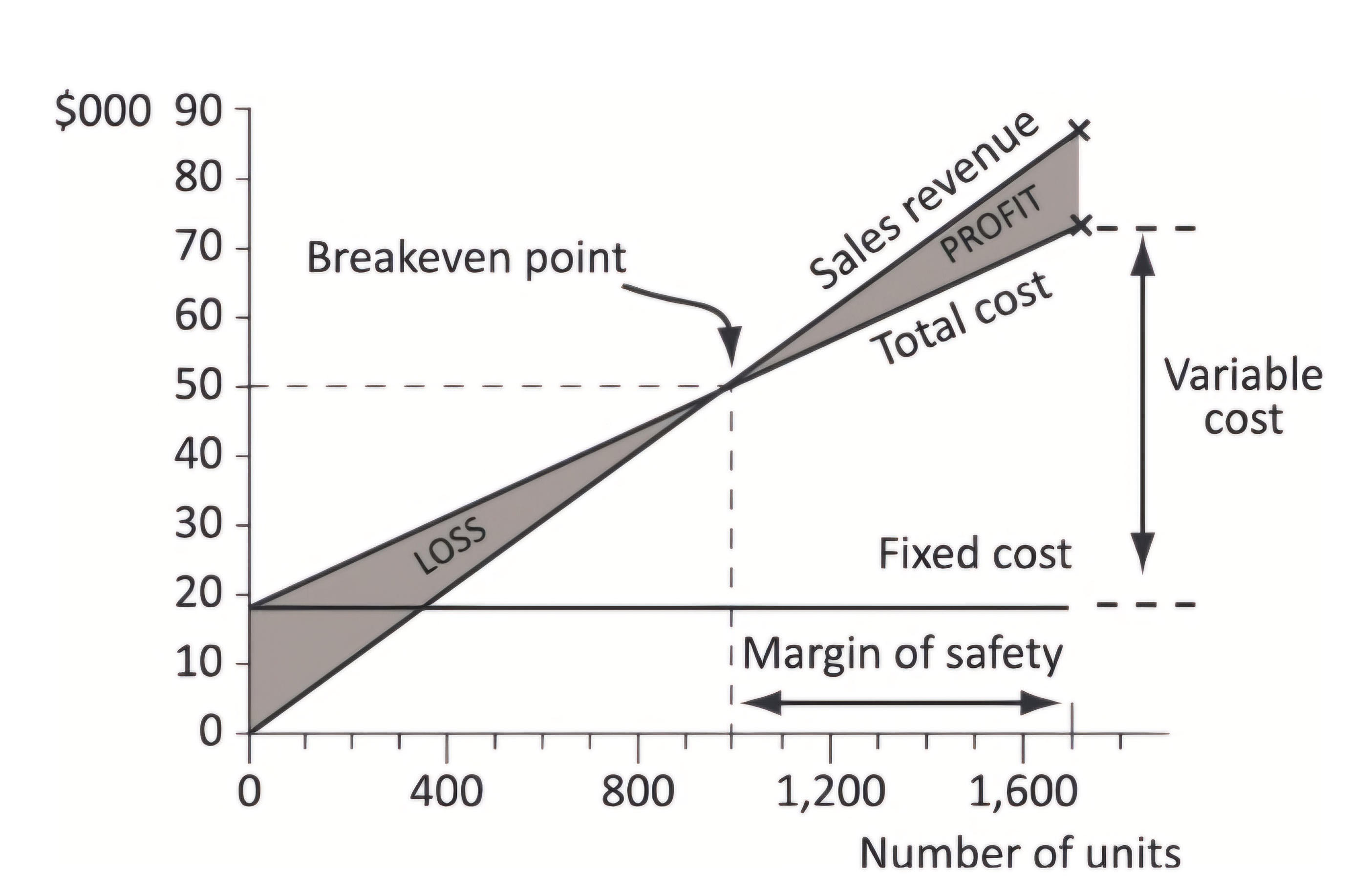
C/S ratio
Breakeven point
Margin of safety
9
Explain multi product profit volume graph
~ Straight line where constant sales mix is assumed
~ Bow shaped line where sales assumed to be sold in order of highest C/S ratio
Benefits ~ gives idea of minimum sales needed to make no loss or profit
~ Shows when we will start making profit
Limitations of stright line ~ Assumes sales made in pre determined mix, may vary, customer preferences may change
Limitations of curved line ~ assumes sales made in ordeer of C/S ratio, very unrealistic, customers will order in the order that they prefer, full range needs to be on offer, cannot restrict sales to profitable first. However could market the more profitable harder.
Other limitations ~ assumes all costs and sales prices are know and remain constant. Standard costs could change. if we offer discounts that affects contribution. Assumes fixed costs stay same but there could be steped fixed costs
Could prepare what if analysis with different selling prices/costs to see how breakeven would be affected.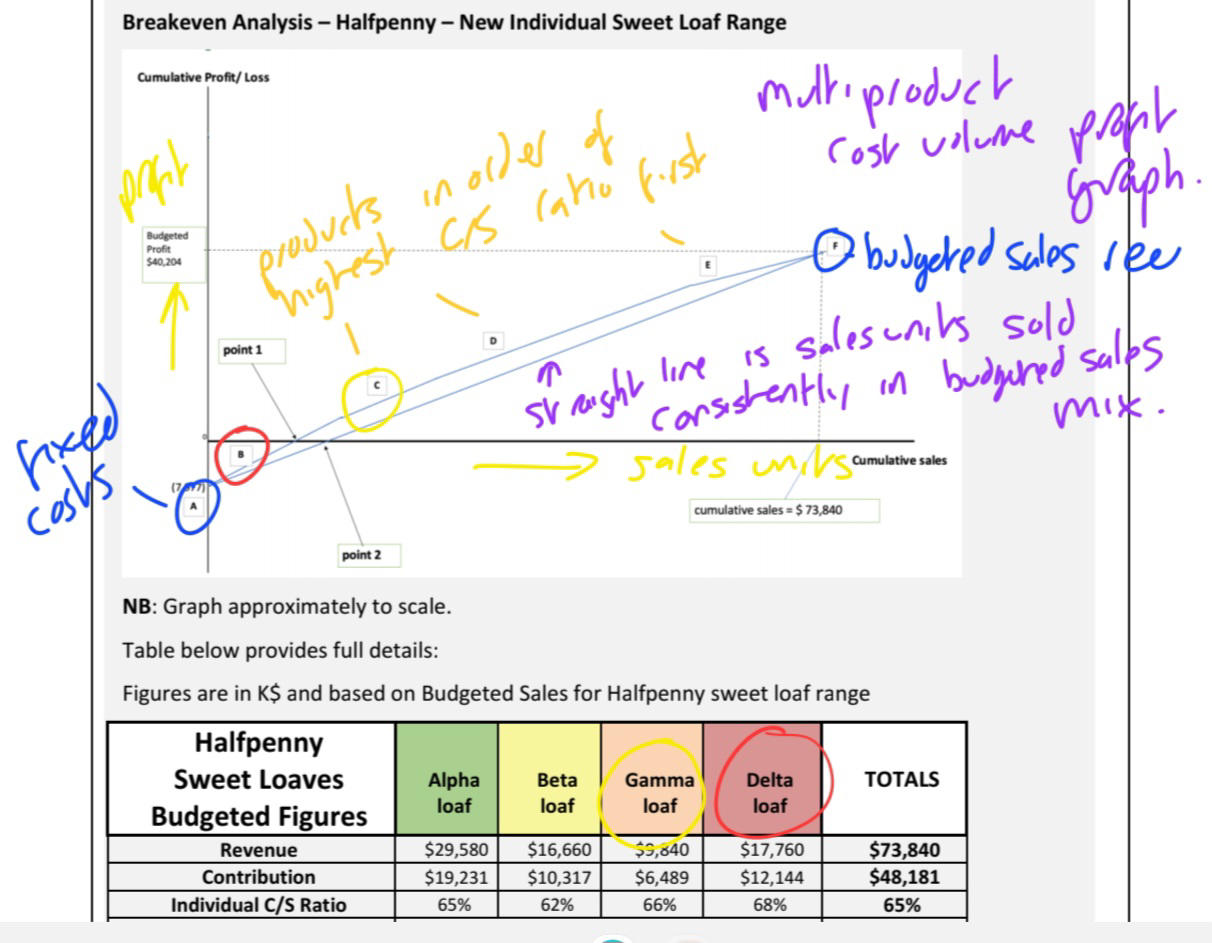
~ Bow shaped line where sales assumed to be sold in order of highest C/S ratio
Benefits ~ gives idea of minimum sales needed to make no loss or profit
~ Shows when we will start making profit
Limitations of stright line ~ Assumes sales made in pre determined mix, may vary, customer preferences may change
Limitations of curved line ~ assumes sales made in ordeer of C/S ratio, very unrealistic, customers will order in the order that they prefer, full range needs to be on offer, cannot restrict sales to profitable first. However could market the more profitable harder.
Other limitations ~ assumes all costs and sales prices are know and remain constant. Standard costs could change. if we offer discounts that affects contribution. Assumes fixed costs stay same but there could be steped fixed costs
Could prepare what if analysis with different selling prices/costs to see how breakeven would be affected.
10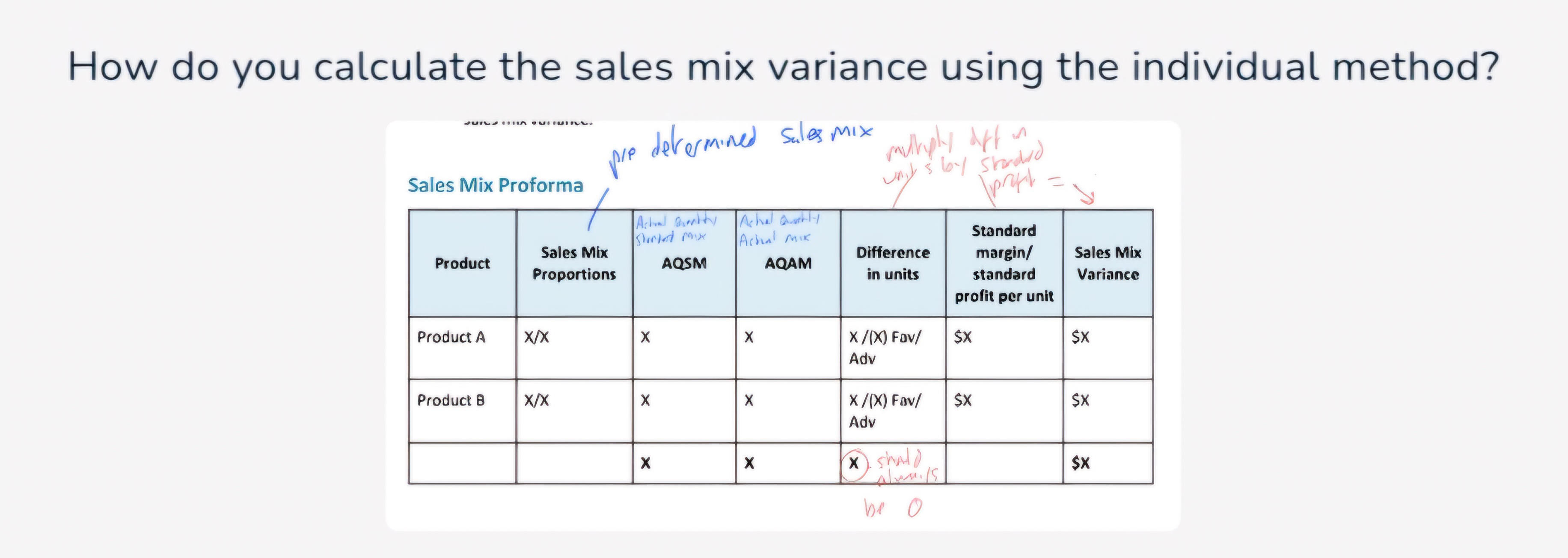
Sales mix variance individual method
11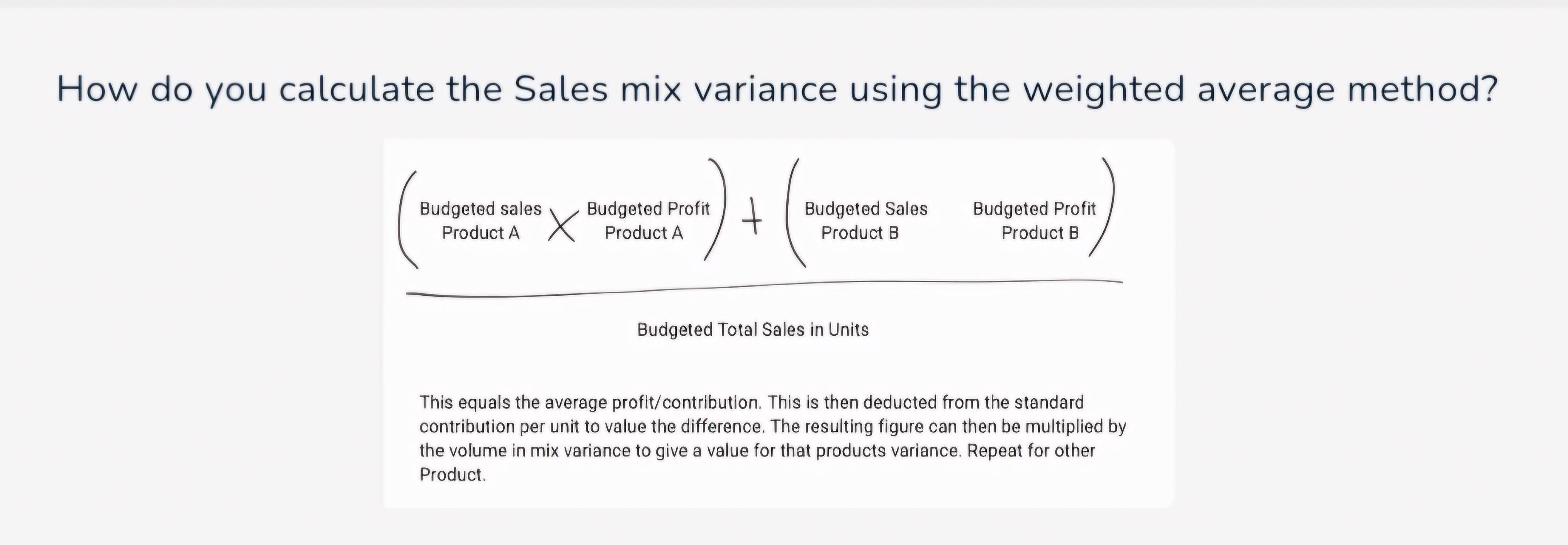
Sales mix variance weighted average method
12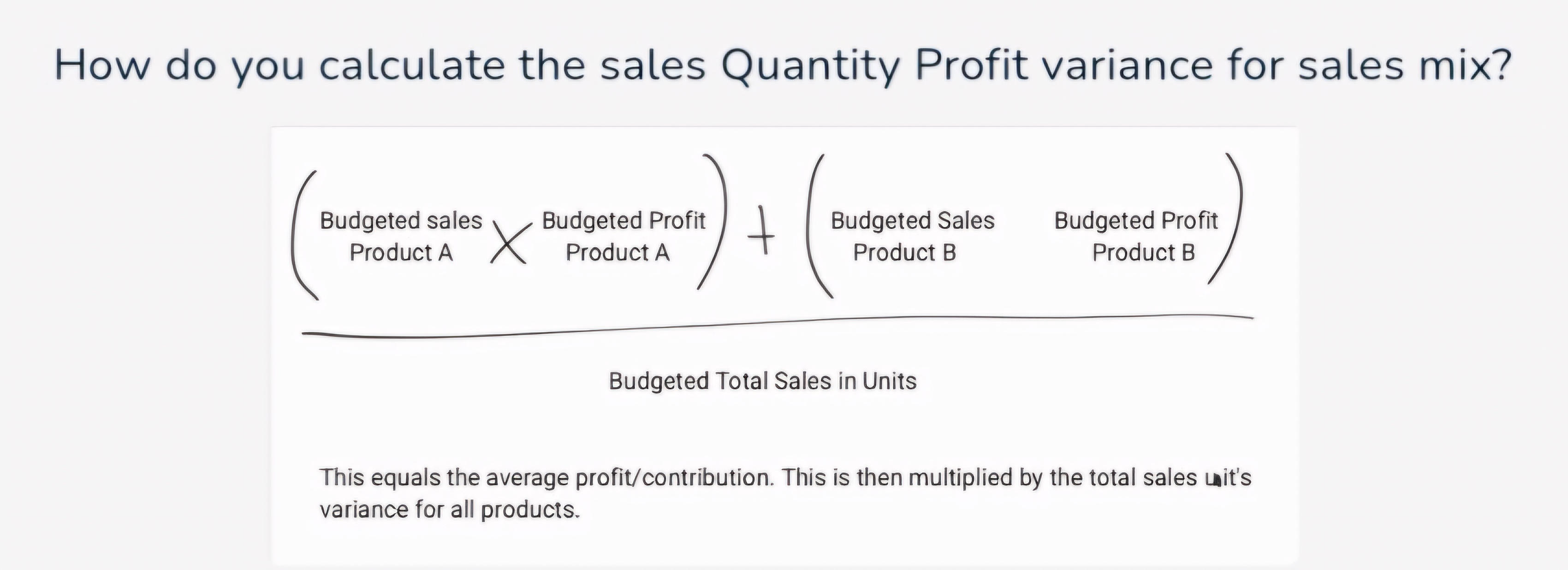
Sales quantity profit variance for sales mix
13
Benefits and problems of mix and quantity variances
Benefits
~ Allows company to to identify trends in sales of individual sales rather than just total sales, shows individual product success/failure
~ Saless quantity variance can identify changes in the market
~ Sales mix variance can indicate future directions for sales strategies, ie repeat favourable
~ sales mix variance can gauge the success/failure of new marketing campaigns
~ sales mix can identify impact of new products on company profits
~ Responsibility accounting can be improved when sales mix and and volume are split, right managers held accountable
Problems
~ Still need to take into account the controllability of variances (like with planning and operational variances)
~ variances need to be considered as a whole rather than individual basis, ie decisions made in production could affect sales
~ Sales mix variance is ONLY relevant if the products have some sort of relationship between them, ie same type different variety
~ can be difficut to apply in organisations with broad range of products
~ Allows company to to identify trends in sales of individual sales rather than just total sales, shows individual product success/failure
~ Saless quantity variance can identify changes in the market
~ Sales mix variance can indicate future directions for sales strategies, ie repeat favourable
~ sales mix variance can gauge the success/failure of new marketing campaigns
~ sales mix can identify impact of new products on company profits
~ Responsibility accounting can be improved when sales mix and and volume are split, right managers held accountable
Problems
~ Still need to take into account the controllability of variances (like with planning and operational variances)
~ variances need to be considered as a whole rather than individual basis, ie decisions made in production could affect sales
~ Sales mix variance is ONLY relevant if the products have some sort of relationship between them, ie same type different variety
~ can be difficut to apply in organisations with broad range of products
14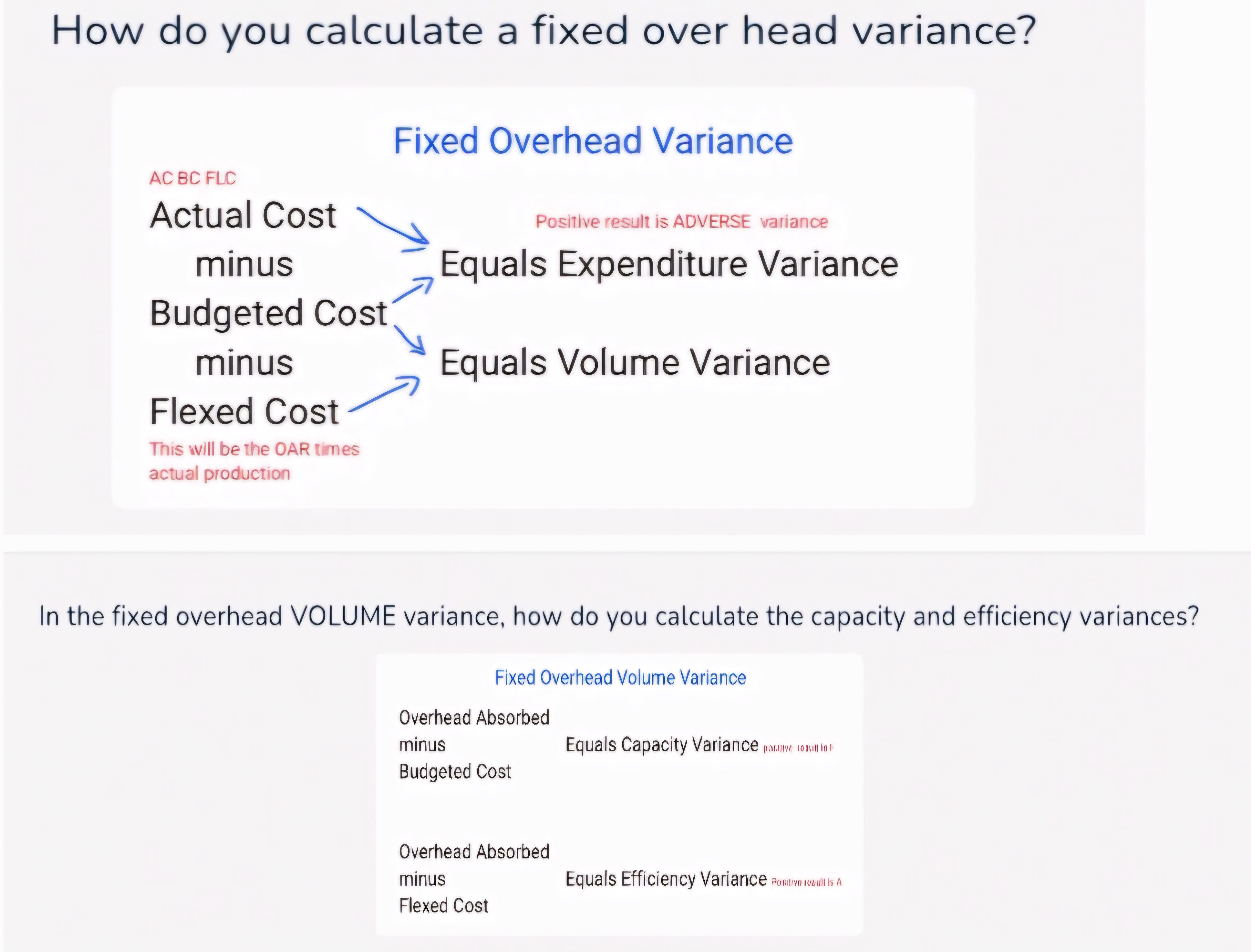
How do you calculate fixed overhead variance
15
Explain decisin tree
a decision tree is a diagrammatic representation of a decidion problem, where all possible courses of action are represented, and every possible outcome of each course of action is shown.
should be used where a series of decisions ate made with several possible outcomes, maybuse joint probabilities - where the outcome of one event depends on the outcome of a preceeding event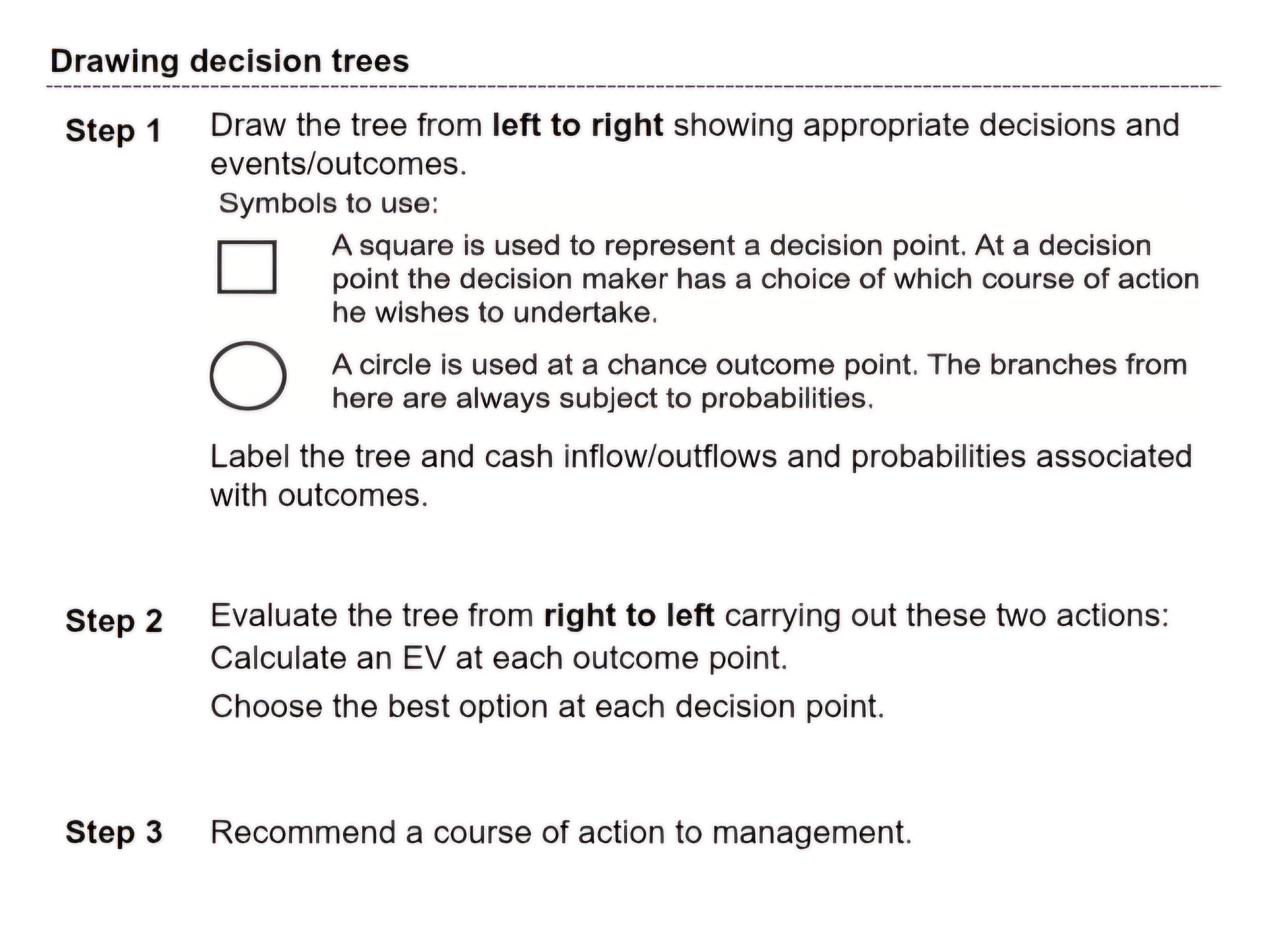
should be used where a series of decisions ate made with several possible outcomes, maybuse joint probabilities - where the outcome of one event depends on the outcome of a preceeding event
16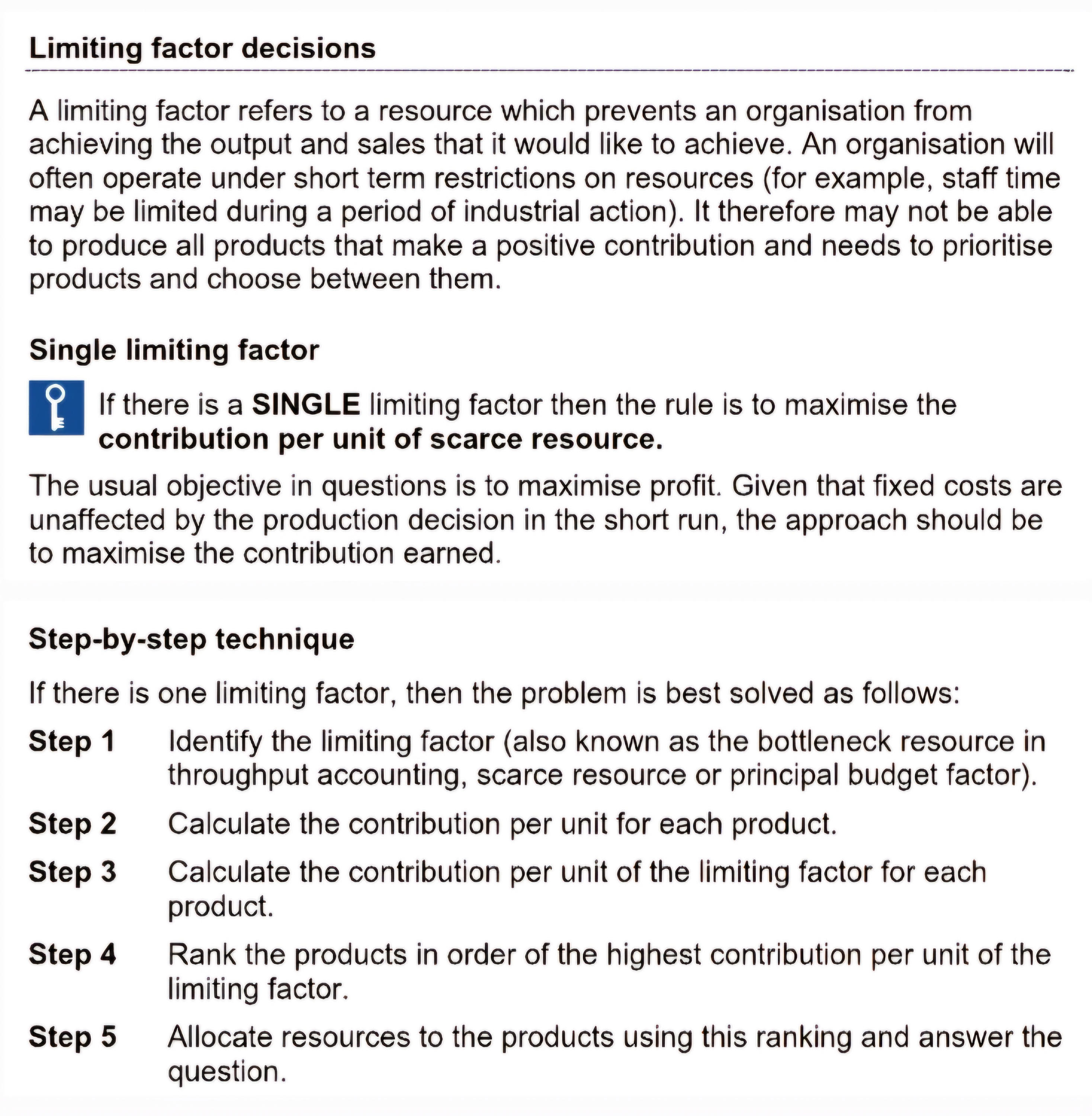
Explain limiting factor decisions
17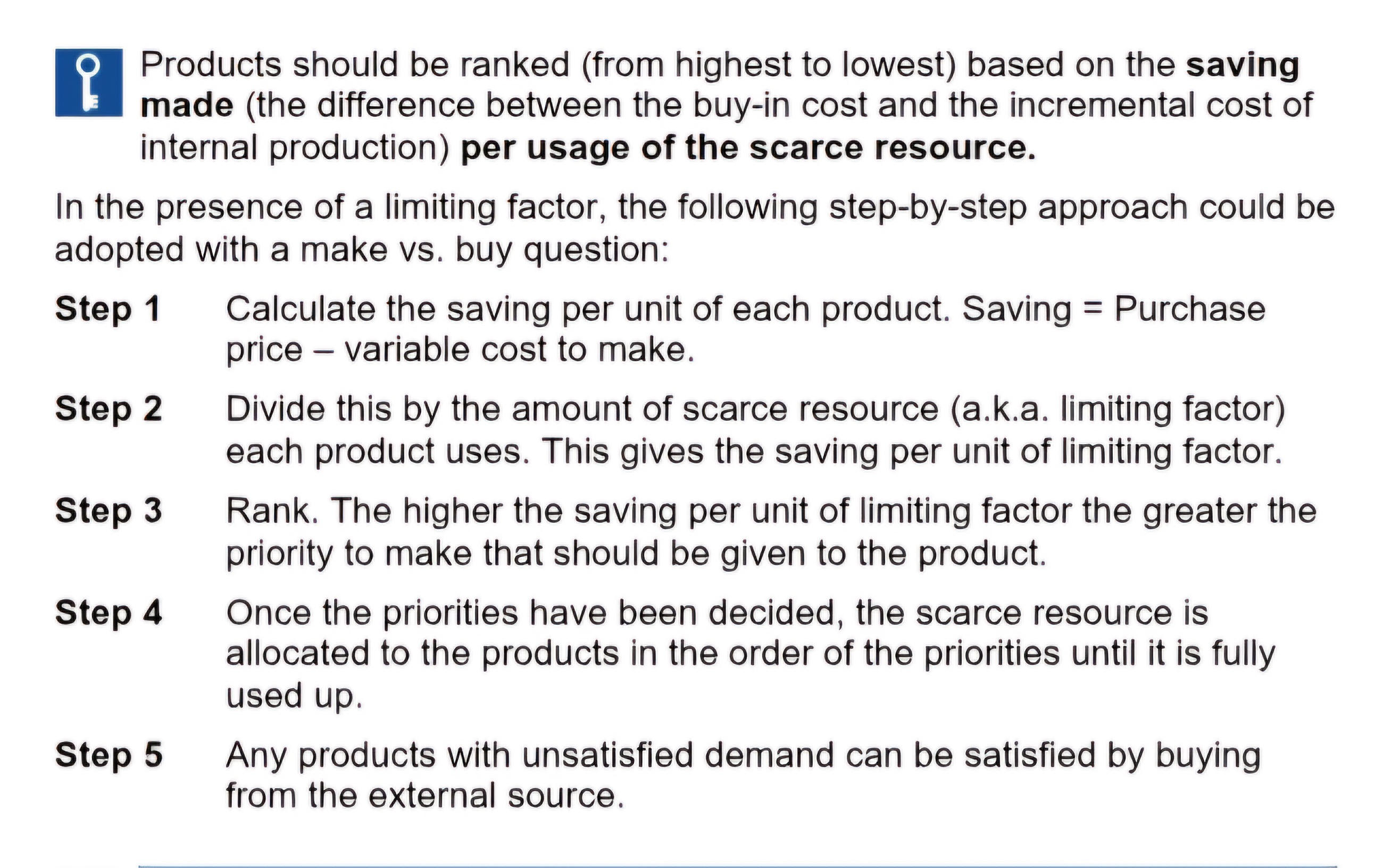
How do you deal with make or buy decisions with limiting factors
18
Explain relevant costs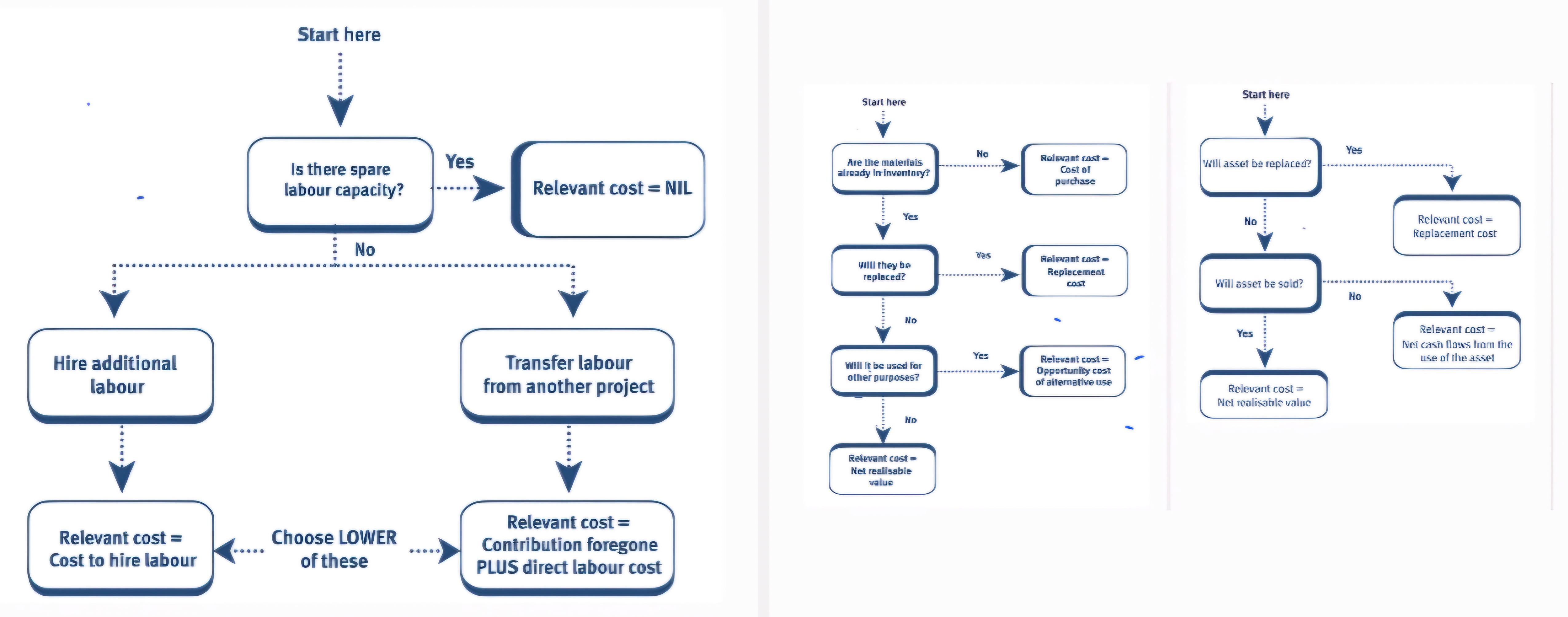
Relevant
future costs or revenues
incremental or differential - only the change in cost that is due to the decision
Cash flows - not profits as they can be manipulated
Opportunity cost - the value of the benefit sacrificed when one course of action is chosen, in preference to an alternative. It represents the forgone potential benefit from the best rejected course of action
Avoidable costs - the specific costs of an activity or sector of a business which would be avoided if that activity or sector did not exist
Non relevant costs
Sunk costs - already incurred
Committed costs- future costs that are the result of past decisions and not affected by current decision
Fixed costs - as they won't change. Overheads absorbed also ignored as it is an accounting procedure
Depreciation
Notional costs - ie rent charged to a section of the business
future costs or revenues
incremental or differential - only the change in cost that is due to the decision
Cash flows - not profits as they can be manipulated
Opportunity cost - the value of the benefit sacrificed when one course of action is chosen, in preference to an alternative. It represents the forgone potential benefit from the best rejected course of action
Avoidable costs - the specific costs of an activity or sector of a business which would be avoided if that activity or sector did not exist
Non relevant costs
Sunk costs - already incurred
Committed costs- future costs that are the result of past decisions and not affected by current decision
Fixed costs - as they won't change. Overheads absorbed also ignored as it is an accounting procedure
Depreciation
Notional costs - ie rent charged to a section of the business
19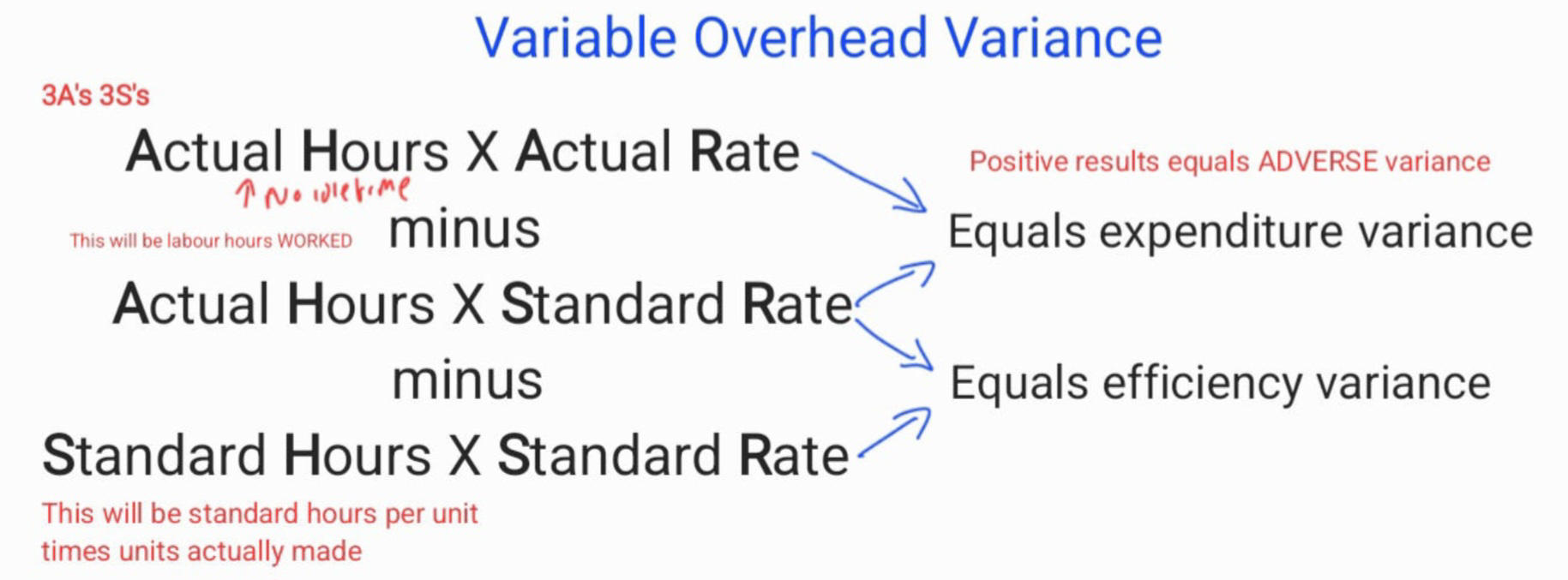
How to calculate variable overhead variance
20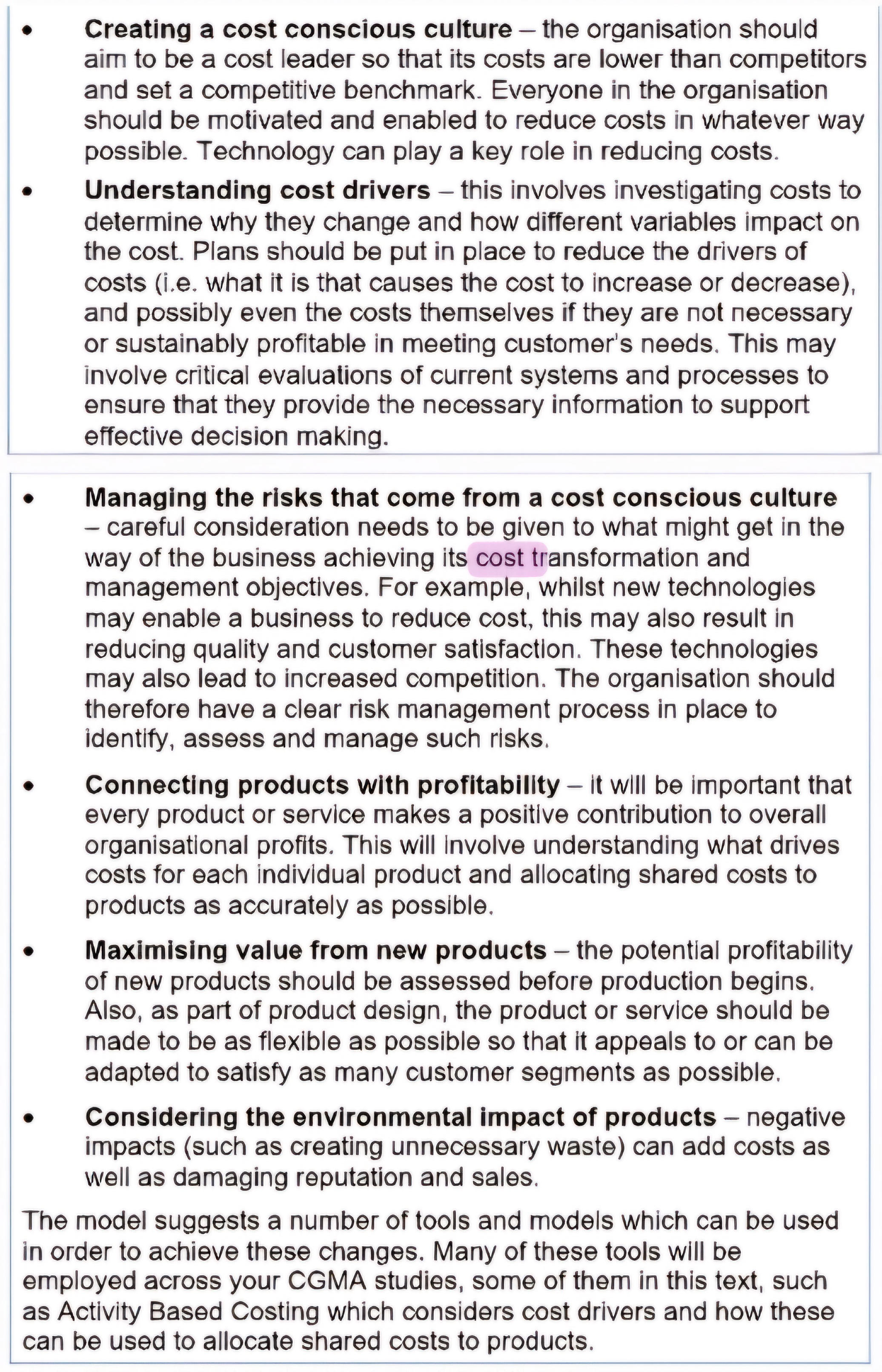
CGMA cost transformation model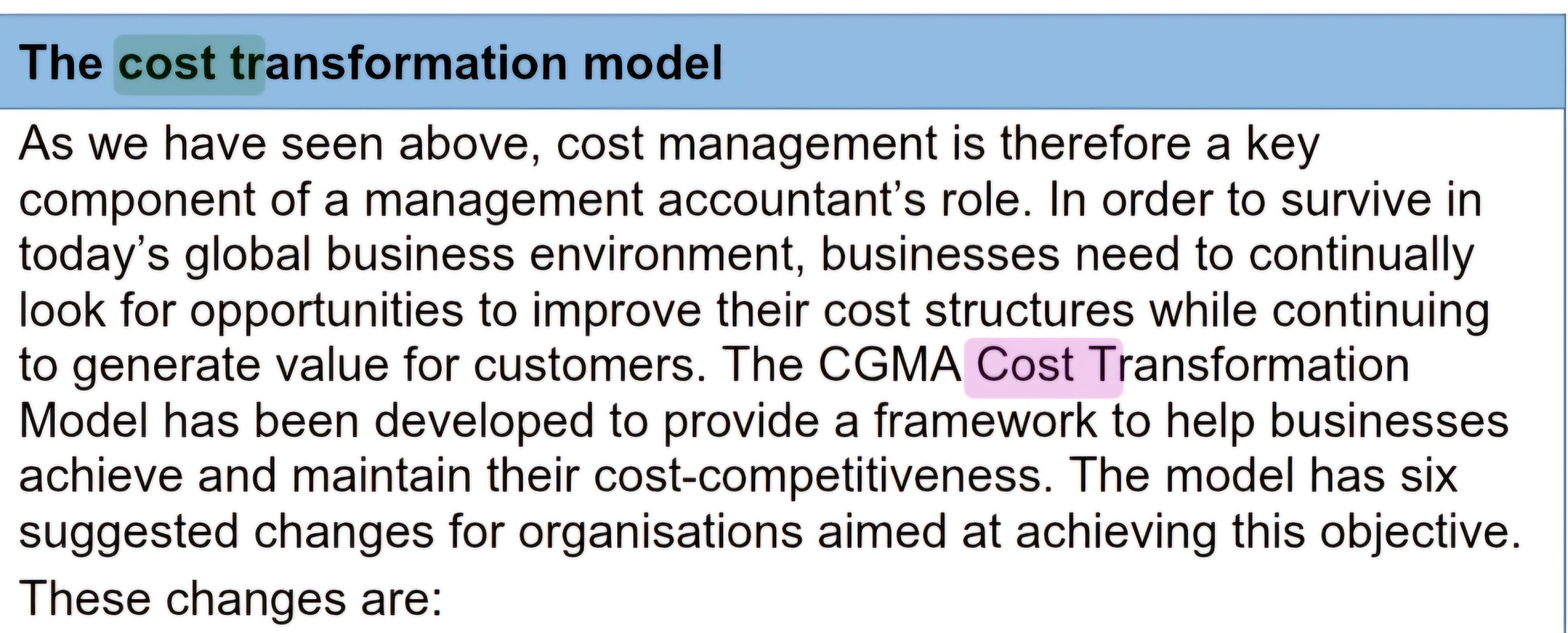
21
Throughput accounting
A technique where the primary goal is to maximise throughput while simultaneously maintaining or decreasing inventory and operating costs.
Based on 3 concepts, throughput, inventory and operating expenses.
Throughput = Sales revenue - direct material costs
all costs except direct materials are considered total factory costs
The aim of throughput is to maximise throughput contribution
If the business has a constraint that prevents it from meeting customer demand in full, it should make the most profitable use that it can of the constraining resource, giving priority to those products earning the highest throughput contribution. The factor causing the constraint is called the bottleneck.
Process
Step 1 - Identify the bottleneck resource
Step 2 - Calculate the throughput contribution per unit for each product
Step 3 - Calculate the throughput contribution per unit of the bottleneck resource for each product (also known as the return per factory hour)
Step 4 - Rank the products in order of the throughput contribution per unit of the bottleneck resource (from highest to lowest)
Step 5 - Allocate resources using this ranking and answer the question.
TPAR > 1 would suggest that the return exceeds the operating costs so the product should make a profit.
TPAR < 1 would suggest that the return is insufficient to cover the operating costs, resulting in a loss.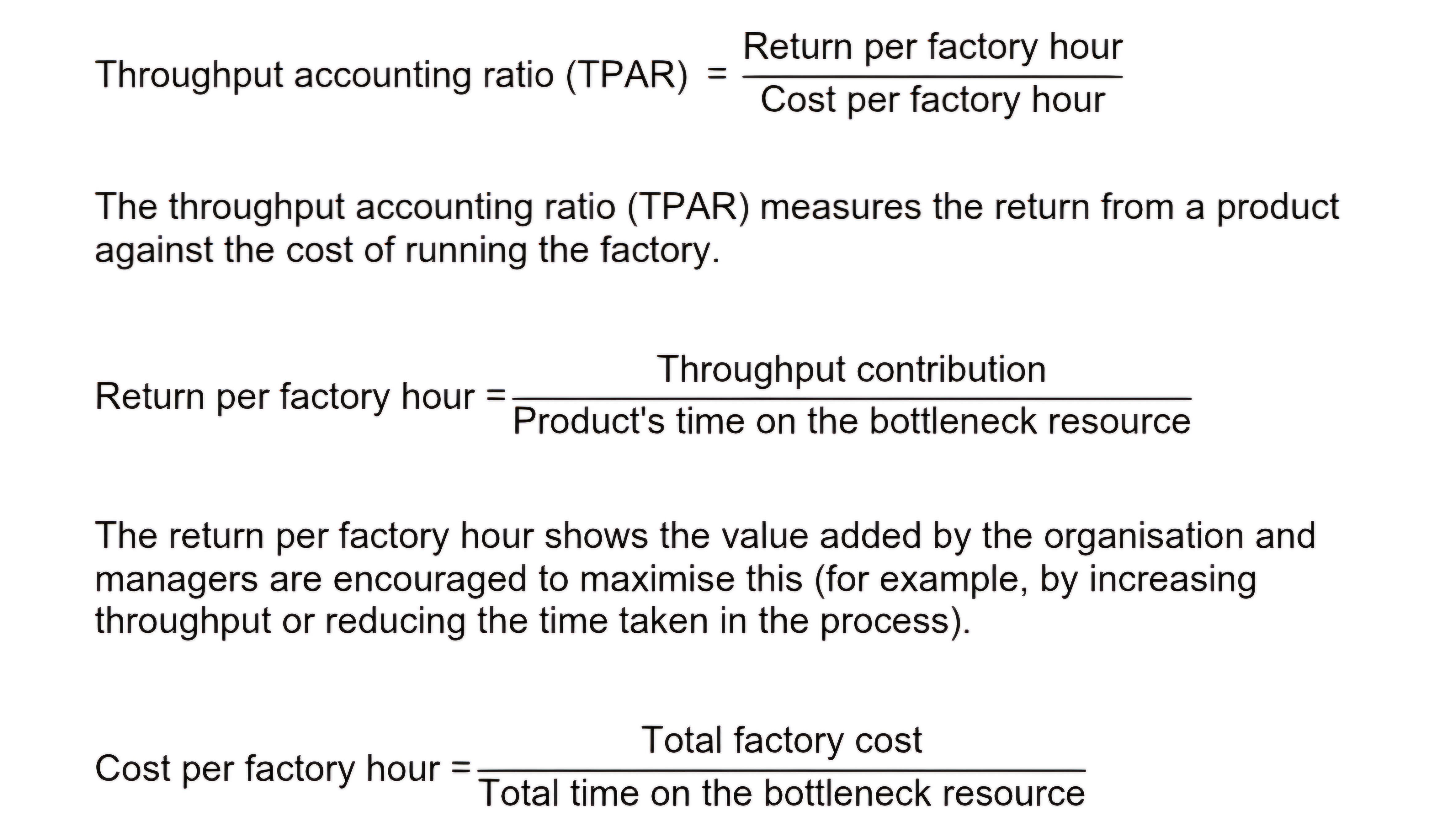
Based on 3 concepts, throughput, inventory and operating expenses.
Throughput = Sales revenue - direct material costs
all costs except direct materials are considered total factory costs
The aim of throughput is to maximise throughput contribution
If the business has a constraint that prevents it from meeting customer demand in full, it should make the most profitable use that it can of the constraining resource, giving priority to those products earning the highest throughput contribution. The factor causing the constraint is called the bottleneck.
Process
Step 1 - Identify the bottleneck resource
Step 2 - Calculate the throughput contribution per unit for each product
Step 3 - Calculate the throughput contribution per unit of the bottleneck resource for each product (also known as the return per factory hour)
Step 4 - Rank the products in order of the throughput contribution per unit of the bottleneck resource (from highest to lowest)
Step 5 - Allocate resources using this ranking and answer the question.
TPAR > 1 would suggest that the return exceeds the operating costs so the product should make a profit.
TPAR < 1 would suggest that the return is insufficient to cover the operating costs, resulting in a loss.
22
Feedback control
In this system the aim is to correct problems that have been discovered at the period end, when the actual results are compared with the budget. If there is a significant difference, then it is investigated and, if possible and desirable, it is corrected. Feedback control systems are therefore REACTIVE, feedback happens AFTER the event.
CIMA - Measurement of differences between planned outputs and actual outputs achieved, and the modification of subsequent action and/or plans to achieve future required results. Feedback control is an integral part of budgetary control and standard costing systems.
Negative feedback
Is corrective action intended to bring actual performance closer to the target or plan (to reverse a deviation from standard). For example, if actual costs are higher than budget, control action might be taken to cut costs. Similarly, if actual sales volume is lower than budgeted sales, action might be taken to boost sales.
Positive feedback
Is corrective action intented to increase the difference between actual performance and the target or plan. For example, if actual sales are higher then budget, control action might be taken to make this situation continue. Similarly, when actual costs are less than budget, measures might be taken to keep costs down.
CIMA - Measurement of differences between planned outputs and actual outputs achieved, and the modification of subsequent action and/or plans to achieve future required results. Feedback control is an integral part of budgetary control and standard costing systems.
Negative feedback
Is corrective action intended to bring actual performance closer to the target or plan (to reverse a deviation from standard). For example, if actual costs are higher than budget, control action might be taken to cut costs. Similarly, if actual sales volume is lower than budgeted sales, action might be taken to boost sales.
Positive feedback
Is corrective action intented to increase the difference between actual performance and the target or plan. For example, if actual sales are higher then budget, control action might be taken to make this situation continue. Similarly, when actual costs are less than budget, measures might be taken to keep costs down.
23
Feedforward control
In this system the aim is to anticipate problems with the aim of preventing them from occuring. It is therefore more PROACTIVE than feedback control. A feedforward control system operates by comparing results that are currently expected in the light of the latest information and the desired results. If there is a difference, then it is investigated and corrected. For example, if the forecast is bad, control action is taken before the actual poor results arise. Feedforward control should be used in conjunction with feedback control.
CIMA - It is defined as the forecasting of differences between actual and planned outcomes and the implementation of actions before the event, to avoid such differences.
Feedforward looks ahead and compares the target or objectives for the period and what actual results are now forecast.
Example - cash budgeting, which will warn management if a major cash surplus or deficit is expected to arise at some date in the future so that management can take action now.
Advantages & problems
Feedforward control reporting offers the key advantage that it is forward looking. It informs management what is likely to happen unless control measures are taken. Management can compare their targets for the period with current expectations.
In contrast, feedback control is backward looking, and historical variances or differences from plan are not necessarily a guide to what will happen over the full budget period.
A problem with feedforward control is that control reports should be produced regularly, which means that forecasts must be updated regularly. To implement an efficient feedforward control system, it is therefore necessary to have an efficient forecasting system. Forecasts might be prepared using computer models, with revisions to the forecast each month based on updated information about actual results to date, and where appropriate by making alterations to the basic assumptions in the model
CIMA - It is defined as the forecasting of differences between actual and planned outcomes and the implementation of actions before the event, to avoid such differences.
Feedforward looks ahead and compares the target or objectives for the period and what actual results are now forecast.
Example - cash budgeting, which will warn management if a major cash surplus or deficit is expected to arise at some date in the future so that management can take action now.
Advantages & problems
Feedforward control reporting offers the key advantage that it is forward looking. It informs management what is likely to happen unless control measures are taken. Management can compare their targets for the period with current expectations.
In contrast, feedback control is backward looking, and historical variances or differences from plan are not necessarily a guide to what will happen over the full budget period.
A problem with feedforward control is that control reports should be produced regularly, which means that forecasts must be updated regularly. To implement an efficient feedforward control system, it is therefore necessary to have an efficient forecasting system. Forecasts might be prepared using computer models, with revisions to the forecast each month based on updated information about actual results to date, and where appropriate by making alterations to the basic assumptions in the model
24
What is a digital product
a digital product refers to a product t that is stored, delivered and consumed electronically. The products can be delivered in many ways such as through a website, a mobile phone app or email. A digital product can also refer to digital media that will be distributed such as TV programmes or music. For example, if we were to sell videos to educate customers on how to recreate out loaves by baking at home, these videos would be digital products
25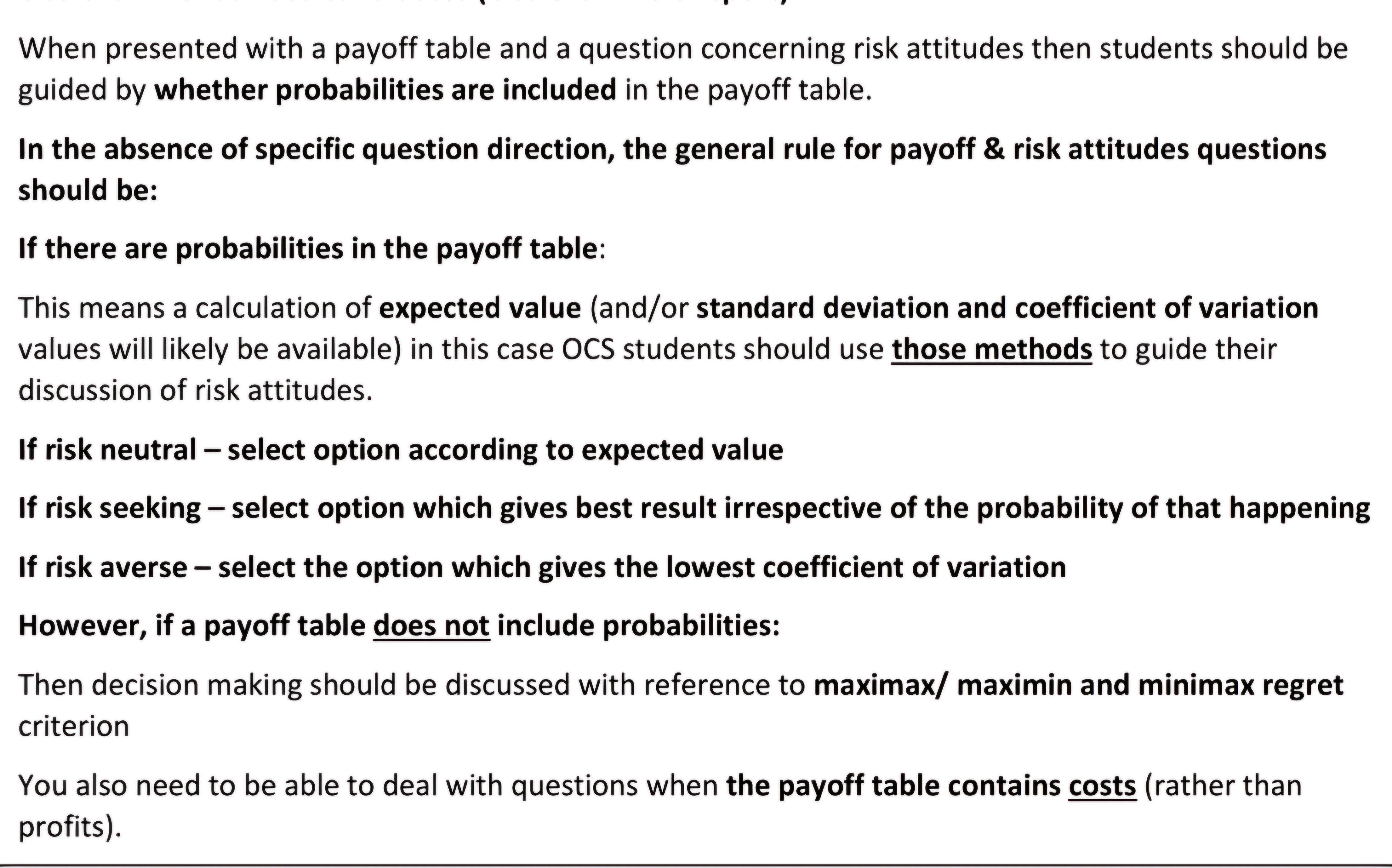
When making a risk decision how do yoiui know what methos to use
26
What are the 7 ethical dilemmas of budgeting
> inclusion of slack
> Lack of goal congruence
> Over stating results
> Budget constrained management styles
> Undue pressure on the budget holder
> Pseudo participation
> Budget as a pot of cash
> Lack of goal congruence
> Over stating results
> Budget constrained management styles
> Undue pressure on the budget holder
> Pseudo participation
> Budget as a pot of cash