Working Capital
Study these flashcardsFree · spaced repetition · iPhone, Android, Mac & web
All cards
1
The working capital cycle
The working capital cycle reflects a firm’s investment in working capital
as it moves through the production process towards sales. The
investment in working capital gradually increases, first being only in raw
materials, but then in labour and overheads as production progresses.
This investment must be maintained throughout the production
process, the holding period for finished goods and up to the final
collection of cash from trade receivables.
(Note: The net investment can be reduced by taking trade credit from
suppliers.)
as it moves through the production process towards sales. The
investment in working capital gradually increases, first being only in raw
materials, but then in labour and overheads as production progresses.
This investment must be maintained throughout the production
process, the holding period for finished goods and up to the final
collection of cash from trade receivables.
(Note: The net investment can be reduced by taking trade credit from
suppliers.)
2
Explain working capital
Working capital is the difference between a company's current assets and current liabilities. It represents the short-term liquidity available for day-to-day operations.
3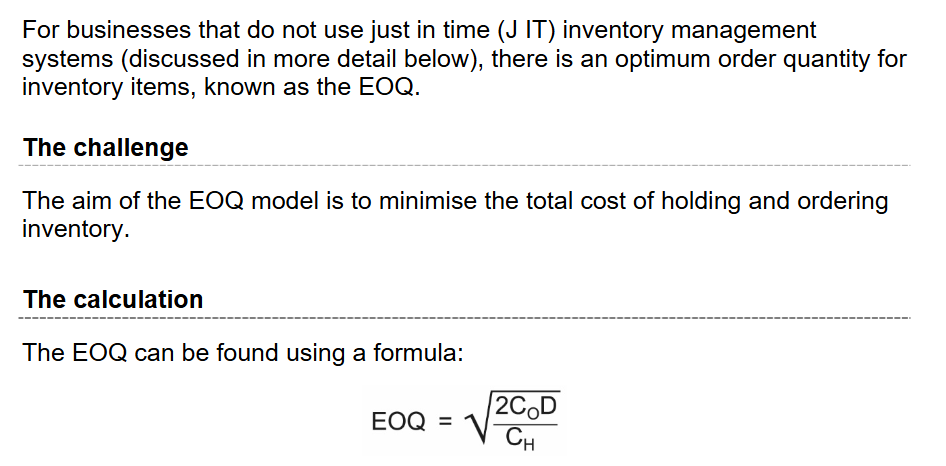
Economic order quantity (EOQ)
4
How EOQ works
In order to minimise the total cost of ordering and holding inventory it is necessary to balance the relevant costs. It is assumed that there is a fixed cost each time and order is placed and a variable cost for storing the inventory. Therefore the more inventory stored the higher the cost of storing inventory. The more orders placed the higher the cost of ordering. If you increase the number of orders the holding cost will reduce but the ordering cost will increase.,The EOQ attempts to balance the 2 costs, so the minimum cost will be at the point total ordering cost equals total holding cost
5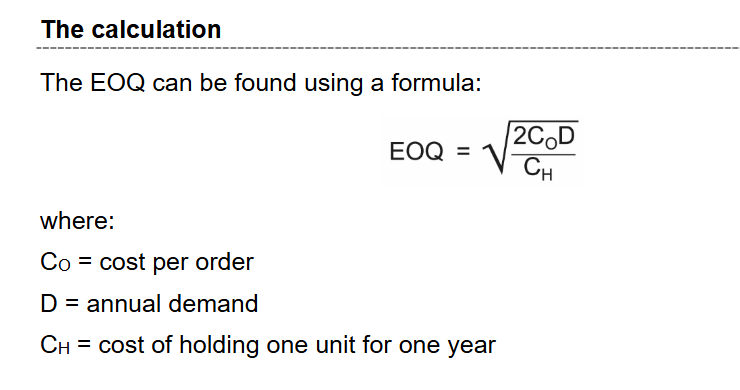
What is the formual for EOQ
6
What are the assumptions made when using EOQ
The following assumptions are made:
demand and lead time are constant and known
purchase price is constant
no buffer inventory held as it is assumed that it is not needed since
demand and lead times are known with certainty
- assumes that it costs a certain amount to hold a unit of inventory for one year
demand and lead time are constant and known
purchase price is constant
no buffer inventory held as it is assumed that it is not needed since
demand and lead times are known with certainty
- assumes that it costs a certain amount to hold a unit of inventory for one year
7
What are the criticisms of EOQ
1. It is based on simplifying assumptions, such as constant and predictable material usage rates
2. It will not indicate the optimal purchase quantity when there are price discounts for buying in larger quantities
3. Ignores the problems of managing stock outs
4. It is inconsistent with the philosophy of just in time management and total quality management
2. It will not indicate the optimal purchase quantity when there are price discounts for buying in larger quantities
3. Ignores the problems of managing stock outs
4. It is inconsistent with the philosophy of just in time management and total quality management
8
How do you calculate if EOQ is more cost effective than placing a larger order for a bulk purchase discount
1. calculate EOQ ignoring discount
2. Calculate the total annual inventory cost (including purchase cost of the inventory) arising from using EOQ
3. Recalculate total annual inventory costs (including purchase cost of inventory) using the order size required to just obtain each discount
4. compare the costs of EOQ and discount and select minimum cost alternative
5. repeat for each discount level
2. Calculate the total annual inventory cost (including purchase cost of the inventory) arising from using EOQ
3. Recalculate total annual inventory costs (including purchase cost of inventory) using the order size required to just obtain each discount
4. compare the costs of EOQ and discount and select minimum cost alternative
5. repeat for each discount level