F2 Consolidated Statement of Cashflow
Study these flashcardsFree · spaced repetition · iPhone, Android, Mac & web
All cards
1
What are the three main sections of a statement of cash flows?
Operating activities,
Investing activities,
Financing activities.
Investing activities,
Financing activities.
2
What is the primary purpose of the statement of cash flows?
To explain the movement of cash and cash equivalents during a period, showing where cash came from and how it was used.
3
What method is commonly used to prepare the operating activities section?
The indirect method.
4
What is the first step in the indirect method for operating activities?
Start with net profit before interest and tax (operating profit).
5
What non-cash items are added back to profit in the operating activities section?
Depreciation, amortization, impairment, and loss on disposal of assets.
6
How are changes in working capital treated in the operating activities section?
Increase in receivables or inventory: subtract from cash
Decrease in receivables or inventory: add to cash
Increase in payables: add to cash
Decrease in payables: subtract from cash
Decrease in receivables or inventory: add to cash
Increase in payables: add to cash
Decrease in payables: subtract from cash
7
What types of transactions are included in the investing activities section?
Purchase and sale of property, plant, and equipment (PPE), and other long-term investments.
8
What types of transactions are included in the financing activities section?
Issue or repayment of shares and loans, and payment of dividends.
9
Why is it important to adjust for non-cash items in the cash flow statement?
Because they affect profit but do not involve actual cash movement.
10
How do you calculate cash paid for tax?
Opening tax payable + tax expense (from P&L) – closing tax payable = cash paid for tax
11
How do you calculate cash paid for interest?
opening balance + charges for year - closing balance
12
How do you calculate cash from investing activities?
Cash paid to purchase PPE or investments: show as cash outflow
Cash received from sale of PPE or investments: show as cash inflow
Use actual cash amounts, not book values.
Cash received from sale of PPE or investments: show as cash inflow
Use actual cash amounts, not book values.
13
How do you calculate cash from financing activities?
Cash received from issuing shares or loans: add as inflow
Cash paid to repay loans or pay dividends: subtract as outflow
Use the movement in share capital, share premium, and loan balances.
Cash paid to repay loans or pay dividends: subtract as outflow
Use the movement in share capital, share premium, and loan balances.
14
Where are dividends received from associates recorded in the consolidated cash flow statement?
In the investing section.
15
: Where are dividends paid to non-controlling interests (NCI) recorded?
In the financing section.
16
Front: How do you calculate the dividend paid to Non-Controlling Interest (NCI) in consolidated statement of cashflow
Note NCI at the start of the year.
Add: NCI’s share of profit for the year.
Add/Subtract: Any changes in ownership (acquisitions/disposals)—if none, skip this step.
Subtract: NCI at the end of the year.
The difference = Dividend paid to NCI. (Expressed as: Start NCI + NCI Profit ± Ownership changes – End NCI = Dividend Paid)
Placement in financials: Cash outflows for dividends paid to NCI appear under the “Financing activities” section of the cash flow statement.
Add: NCI’s share of profit for the year.
Add/Subtract: Any changes in ownership (acquisitions/disposals)—if none, skip this step.
Subtract: NCI at the end of the year.
The difference = Dividend paid to NCI. (Expressed as: Start NCI + NCI Profit ± Ownership changes – End NCI = Dividend Paid)
Placement in financials: Cash outflows for dividends paid to NCI appear under the “Financing activities” section of the cash flow statement.
17
How do you calculate the dividend received from an associate?
Find the investment in the associate at the start and end of the year.
Calculate increases from the share of profit and other comprehensive income (OCI).
The formula: Dividend received = (Start of year investment + Share of profit + Share of OCI) - End of year investment
The result is the cash dividend received (recorded in the investing section of the cash flow statement).
Journal entry: Debit bank, Credit investment in associate.
Calculate increases from the share of profit and other comprehensive income (OCI).
The formula: Dividend received = (Start of year investment + Share of profit + Share of OCI) - End of year investment
The result is the cash dividend received (recorded in the investing section of the cash flow statement).
Journal entry: Debit bank, Credit investment in associate.
18
What is the direct impact of acquiring or disposing of a subsidiary?
The direct impact is cash paid out to acquire or cash received from disposing of a subsidiary, recorded in the investing section. The net effect is the cash outflow or inflow minus any cash bank deposits held by the subsidiary at the time of acquisition or disposal.
19
How do you calculate the net cash effect for acquiring a subsidiary?
Net cash effect = Cash paid to acquire the subsidiary minus cash or bank balance held by the subsidiary at acquisition.
20
What is the indirect impact in the context of acquisitions/disposals of subsidiaries?
The indirect impact involves ensuring that the consolidated cash flow statement does not double count the subsidiary’s cash flows or asset/liability movements due to acquisition/disposal.
21
Why must you adjust inventory changes when a subsidiary is acquired?
To avoid double counting: part of the inventory increase may be from acquiring a subsidiary with existing inventory. Only the increase not from acquisition affects operating cash flow.
22
How is an increase in inventory handled in the consolidated cash flow statement when a subsidiary is acquired?
Adjust the inventory movement to exclude the inventory acquired with the new subsidiary. Only the net increase (excluding that from acquisition) appears as a cash outflow in the operating section.
23
How are non-cash acquisitions, such as share issues to acquire subsidiaries, treated in the cash flow statement?
Non-cash acquisitions (like issuing shares) are not reflected as cash flows in the cash flow statement.
24
Where are receipts or payments relating to acquisitions of associates or joint ventures recorded in the cash flow statement?
They are recorded in the investing section. Dividend income from associates or joint ventures is also shown in this section unless proportionately consolidated (rare).
25
How do you work out if there is an adjustment for goodwill impairment needed?
Calculate the goodwill at acquisition, compare it to the C/F goodwill, if it matches no adjustment is needed, if it is less you will need to add back the difference in the cash from operating activites section
26
How do you calculate the adjustments needed for trade payables / receivables
calcualte the difference from prev year to current year as usual but deduct the balance of the acquired subsidiary from the answer to get the total cash adjustment for operating activities
27
How do you calcualte the cash paid for a subsidiary
Take the amount paid (only the cash) and deduct the cash in bank of the subsidiary
28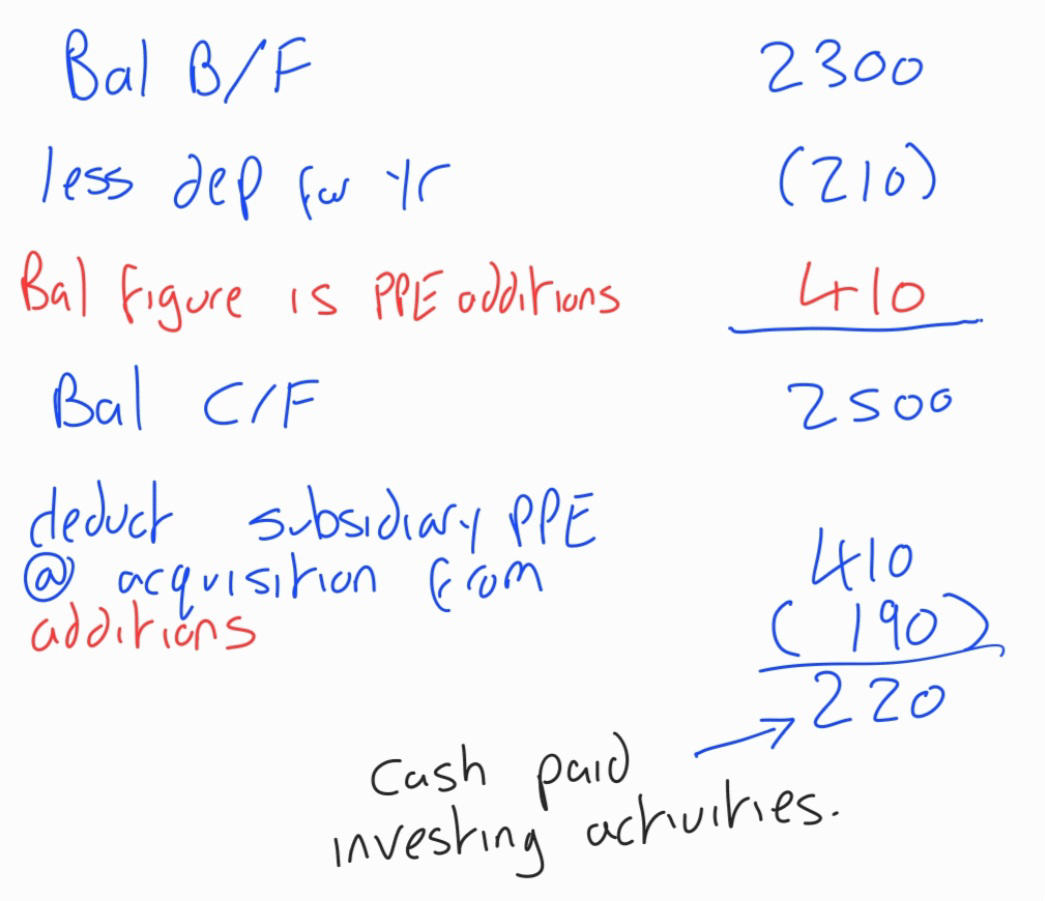
How do you calculate the cash paid for the purchase of PPE (Property, Plant, and Equipment) when there are no disposals, and part of the PPE comes from acquiring a subsidiary?
29
How do you calculate cash inflow from the issue of shares?
Sum the share capital and share premium for this year and last year; subtract previous year from current year to get the increase. Then subtract any non-cash considerations (e.g., shares issued to subsidiary shareholders).
30
How do you check for dividends paid?
Add the profit attributable to the parent to last years retained earnings. If it equals your retained earnings carried forward then no adjustment to investing activites is needed, if it does not then a divident was paid and you need to subtract the divident in investing activities
31
How would you calculate a parents share of profit from associate from the SOFP investment in associate and dividend paid figures
Deduct the dividend from prev year investment in associate figure. Then deduct the result from the current year investment in associate figure to get the share of profit as the balancing figure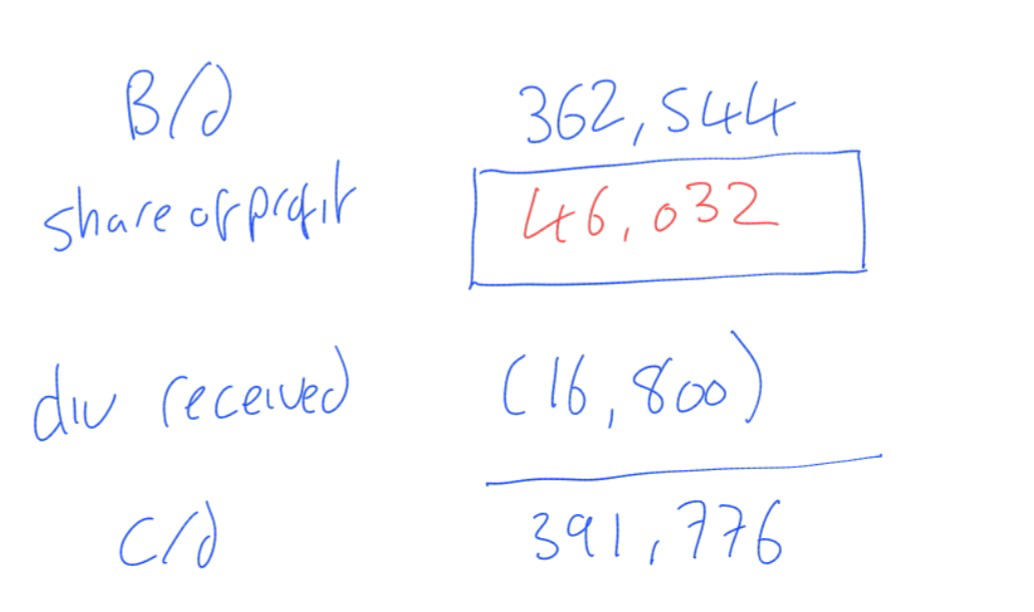
32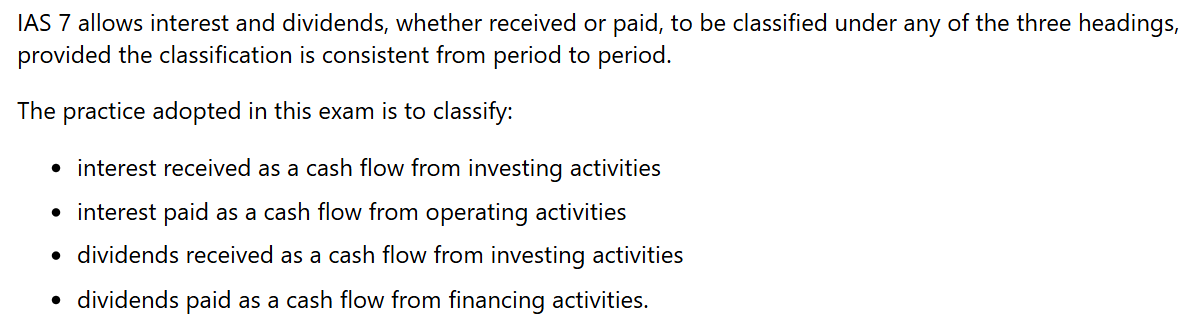
For the purpose of the exam where should interest and dividend be shown in the statement of cashflows
33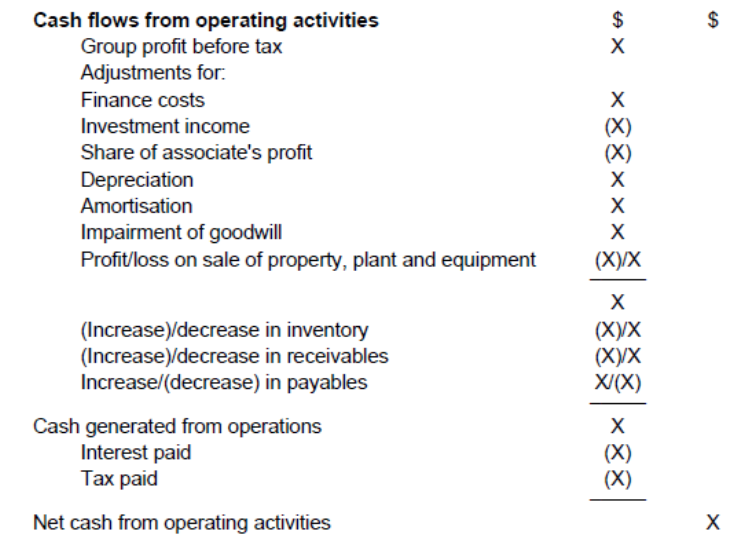
What is the pro forma for cash generated from operating activites
34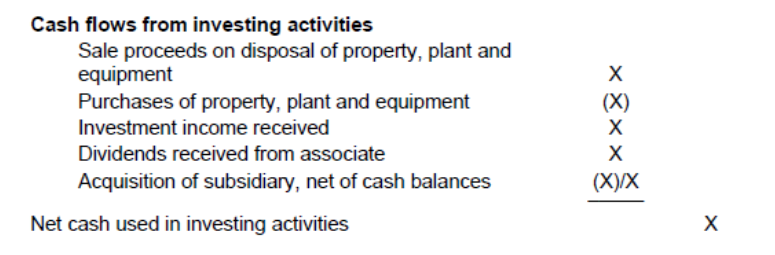
What is the pro forma for cash generated from investing activites
35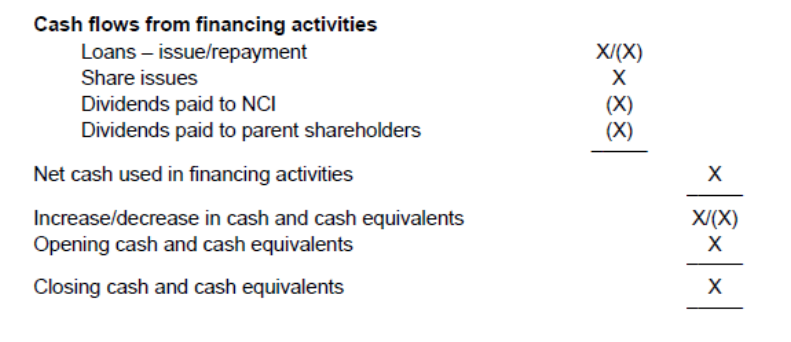
What is the pro forma for cash generated from financing activites