F2 Related Party Transactions
Study these flashcardsFree · spaced repetition · iPhone, Android, Mac & web
All cards
1
When is an entity a related party?
* Directly or indirectly controls or has significant influence over entity
* Has joint control
* the party is an associate
* the party is a joint venture in in which the entity is a venturer
* the party is a member of key management personnel of the entity/it parent
*The party is a close family member of a key personel of entity or their sub/associate/joint arrangement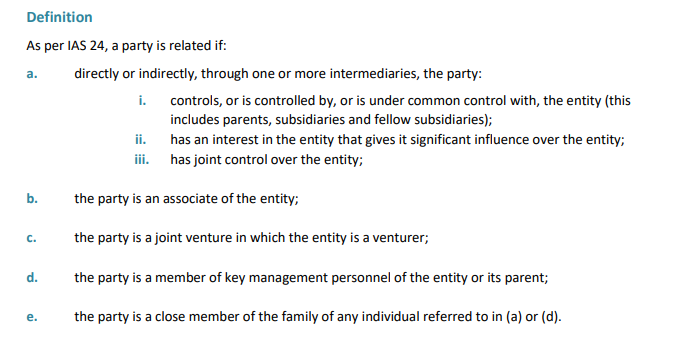
* Has joint control
* the party is an associate
* the party is a joint venture in in which the entity is a venturer
* the party is a member of key management personnel of the entity/it parent
*The party is a close family member of a key personel of entity or their sub/associate/joint arrangement
2
What is the definition of a related party?
A related party is 'a person or entity that is related to the entity that is preparing its financial statements (the reporting entity)' (IAS 24, para 9).
3
What are key management personnel?
Key management personnel are 'those persons having authority and responsibility for planning, directing and controlling the activities of the entity, directly or indirectly, including any director (whether executive or otherwise) of that entity' (IAS 24, para 9).
4
Does joint control between two entities automatically make them related parties to each other?
No. If two entities share joint control (like both owning 50% of a third entity), they are related to the entity they control jointly, but not to each other.
5
Are two companies with a common director automatically related parties?
No. They are only related parties to the director, not to each other, unless there is evidence of control or significant influence.
6
Are providers of finance like banks, trade unions, or government agencies considered related parties?
No. Merely providing finance or funding does not make them related parties.
7
Does a large volume of trade with a customer or supplier make them a related party?
No. The volume of business alone does not create a related party relationship.
8
Which close family members are considered related parties?
Spouses, partners, children, and dependents living in the same household who could be influenced by the key management personnel.
9
What is significant influence, and at what ownership percentage is it usually considered?
Significant influence is usually presumed when owning 20–50% of shares in another entity.
10
What is a related party transaction?
A related party transaction is 'a transfer of resources, services or obligations between a reporting entity and a related party, regardless of whether a price is charged' (IAS 24, para 9).
11
When a related party transaction has occurred what disclosures are required?
12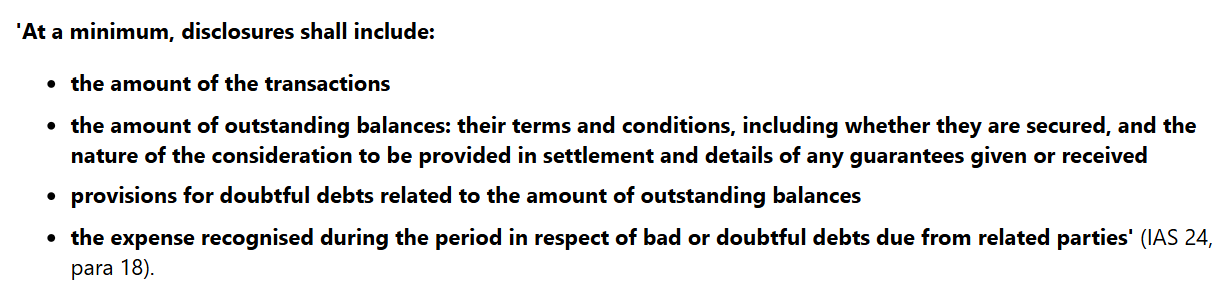
what is the minimum disclosure requirement
13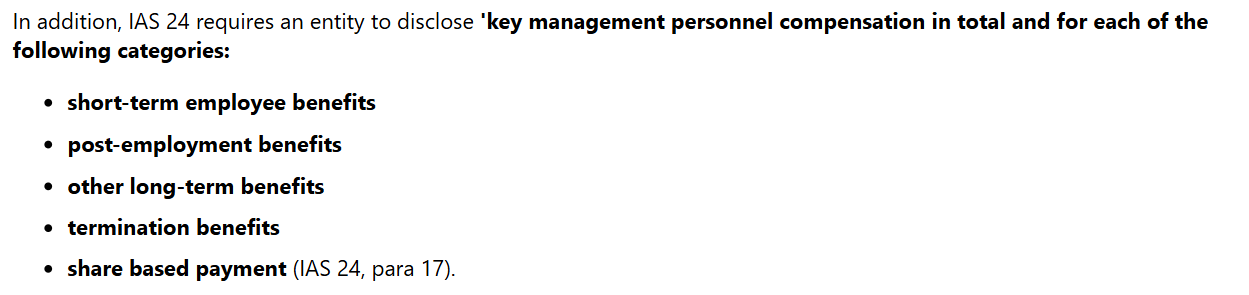
What disclosures are required for key management compensation
14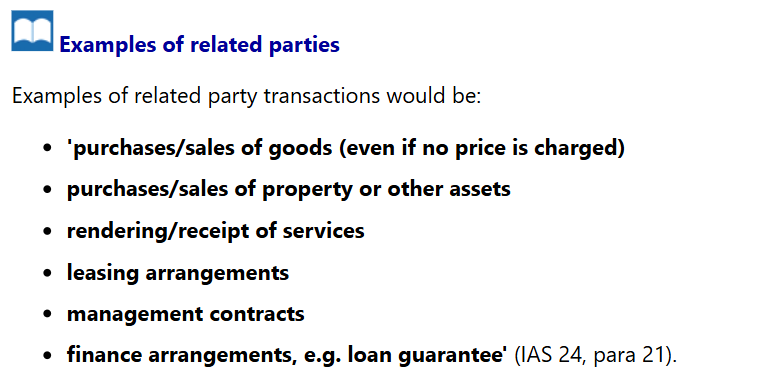
What type of transactions would be related party transactions
15
Should related party transactions be disclosed if they were conducted on normal commercial terms?
Yes, these transactions must still be disclosed even if they were on normal commercial terms.
16
re intergroup related party transactions required to be disclosed in consolidated financial statements?
No, because they are eliminated during consolidation.
17
How should disclosures for each category of related party be presented?
With separate disclosure, often using a table showing transactions and amounts outstanding for each category.
18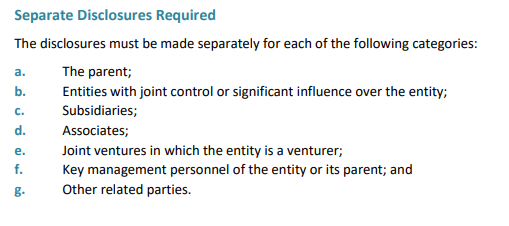
What are the categories that require separate disclosures?