E2 Project Management
Study these flashcardsFree · spaced repetition · iPhone, Android, Mac & web
All cards
1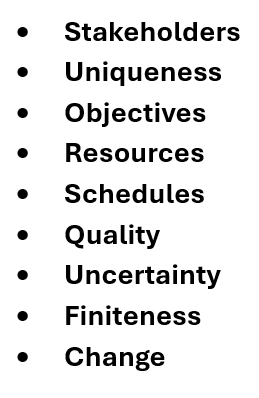
What are the charaacteristics of a project?
2
What are the project constraints?
* Time
* Cost
* Quality
* Cost
* Quality
3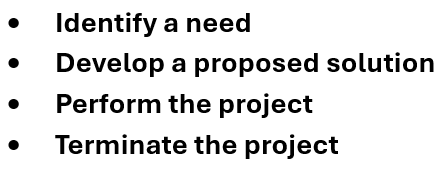
What are Gido and Clements stages of the project lifecycle?
4
Explain the identify a need stage of the project lifecycle
5
Explain the Develp a proposed solution stage of the project lifecycle
6
Explain the implementation stage of the project lifecycle
7
Explain the close stage of the project lifecycle
8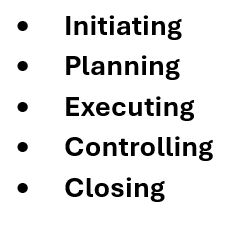
What is the alternative 5 stages of a project?
9
What is included in the initiation stage of a project?
* Feasability
* PID (project initiation document)
* PID (project initiation document)
10
What are the types of feasability of a project that should be considered?
* Technical
* Social
* Ecological (environmental)
* Economic
Additional
* Business
* Time
* Social
* Ecological (environmental)
* Economic
Additional
* Business
* Time
11
What is technical feasibility?
Can it be done?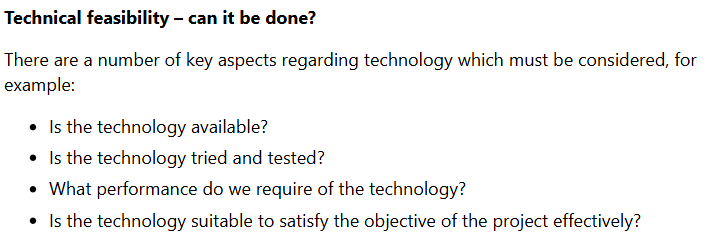
12
What is social feasibility?
Does it fit with current operations?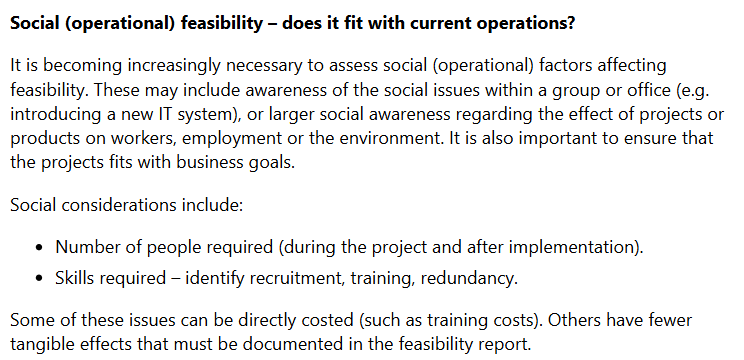
13
What is ecological (environmental) feasibility
How does it affect the environment?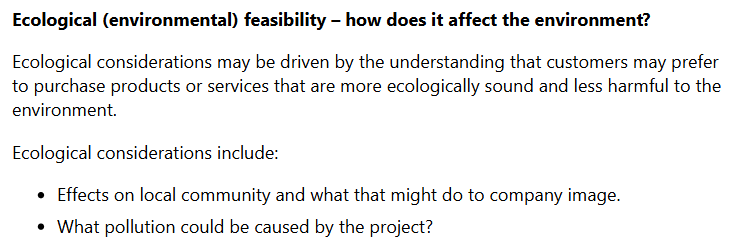
14
What is economic feasibility?
Is it worth it?
15
What does a PID (project initiation document do?
* Defines the project
* Justifies the project
* Defines the roles and responsibilities
* Secures funding for the project if needed
* Gives people the information they need to be productive and effective right from the start
* Justifies the project
* Defines the roles and responsibilities
* Secures funding for the project if needed
* Gives people the information they need to be productive and effective right from the start
16
What would be contained in a PID (Project initiation document)?
PURPOSE STATEMENT - explains why the project is being undertaken
SCOPE STATEMENT - puts boundaries to the project by outlining major activities. Prevents 'scope creep' where additional activites are added making achievement of the cost and time objectives impossible
DELIVERABLES - tend to be tangible elements of the project, such as report, assets and other outputs
COST & TIME ESTIMATES - Early estimates, will be modified later
OBJECTIVES - clear statement of mission, CSF's and key milestones of the project
STAKEHOLDERS - list of major stakeholders in the roject and their interest in the project
CHAIN OF COMMAND - a statement (and diagram) of the project organisation structure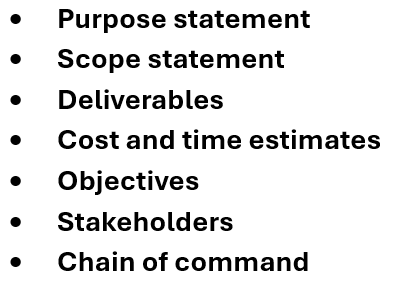
SCOPE STATEMENT - puts boundaries to the project by outlining major activities. Prevents 'scope creep' where additional activites are added making achievement of the cost and time objectives impossible
DELIVERABLES - tend to be tangible elements of the project, such as report, assets and other outputs
COST & TIME ESTIMATES - Early estimates, will be modified later
OBJECTIVES - clear statement of mission, CSF's and key milestones of the project
STAKEHOLDERS - list of major stakeholders in the roject and their interest in the project
CHAIN OF COMMAND - a statement (and diagram) of the project organisation structure
17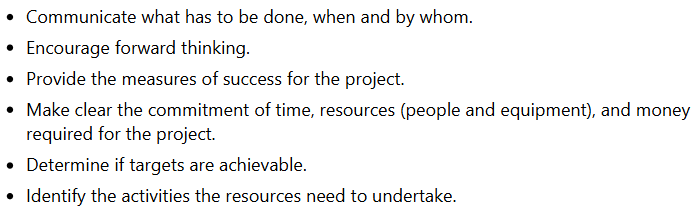
What does the planning stage of a project do?
18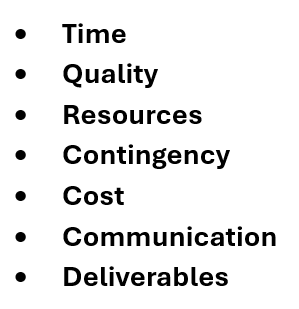
What are the different plans for the planning stage of a project?
19
What does the time plan do?
20
What does the quality plan do?
21
What does the resources plan do?
22
What does the contingency plan do?
23
What does the cost plan do?
24
What does the communication plan do?
25
What does the deliverables plan do?
26
What is the purpose of a control system?
* Prevention of deviations
* Correction of deviations
* Prevention of any future deviations, by revising plans, target, measures etc
* Implementation of recommendations from monitoring, reviewing and evluating the project
* Correction of deviations
* Prevention of any future deviations, by revising plans, target, measures etc
* Implementation of recommendations from monitoring, reviewing and evluating the project
27
What is the change control and management process?
* Authorisation
* Agreement
* Recording
Communication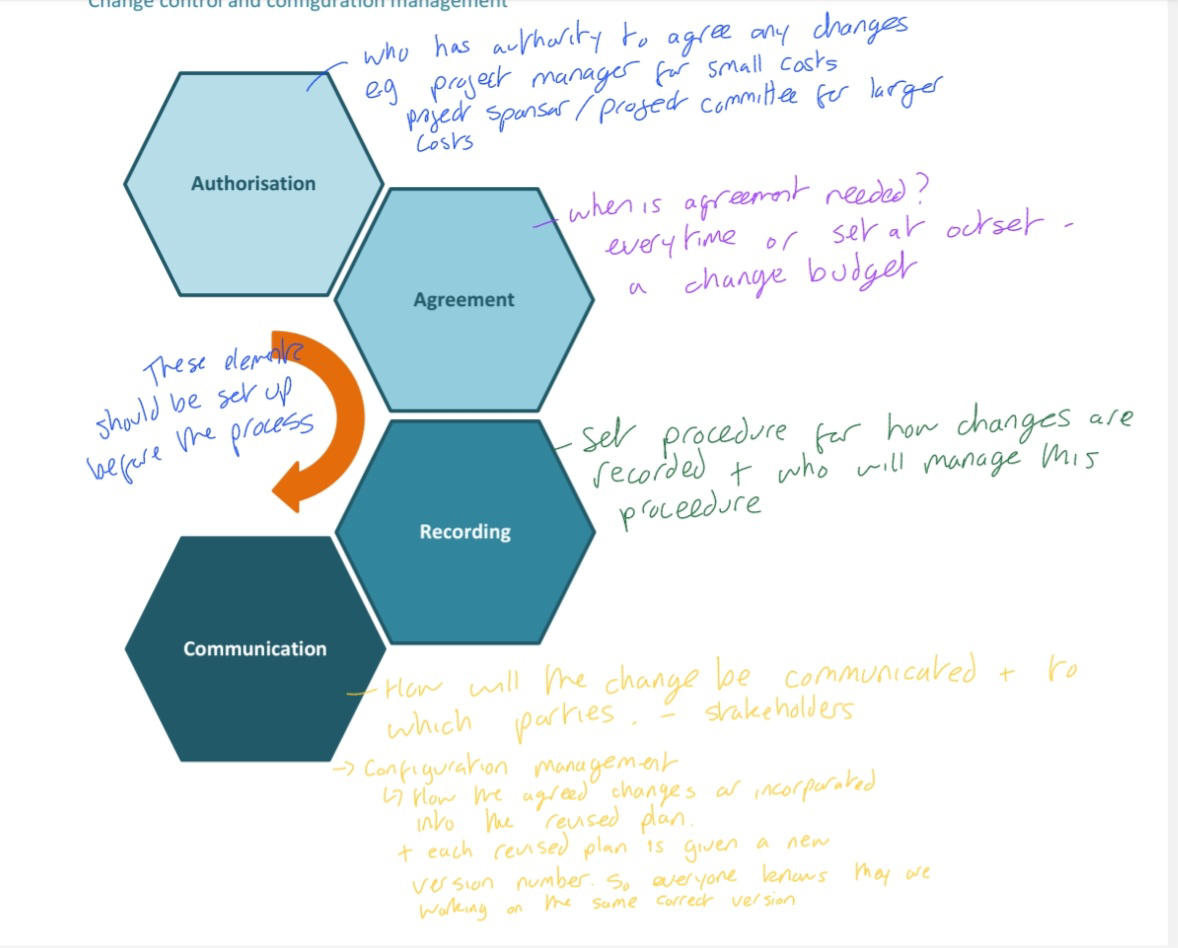
* Agreement
* Recording
Communication
28
In the change and control management process explain Authorisation
* Who has the authority to agree any changes
eg project manager for small changes - project sponsor/project commitee for larger costs
eg project manager for small changes - project sponsor/project commitee for larger costs
29
In the change and control management process explain Agreement
* When is agreement needed?
everytime or set out outset
everytime or set out outset
30
In the change and control management process explain Recording
Set procedure for how changes are recorded & who will manage this procedure
31
In the change and control management process explain Communication
How will the change be comminucated & to which parties - stakeholders
32
Explain configuration management
* How the agreed changes are incorporated into the revised plan
* Each revised plan is given a new version number so everyone knows they are working on the same correct version.
* Each revised plan is given a new version number so everyone knows they are working on the same correct version.
33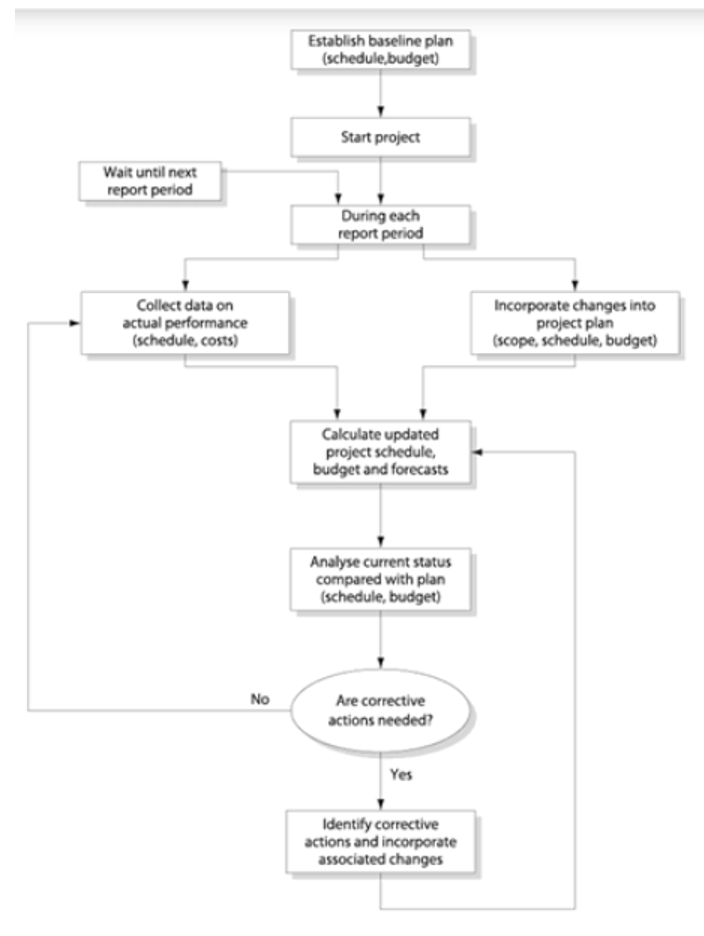
What is the Gido and Clements control system?
34
What project reports and meetings should be done?
* Exception
* Progress
* Team meetings - explain position/discuss corrective action
* Post completion review - lessons learnt
* Progress
* Team meetings - explain position/discuss corrective action
* Post completion review - lessons learnt
35
What is change control?
* Prioritise changes
* Recording changes
* Agreement of change budget
* Recording changes
* Agreement of change budget
36
What is configuration management?
Tracking changes in order to update plans & managing version control
37
What is conformance management?
Using inspection, quality control & quality assurance to ensure the project meets the customer expectations & technical requirements
38
What is the project closure process?
* Delivered to users
* Documents filed
* Final payments
Project objectives (make sure business case has been delivered
* Team integrated back to their day to day tasks
* Documents filed
* Final payments
Project objectives (make sure business case has been delivered
* Team integrated back to their day to day tasks
39
What is included in a post completion review meeting?
* Project manager - how well they performed & worked with team
* Project team - How individual members performed and how they worked as a team
* Tools & tgechniques used - effectiveness of the overall process/individual tools & techniques
* Business case - actual acheivement in relation to costs / schedules / benefits defined
* Project team - How individual members performed and how they worked as a team
* Tools & tgechniques used - effectiveness of the overall process/individual tools & techniques
* Business case - actual acheivement in relation to costs / schedules / benefits defined
40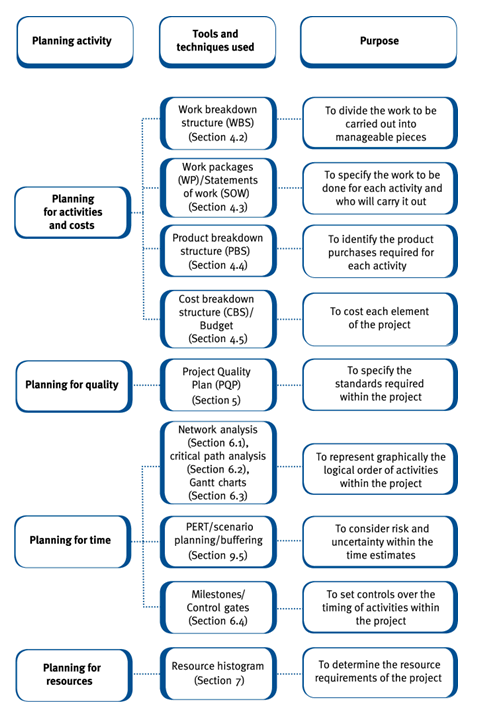
What are the tools and techniques for managing projects?
41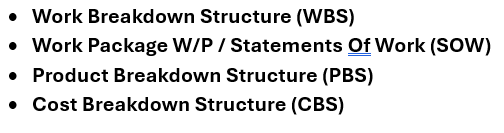
What are the tools for planning for activities and costs?
42
What is the tool for planning for quality?
43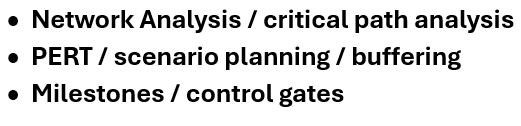
What are the tools for planning for time?
44
What are the tools for planning resources?
45
What is a Work Breakdown Structure (WBS)
The WBS is an important starting point for planning. It contributes to planning in the following ways :_
* Breaks complex tasks into manageable pieces
* Sets out the logical sequence of project events
* Provides a logical framework for making decisions
* Provides an input into subsequent project processes ie estimating time and resources
* Provides a framework for continuious assesment of the project progression
* Provides a communication tool
* Breaks complex tasks into manageable pieces
* Sets out the logical sequence of project events
* Provides a logical framework for making decisions
* Provides an input into subsequent project processes ie estimating time and resources
* Provides a framework for continuious assesment of the project progression
* Provides a communication tool
46
What are the benefits of a Work Breakdown Structure (WBS)
* Summarise activities
* Display the interrelationships
* Establishes authority & responsibility
* Estimates project costs
* Performs risk analysis
* Schedules jobs (work packages)
* Provide basis for controlling the application of resources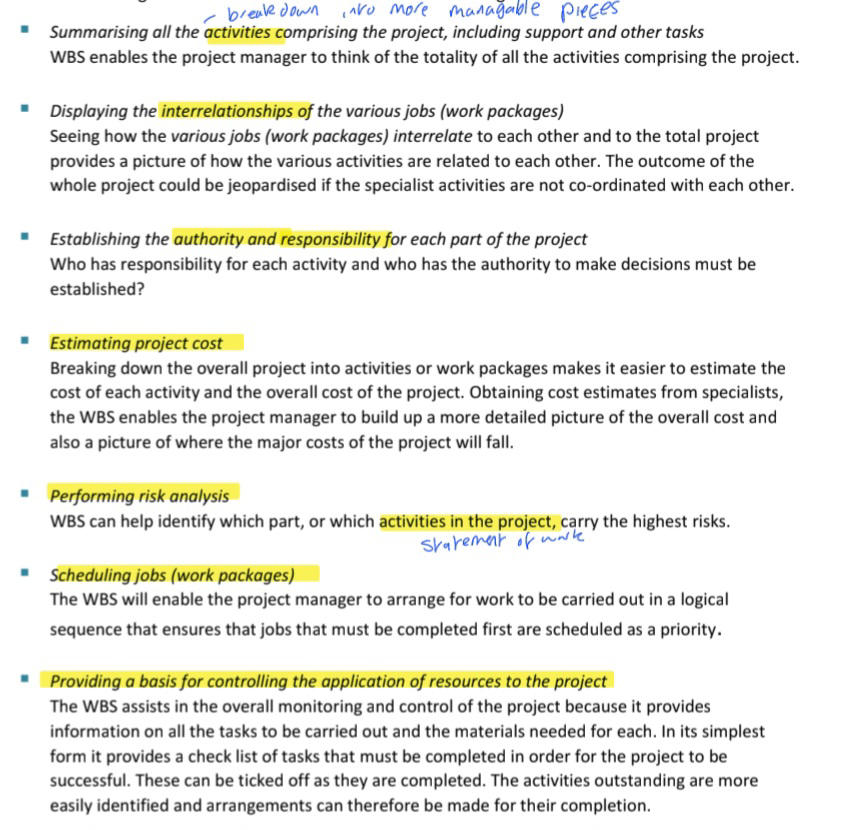
* Display the interrelationships
* Establishes authority & responsibility
* Estimates project costs
* Performs risk analysis
* Schedules jobs (work packages)
* Provide basis for controlling the application of resources
47
What is a Work Package (WP)?
Work Package specifies the work to be done for each package described in the work breakdown structure.
48
What is the Statement Of Work?
Statement of Work describes the deliverables against which the project can be measured. It also indicates who is responsible and when the work needs to be delivered.
49
What is the Product Breakdown Structure (PBS)?
On completion of the WPs and SOW, the products required for each activity are listed. For example, the Olympic Games long jump would require a sand pit, a white board and measuring equipment.
50
What is the cost breakdown structure?
The cost breakdown structure (CBS) describes the categories that require costing to ensure nothing is left out of the budget process. Numbers and costs are allocated to each product. This creates the detailed financial plan (budget) for the project.The CBS will include information gathered from the WBS, WPs, SOW and PBS and also the capital and revenue costs identified in the cost-benefit analysis and feasibility study documents.
51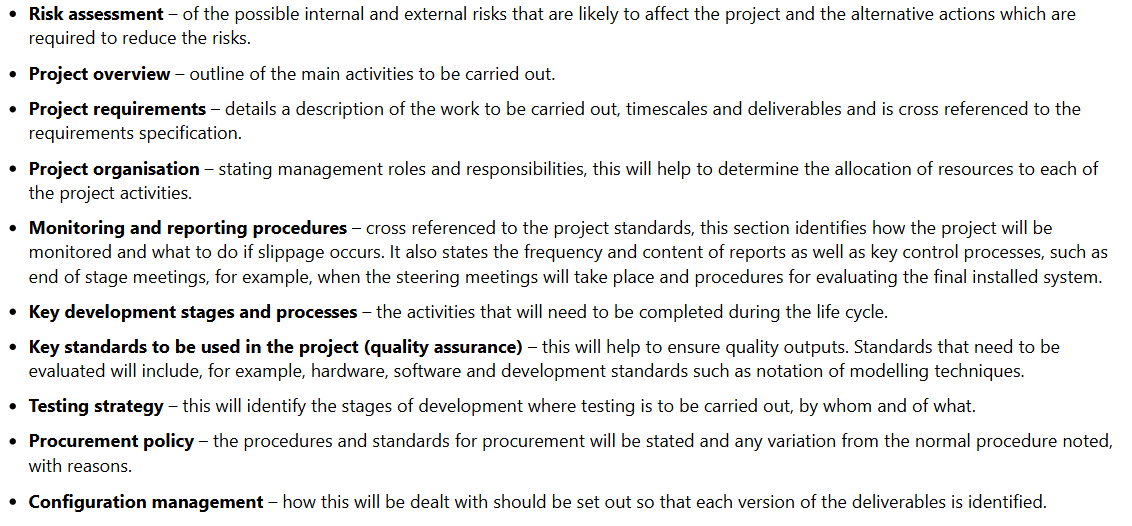
What is included in a Project Quality Plan (PQP)?
52
What is network analysis?
Network analysis is a general term, referring to various techniques adopted to plan and control projects. It breaks complex activities down into smaller activities, which are then organised in a sequence. It is used to analyse the inter-relationships between the tasks identified by the work breakdown structure and to define the dependencies of each task. Whilst laying out a network it is often possible to see that assumptions for the order of work are not logical or could be achieved more cost effectively by re-ordering them. This is particularly true whilst allocating resources; it may become self evident that two tasks cannot be completed at the same time by the same person due to lack of working hours or, conversely, that by adding an extra person to the project team, several tasks can be done in parallel thus shortening the length of the project and ensuring project deadlines are met.
53
What is critical path analysis?
One of the component parts of network analysis is critical path analysis (CPA) (Note: this is often called network analysis, even though it is only a component part.) It is the most commonly used technique for managing projects.
54
Explain the components of the network analysis / critical path diagram
Critical path isthe one that takes
the longest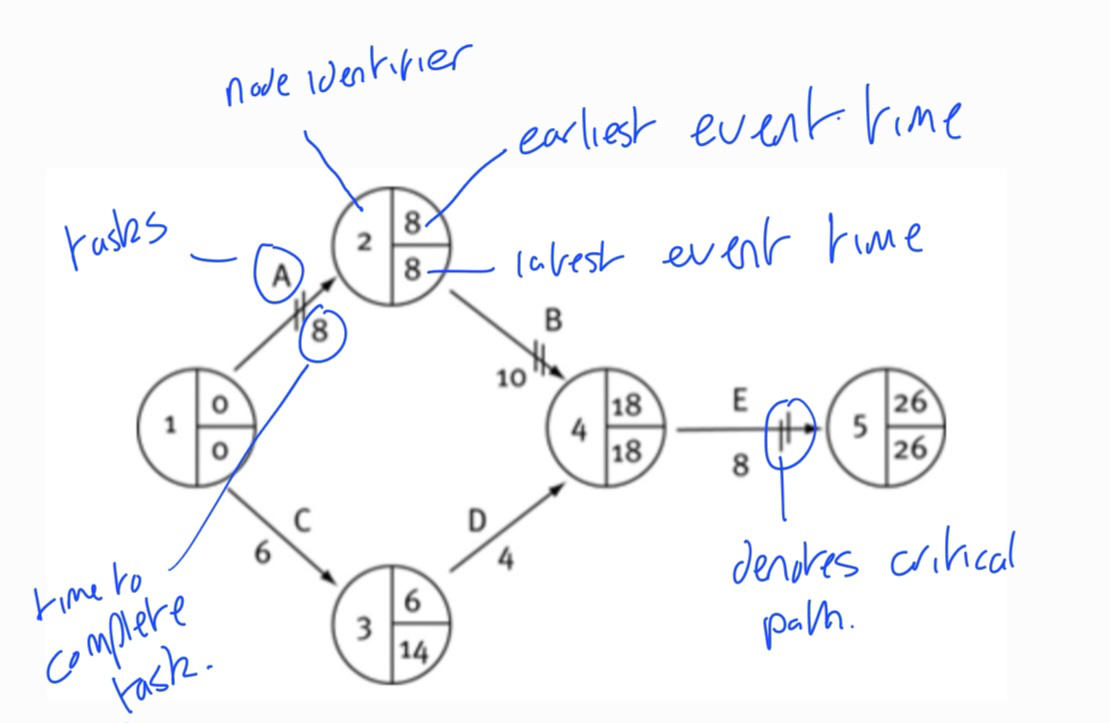
the longest
55
How is the earliest event time calculated?
56
How is the Lastest event time calculated
57
How do you read a netwrok analysis?
58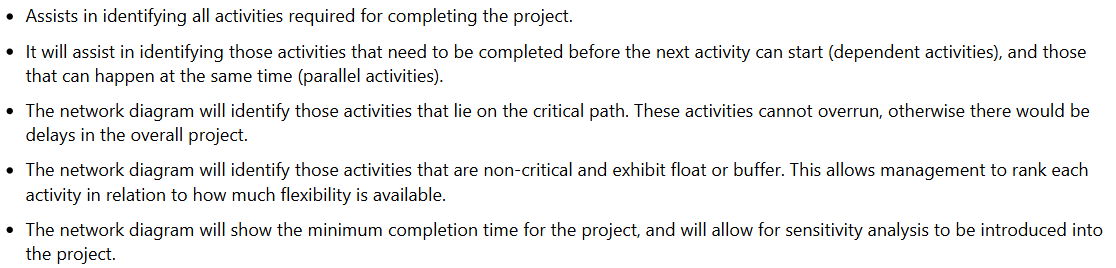
What are the benefits of critical path analysis?
59
What are the limitations of critical path analysis?
60
What is a resource Histogram?
A tool for planning resources - capacity planning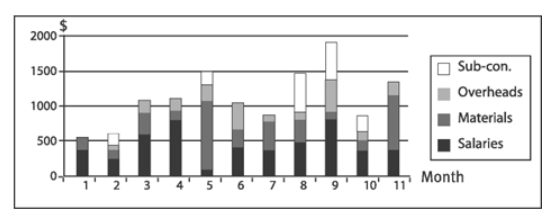
61
What are the benefits of a resource histogram?
62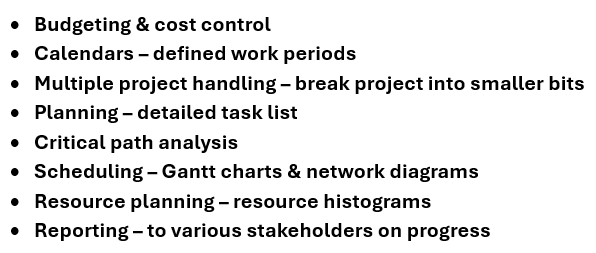
What common features are included in project management software?
63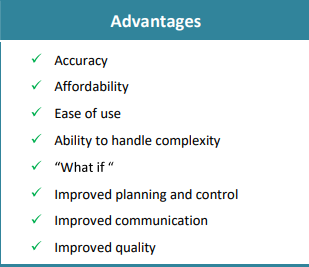
What are the advantages of project management software?
64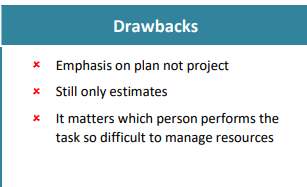
What are the drawbacks of project management software?
65
What is PRINCE2
A project methodology that helps with :-
* Delivery of agreed outcomes
* On time
* Within budget
* Conforming to the required quality standards
* Delivery of agreed outcomes
* On time
* Within budget
* Conforming to the required quality standards
66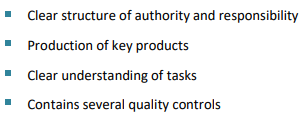
What are the main control features of of PRINCE2
67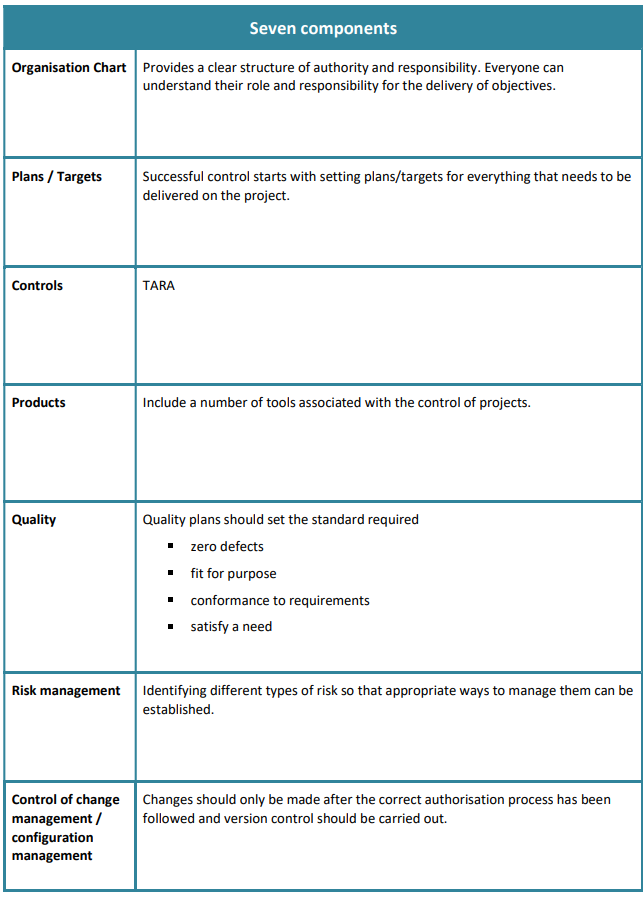
What are the 7 components of PRINCE2?
68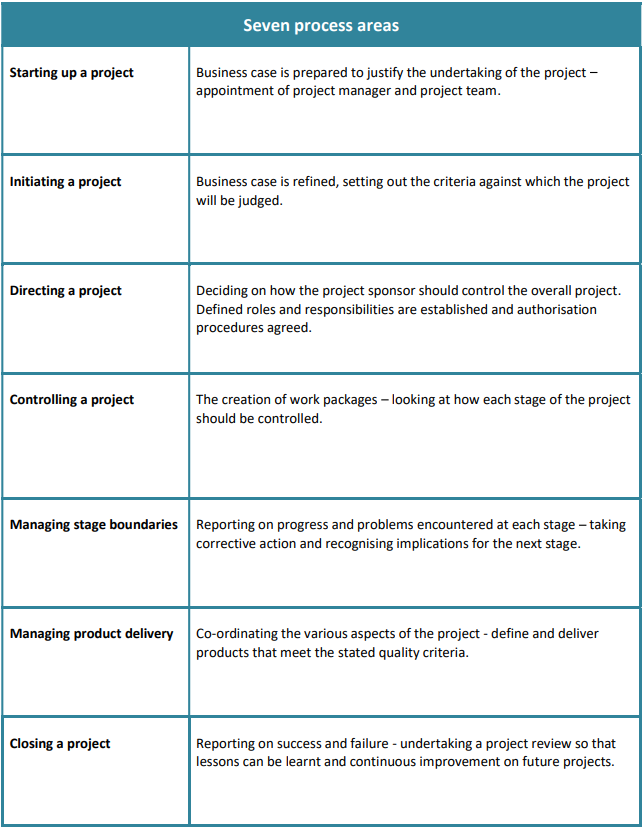
What are the 7 process areas of PRINCE2?
69
What is PMBOK?
Project management body of knowledge
A project management methodology
A project management methodology
70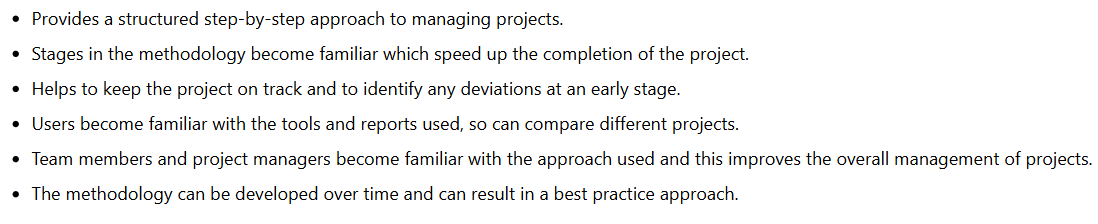
What are the benefits of using a single methodology?
71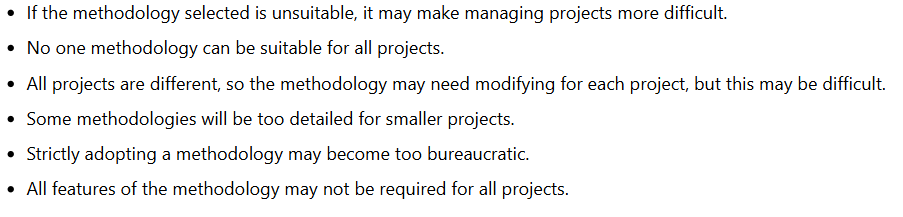
What are the limitations of using a single methodology?
72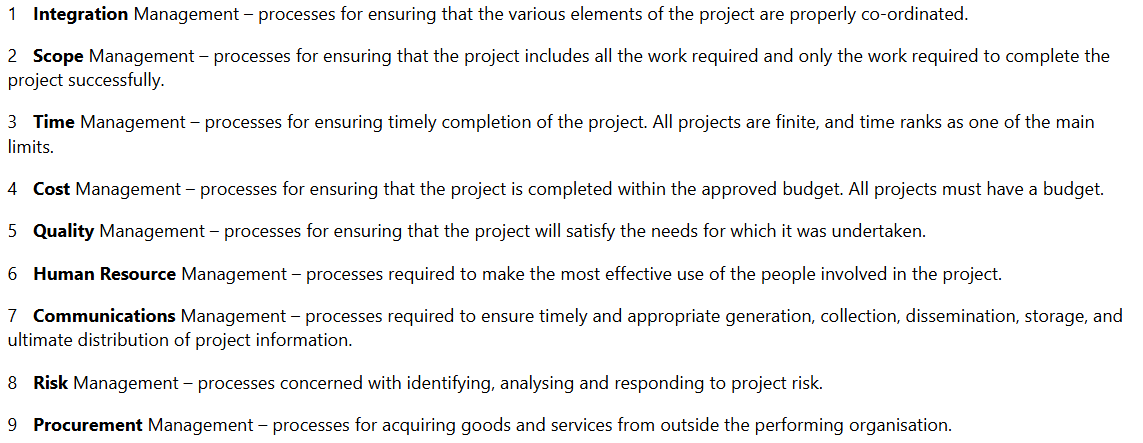
What are the 9 key project management knowledge areas pf PMBOK?
73
What is the process for planning for risk?
74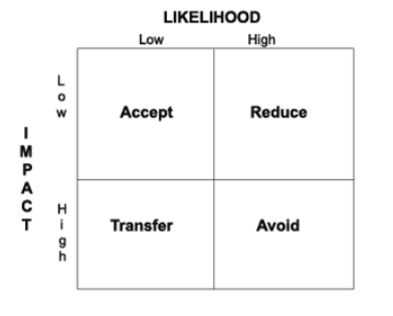
What is the process for managing risk?
75
When managing risk explain TRANSFER
76
When managing risk explain ACCEPT
77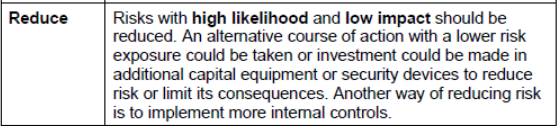
When managing risk explain REDUCE
78
When managing risk explain AVOID
79
What is uncertainty?
Events that are impossible to assign probabilities to or to reduce the possibility of its occurance
80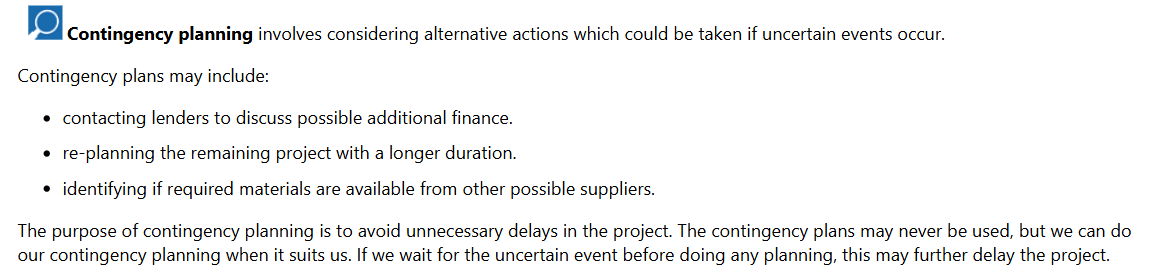
What is contingency planning?
81
What is PERT?
Project Evaluation and Review Technique
this can be used to overcome uncertainties over times taken for individual activities in a network diagram.
this can be used to overcome uncertainties over times taken for individual activities in a network diagram.
82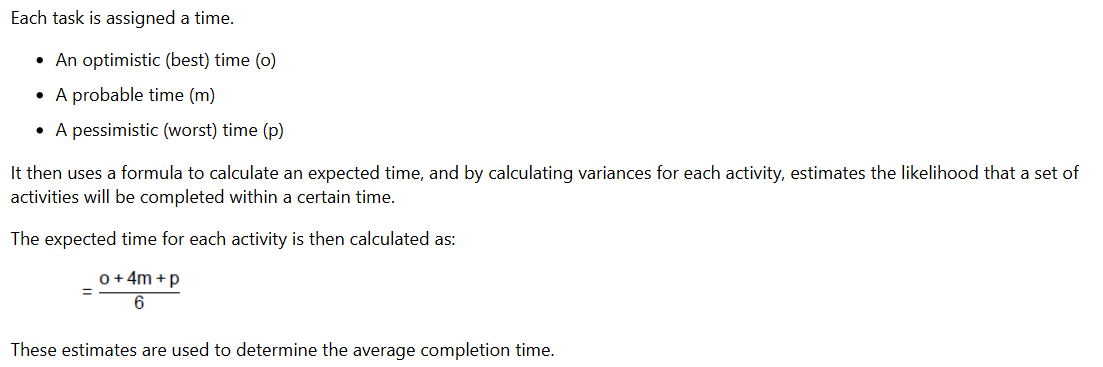
What is the PERT process?
83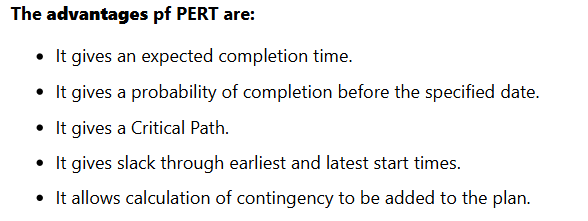
What are the advantages of PERT?
84
What are the limitations of PERT?
85
What is Scenario planning?
Having alternative plans ready for when things go wrong
86
What is buffering?
Adding artificial slack / padding into risky activities
87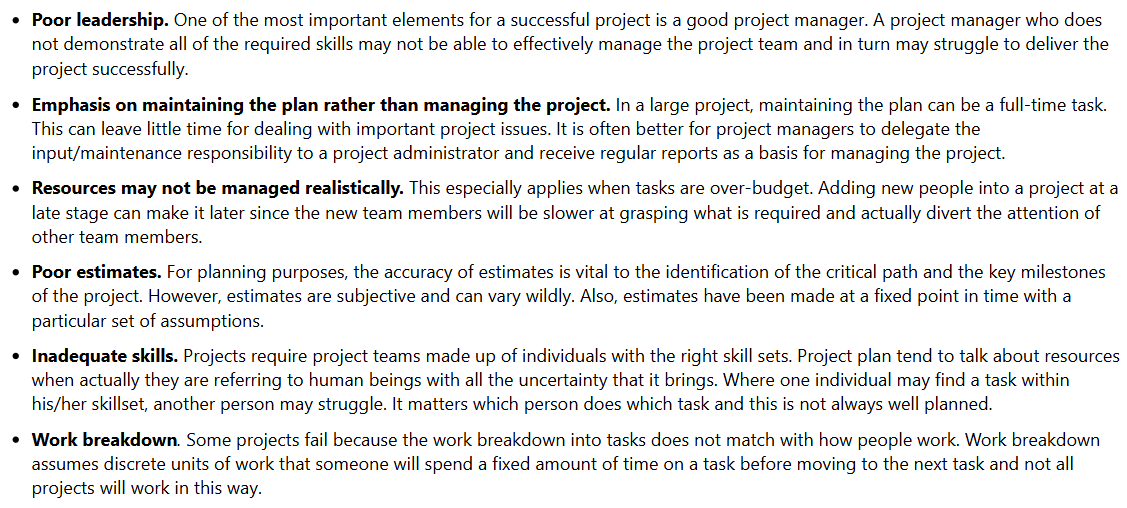
What are the common reasons projects fail?
88
What is a Gantt chart?
A Gantt chart is a horizontal bar chart where the length of the bar represents the duration of the activity.
89
How do you create a gantt chart?
1) Display a schedule of activities using bars.
2) List the activities down the side of the page.
3) Using a horizontal timescale, draw a bar for each activity to represent the period over which it is to be performed.
4) Both budgeted and actual timescales can be shown on the same chart.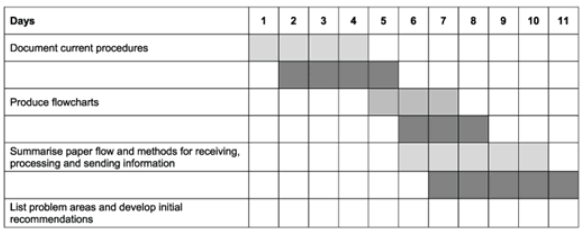
2) List the activities down the side of the page.
3) Using a horizontal timescale, draw a bar for each activity to represent the period over which it is to be performed.
4) Both budgeted and actual timescales can be shown on the same chart.
90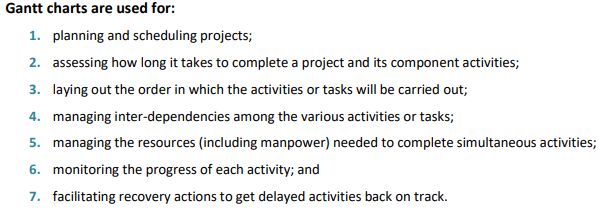
What are the advantages of a Gantt chart?
91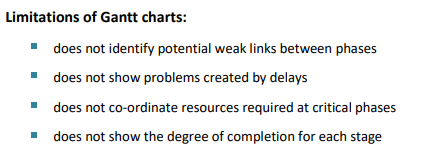
What are the limitations of a Gantt chart?
92
What is a milestone?
A milestone is an event that is clearly identifiable as a measure of how far the project has progressed and
how far it has to run. This involves partitioning the project into identifiable and manageable phases that are
well defined key events.
how far it has to run. This involves partitioning the project into identifiable and manageable phases that are
well defined key events.
93
What is a control gate?
A milestone that can only be passed if it meets the pre determined performance standards
94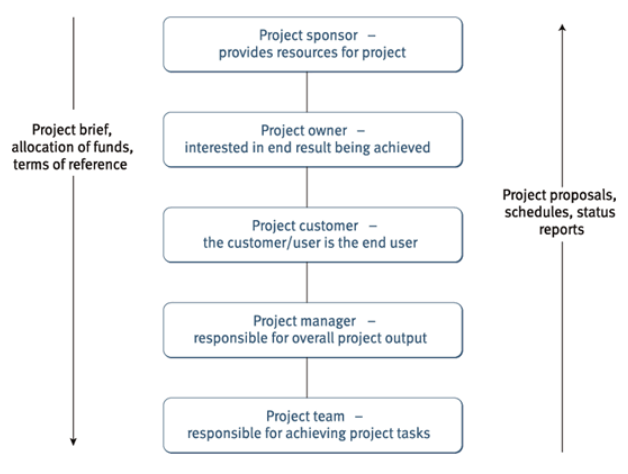
What is the Gido and Clements stakeholder heiachy?
95
Who is the project sponsor?
96
Who is the project owner?
97
Who is the project manager?
98
Who is the project team?
99
Who is the customer / Users?
100
Who is the project steering committee / project board
101
Who is the project champion?
102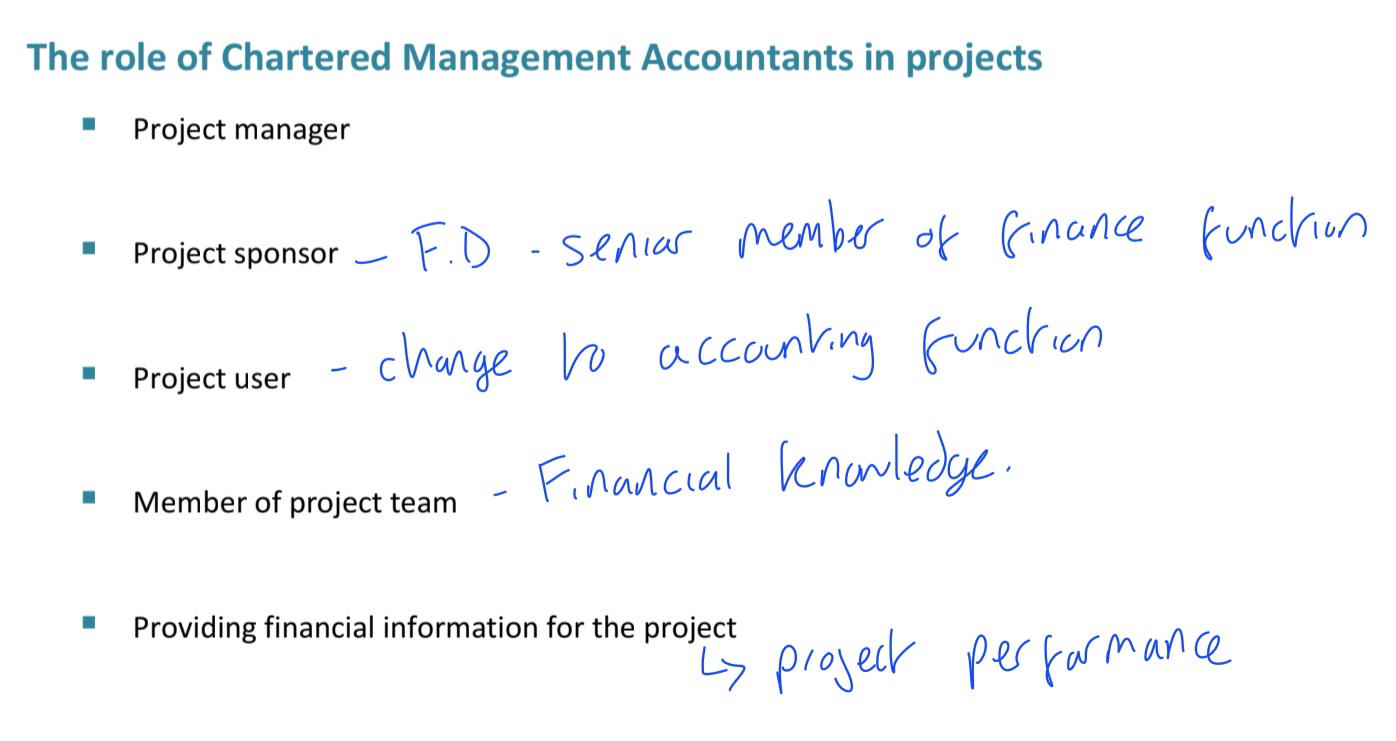
what role can Management accountants play in projects?
103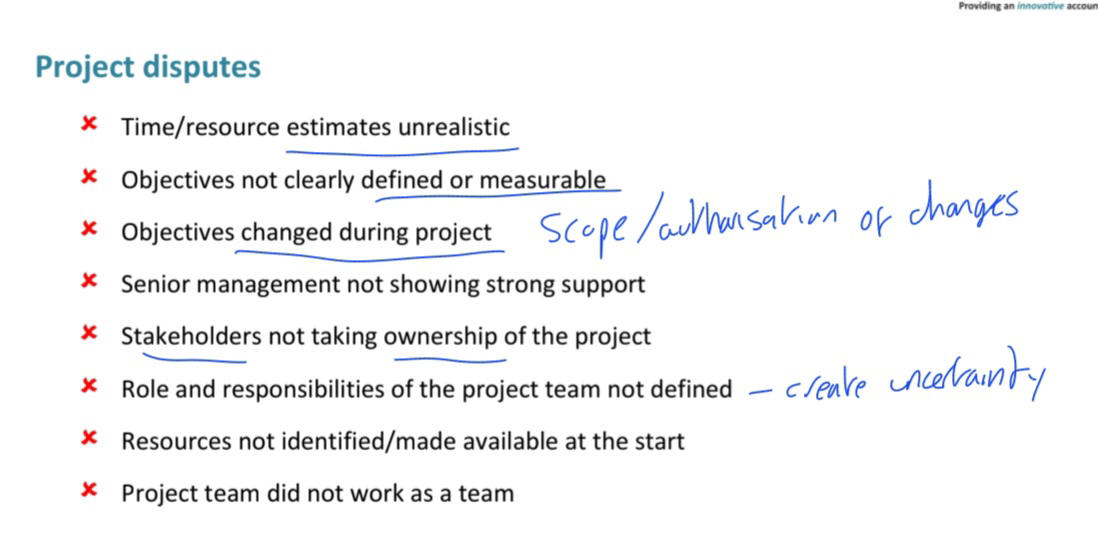
what causes project disputes?
104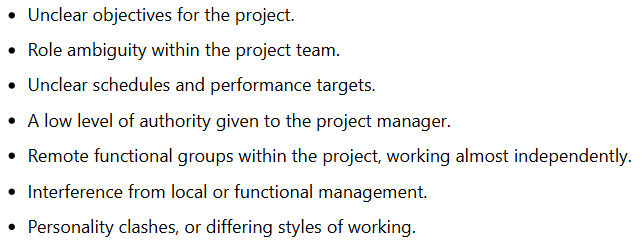
What causes stakeholder conflict?
105
How can you resolve project disputes?
106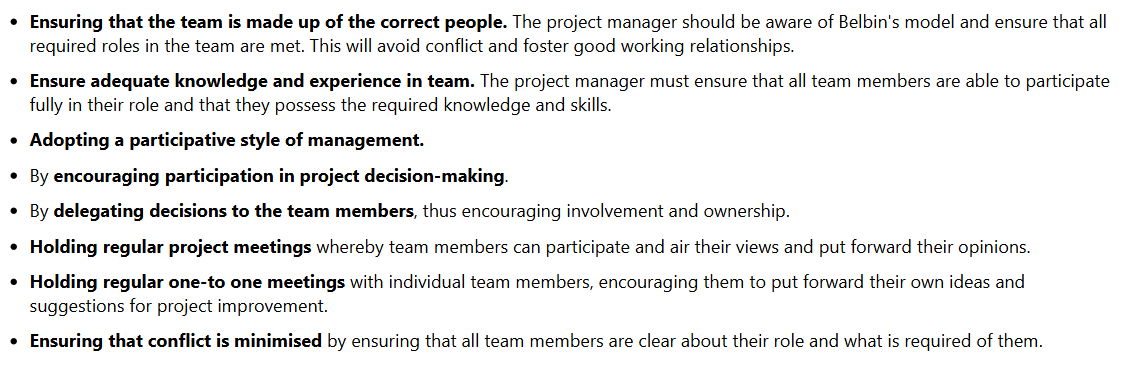
How can the project manager create a supportive environment where memebers feel enthusiastic to work towards project?
107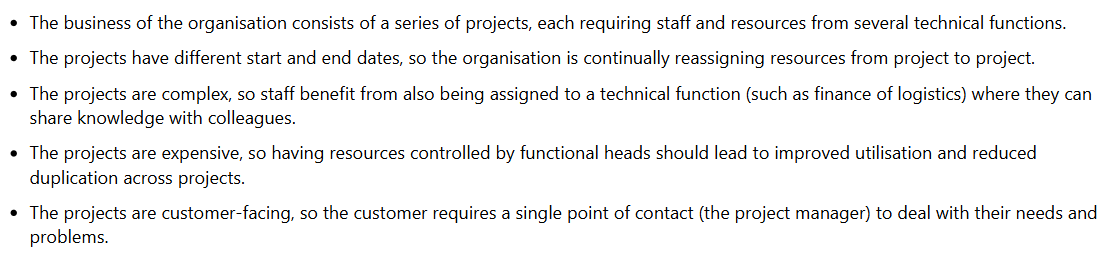
When is the matrix structure of management suitable for a project?
108
What are the advantages of the matrix structure?
109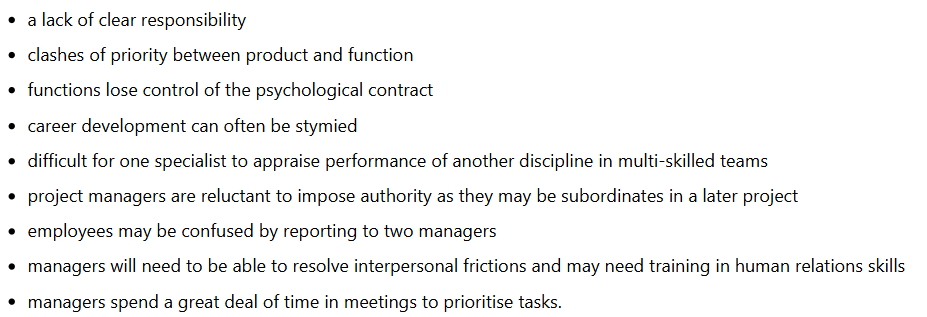
What are th disadvantages of the matrix structure?
110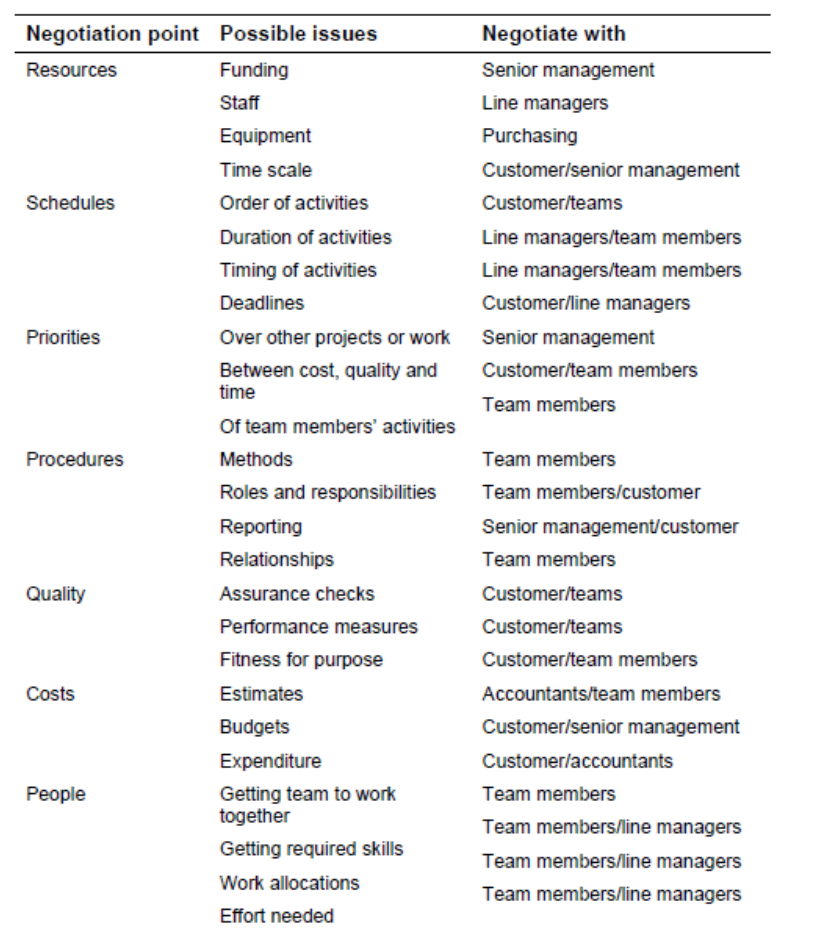
What are the negotiation points for project managers?
111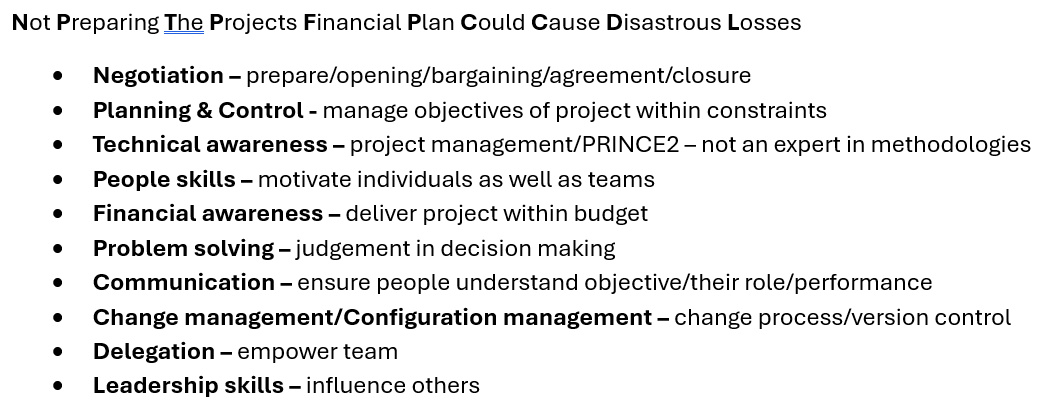
What skills does the project manager need?