F2 Group Accounts - Associates & Joint Arrangements
Study these flashcardsFree · spaced repetition · iPhone, Android, Mac & web
All cards
1
What is an associate
An entity over which the investor has significant influence and which is neither a subsidiary or joint venture
2
What is significant influence?
Significant influence is defined as 'the power to participate in the financial and operating policy decisions of the investee but is not control or joint control of those policies' (IAS 28, para 3).
3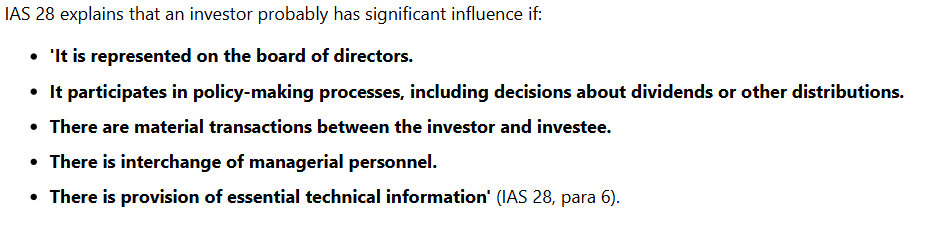
IAS 28 would say an investor has significant influence if they have what?
4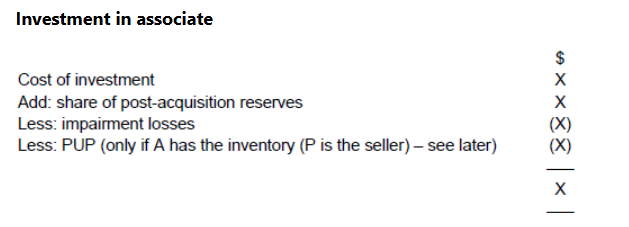
How do you calculate an investment in an associate in the consolidated statement of financial position?
5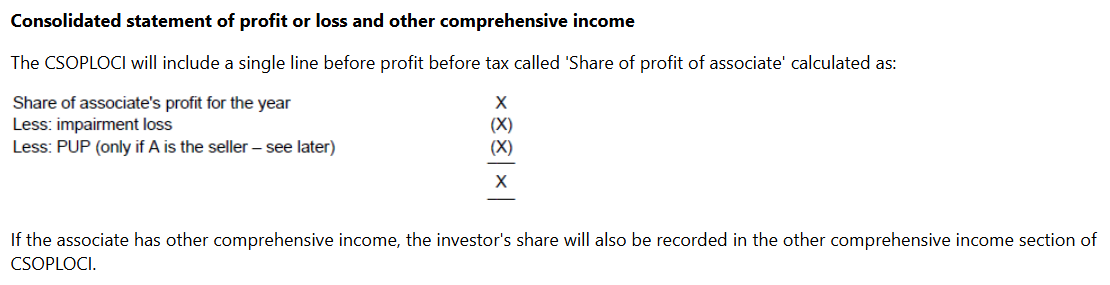
How do you show income from associate in the P&L
6
What accounting method should be used for an associate?
Equity method
7
When should the equity method NOT be used for an associate or joint venture?
8
What percentage of shares typically gives a parent company "significant influence" over an associate?
Between 20% and 50% of the shares.
9
When acquiring an associate partway through the year, how do you calculate the share of profit?
Pro-rate the associate’s profit for the months the parent had significant influence.
10
How are unrealized profits from intercompany transactions with associates treated?
Only the group’s share of the unrealized profit is eliminated, calculated the same way as with a subsidiary, but only the group’s share is adjusted.
11
What adjustment is made if there is an impairment of the associate?
The full impairment amount (not just the group’s share) is deducted from the parent’s share of the associate’s profit and the investment in the associate
Dr income from associate
Cr investment in associate
Dr income from associate
Cr investment in associate
12
How are dividends received from an associate treated in the consolidated P&L?
Dividend income from the associate is removed from investment income to avoid double counting, as the share of profit is already included.
13
What happens if the associate has a post-acquisition loss?
The investor’s share of the loss is deducted from the investment value.
14
When do you adjust for unrealized profit with an associate in group accounts?
Only if the profit (inventory) is still in stock at the end of the year.
15
How much unrealized profit do you eliminate for an associate?
Only the group’s share of the unrealized profit (e.g., if the parent owns 30%, eliminate 30%).
16
If the parent sells to the associate and the inventory is still with the associate, where do you post the elimination? (SOFP)
Debit Cost of Sales (which goes to group retained earnings) (working 5), credit investment in associate (assets)
no cant cr inv as we do not add in the associates inv line.
no cant cr inv as we do not add in the associates inv line.
17
If the associate sells to the parent and the inventory is still with the parent, where do you post the elimination?
Debit share of profit from associate (which affects group retained earnings), credit inventory.
18
Do you cancel intergroup balances between parent and associate?
No, normally there is no adjustment or cancelling of intergroup balances with associate except for unrealised profit
19
In all associate unrealized profit adjustments, which working do you always use for the debit?
Always debit working 5 (group retained earnings).
20
What is the PURP adjustment when the parent sells to the associate?
DR Group cost of sales (cancel profit on goods still in the group)
CR investment in assiciate (SFP)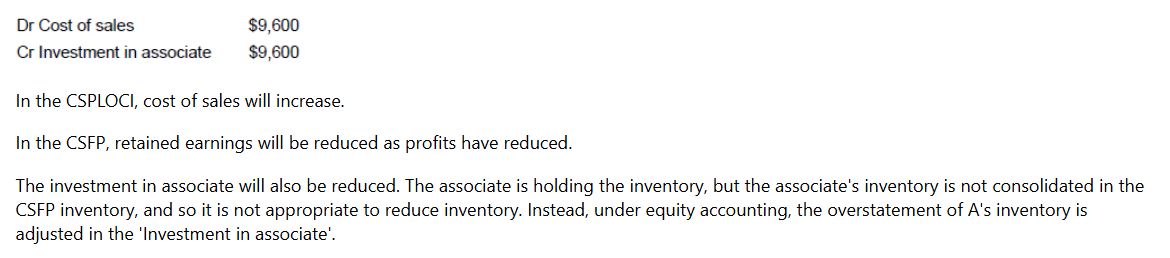
CR investment in assiciate (SFP)
21
What is the PURP adjustment when the associate sells to the parent?
DR share of profit of associate (cancel profit on goods still in group)
CR Group inventory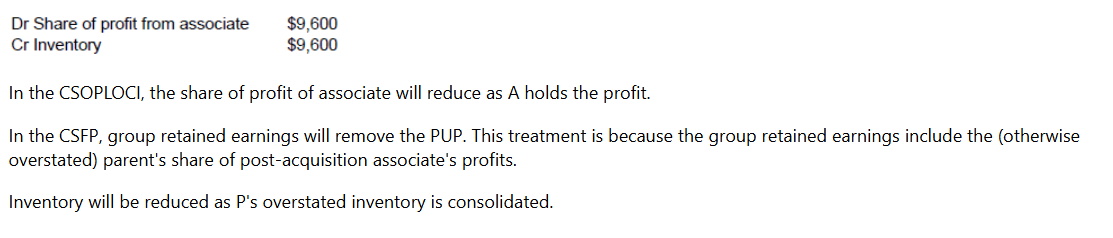
CR Group inventory
22
What is a joint arrangement?
23
What is a joint venture?
24
What accounting method is used for a joint venture?
25
What is a joint operation?
26
What method is used to account for a joint operation?
27
What is the double entry when you receive a dividend from an associate
Debit bank credit investment in associate