F2 Revenue from Contracts with Customers
Study these flashcardsFree · spaced repetition · iPhone, Android, Mac & web
All cards
1
What is the main focus of IFRS 15
Revenue from contracts with customers, including both goods/services sales and construction contracts.
2
What should revenue NOT include under IFRS 15?
Contributions from owners (like share capital), proceeds from sale of non-current assets, and amounts like VAT collected on behalf of others.
3
If a business acts as an agent and earns commission, what is recognized as revenue?
Only the commission (the business’s portion), not the total amount received from the customer
4
Why aren’t contributions from equity participants recognized as revenue?
Because they are not from the entity’s ordinary activities and are a means of raising finance, not income from operations.
5
What does “performance obligations” refer to in the context of IFRS 15?
The specific promises in a contract with customers that must be satisfied to recognize revenue.
6
ow does IFRS 15 define "income"?
Income is defined as increases in economic benefits during the period in the form of inflows or enhancements of assets, or decreases of liabilities, that result in increases in equity other than those relating to contributions from equity participants.
7
What is "revenue" under IFRS 15?
Revenue is a subset of income that arises in the course of the ordinary activities of an entity, such as sales of goods, provision of services, interest, dividends, or royalties.
8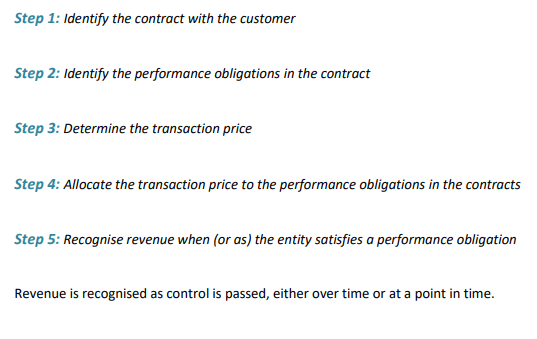
What is the 5 step model framework to recognising revenue from contracts with customers?
9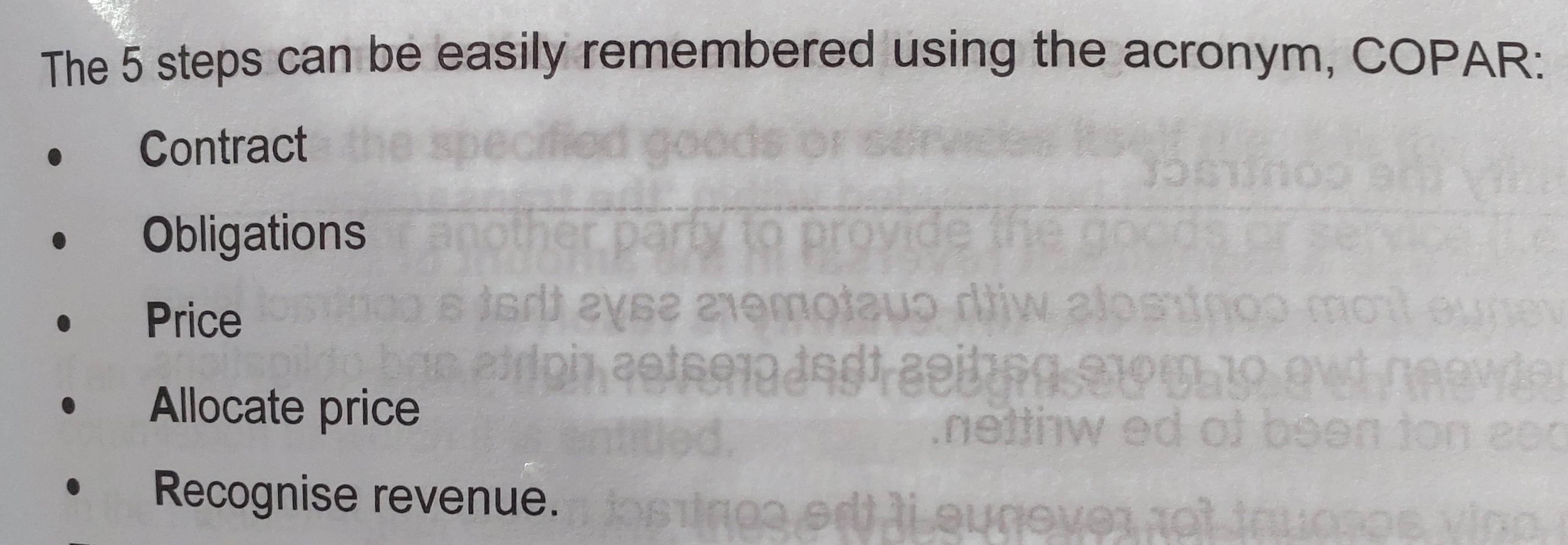
what is the acronym for remembering the 5 step process to revenue recognition
10
What are performance obligations in a contract?
Distinct goods or services promised in a contract that must be delivered to the customer.
11
When can revenue be recognized according to IFRS 15?
When a performance obligation is satisfied—either over time or at a point in time.
12
What is a 'contract liability' and when does it arise?
It’s when cash is received before delivering the good or service; recognized as a liability until the performance obligation is satisfied
13
What is the difference between 'contract liability' and 'deferred income'?
IFRS 15 uses 'contract liability' instead of 'deferred income,' but both refer to income received before performance.
14
What happens if a service is performed before invoice raised?
credits revenue, debits a contract asset if not yet invoiced.
15
How should contract assets and receivables be treated for impairment?
Accounted for in accordance with IFRS 9; any impairment loss reduces the asset and is charged to profit and loss.
16
What is the "substance over form" principle in IFRS 15?
It means recognizing the substance of a transaction over its legal form. For most businesses, the commercial substance and legal form of a transaction are the same, but substance should be followed if they differ.
17
What is a "sale or return" arrangement?
It's when a dealer has the right to return unsold inventory to the manufacturer within a specific period. Legal title remains with the manufacturer until a certain event occurs (e.g., sale to a third party or the end of the period).
18
When can a manufacturer recognize revenue in a sale or return arrangement?
Revenue can be recognized either at the end of the specified period if the inventory is not returned, or earlier if the dealer sells the inventory to a third party.
19
What risk does the manufacturer hold in a sale or return agreement?
The manufacturer holds the risk of inventory becoming obsolete and unsold until certain criteria are met.
20
What is a sale and repurchase agreement?
A sale and repurchase agreement (repo) is a short-term borrowing arrangement commonly used in financial markets. It involves two linked transactions:
1. Sale
One party (usually a bank or financial institution) sells securities—often government bonds—to another party and receives cash.
To the seller, this functions like a loan secured by collateral.
2. Repurchase
At the same time, the seller agrees to buy back the same securities at a later date (often the next day or within a week) at a slightly higher price.
The difference between the sale price and the repurchase price is effectively interest, called the repo rate.
1. Sale
One party (usually a bank or financial institution) sells securities—often government bonds—to another party and receives cash.
To the seller, this functions like a loan secured by collateral.
2. Repurchase
At the same time, the seller agrees to buy back the same securities at a later date (often the next day or within a week) at a slightly higher price.
The difference between the sale price and the repurchase price is effectively interest, called the repo rate.
21
What is the key principle to consider with sale and repurchase agreements?
The substance of the transaction over its legal form—often, such agreements are loans against an asset, not genuine sales.
22
In a sale and repurchase agreement How is interest on the 'loan' accounted for each year?
Accrue interest expense (e.g., 10% of 2.4 million = 240k), debit finance cost in P&L, credit accruals (liability).
23
In a sale and repurchase agreement What do the buy-back clauses in the agreement mean for the risks and rewards of the asset?
Risks and rewards of changes in property value remain with the seller
24
How does a sale and repurchase agreement affect the financial statements of the seller?
The property remains on the balance sheet at cost, the proceeds are recognized as a loan, and annual interest is expensed.
25
What is consignment inventory?
It occurs when a manufacturer delivers to a dealer, but the manufacturer retains ownership until the products are sold to third parties.
26
What main factor determines when revenue can be recognized on consignment inventory?
Whether the risks and rewards of ownership have been transferred from the manufacturer to the dealer.
27
If the dealer has the right to return inventory without penalty, who retains the risks of obsolete stock? (consignment inventory)
The manufacturer retains the risks.
28
What does it suggest if the sale price is set at the time of delivery and does not change? (consignment inventory)
That the transfer of risks and rewards may have occurred at delivery, supporting recognition of a sale.
29
What is the most important contractual provision affecting inventory recognition?(consignment inventory)
The right to return at any time without a penalty.
30
What accounting standard is used for construction contract revenue recognition?
IFRS 15 (“Revenue from Contracts with Customers”).
31
What is the "percentage of completion" method?
Recognizing revenue and profit based on how much of the contract is completed, either by costs incurred or work certified.
32
What's the difference between the input and output methods?
Input method uses actual costs compared to estimated total costs. Output method uses work certified by a surveyor as complete.
33
When is profit recognized in a construction contract?
Only when the outcome can be estimated with reasonable certainty; if not, revenue equals costs (no profit recognized).
34
How are payments received before work is done treated?
They are not revenue until the related work is performed.
35
How are over- or under-billings shown on the balance sheet?
Amounts due from customers = asset; amounts due to customers = liability.
36
What happens if a contract is expected to make a loss?
The full expected loss is recognized as soon as it’s identified.
You still use the % of work completed for revenue figure, use the whole loss figure for project and then calculate the cost of sales as the balancing figure between the 2
You still use the % of work completed for revenue figure, use the whole loss figure for project and then calculate the cost of sales as the balancing figure between the 2
37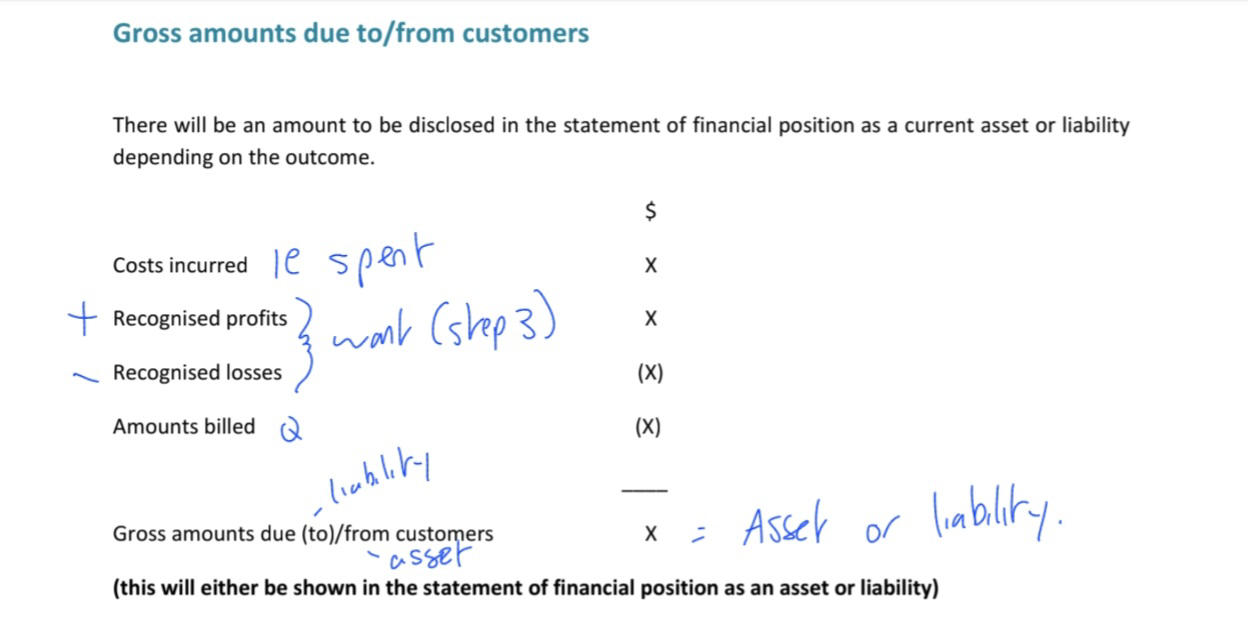
how do you calculate the amount due to or from a customer in a construction contract for the SOFP
38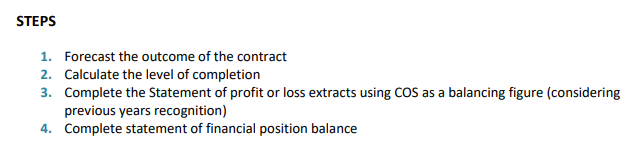
What are the 4 steps to calculating contract revenue?
39
how does a company account for a sale they make on finance
times the total sales value by the discount factor