Corporate governance
Study these flashcardsFree · spaced repetition · iPhone, Android, Mac & web
All cards
1
What is corporate governance?
Corporate governance refers to the systems, principles, and processes by which companies are directed and controlled. It ensures accountability, transparency, and ethical decision-making within the organization.
2
Why is corporate governance important?
Good corporate governance promotes trust, efficiency, and stability within organizations, which ultimately enhances investor confidence, financial performance, and long-term sustainability.
3
Who is typically responsible for overseeing corporate governance in a company?
A: The Board of Directors is primarily responsible for corporate governance, with various committees (e.g., Audit, Risk, Nomination, and Remuneration Committees) playing supportive roles.
4
What is the role of the Board of Directors in corporate governance?
Setting the company's strategic direction
Overseeing performance and management
Ensuring compliance with laws and regulations
Protecting the interests of shareholders and other stakeholders
Overseeing performance and management
Ensuring compliance with laws and regulations
Protecting the interests of shareholders and other stakeholders
5
: What is the role of the Audit Committee in corporate governance?
Monitor financial reporting processes
Oversee the internal and external audit functions
Ensure effective internal controls
Ensure the integrity of financial statements
Oversee the internal and external audit functions
Ensure effective internal controls
Ensure the integrity of financial statements
6
What are the benefits of good corporate governance?
Improved company performance and profitability
Enhanced investor confidence
Reduced business risk and fraud
Better compliance with laws and regulations
More effective decision-making and accountability
Enhanced investor confidence
Reduced business risk and fraud
Better compliance with laws and regulations
More effective decision-making and accountability
7
What are the key corporate governance codes?
UK Corporate Governance Code
OECD Principles of Corporate Governance
King IV Code (South Africa)
Sarbanes-Oxley Act (US)
OECD Principles of Corporate Governance
King IV Code (South Africa)
Sarbanes-Oxley Act (US)
8
What is stakeholder theory in corporate governance?
: Stakeholder theory argues that companies should not only focus on shareholder returns but also consider the interests of other stakeholders, including employees, customers, suppliers, and the community.
9
What is corporate social responsibility (CSR) in the context of governance?
: CSR refers to the responsibility of a company to act ethically and contribute to economic development while improving the quality of life of the workforce, the local community, and society at large.
10
What are the main objectives of corporate governance?
Ensure ethical decision-making
Protect stakeholders' interests
Improve transparency and accountability
Ensure compliance with laws and regulations
Promote long-term sustainability
Protect stakeholders' interests
Improve transparency and accountability
Ensure compliance with laws and regulations
Promote long-term sustainability
11
: Who are the key stakeholders in corporate governance?
Shareholders – Owners of the company
Board of Directors – Oversees management
Employees – Work for the company
Customers – Buy the company’s products/services
Suppliers – Provide materials/services
Regulators – Ensure legal compliance
Board of Directors – Oversees management
Employees – Work for the company
Customers – Buy the company’s products/services
Suppliers – Provide materials/services
Regulators – Ensure legal compliance
12
What is stakeholder theory in corporate governance?
: It suggests that companies should consider all stakeholders’ interests (employees, customers, society) rather than focusing solely on shareholders' profits.
13
What is the difference between Executive Directors and Non-Executive Directors (NEDs)?
Executive Directors – Involved in day-to-day management
NEDs – Independent, oversee the board, and provide strategic guidance
NEDs – Independent, oversee the board, and provide strategic guidance
14
What is the agency problem?
The agency problem arises as a result of directors controlling a company
whilst shareholders own the company. Directors might not act in the
shareholders (or other stakeholders) best interests
whilst shareholders own the company. Directors might not act in the
shareholders (or other stakeholders) best interests
15
What are the symptoms of poor corporate governance?
1. Domination of the board by a single individual or group
2. No involvement by the board, for example meeting irregularly, failing to
consider systematically the organisation’s activities and risks, or basing
decisions on inadequate information
3. An inadequate control function, for instance no internal audit, or a lack
of adequate technical knowledge in key roles, or a rapid turnover of staff
involved in accounting and control
4. Lack of supervision of employees
5. Lack of independent scrutiny by external or internal auditors
6. Lack of contact with shareholders
7. Emphasis on short-term profitability, leading to concealment of
problems or errors, or manipulation of financial statements to achieve
desired results
8. Misleading financial statements and information
2. No involvement by the board, for example meeting irregularly, failing to
consider systematically the organisation’s activities and risks, or basing
decisions on inadequate information
3. An inadequate control function, for instance no internal audit, or a lack
of adequate technical knowledge in key roles, or a rapid turnover of staff
involved in accounting and control
4. Lack of supervision of employees
5. Lack of independent scrutiny by external or internal auditors
6. Lack of contact with shareholders
7. Emphasis on short-term profitability, leading to concealment of
problems or errors, or manipulation of financial statements to achieve
desired results
8. Misleading financial statements and information
16
What are the key points to the US Sarbanes-Oxley Act
1. Auditor independence - Auditors are restricted in the additional services they can provide to an audit client
2. Audit Committee - Company must have an audit committee - will be disallowed from trading until they do
3. Internal control report - Annual report must include statements concerning the internal control systems in the company
4. Increased financial disclosures - Financial reports to detail all balance sheet financing
5. US stock exchange regulations - Required under the act
2. Audit Committee - Company must have an audit committee - will be disallowed from trading until they do
3. Internal control report - Annual report must include statements concerning the internal control systems in the company
4. Increased financial disclosures - Financial reports to detail all balance sheet financing
5. US stock exchange regulations - Required under the act
17
What is the purpose of the AGM
The board should use the annual general meeting (AGM) to construct a
dialogue with shareholders
dialogue with shareholders
18
What type of board should a company have
The company should have an effective board (with a balance of skills,
experience, independence and knowledge) that meets regularly. The annual
report should identify the Chairman, Deputy Chairman, Chief Executive Officer
(CEO), senior independent directors and the members and chairs of the board
committees. It should also disclose the number of meetings held and the
directors’ attendance.
The revised 2018 Code emphasises the importance of positive relationships
between the company, its shareholders and its stakeholders. For example, the
board is now responsible for workforce policies and practices that reinforce a
healthy culture
experience, independence and knowledge) that meets regularly. The annual
report should identify the Chairman, Deputy Chairman, Chief Executive Officer
(CEO), senior independent directors and the members and chairs of the board
committees. It should also disclose the number of meetings held and the
directors’ attendance.
The revised 2018 Code emphasises the importance of positive relationships
between the company, its shareholders and its stakeholders. For example, the
board is now responsible for workforce policies and practices that reinforce a
healthy culture
19
What should be noted about the Chairman and Chief Executive Officer (CEO)
The positions of the Chairman (the person, irrespective of gender, responsible
for leadership and board effectiveness) and the CEO (the person in charge of
running the company) should be separated. This is to ensure that no one
individual has too much power within the company. The Chairman should be
independent on appointment
for leadership and board effectiveness) and the CEO (the person in charge of
running the company) should be separated. This is to ensure that no one
individual has too much power within the company. The Chairman should be
independent on appointment
20
What is a Non-executive directors (NEDs)
Those who primarily only
attend board meetings (and the meetings of board committees) are known as
NEDs
attend board meetings (and the meetings of board committees) are known as
NEDs
21
What are the rules around who can be a NED?
Current guidance is that NEDs should as far as possible be ‘independent’ so
that their oversight role can be effectively and responsibly carried out. NEDs
must not:
• have been an employee of the company in the last five years
• have had a material business interest in the company for the last three
years either directly or indirectly (for example, as an employee of an
organisation that has a relationship with the business)
• participate in the company’s share options, performance-related pay
scheme or pension schemes
• have close family ties with company directors or senior employees
• serve as a NED for more than nine years with the same company
• hold cross directorship (i.e. two or more directors sit on the board of the
same third party company) or have significant links with other directors
through involvement in other organisations.
If any of these apply to a NED, their independence will be seriously
compromised.
Typical recommendations include:
• At least half of the board (excluding the Chairman) should comprise
independent NEDs. A smaller company should have at least two
independent NEDs.
• One of the NEDs should be appointed the ‘senior independent director’.
Shareholders can contact them if they wish to raise matters outside the
normal executive channels of communication.
that their oversight role can be effectively and responsibly carried out. NEDs
must not:
• have been an employee of the company in the last five years
• have had a material business interest in the company for the last three
years either directly or indirectly (for example, as an employee of an
organisation that has a relationship with the business)
• participate in the company’s share options, performance-related pay
scheme or pension schemes
• have close family ties with company directors or senior employees
• serve as a NED for more than nine years with the same company
• hold cross directorship (i.e. two or more directors sit on the board of the
same third party company) or have significant links with other directors
through involvement in other organisations.
If any of these apply to a NED, their independence will be seriously
compromised.
Typical recommendations include:
• At least half of the board (excluding the Chairman) should comprise
independent NEDs. A smaller company should have at least two
independent NEDs.
• One of the NEDs should be appointed the ‘senior independent director’.
Shareholders can contact them if they wish to raise matters outside the
normal executive channels of communication.
22
What is the purpose of the nomination committee?
Appointments to the board should be made via a nominations committee.
Over 50% of this committee should be made up of NEDs. This is to provide some
independence from the current board members and to ensure that all
appointments are based on merit and suitability and that the composition of the
board is balanced.
The revised 2018 Code states that the committee is responsible for effective
succession planning when developing a more diverse board and that the
gender balance of senior management and their direct reports should be
reported
Over 50% of this committee should be made up of NEDs. This is to provide some
independence from the current board members and to ensure that all
appointments are based on merit and suitability and that the composition of the
board is balanced.
The revised 2018 Code states that the committee is responsible for effective
succession planning when developing a more diverse board and that the
gender balance of senior management and their direct reports should be
reported
23
What is the purpose of the remuneration committee?
It is an important principle of corporate governance that no director should be
involved in setting the level of their own remuneration.
A remuneration committee is a committee made up of NEDs (at least three
for FTSE 350 companies and at least two for smaller listed companies)
which is responsible for deciding on the pay and incentives offered to
executive directors (including pension rights and compensation
payments).
The Chairman can be a member but cannot chair the
committee. The chair must have been a committee member for at least
12 months.
Remuneration should be sufficient to attract, retain and motivate quality
directors but shouldn’t be more than necessary.
A significant proportion of director’s pay should be performance related.
The revised 2018 Code states that there should be clear reporting on
remuneration and how it helps the organisation to achieve its strategy and long-
term success and its alignment to workforce remuneration
involved in setting the level of their own remuneration.
A remuneration committee is a committee made up of NEDs (at least three
for FTSE 350 companies and at least two for smaller listed companies)
which is responsible for deciding on the pay and incentives offered to
executive directors (including pension rights and compensation
payments).
The Chairman can be a member but cannot chair the
committee. The chair must have been a committee member for at least
12 months.
Remuneration should be sufficient to attract, retain and motivate quality
directors but shouldn’t be more than necessary.
A significant proportion of director’s pay should be performance related.
The revised 2018 Code states that there should be clear reporting on
remuneration and how it helps the organisation to achieve its strategy and long-
term success and its alignment to workforce remuneration
24
What is the purpose of the Audit committee?
An audit committee consists solely of independent NEDs (at least three for
FTSE 350 companies and at least two for smaller listed companies) who
are responsible for monitoring and reviewing the company’s financial
controls and the integrity of the financial statements.
The board should review the effectiveness of risk management and internal
controls at least annually and report to shareholders covering all material
controls.
The audit committee acts as an interface between the board of directors on one
side and the internal and external auditors on the other side. They:
• review the work and effectiveness of the internal audit function
• monitor the external auditor’s independence and objectivity
• short-list external audit firms when a change is needed.
An audit committee should be the first point of contact for auditors, improving
the independence and the overall quality of the audit functions.
FTSE 350 companies and at least two for smaller listed companies) who
are responsible for monitoring and reviewing the company’s financial
controls and the integrity of the financial statements.
The board should review the effectiveness of risk management and internal
controls at least annually and report to shareholders covering all material
controls.
The audit committee acts as an interface between the board of directors on one
side and the internal and external auditors on the other side. They:
• review the work and effectiveness of the internal audit function
• monitor the external auditor’s independence and objectivity
• short-list external audit firms when a change is needed.
An audit committee should be the first point of contact for auditors, improving
the independence and the overall quality of the audit functions.
25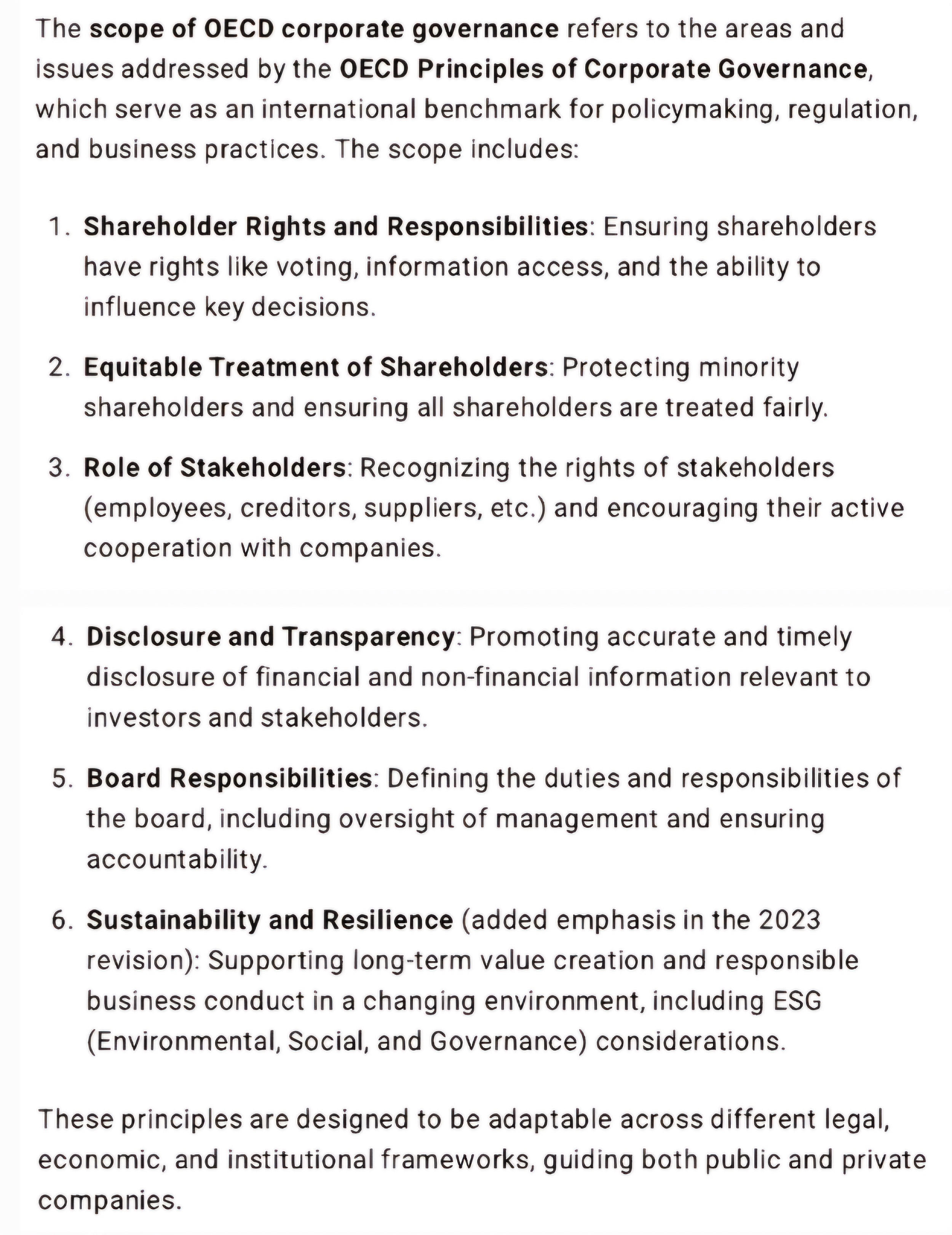
What is the scope of OECD corporate governance