F2 The Consolidated SOFP
Study these flashcardsFree · spaced repetition · iPhone, Android, Mac & web
All cards
1
What is the accounting treatment when one entity purchases shares in another entity in its individual accounts?
Debit investment (non-current asset) at cost, credit cash (or other consideration given)
2
When does the issue of group (consolidated) accounts arise?
When the investment gives the investor enough influence or control over the investee company.
3
What are some motives for acquiring influence in another company?
To reduce competition,
Diversify into new markets,
Bring expertise in-house
Benefit from synergies and intercompany transactions.
Diversify into new markets,
Bring expertise in-house
Benefit from synergies and intercompany transactions.
4
What is group accounting an example of?
"Commercial substance over strict legal form"
5
What is the main focus of IFRS 10 in group accounting?
IFRS 10 focuses on the concept of control to determine whether an entity is a subsidiary and should be consolidated.
6
What are the three elements required to establish control under IFRS 10?
1) Power over the investee, to direct activities and affect investee's returns
2) Exposure or rights to variable returns,
3) Ability to use power to affect those returns.
2) Exposure or rights to variable returns,
3) Ability to use power to affect those returns.
7
Does owning more than 50% of shares always mean you have control?
No. While it usually indicates control, IFRS 10 requires a principles-based assessment considering all factors, not just shareholding.
8
Can you have control with less than 50% of the voting rights?
Yes. Control can exist with less than 50% if there are contractual arrangements or other rights that give you power over the investee.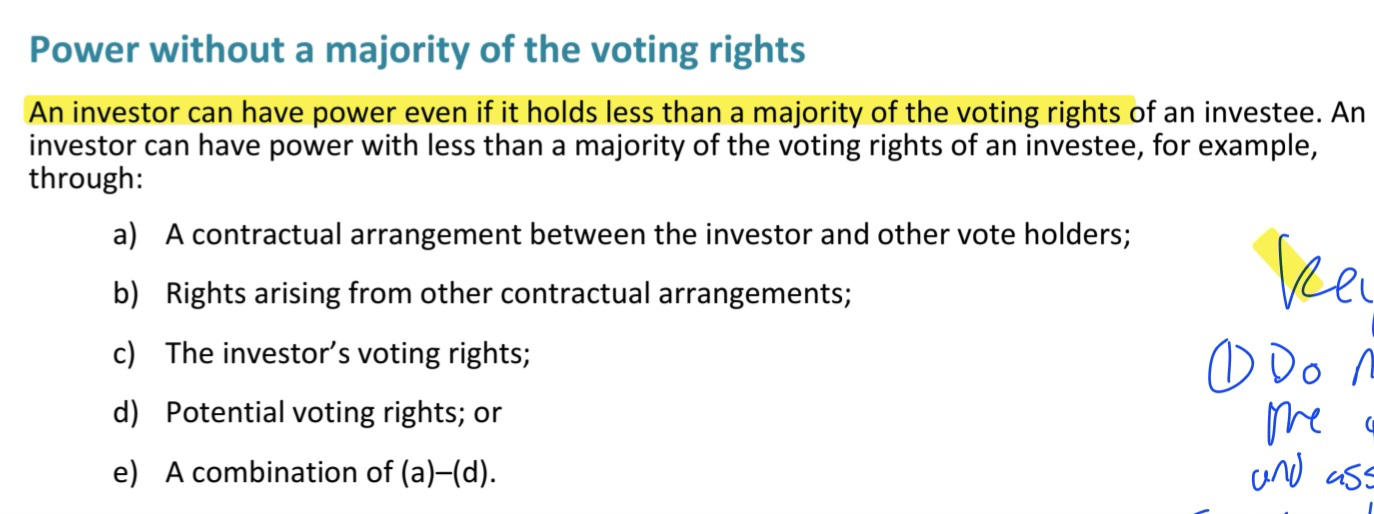
9
Give an example where you might have more than 50% of shares but no control.
If the government, an administrator, or a liquidator imposes restrictions or takes over, you may lose control despite majority shareholding.
10
What is the key principle when assessing control for group accounts?
Always reflect the substance of the transaction over its legal form and consider all circumstances affecting power and control.
11
Why is it important to periodically reassess control over an investee?
Circumstances can change, affecting whether control exists, so regular reassessment ensures accurate and comparable financial statements.
12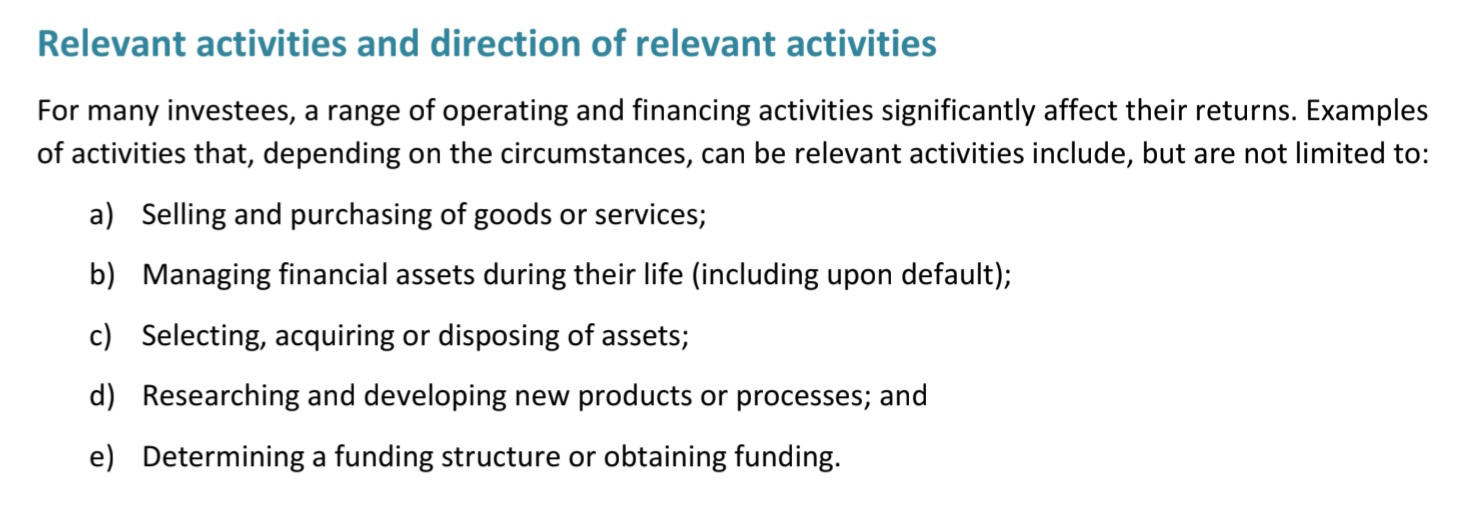
For investees what kind of operating and financing activities significantly affect their returns?
13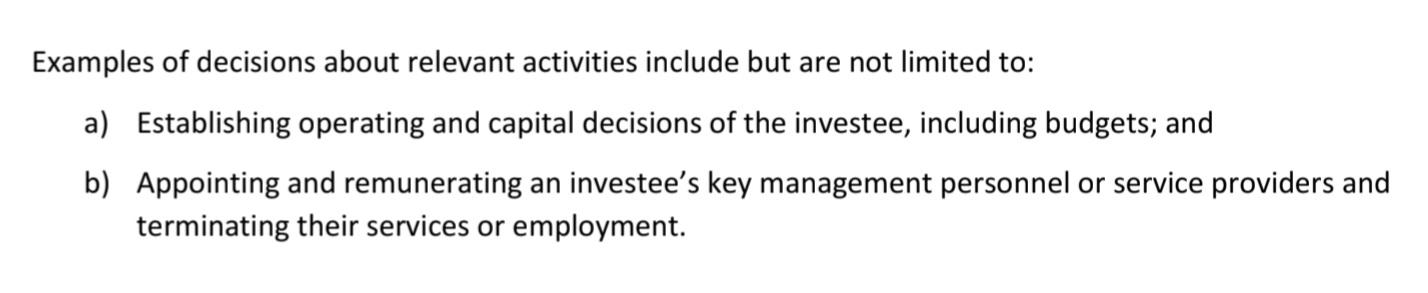
What are some examples about decisions regarding relevant activities?
14
What is the single entity concept in group accounts?
It means that the parent and subsidiary are consolidated and presented as if they were one single economic entity, even though they are legally separate companies.
15
Why do we prepare consolidated financial statements?
To show the group as a single economic entity, reflecting the substance of control rather than just the legal form.
16
Where is goodwill reported in consolidated financial statements?
Goodwill appears as a separate figure in the non-current asset section of the consolidated statement of financial position.
17
What does non-controlling interest (NCI) represent?
NCI represents the portion of net assets in a subsidiary attributable to minority shareholders who do not have control.
18
How is non-controlling interest reported in the group’s financial statements?
As a separate line item within the equity section of the consolidated statement of financial position.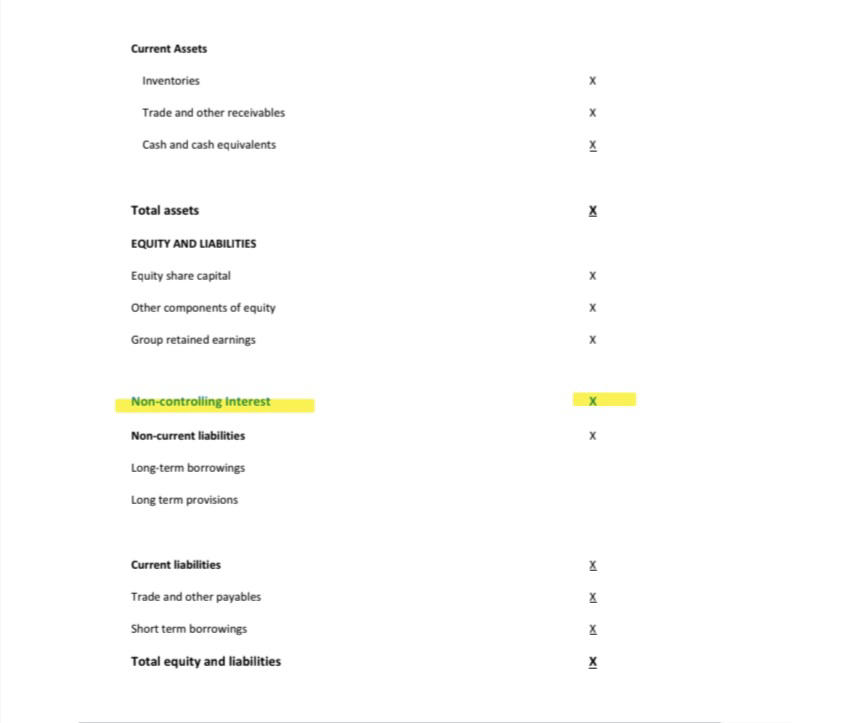
19
What is the objective of IFRS 3 Business Combinations?
To specify how to account when one entity gains control over another, including the preparation of group accounts in addition to individual company accounts. focus on acquisition
20
What is the process of consolidation in group accounting?
Consolidation involves adding 100% of the assets and liabilities of the subsidiary to the parent, line by line, to show control, and reflecting ownership through the non-controlling interest (NCI).
21
What happens to the investment in the subsidiary during consolidation?
The investment in the subsidiary is cancelled against the subsidiary’s net assets at acquisition (share capital and retained earnings at acquisition).
22
What are the two allowable methods for measuring goodwill and NCI?
The fair value method and the proportionate share of net assets method.
23
How is non-controlling interest (NCI) shown in the consolidated accounts?
NCI is shown in the equity section, representing the portion of the subsidiary not owned by the parent.
24
What is purchase goodwill and how is it treated?
Purchase goodwill is the excess of the cost of investment (plus NCI) over the fair value of net assets acquired. It is recognized as an intangible asset and reviewed annually for impairment.
25
What is negative goodwill (bargain purchase) and how is it treated?
Negative goodwill arises when the cost of investment (plus NCI) is less than the fair value of net assets acquired. It is credited immediately to the profit and loss account.
26
Is internally generated goodwill recognized in the accounts?
No, internally generated goodwill is never recognized.
27
What is internally generated goodwill?
Internally generated goodwill refers to the value that a company believes it has created through its own operations, reputation, customer relationships, or brand strength, rather than through the acquisition of another business. Under IFRS 3 and accounting standards, internally generated goodwill is never recognized as an asset in the financial statements. Only goodwill arising from the purchase of another company (purchase goodwill) is recognized. This prevents companies from artificially inflating their balance sheets by estimating and recording their own perceived value.
28
How is share capital shown in group accounts?
Only the parent’s share capital is shown; the subsidiary’s share capital is cancelled.
29
How are retained earnings shown in group accounts?
All of the parent’s retained earnings plus the parent’s share of the subsidiary’s post-acquisition profits.
30
What are post-acquisition profits?
Profits earned by the subsidiary since the date of acquisition.
31
How is negative goodwill treated in later years?
It is recorded against retained earnings in group reserves if not recognized in the year of acquisition.
32
Why do we consolidate 100% of the subsidiary’s assets and liabilities even if we own less than 100%?
To show control; ownership is reflected separately through the NCI.
33
What is the first step in preparing consolidated financial statements?
Establish the group structure—determine if the parent has control, the date of acquisition, and the percentage of shares held.
34
What is the purpose of calculating post-acquisition profit?
To determine the profit generated by the subsidiary since the parent gained control, which is then split between the parent and NCI.
35
What is included in group retained earnings?
All of the parent’s retained earnings plus the parent’s share of the subsidiary’s post-acquisition profit, minus any impairment (depending on the method).
36
What is non-controlling interest (NCI)?
NCI is the equity in a subsidiary not attributable, directly or indirectly, to the parent company.
37
How is NCI measured at acquisition?
NCI can be measured at fair value or at the NCI’s proportionate share of the subsidiary’s net identifiable assets.
38
How is NCI valued under the fair value method?
NCI is valued using the market value of the subsidiary’s shares at the date of acquisition or other valuation techniques if not traded.
39
How is NCI valued under the proportion of net assets method?
NCI is valued by calculating their share of the fair value of the subsidiary’s net assets at acquisition.
40
How does the choice of NCI valuation method affect goodwill?
The method chosen impacts the amount of goodwill recognized; fair value usually results in higher goodwill than the proportionate method.
41
Why does the fair value method usually result in higher goodwill?
Because the NCI is valued higher under the fair value method, increasing the total goodwill recognized.
42
What does IFRS 3 state regarding the measurement of acquired net assets?
IFRS 3 requires that acquired net assets must be measured at fair value at the date of acquisition.
43
How should intangible assets be valued in accordance with IAS 38 during an acquisition?
Intangible assets must be valued at fair value, which is equivalent to their current carrying value as per IAS 38.
44
What is the fair value measurement for Property, Plant, and Equipment (PPE) in acquisition accounting?
The fair value of PPE should generally be the market value; if market evidence is lacking, depreciated replacement cost may be used.
45
How is the fair value of financial assets and securities determined?
Fair value for traded financial assets and securities is determined by the quoted market price. For non-marketable securities, fair value is estimated using comparable securities.
46
How is work in progress valued?
Work in progress is valued at the selling price minus completion costs, disposal costs, and any profit margin included in the selling price.
47
What factors should be considered when valuing finished goods in inventory?
The valuation should reflect the selling price less any disposal costs associated with those goods.
48
What concept is crucial for assessing the value of receivables?
The present value of expected future cash flows from receivables must be calculated. Discounting is not necessary for short-term receivables but is required for longer-term ones.
49
How are payables valued in consolidated SOFP
Payables are recorded at the fair value of the amounts expected to be paid, discounted to present value if applicable.
50
What is the approval process for fair value estimates in acquisition accounting?
Fair value estimates should be approved at the date of acquisition and verified with the first post-acquisition financial statements produced by the group.
51
What is the first step in preparing a consolidated statement of financial position (SFP)?
Lay out the pro forma SFP, including non-current assets, current assets, share capital, retained earnings, NCI, and current liabilities. Do not include the investment in the subsidiary; it will be replaced by goodwill.
52
How do you adjust a subsidiary’s net assets to fair value at acquisition?
Increase the relevant asset (e.g., PPE) by the fair value uplift and credit the reserves. Recognize any contingent liabilities by increasing liabilities and debiting reserves.
53
How do you recognize a contingent liability on acquisition?
Add the contingent liability to current liabilities and reduce the subsidiary’s net assets by the same amount at acquisition.
54
How do you determine the non-controlling interest (NCI) using the proportion of net assets method?
NCI = NCI percentage × subsidiary’s net assets at acquisition (after fair value adjustments).
55
What is the effect of negative goodwill on the profit and loss account?
Negative goodwill is recognized immediately as an income in the profit and loss account, indicating a bargain purchase.
56
What is the impact of goodwill impairment on financial statements?
Goodwill impairment decreases the asset value on the statement of financial position and reflects an expense on the profit and loss account.
57
When consolidating, what assets and liabilities are added line by line?
100% of the parent’s and subsidiary’s assets and liabilities are added line by line, except for the investment in the subsidiary.
58
What replaces the investment in the subsidiary in the consolidated SFP?
Goodwill, calculated at acquisition.
59
How do you account for fair value adjustments on subsidiary (e.g., PPE, contingent liabilities) in consolidation?
Adjust the subsidiary’s net assets at both acquisition and reporting dates for fair value changes, and account for extra depreciation or liability as needed.
60
How are post-acquisition profits calculated?
The difference in the subsidiary’s net assets between acquisition and reporting date.
61
In the consolidated SFP, whose share capital is shown?
Only the parent’s share capital.
62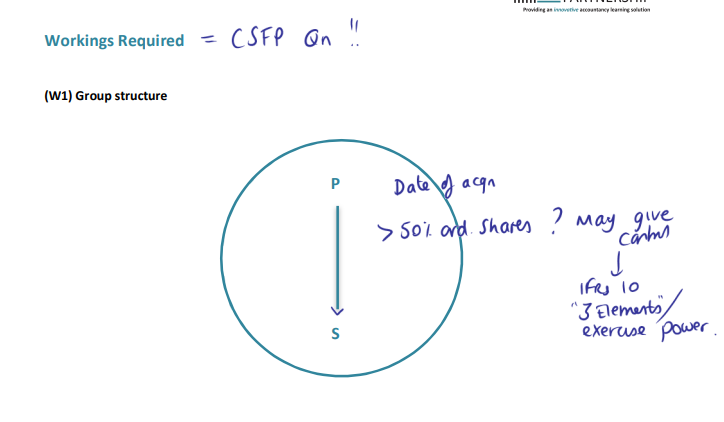
In the working for consolidated SOFP what is W1
63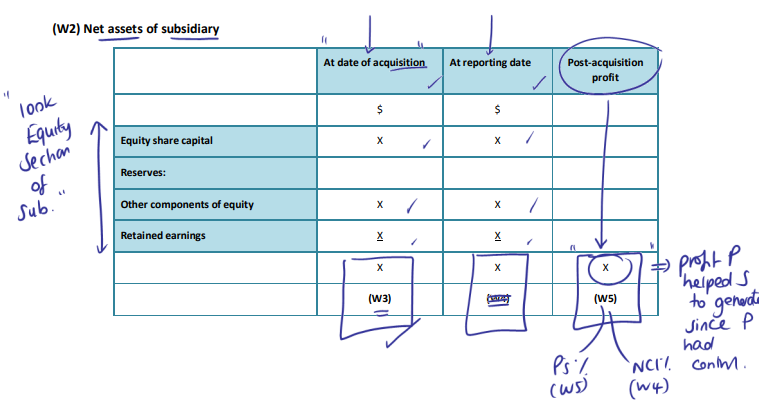
In the working for consolidated SOFP what is W2
64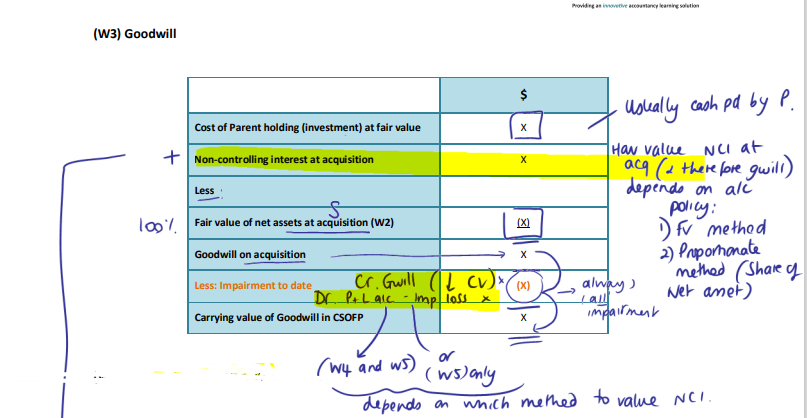
In the working for consolidated SOFP what is W3
65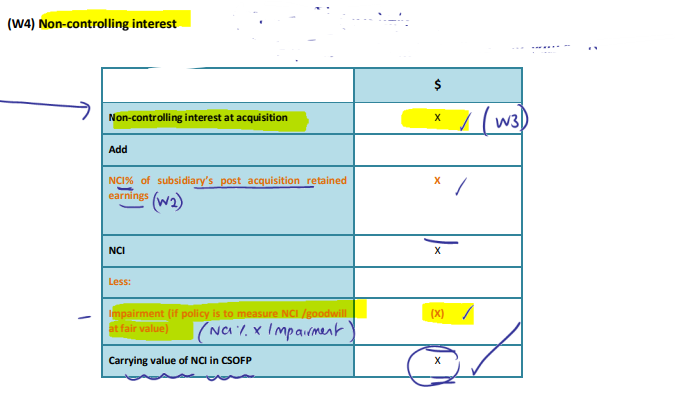
In the working for consolidated SOFP what is W4
66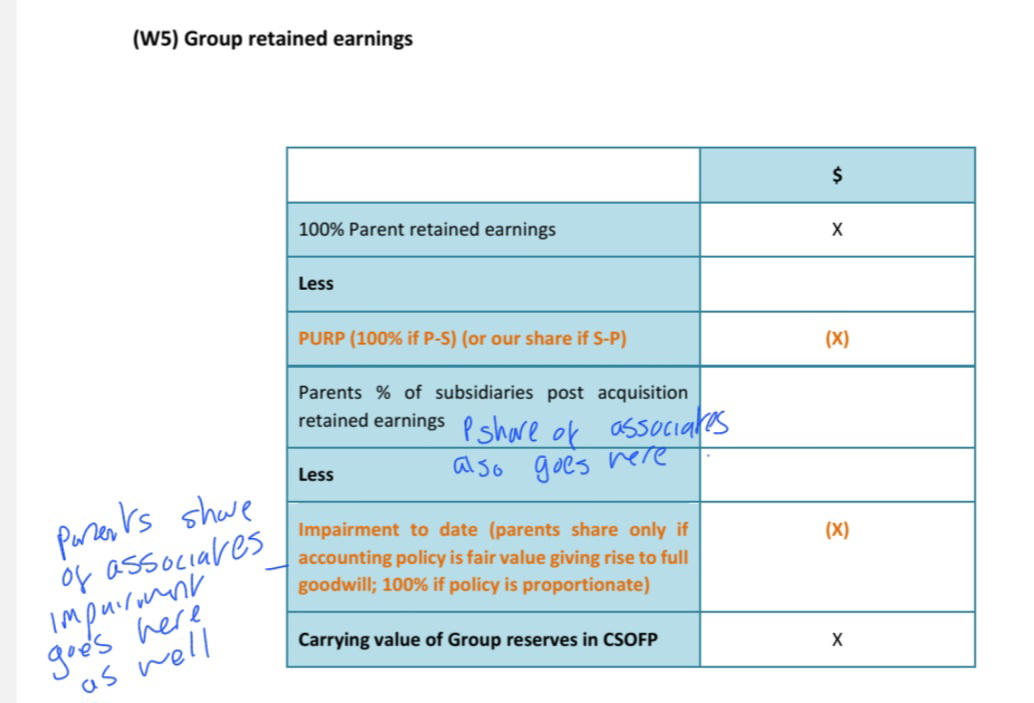
In the working for consolidated SOFP what is W5
67
What is the consideration?
The cost of the investment to be recorded
68
How is immediate cash consideration recorded in the parent’s books?
Debit Investment, Credit Cash
69
How is consideration by shares recorded?
Debit Investment (fair value), Credit Share Capital (nominal value), Credit Share Premium (excess over nominal value).
70
How is deferred cash consideration recorded?
Debit Investment, Credit Liability (at present value of the obligation).
71
How is contingent consideration defined and measured?
It is dependent on meeting certain conditions or clauses, and is measured at fair value based on the likelihood and amount involved.
72
How are shares not yet issued for deferred or contingent consideration recorded?
Set up a new equity line called "shares not yet issued" within equity.
73
How are issue costs of shares or professional costs treated? (the costs of selling shares)
They must be expensed immediately in the profit and loss account, not included in the cost of acquisition.
74
What must be done with intergroup balances (e.g., receivables and payables) during consolidation?
Intergroup balances must be eliminated so that only balances with the outside world are shown
75
What are the two steps to handle intergroup balances in consolidation?
1. Ensure the balances agree (reconcile differences, e.g., cash in transit). 2. Cancel or contra the balances.
76
What is "cash in transit" in the context of intergroup transactions?
Cash in transit occurs when payment has been made by one group company but not yet received by the other at the reporting date, causing a mismatch in balances.
77
How do you adjust for cash in transit in the subsidiary’s books?
Debit bank (increase cash) and credit receivables (reduce receivable).
78
Why do we eliminate intergroup loans in consolidated financial statements?
Because loans between group companies do not represent transactions with the outside world and must be removed to reflect the group as a single entity.
79
What is PURP?
Provision for Unrealised Profit
80
What is unrealized profit in the context of group accounts?
Profit included in inventory when goods are sold between group companies but not yet sold to an external party by year end.
81
When do you need to make a provision for unrealized profit (perp) adjustment?
Only when the goods transferred between group companies are still in inventory at the year end.
82
Is an adjustment needed in the SOFP if the goods have been sold to a third party by year end?
No, because the profit is now realized.
83
What journal entries are made to adjust for unrealized profit in group accounts?
Credit inventory (to reduce it) and debit retained earnings, which reduces group profit.
This is because we are reducing the value of the inventory in the subs accounts and reducing the profit in the parents accounts as we are removing the profit charged within the group
This is because we are reducing the value of the inventory in the subs accounts and reducing the profit in the parents accounts as we are removing the profit charged within the group
84
When adjusting for unrealized profit, how do you decide where the adjustment goes?
If the parent is the seller, the adjustment goes to the parent’s retained earnings (W5); if the subsidiary is the seller, the adjustment is shared between the parent and non-controlling interest (W4)
85
What must always balance in the consolidated statement of financial position?
Total assets must equal total equity and liabilities.
86
What is a fair value uplift of PPE in a group consolidation context?
It is an increase in the carrying value of a subsidiary’s PPE to reflect its fair value at the date of acquisition.
87
How does the fair value uplift affect the net assets working in consolidation?
The uplift is added to the net assets at acquisition and at the reporting date in the net assets working. W2
88
How is depreciation on the fair value uplift calculated?
Divide the uplift amount by the asset’s remaining useful life at acquisition to get annual extra depreciation.
89
How is the extra depreciation on the fair value uplift accounted for at the reporting date?
Reduce the carrying value of PPE (CSOFP) and reduce retained earnings of sub (W2) by the accumulated extra depreciation. ie times the annual calulated extra depreciation by number of years since acquisition
90
How does the fair value uplift and its depreciation affect the calculation of goodwill?
The uplift increases net assets at acquisition, which reduces calculated goodwill.
91
How does the fair value uplift affect the NCI (Non-Controlling Interest)?
NCI’s share of net assets at acquisition and post-acquisition includes their share of the fair value uplift and related depreciation.
92
In CSOFP what is W6
Consolidaated PPE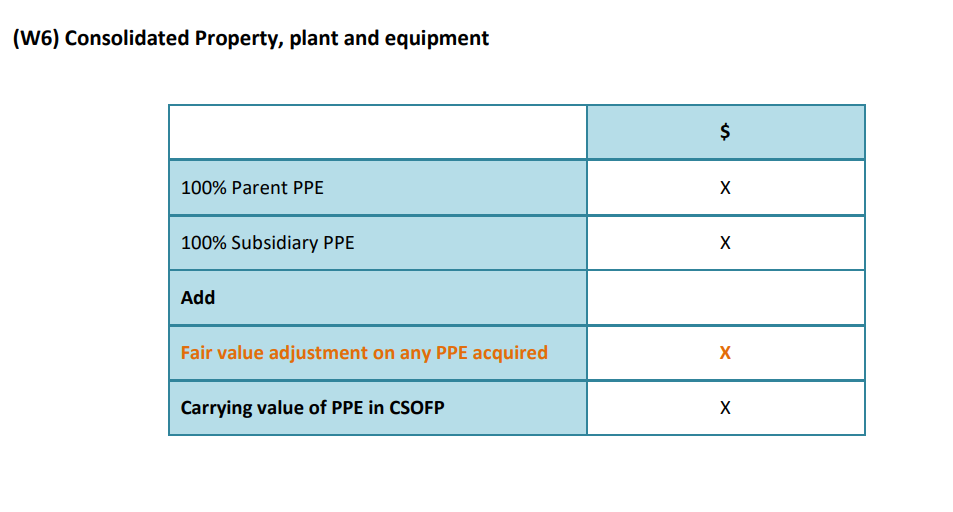
93
In CSOFP what is W7
Investments in associate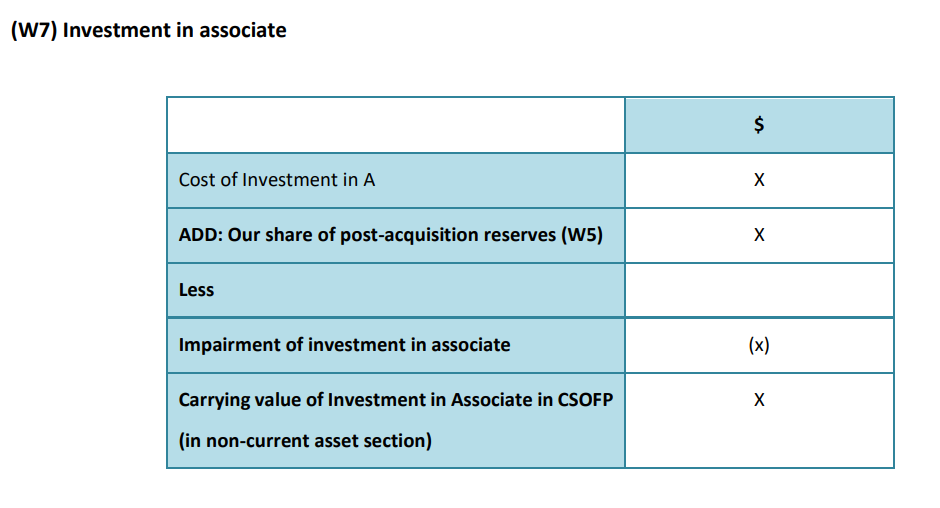
94
In CSOFP what is W8
Inventories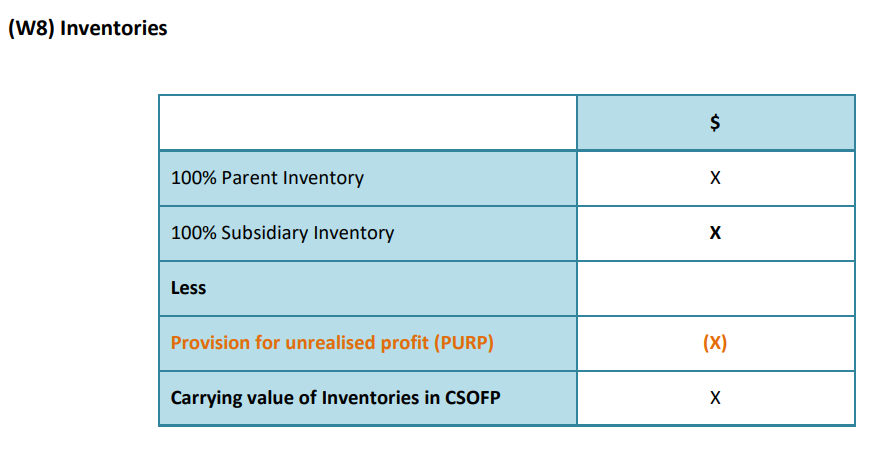
95
In CSOFP what is W9
Trade and other receivables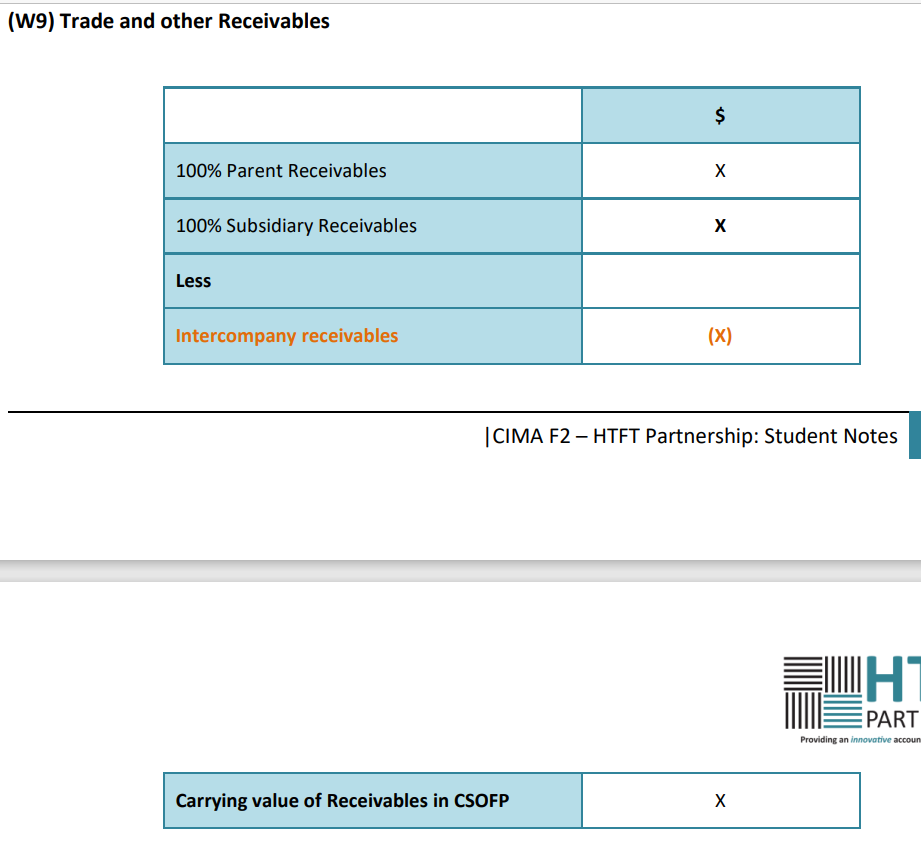
96
In CSOFP what is W10
Consolidated cash and cash equivelents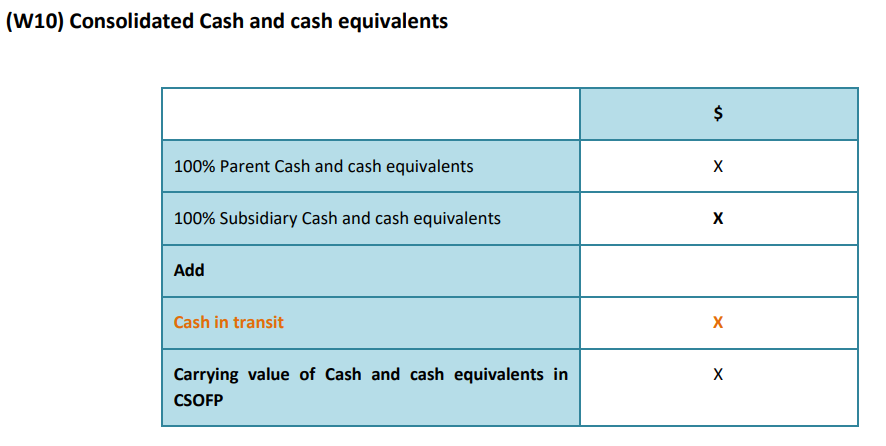
97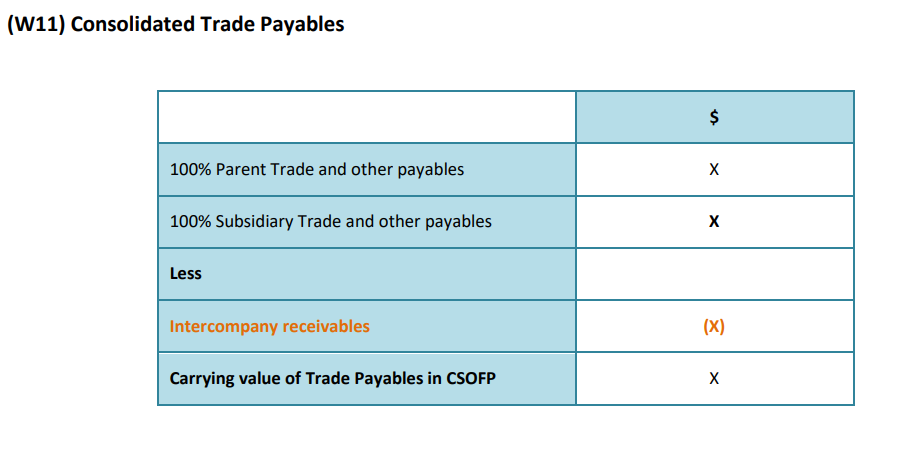
In CSOFP what is W11
98
How is an impairment of goodwill treated if the valuation method is fair value
Impairment Treatment: If goodwill is impaired (i.e., its value has decreased), the impairment loss is shared between the parent and the NCI in proportion to their ownership interests.
The impairment is credited to goodwill (reducing its carrying value).
The parent’s share of the impairment is debited to the group’s retained earnings (working five).
The NCI’s share of the impairment is debited to the NCI (working four).
Rationale: This is because, under the fair value method, the NCI is recognized at its full fair value, which includes its share of goodwill. Therefore, both the parent and NCI share in any impairment loss.
Summary: Under the fair value method, impairment of goodwill is split between the parent and the NCI, reducing both their respective equity interests in the consolidated financial statements.
The impairment is credited to goodwill (reducing its carrying value).
The parent’s share of the impairment is debited to the group’s retained earnings (working five).
The NCI’s share of the impairment is debited to the NCI (working four).
Rationale: This is because, under the fair value method, the NCI is recognized at its full fair value, which includes its share of goodwill. Therefore, both the parent and NCI share in any impairment loss.
Summary: Under the fair value method, impairment of goodwill is split between the parent and the NCI, reducing both their respective equity interests in the consolidated financial statements.
99
How is an impairment of goodwill treated if the valuation method is the proportion of net assets method
Impairment Treatment: If goodwill is impaired, the entire impairment loss is allocated to the parent only.
The impairment is credited to goodwill (reducing its carrying value).
The full amount of the impairment is debited to the group’s retained earnings (working five).
No portion of the impairment is allocated to the NCI.
Rationale: Under the proportionate method, the NCI is recognized only for its share of the subsidiary’s net assets, not including any goodwill. Therefore, the NCI does not share in any impairment of goodwill.
Summary: Under the proportionate method, all impairment of goodwill is borne by the parent, with no impact on the NCI.
The impairment is credited to goodwill (reducing its carrying value).
The full amount of the impairment is debited to the group’s retained earnings (working five).
No portion of the impairment is allocated to the NCI.
Rationale: Under the proportionate method, the NCI is recognized only for its share of the subsidiary’s net assets, not including any goodwill. Therefore, the NCI does not share in any impairment of goodwill.
Summary: Under the proportionate method, all impairment of goodwill is borne by the parent, with no impact on the NCI.
100
What is the purpose of IFRS 10
Focus: After the acquisition — ongoing control and consolidation.
Purpose
IFRS 10 sets out principles for presenting and preparing consolidated financial statements when an entity controls one or more other entities.
Purpose
IFRS 10 sets out principles for presenting and preparing consolidated financial statements when an entity controls one or more other entities.
101
What is a joint arrangement under IFRS 11?
It is an arrangement where two or more parties have joint control over an activity, requiring unanimous consent for decisions.
102
What are the two types of joint arrangements under IFRS 11?
Joint ventures and joint operations.
103
What is a joint venture?
A joint arrangement where parties have joint control through a separate entity (can be a company or unincorporated business).
104
How are joint ventures accounted for?
Using the equity method, similar to associates.
105
What is a joint operation
A joint arrangement where parties have joint control over assets and obligations, without a separate entity.
106
How are joint operations accounted for?
Each party recognizes its share of assets, liabilities, revenue, and expenses directly and takes a proportion of the sale proceeds (line by line)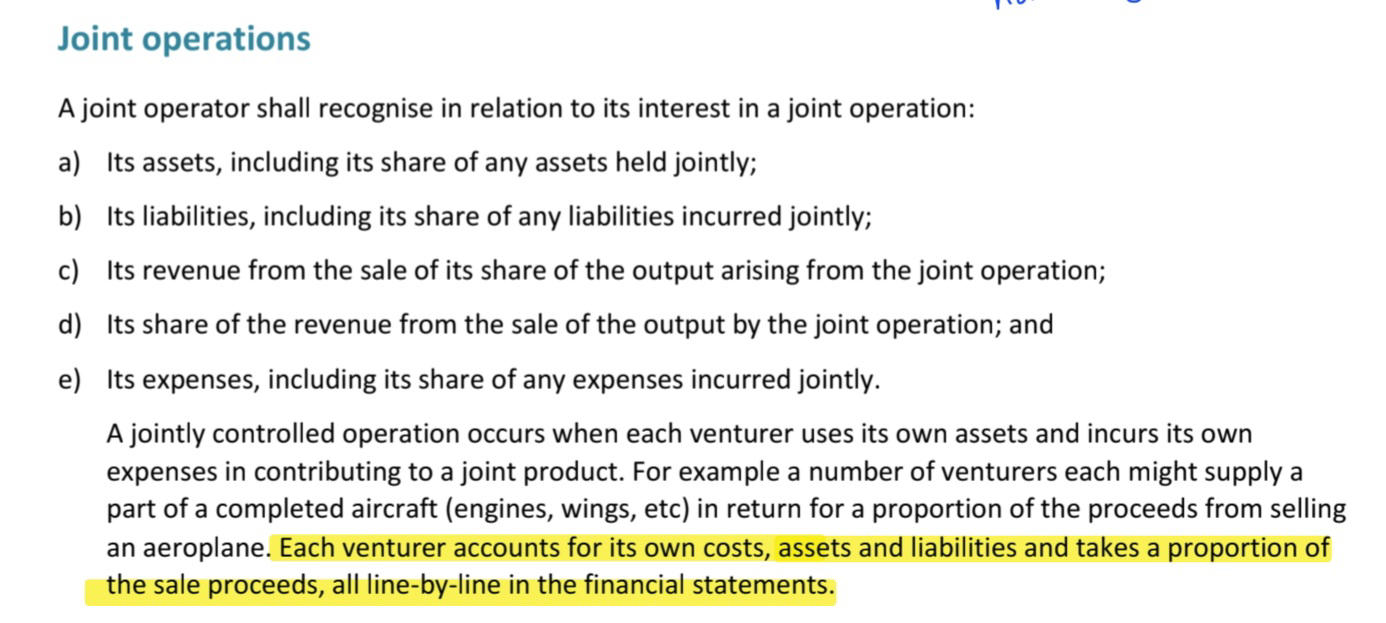
107
Can you give an example of a joint operation?
Oil companies sharing control over a pipeline, each using its own assets and incurring its own expenses.
108
What does IAS 27 address in relation to parent companies?
IAS 27 covers how parent companies should account for investments in subsidiaries, associates, or joint ventures in their separate financial statements.
109
In a parent company’s separate accounts, how can investments in subsidiaries be measured?
Investments can be measured at either cost or fair value (with gains/losses through OCI).
110
When calculating goodwill, which value should be used for the parent’s investment in a subsidiary?
Always use the original cost of investment, regardless of any fair value adjustments made in the parent’s separate accounts.
111
What should you do if the parent company has made fair value adjustments to the investment in their own accounts?
Reverse any fair value adjustments and use the original cost for goodwill calculation.
112
Why is it important to use the original cost of investment when calculating goodwill?
Using the original cost ensures goodwill remains consistent and is not affected by ongoing fair value changes in the parent’s separate accounts.
113
How do you record an impairment of goodwill under the fair value method?
114
How do you record an impairment of goodwill under the proportion of net assets method?
115
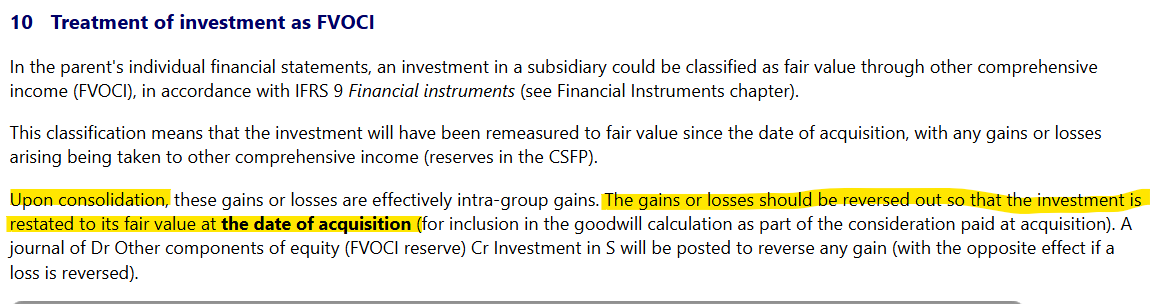
If a parent has classified an investment as fair value through other comprehensive income (FVOCI) what adjustment needs to be made at consolidation?
Reverse the gain or loss that occurred after aquisition