F2 Provisions, Contingent Liabilities and Contingent Assets
Study these flashcardsFree · spaced repetition · iPhone, Android, Mac & web
All cards
1
What is IAS 37
Provisions, Contingent liabilities and contingent assets
2
What is the definition of a provision?
A liability of uncertain timing or amount.
3
What is the definition of a liability?
A present obligation arising from past events, the settlement of which is expected to result in an outflow of econominc benefits
4
What is the accounting treatment for recognizing a provision?
Debit an expense in the profit and loss account and credit a provision account.
5
When shal a provision be recognised?
When -
1) An entitiy has a present obligation, legal or constructive, as a result of a past even
2) It is probable that an outflow of resources will be required to settle the obligation
3) A reliable estimate can be made of the amount of the obligation
If these conditions are not met, no provision shall be recognised
1) An entitiy has a present obligation, legal or constructive, as a result of a past even
2) It is probable that an outflow of resources will be required to settle the obligation
3) A reliable estimate can be made of the amount of the obligation
If these conditions are not met, no provision shall be recognised
6
What are the two types of obligations for recognizing a provision?
Legal (from contracts or legislation) and constructive (from an entity's actions or expectations created).
7
What is a legal obligation
An obligation that derives from
- A contract
- Ligislation
- A contract
- Ligislation
8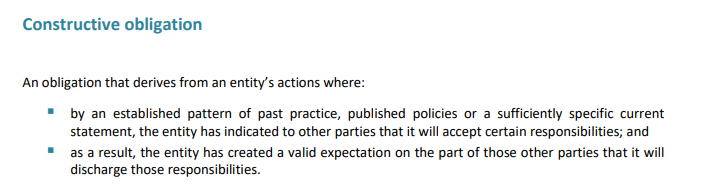
What is a constructive obligation?
9
Give an example of a constructive obligation
A company has a past practice—such as Marks & Spencer giving refunds without receipts—creating a valid expectation among customers.
10
What happens if the criteria for recognizing a provision are not met?
The item may need to be disclosed as a contingent liability instead.
11
What are the three elements required to recognize a provision?
Present obligation (legal or constructive), probable outflow, and reliable estimate.
12
What is meant by a “reliable estimate” in the context of provisions?
An estimate of the amount that can be reasonably determined, considering uncertainties.
13
When should a provision be added to the cost of a non-current asset instead of the P&L?
When the provision is for dismantling or restoring an asset, established by a past event at acquisition or construction.
14
How are long-term provisions (over 12 months) measured initially?
Record at the present value of the future obligation (discounted amount).
15
What happens as a long-term provision gets closer to payment?
Unwind the discount and debit finance costs in P&L, crediting the provision.
16
What should always accompany movements in provisions in financial statements?
A disclosure note explaining increases and decreases and their impact on profit.
17
How is a provision for a single obligation, like a court case, calculated?
By using the best estimate from management judgement, possibly with external advice such as from a solicitor
18
How is a provision for a group of obligations, such as warranties, calculated?
Using the expected value method, where each possible outcome is weighted by its probability.
19
What is a contingent liability?
A possible obligation with less than a 50% chance of being incurred, often not entirely within the company’s control.
20
How is a contingent liability different from a provision? A:
A provision is a present obligation from a past event that is probable and can be reliably measured; a contingent liability does not meet these criteria.
21
When must a possible obligation be classified as a contingent liability instead of a provision?
When it is not probable or cannot be measured with sufficient reliability.
22
How are contingent liabilities reported in the financial statements?
They are not recognized as liabilities but disclosed only in the notes to the financial statements.
23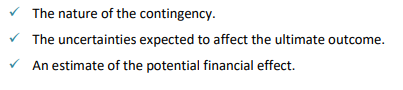
What information must be disclosed in the notes about contingent liabilities?
24
What is the principle of prudence in accounting?
Prudence means anticipating losses and liabilities as soon as we think they're going to occur, but only recognizing assets when they actually happen.
25
What is a contingent asset?
A contingent asset is a potential asset that may be realized in the future, such as a successful counterclaim against a manufacturer.
26
When can a contingent asset be recognized in the financial statements?
Only when it is virtually certain that the benefit will be received.
27
How should you account for a contingent asset that is probable but not virtually certain?
It should be disclosed, but not recognized as an asset.
28
What should you do if a contingent asset is only possible or remote?
Ignore it—do not recognize or disclose.
29
hat journal entries should be made if a contingent asset becomes virtually certain?
Debit the asset (receivable), credit the P&L (income statement) with the income.
30
Are disclosure requirements for contingent assets the same as for contingent liabilities?
Yes, disclosure should be made according to the same requirements as for contingent liabilities.
31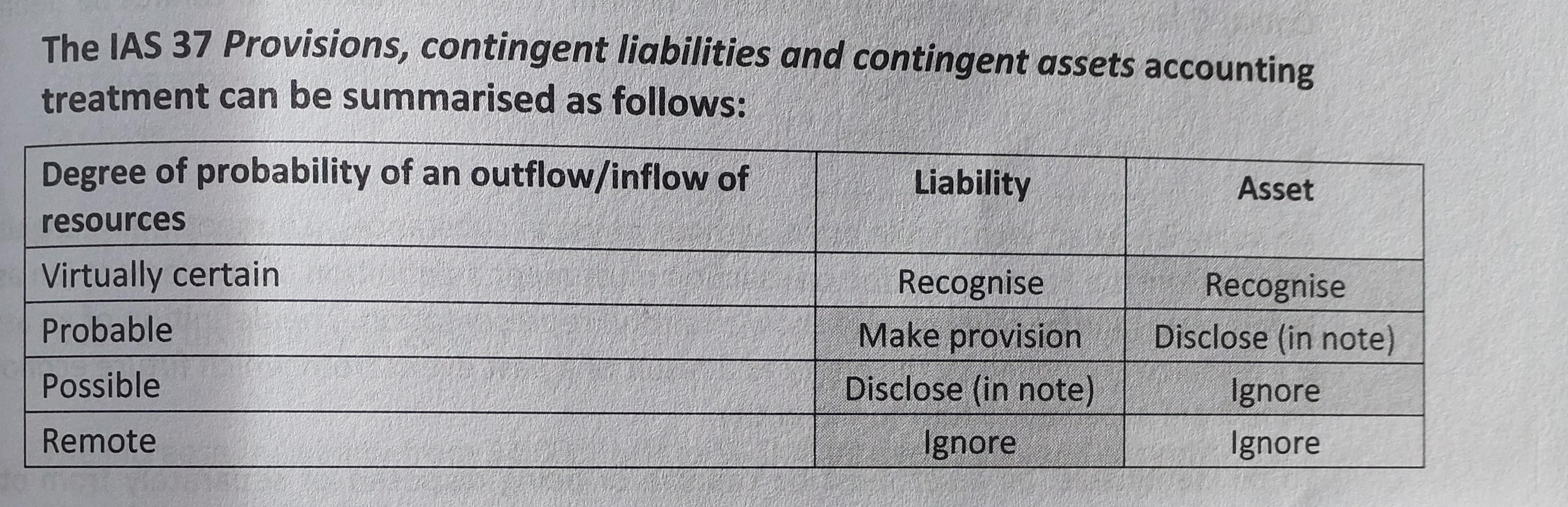
summmary of when to recognise or disclose potential assets and liabilities