Biochem lecture 7
Study these flashcardsFree · spaced repetition · iPhone, Android, Mac & web
All cards
1
Monosaccharides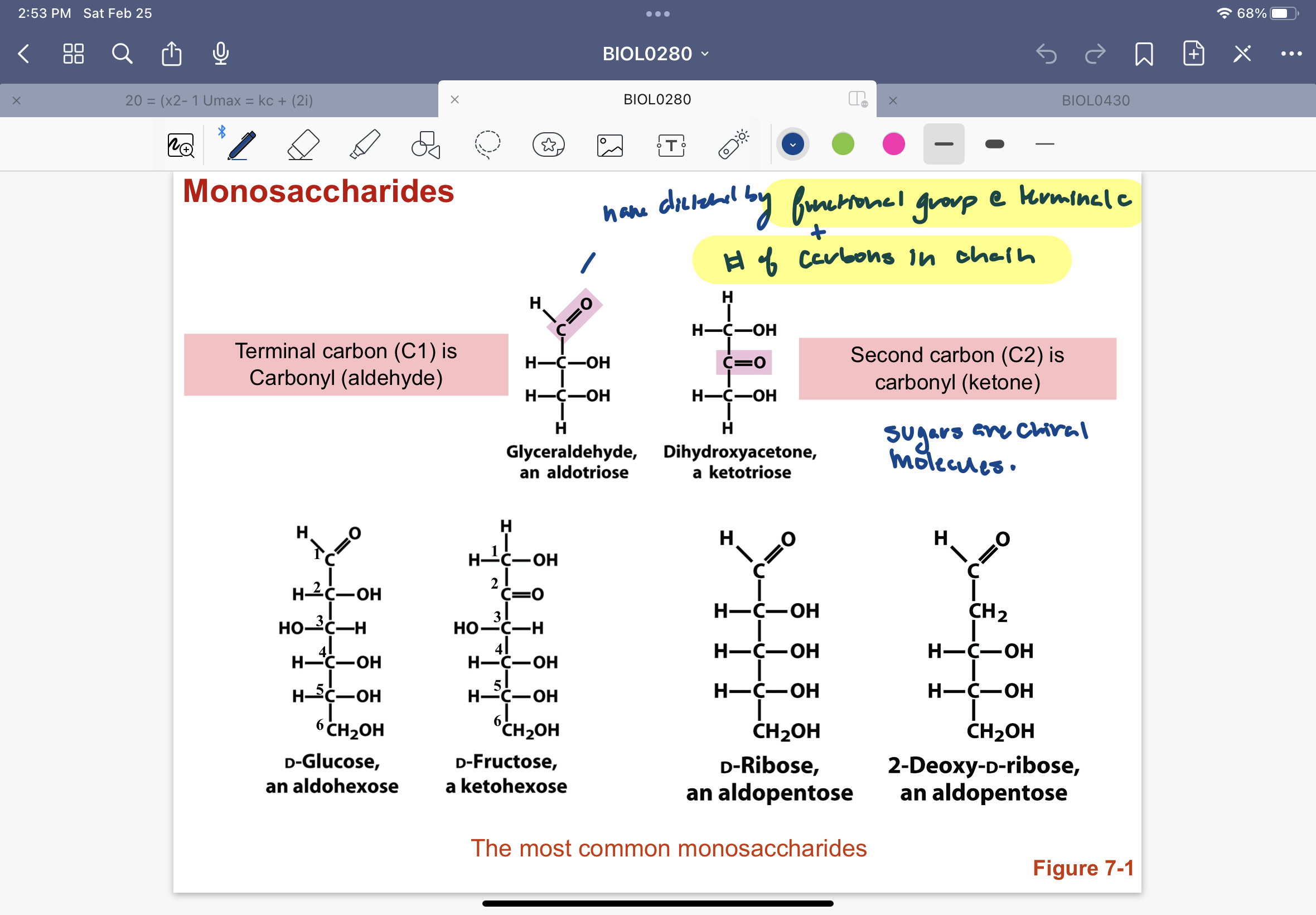
Terminal Carbon (c1) is carbonyl (aldehyde) and C2 is carbonyl (ketone). Their names are dictated by the functional group at the terminal C and the number of carbons in the chain. *look at most common monosaccharides*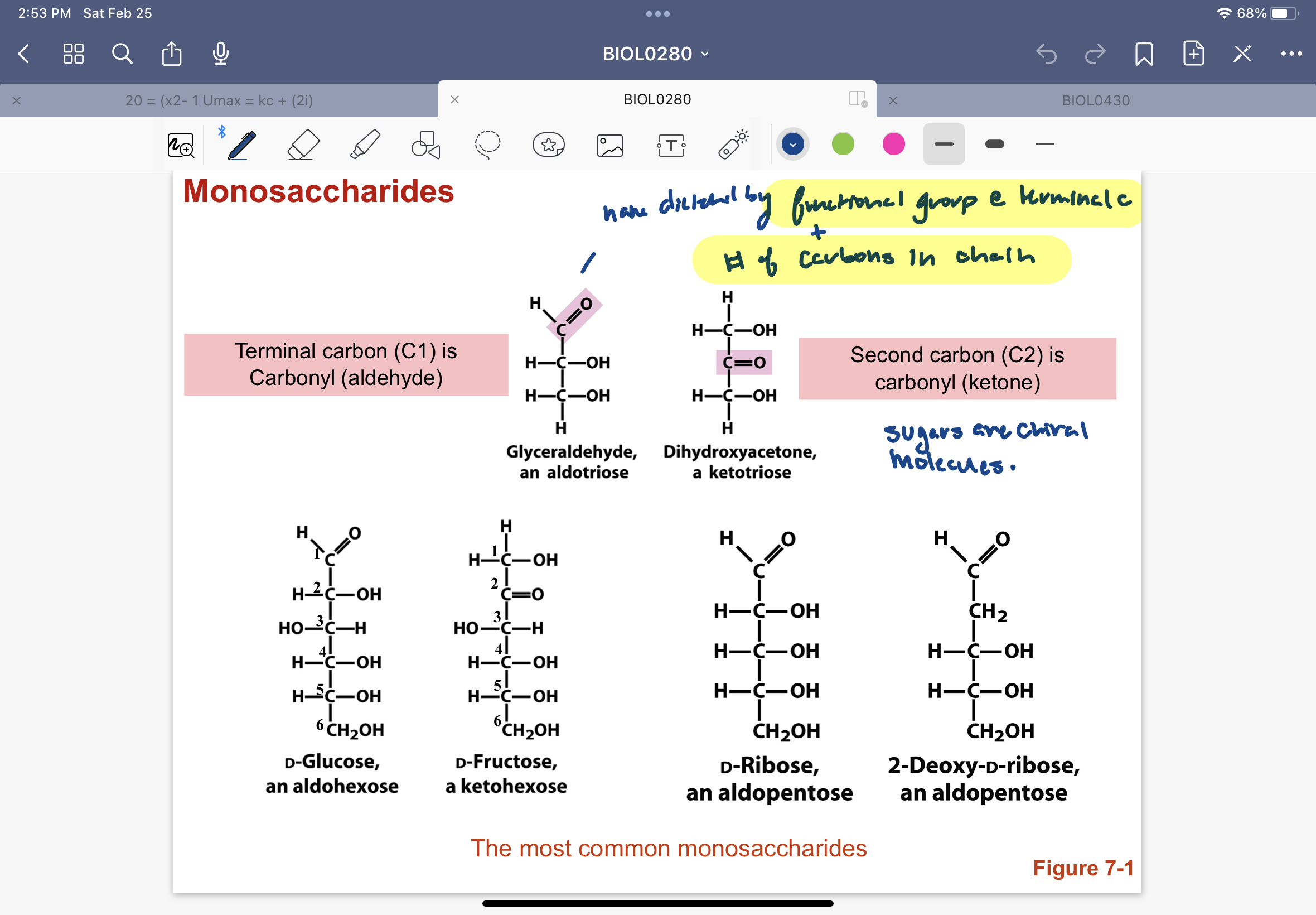
2
Stereoisomers of Glyceraldehyde 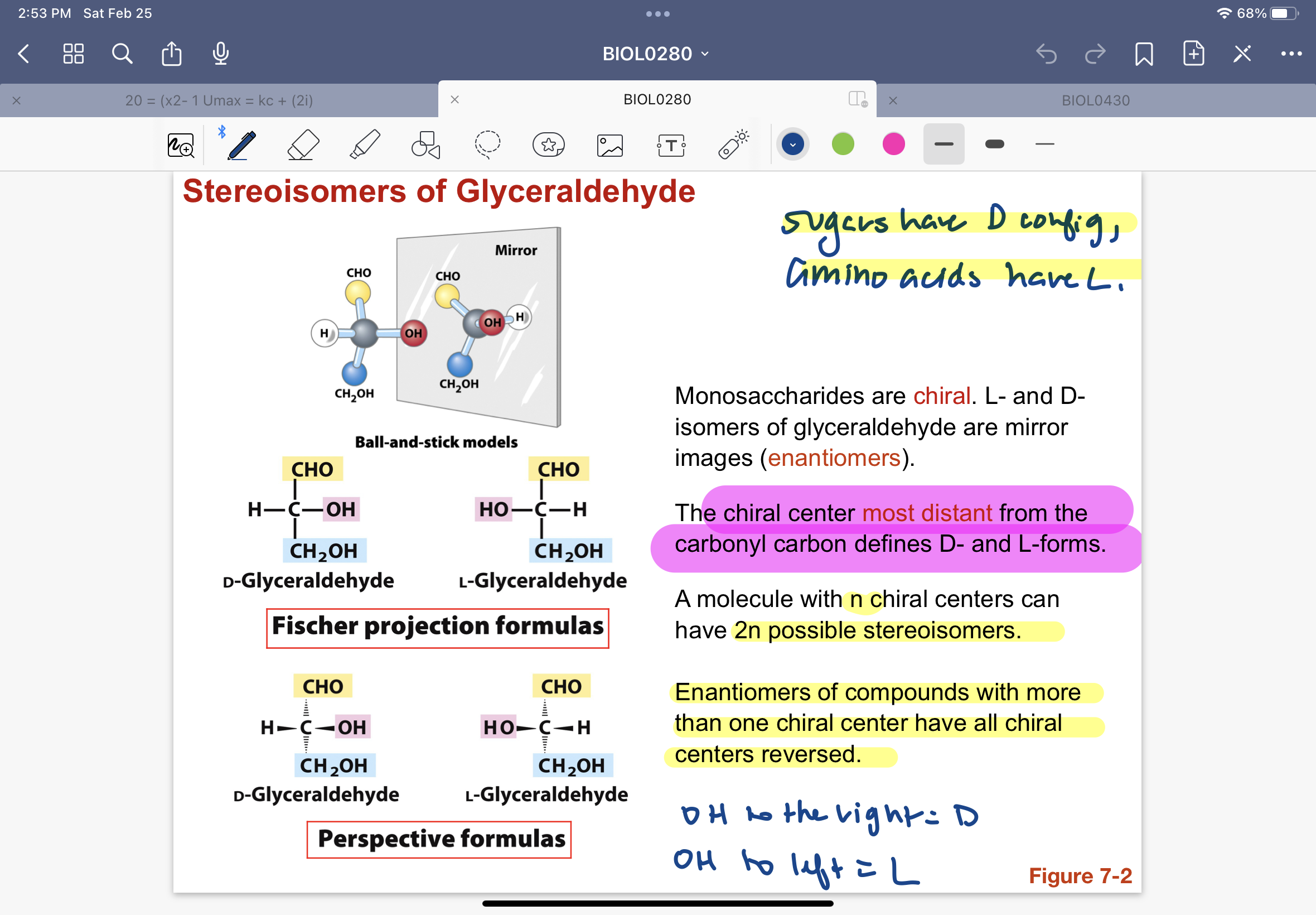
Monosaccharides are chiral. If configurations are mirror images then they are enantiomers, if more than one chiral center all centers are reversed in enantiomers. The chiral center most distant from the carbonyl carbon defines D and L forms. . Molecule with n chiral centers ha 2n possible steroisomers. If Oh is to the right when CH2OH is on the bottom then its D config, if on left its L config. Amino acids are mostly in L config while Sugars are mostly in D config.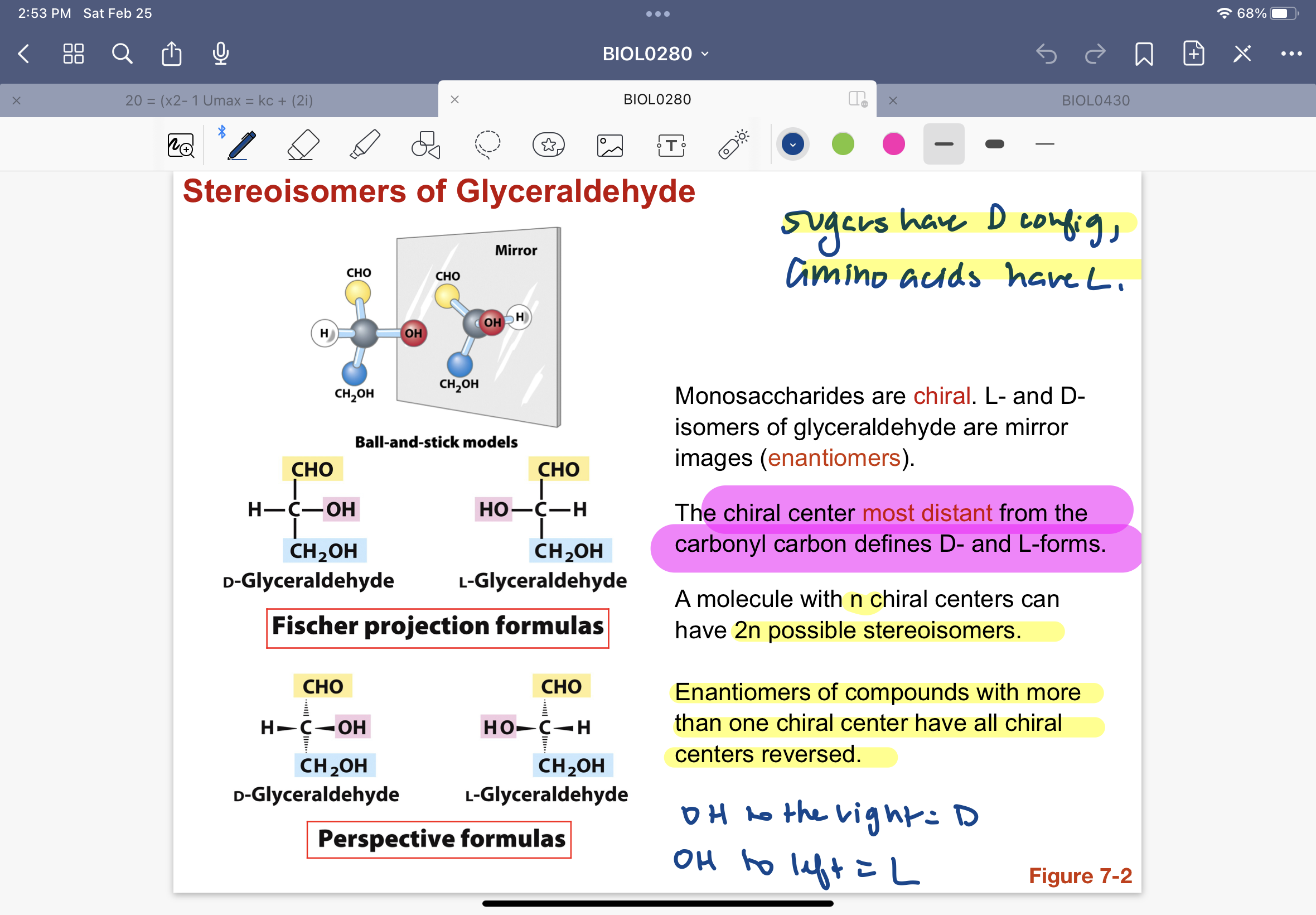
3
Epimers of Glucose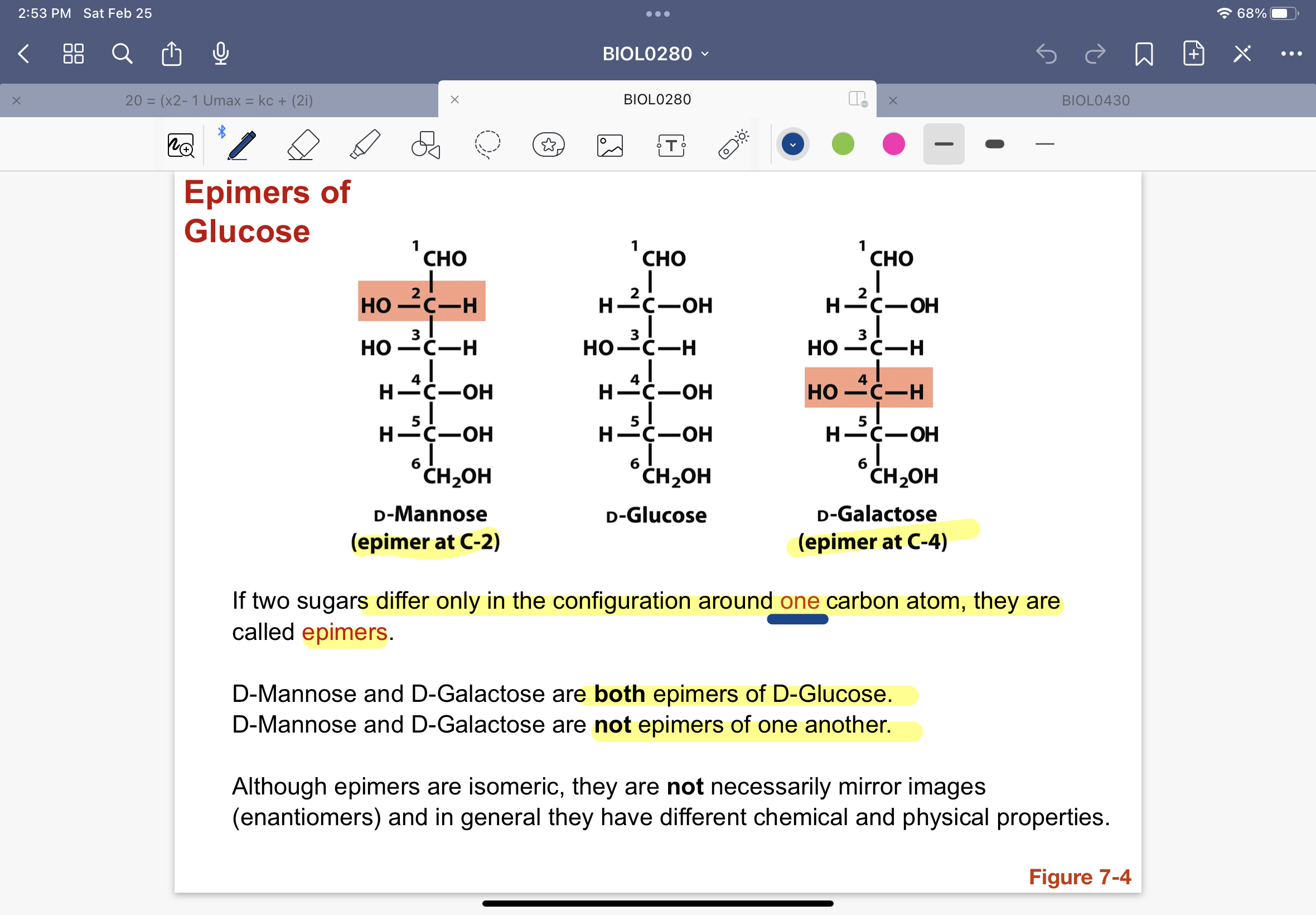
If 2 sugars differ only in the configuration around ONE carbon atom they are epimers. D Mannose and D Galactose are epimers of D glucose but not to each other. Epimers are isomeric but usually have different physical and chemical properties. 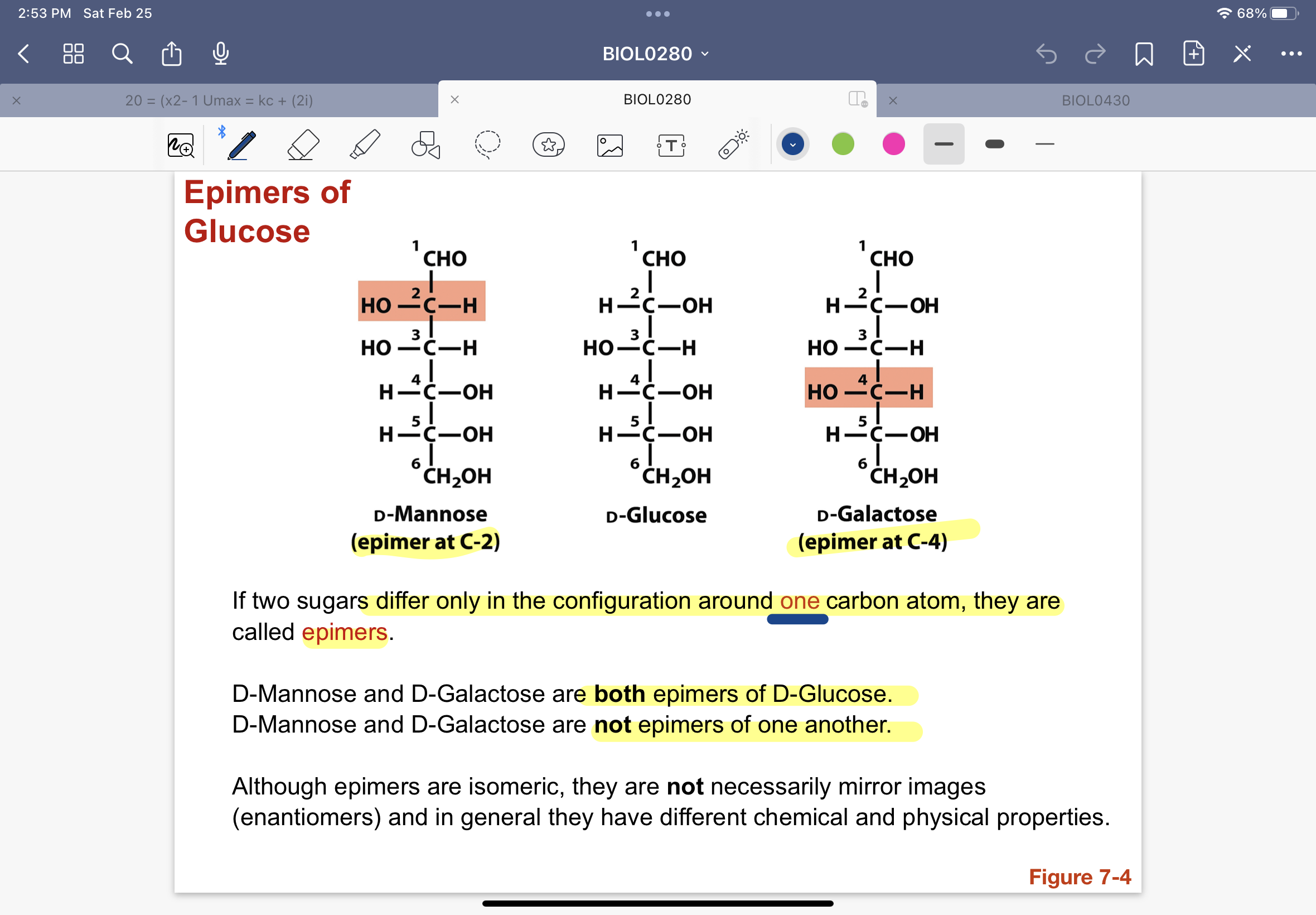
4
Cyclic forms of monosaccharides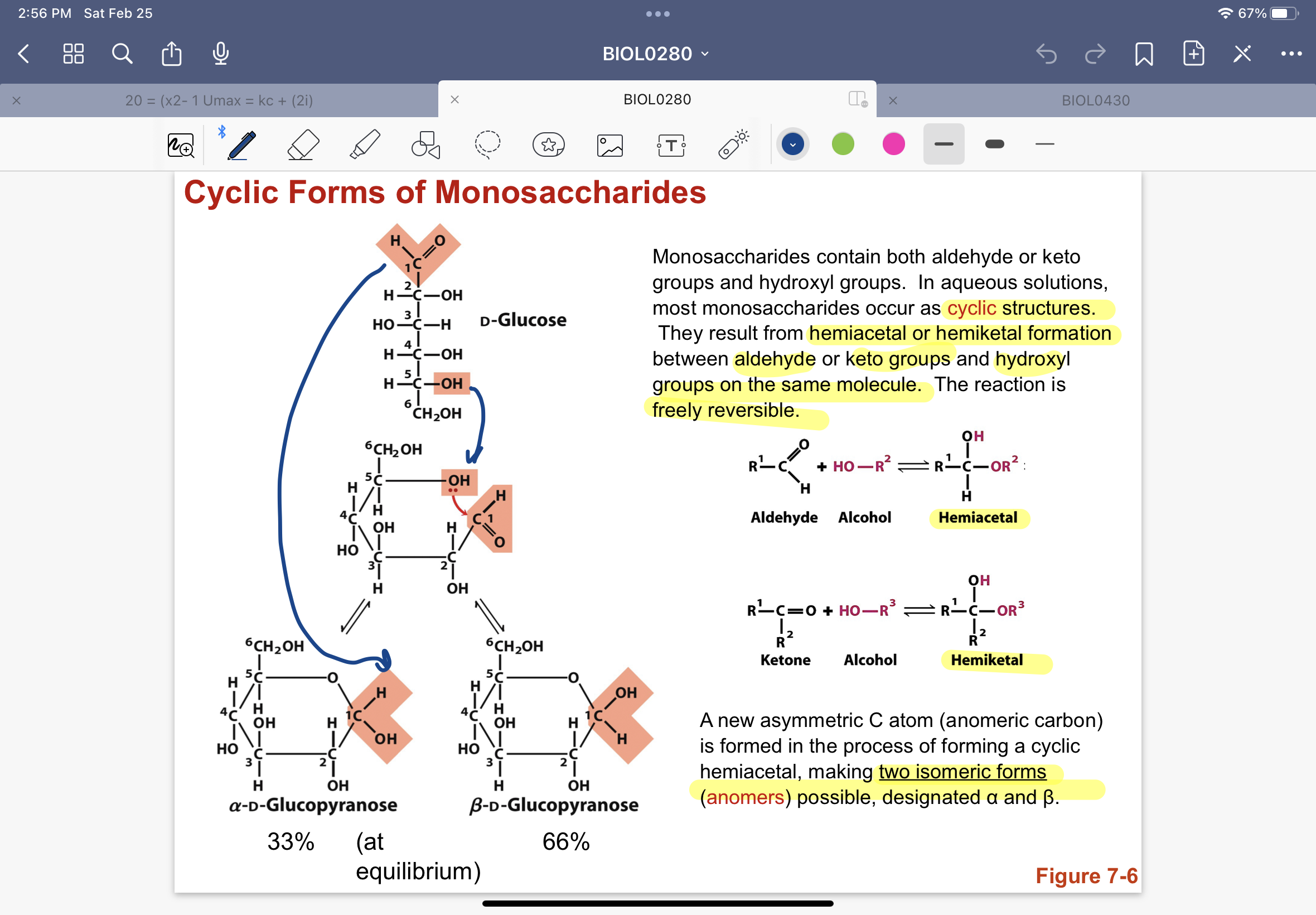
Monosaccharides contian both aldehyde or keto groups and hydroxyl groups. in aq soln. most occur as cyclic structures due to hemiacetal or hemiketal formation btwn aldehyde or keto groups and hydroxyl groups on the same molecule. (freely reversible reaction). New asymmetric C atom (anomeric carbon) is formed in the process of forming a cyclic hemiacetal, making 2 isomeric forms (anomers) possible, Alpha and Beta. .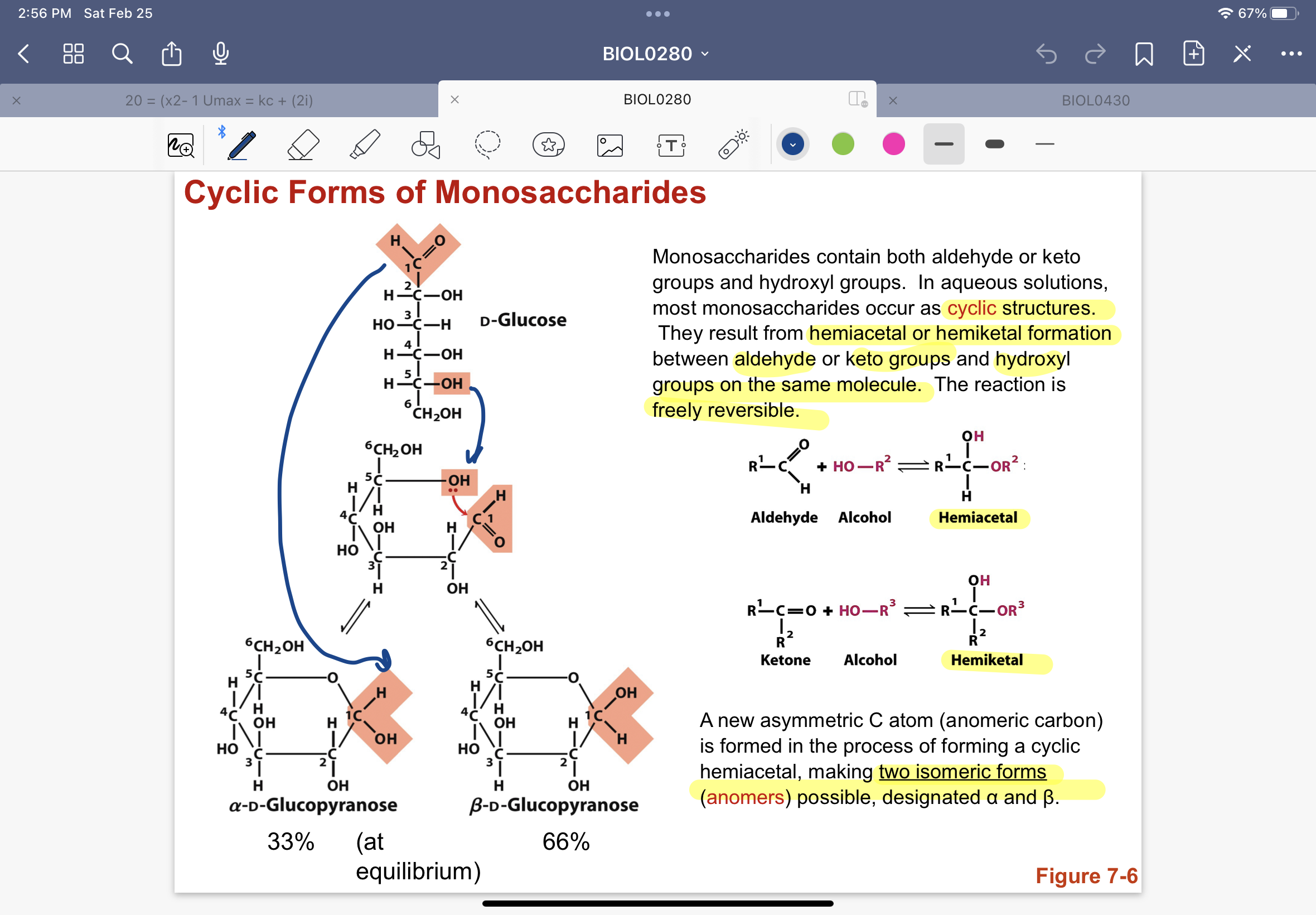
5
Pyranose rings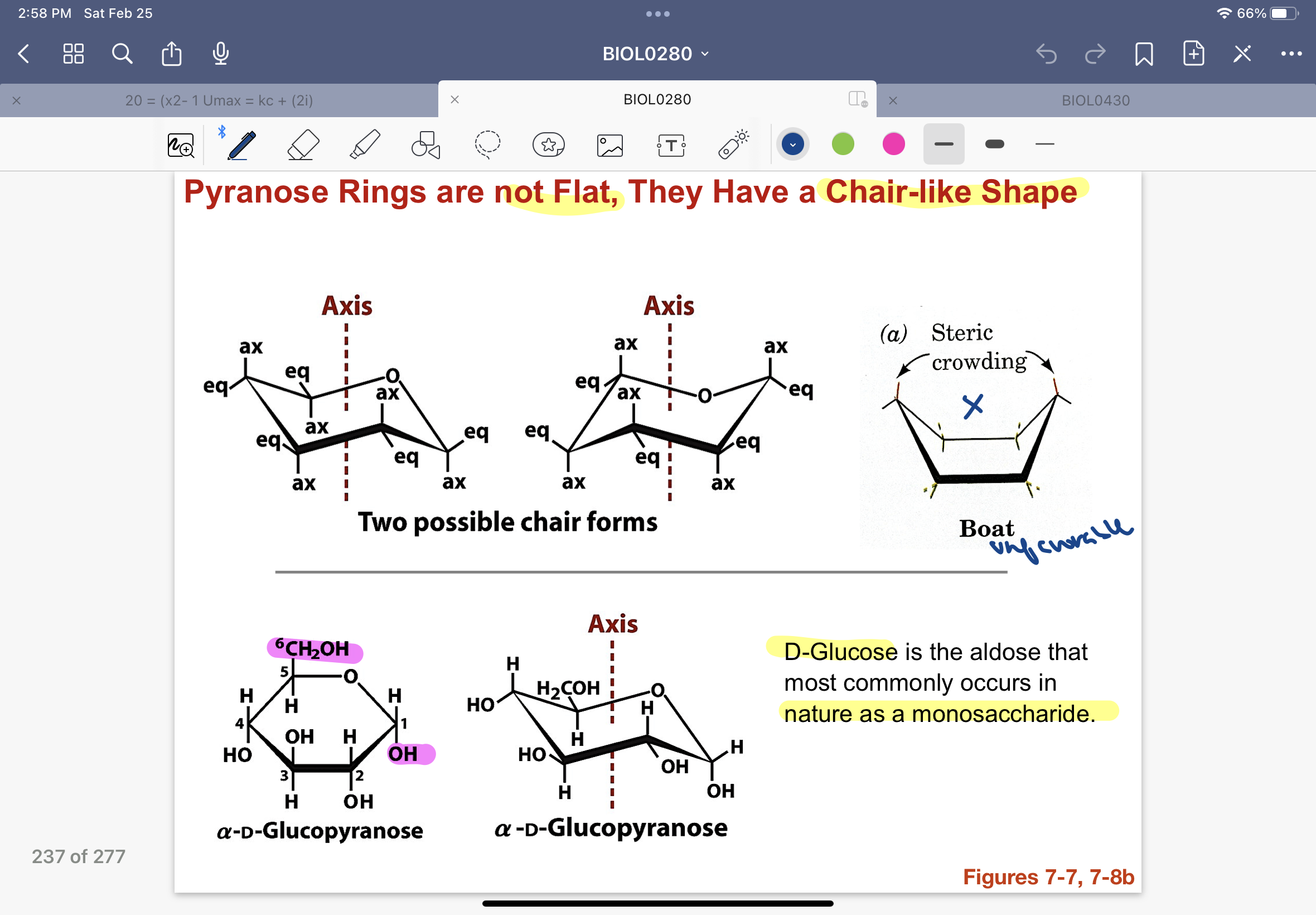
Rings are not flat and instead have a chair like shape with 2 conformations. D-glucose is the aldose that most commonly occurs in nature as a monosaccharide. .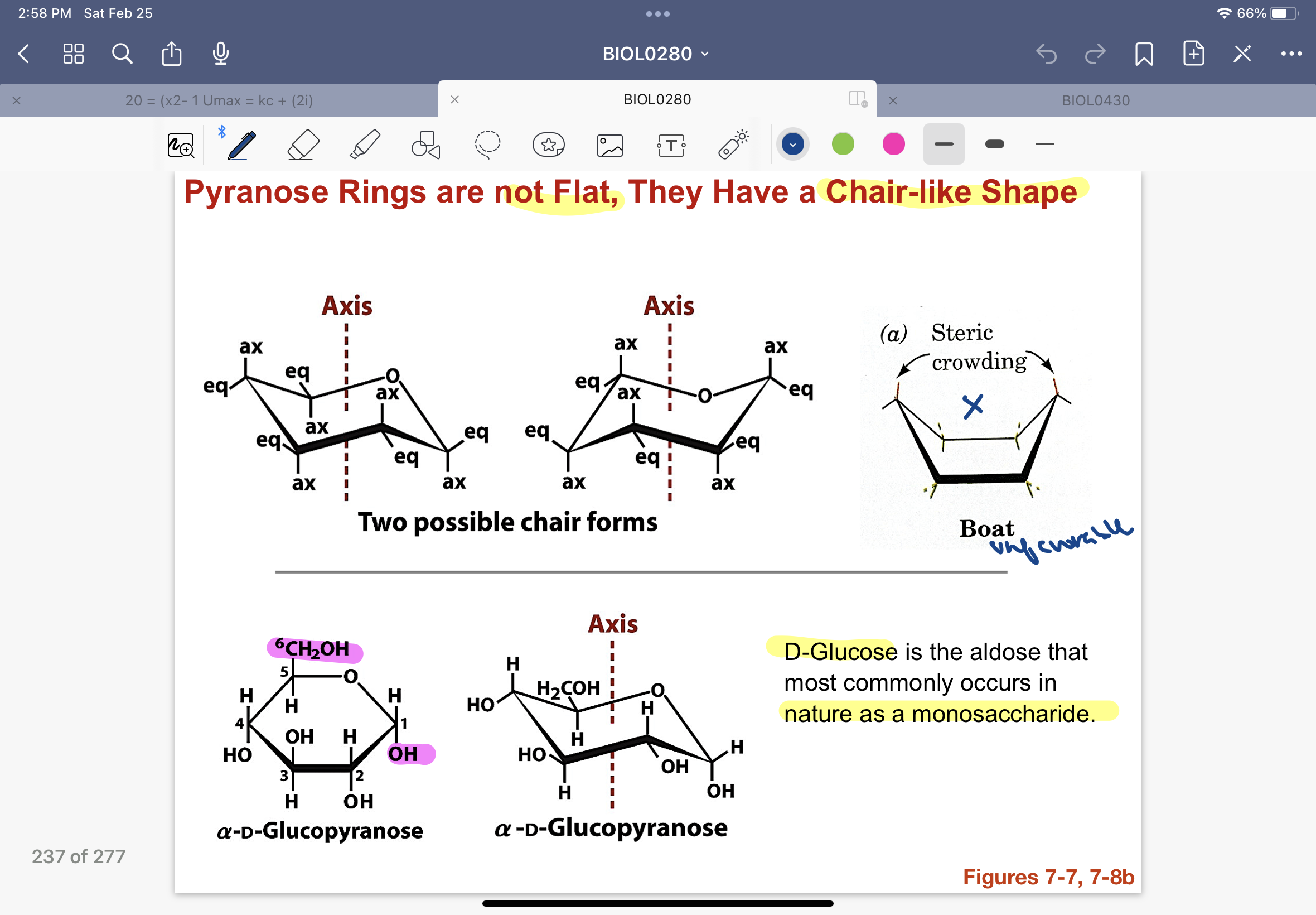
6
Haworth perspectives of Cyclic Sugars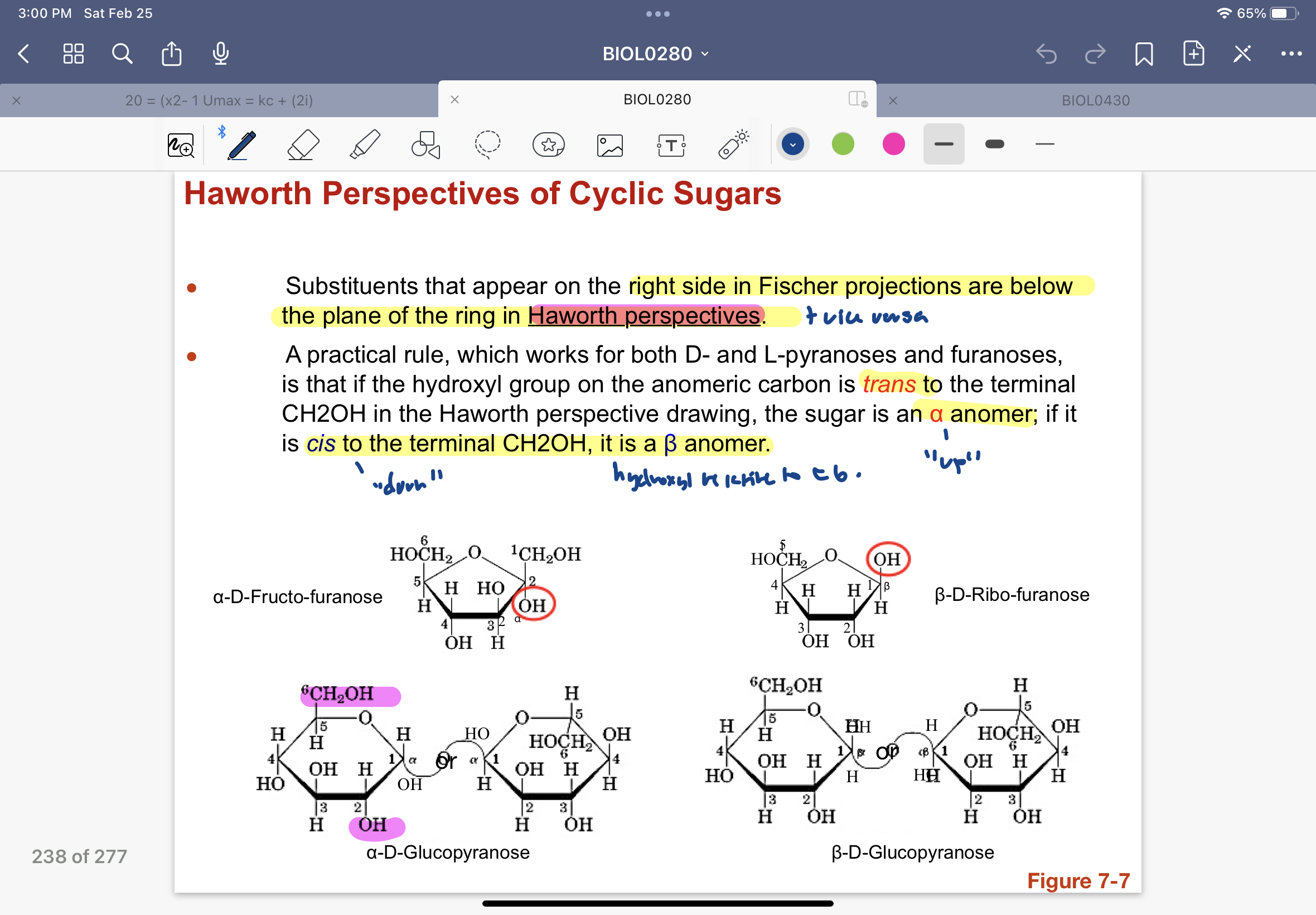
Substituents that appear on the right side in Fischer projections are below the pplanof the ring in Haworth perspectives. rule that works for both D and L pyranoses and furanoses: if Hydroxyl group on the anomeric carbon is TRANS to the terminal CH2OH in the Haworth Perspective, the sugar is an Alpha anomer, if CIS then its a beta anomer.
7
Mutarotation
Anomers are isomeric but NOT mirror images (enantiomers). Dif. properties and roationof polarized light. Monosacharide Alpha and Beta anomers can converts via linear (aldehyde or ketone) form until equilibirum between the 2 is reached. This is Mutarotation. equilibrium /= 1:1. Since anomers rotate light differently, converting back and forth changes the optical roation of the soln in the process. At equilibrium, the linear (aldose or ketose) form is present only in minute amounts.
8
Pyranoses and Furanoses: 6 or 5 carbon rings. 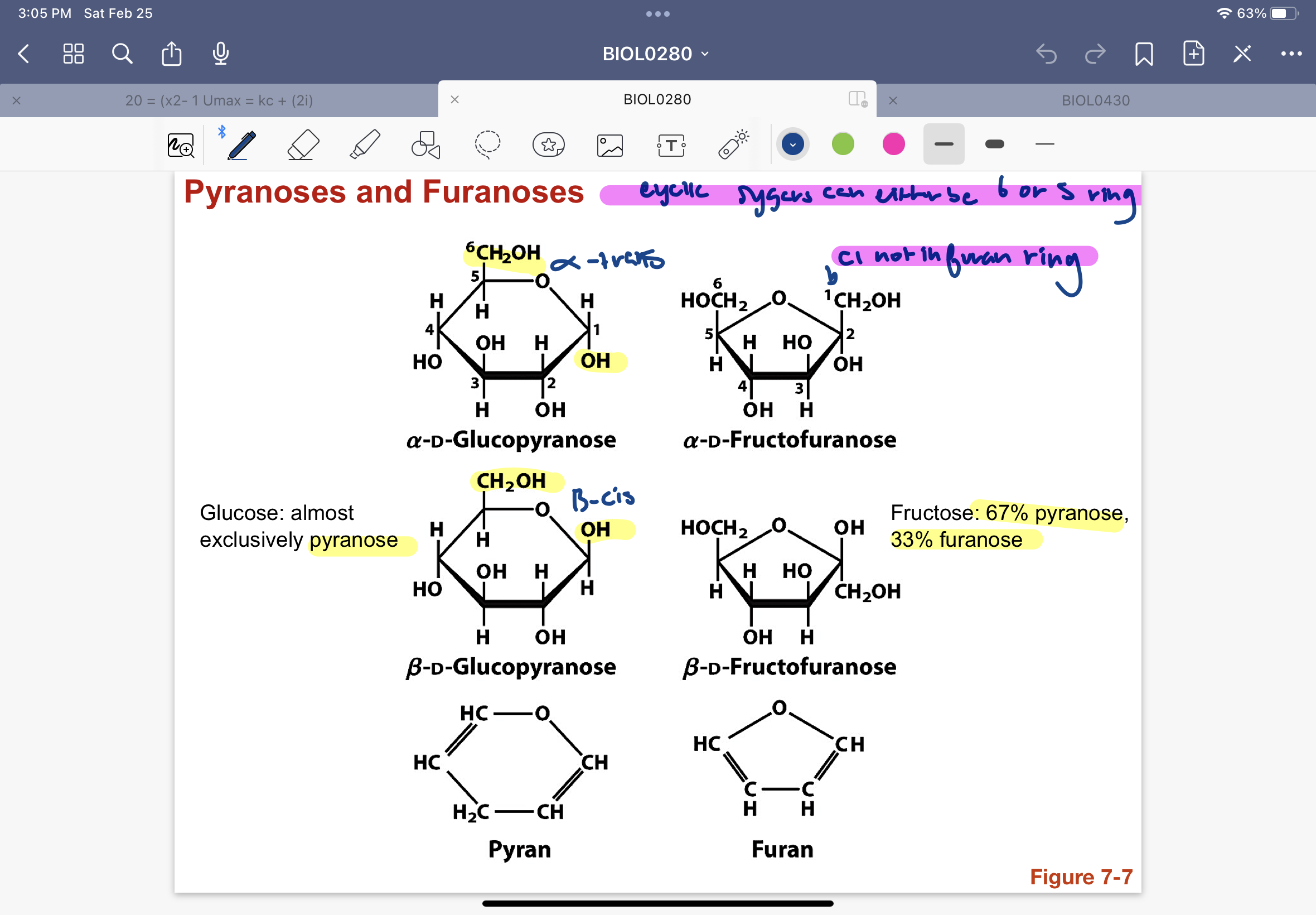
Cyclic sugars can either be 6 or 5 ringed. C1 in the Furan is not techniciallyin the ring becuase is a substituent. Glucose is almost exclusively 6 carbon ringed. 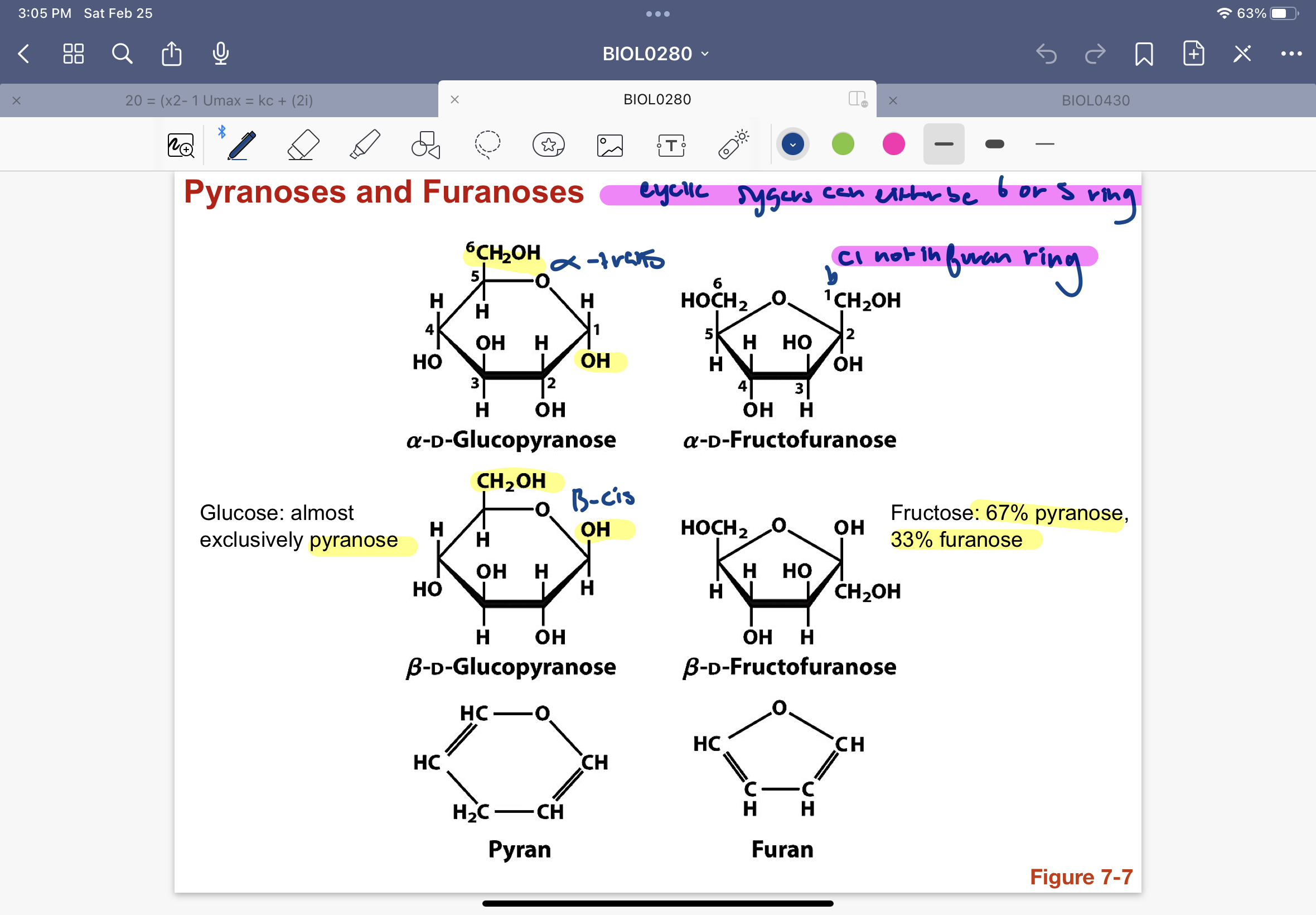
9
Drawing cyclic sugars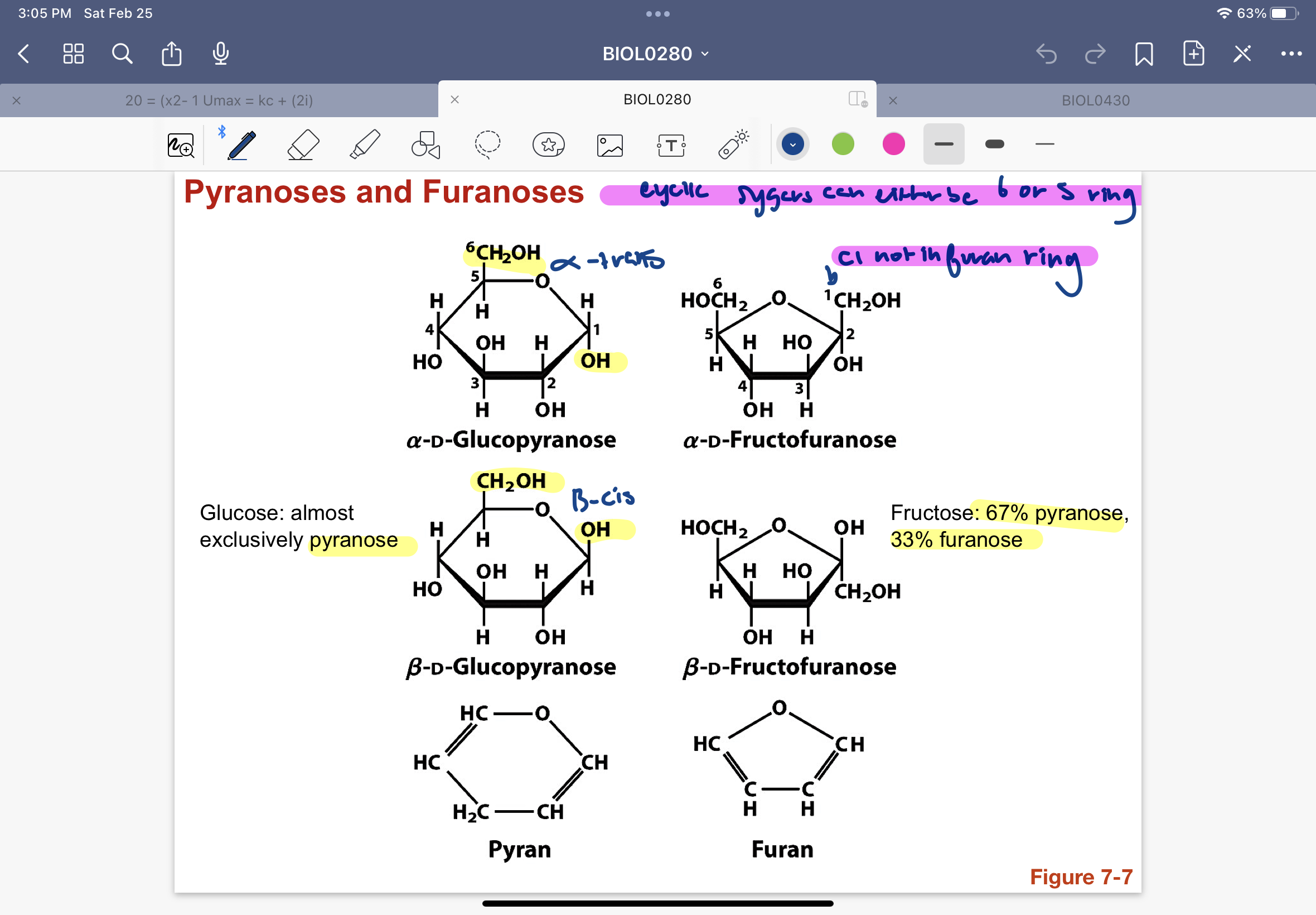
1) count number of carbons, linkage will be between OH and terminal carbon. 2) draw pyranose ring with oxygen at top rihgt, then add the C6 linkage in right place. 3) Number clockwise (6 should be a substituent) 4) Place OH 5) Add CH2OH at 6, specific anomeric Carbon, if OH trans to C6 then alpha, if OH cis to C6 then beta. Fischer projection left side = UP right side = DOWN. Remember C5 Oxygen not added on it since technically 6th thing in ring!. ***Whatever is to the right of the oxygen in cyclic form is what you start with in linear form!
10
Sugars as reducing agents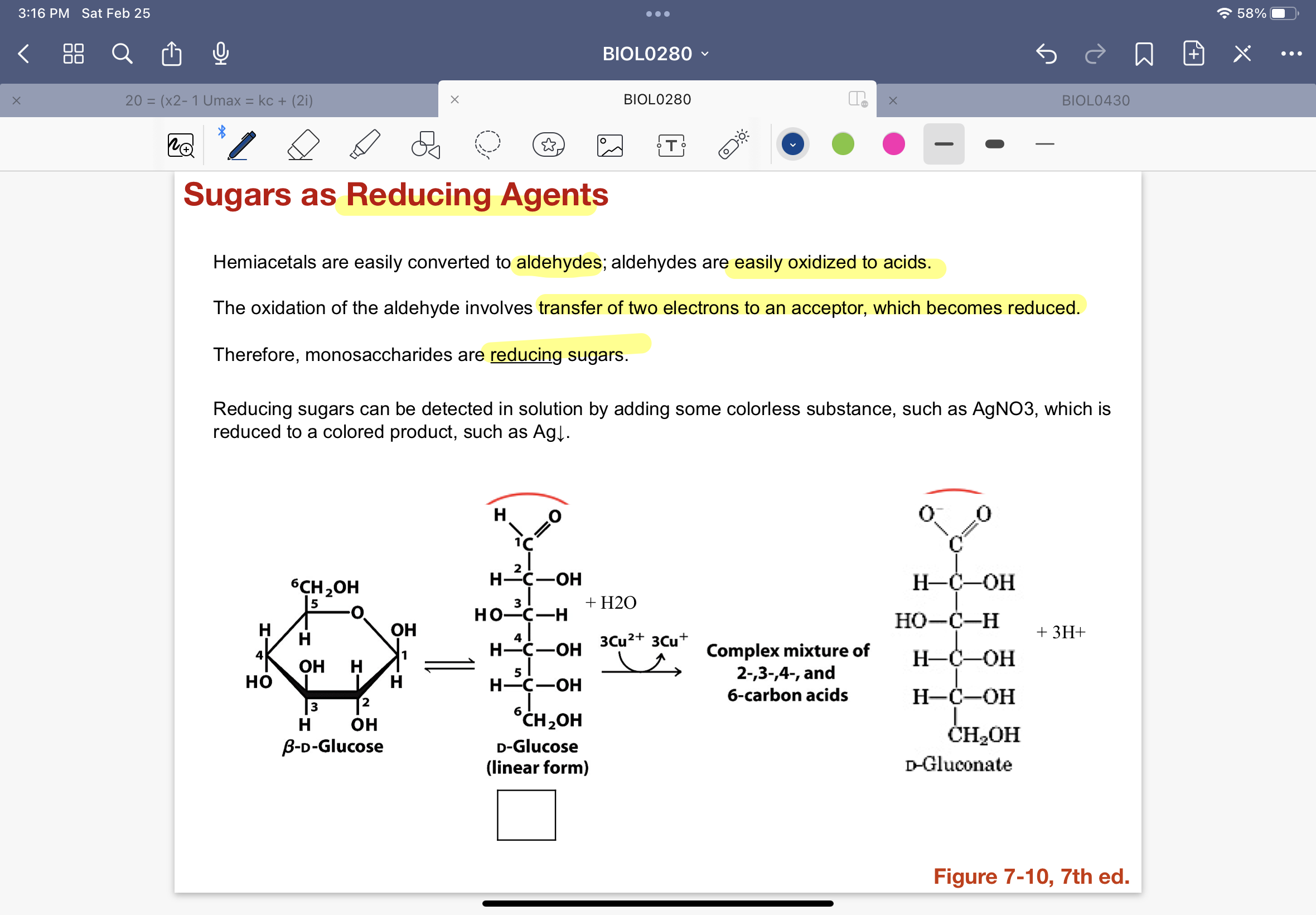
Hemiacetals are easily converted into aldehydes which are easily oxudized to acids (requires transfer of 3 e- to an acceptor which becomes reduced). Therefore monosaccharides are reducing sugars. They can this be detected in soln. by adding some colorless substance such as AgNO3 which is reduced to a color product as Ag decreases. Oxidation at other carbons is more difficult but do occur. 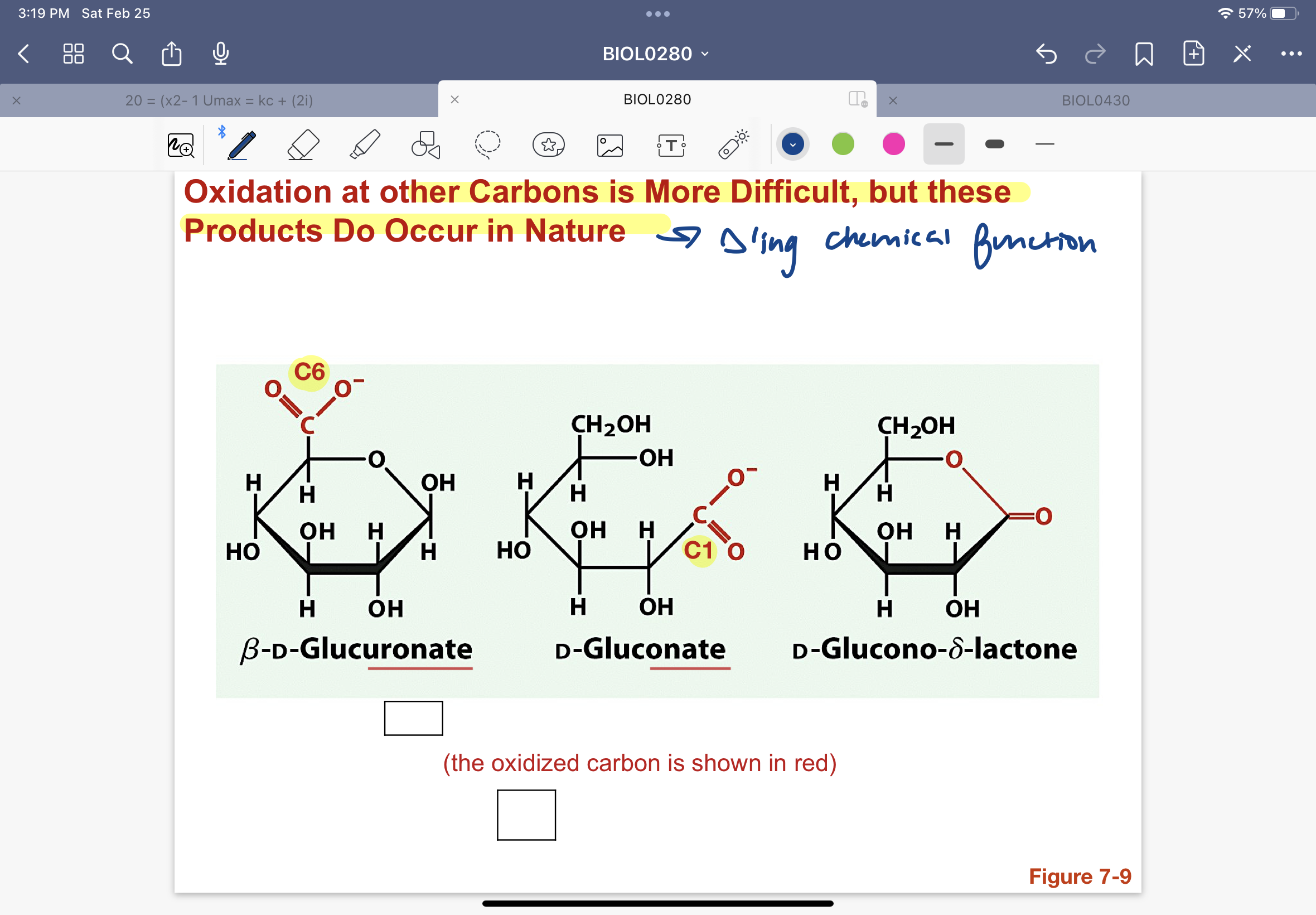
11
Blood glucose Determination *JUST AN FYI*
oxidized glucose (gluconate) has a tendency to esterfy (lactone formation) this helps drive rxn by lowering [product]. Peroxide rxn uses the H2O2 produced by glucose oxidase to convert a colorless compound into a colored one, which absorbs lifht at a certain wavelength.
12
Hemi acetals and Kemiketals 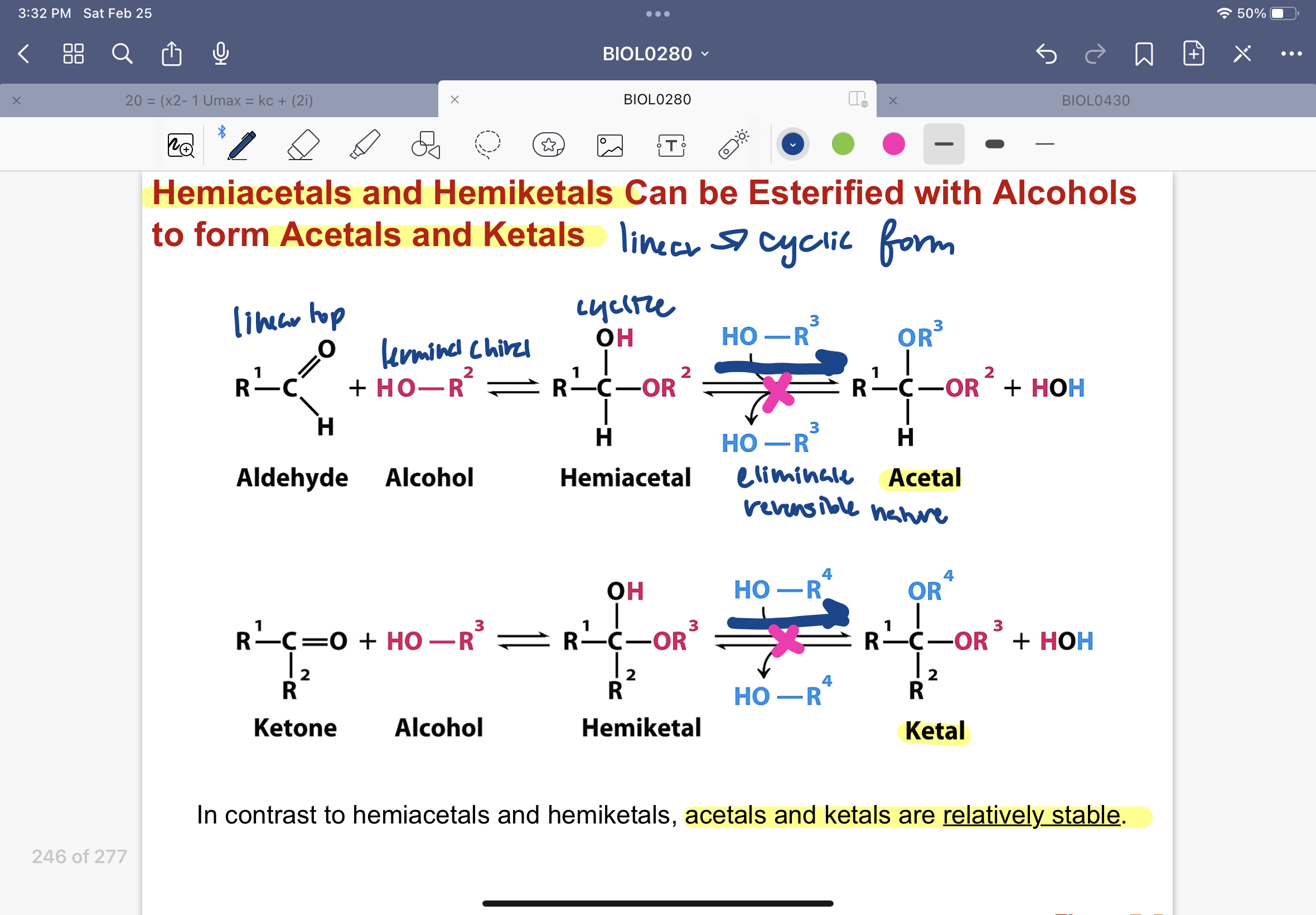
They can be esterfied with alcohols to form acetals and ketals. (from linar to cyclic form). This is helpful because unlike hemiacetals and hemiketals, acetals and ketals are relatively stable. No longer reversible. 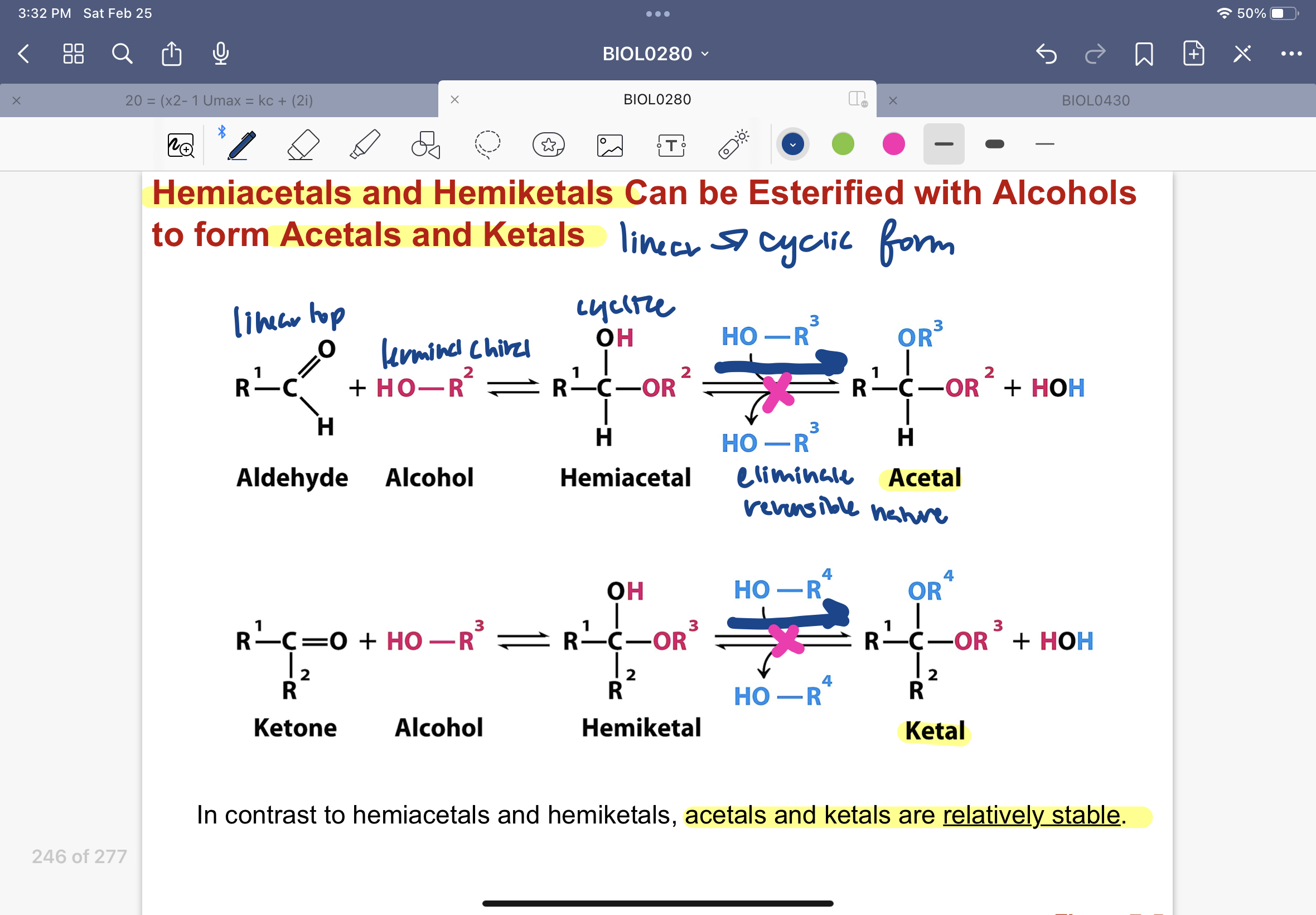
13
Formation of the acetal disaccharide Maltose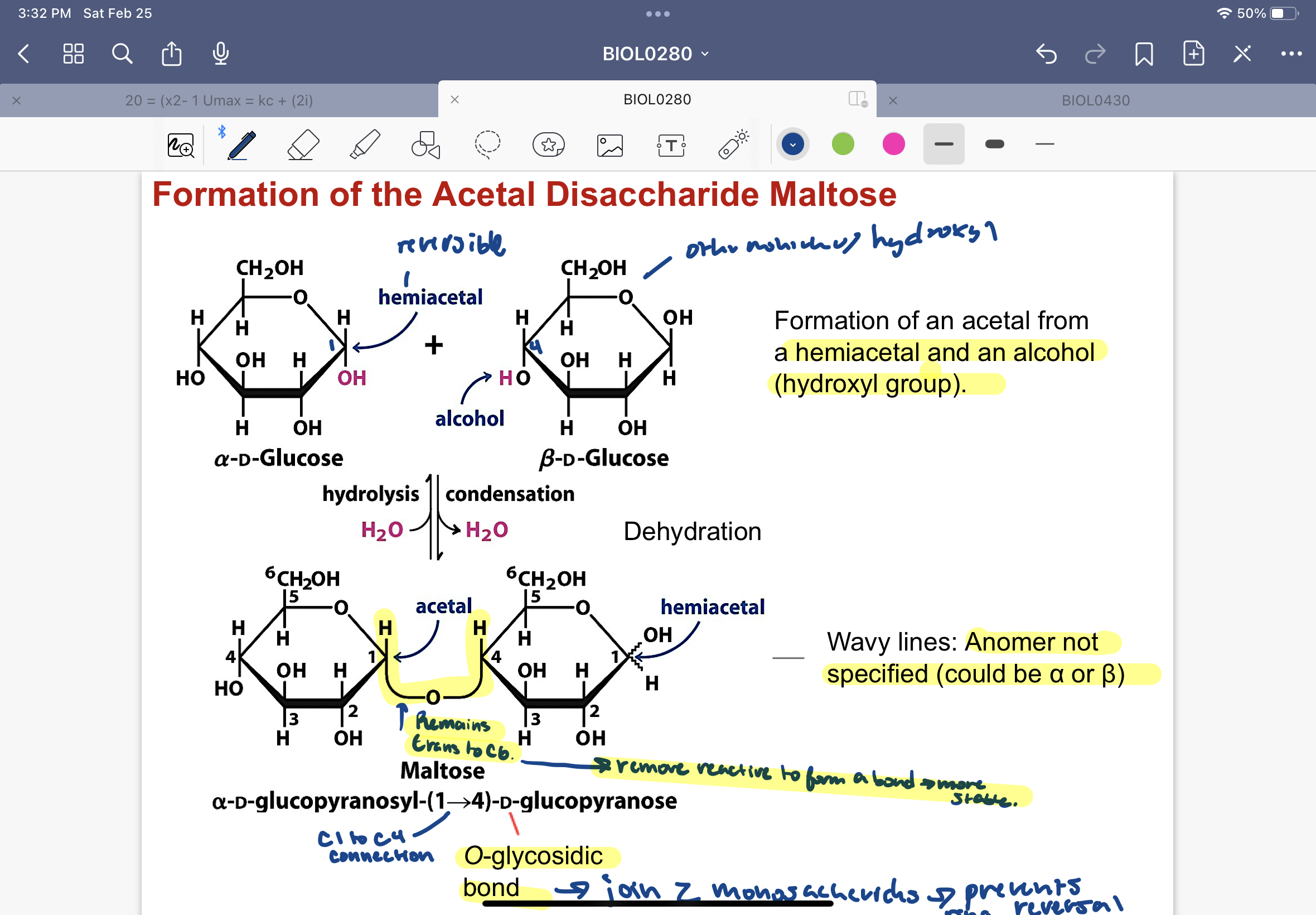
Formation of an acetal from a hemiacetal and an alcohol (hydroxyl group). Undergo dehrydration. O-glycosidic bond remains trans to C6 for left molecule, but loss of OH groups on both molecules removed the reactive sites to form a bond making it overall a more stable strucutre. Way lines indicate that the anomer is not specified in direction. (1>4) means its a C1 to C4 connection. The O-glycosidic bond is what joins the 2 monosaccharides and prevents ring reversal. 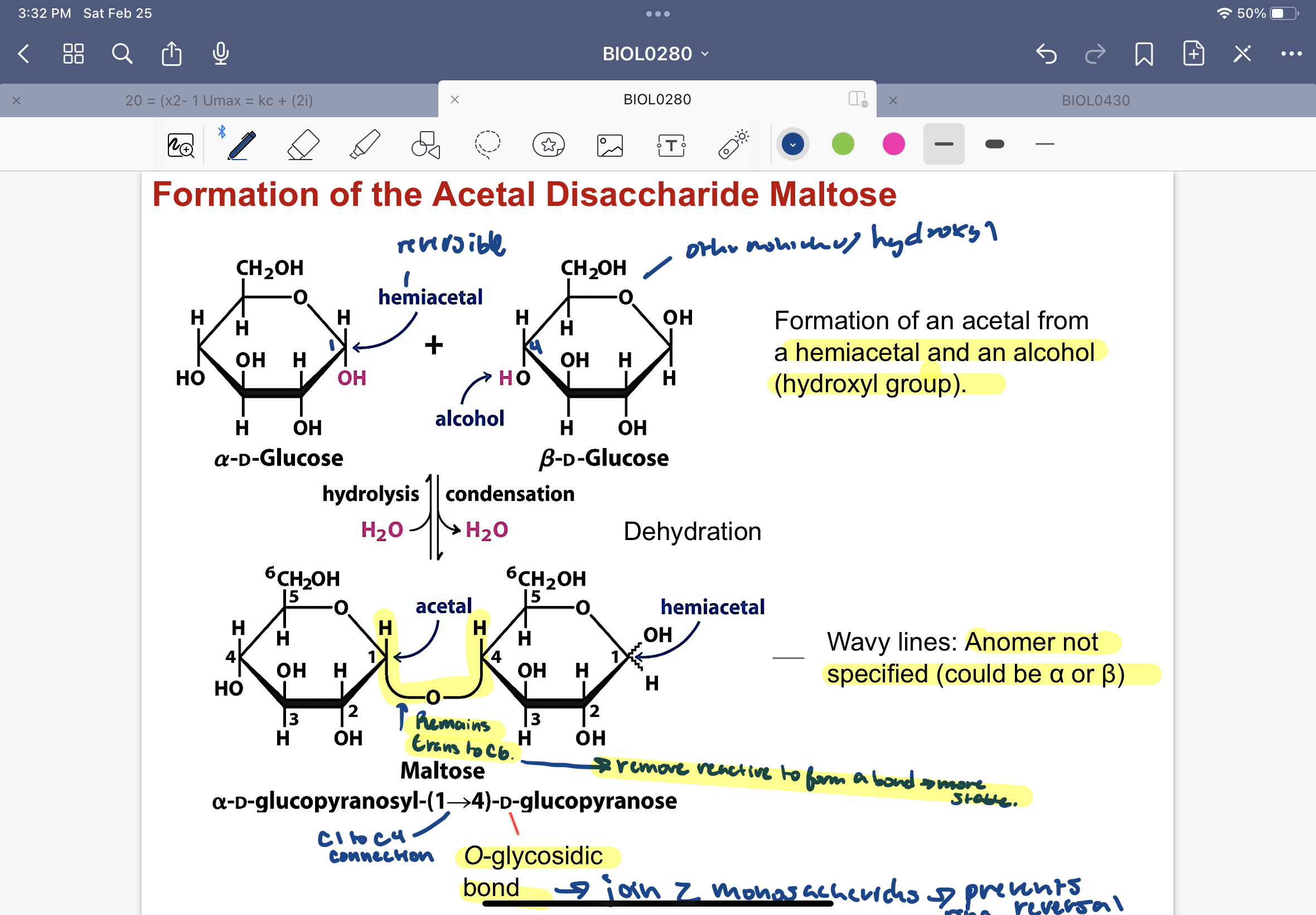
14
Common Disaccharides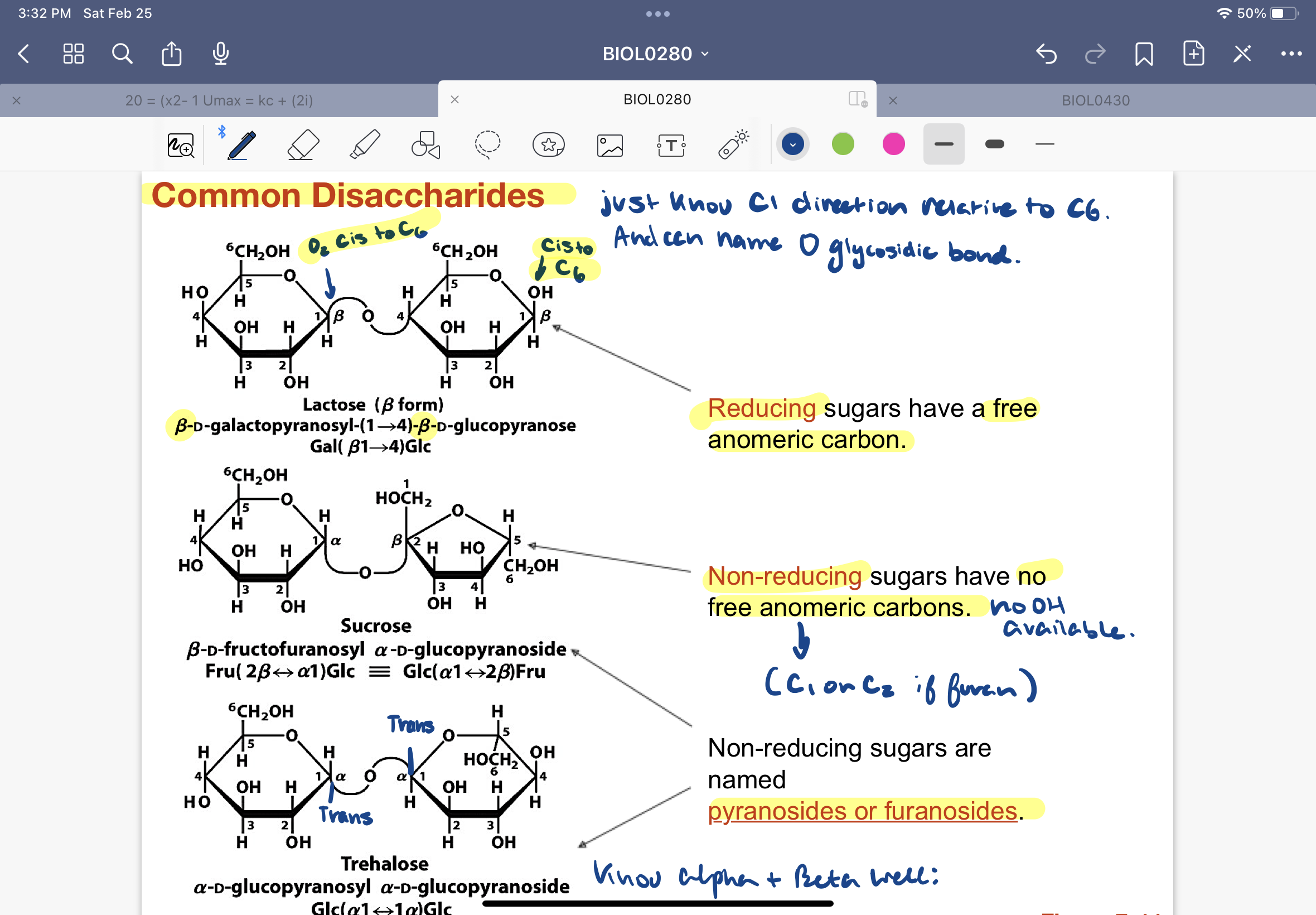
Reducing sugars still have a free anomeric carbon on the right molecules C1. Non reducing sugars have no free anomeric carbons (no OH available to reaction since C1/C2 are reacting together with both molecules). C1 rules are on C2 on FURAN!!!!!!! named Pyranosides or furanasides.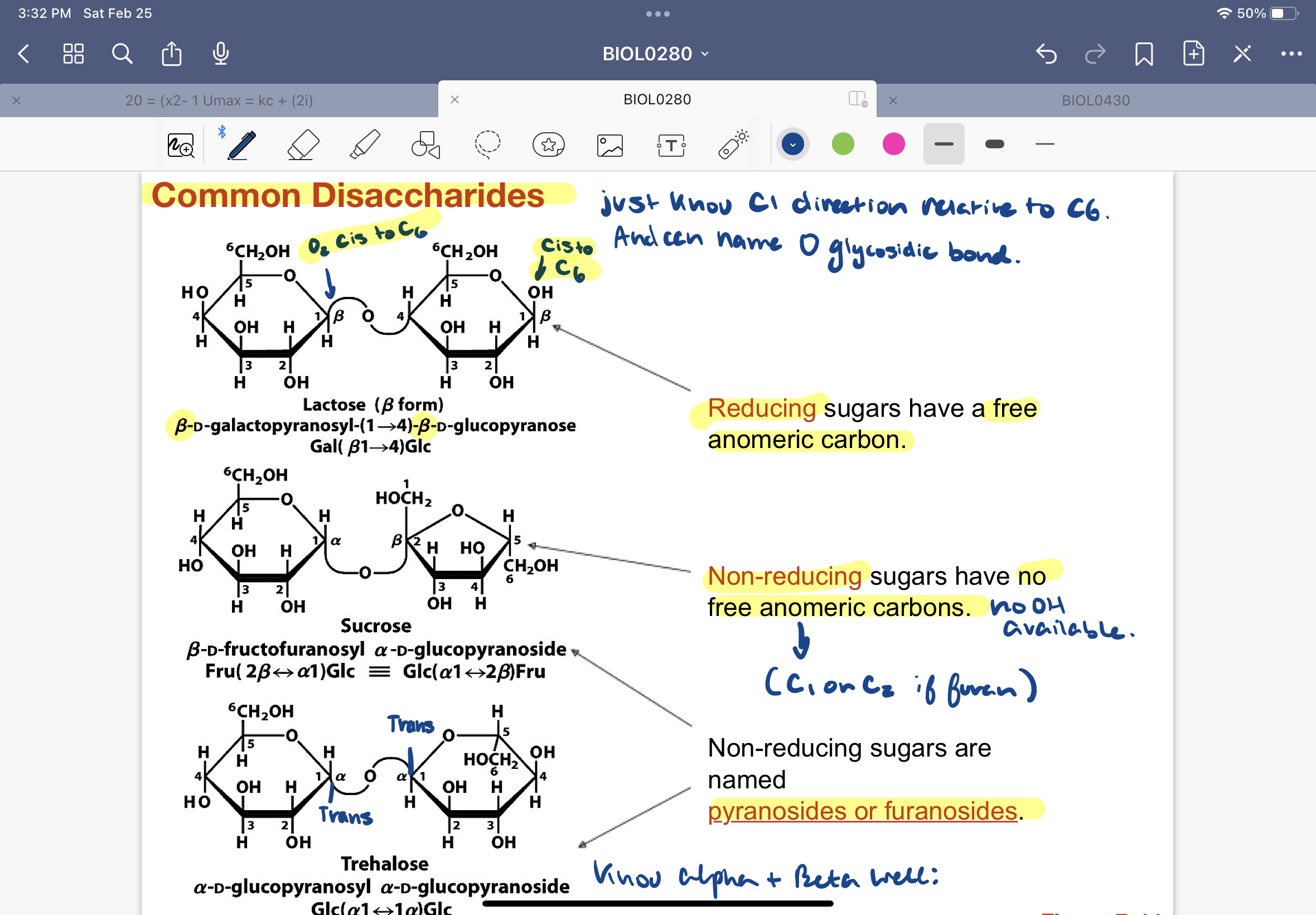
15
Naming conventions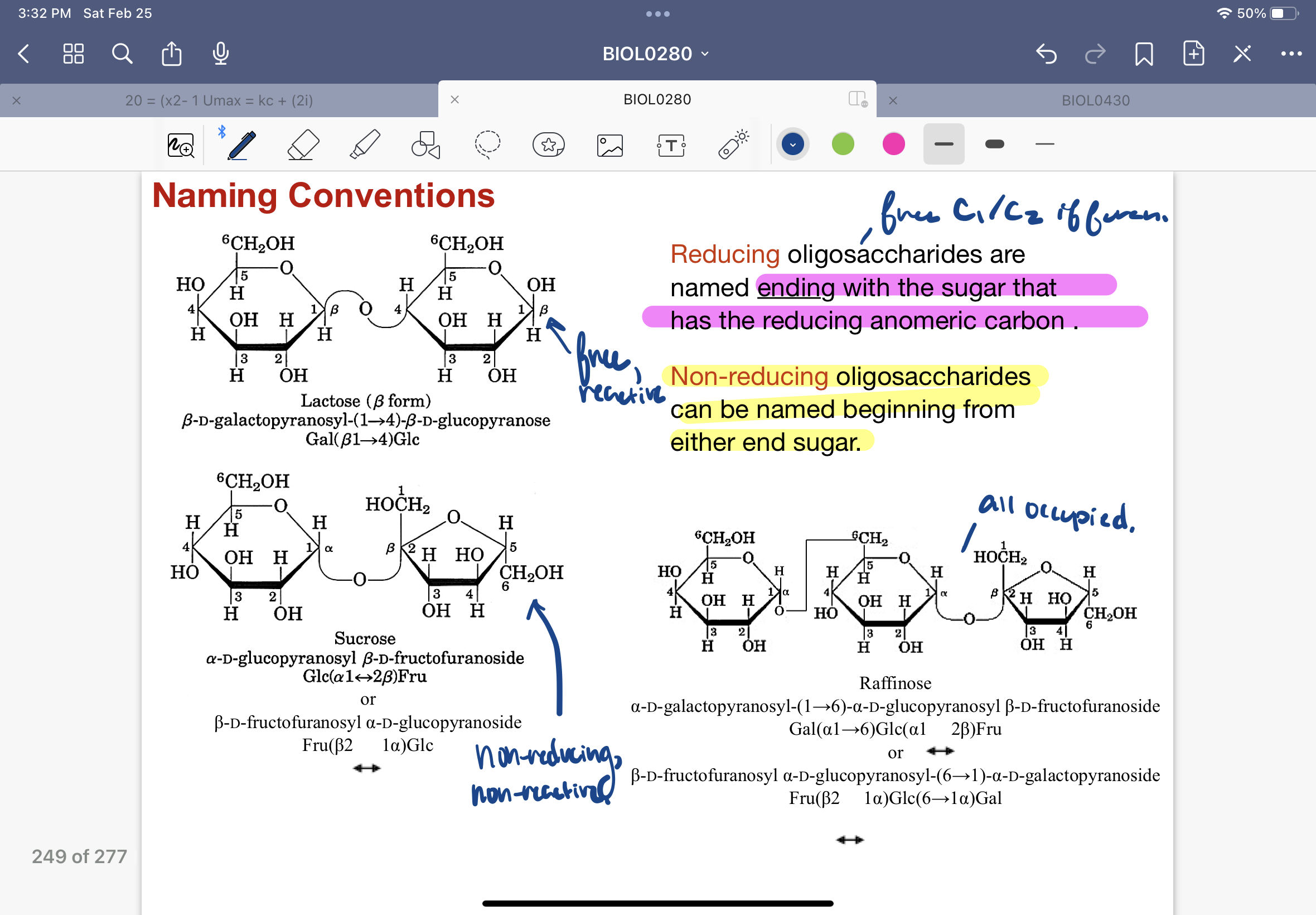
Reducing Oligosaccharides are named ENDING with the sugar that had the reducing anomeric carbon (arrow going one way) . Non-reducing oligosaccharides can be named beginning from either end sugar. (arrow back and forth)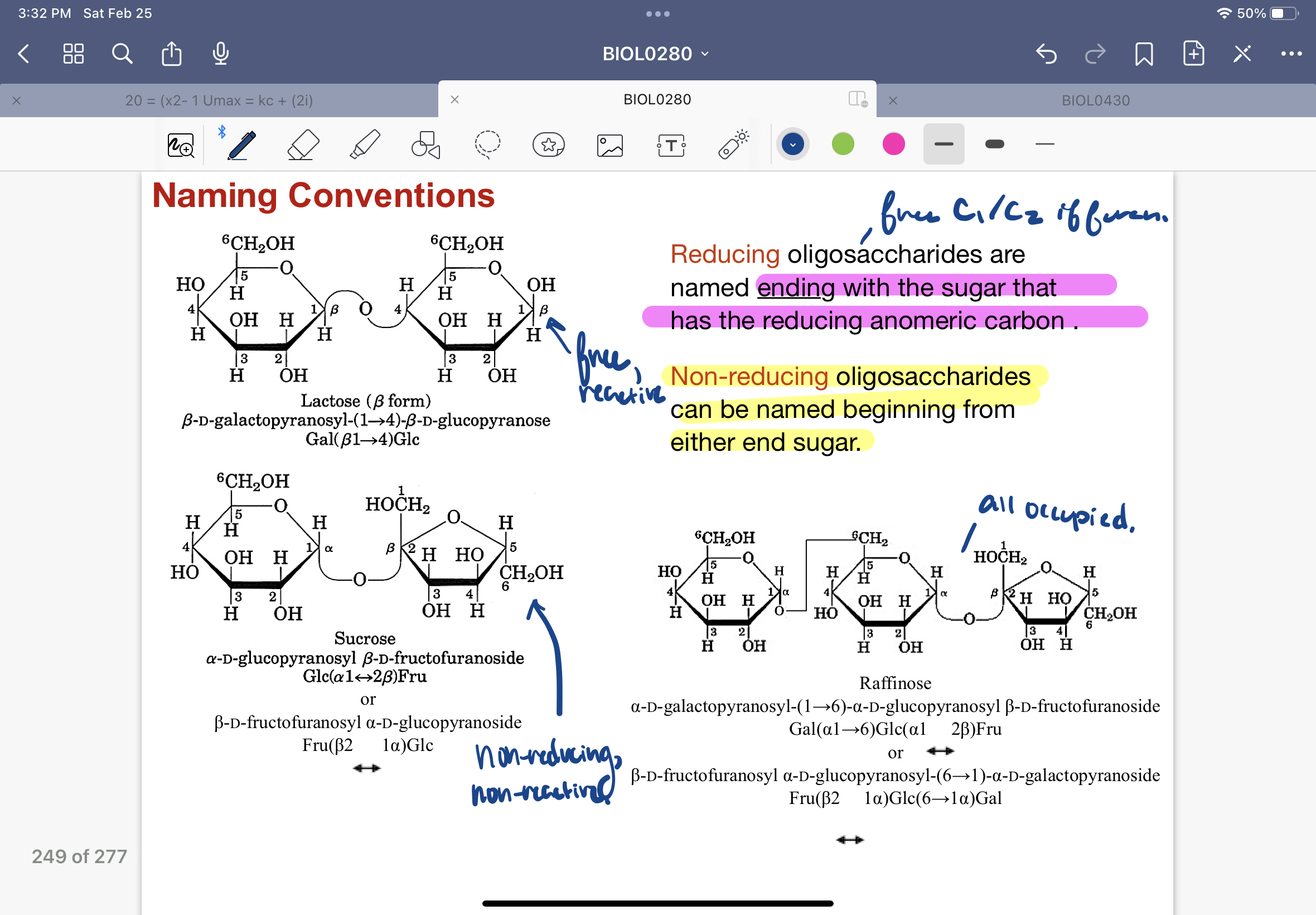
16
Polysaccharides (glycans)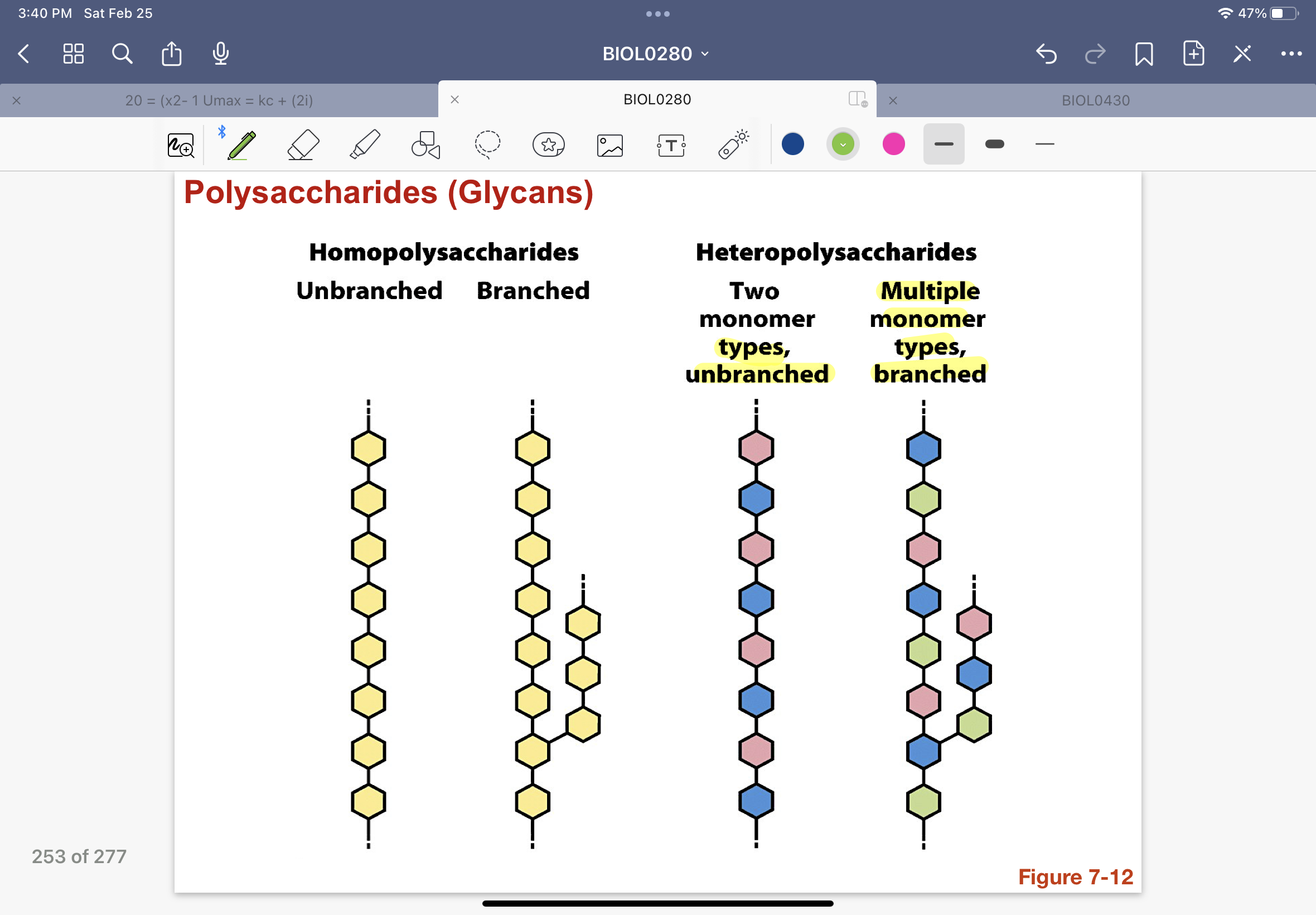
Homo can be unbranched or branched but all of the same kind, while hetero polysaccharides can be unbranched (with 2 monomer types) or branched (with. multiple monomer types). Ex: Starch and cellulose both consist of recurring units of D-Glucose. their different properties results from different types of glycosidic linkage. (Chitin for exoskeletons and cell walls and Peptidoglycans for bacterial cell walls. )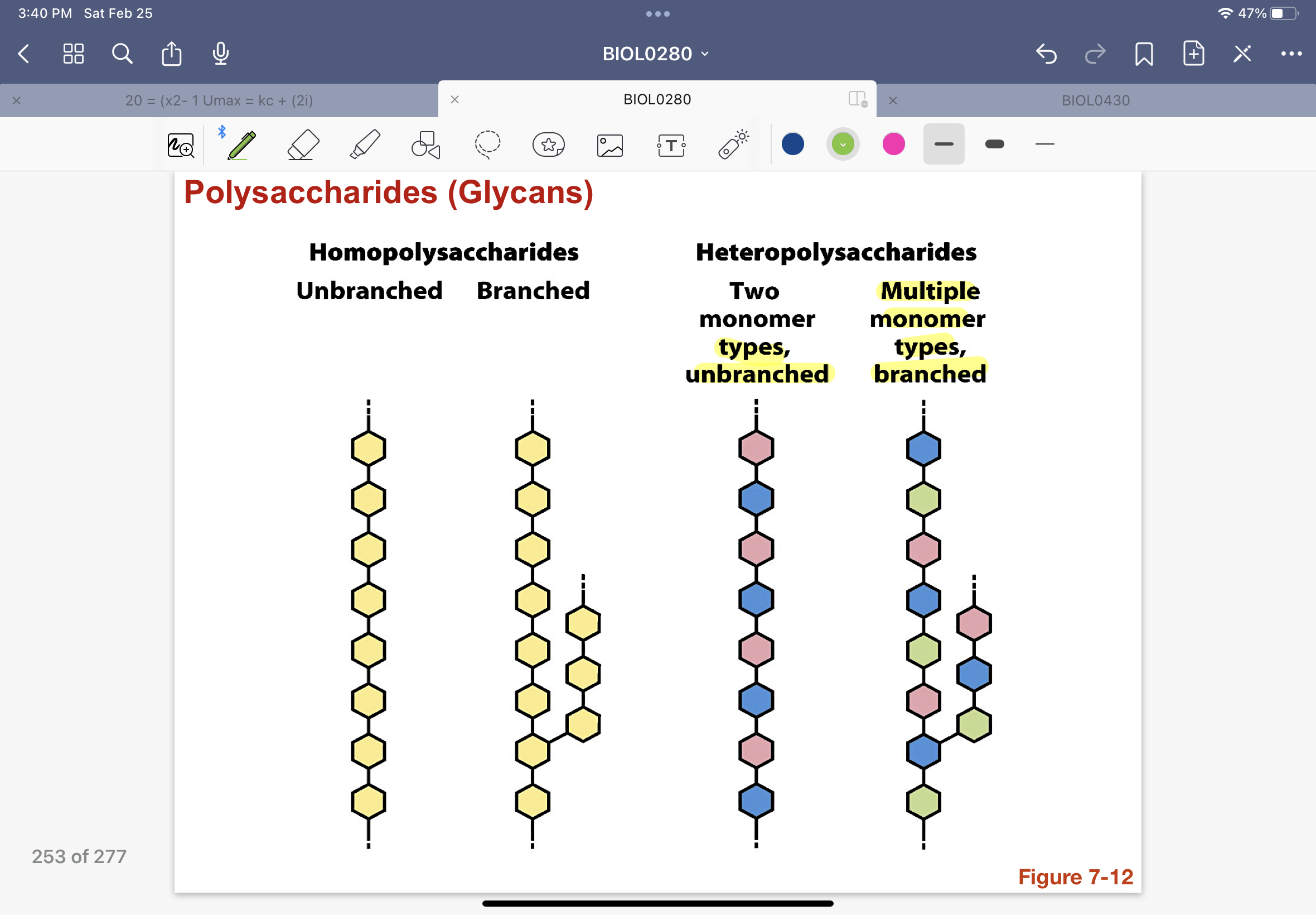
17
Molecular makeup of starch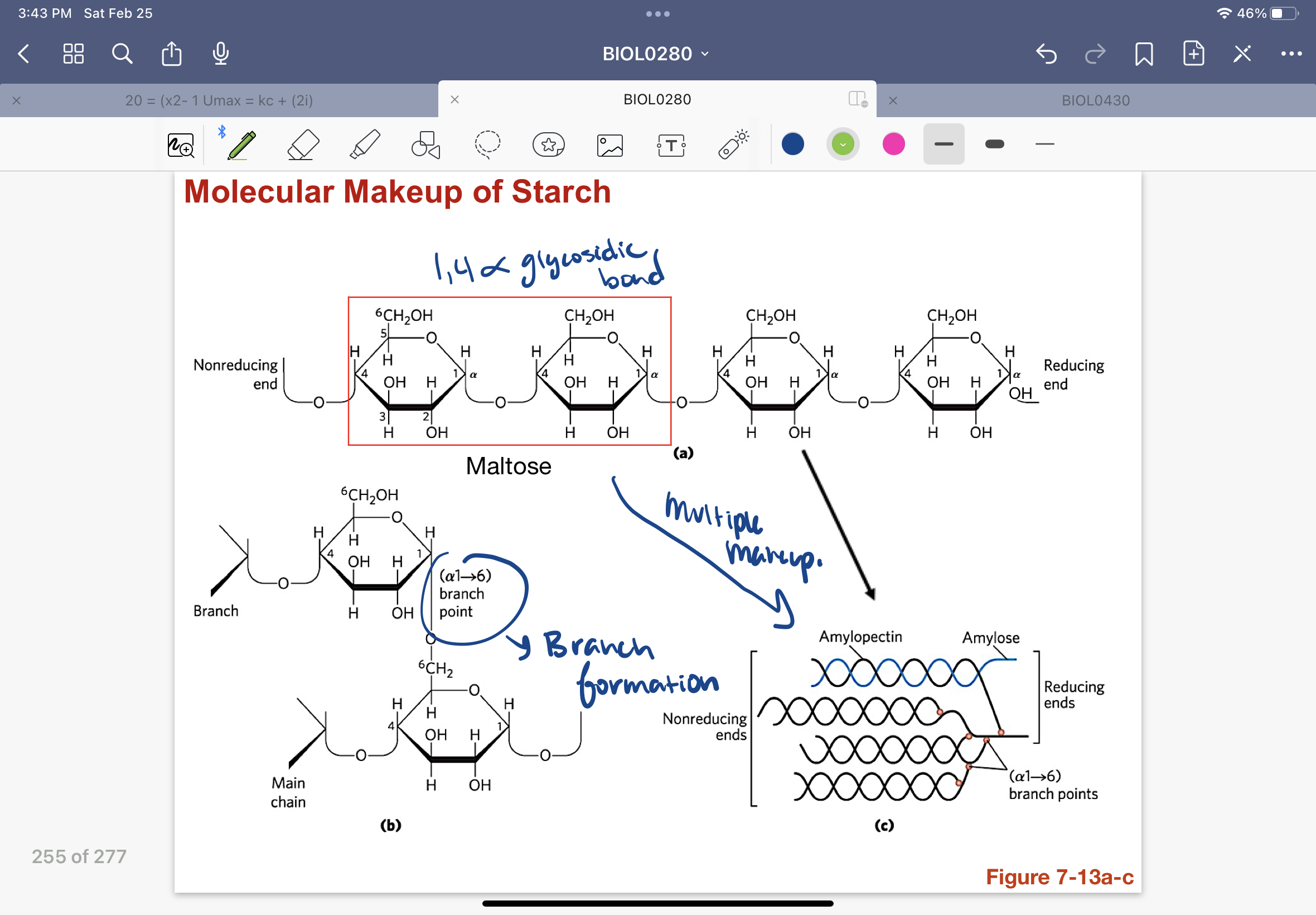
Maltose 1,4 alpha glycosidic bond, branch formation, multiple of which makeup picture. Nice to have many non reducing ends (branching) and only one reducing end becuase it limits/ controls reactivity. Nice to also store glucose as a polymer so that it can be used to store energy and broken down for energy. 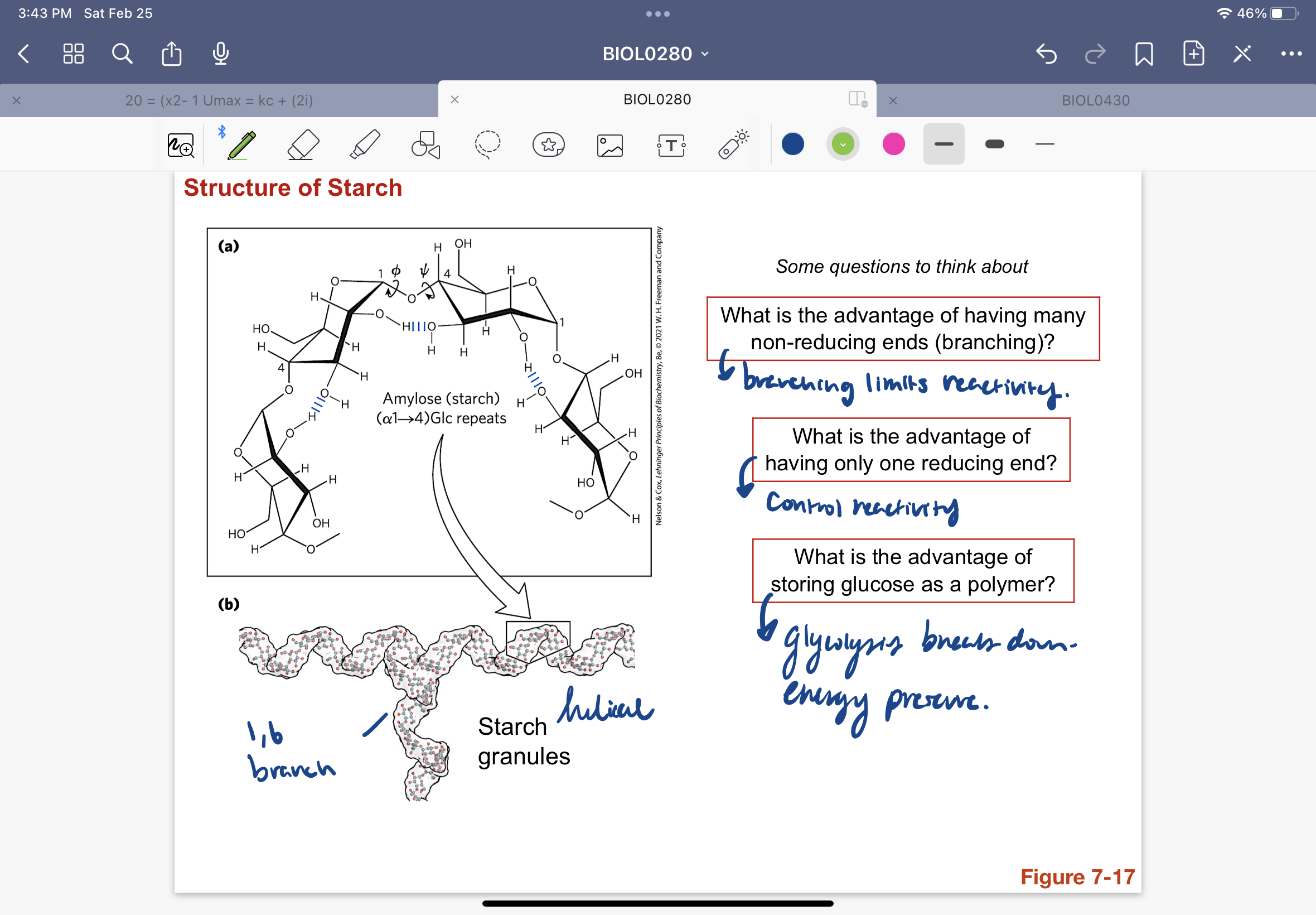
18
Cellulose 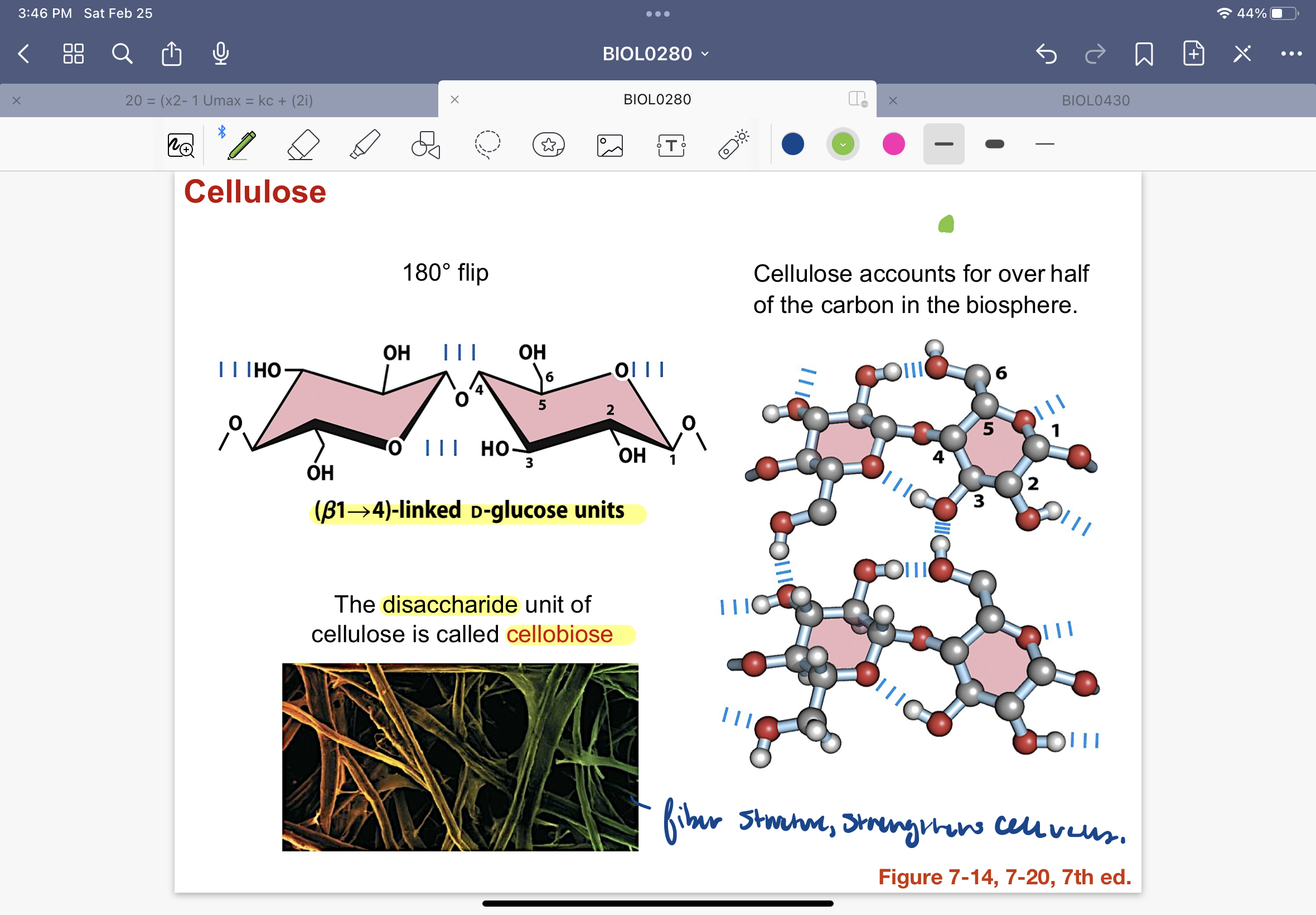
The disaccharide unit of cellulose is called cellobiose. cellulose accounts for over half of the carbon in the biosphere. Has a fiber structure that strengthens cell walls. 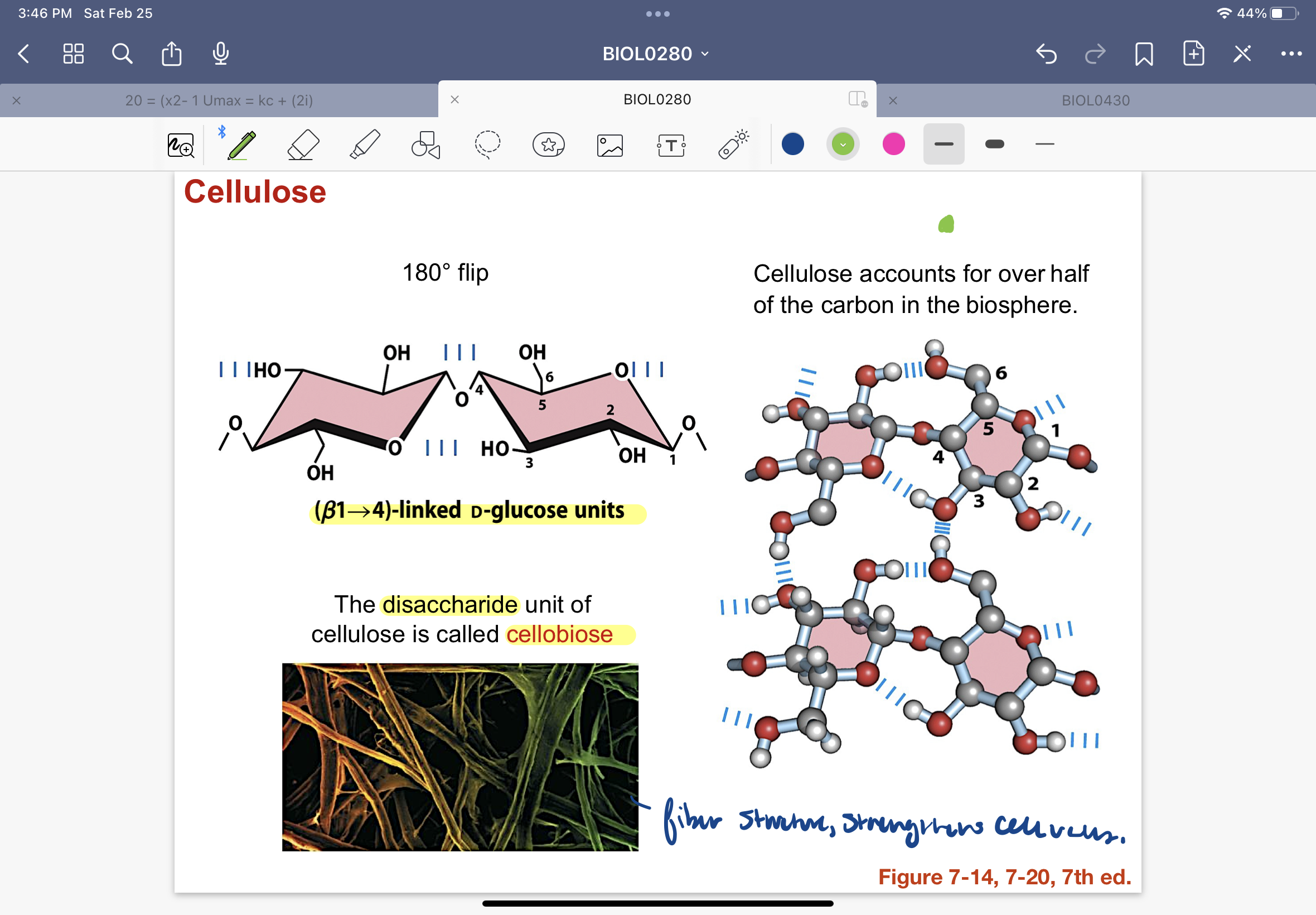
19
Chitin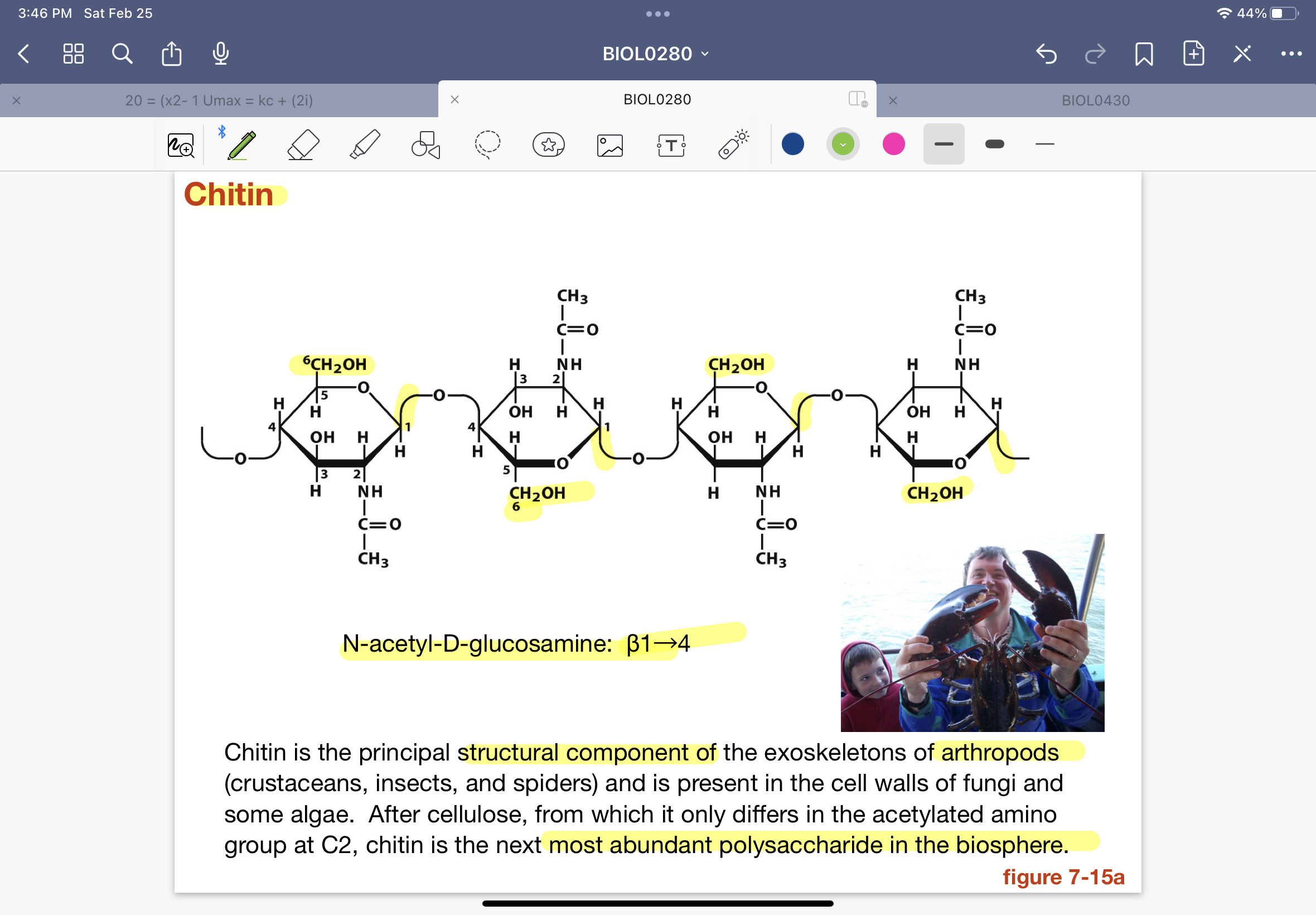
Chitin is the principal structural component of the exoskeletons of arthropods and is present in teh cell walls of fungi and some algae. After cellulose, chitin is the next most abundant polysaccharide in the biosphere. 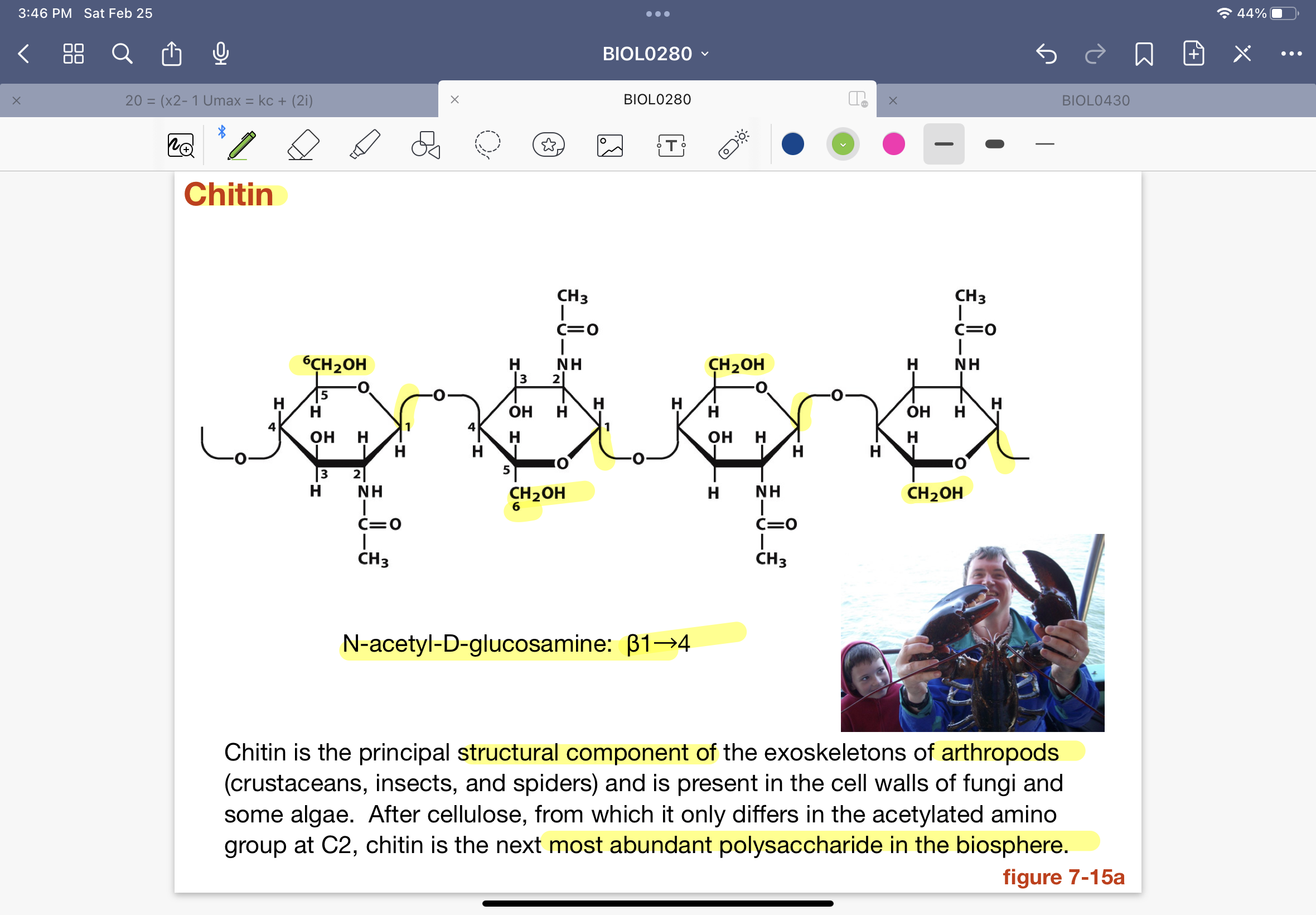
20
Proteoglycans (more carbs than protein)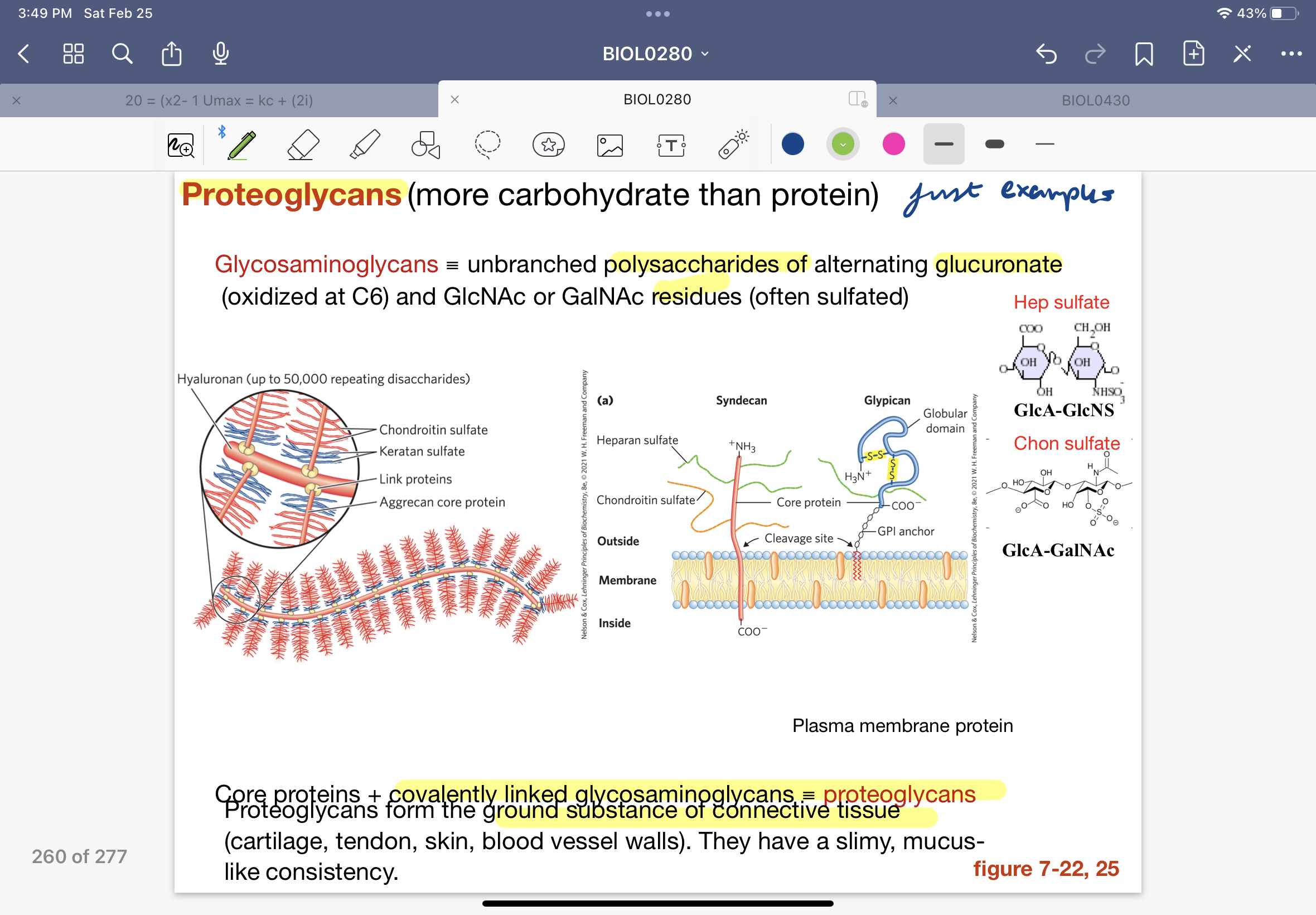
Glycosaminoglycans are unbranched polysaccharides of alternating glucuronate )oxidized at C6) and GlcNAc or GalNAc residues (often sulfated). Core proteins + covalently linked glycosaminoglycans= proteoglycans which form the ground substance of connective tissue(cartilage, tendon, skin, blood vessel walls). They have a slimy mucis like consistency. 
21
Glycoproteins (more portein than carbs)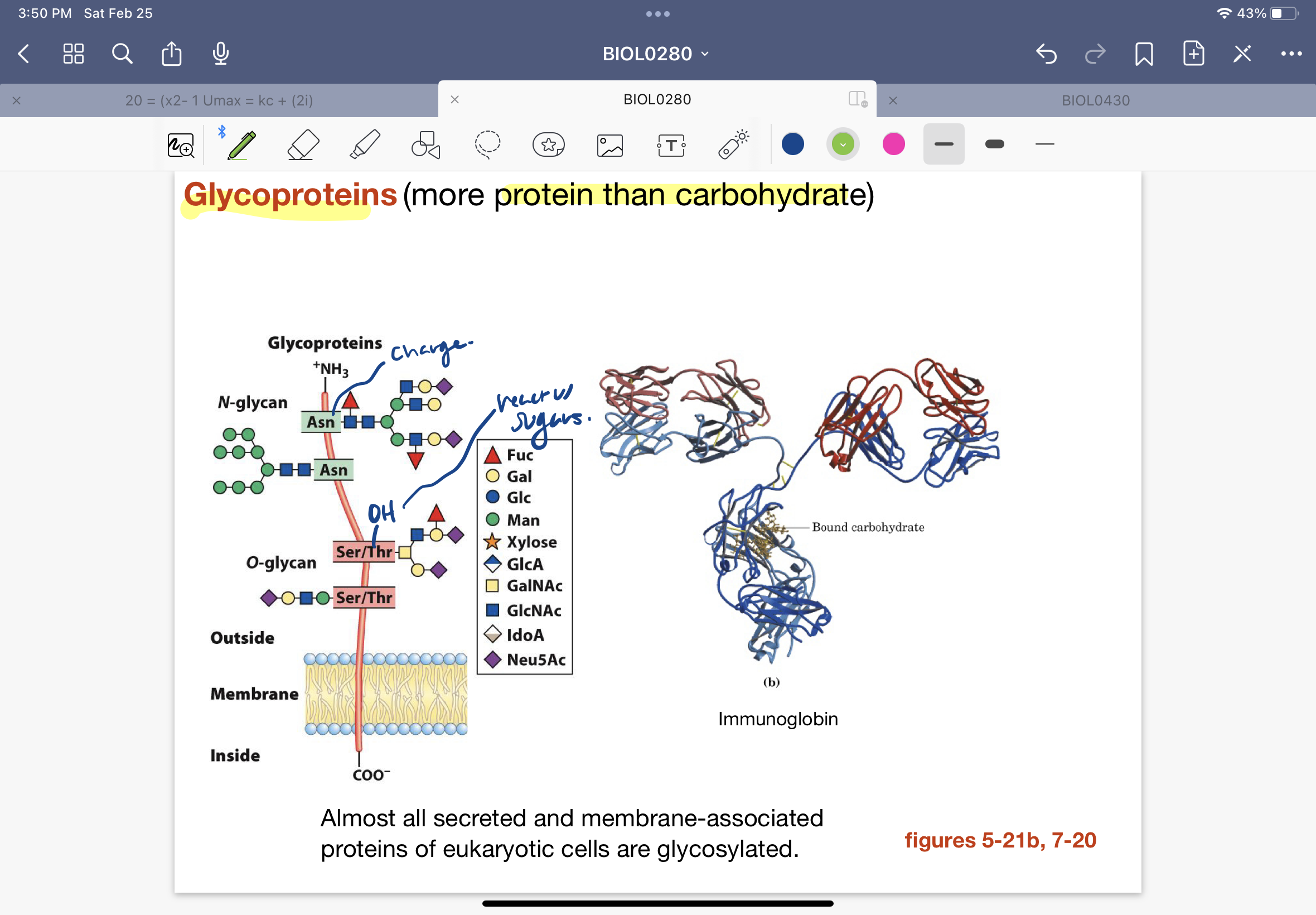
Almost all secreted and membrane -associated proteins of eukaryotic cells are glycosylated. Asparagine charges, Serine and Threonine OH react with sugars. Bioorthogonal and protein mod tools can be used to study surface glycosylation processes. 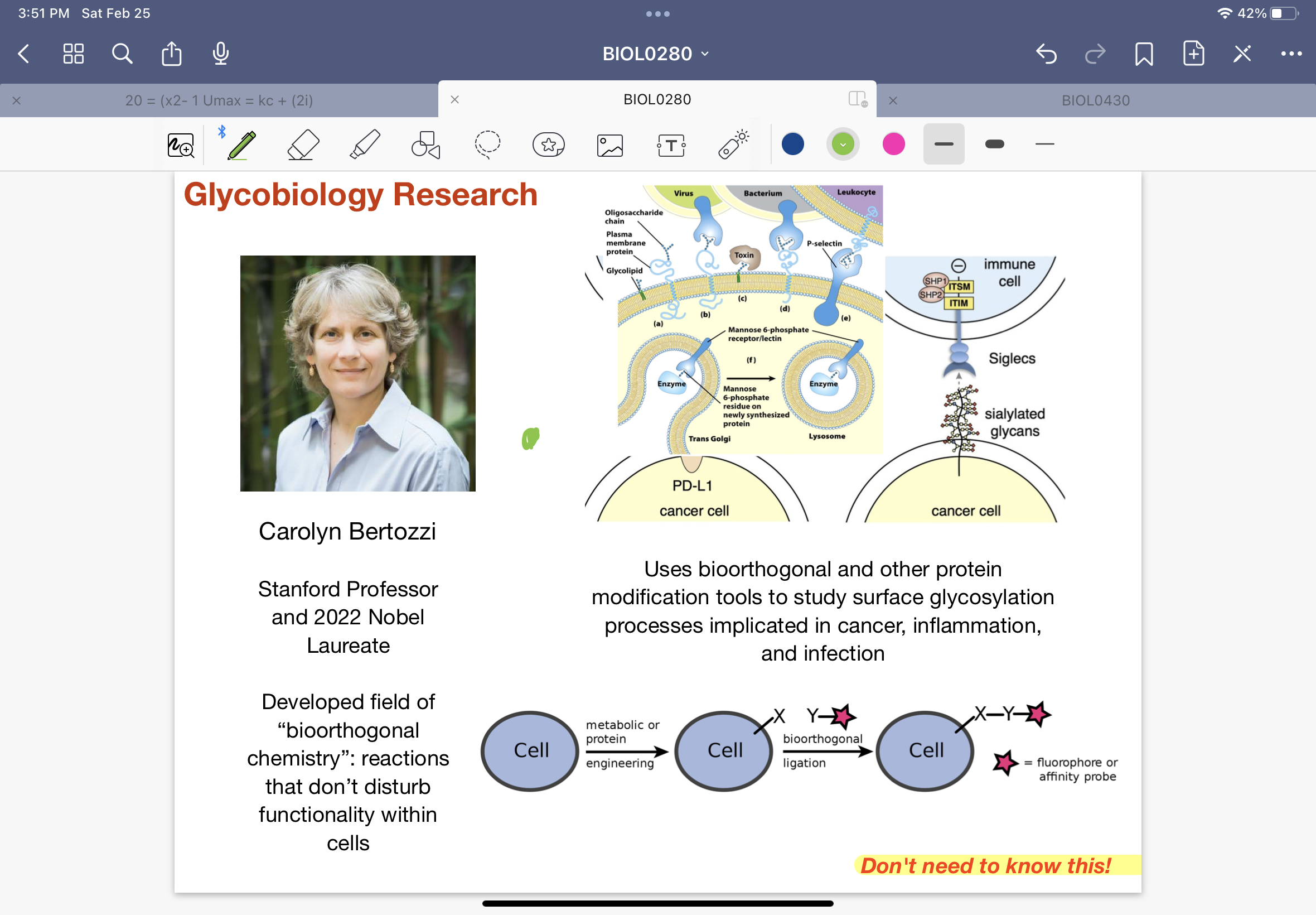
22
Equilibirum constant Keq and Delta G relation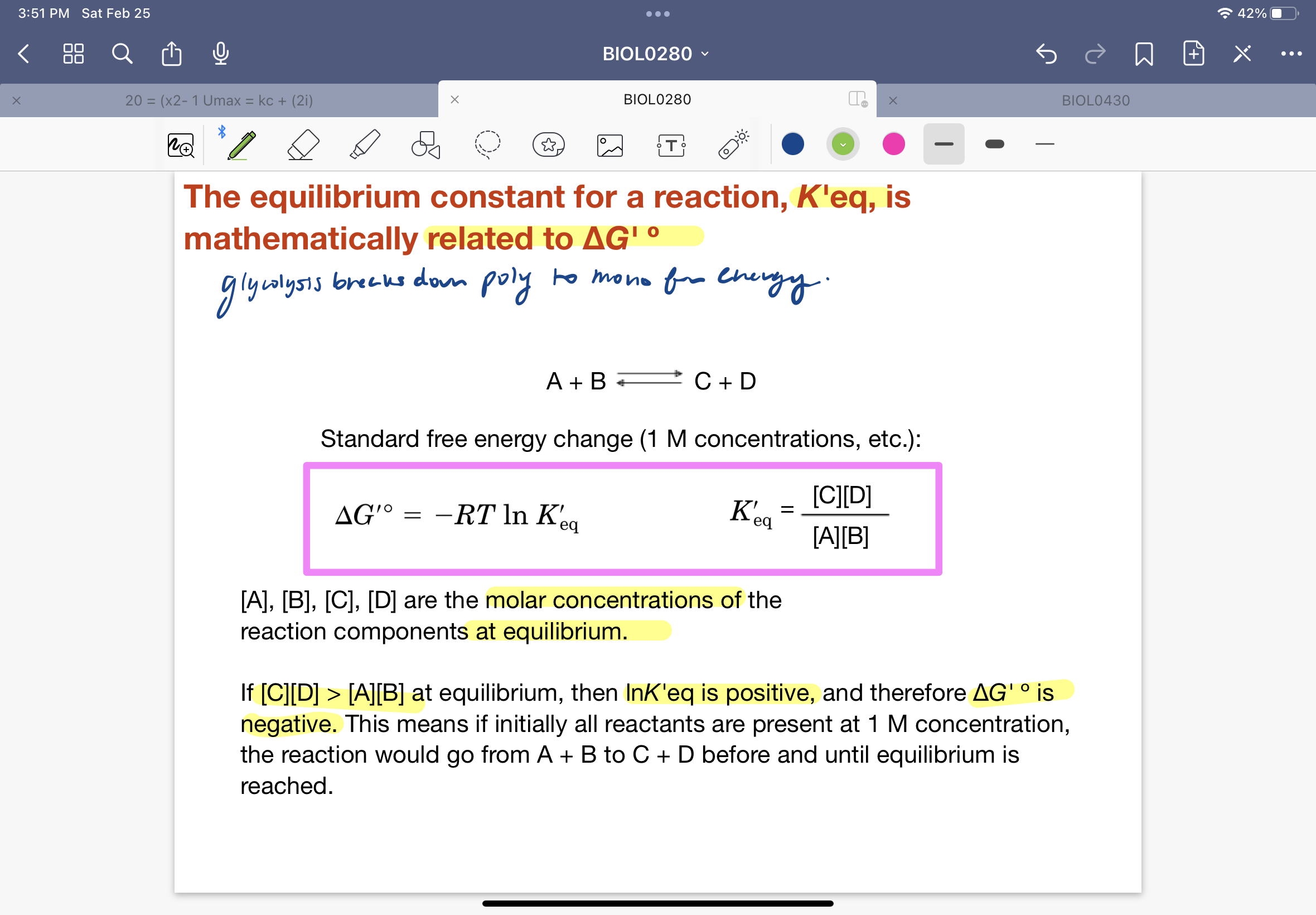
If [C][D] >[A]{B] at equilibrium, then lnK'eq is positive and therefore delta G is negative. This means if initially all reactants are present at 1M [], the reaction would go from A+B to C+D till equilibirum is reached. Glycolysis breaks down polysaccharides to monosaccharides for energy. The Actual delta G of a reaction though depends on real reactant product [] as well as the ideal 1M everything approximate of delta G. Therefore, delta g prime thats positive can still go forward with the real delta G is negative (like when products are constantly removed as they are formed). 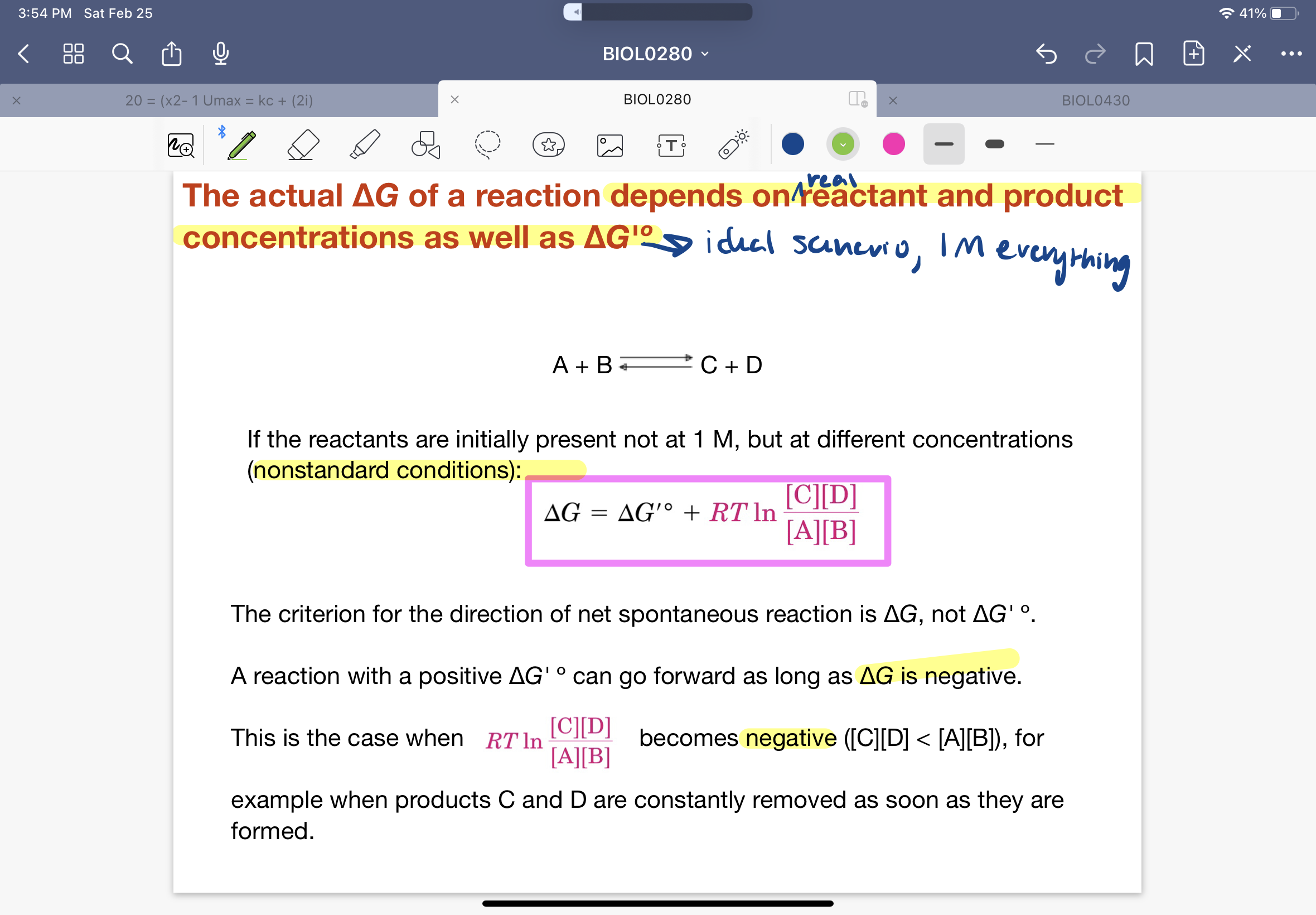
23
Additive porperty of standard free energy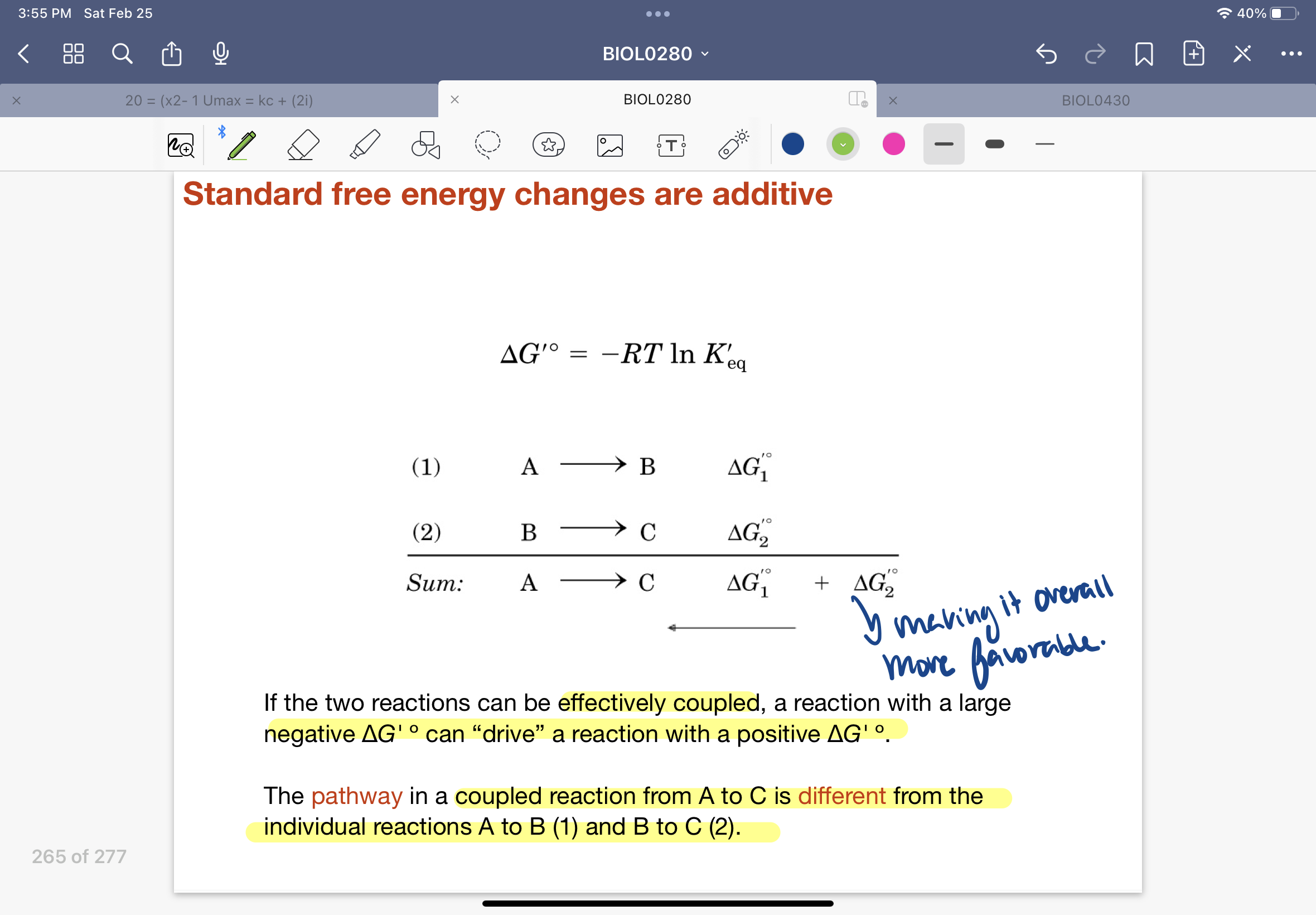
If reactions can be coupled, a large negative delta G prime can drive a reaction with a positive one. Coupled is not just A>B then B>C, its a new pathway to couple. Endergonic delta G is Positive and unfavorable, Exergonic delta G is negative and favorable. Energy coupling occurs through shared intermediates (Pi in this case). 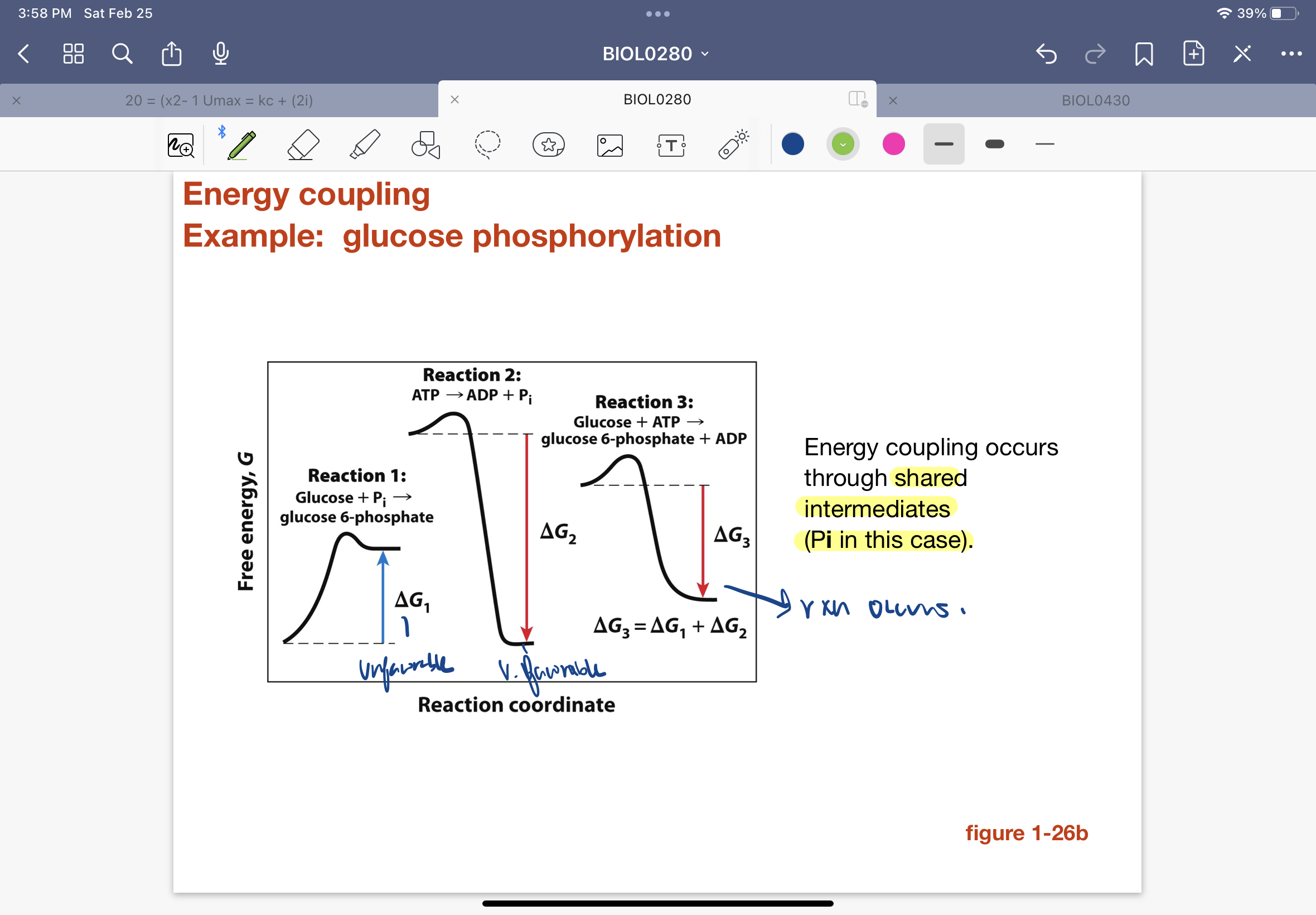
24
Nucleotides and Nucleosides 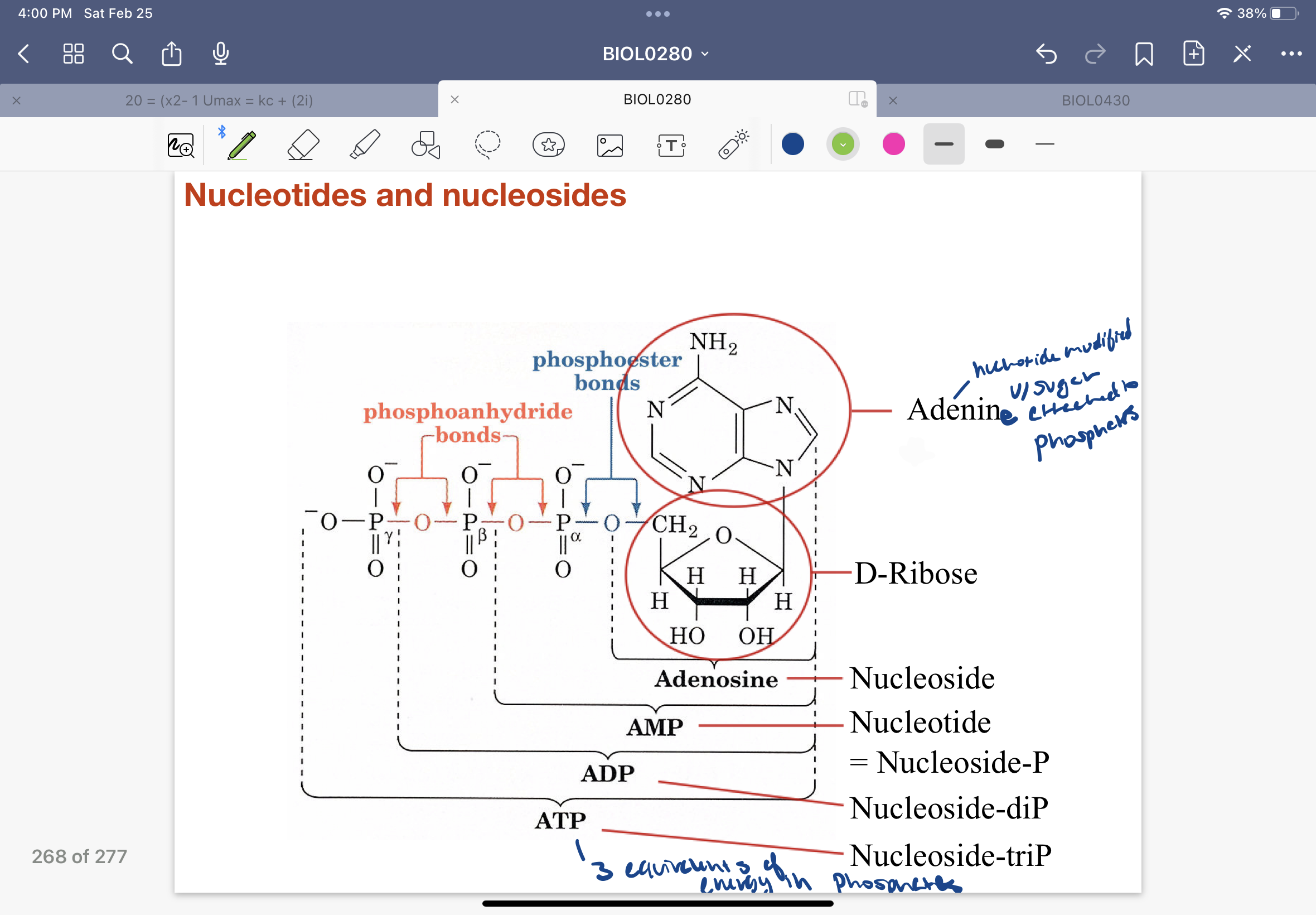
Adenine is a nucleotide modified with sugar and attached to phophoester. ATP is overall 3 equivalents of energy in the differernt phosphate. 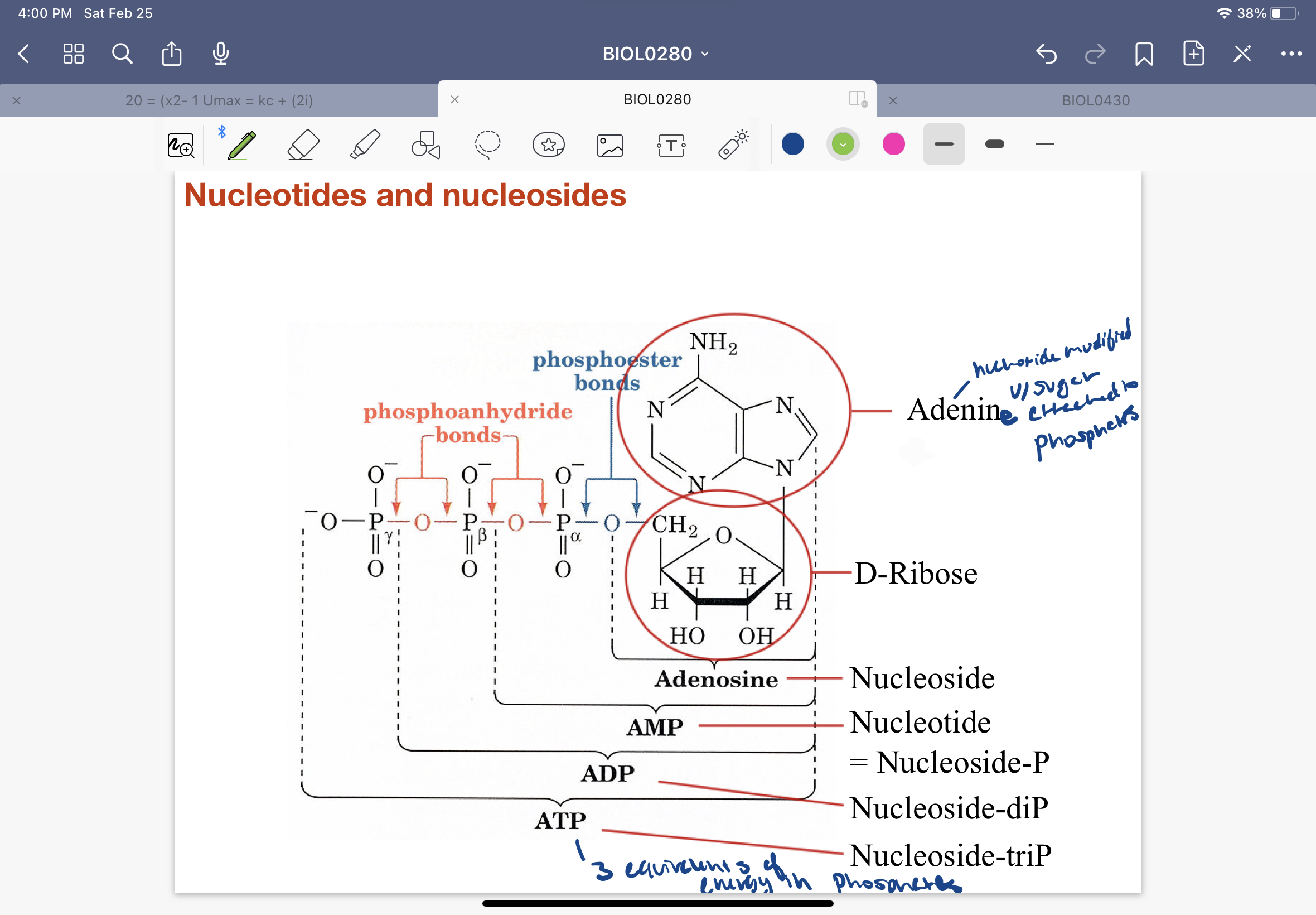
25
Adenosine Triphosphate (ATP) and Hydrolysis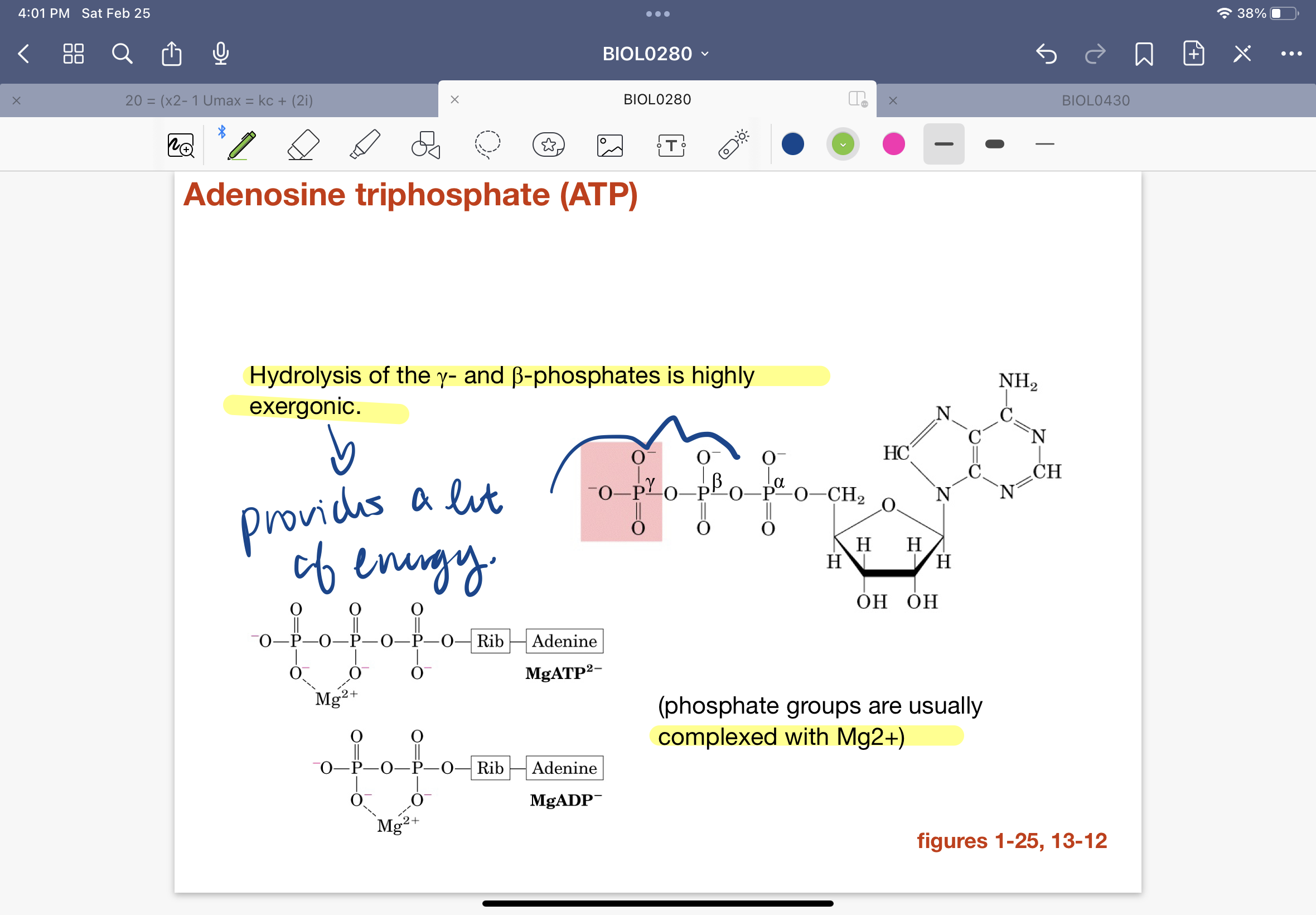
Hydrolysis of the gamma and beta phosphates is highly exergonic, providing a lot of energy. phosphate groups are usually complexed with Mg2+ ATP wants to be hydrolyzed becuase it wants to relieve electrostatic repulsion, wants its inorganic phosphate (Pi) to be stabilized by resonance, and becuase mass action favors hydrolysis ( high H2O concentration). 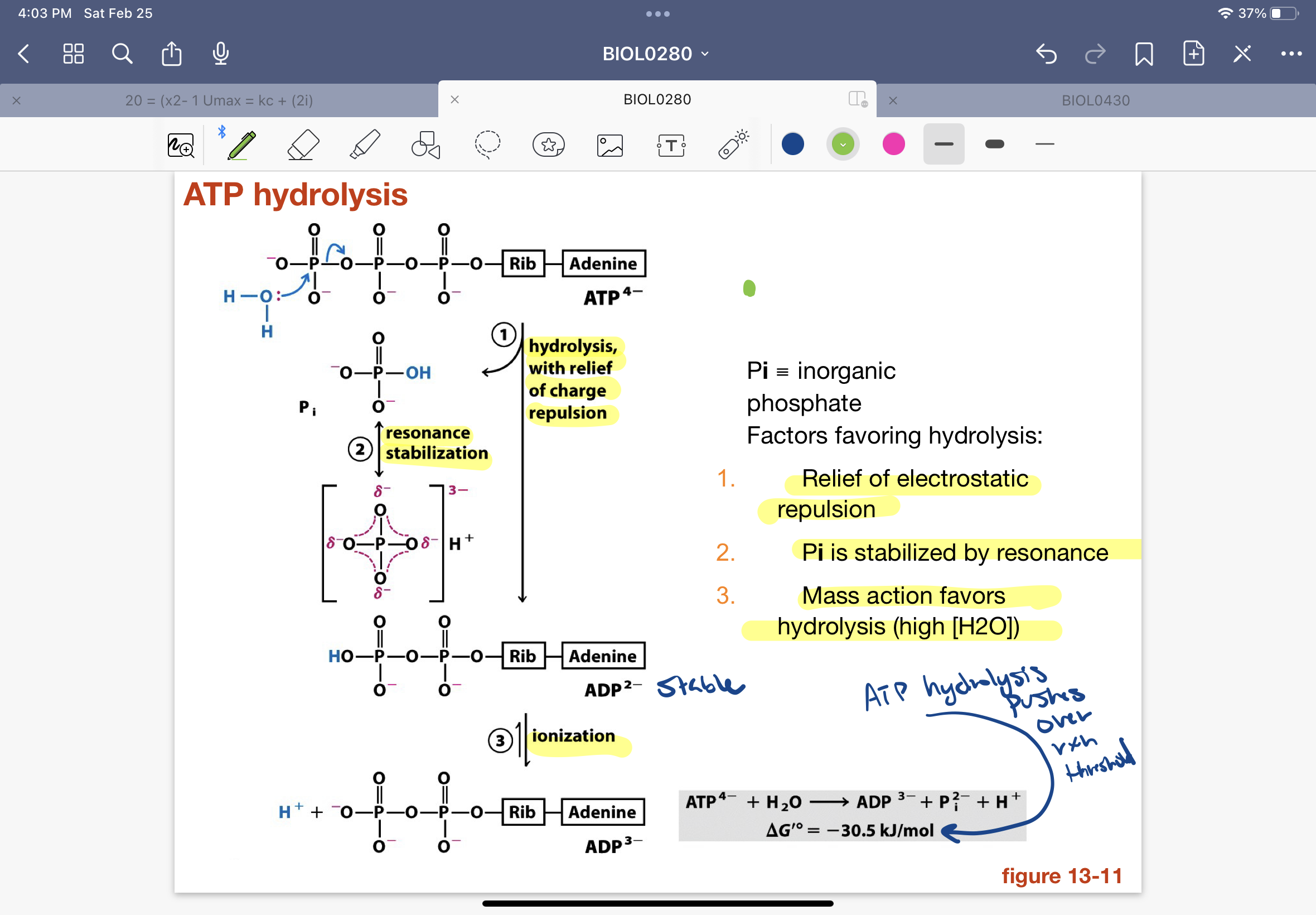
26
Hydrolysis reaction table 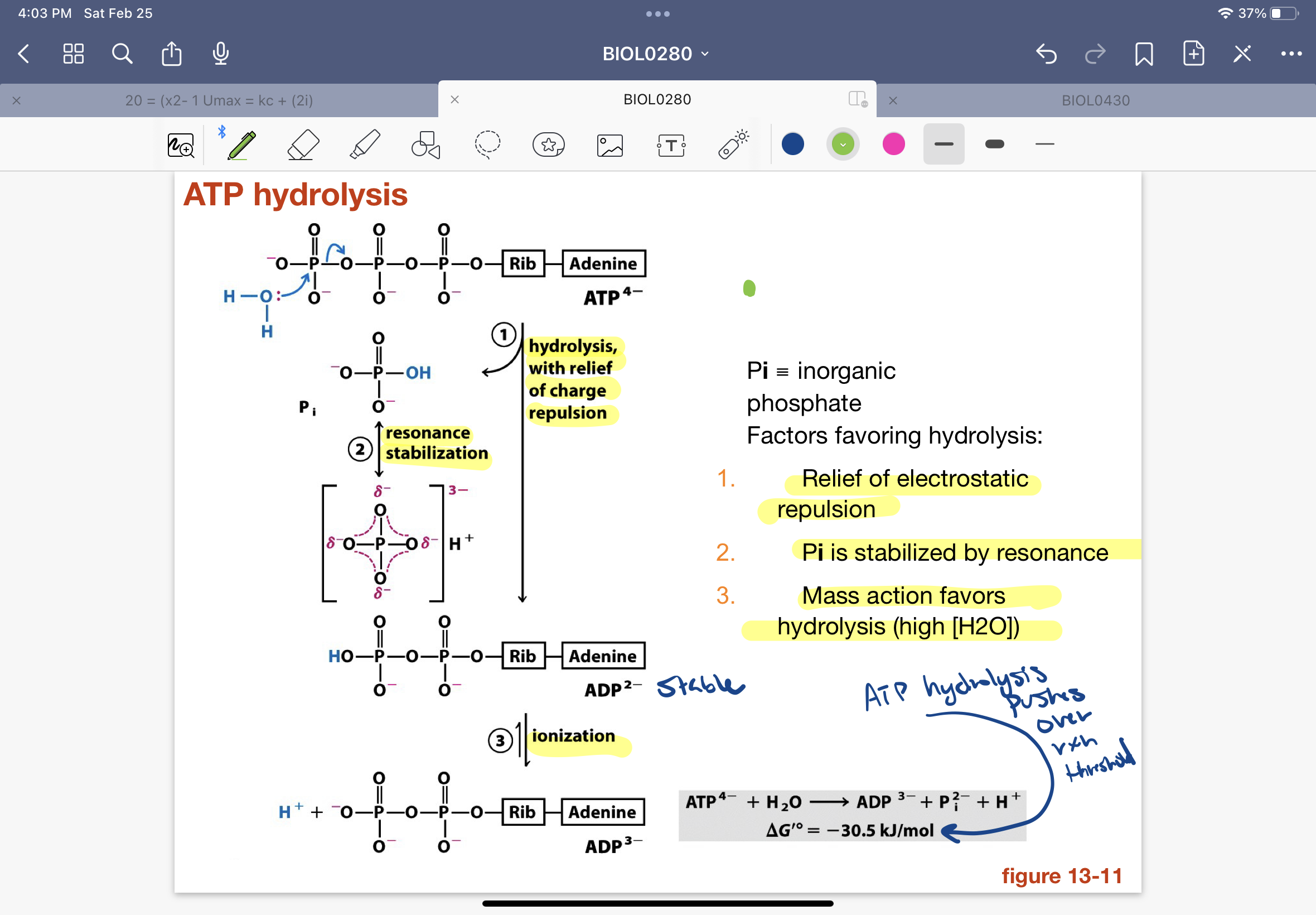
In intact cells, delta G for ATP hydrolysis is often much more negative than chart -30.5, ranging from -50- -65 kJ.mol. This is becuase [ATP]/[ADP][Pi]>1 is cells. 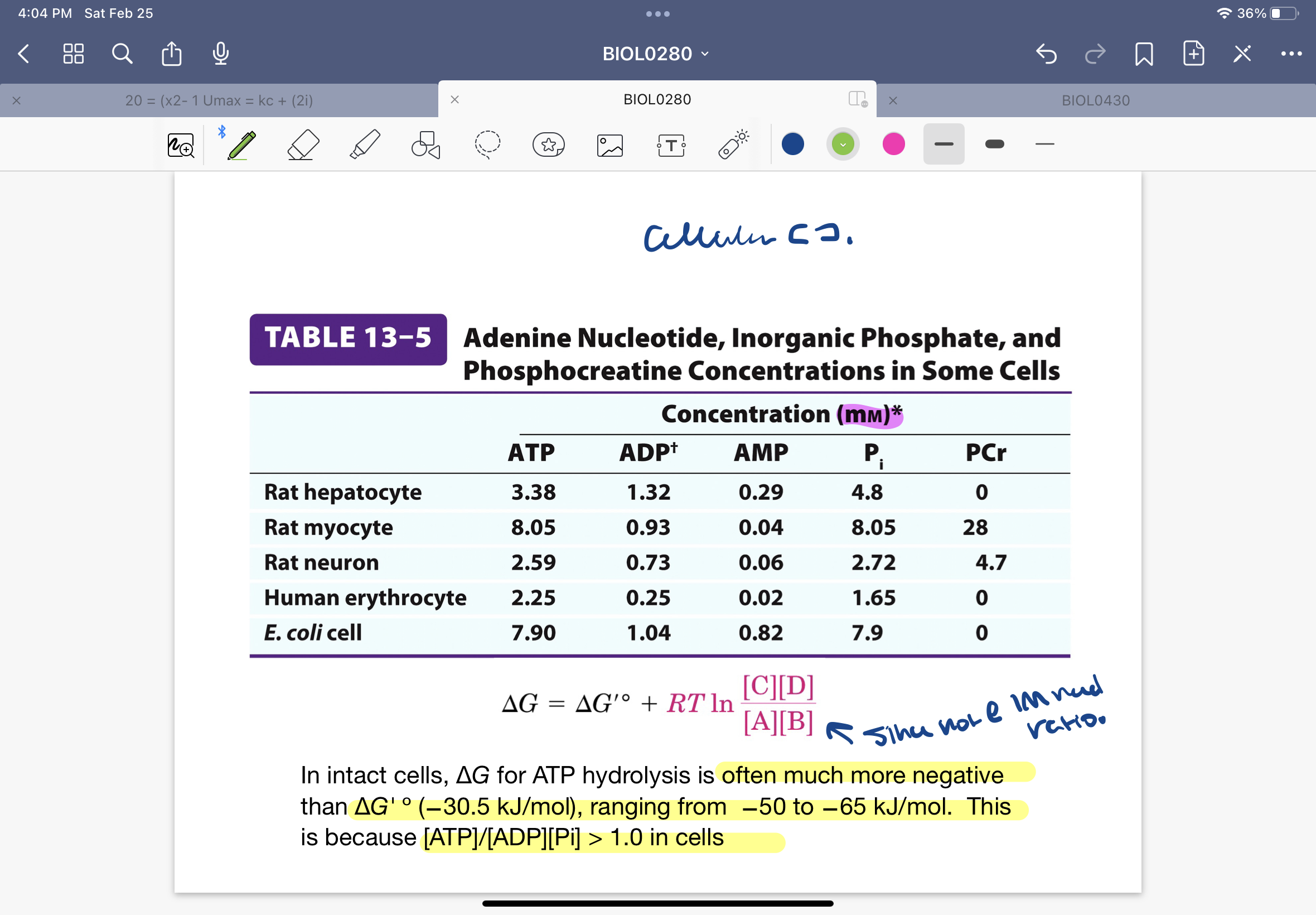
27
Glucose 1-phosphate rearrangements chart + energy released by hydrolysis of biological phosphate compounds. 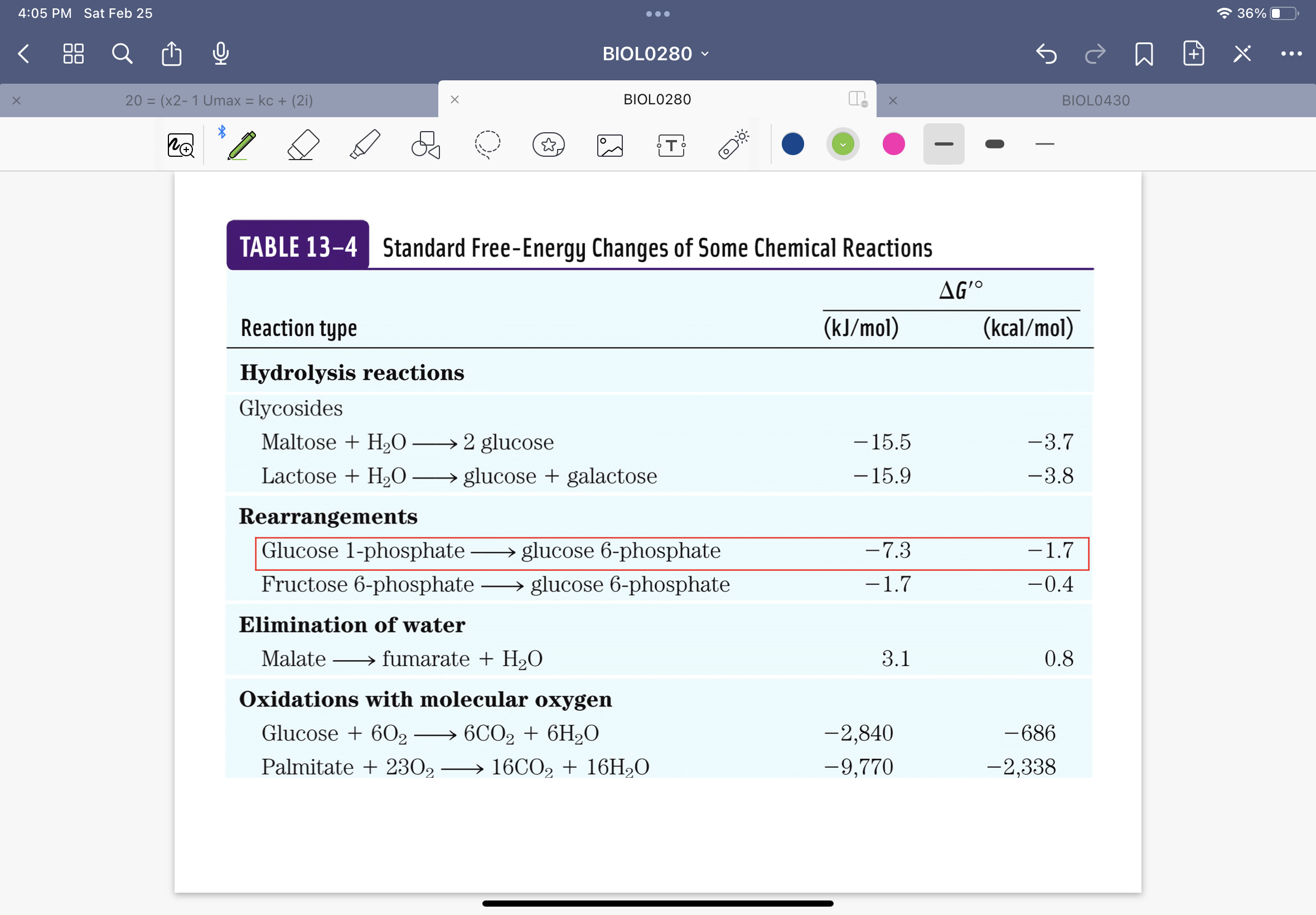
Takes a larger energy to regenerate ATP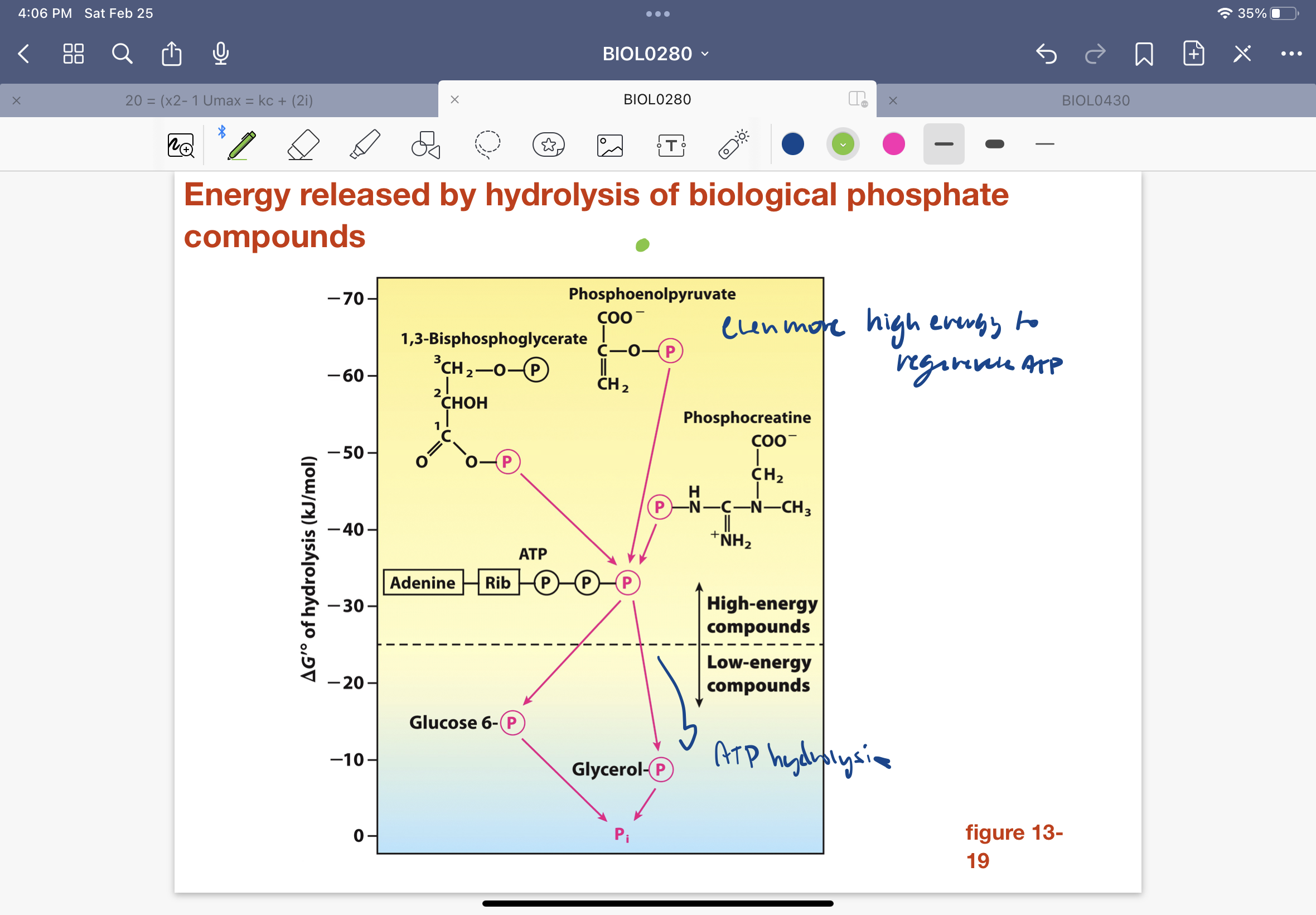
28
Hydrolysis of Phosphocreatine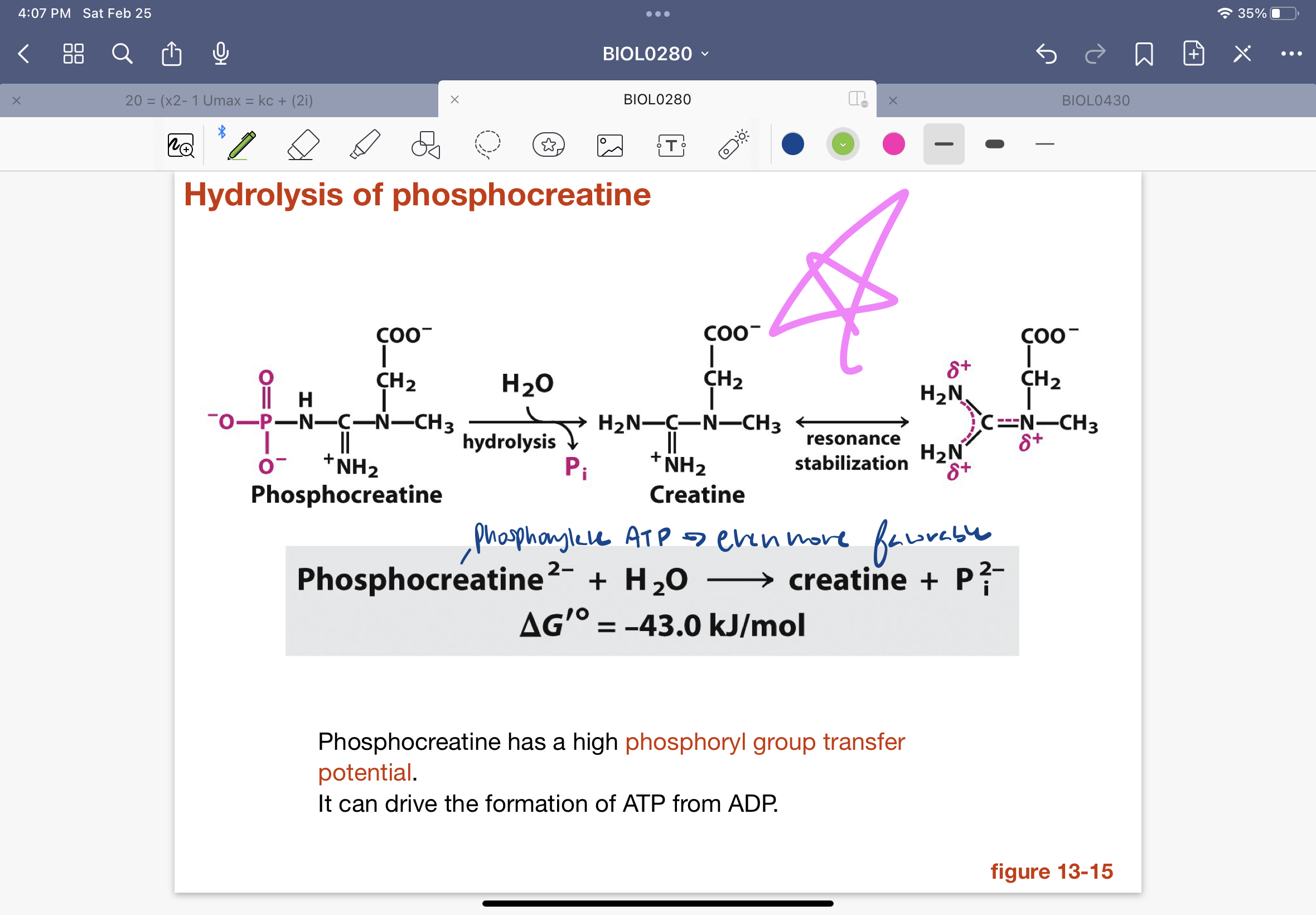
A phsophorylated version of ATP meaning its even more favorable. It has high phosphoryl group transfer potential and can drive the formation of ATP from ADP