Biochem Lecture 6
Study these flashcardsFree · spaced repetition · iPhone, Android, Mac & web
All cards
1
Arrhenius eEuation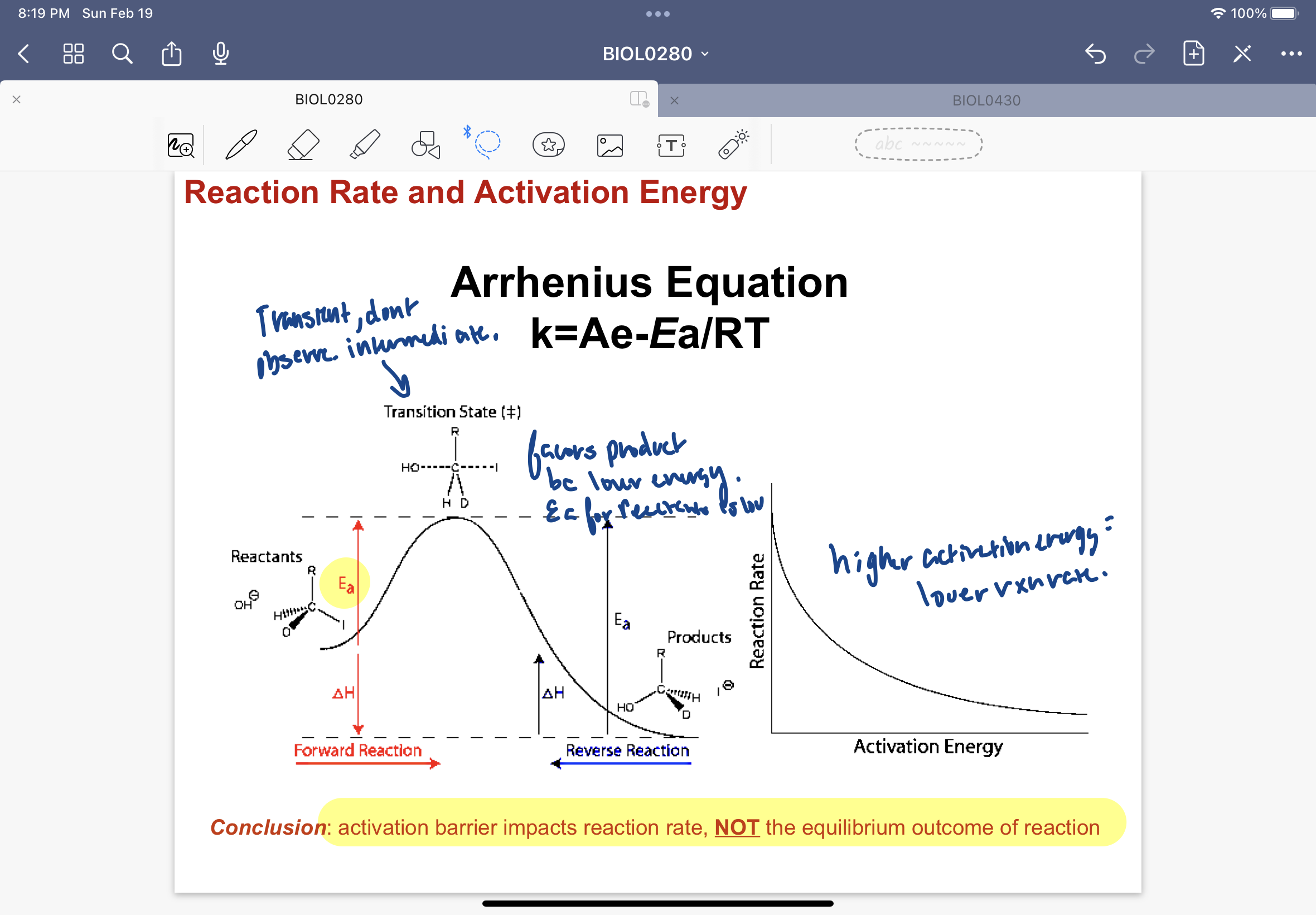
The higher the activation energy the lower the reaction rate. Has no affect on the equilibirum outcome of the reaction.
2
Modes of Catalysis (how enzymes bind).
Binding energy (uncatalyzed- catalyzed energy)., Hbonds,electrostatic, hydrophobic, Desolvation(replacing Hbondsbtwn substrate and H2O), positioning of substrates (especially for bisubstrate reactions)., proton transfer (acid base catalysis), covalent catalysis (bond cleavage and formation)., metal ion catalysis (ionic interactions, oxidation reduction). Bound Substrate is called the cofactor and enzyme with nothing attached to it is the Apoenzyme. Together they form a Holoenzyme. Cofactor can be metal ions, organic non proteins (reversible coenzymes or irreversible prosthetic groups).
3
Condensation and Hydrolysis: water as a reactant.
Leabes both with an OH in Hydolysis, combines carboxyl and amine groups in condensation (water leaves). 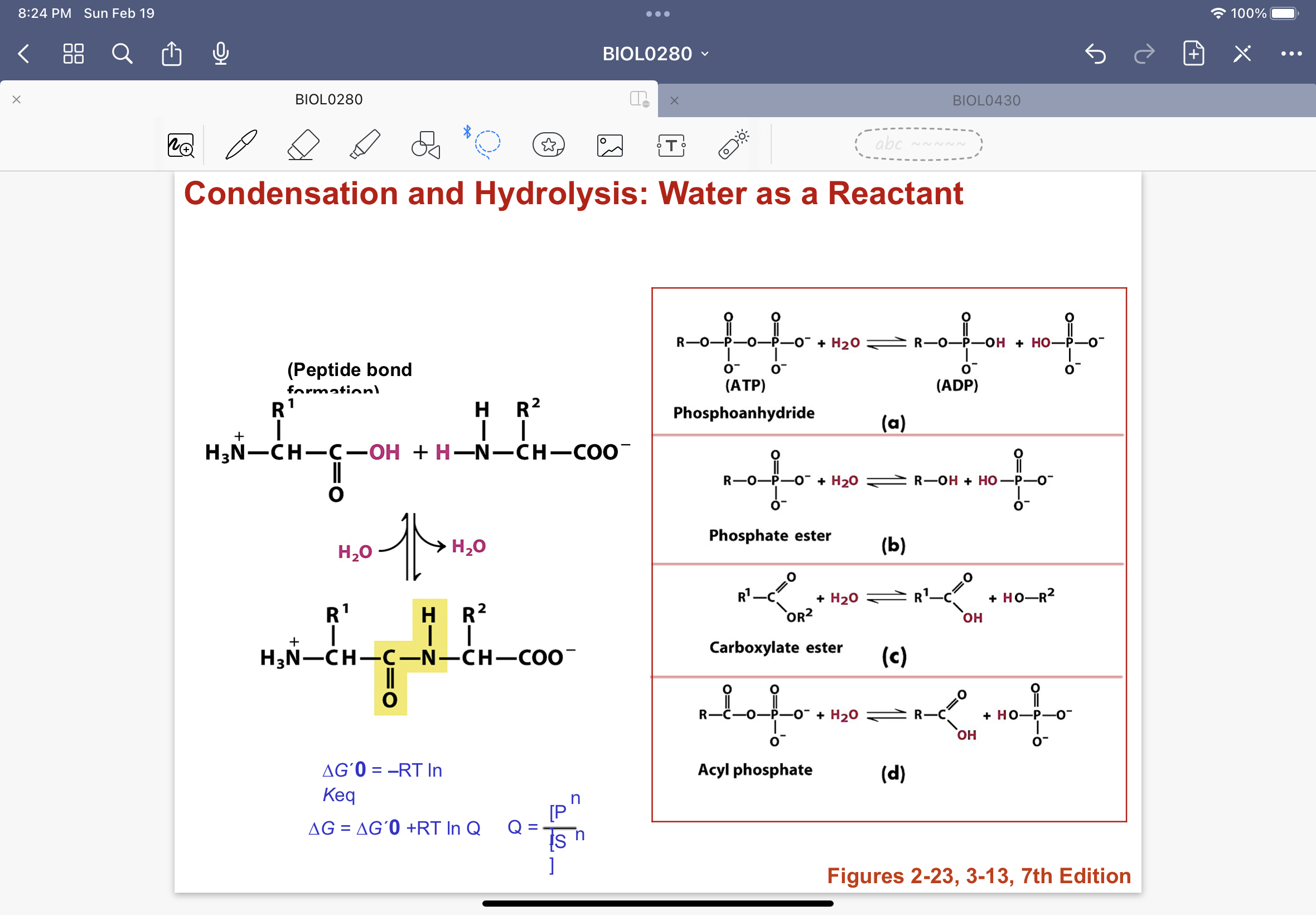
4
Acid- Base Catalysis 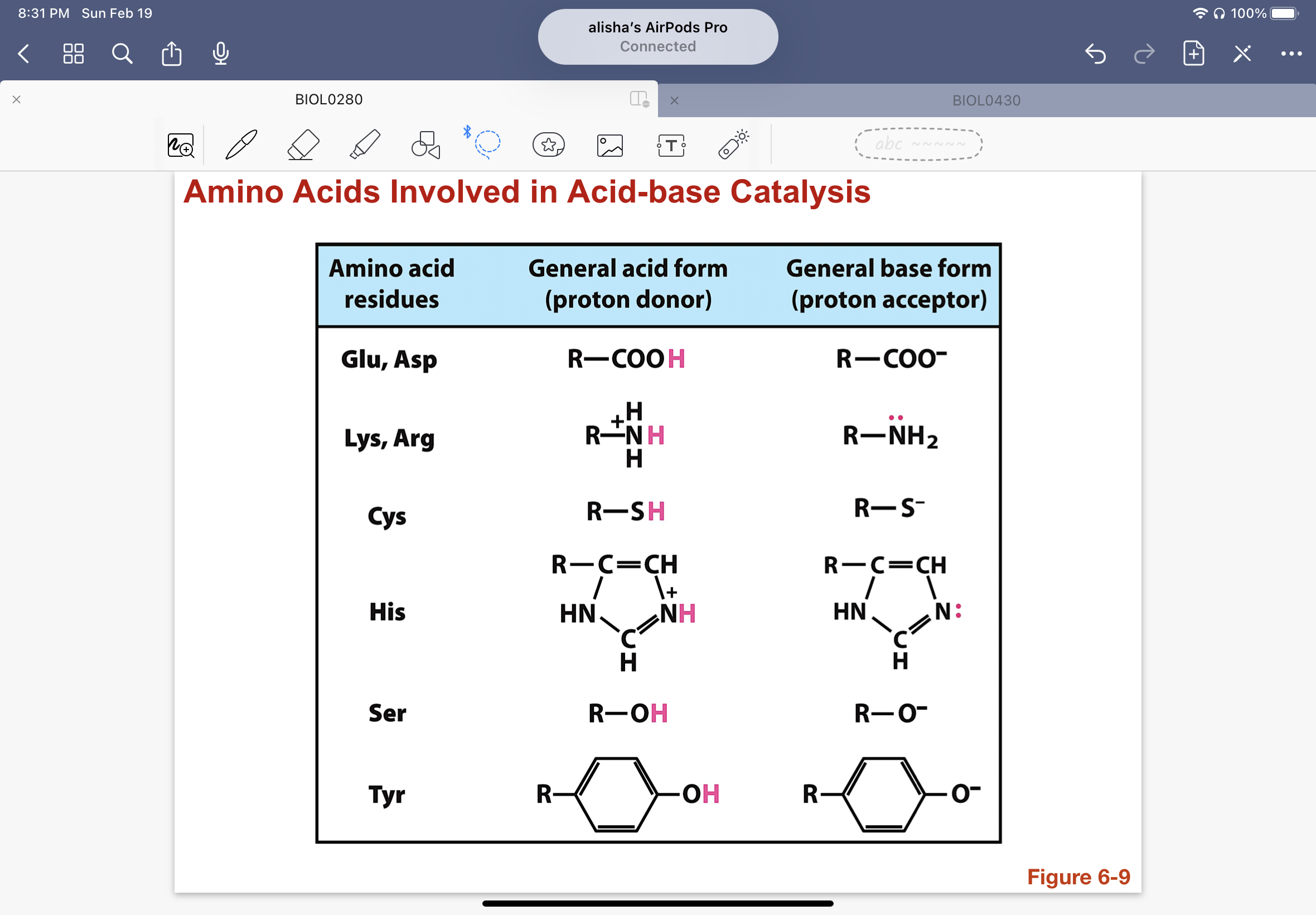
Specific:: When proton transfer to or from H2O is faster than the rate of break-down of intermediates, the presence of other proton donors or acceptors does not increase the rate of the reaction. General: Without Catalysis, unstable (charged) intermediates break down rapidly to form reactants. When proton transfer to or from H2O is slower than the rate of breakdown of intermediates, only a fraction of the intermediates formed are stabilized. The presence of alternative proton donors (HA) or acceptors (B) increases the rate of the reaction (water can increase rate then). *know amino acids involved in acid base catalsysis. 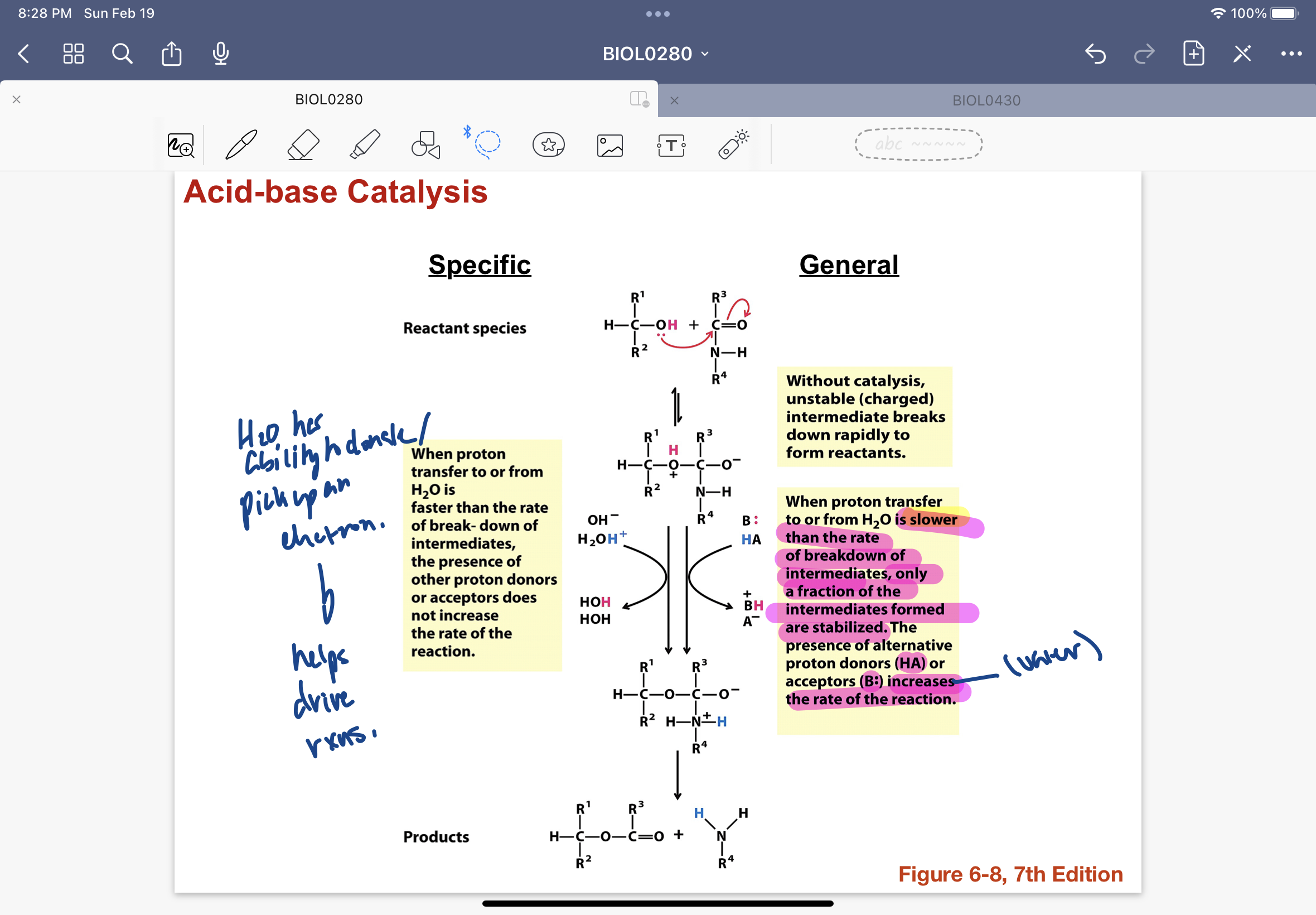
5
Chymotrypsin facts 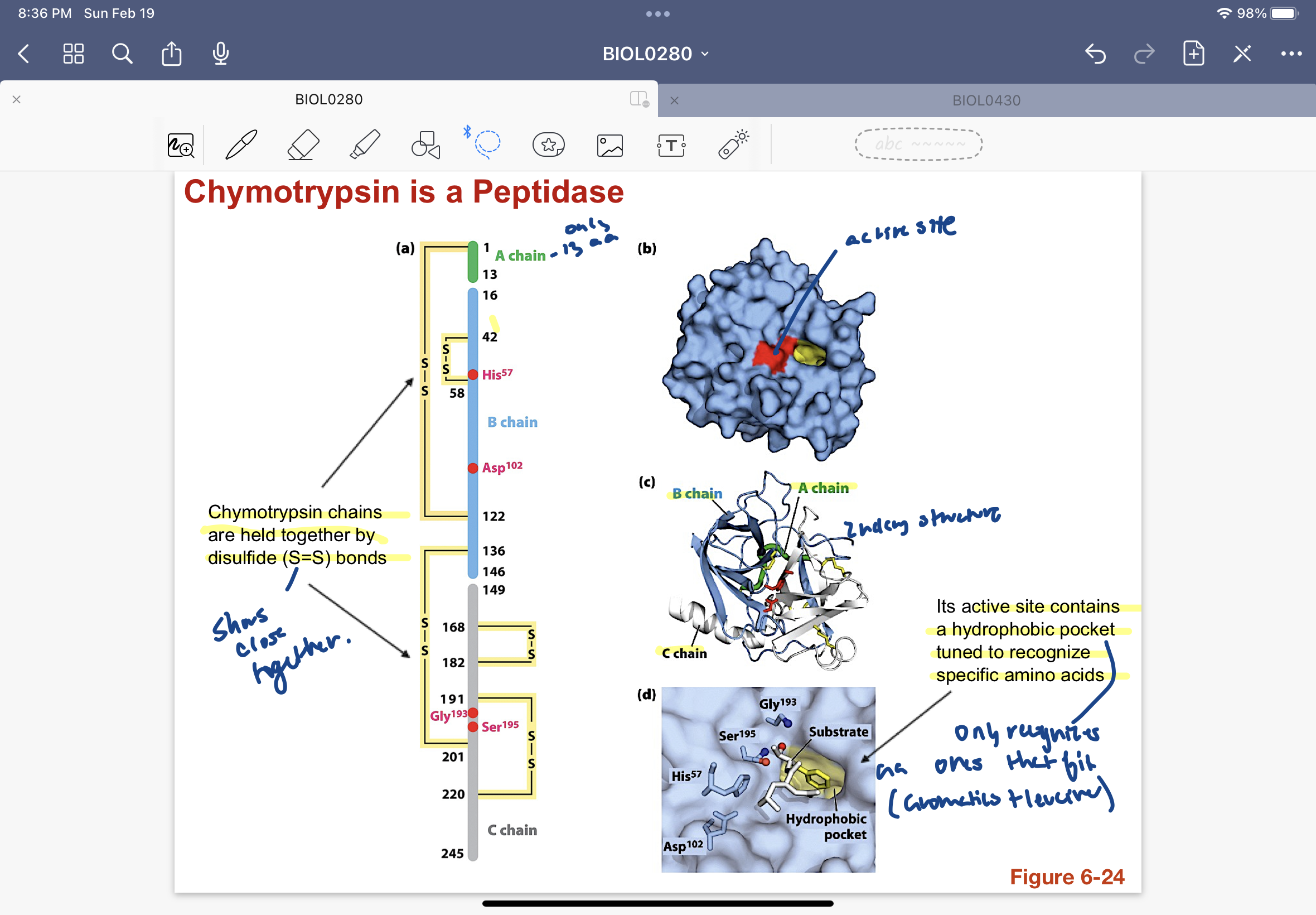
Cleaves Leucine, Phenyalanine, Tryptophan, and Tyrosine at the C terminus. It is a peptidase with AB and C chains held together by Disulfide bonds. Active site contains a hydrophobic pocket that is tuned to recognize specific amino acids. (aromatics and leucine). Utilizes general acid base catalysis. 1) Starts with a catalytic triad: Asp 102 residue (-) polarizes Histadine 57 making its Nitrogen a better base, which then lets it attack Serines OH, H , making serine's Oxygen connected to it more nucleophilic so that it can attack the substrates carbonyl and transform it .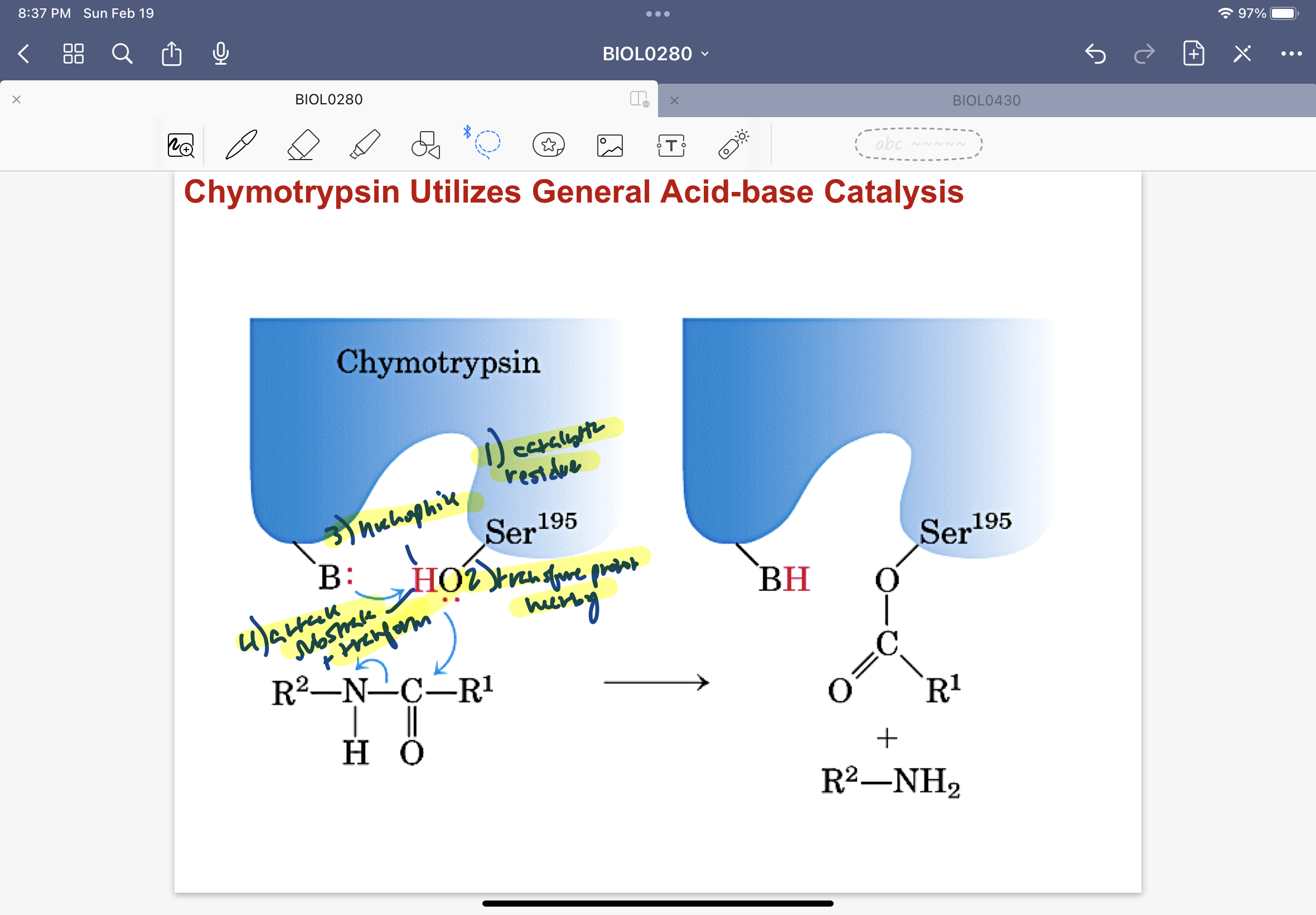
6
Hydrolyzing the peptide bond (proteases to break down the proteins). CHYMOTRYPSIN STEP 1: Substrate binding. ES complex here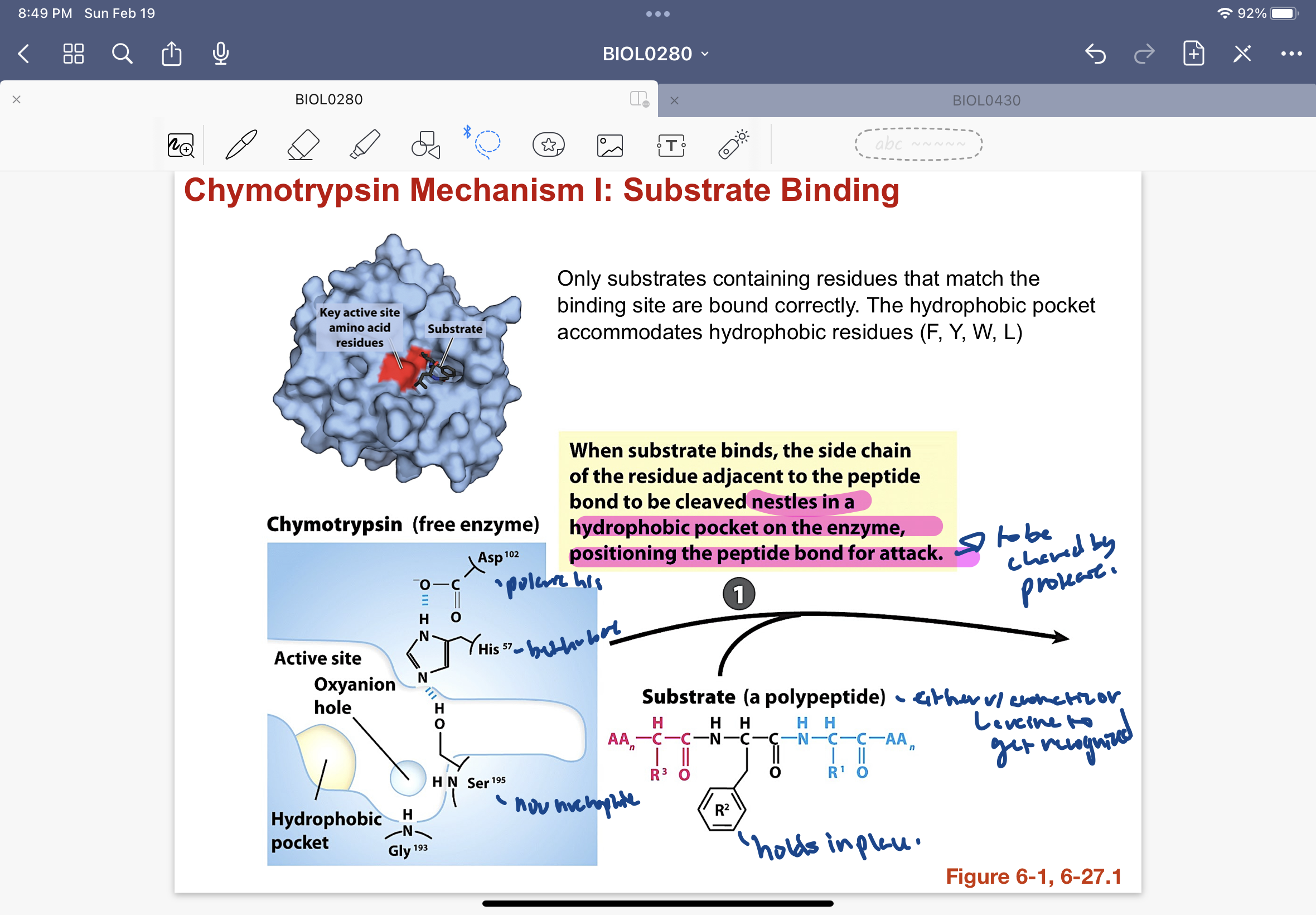
1) Substrate that matches binding site is bound. When bound, the side chain of the residue adjacent to the peptide bond that will be cleaved nestles in a selective hydrophobic pocket on the enzyme, positioning the peptide bond for attack. The F,Y,W,L residues essentially are there to hold the enitre polypeptide in place in the pocket. 2) Carboxyl C of the aromatic/Leucine is positioned near Ser 195. Histadine Serine interaction generates a nucleophilic alkoxide ion on Serine 195. The ion attacks the peptide carbonly group forming a tetrahedral acyl-enzyme. A short lived negative charge is created on the carbonyl oxygen of the substrate, which is then stabilized by hydrogen bonding with Serine's 195 / Glycine's 193 NH in the Oxyanion hole. . 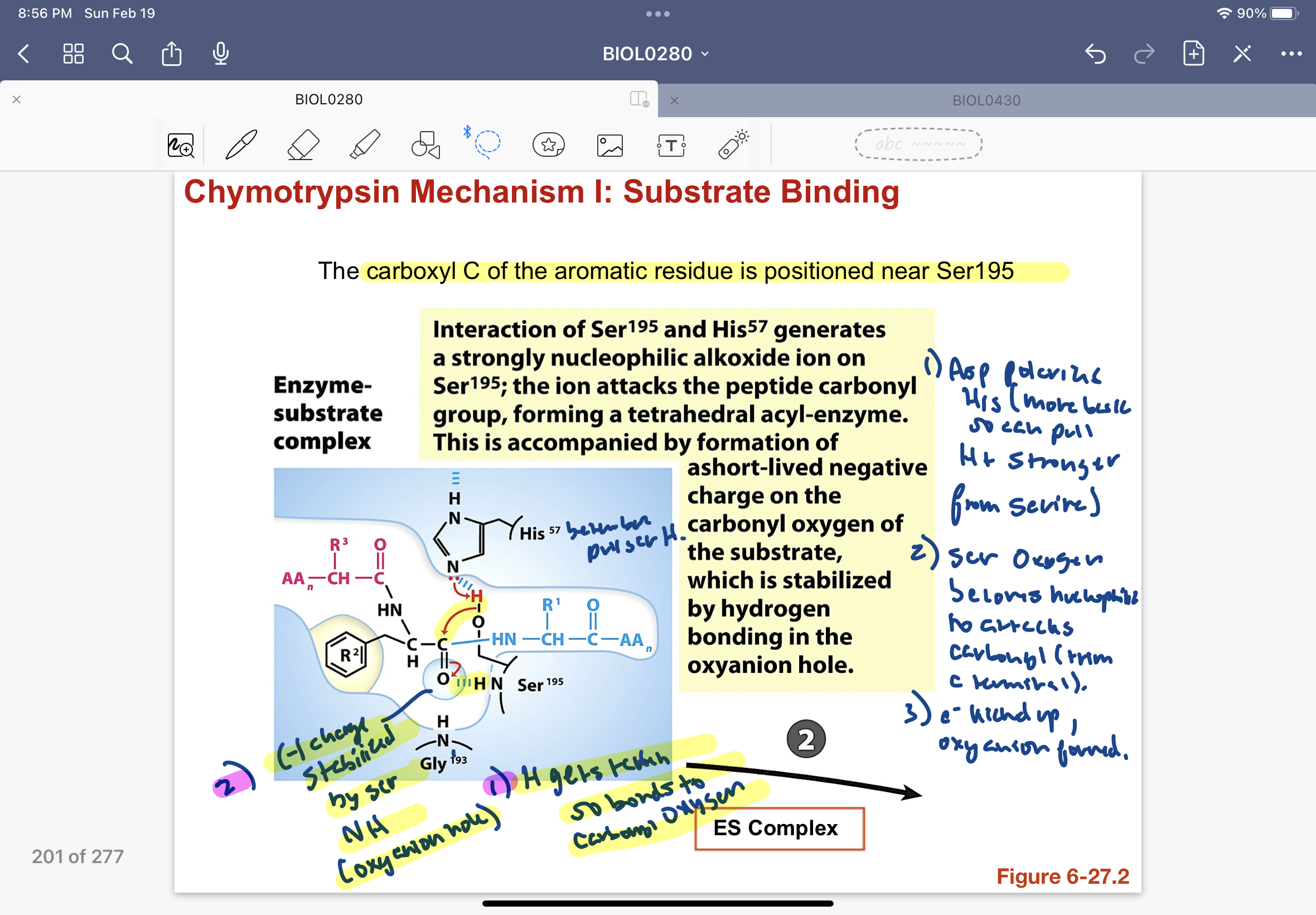
7
Chymotrypsin Step 2: Ester Formation 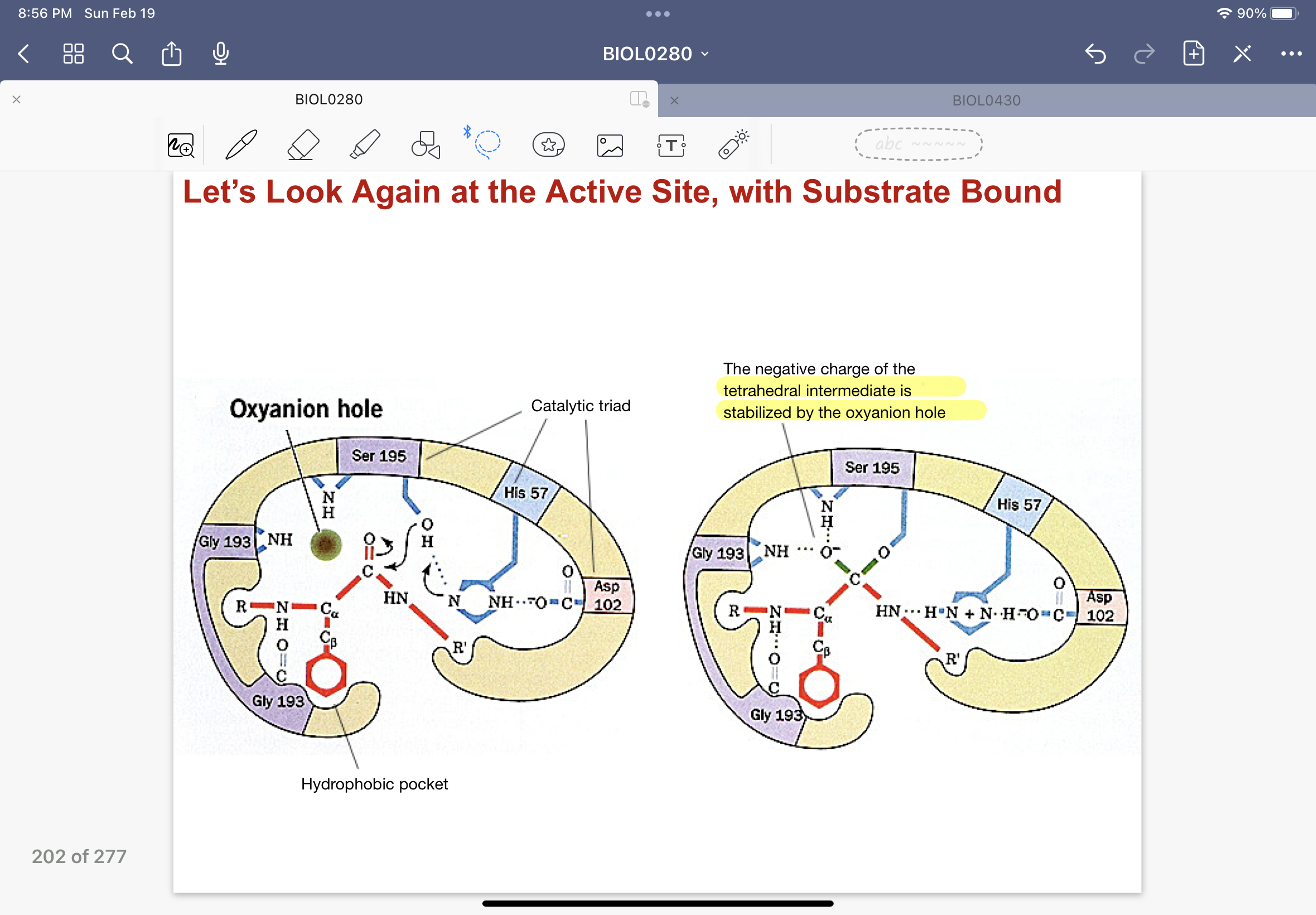
Deprotonated Ser195 strong base attacks peptide carboxyl C forming an ester bond. displacing the amino N. oxyanion is stabilized by H bonds to amide N atoms in the oxyanion hole. (step 1). This is a transition state acyl intermediate. N terminus of polypeptide is also having slight interaction with Histadine H. 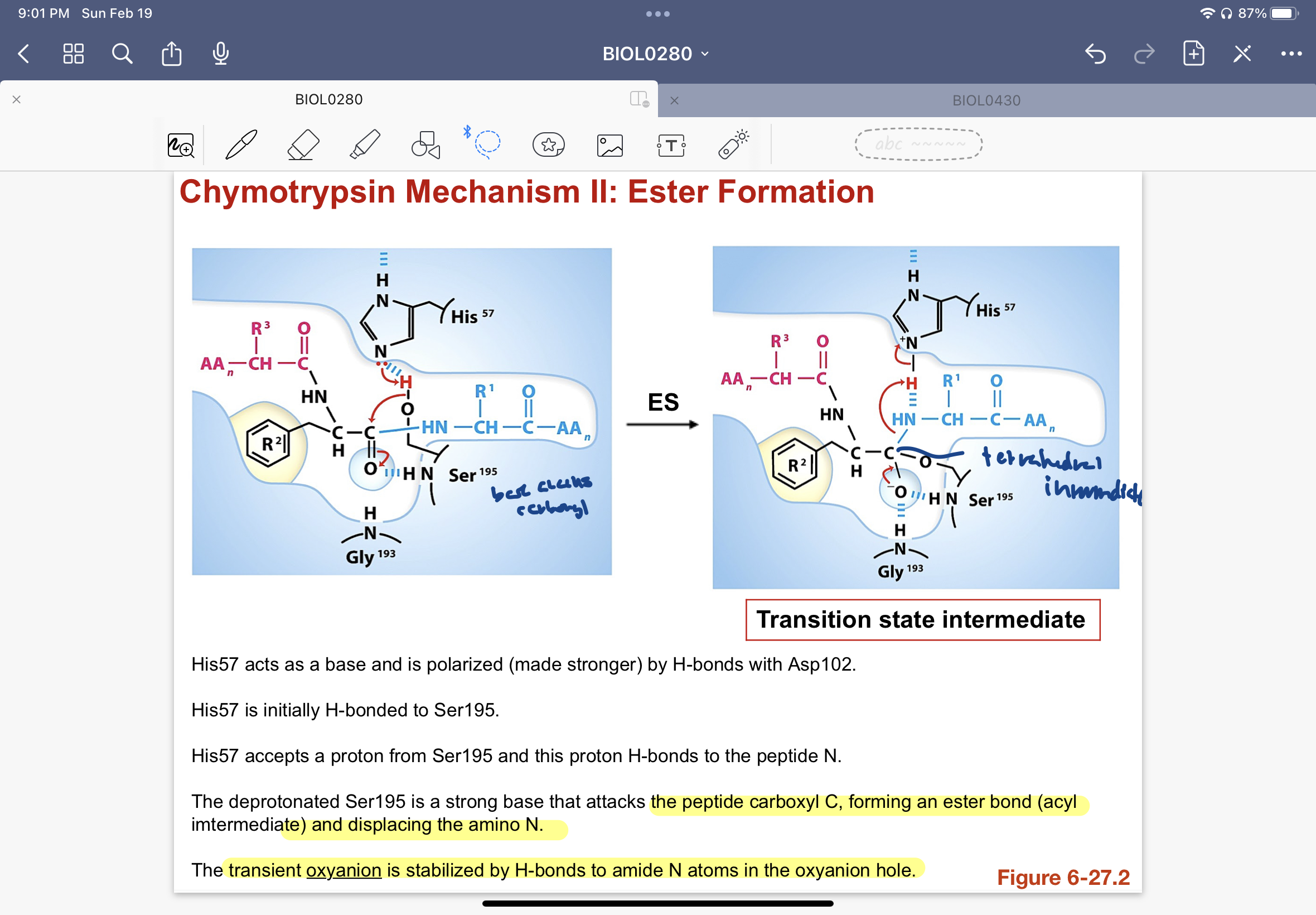
8
Chymotrypsin Step 3: Product 1 Release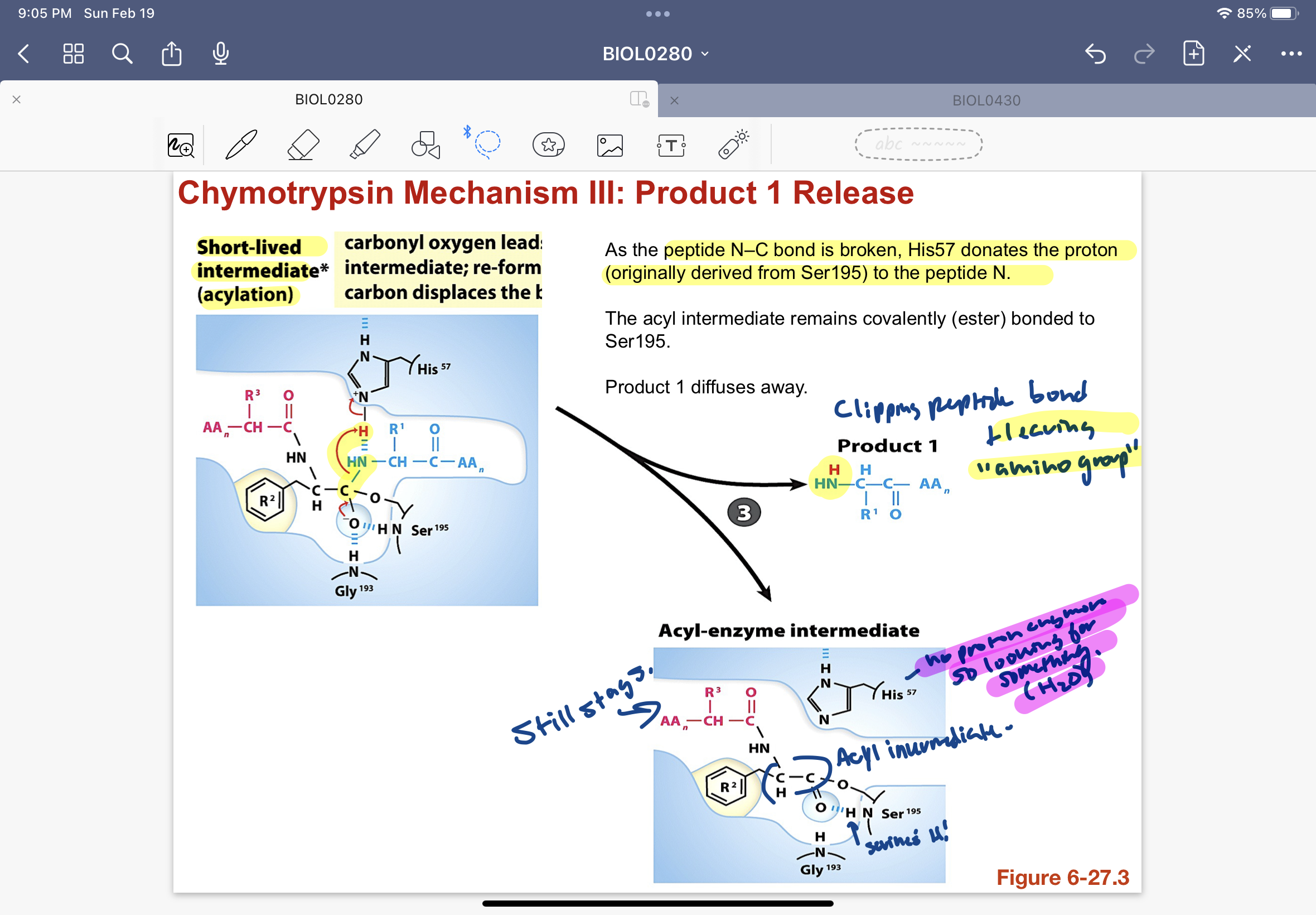
As the peptide N-C bond is broken, His57 donates the proton it got from Ser195 to the peptide N. Acyl intermediate remains covalently (ester) bonded to Ser 195. Product 1 diffuses away. Clipped peptide bond at this point and formed a new amino group. Histadine now no longer has a proton so will seek out Water's H.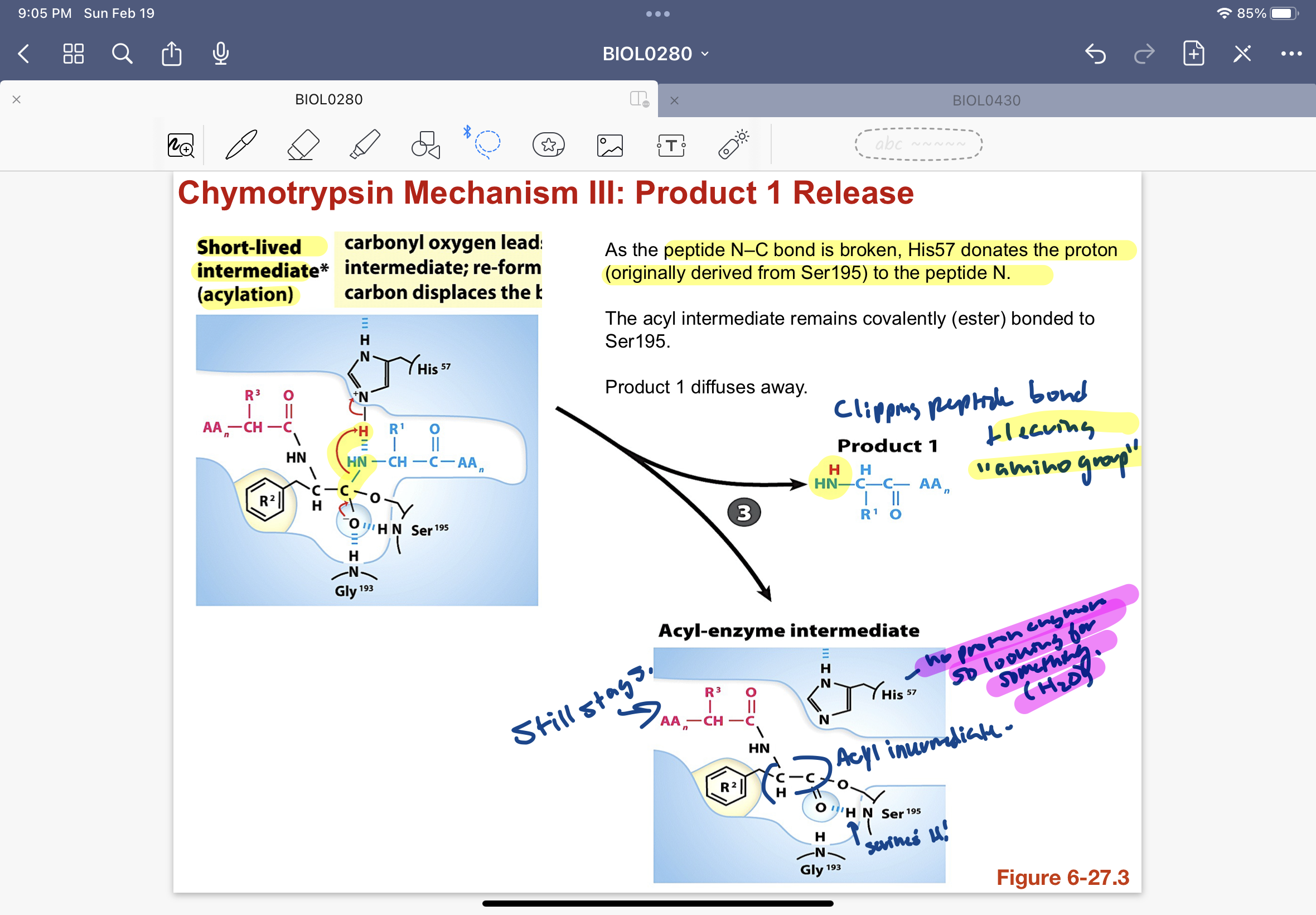
9
Chymotrypsin Step 4: Water Deprotonation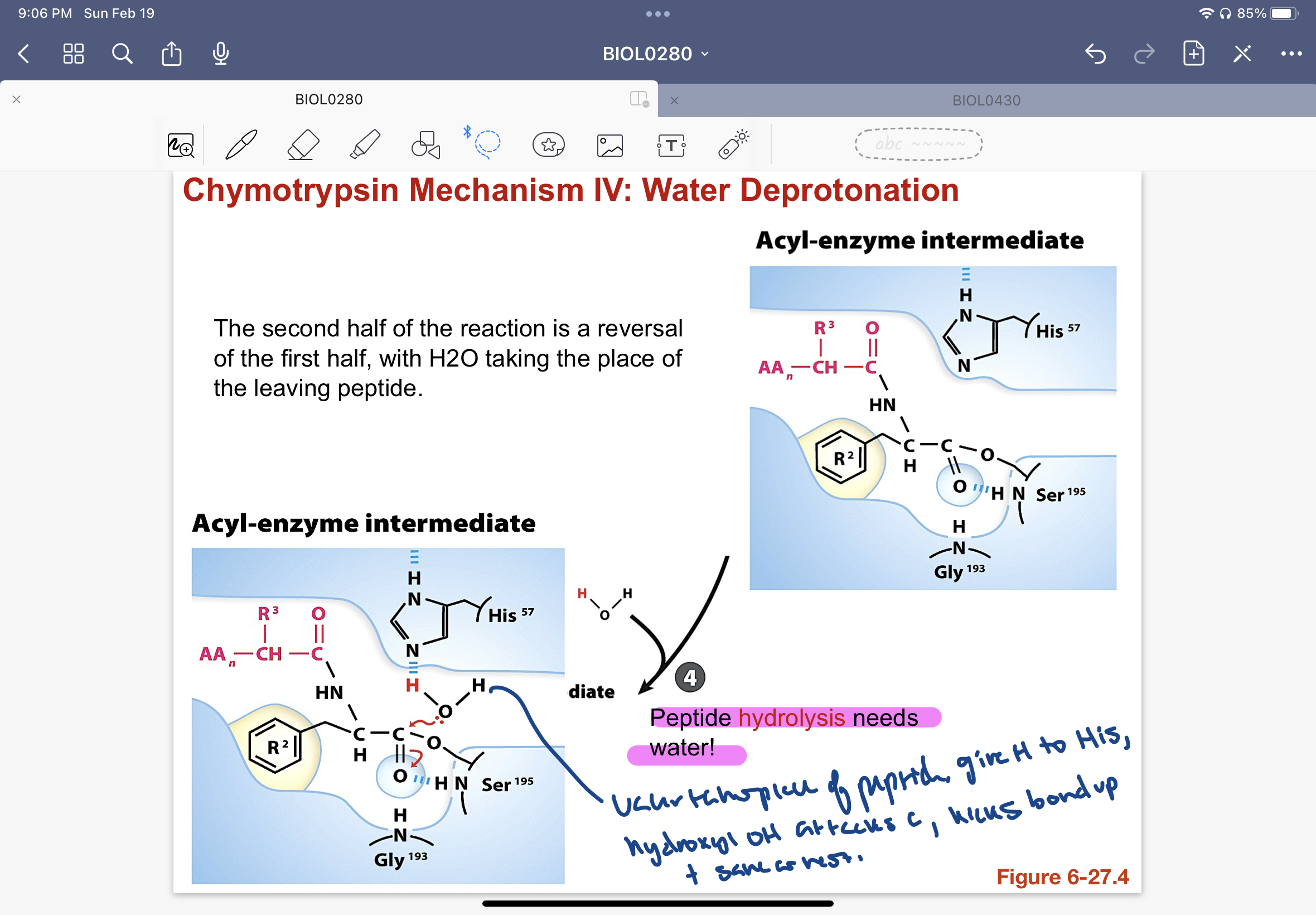
Peptide hydrolysis needs water so water comes in, gives its H to His 57, its hydroxyl OH then attacks the peptides carbonyl, which causes it to kick its oxygen electrons up to be stabilized again in the oxyanion hole. 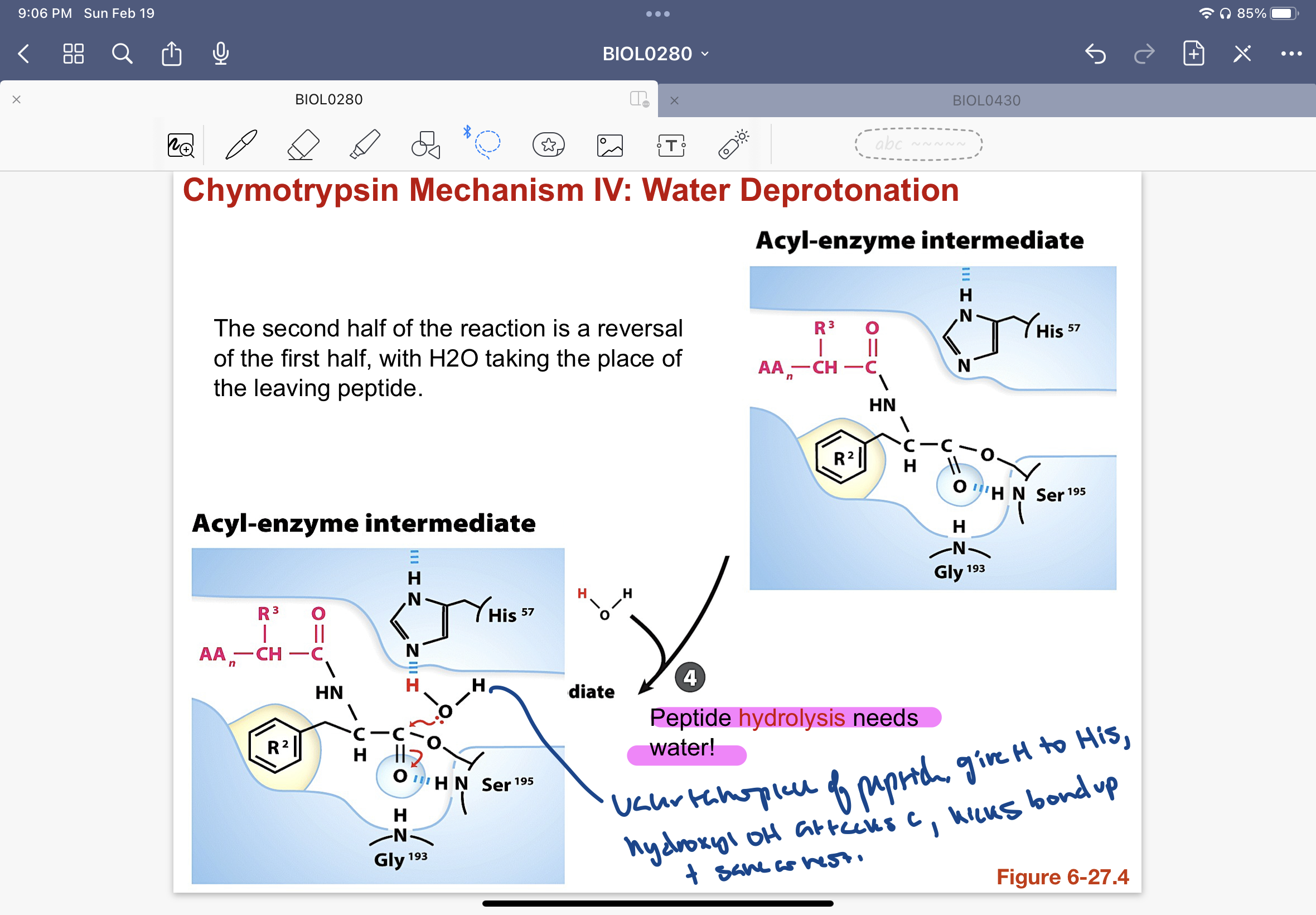
10
Chymotrypsin Step 5: Ester Hydrolysis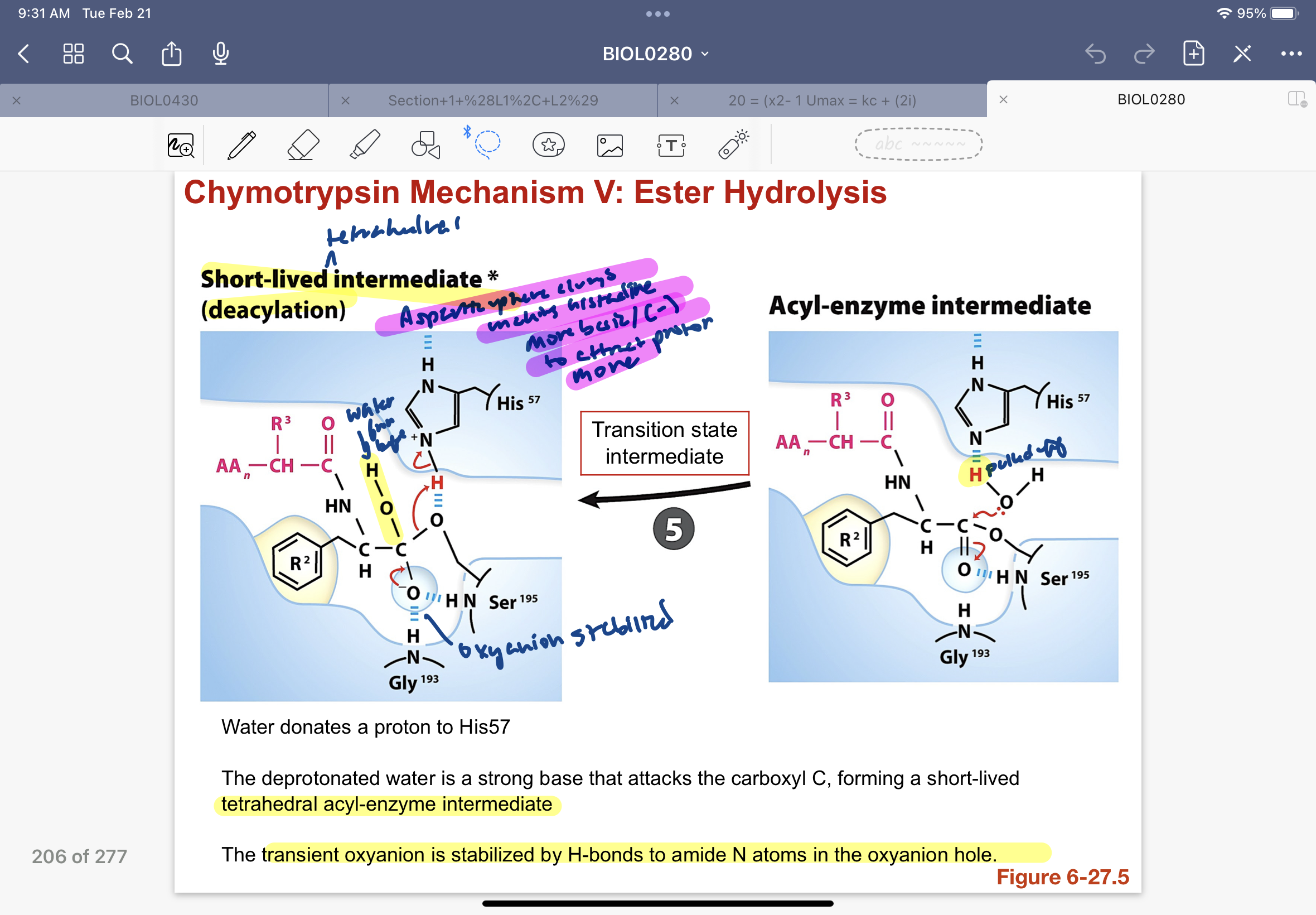
His57 now has a proton from water, which interacts a bit with Ser195 O. Rest of water has attacked carbonyl C, forming short lived tetrahedral acyl-enzyme intermediate again. Oxyanion stabilized again by H bonds to amide atoms in oxyanion hole. 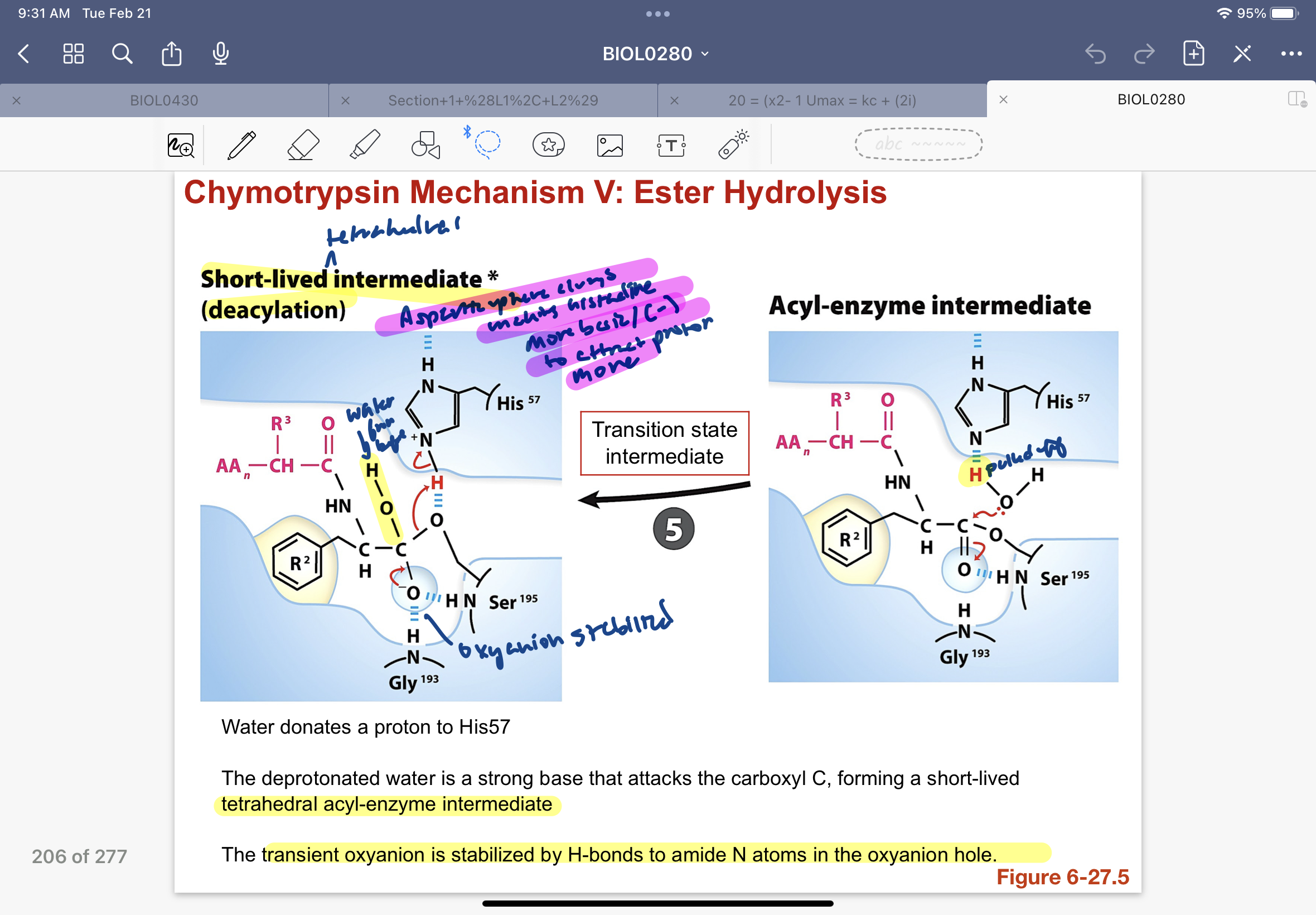
11
Chymotrypsin Step 6: Ester Hydrolysis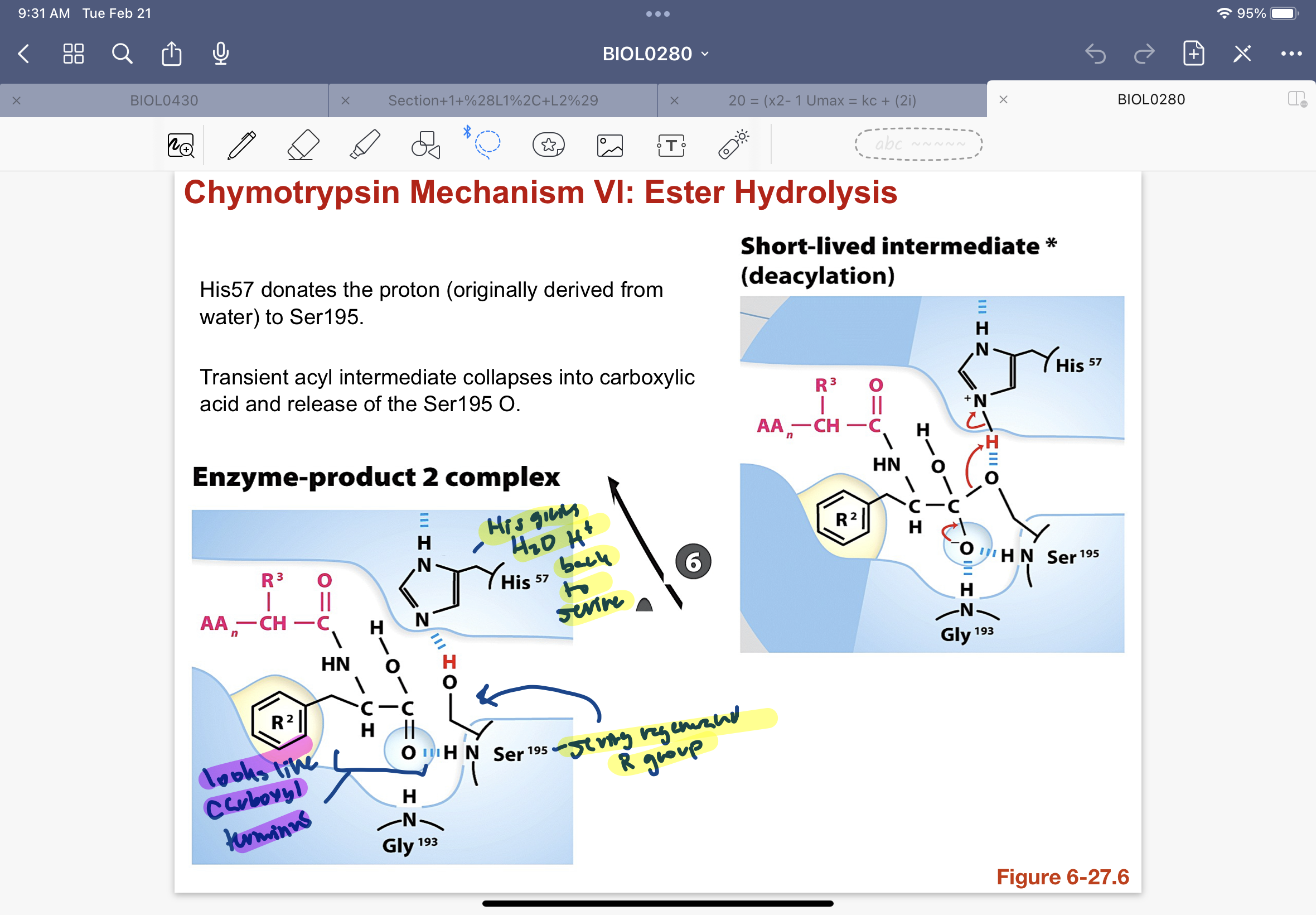
His57 gives H+ from water back to Serine. Transient acyl intermediate collapses into carboxylic acid and releases Ser195 O. Whats left on peptide essentially looks like C terminus. 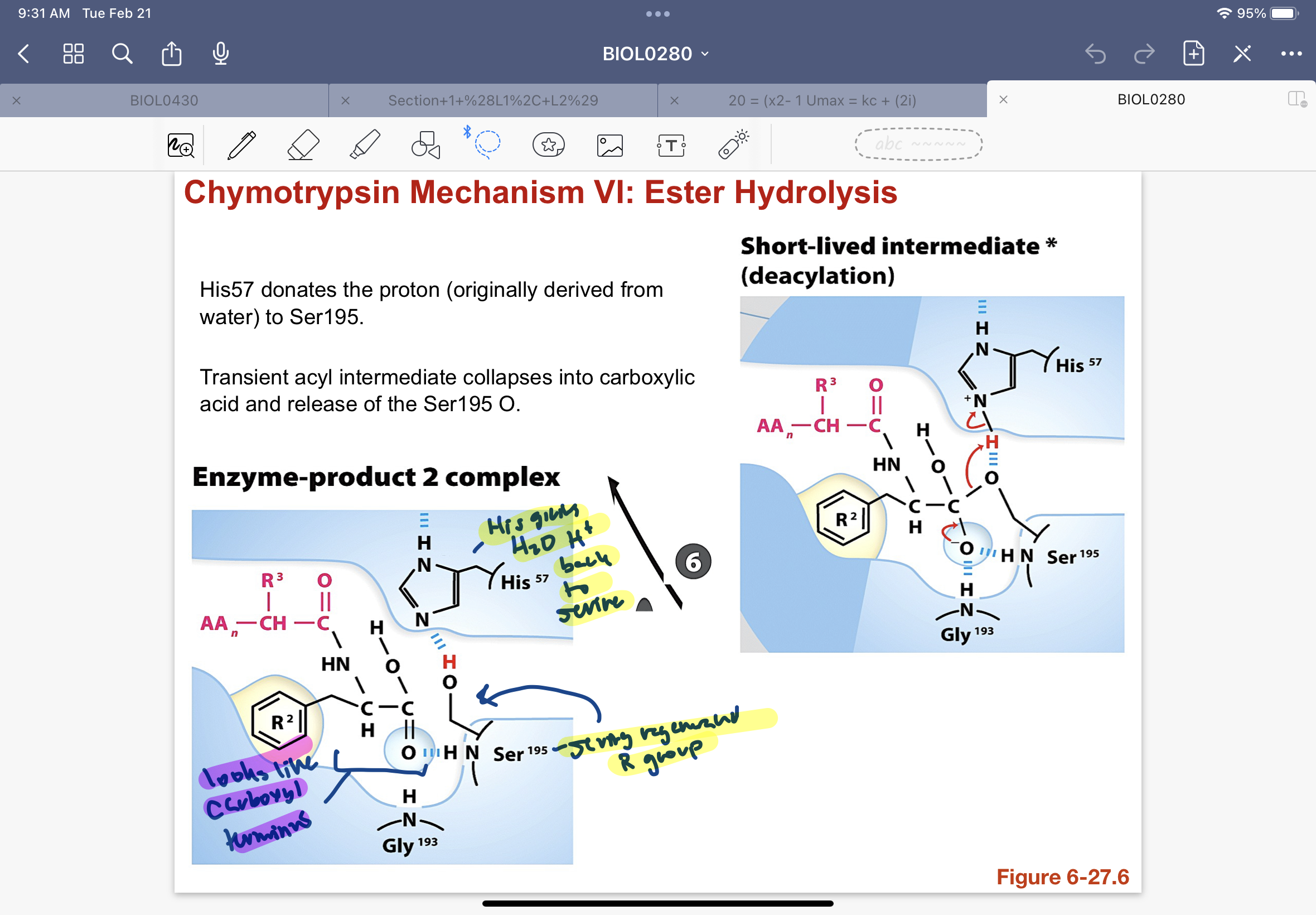
12
Chymotrypsin Step 7: Product 2 Release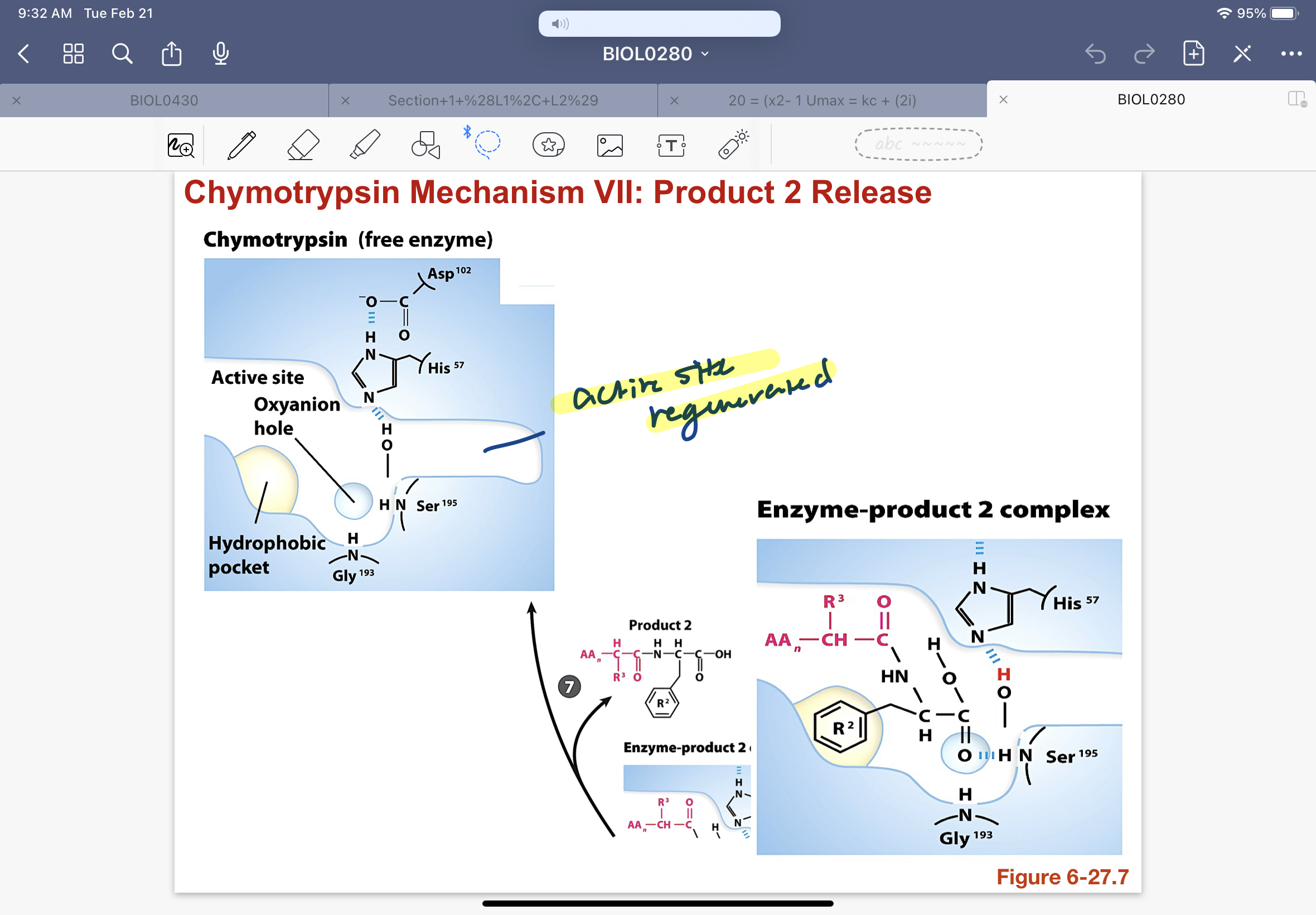
Product 2 detaches from Serine H and diffuses out. Active site of Chymotrypsin is regenerated. 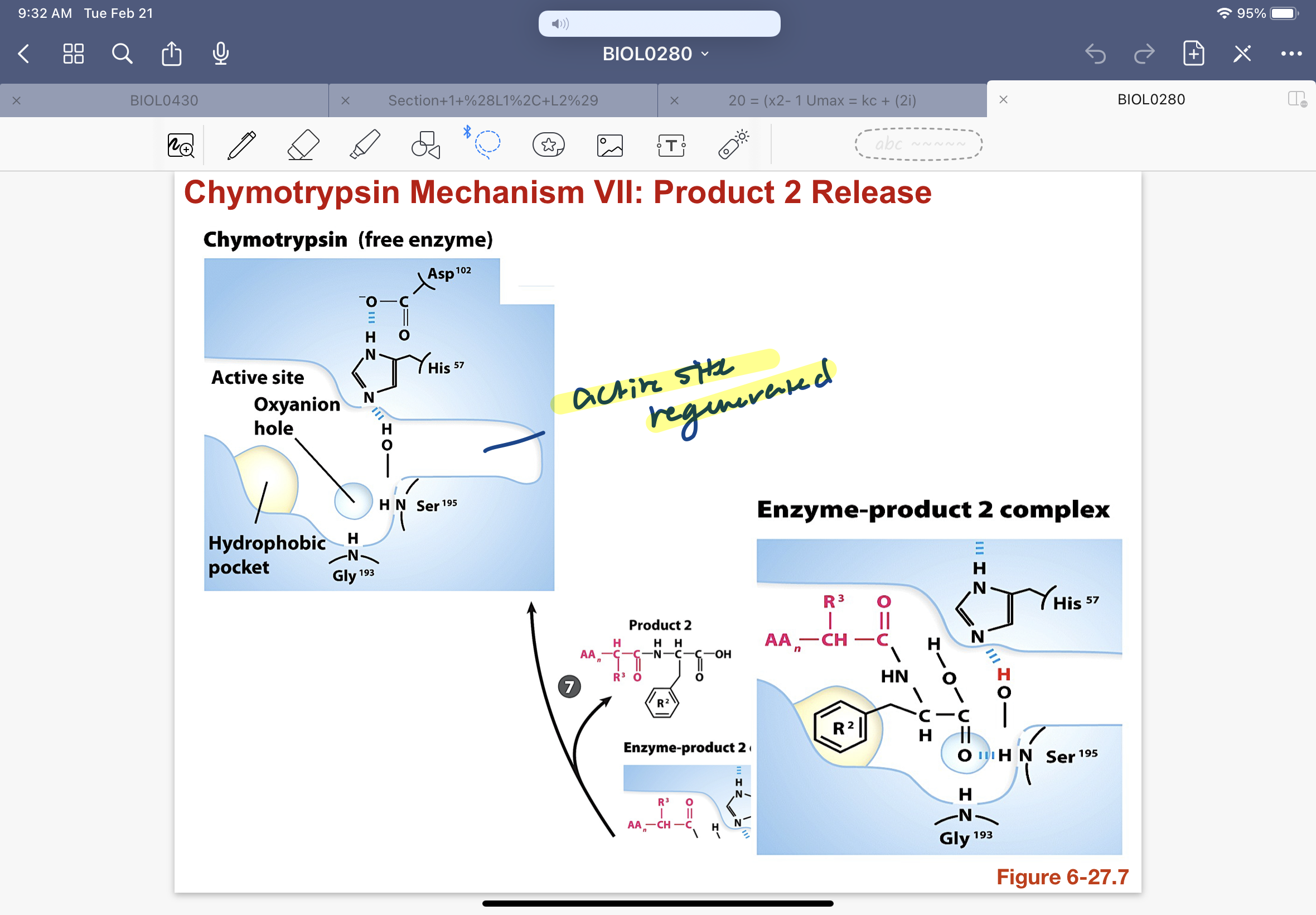
13
Chymotrypsin Summary
Uses several mechanisms to speed up peptide hydrolysis: 1) Acylation phase: cleavage of peptide bond which involves covalent ester linkage btwn Ser 195 and substrate peptide. 2) Oxyanion hole: a transient negative oxyanion is stabilized by H bonds of NH from peptide bonds of the enzyme active site (binding energy). 3) Hydrolysis of Ester Linkage: general acid-base catalysis by other groups of the active site. 4) Substrate positioning by hydrophobic pocket: to control the entropy and positioning of the substrate. overall increases the rate by 10^9!.
14
pH dependence of Chymotrypsin activity. 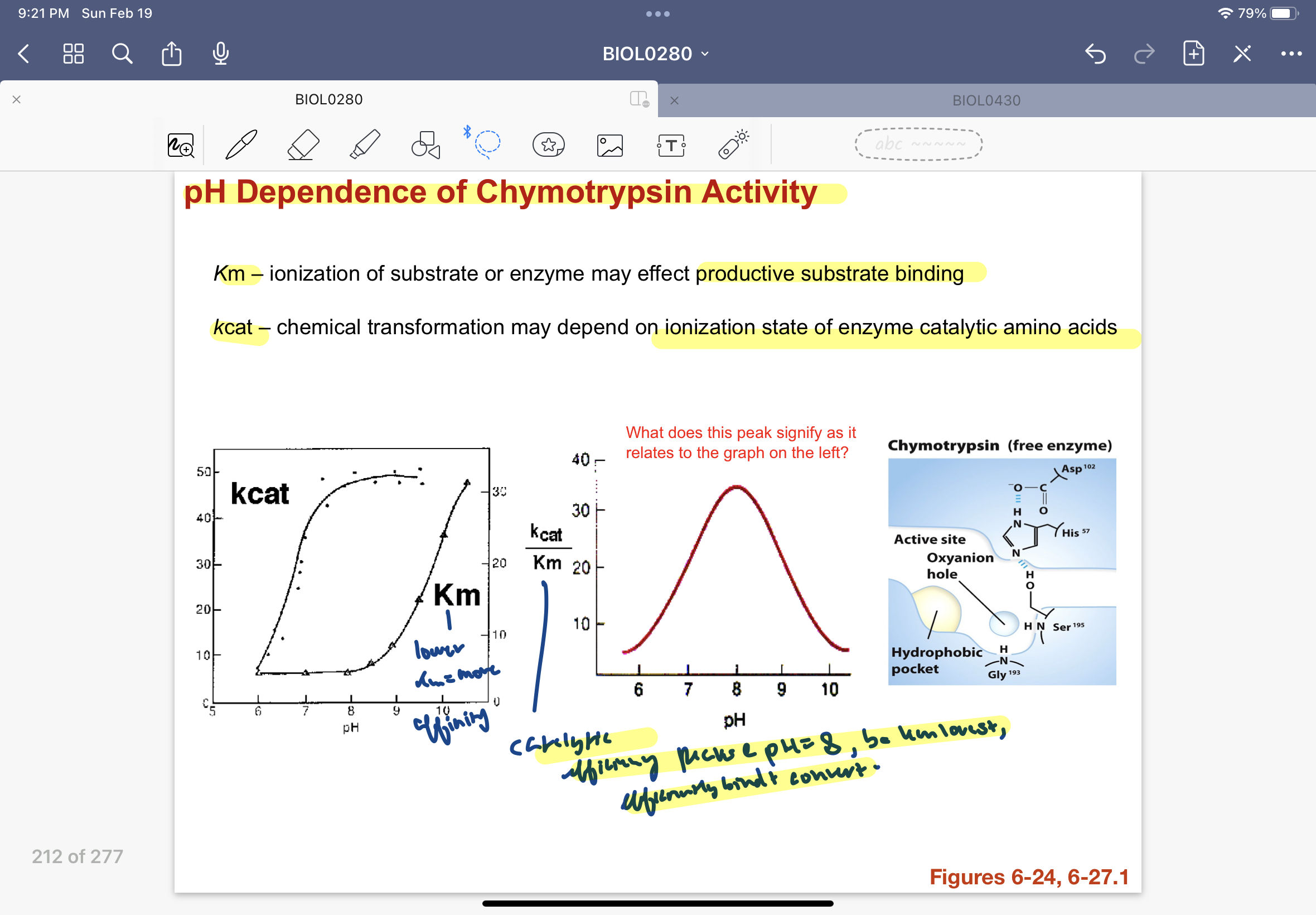
Km- ionization of substrate or enzyme may effect productive substrate binding. Kcat- chemical transformation may depend on ionization state of enzyme catalytic amino acids. Efficiency peaks at certain pH's because Km is lowest (binding is strongest) and Kcat is highest (convert is highest). Mechanism was determined by experimental evidence like irreversible inihibitor probes to inhibit specific amino acids, and through the use of chromogenic substrates. (trackable substrates). 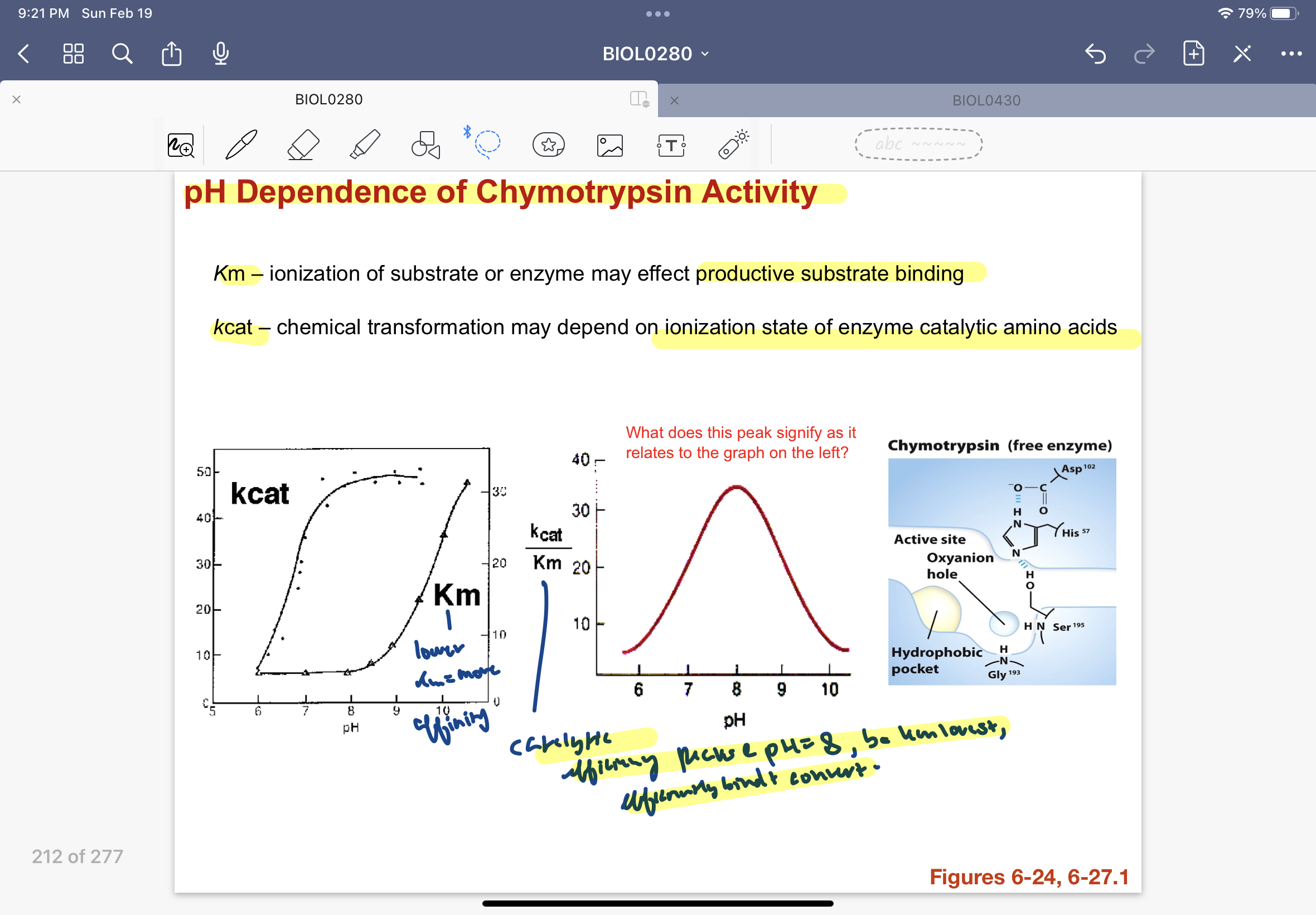
15
Irreversible Inactivation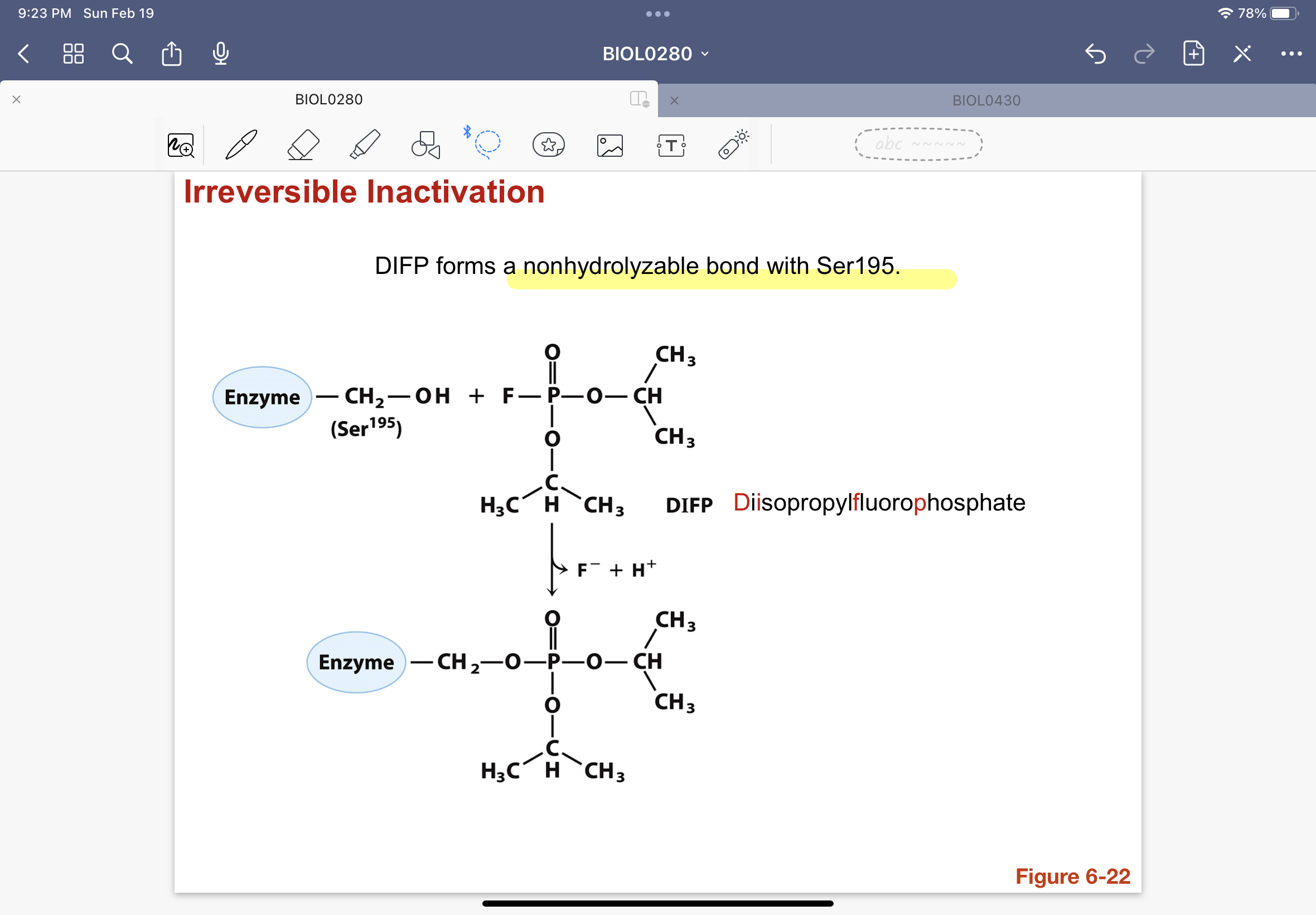
In absence of protein structure this allows you to determine amino acids involved. DIFP is a suicide substrate that creates a non-hyrolyzable bond with Serine 195 that can never be cleaved. It kills the enzyme whos activity is being recorded to confirm its presence (probe) . TPCK irreversibly alkylates HIS57 N (phenyl group similar to R) 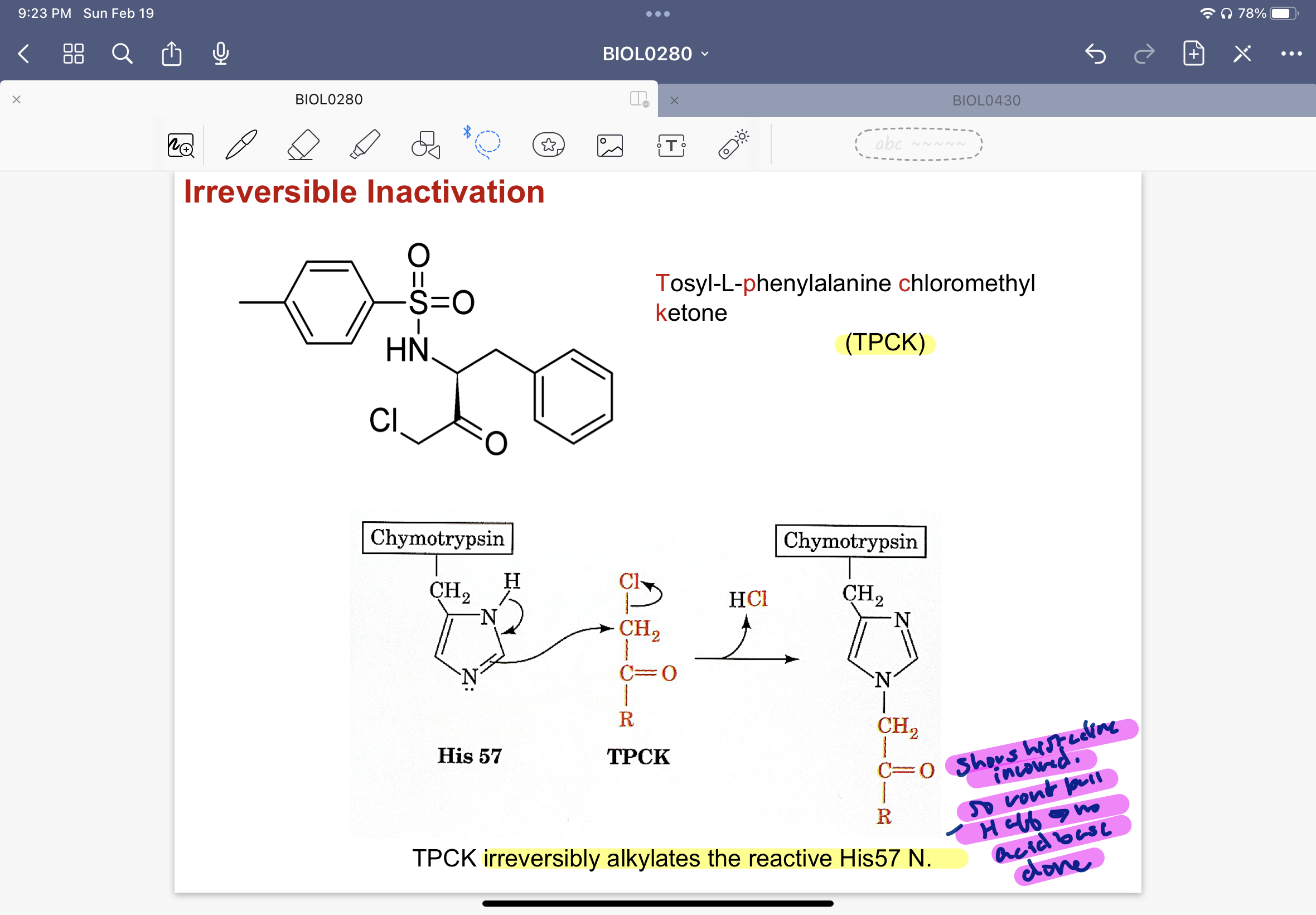
16
Pre-steady state kinetic evidence for Acyl-enzyme intermediate.
P-nitrophenylacetate is substrate that releases colored product (p-nitrophenol) when cleaved. Allows you to track progress of rxn/ if multiple steps occur. If intial burst of P-nitrophenol occurs followed by slower steady rate of formation, this indicates that product 1 formation and release is not the rate-limiting reaction step. 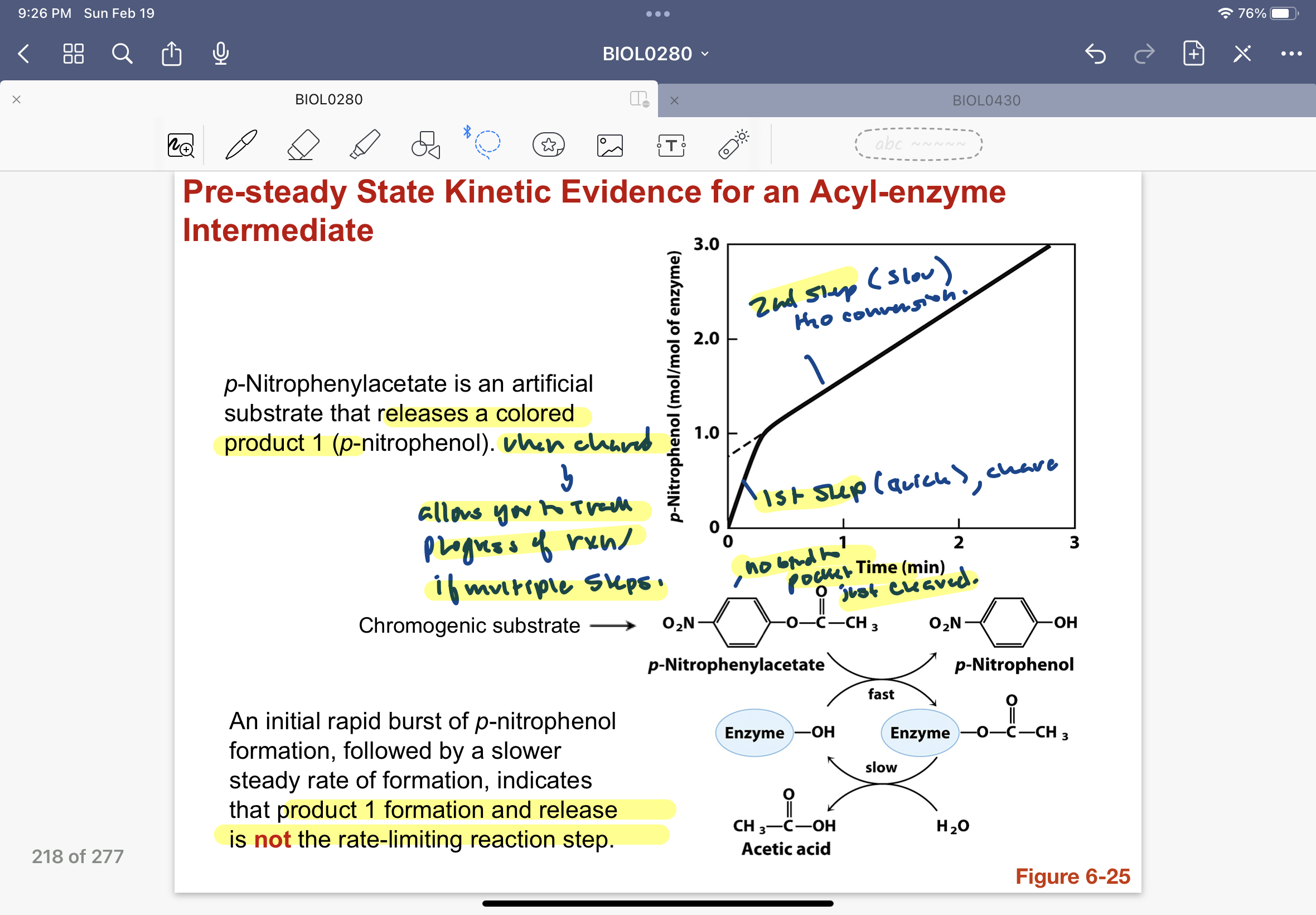
17
Summarizing Protease Families and Family members.
Depending on the residue in teh active site, proteases are classified as Serine, Cysteine, Aspartate, or Metallo proteases. Chymotrypsin, Trypsin, and other relateedSer-Proteases use the same catalytic trias, but have different substrate specificities (pocket differences). So once bound, use the same mechanisms of catalysis to operate.
18
Regulation of Enzyme activity
1) Proteolytic cleavage (Zygomens), 2) Signaling Cascades, 3) Reversible covalent modification (ex: phosphorylation), 4) Allosteric Modulation.
19
Zygomens
Inactive enzyme precursors. They have a distorted active site. A molecule (Trypsin for chymotrypsin) will break up the inactive form, making a slightly more active chain, for another molecule (Pi Chymotrypsin) to cleave again into its acitve form. Activation is irreversible and requires a specific protein inhibitor to tightly bind the active site to inactivate. Regulats function by not allowing change to become active. 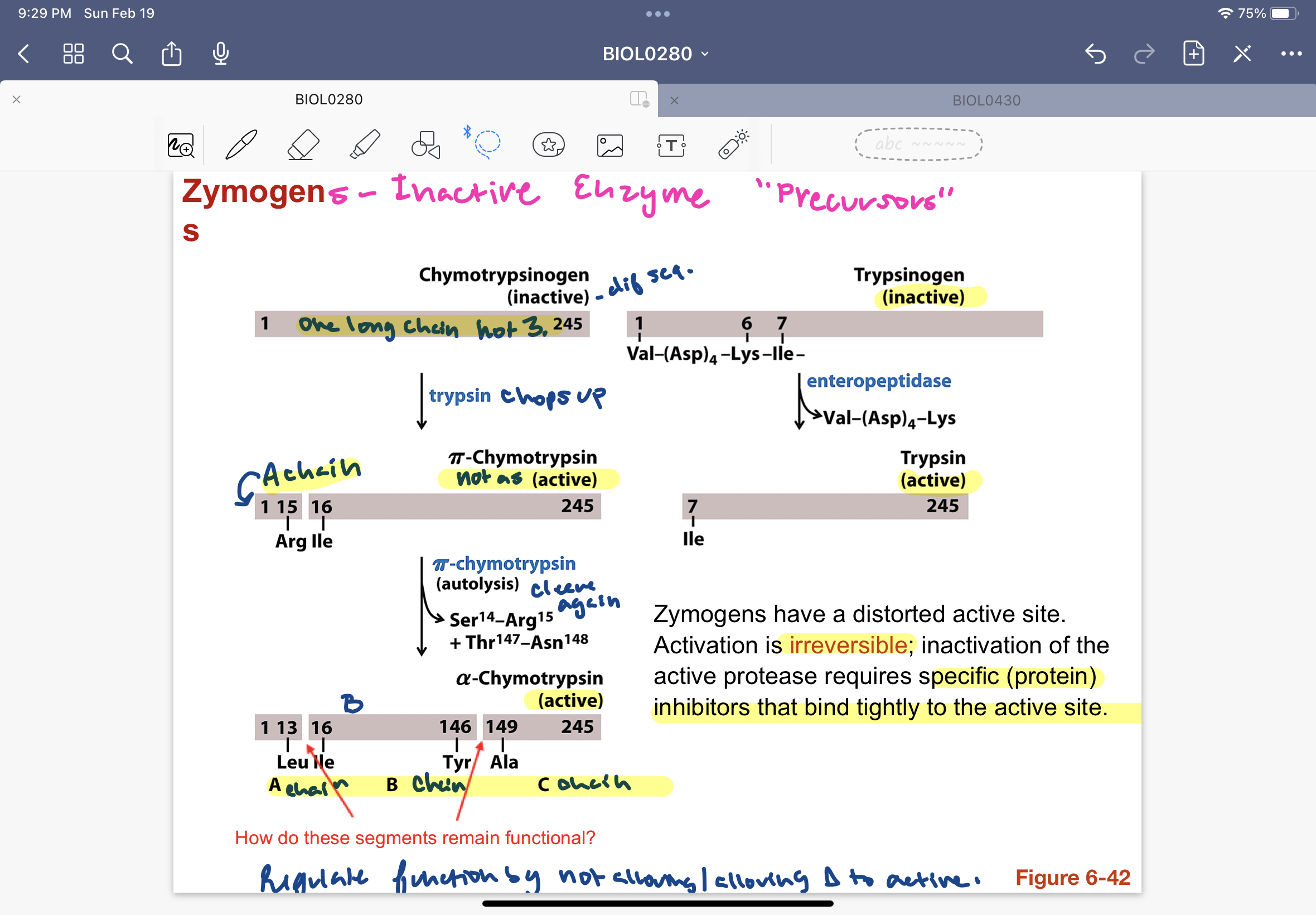
20
Enzyme Cascades and Signal Amplification
When enzymes activate enzymes, the number of affected molecules increases geometrically in a cascade. 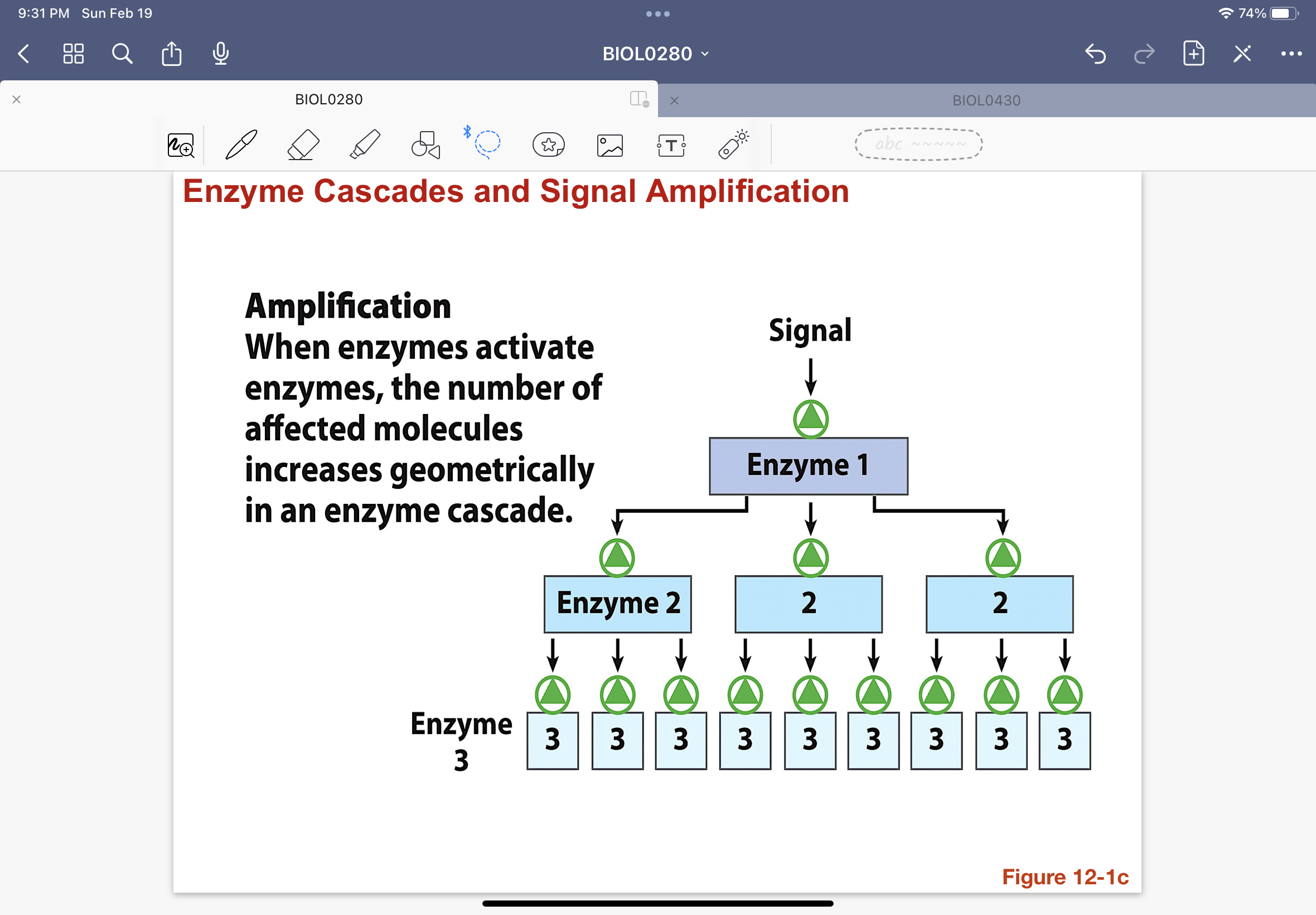
21
Allosteric enzymes
binding of. ligand at a regulatory binding site influences the properties of an enzyme positively or negatively. Homotropic allosteric enzymes are when the ligand and modulator are identical (like hemoglobin with oxygen, V0 v. [S] curves for these will be sigmoidal in their kinetics indicating cooperative binding. AKA non-Michaelis menton kinetics since hyperbolic and wont produce linear lineweaver berk plots) ,Heterotropic enzymes are when ligand and modulators are different molecules. 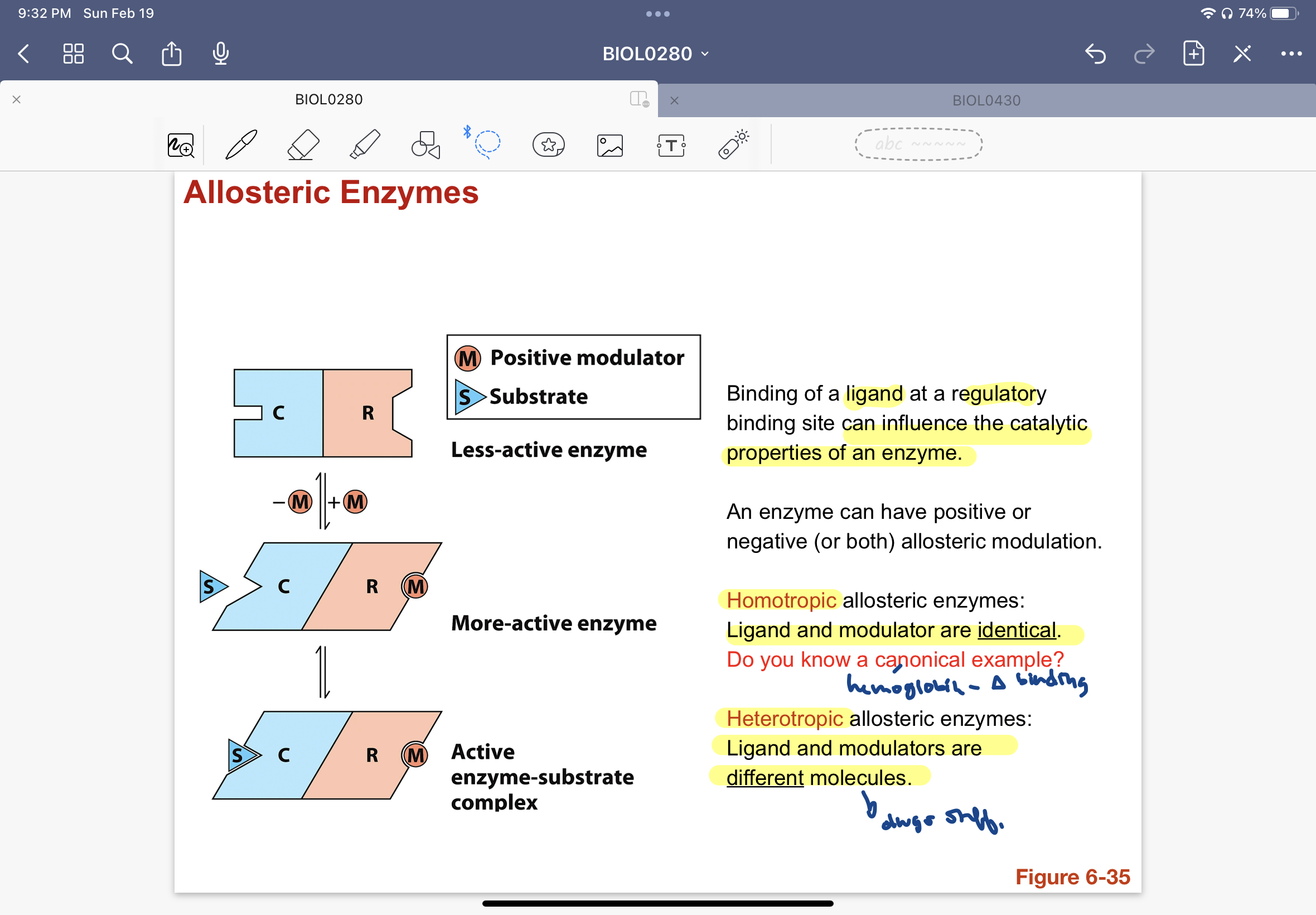
22
Heterotropic Allosteric Enzymes Kinetics.
Can regulate Binding affinity and velocity of reaction. 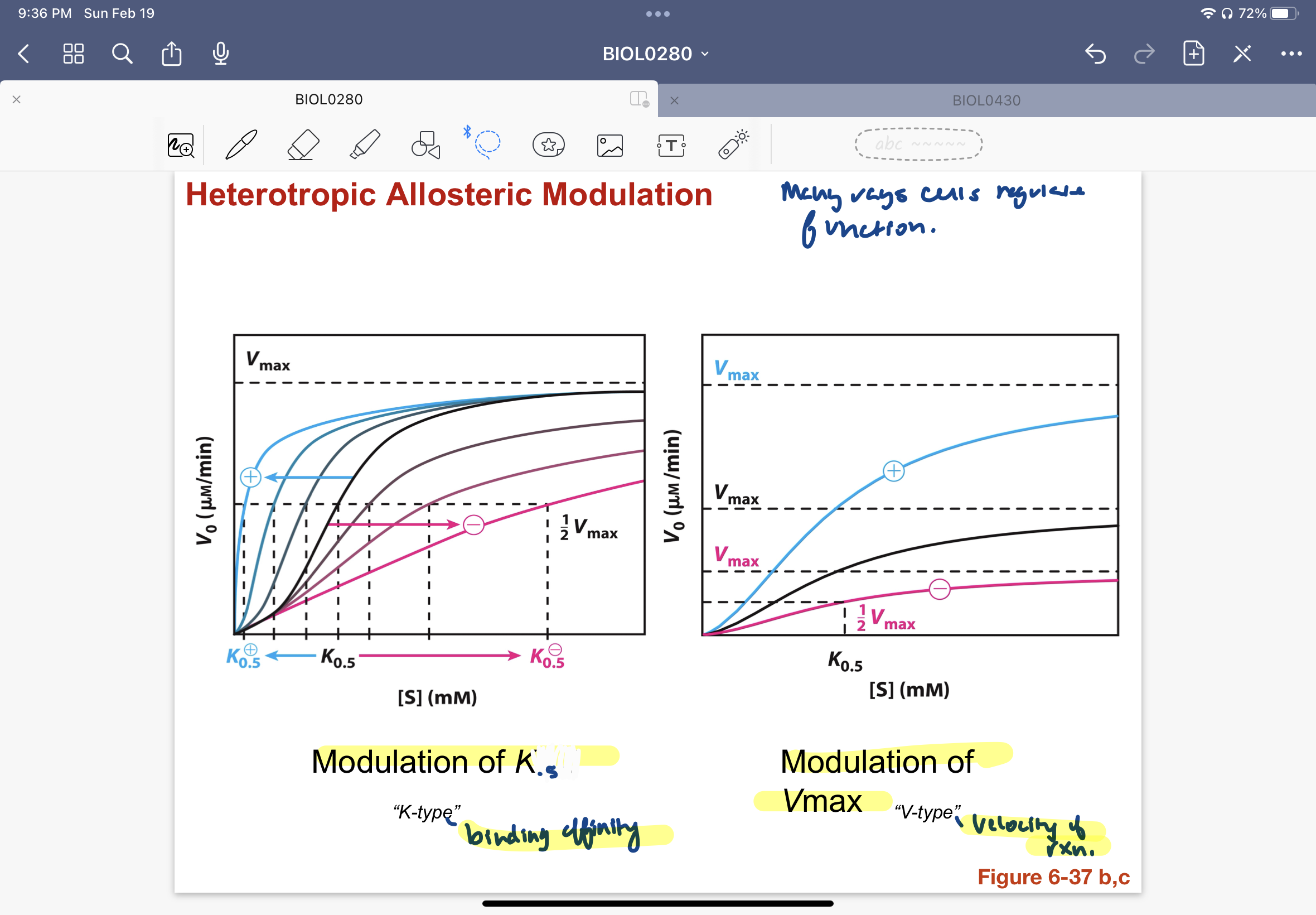
23
Feedback Inhibition
Enzymes at branching points or starting points of metabolic pathways are often heterotopically allosterically regulated (postively or negatively).
24
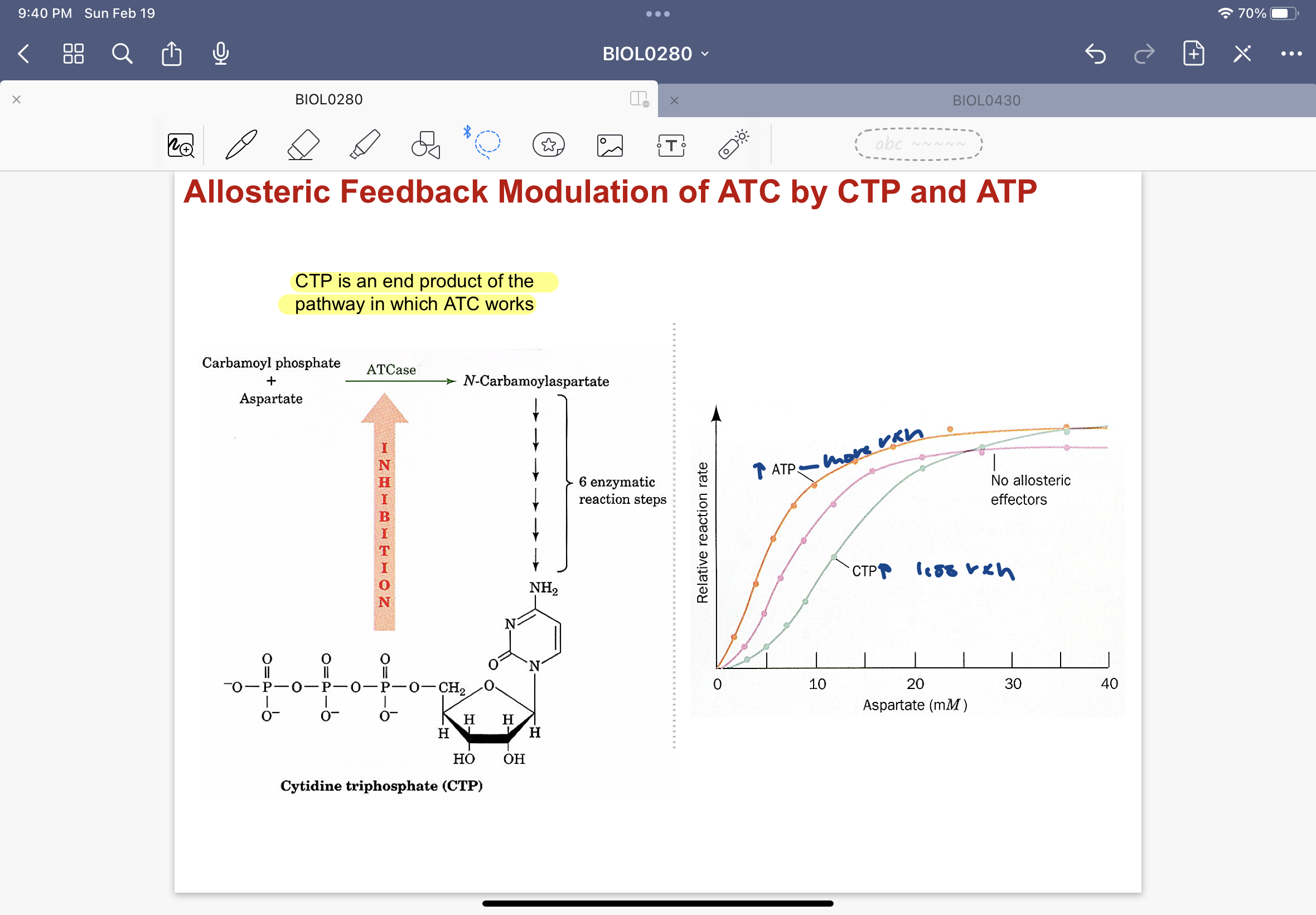
Aspartate Transcarbamoylase (ATC) Feedback inhibition example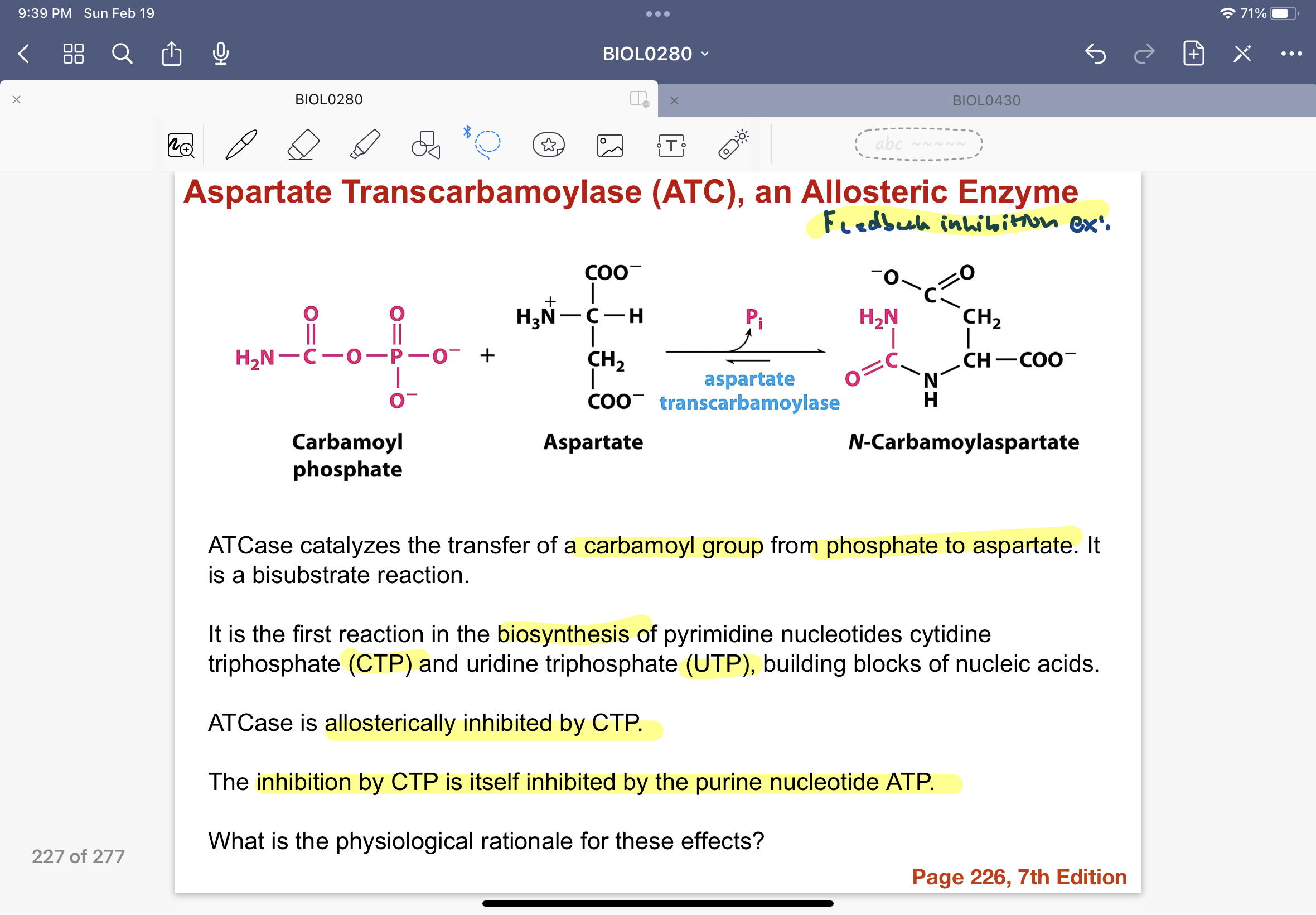
catalyzes the transfer of a carbamoyl group from phosphate to aspartate. (bisubstrate rxn). 1st reaction in biosynthesis of CTP and UTP. Is allosterically inhibited by CTP. Wont be inhibited by CTP if ATP is there. ATP is competitive with CTP heterotropic allosteric inhibitor at the regulatory site decreaseing its inhibitory affect. CTP is an end product of the pathway ATC works. Allows for maintenance of homeostasis.