Biochem Lectures 4-5
Study these flashcardsFree · spaced repetition · iPhone, Android, Mac & web
All cards
1
Myoglobin- 1st protein structure looked at
Ligand bound heme group. Oxygenated=red. P50 for O2 is .26KPa. O2 pressure at sea level is 21.2kPa, so the p50 is achieved at 1.2% of atmospheric [O2]/ myoglobin is half saturated with O2 at 1.2% of atmospheric [O2]. Used to store O2 in the muscles. hyperbolic saturation of O2 vs pO2 plot.
2
Heme and Porphyrins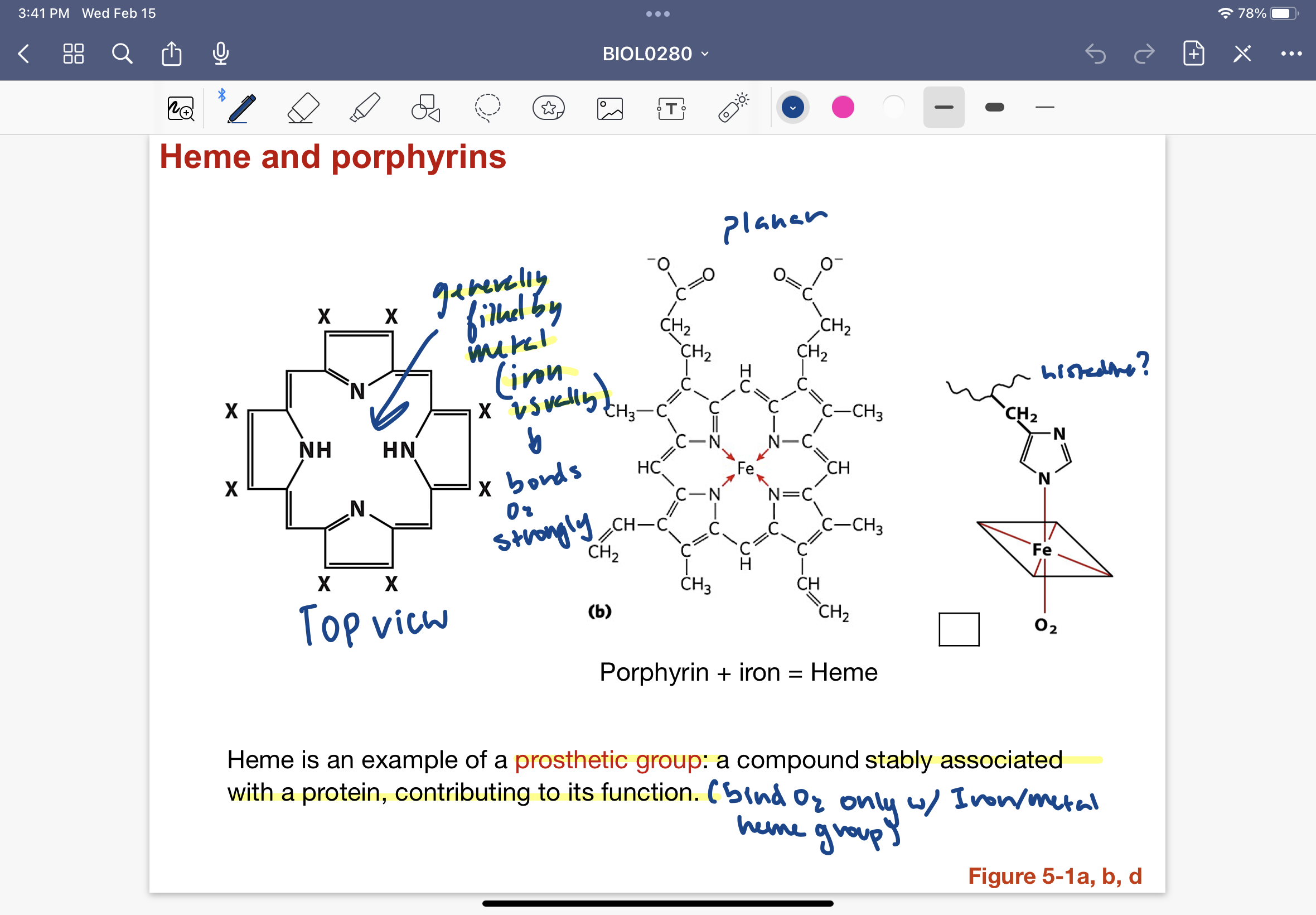
Heme is an example of a prosthetic group: a compound stably associated with a protein that contributes to its function. Generally center of porphyrin is filled by a metal (Iron usually), creating the Heme, which is attached to the protein (Histadine in Myoglobin?) and can attach to an Oxygen. 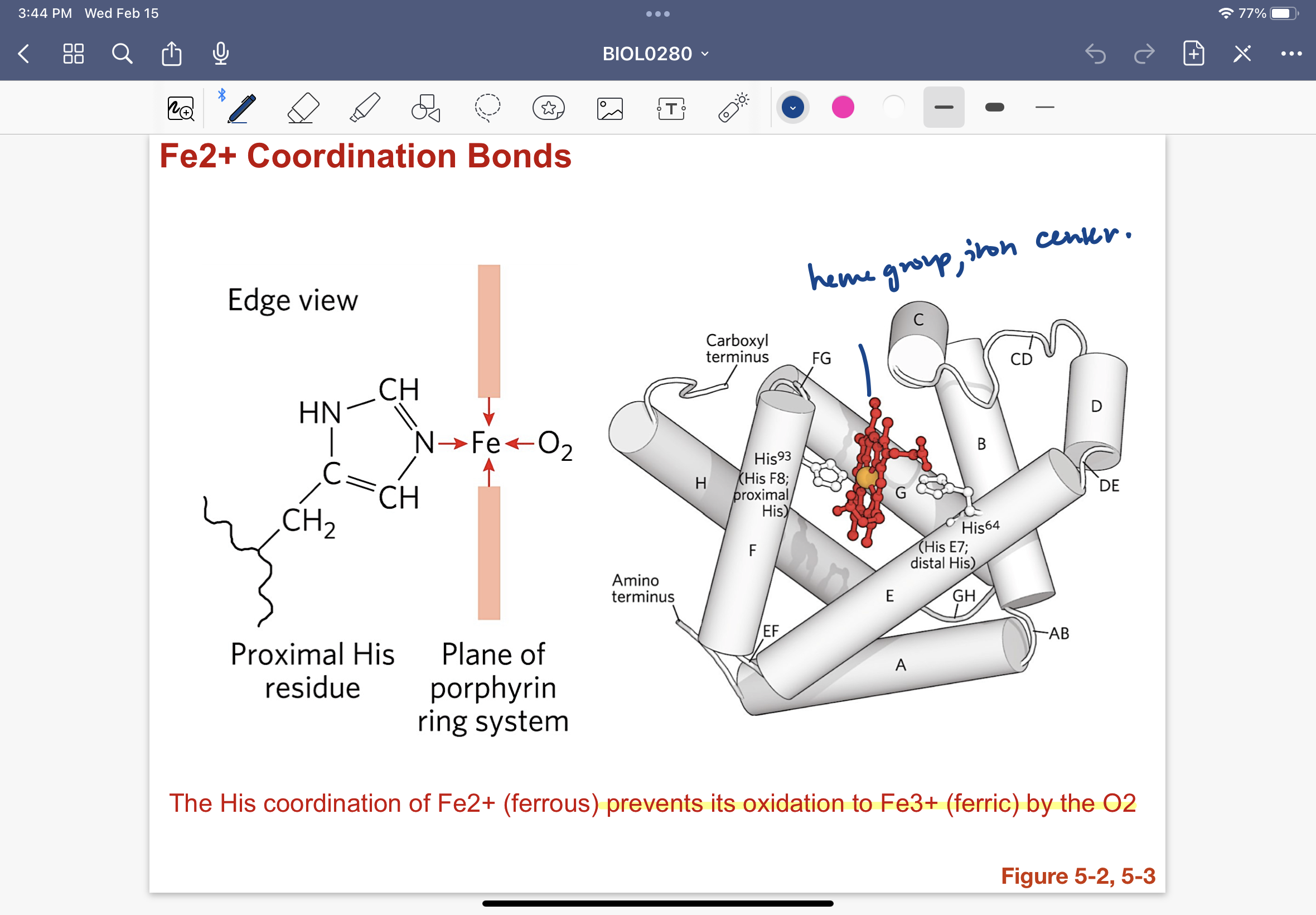
3
Ligand binding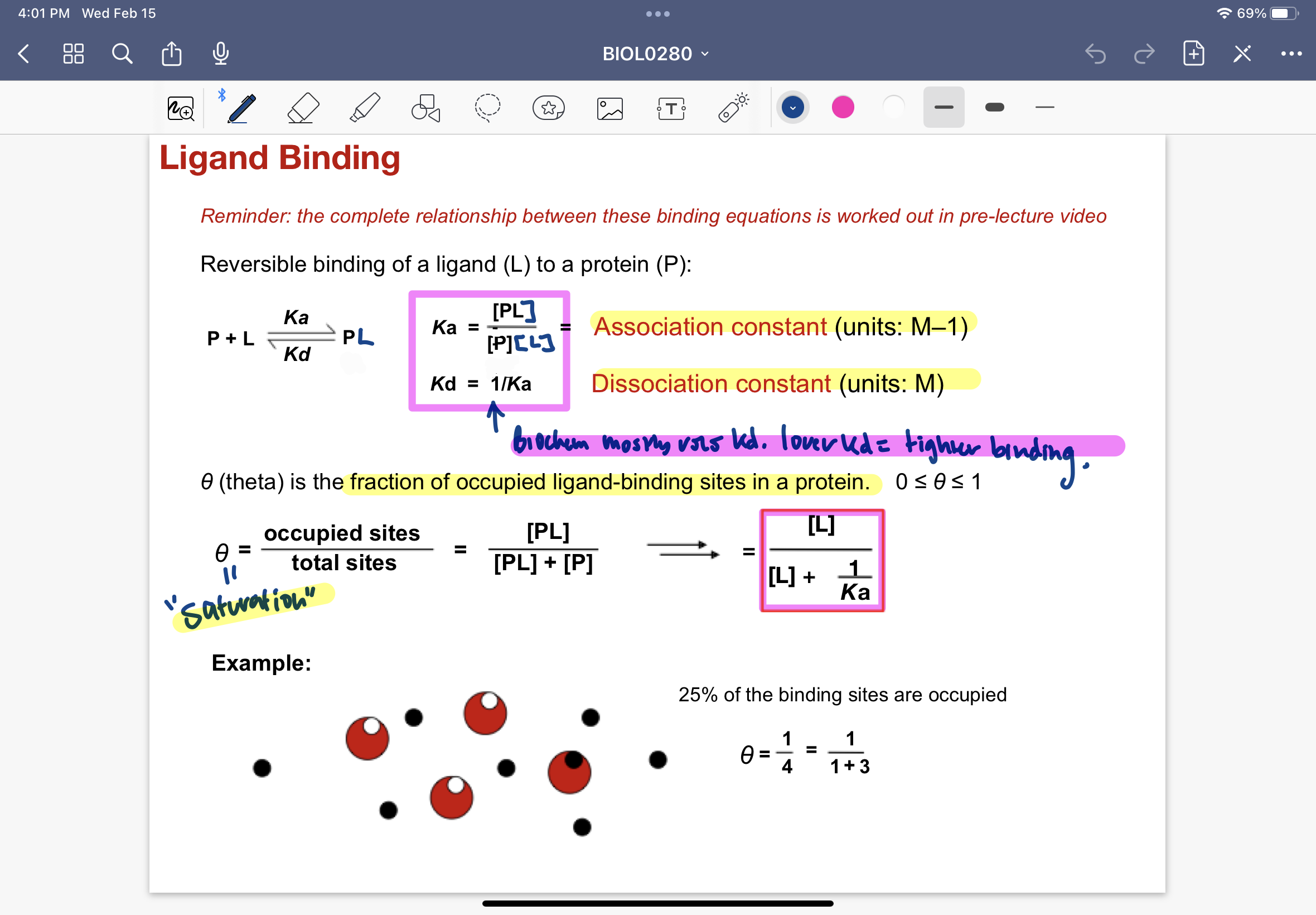
Ligand is a molecule bound reversibly by a protein. The lower the dissasociation constant (Kd) the tighter the binding. It is the molar concentration at which half of the ligand binding sites are occupied (or partial pressure if gas). Theta is equivalent to the saturation, or the fraction of occupied ligand-binding sites in a protein. 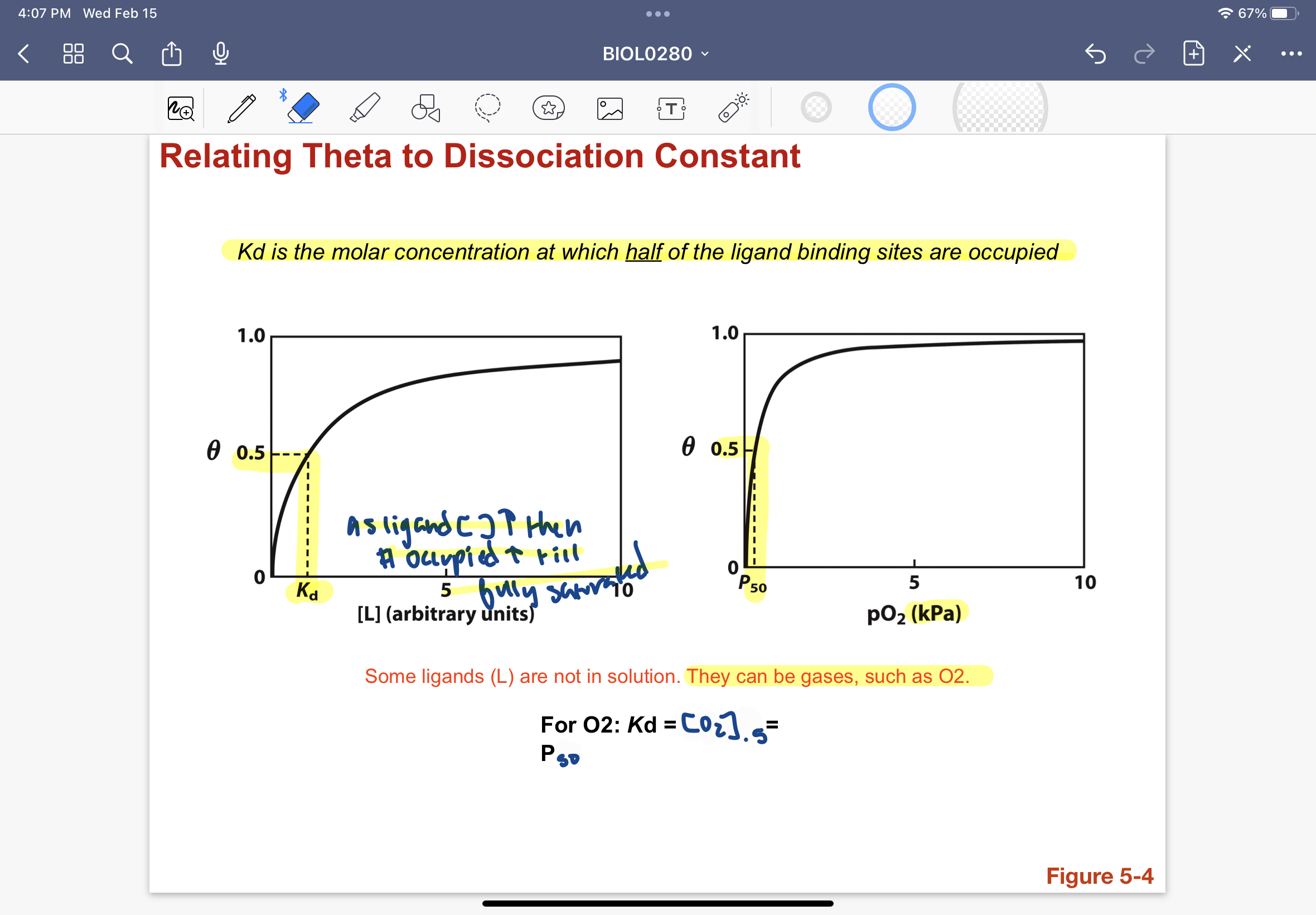
4
Fe 2+ coordination bonds with CO2 and O2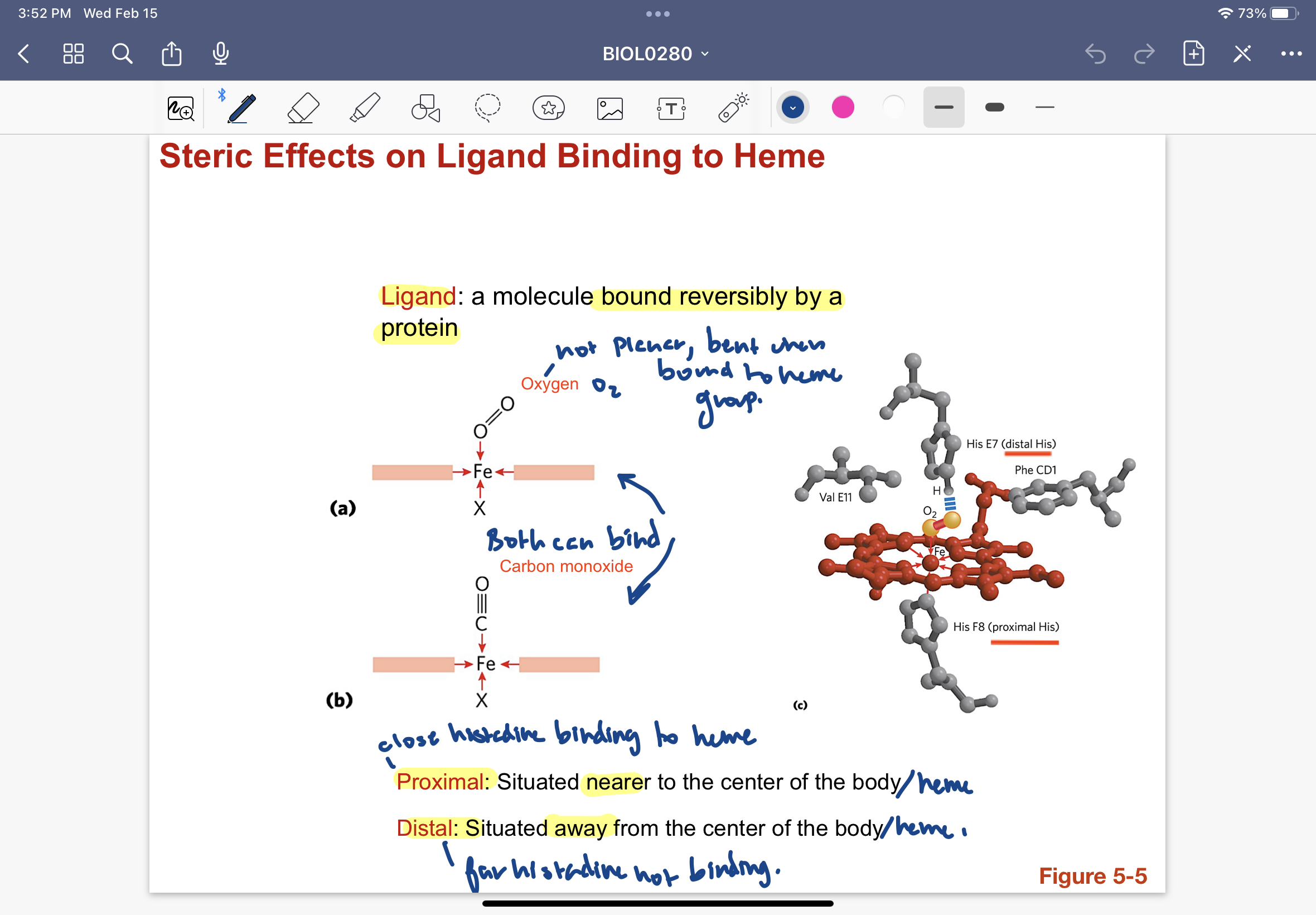
Histadine coordination of Fe2+ prevents its ocidation to Fe3+ by the O2. Both Oxygen and CO2 can bind to heme group but Oxygen binds at an angle so less steric hinderance. The proximal histadine would be the one the heme is bound to while the distal histadine would be the one the O2 is associated with. Free heme binds CO 25000X more tightly than O2. Myoglobin only binds CO 40X more tightly than O2 becuase of O2's lower steric hinderence and the distal histadine's Imidazole side chain stabilizing/ binding O2 to make the O2 affinity higher than usual. However, [O2] is higher than [CO] in blood so offsets this so that only 1% of myoglobin is coordinated with CO. 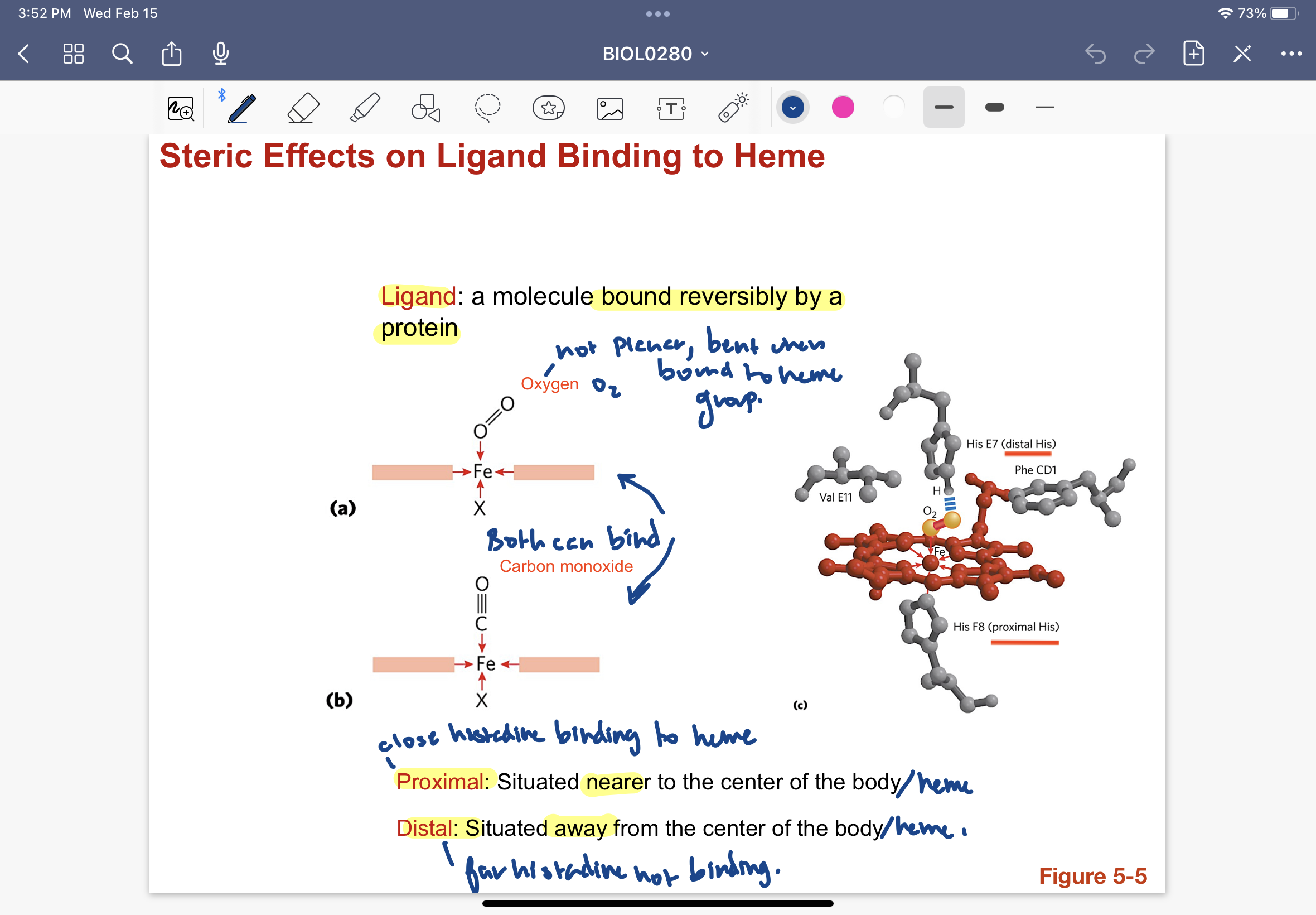
5
Hemoglobin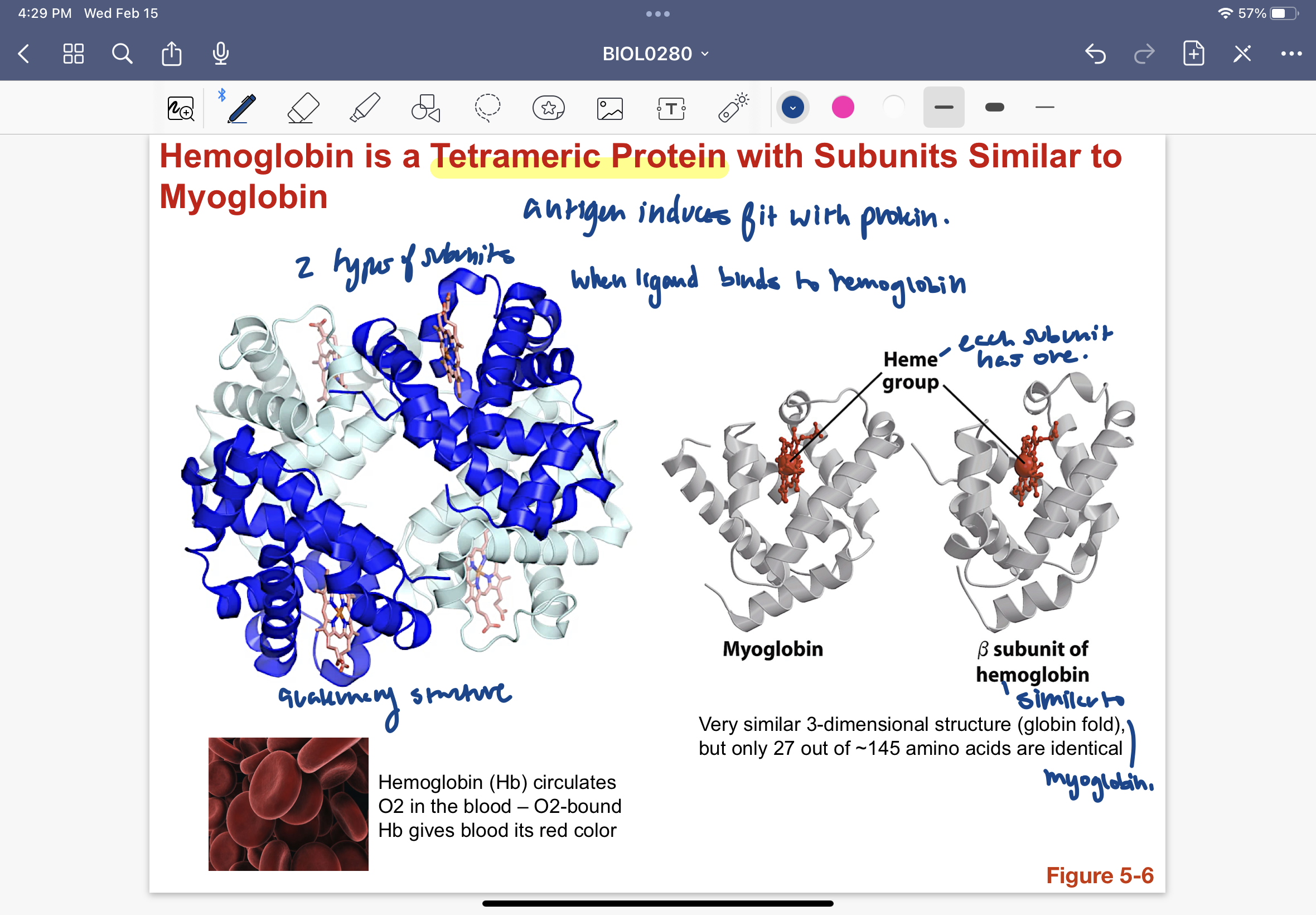
Tetrameric (4 subunits, alpha 2 and beta 2) protein with subunits similar to myoglobin, each with their own heme group. Used to circulate O2 in the blood. Has a sigmoidal binding curve reflecting cooperativity (low to high affinity transition depending on pO2 in tissues vs. lungs.) This allows for oxygen to be bound in the lungs (more likely to bind and hold due to high O2) and released in the tissues (less O2 available and less likely to bind/hold). Venous blood is more acidic (CO2) than arterial blood: H+ binds to any hemoglobin amino acid and CO2 can bind to Hemoglobin at its amino terminus both of which favor the hemoglobin T state (low affinity to oxygen, AKA more acidic lowers hemoglobin affinity for oxygen because protonation allows for new salt bridges stabilizing lower affinity T state. !) .
6
Hemoglobin T and R states. 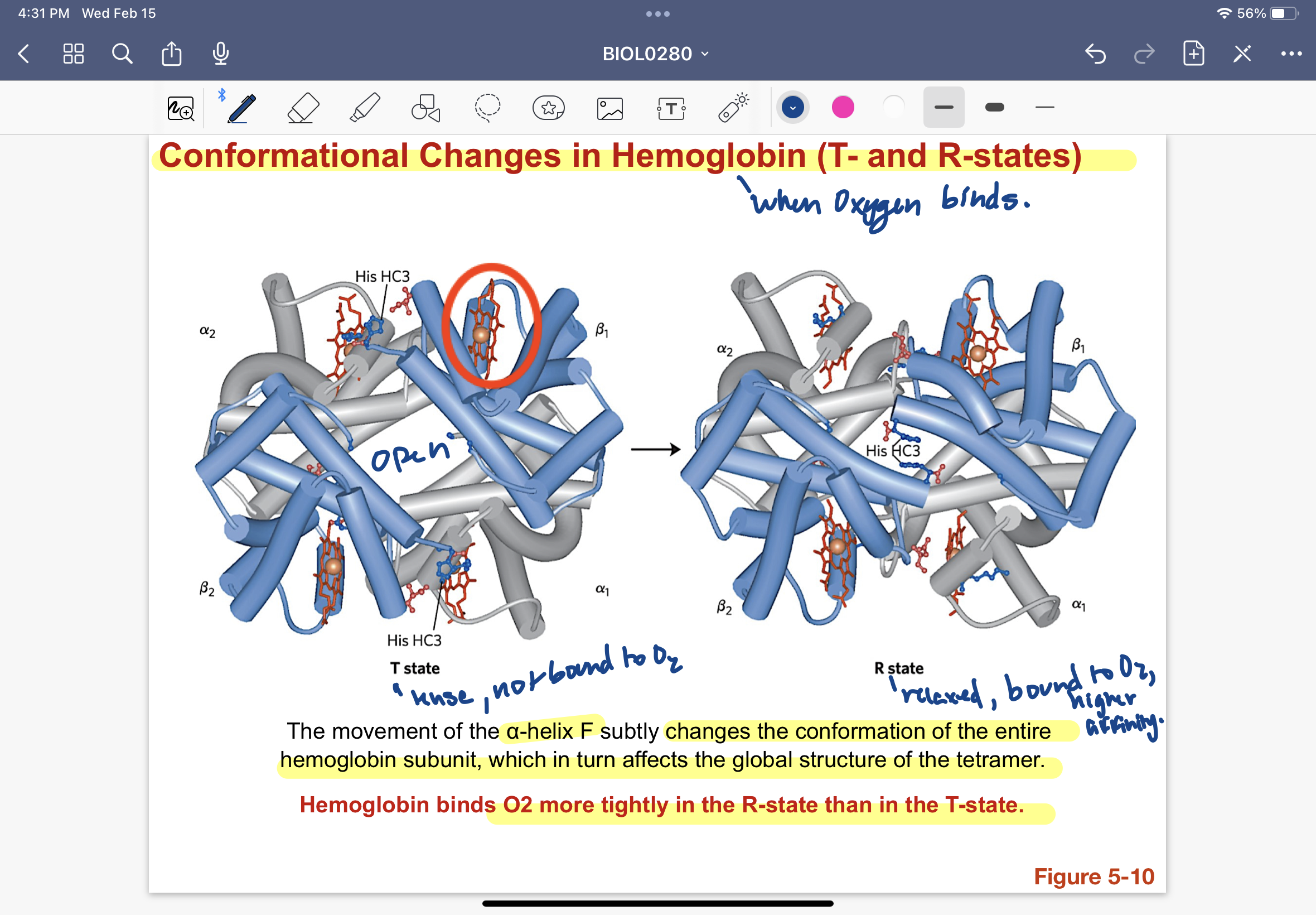
The T state is when no O2 is bound, it is "tense" becuase the heme Fe is pulled out of the plane of the porphyrin by the proximal Histadine, bending the plane and straining it, also makes the the Hemoglobin donut hole is more open. When Oxygen binds, the movement of the alpha helix F changes the conformation of the entire subunit, affecting the entire tetramer. With Oxygen bound the Hemoglobin is now in the R "relaxed" state because the O2 centers the Fe in the plane of the porphyrin (pulling against the proximal histadine, causing its alpha helix F to also move with the histadine towards the porphyrin plane= changing the conformation) so that it is less strained, making the Hemoglobin donut hole smaller. Hemoglobin binds O2 mor tightly in the R state than in the T state due to the cooperativity/ positive allostery of the subunits. 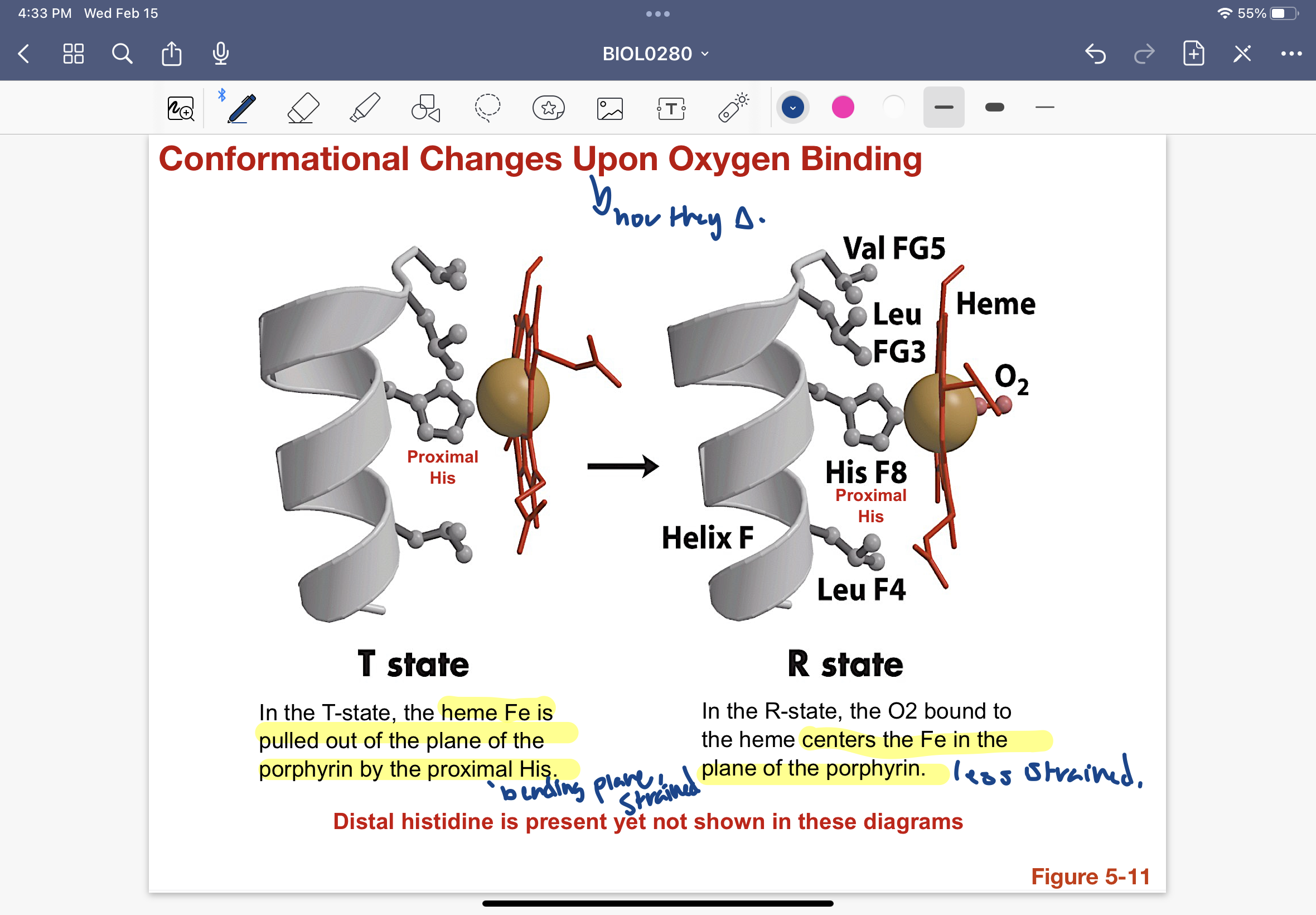
7
Allostery
binding of a ligand to one site affects the binding properties of another site on the same protein. CO2 is acidic, if you have more of it or any acid then you wull have less O2 binding affinity becuase of competition. same with more 2,3 DPG and higher temp.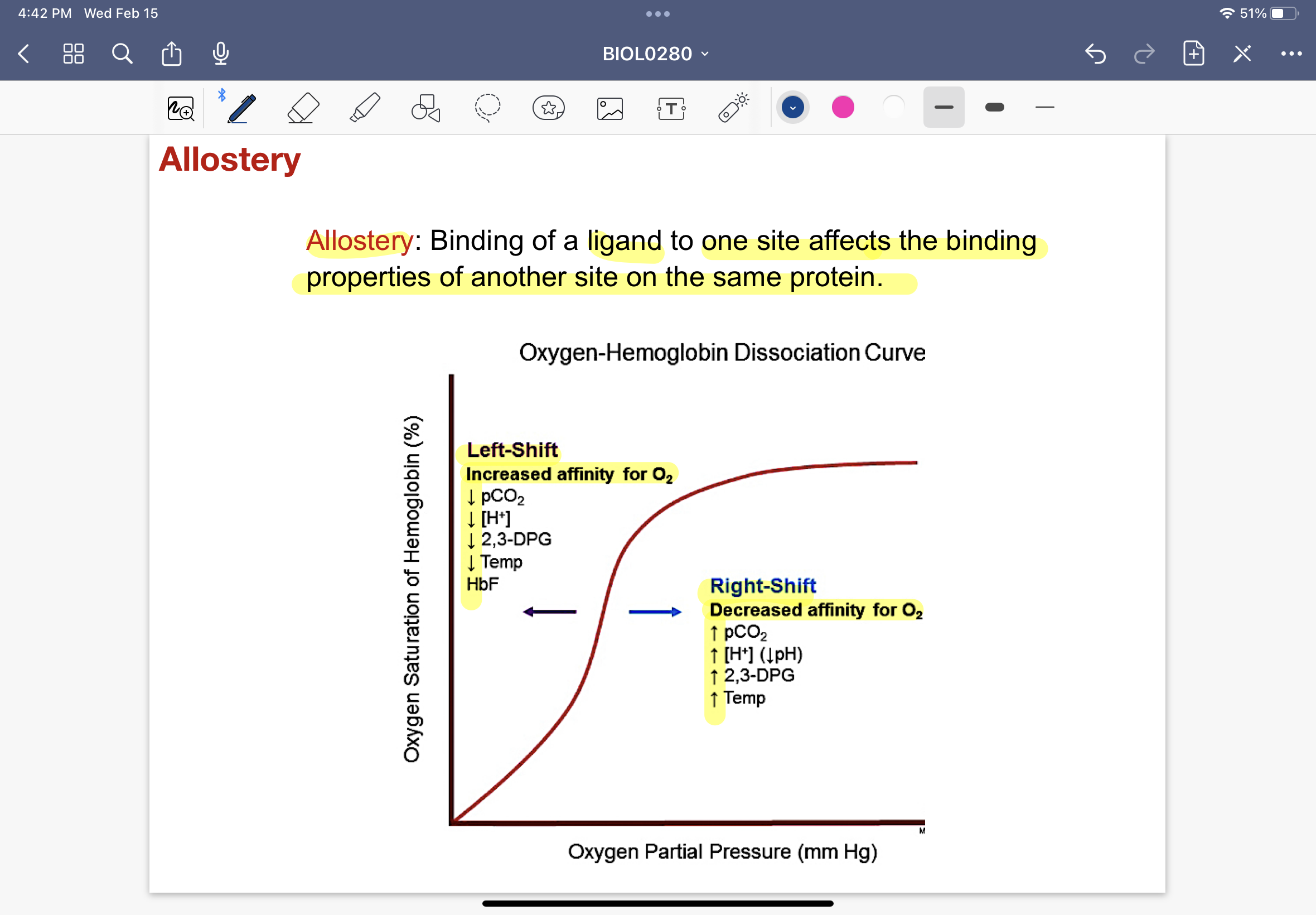
8
Hill's equation and cooperative binding. 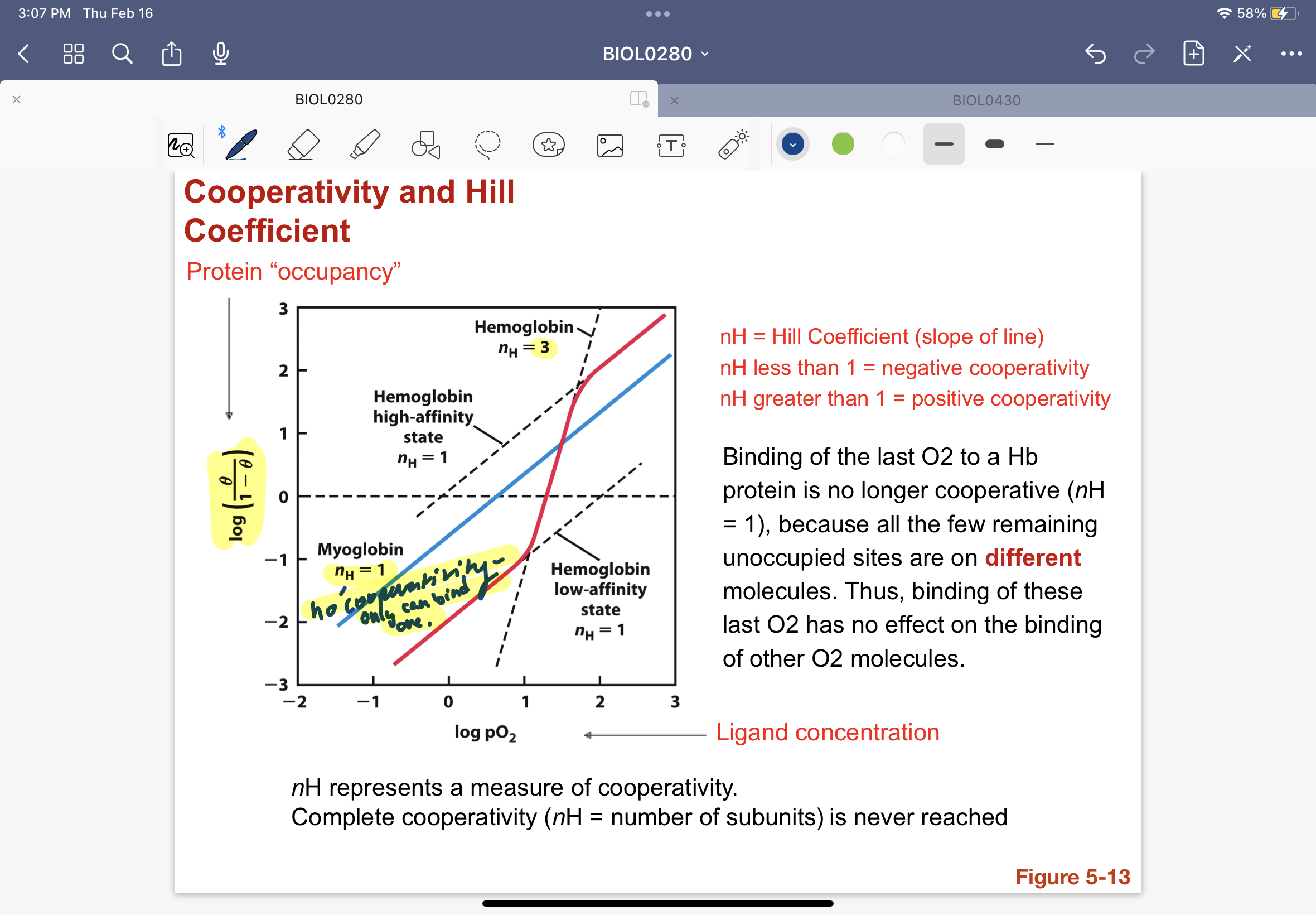
nH is the Hill's coefficient and is the slope of the line if in log form of equation. an Nh less than 1 indicates negative cooperativity, and nH greater than 1 indicates positive cooperativity. Complete cooperativity in which nH=# of subunits is never reached becuase as the last O2 binds to hemoglobin, it cannot increase the afffinity of the other subunits since they are already bound, therefore the last subunit has an nH of 1. (non-cooperative binding). Hill coefficients allow for the comparison of the degree of cooperativity
9
Concerted and sequential allosteric models
(MWC)Concerted states that the binding of one ligand causes all subunits to swtich into the R state (measurable), while the (KNF) sequential model states that the binding of a ligand can range anywhere between no subunits in the R state (despite binding) to all subunits in the R( undetectable quantity). Reality of how it works isnt explained by either. 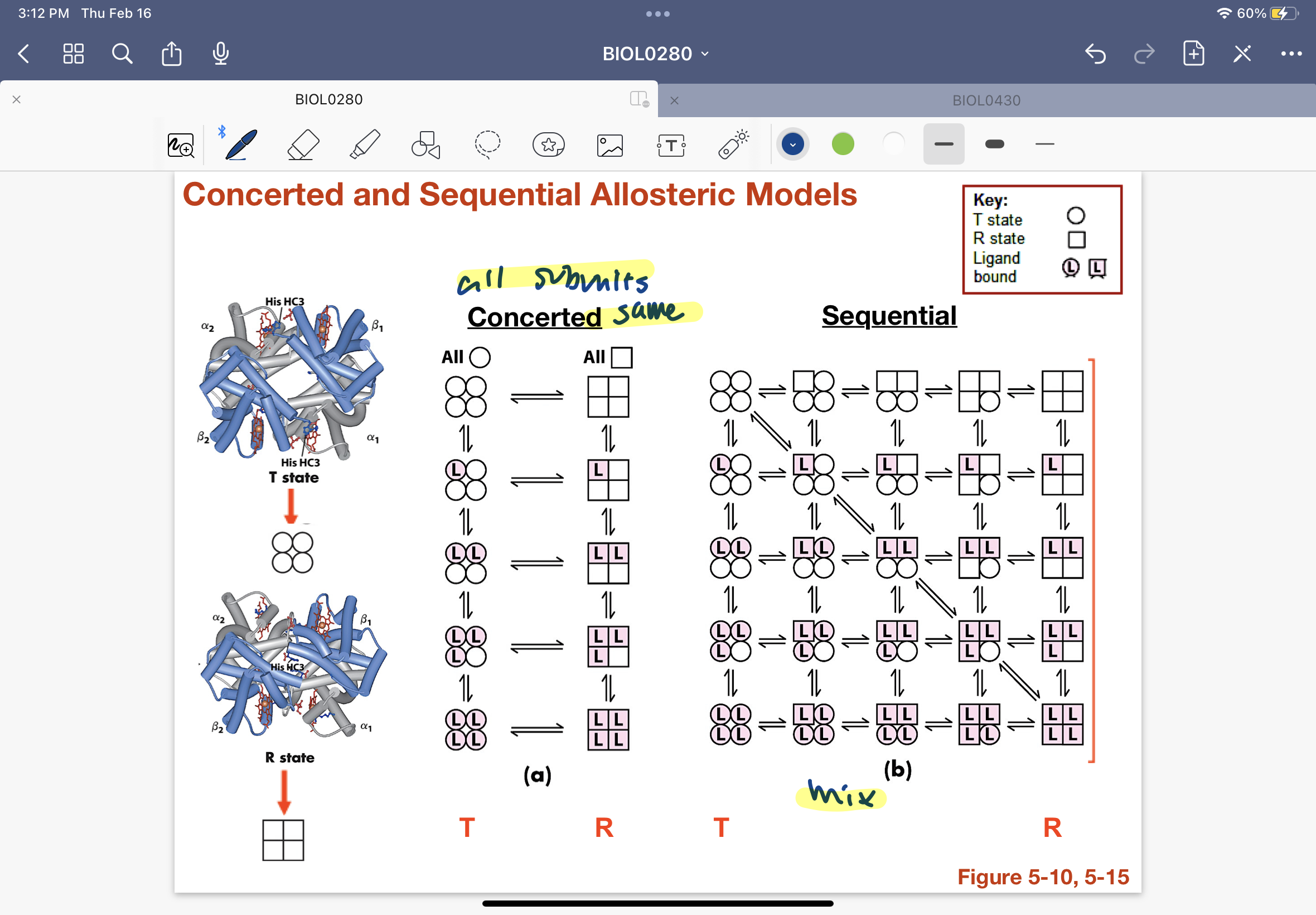
10
2,3-Bisphosphoflycerate (BPG) effect on Hemoglobin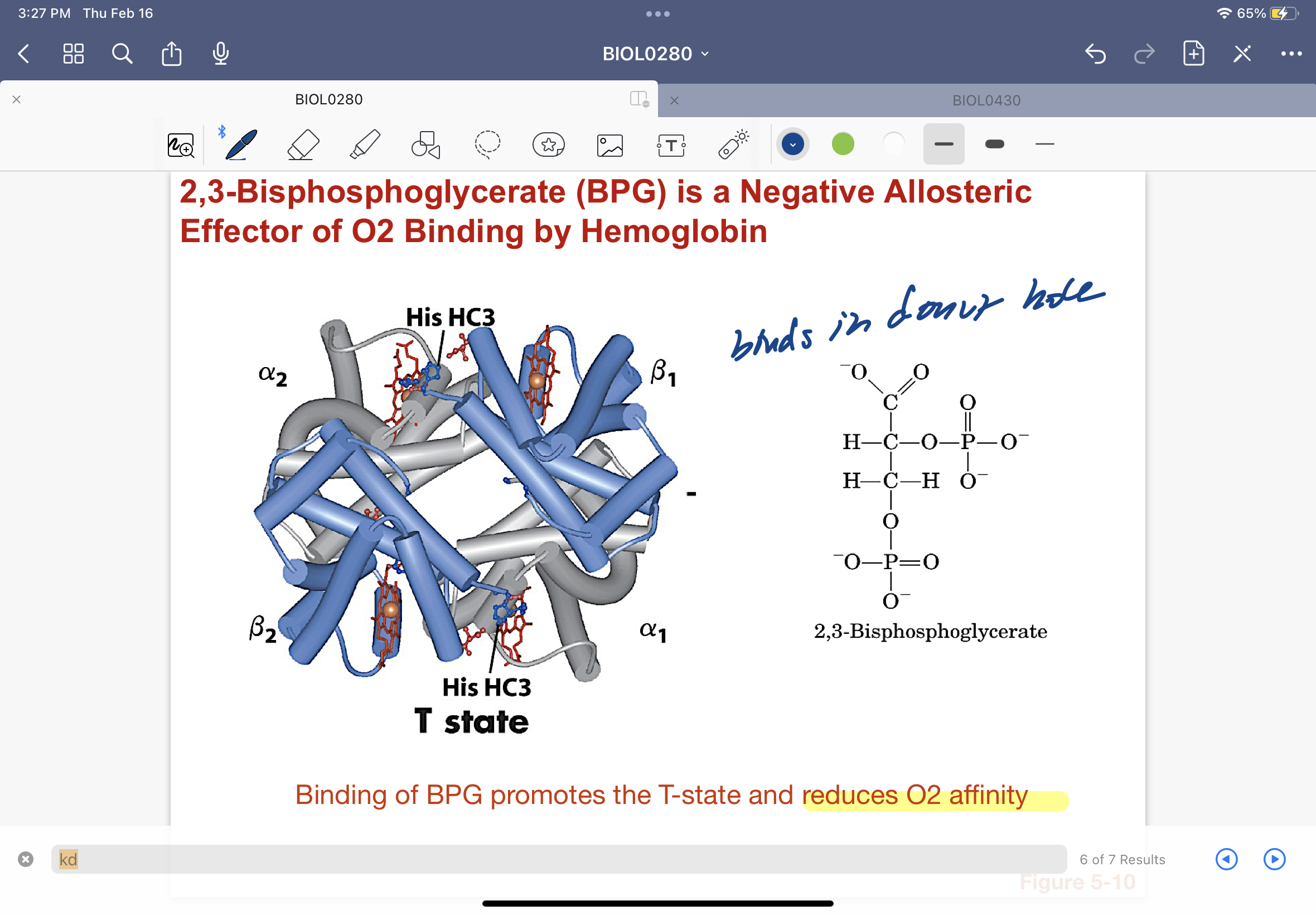
BPC has a negative allosteric effect on O2 binding to Hemoglobin. BPG binds in the donut hole ( - charges attracted to + His aa at center of hemoglobin T-state tetramer only). and promotes the T state, reducing O2 affinity. Normally, going from pO2 of lungs to pO2 of tissues results in 38% of boudn oxygen released into tissue, However, at higher altitudes the pO2 in the lungs is much lower, preventing enough oxygen being released into the tissues. Adding BPG shifts the curve to the right, decreasing Hb affinity to oxygen so it more readily releases it into tissues at higher altitudes. 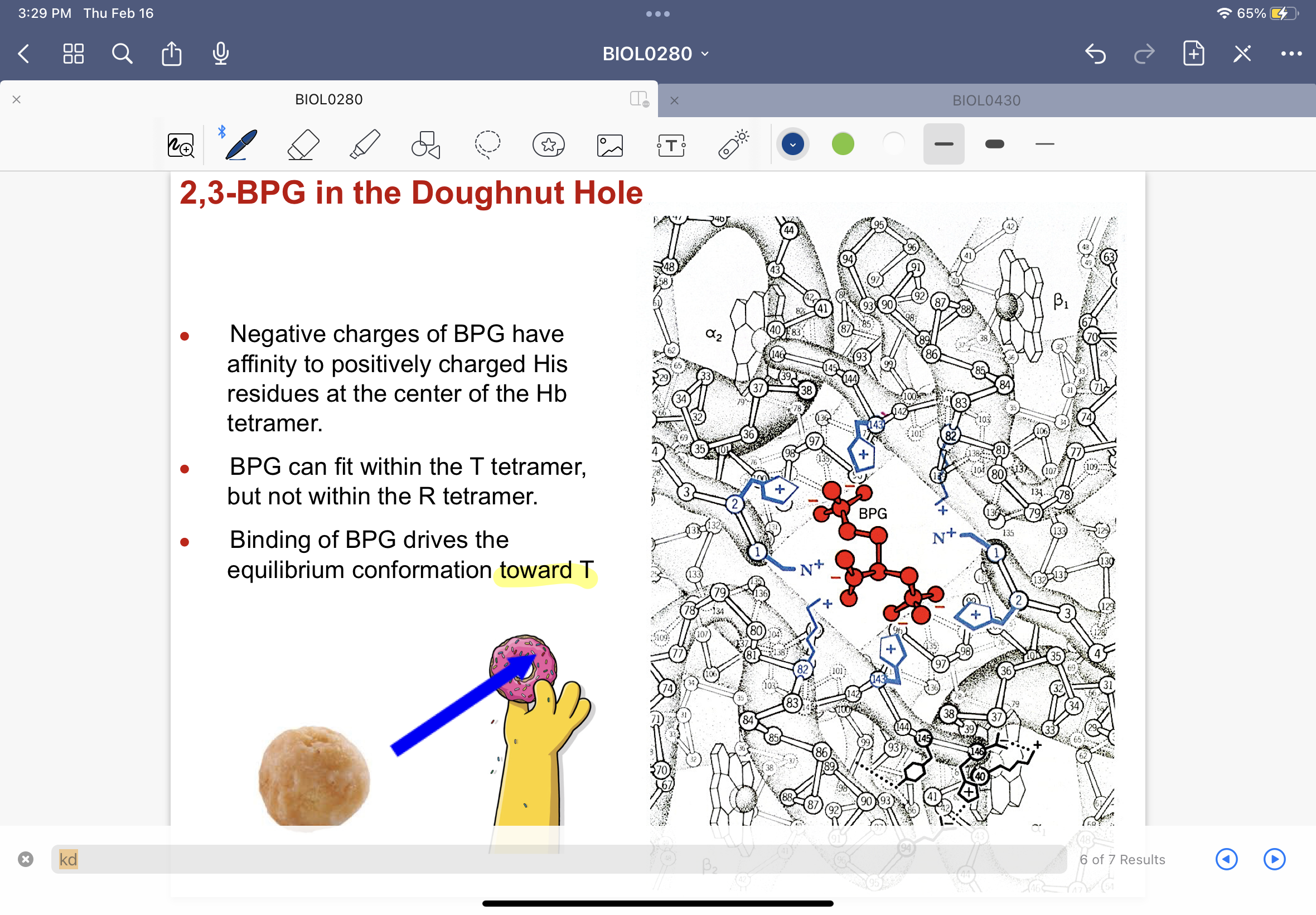
11
Definitions of Kmx, Vmax, and Kcat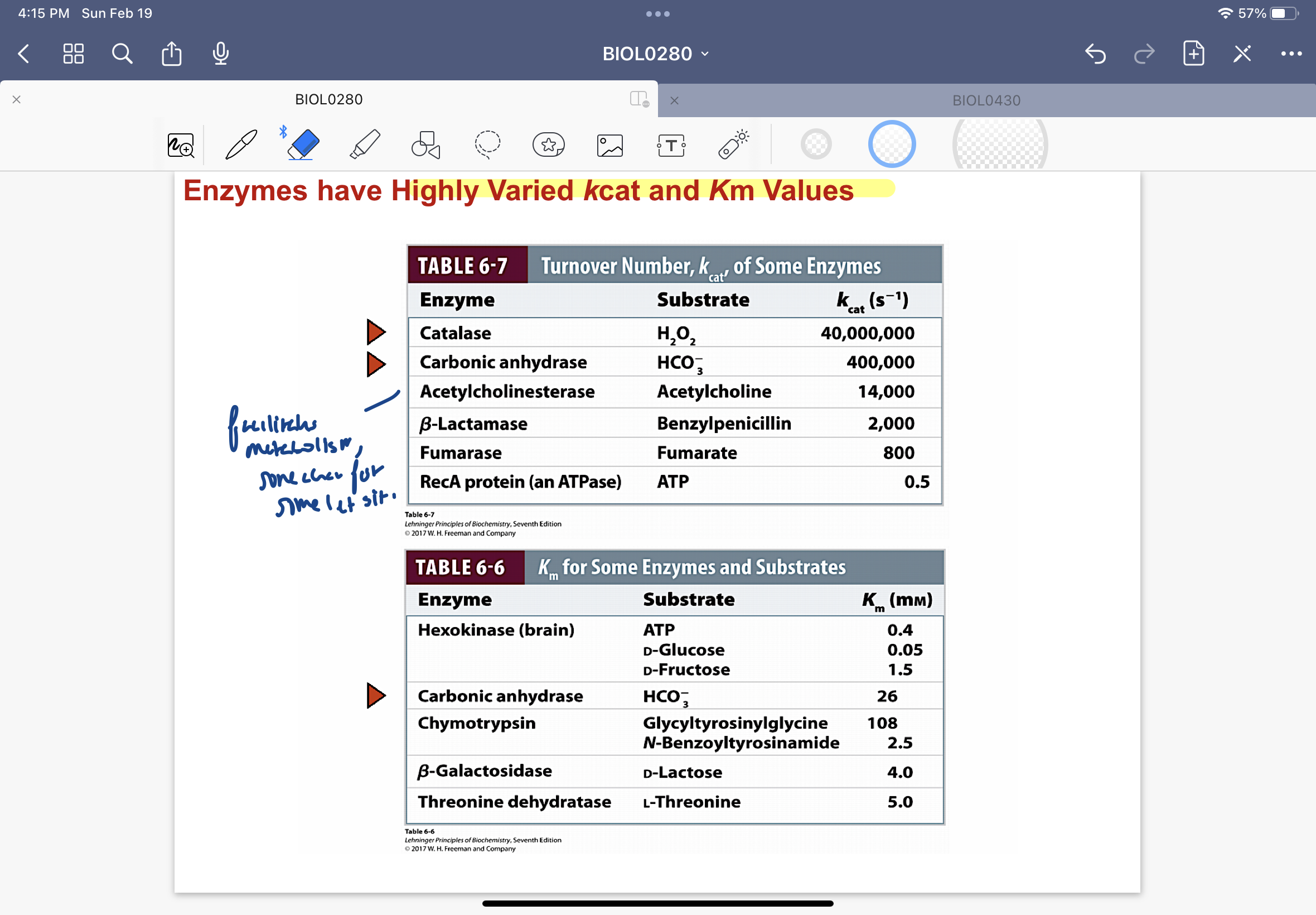
Km- Michaelis menten constant, apparent dissociation constant which correlates reaction rates with the dissociation constant Kd. It is the substrate concentration at which the reaction velocity is half maximal. Units mol/[sec*L] If Km is small, a lower [S] is required to achieve half maximal Vo and the reaction rate at low substrate concentrations is relatively high. ex" acetaldehyde rapidyremoved at low Km but accumulates at high Km. Km is the apparent dissociation constant for S and E becuase it is determiend from kinetic and not equilibrium data. it approximates the true dissociation constant Kd only when the rate of E+s>ES is much more rapid than the rate of ES>EP. If asking for affinity look specifically at table Km values, if asking for stability look specifically at graph. Vmax- the maximal velocity that can be achieved given total enzyme concentration. It is proportional to enzyme concentration and is a measure of how fast the reaction can proceed once [ES] is formed. Units mol/[sec*L] Vmax= Kcat[ET] Kcat is the catalytic constant, or turnover number. It is the number of molecules (or mol) of substrate converted into product per molecule of enzyme at saturating substrate concentration (Vmax conditions). Units 1/sec. Kcat=Vmax/[Et] Essentially, mol product/mol of enzyme @ Vmax.
12
Determing Km from Hyperbolic V0 v. [S] curves. 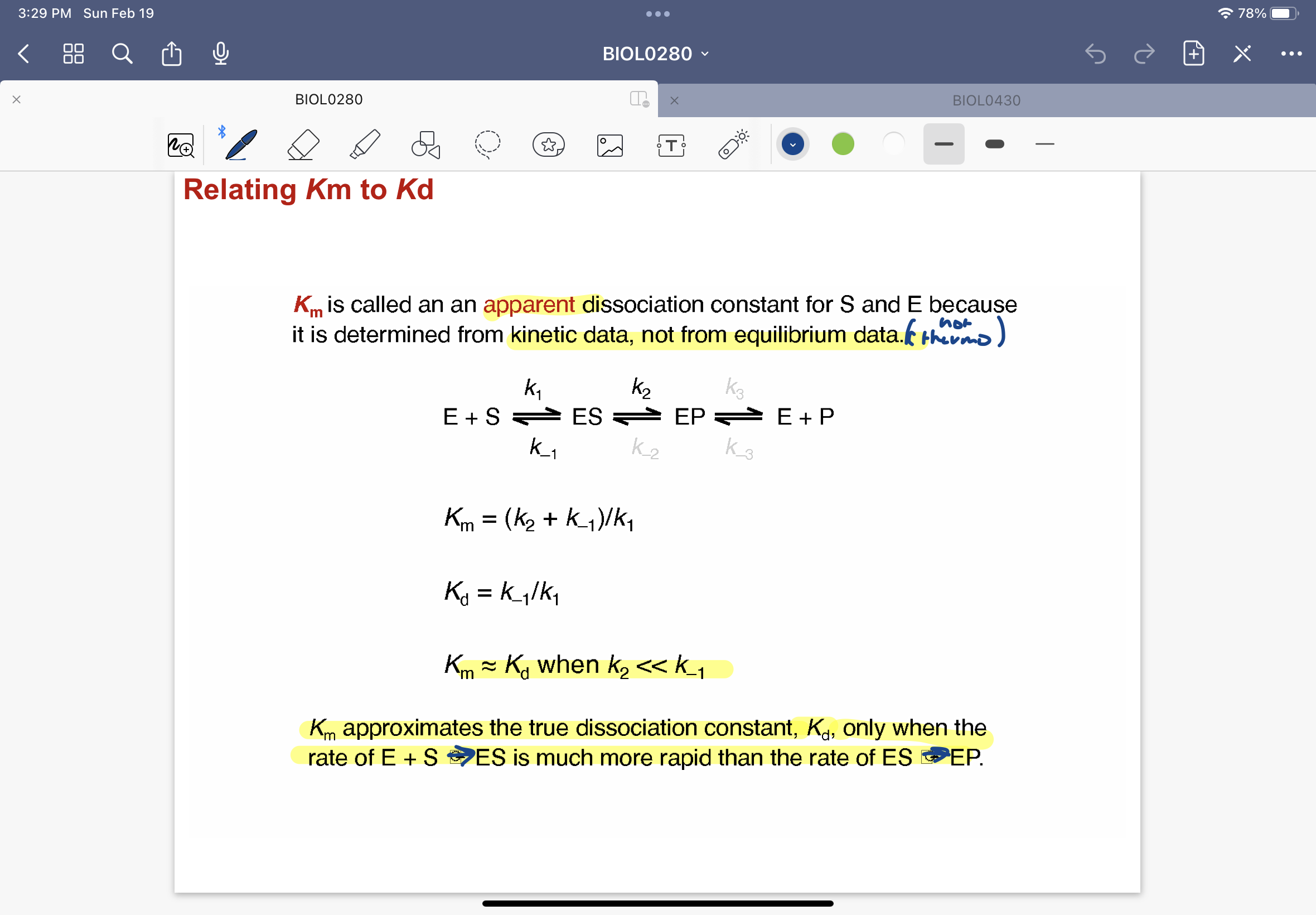
Double reciprocal/ lineweaver- burk plots present km/Vmax as the slope of the line. with 1/V0 as the Y axis and 1/[S] as the x axis. 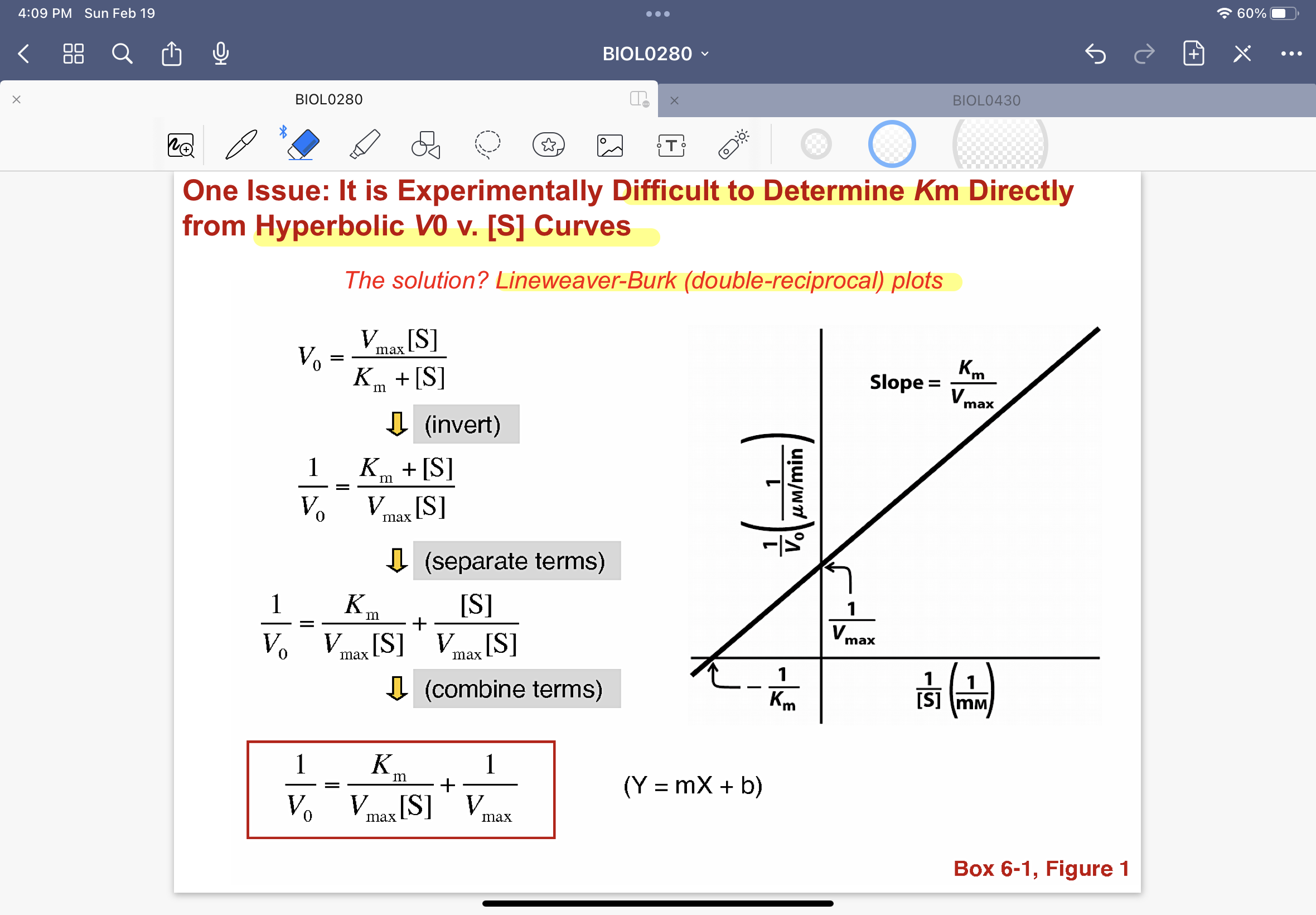
13
Chemical Reaction Coordinate. 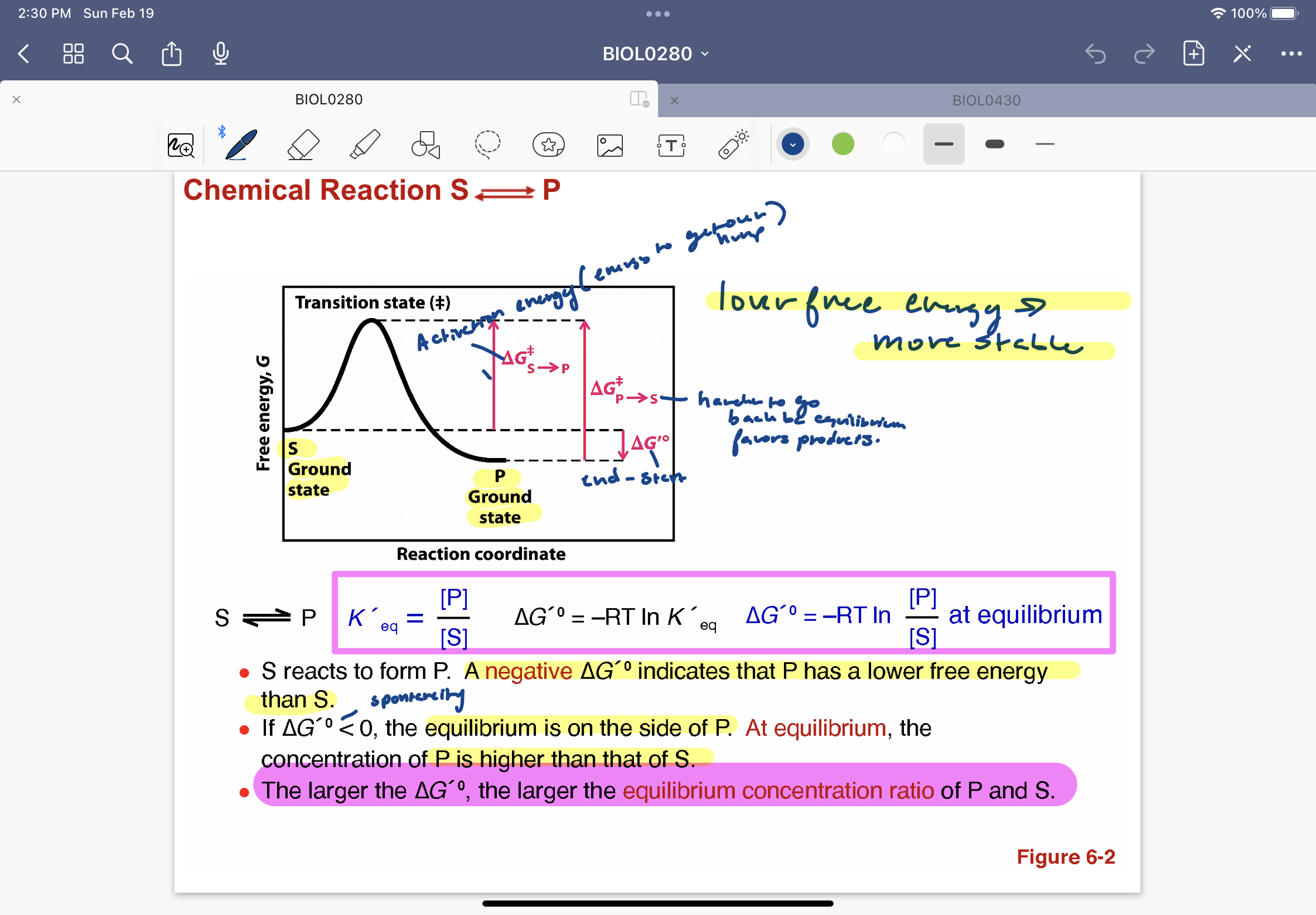
A (-) change in G'0 indicates that the products have a lower free energy than the substrates (favors spontaneity, @ equilibrium [Products] is higher than [Substrate]. The larger the Delta G, the larger the equilibrium concentration ration of P and S.. Transition state= activation energy. Thermodynamics only cares about beginning and end/ how the reaction proceeds. Kinetics considers Delta G bar for the rate of the kinetics. The relative heights from the transition state to the product and substrate ground states determine the equilibrium outcome of the reaction (thermodynamics), whule the absolute height of delta G bar determines the rate at which the ration occurs (kinetics). Delta G bar (aka transition state/activation energy) is lowered by enzymes, increasing rate of the reaction but does not change the starting nor ending results (does not change equilibrium). bumps in reaction coordinate indicate multiple intermediaries. 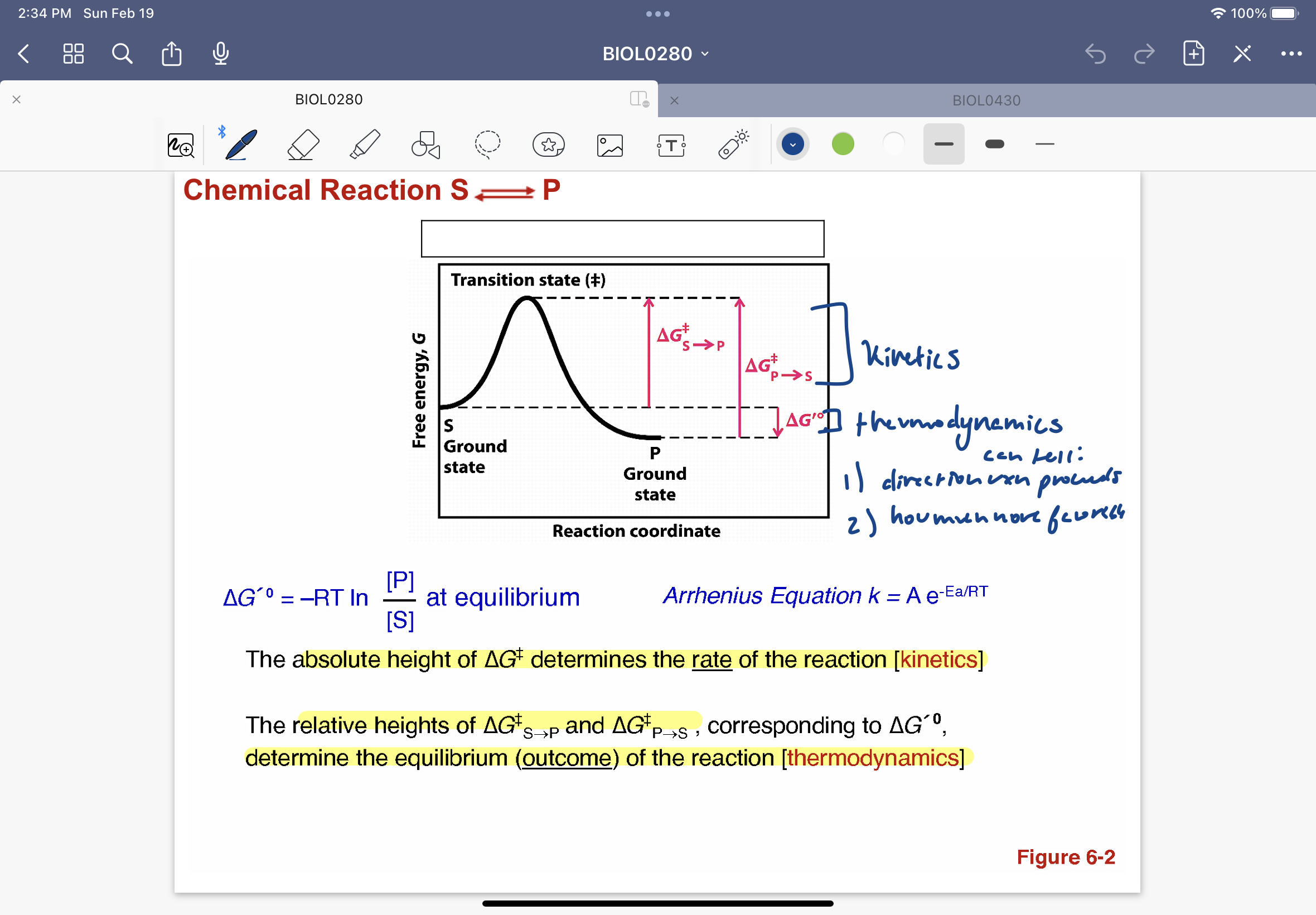
14
Binding energy and Induced fit.
Enzyme active sites are complementary not to substrates but to the transition state conformation, since both protein and ligand are flexible an induced fit occurs. The binding energy (Delta Gb) is a measure of how much the enzyme lowers the activation energy (delta G bar). A lower delta G bar means. higher rate constant k. . Transition state is reached by becoming the enzyme-substrate complex. Cannot be too stable though or would happen less frequently. 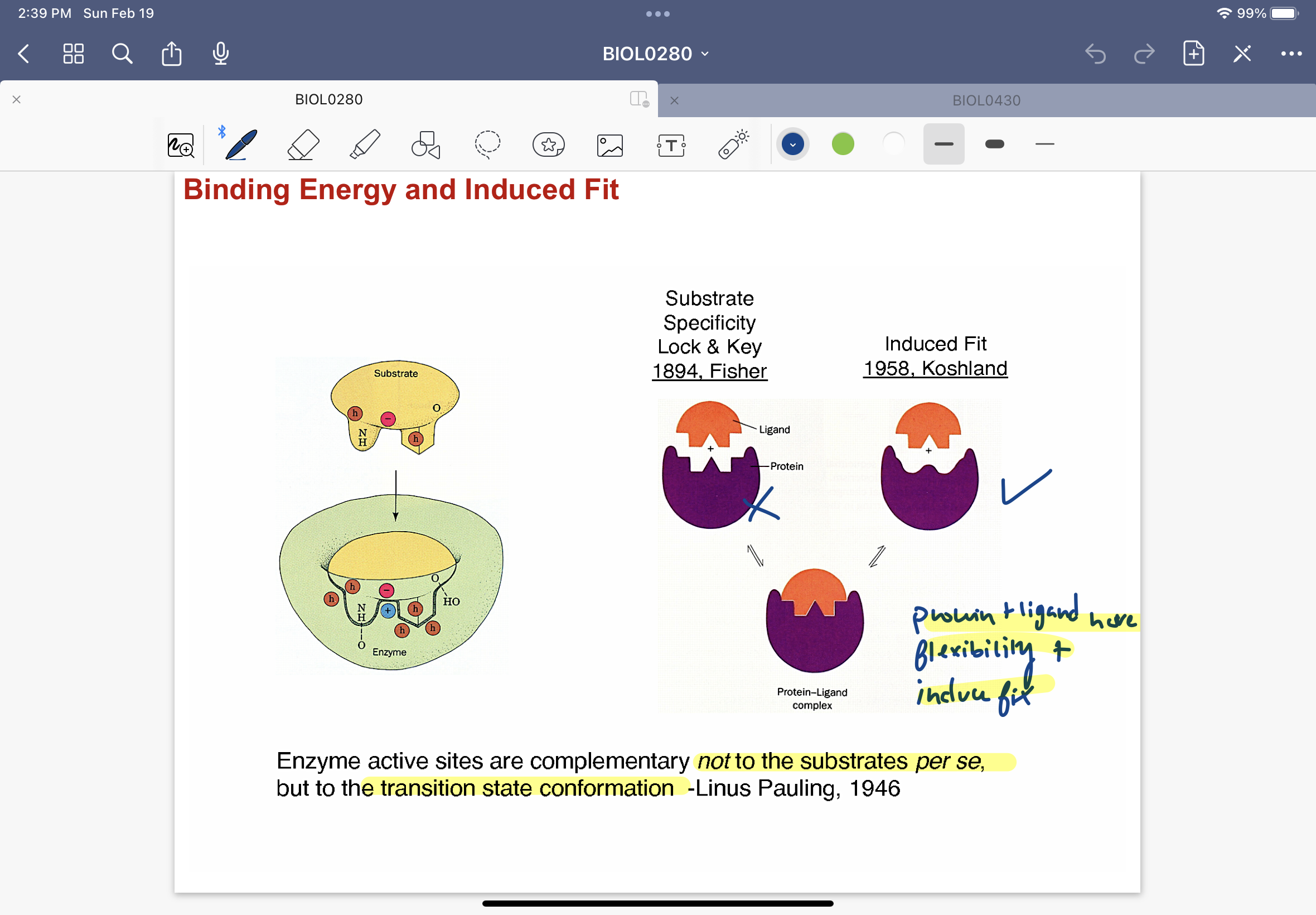
15
Steady State Kinetic Parameters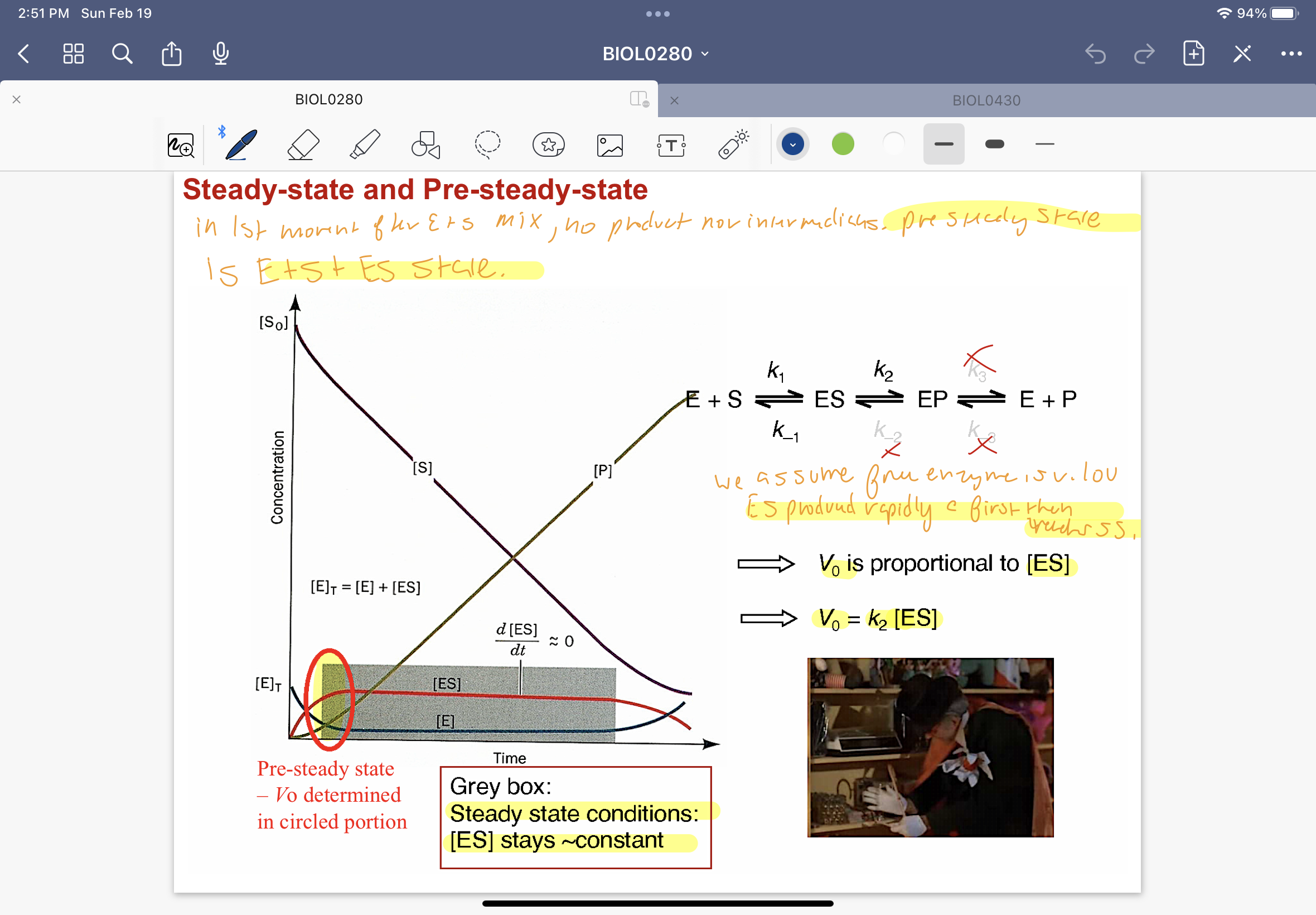
V0 is the rate of the reaction at the beginning of the steady state, when equilibrium btwn E,S and ES has been reached, but before a significant amount of substrate is consumed or product is formed. Rates can be ignored becuase of insignificant amounts of EP and P. Pre-Steady state is similar but only involves E+S >< ES becuase its moment right when E+S mix so no products or intermediates yet and ES is produced very rapidly. Initial velocity is proportional to [ES] becuase Vo=K2[ES]. in Steady state, [ES] stays approximately constant. 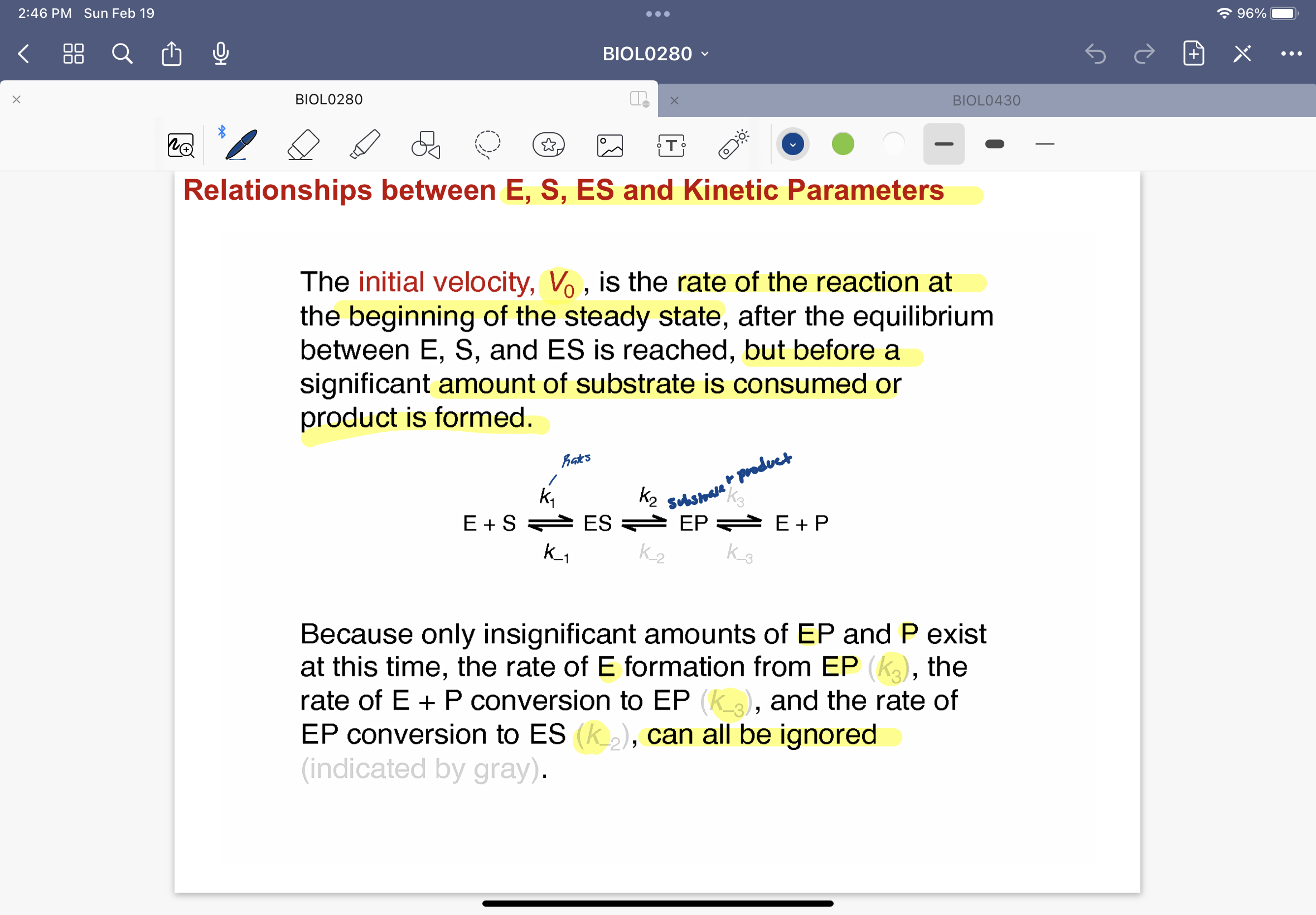
16
Initial velocities of enzyme catalyzed reactions. MICHAELIS MENTEN EQUATION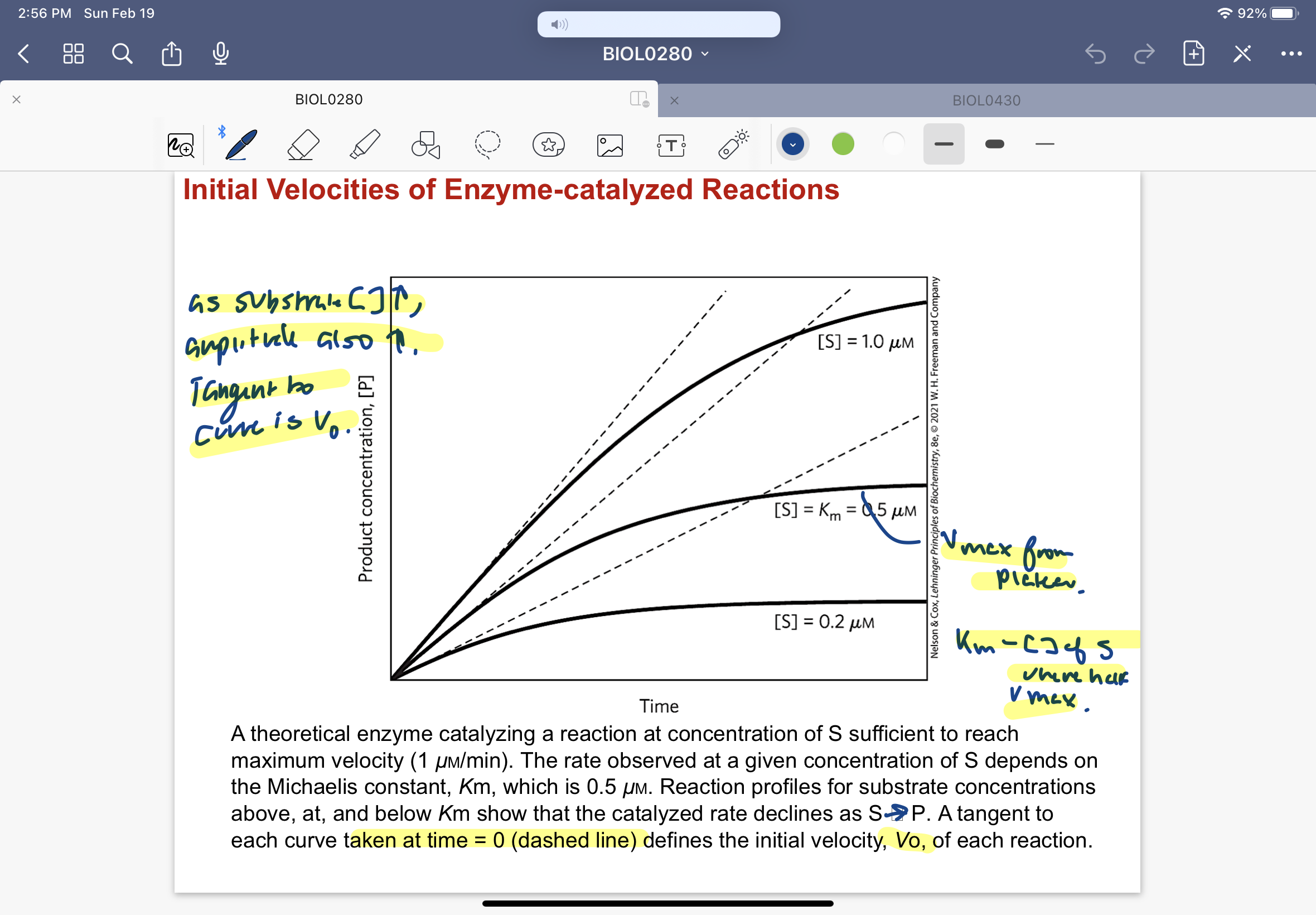
As [substrate] increases, amplitude of product concentration vs. time increases, more substrate= faster initial velocity/ kinetics Tangent to curve at time= 0 shows intiial velocity while Vmax is from plateau of curve. Km=.5Vmax, same as binding site saturation on ligand concentration since substrate binding is same as a ligand. Also because Vo is proportional to [ES] which at intial conditions is hyperbolically related to [s]. Lower kM=Tighter binding . Km= [s] when speed= Vmax/2. Essentially, enxymes work at half the maximal rate when half the active sites are occupied. 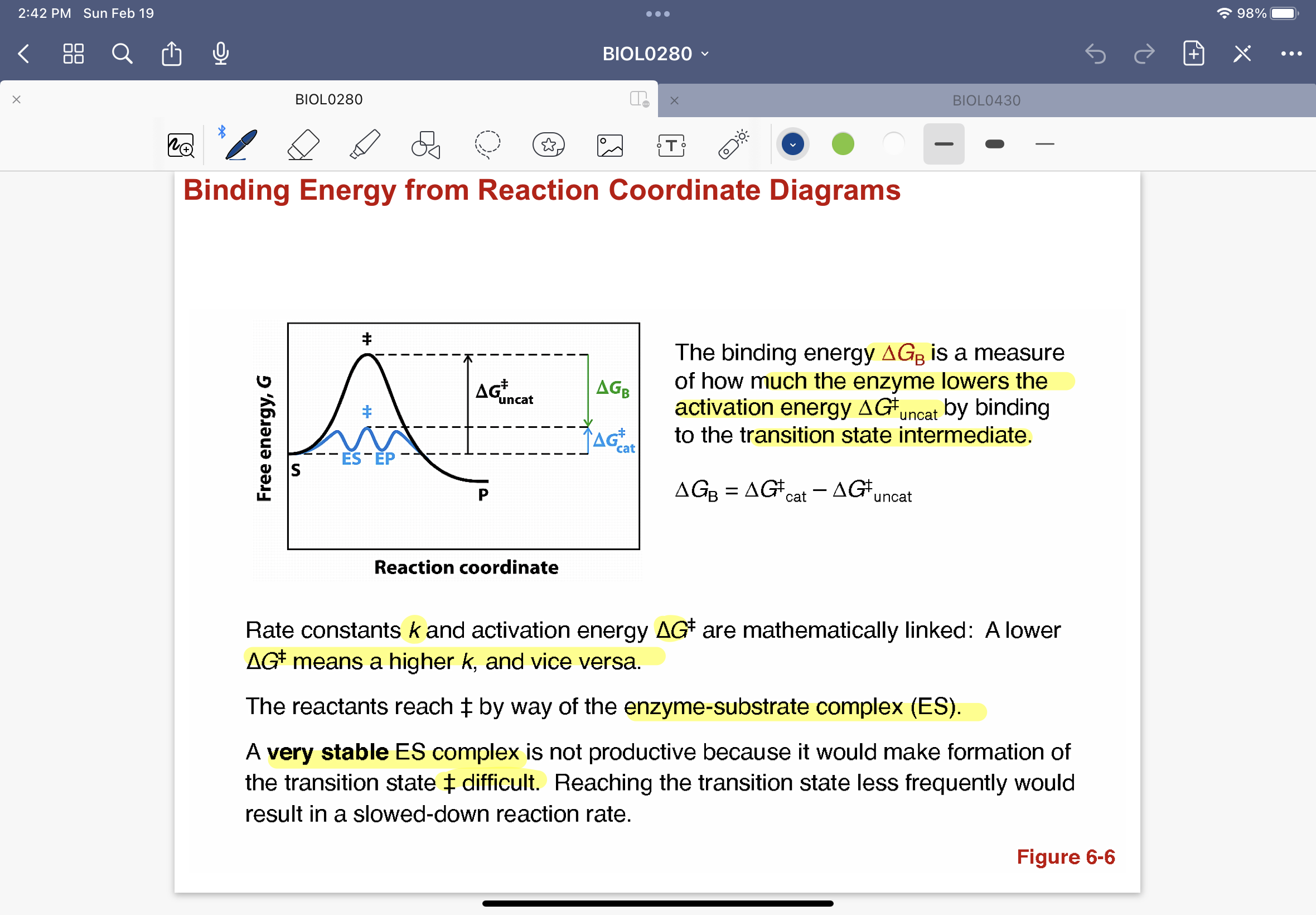
17
Vo curve at high and low [S] 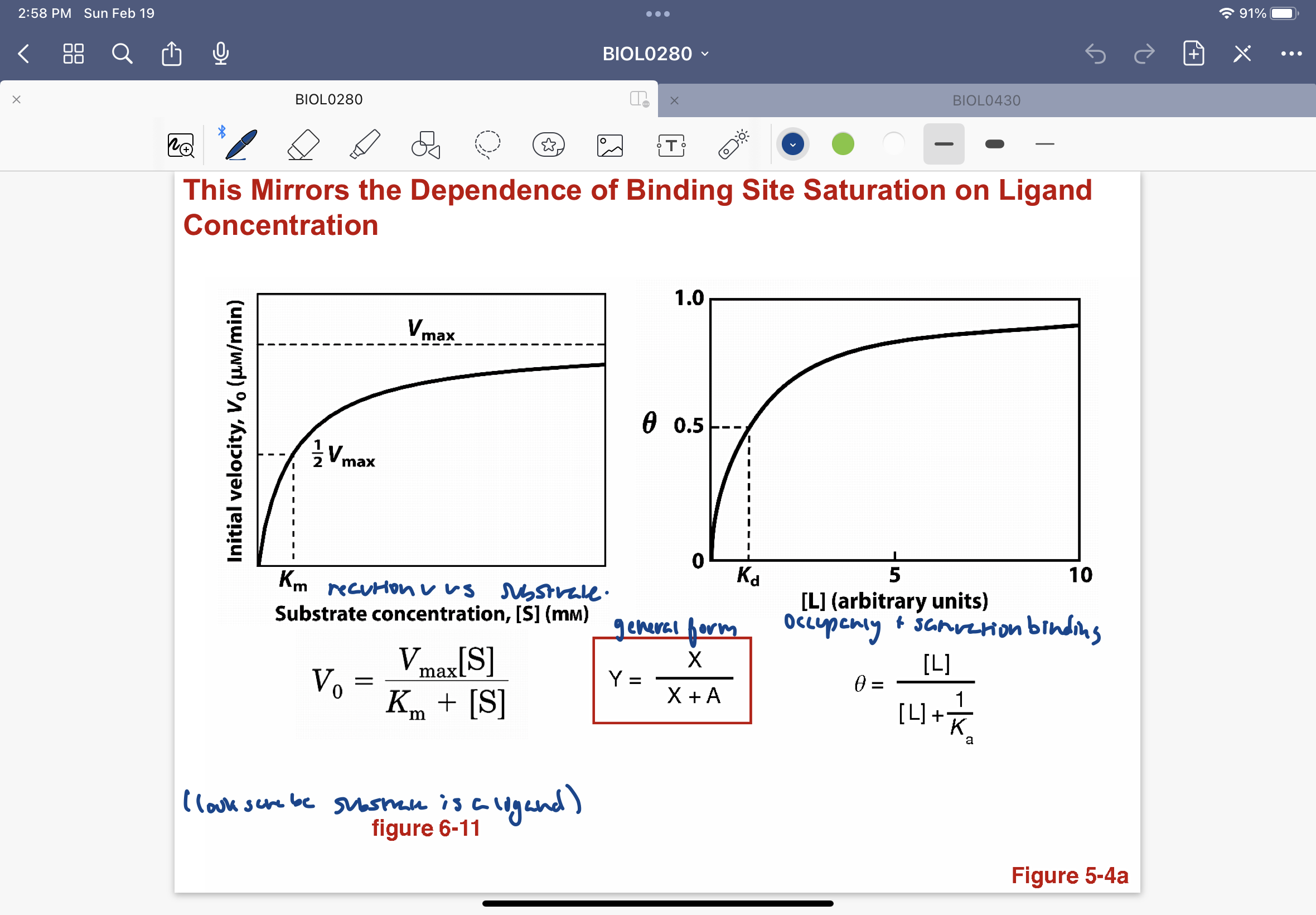
if [S] >Km, then will plateau at high [S] (V0~= Vmax), but if [s] << Km, then there is a linear dependence of Vo at low [S] (V0=Vmax[S]/Km. 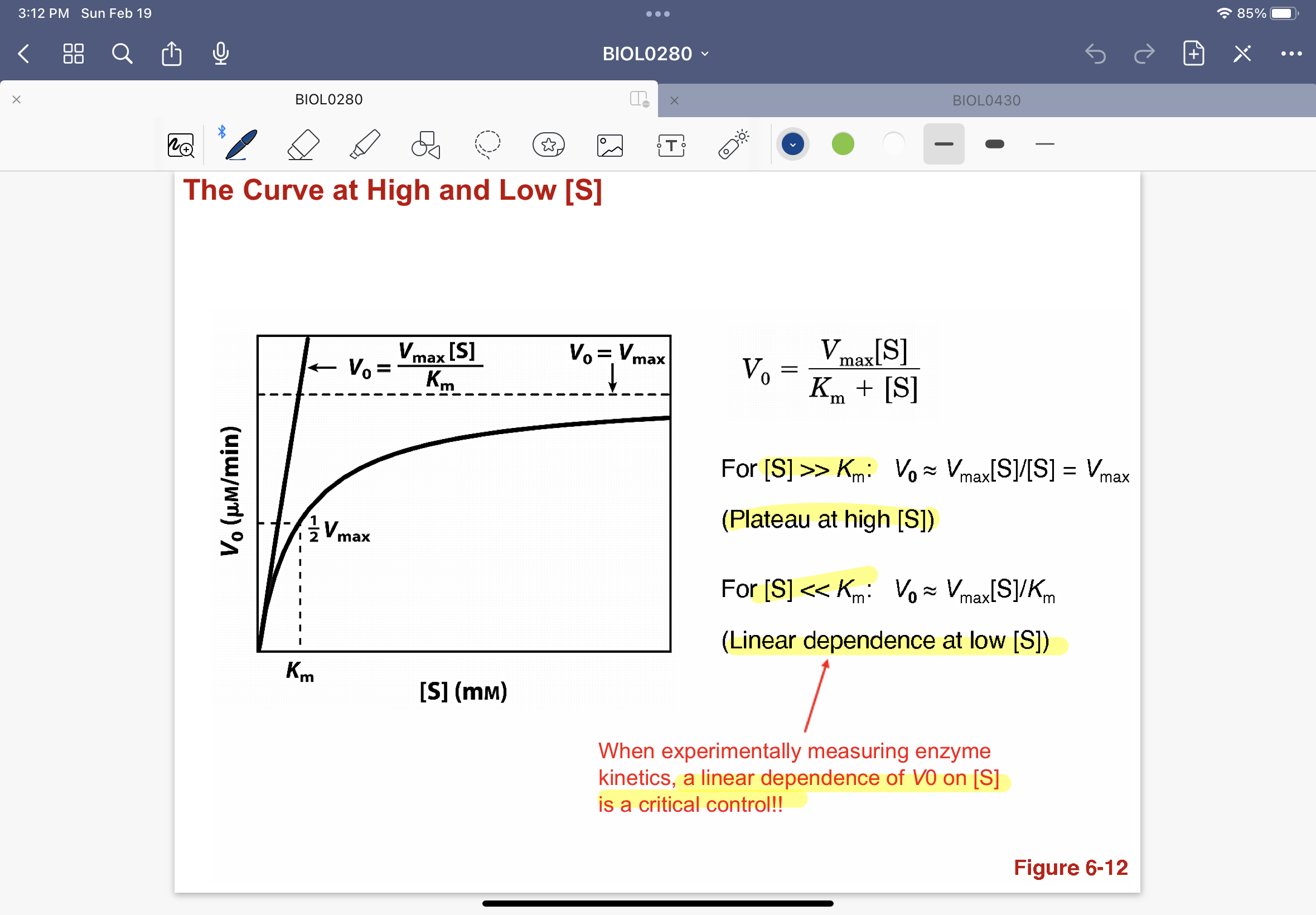
18
Enzymes varied Kcat and Km values, Catalytic efficiency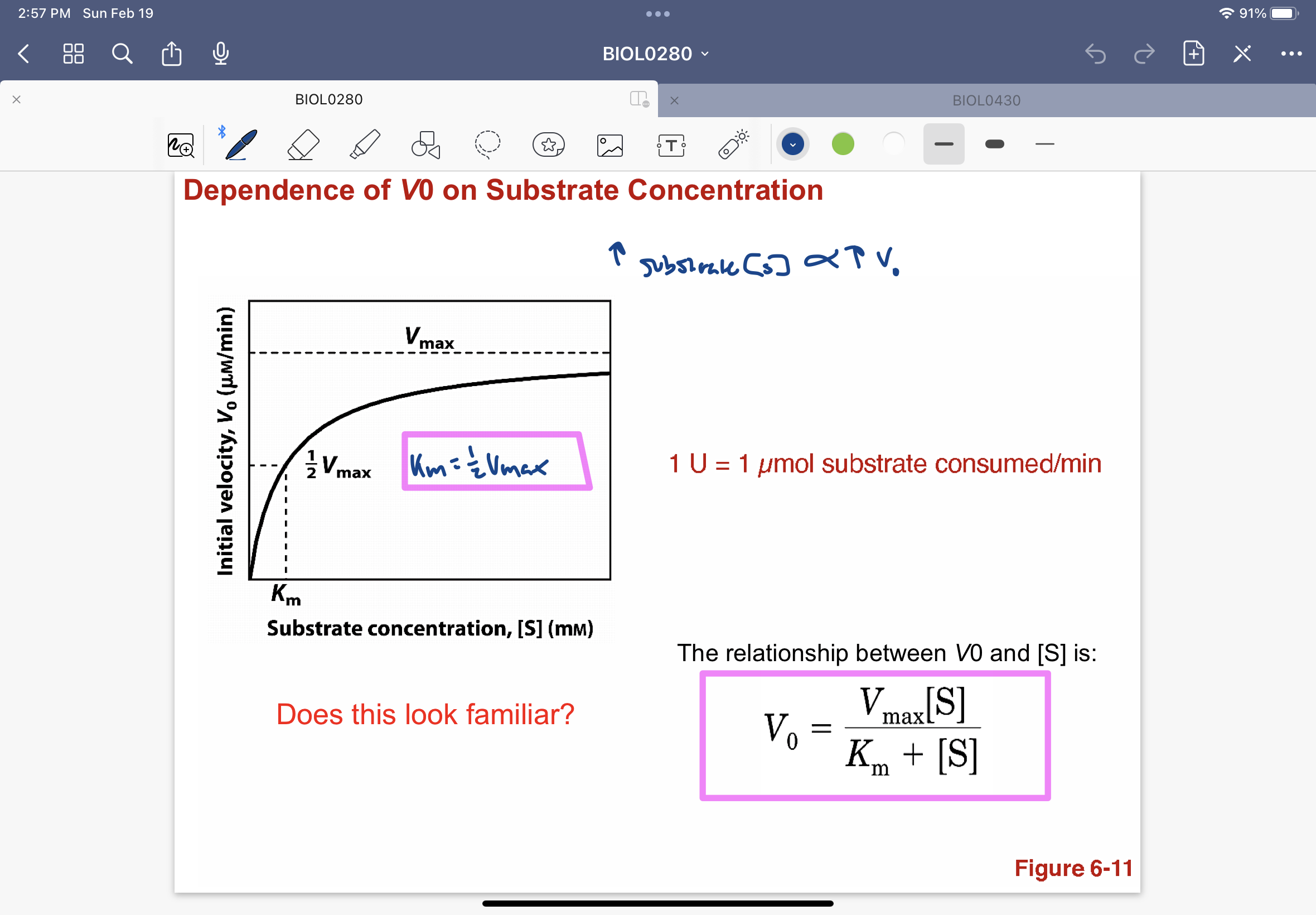
Kcat/Km = V0/([s][Et]). Tells how well binds substrate and how fast it binds, the rate constant for the conversion of E + S > E + P when [S]<<Km. when [s]<< Km, V0 depends on both the turnover number and the fraction of active sites occupied, porportional to both Kcat and 1/Km. The higher the catalytic efficiency, the higher the initial velocity for a given amount of enzyme (Et) at a given substrate concentration (s). Kcat/Km has an upper limit imposed by the rate at which E and S can diffuse together, enzymes with values close to this number are said to be perfect enzymes as they approach "catalytic perfection" (~10^8-10^9 a/(M Sec).
19
Enzyme Inhibition
Inactivator- reacts irreversably with an enzyme (possibly covalently). Inhibitor- binds reversibly to an enzyme. Can be competitive, uncompetitive, or mixed (non-competitive). double reciprocal plots of data collected in the presence of different inhibitor concentrations reveal Ki, the dissociation constant for EI.
20
Competitive inhibition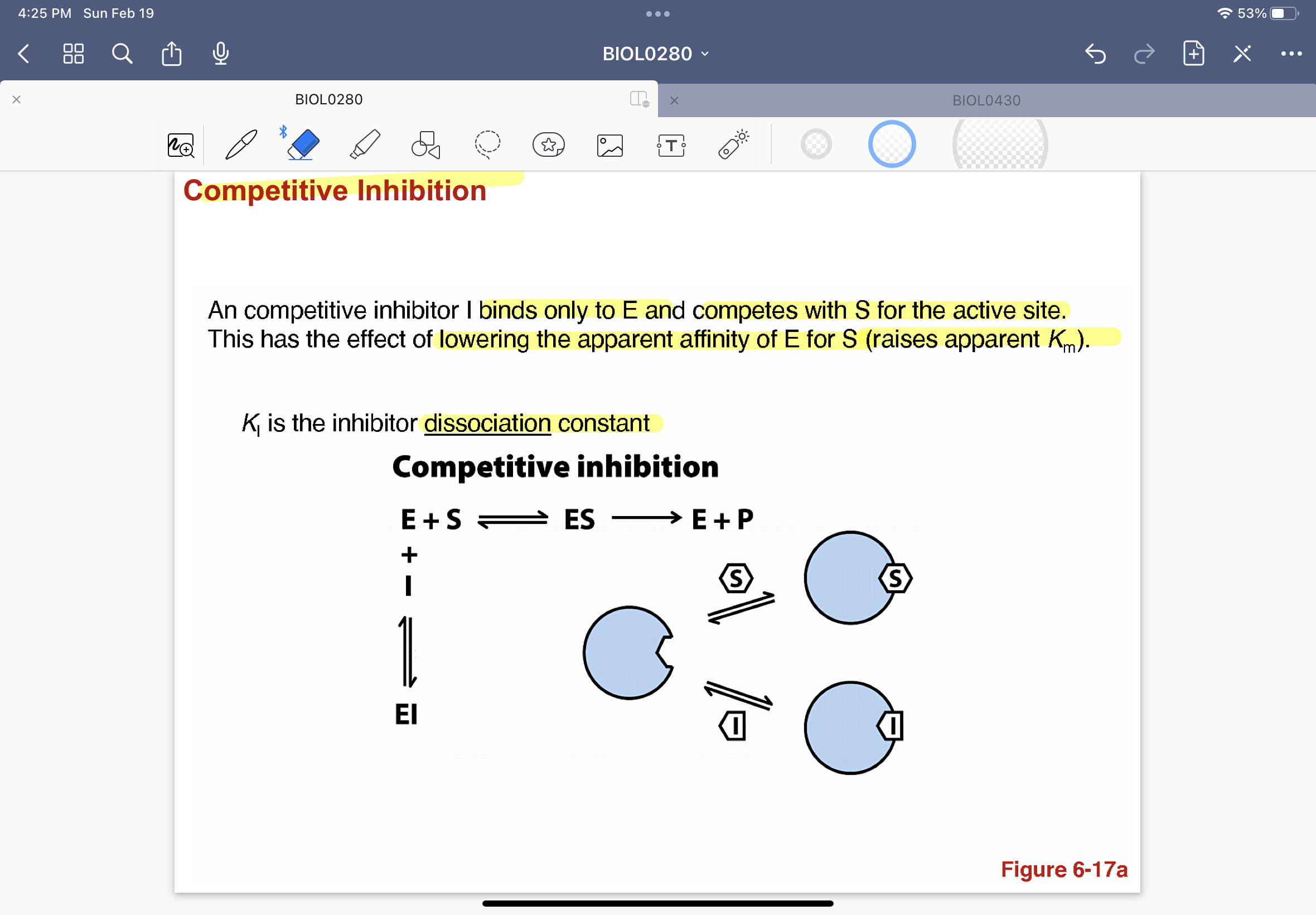
Competitive Inhibitor I binds only to E and competes with S for the active site. Lowers the apparent affinity of E for S, raising the apparent Km becuase of competition. Ki is the inhibitor dissociation constant. Vmax is not affected as it is only dependent on [enzyme], Km is increased by a factor of alpha (halfway point shifts), a smaller fraction of active sites are occupied by substrates, Y intercept stays the same as vmax is unaffected, X intercept and Slope are different becuase Km changes. Slope increases while x intercept get less negative. 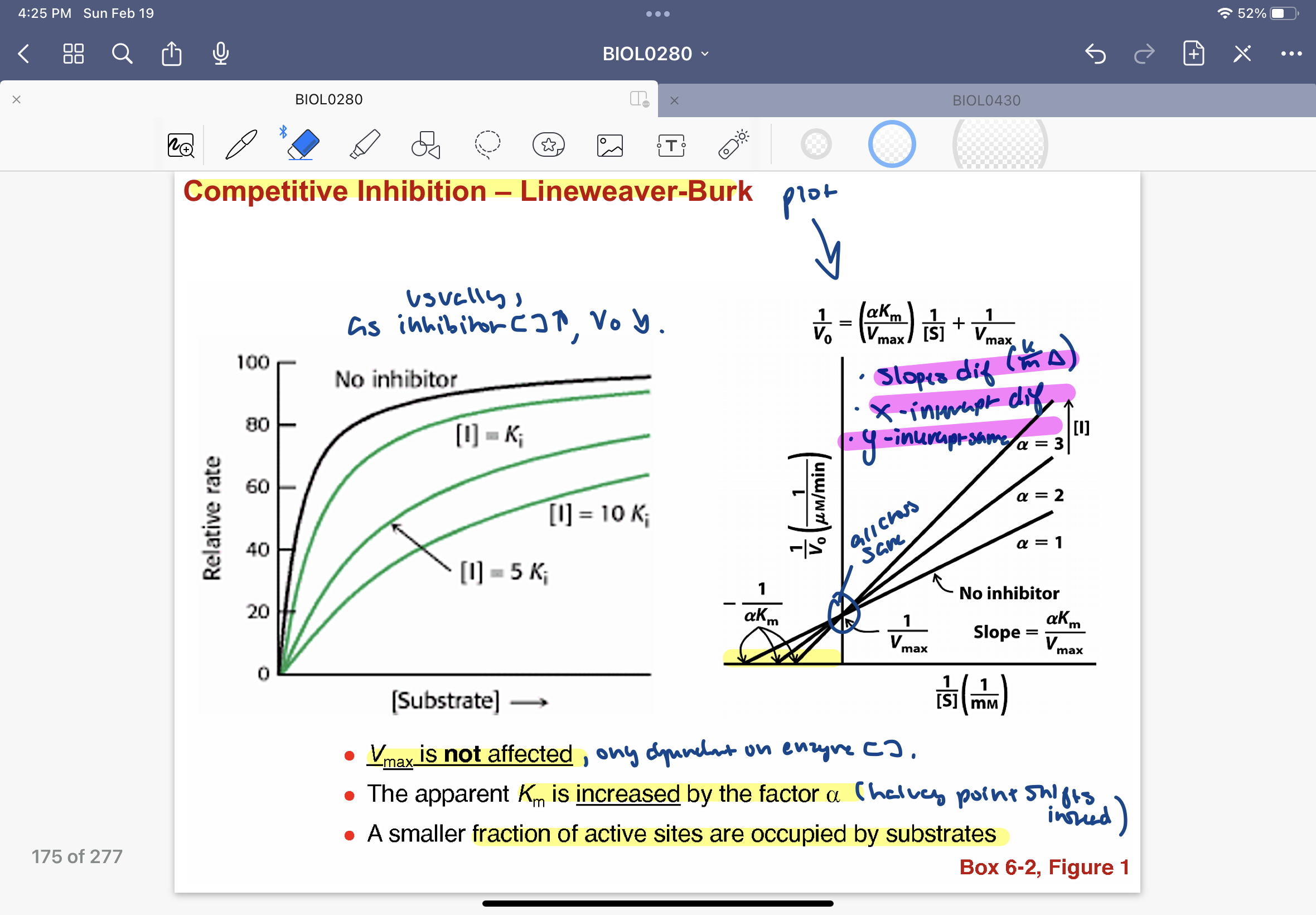
21
Uncompetitive inhibition 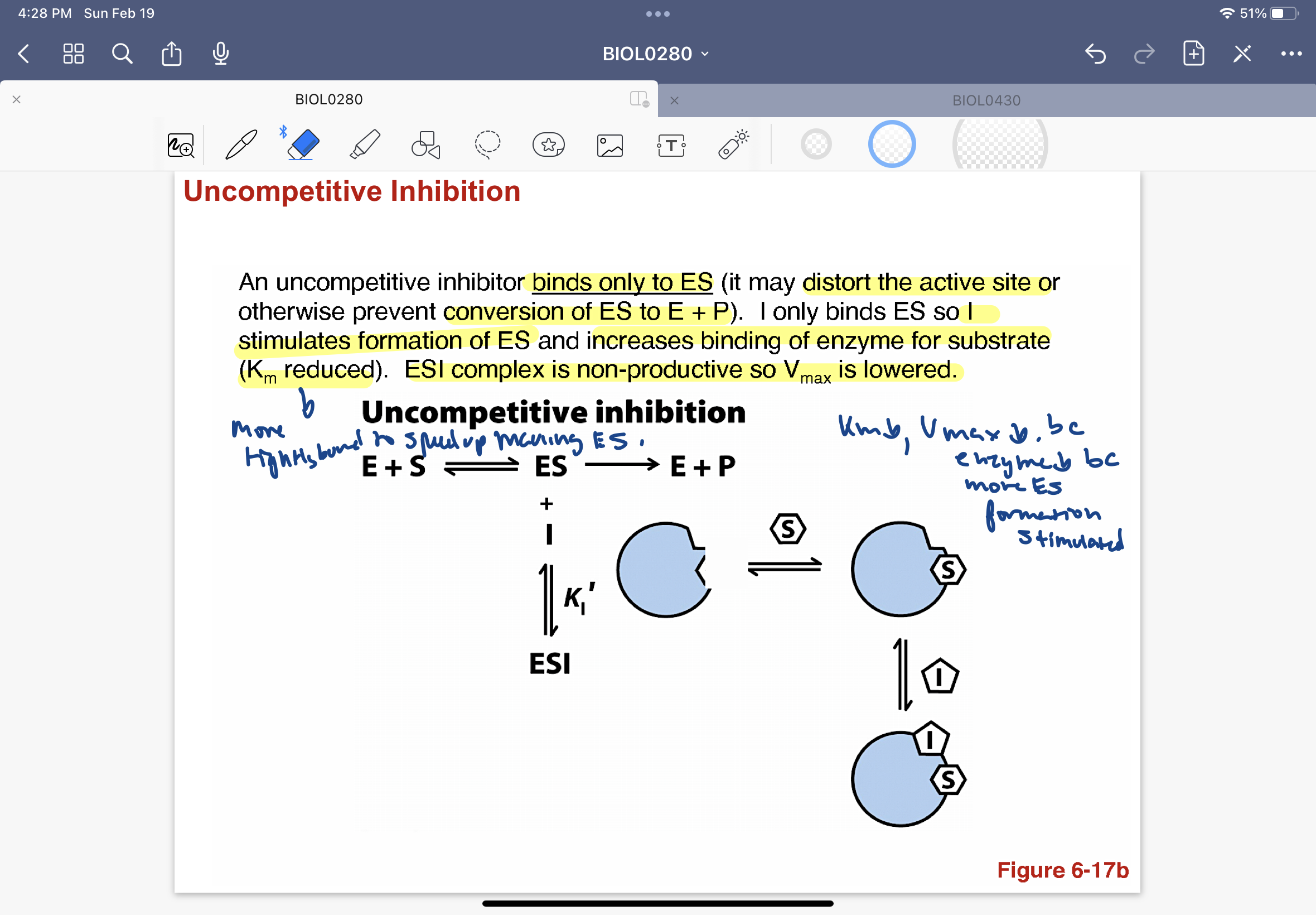
Binds only to Enzyme substrate compelx (may distort the active site or prevent the conversion of ES to E +P. Stimulates the formation of ES and increases binding of enzyme for susbtrate (Km reduced). ESI complex results in no product so Vmax is lowered. Km decreases by alpha prime, V max Decreases by alpha prime becuase overall enzyme decreases since more ES formation is stimulated. since both decreased by same factor, lines are parallel, with y intercepts rising with more inhibition. 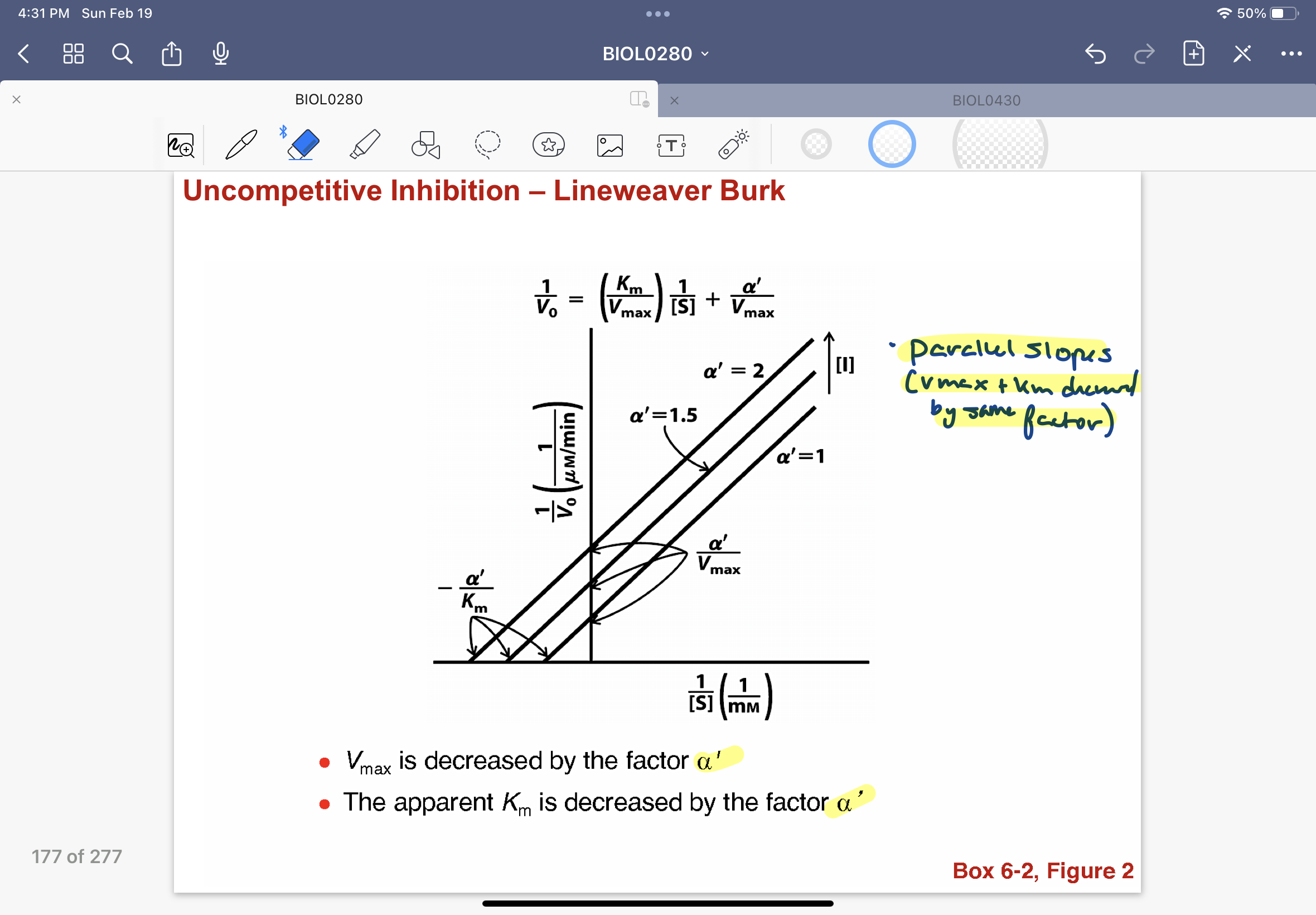
22
Mixed/Non-competitive inhibition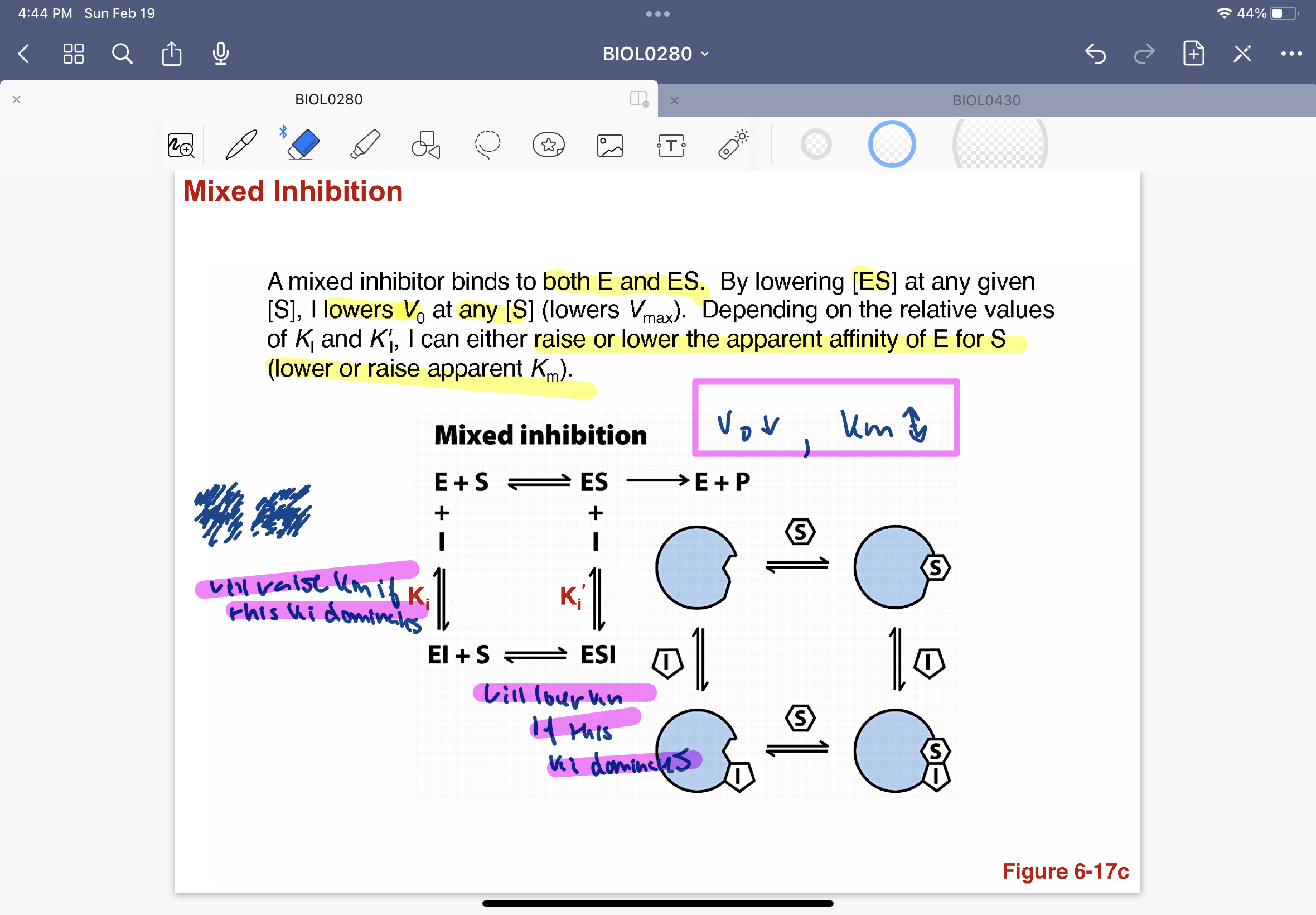
Mixed inhibitor binds to both E and ES. By lowering [ES] at any given [S], the inhibitor lowers the V0 at any [S] Lowering the Vmax. Depending on the relative values of Ki and Ki Prime the inhibitor can either raise or lower the apparent affinity of E for S/ rasie or lower the apparent Km. Overall, V0 and Vmax decreases by factor of alpha prime, while km increases or decreases depending on alpha/alpha prime ratio. raises Km if EI + S dominates or decreases Km is ESI dominates. If both equal then only vmax is affected and the inhibition is labeled NON-COMPETITIVE, with all lines meeting at the 1/[S] intercept. slopes change, y intercept changes, and x intercept changes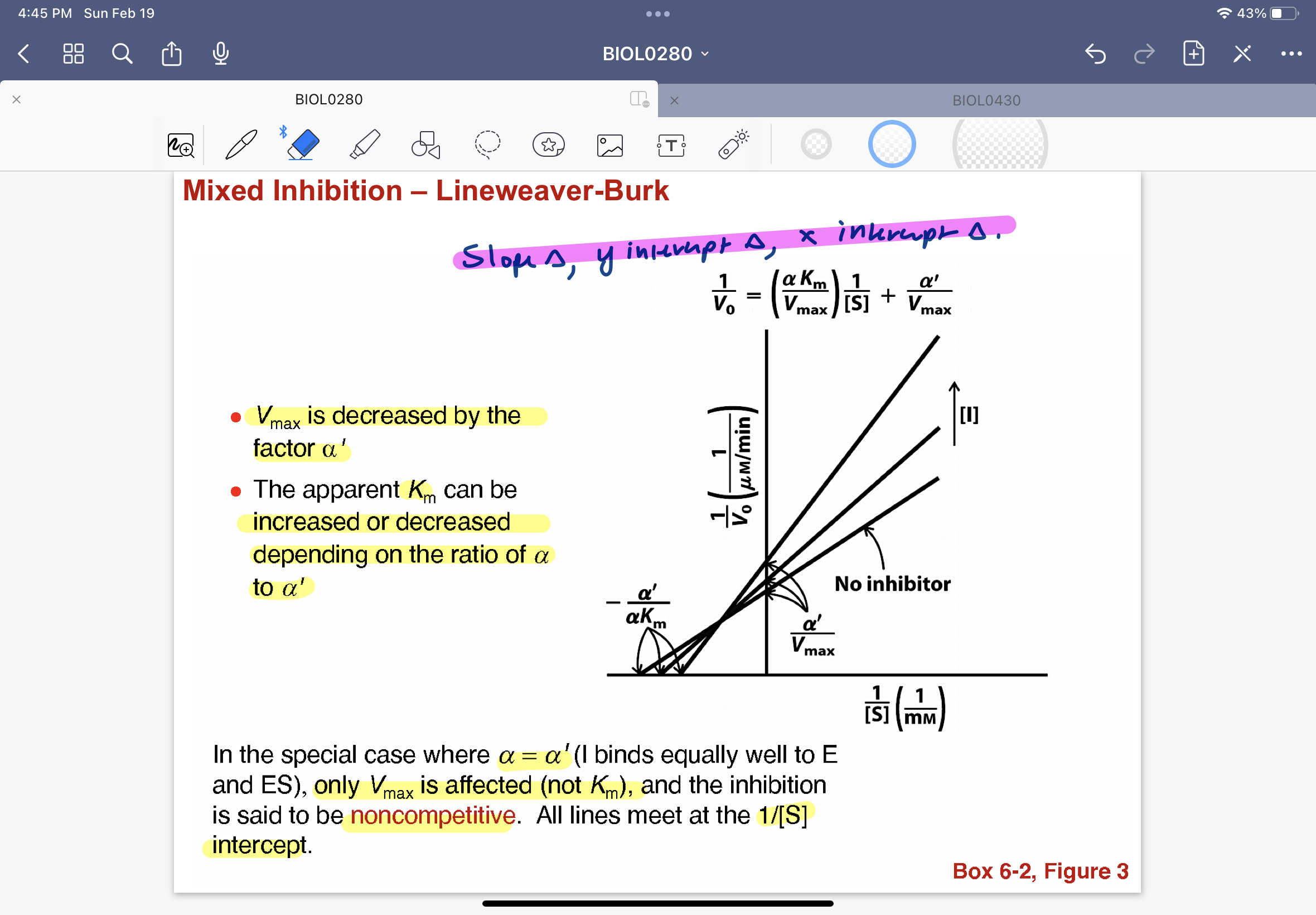
23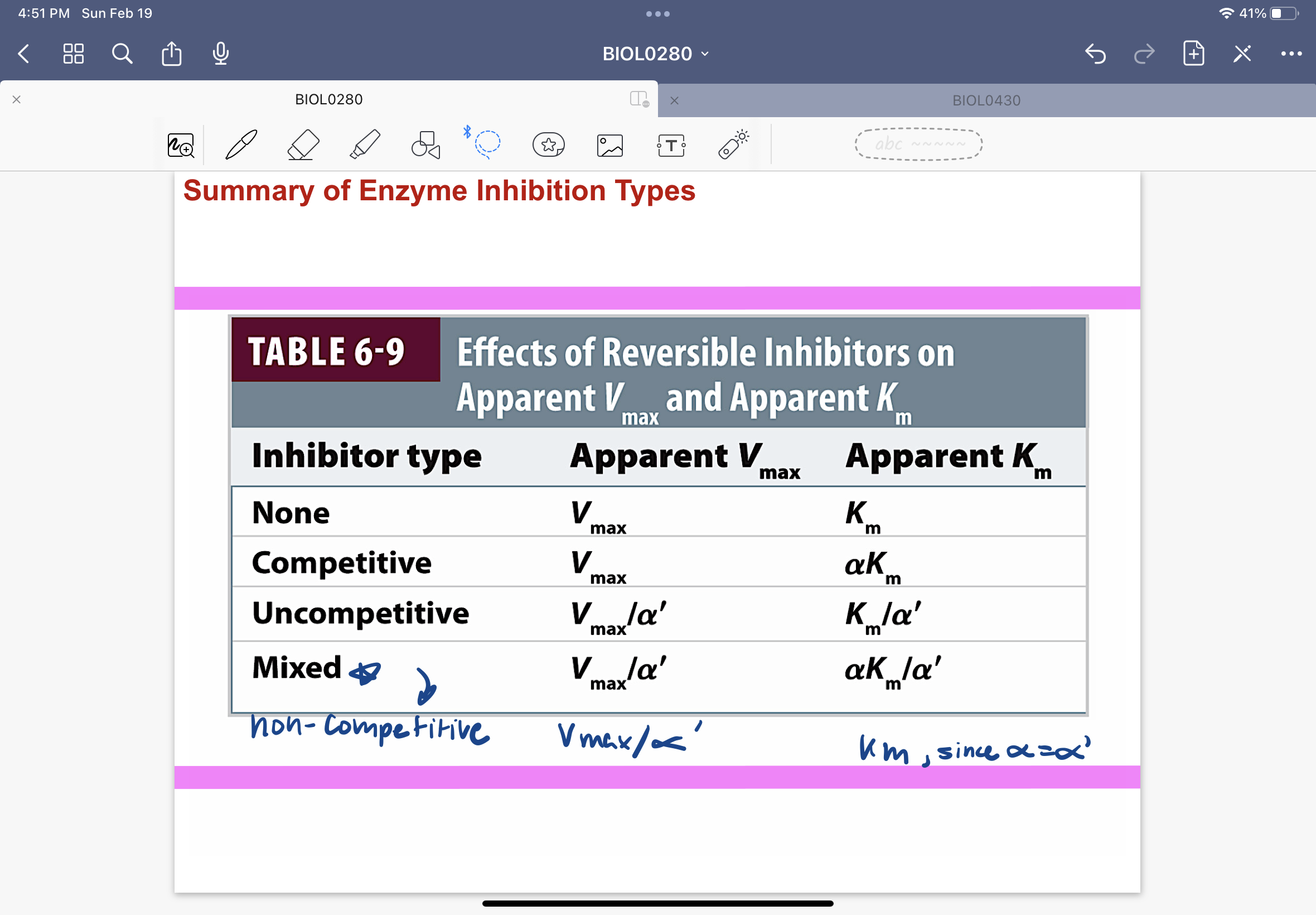
Summary of enzyme inhibiton types table
24
Bisubstrate reactions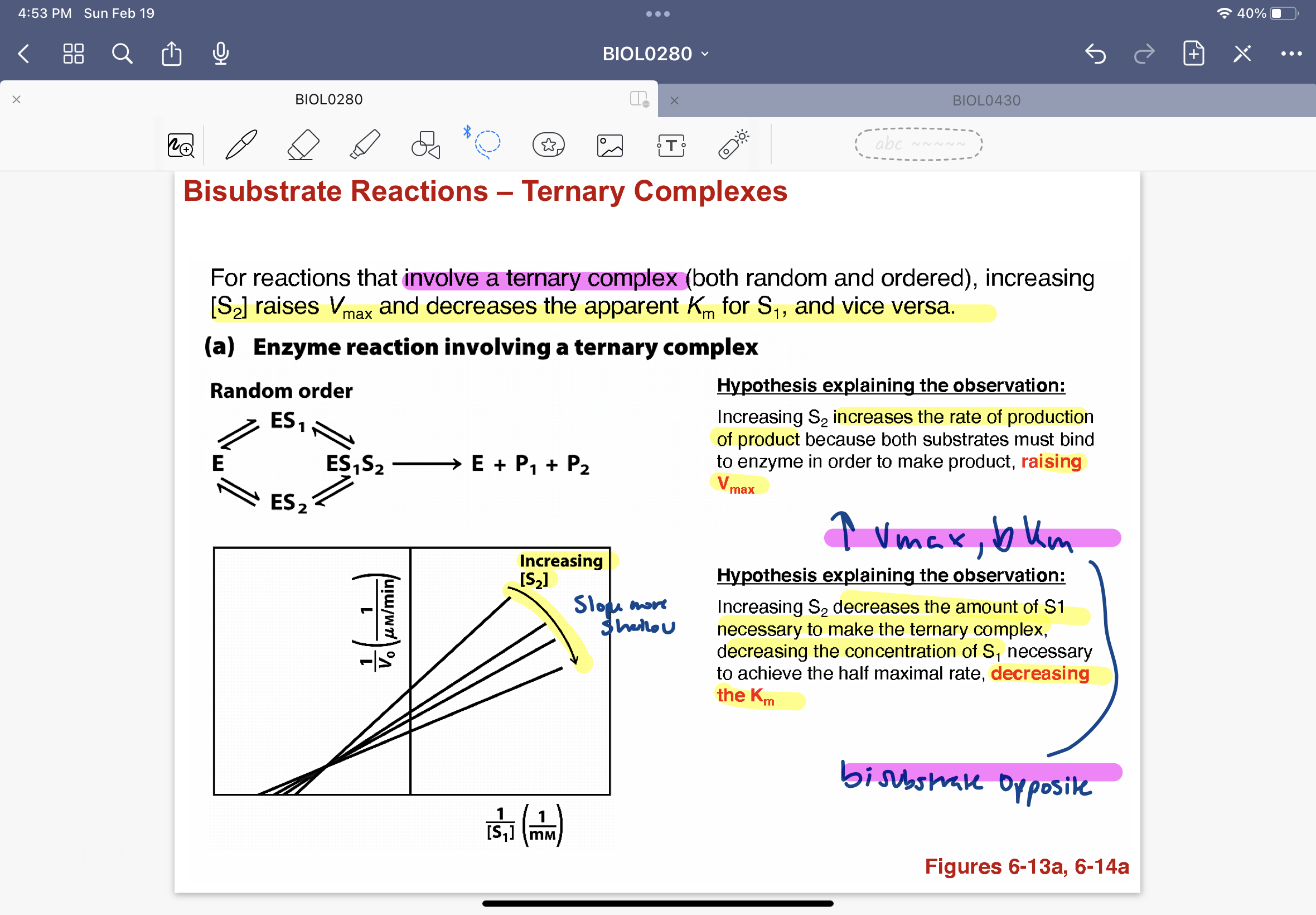
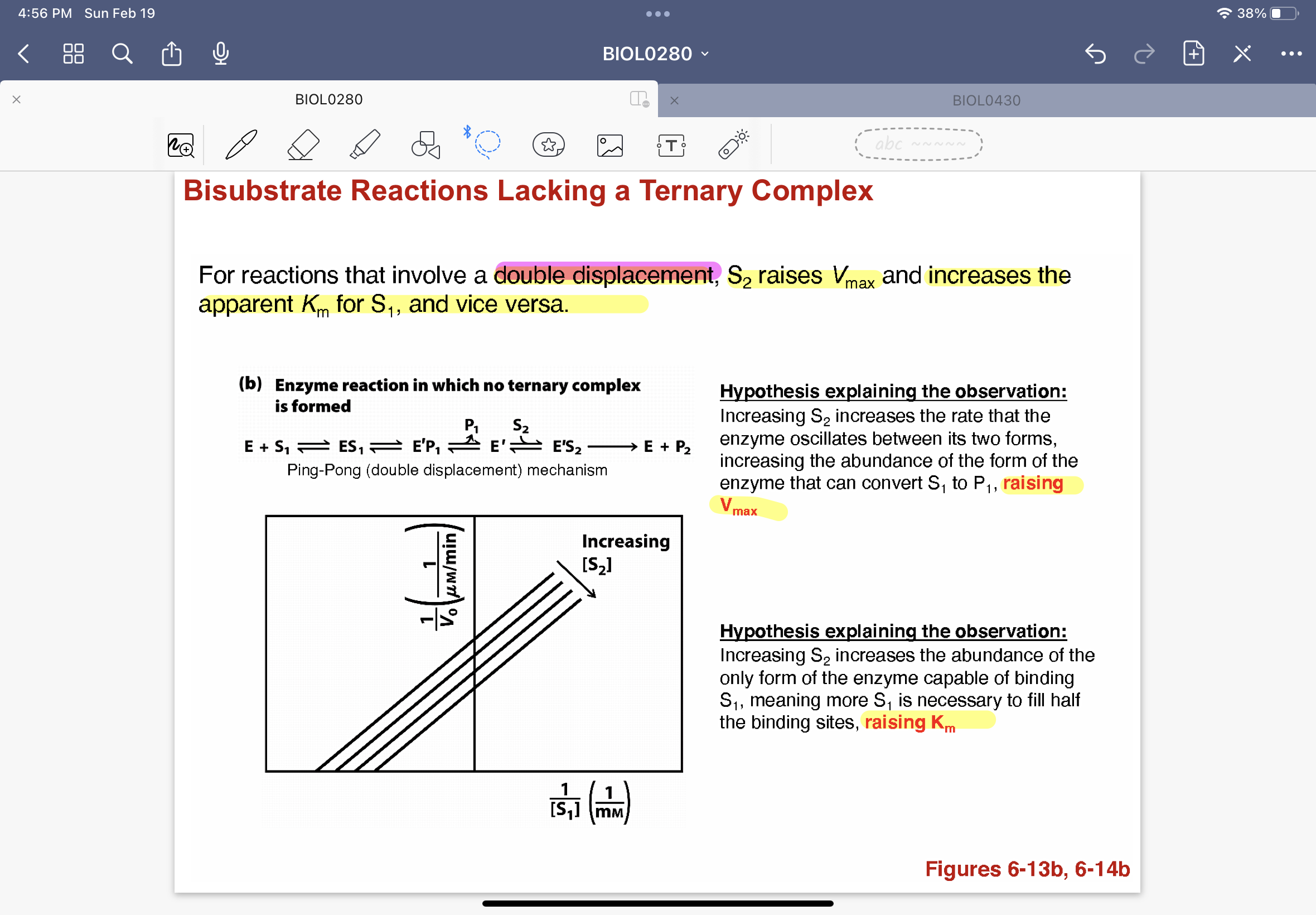
Enzyme reaction not involving a ternary complex (3 things). S1 converted to P and then S2 only binds once S1 and P1 are gone, a double displacement mechanism with the enzyme cycling between E and E' forms. Reactions with ternary complexes (random or ordered) will raise Vmax when [S2] is increased while decreasing Km for S1 and vice versa. This is becauase increasing S2 increases the rate of production of the product, raising Vmax. This also decreases the amount of S1 necessary to make the ternary complex, decreasing [S1] necessary to acheive the hald maximal rate, decreasing the Km. Bisubstrate is the opposite. S2 raises Vmax and increases the apparent Km for S1 and vice versa. increasing S2 increases the rate that the enzyme oscillates btwn its 2 forms, increasing the abundance of the form of the enzyme that can convert S1 to P1, raising Vmax. S2 also increases the abundance of the only form of the enzyme capable of binding S1, meaning more S1 is necessary to fill half the binding sites, raising Km.