Biochem Lecture 8
Study these flashcardsFree · spaced repetition · iPhone, Android, Mac & web
All cards
1
Glycolysis Basic Statements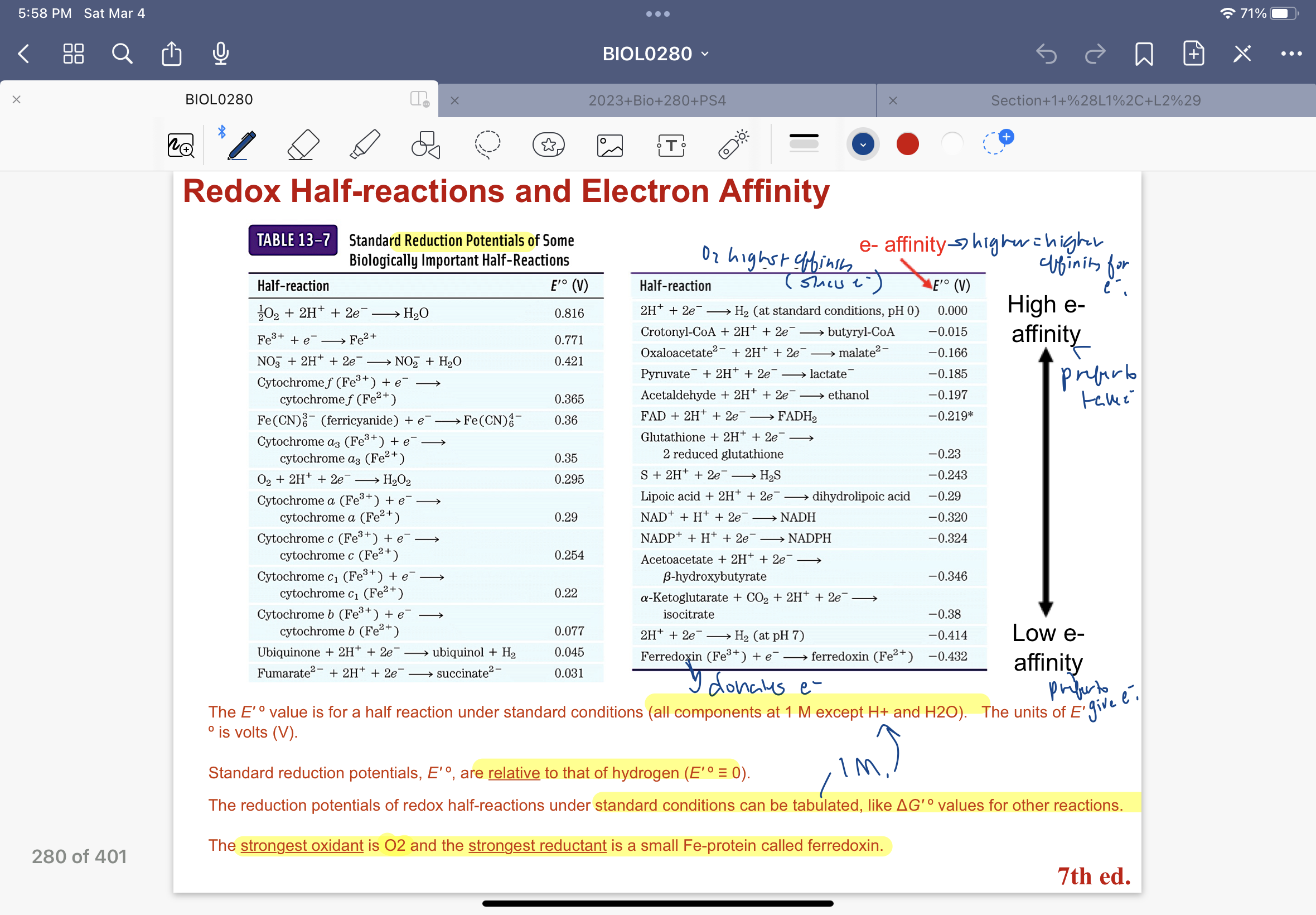
Ezymatic reactions often change the oxidation state of the substrate so Oxidoreductases will transfer electrons. The higher the E' value, the higher the electron affinity/ the more a molecule prefers to take electrons rather than donate electrons. E' prime is the volts for a half reaction under standard conditions (when all components are at 1M except H+ and H2O. All standard reduction potentials are relative to that of hydrogen = 0. Reduction potentials of redox half reactions can be tabulated like delta G' values. The strongest oxidant (takes e-) is O2 and the strongest reductant (gives e-) is a small Fe protein called Ferredoxin. to tabulate put in arrangements Oxidized form + electrons > reduced form. The number of atoms or molecules involved and number of electrons transferred arent in these calculations. Delta G= -nF delta E. Electrons are transferred by cofactors acting as electron carriers. (important redox cofactors are pyridine nucelotides and flavin nucleotides, the reduced form of which are strong reductants). 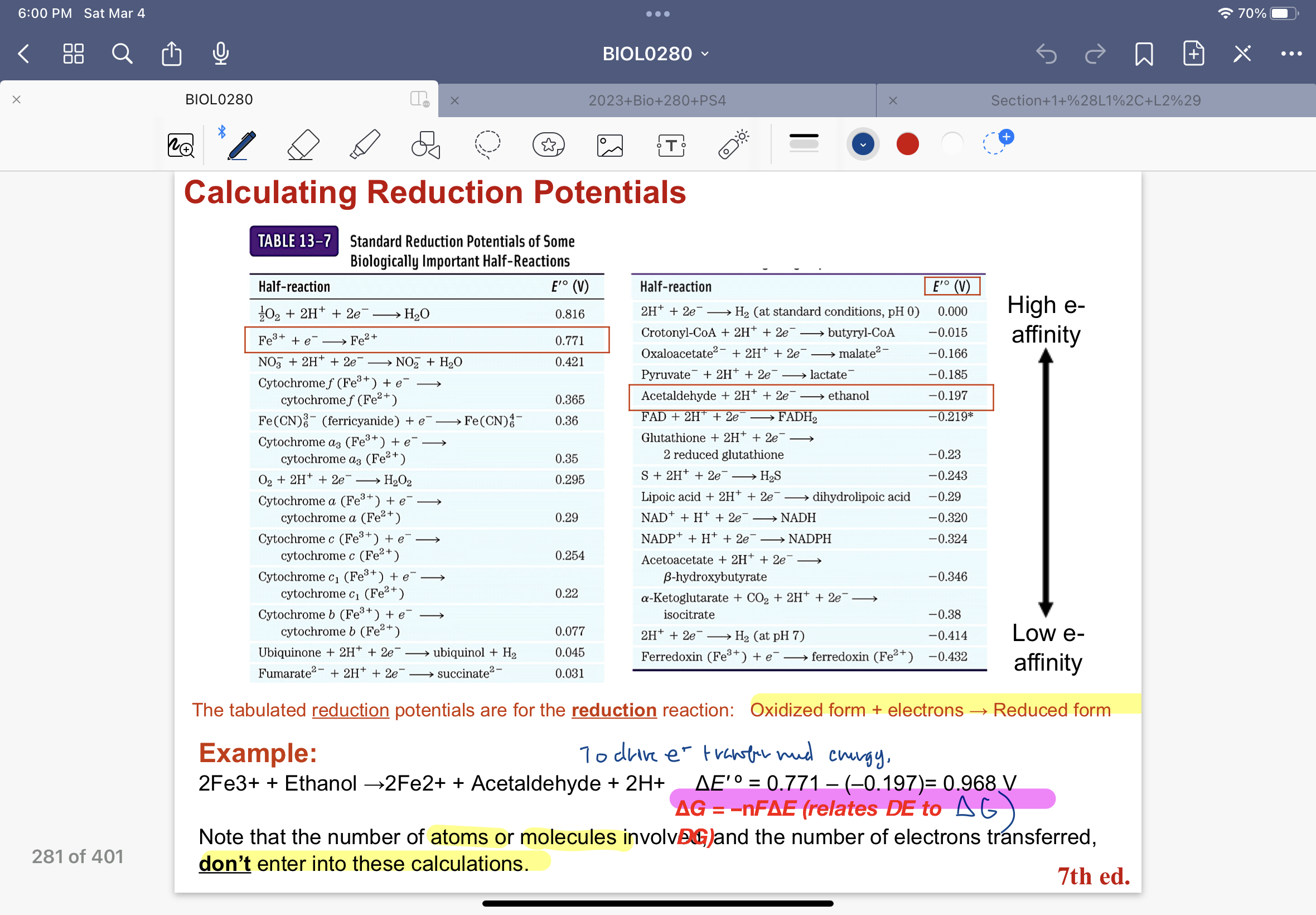
2
Pyradine Nucleotide Coenzyme- NAD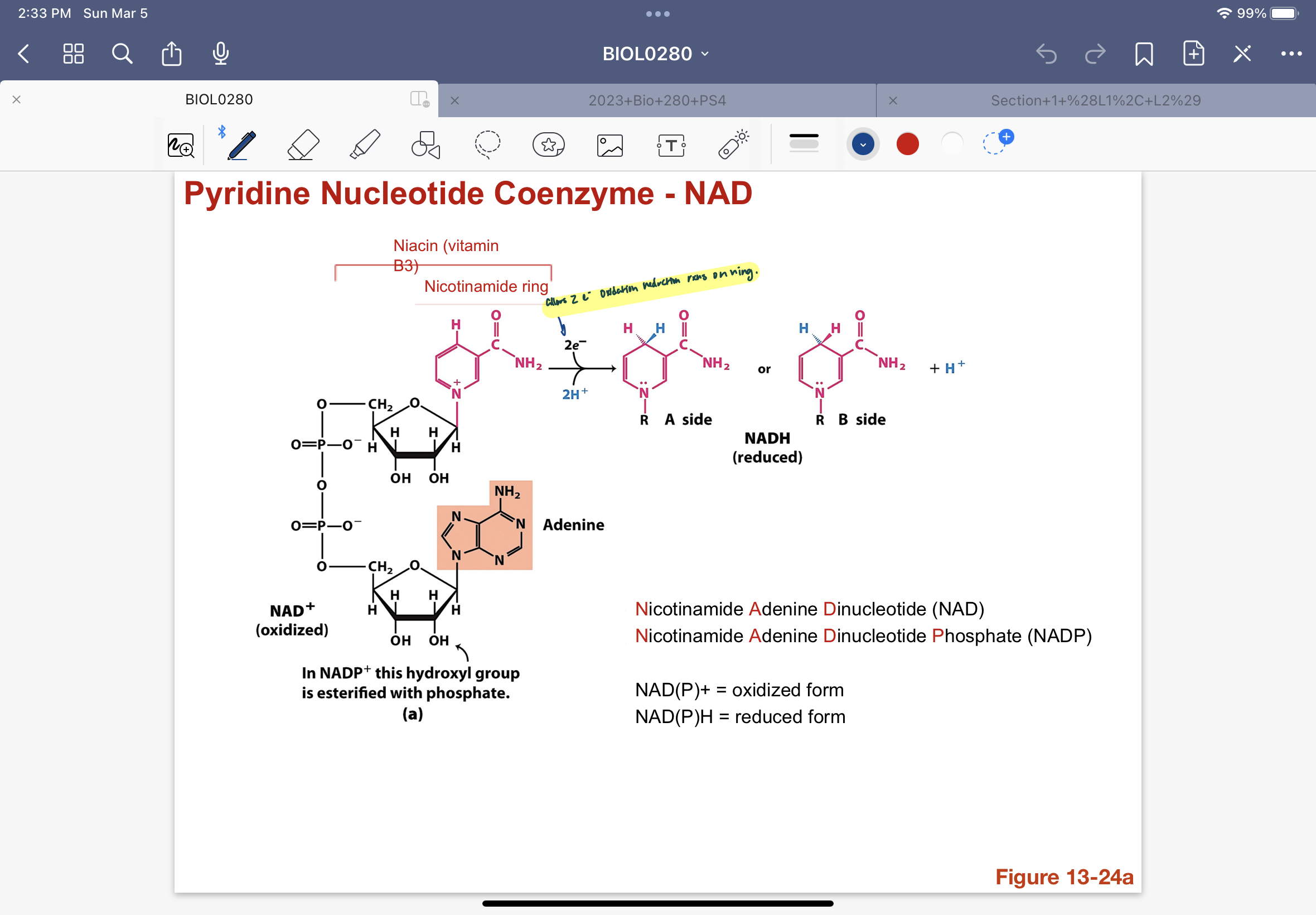
Nicotinamide Adenine Dinucleotide (NAD) or Nicotinamide Adenine Dinucelotide Phosphate (NADP). NADP+ is oxidized form, NAD(P) H is reduced form. Has an Adenine, A Nicotinamide ring. 2 e- oxidation reduction reactions can occur on ring.
3
Flavin Nucleotide Porsthetic group- FAD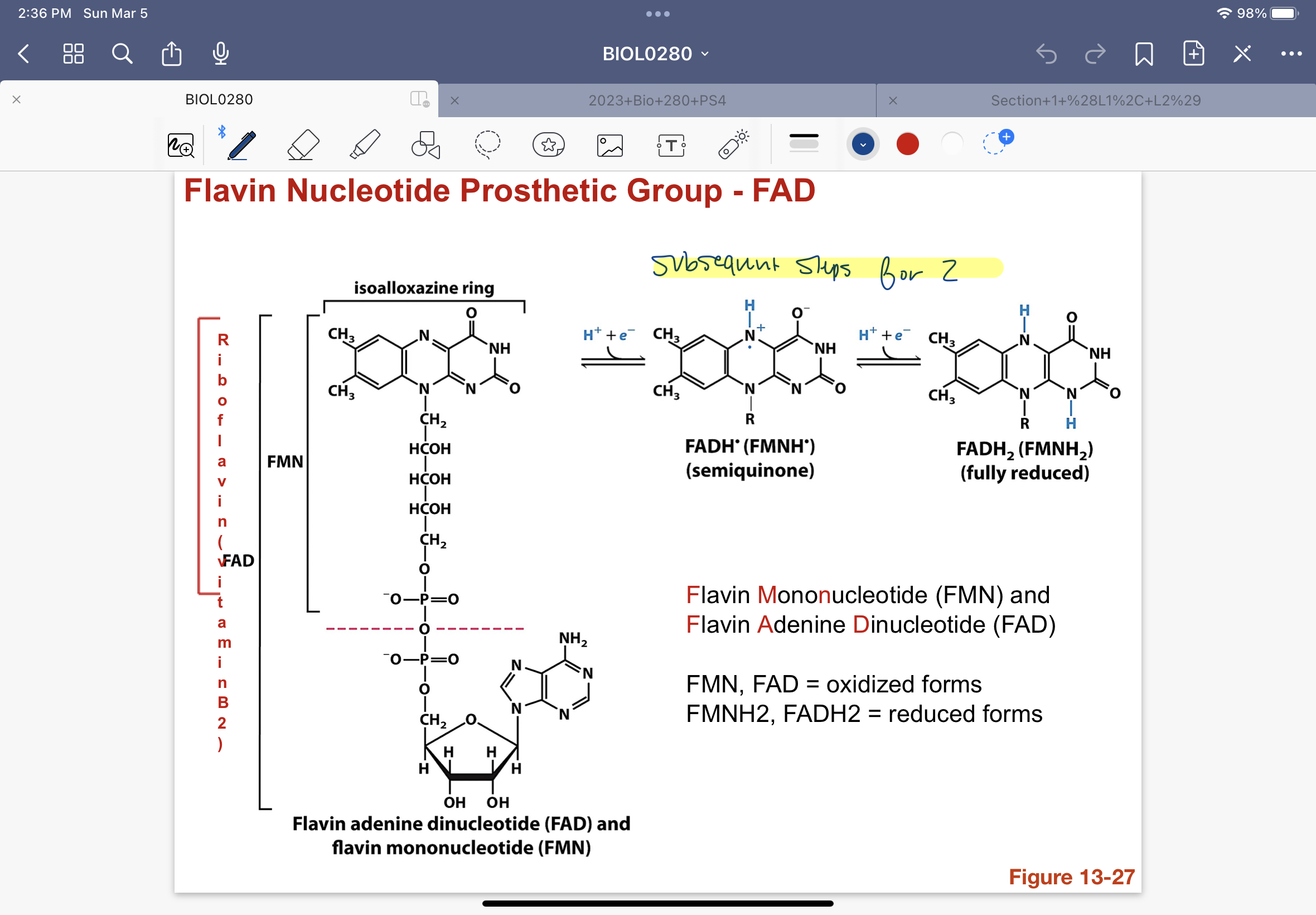
Flavin Mononucleotide (FMN) nd Flavin Adenine Dinucleotide (FAD). FMN, FAD are oxidized forms and FMNH2 and FADH2 are reduced forms. 2 steps for reduced.
4
4 ways to transfer electrons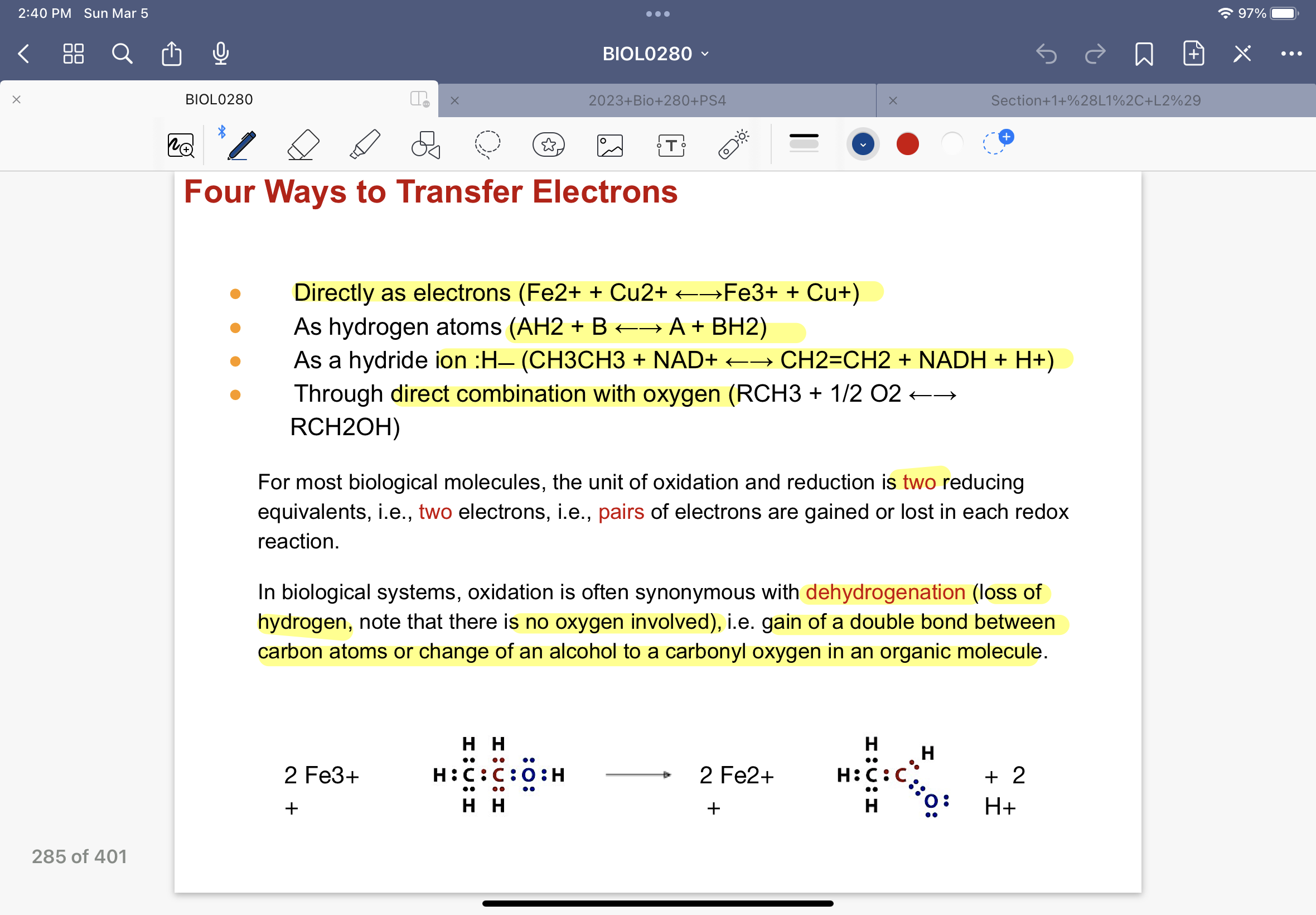
1) Directly as Electrons ( Fe2+ + Cu2+ <> De3+ + Cu+). 2) As Hydrogen atoms (AH2 + B <> A + BH2) 3) As a Hydride ion ( H- (CH3CH3 + NAD+<> CH2=CH2 + NADH+ H+). 4) Through direct comination with O2. (RCH3 + 1/3 O2<> RCH2OH). for most molecules, the unit of oxidation and reduction is 2 reducing equivalents (2 e-, pairs are gained or lost in each reaction. Oxidation is synonymous with dehdrogenation (loss of hydrogen), note that ther is no O2 involved.
5
Catabolism + Anabolism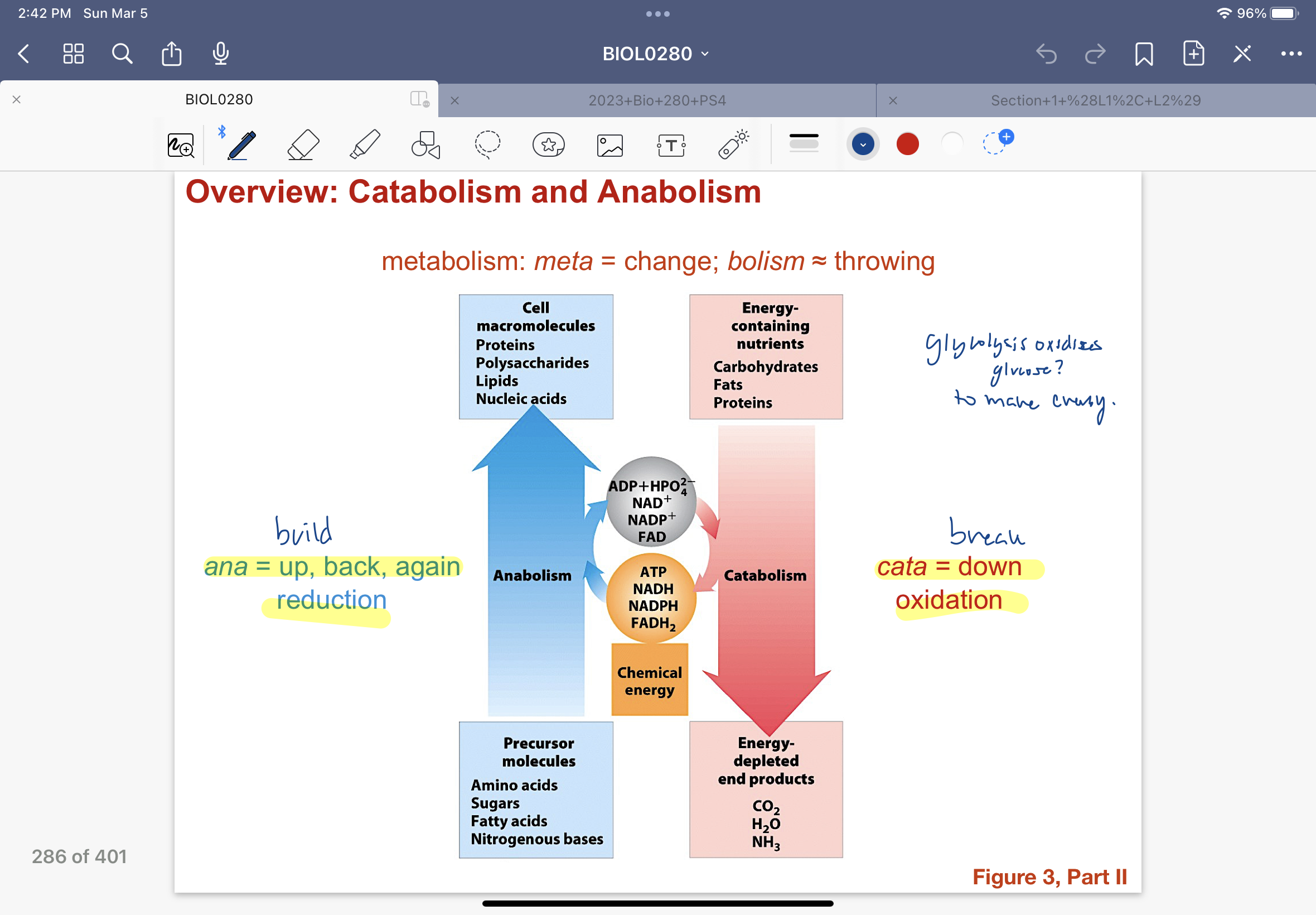
Anabolism is the build up of macromolecules from precursor molecules. Catabolism is the break down of complex molecules into simple ones. Glycolysis is a type of catabolism that oxidizes glucose to make energy. Catabolic pathways converge from complex into one simple thing, anabolic pathways diverge from simple into complex things..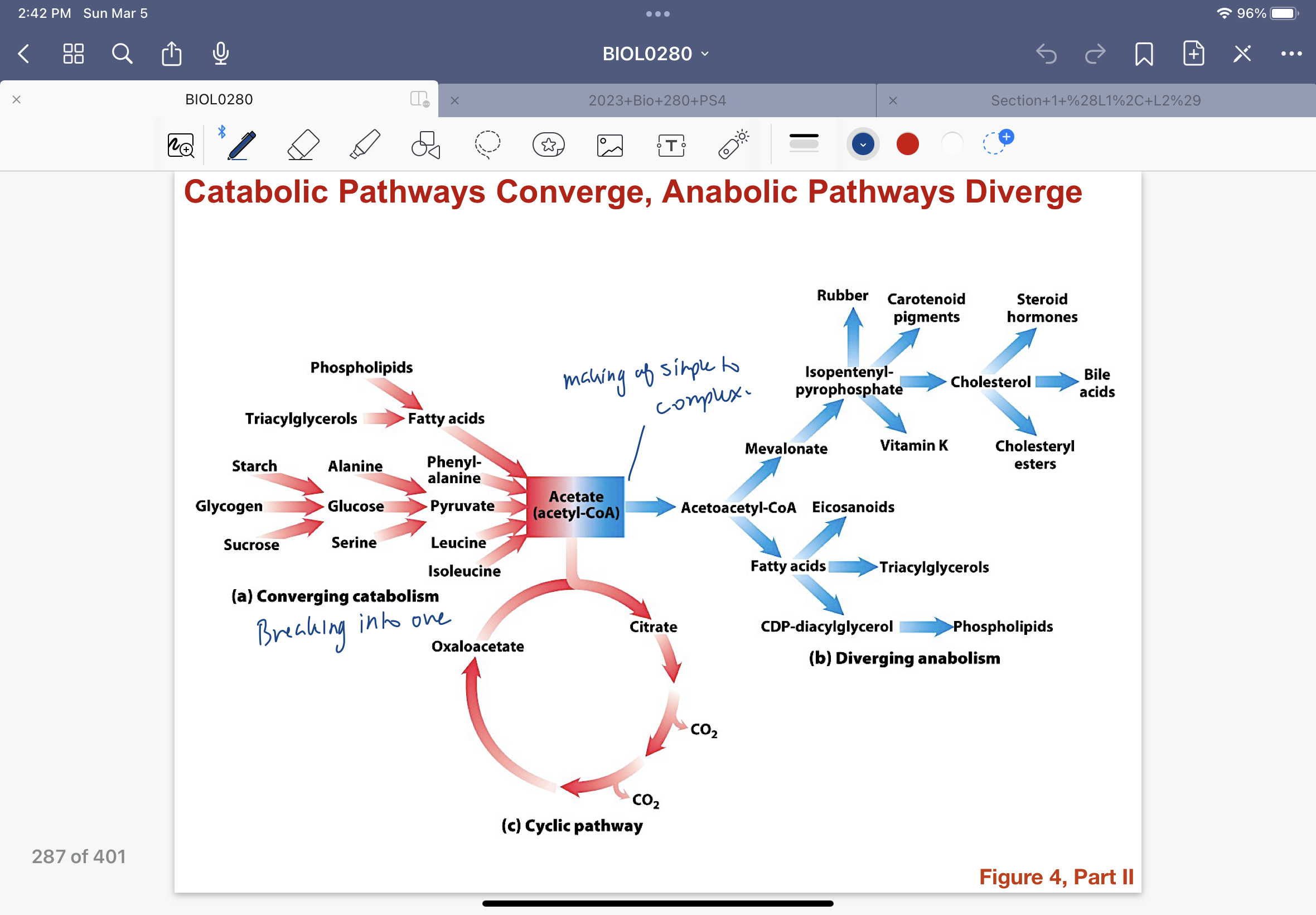
6
3 Stages of cellular respiration overview. 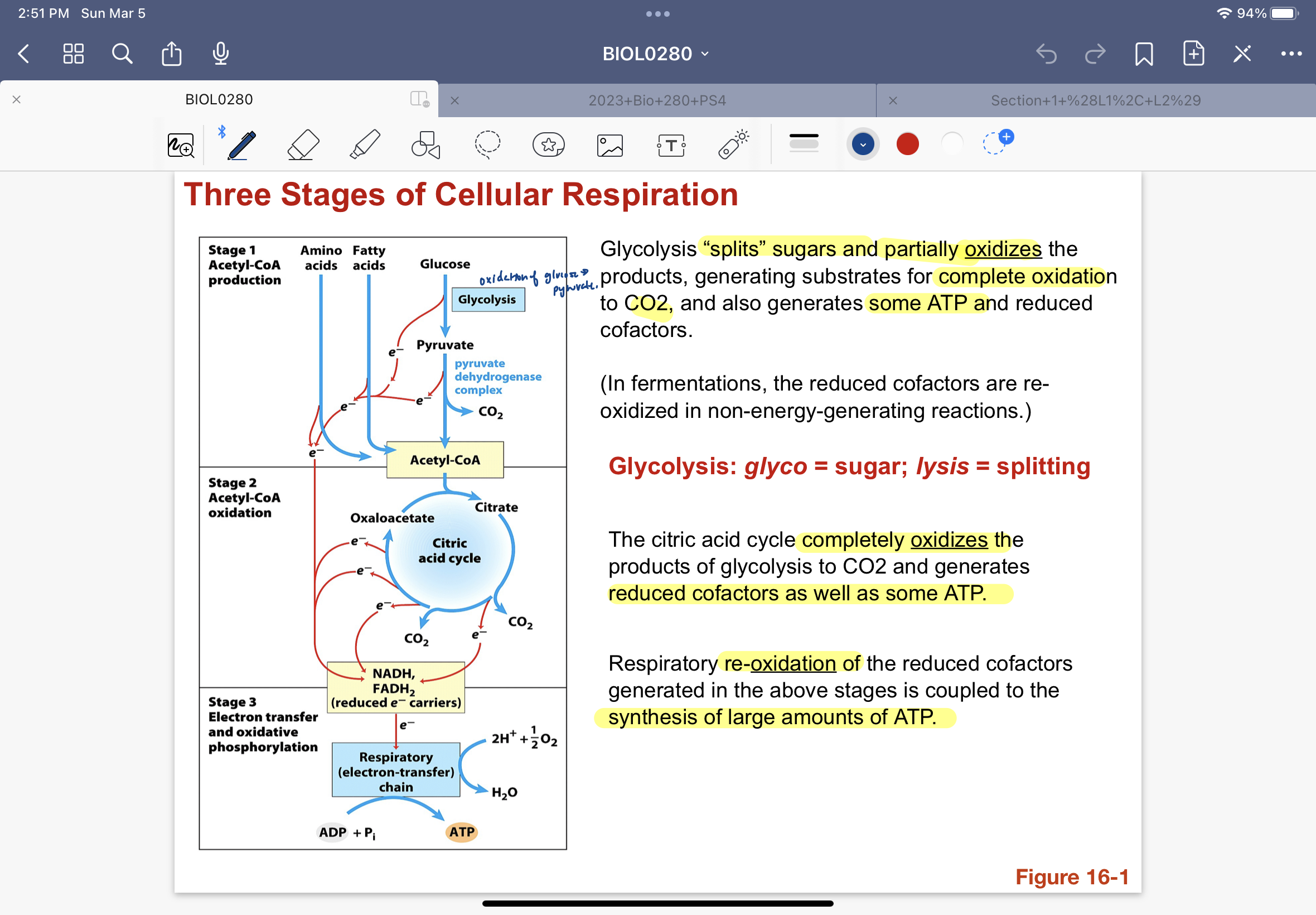
Glycolysis splits sugats and partially oxidizes the porducts generating substrates for complete oxidation to CO2. and also generates some ATP and reduced cofactors. AKA acetyl CoA production. Part 2 is the citric acid cycle which completely oxidizes the products of glycolysis to CO2 and generates reduced cofactors as well as some ATP. AKA acetyl Coa Oxidation. Stage 3 is respiratory re-oxidation of the reduced cofactors generated in the above stages, coupled to the synthesis of large amounts of ATP AKA electron transfer and oxidative phosphorylation.
7
Ocidation of carbon in the Biosphere.
We want to only focus on "owned" electorns when determining redox. Carbon will take all if bonded with H, half if bonded with another C, and will have none if bonded with O2.
8
Glycolysis. Stepwise oxidation of glucose.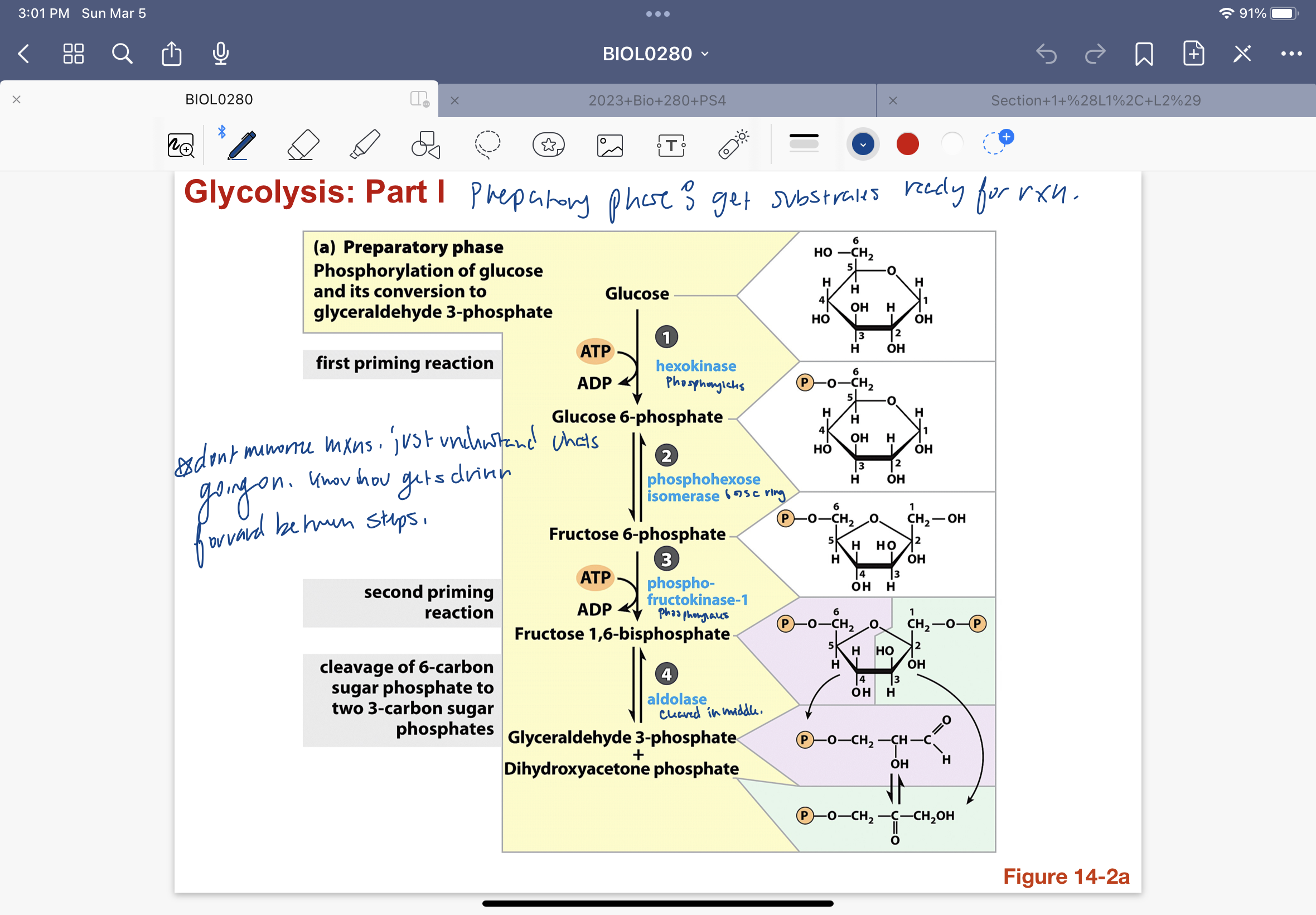
O2 has a higher affinity for electrons than glucose and the various electron carriers. (like NADH). Therefore, the transfer of electrons from these molecules to O2 is energetically favorable. Only 20-50 kJ/mol are required to form one molecule of ATP from ADP + Pi. Stepwise ocidation of glucose converts electron flow into usable energy. The energy released in some steps can be captured by coupling the step to ATP synthesis, or by temporarily storing the electrons in a molecule (like NADH) whose re=oxidation can be coupled to ATP synthesis. 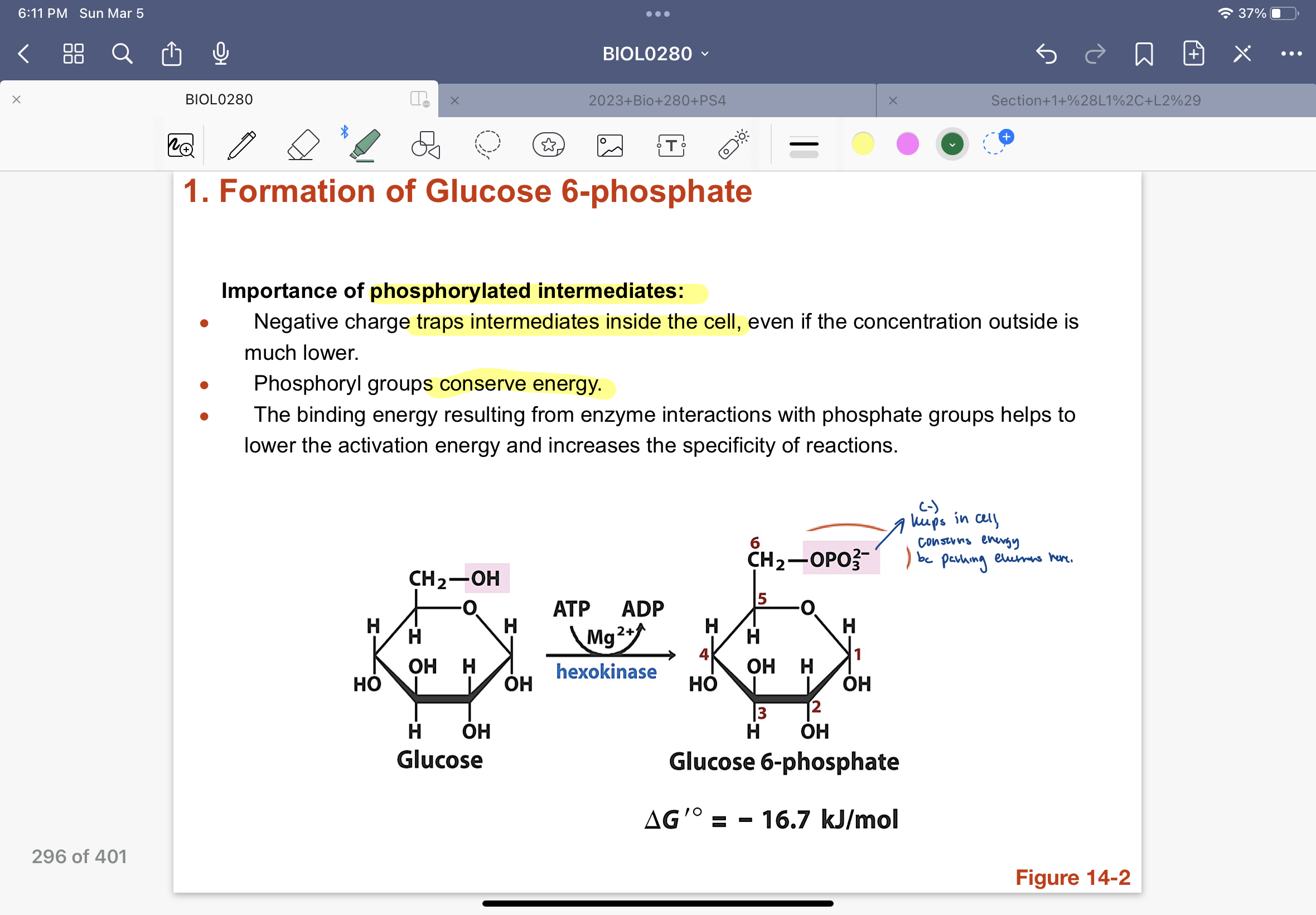
9
Glycolysis Part 1: Prepatory phase to get substrates ready for the reaction.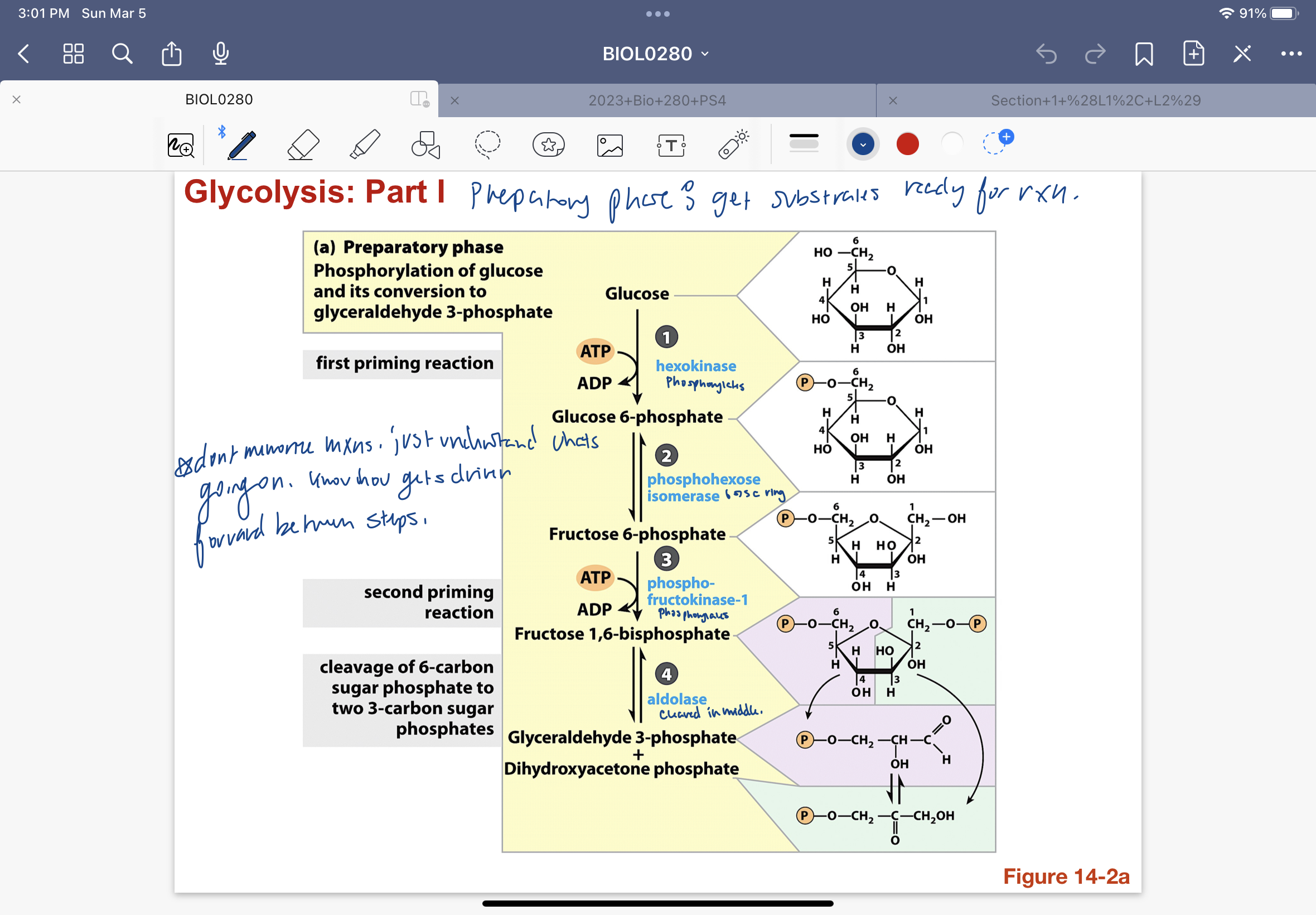
Phosphorylate glucose (through hexokinase and ATP), and convert to glyceraldehyde 3- phsophate. 2 changes from a 6 c to 5 c ring, 3 phosphorylates it again, 4 cleaves it in the middle to make 2 3 carbon sugar phosphates: glyceraldehyde 3 phosphate and Dihydroxyacetone phosphate. Glucose molecule is converted into 2 triosephosphate molecules, at the expense of (driven by) the hydrolysis of 2 ATP molecules.
10
Glycolysis Part 2: "payoff phase" 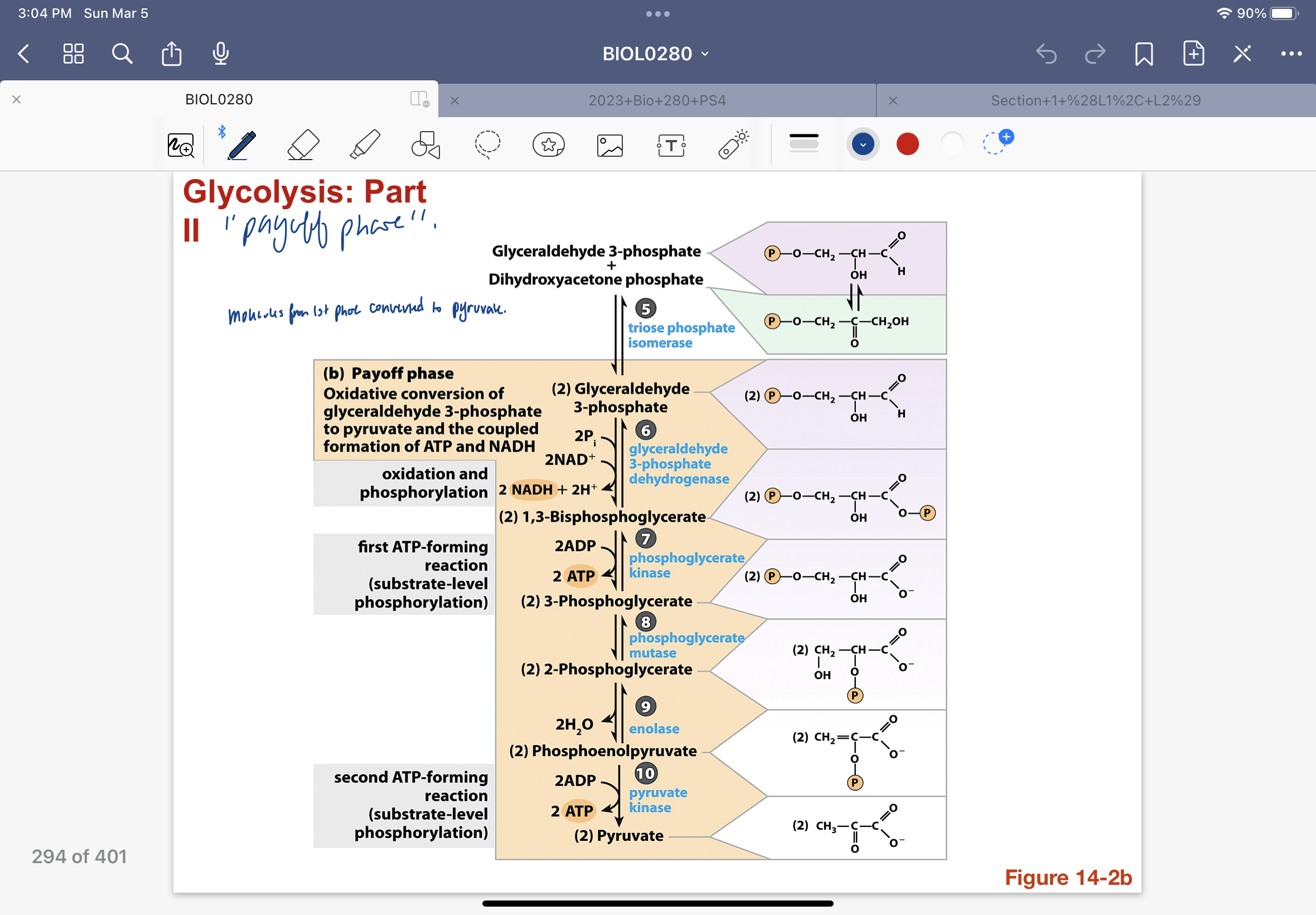
Molecules from 1st part converted to pyruvate. 5 allows for intercovnersion between two types. Then glyceraldehyde 3 phosphate undergoes ocidative conversion to pyruvate with coupled foramtion of ATP and NADH. 6 oxidates and phosphorylates, 7 forms first 2 ATP, 8 moves phosphate, 9 removes OH, 10 kinase phosphorylates ADP by taking molecules P forming 2nd ATP. In this phase, initial 2 ATP molecules hydrolized in part 1 are regenerated and 2 more ATP plus 2 NADH molecules are formed for each molecule of glucose (Regenerate ATP and park e- on cofactors to push the reaction forward).
11
1. Formation fo glucose 6 phosphate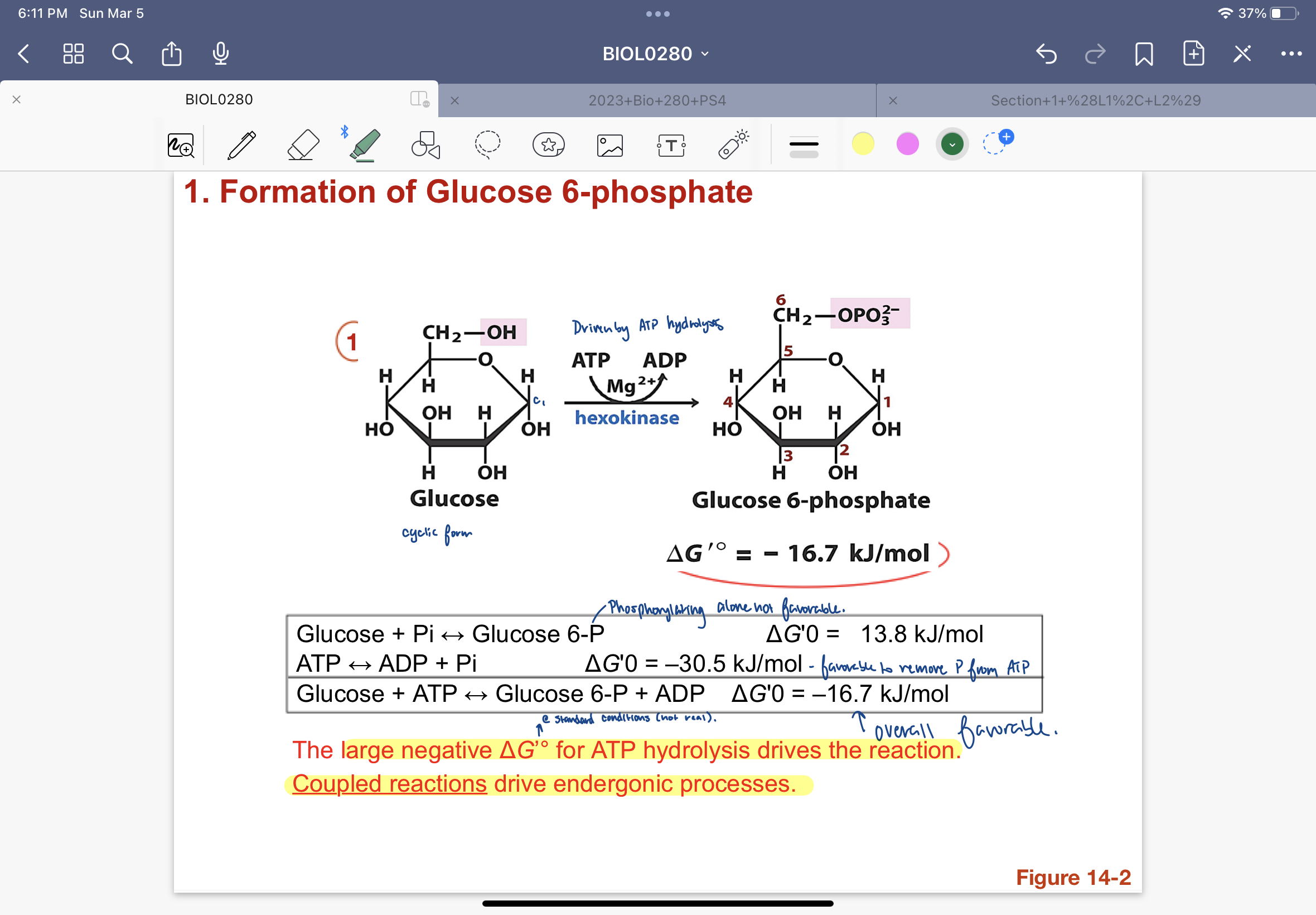
The large negative Delta G' for ATP hydrolysis drives the reaction since it is coupled with the endergonic formation of glucose 6-phosphate. - charge of phosphorylated intermediate traps intermediates inside the cell even if concentration outside is much lower, phosphoryl group conserves energy "parks e- there", and lowers activation energy and increases specificity of reactions.
12
2. Isomerization and 2nd Phosphorylation 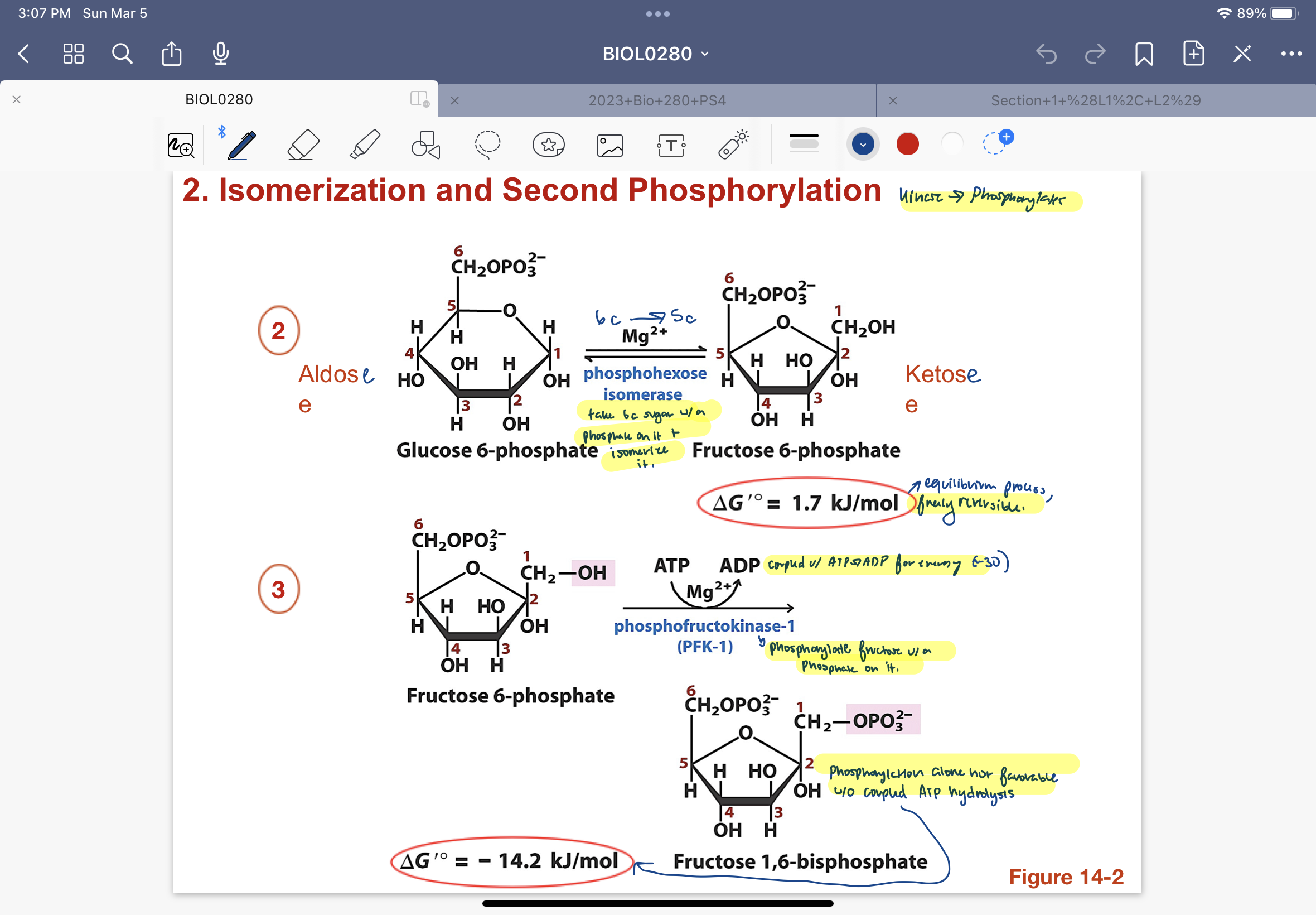
Isomerize= change 6c>5c. Kinase= phosphorylates. If Delta G' is near 0 then freely reversible reaction. . 3 is coupled with ATP>ADP for energy since hard to phosphoylate glucose with a phosphate already on it allowing for creation of Fructose 1,6-biphosphate.
13
4. ALdol Cleavage (the literal glycolytic reaction)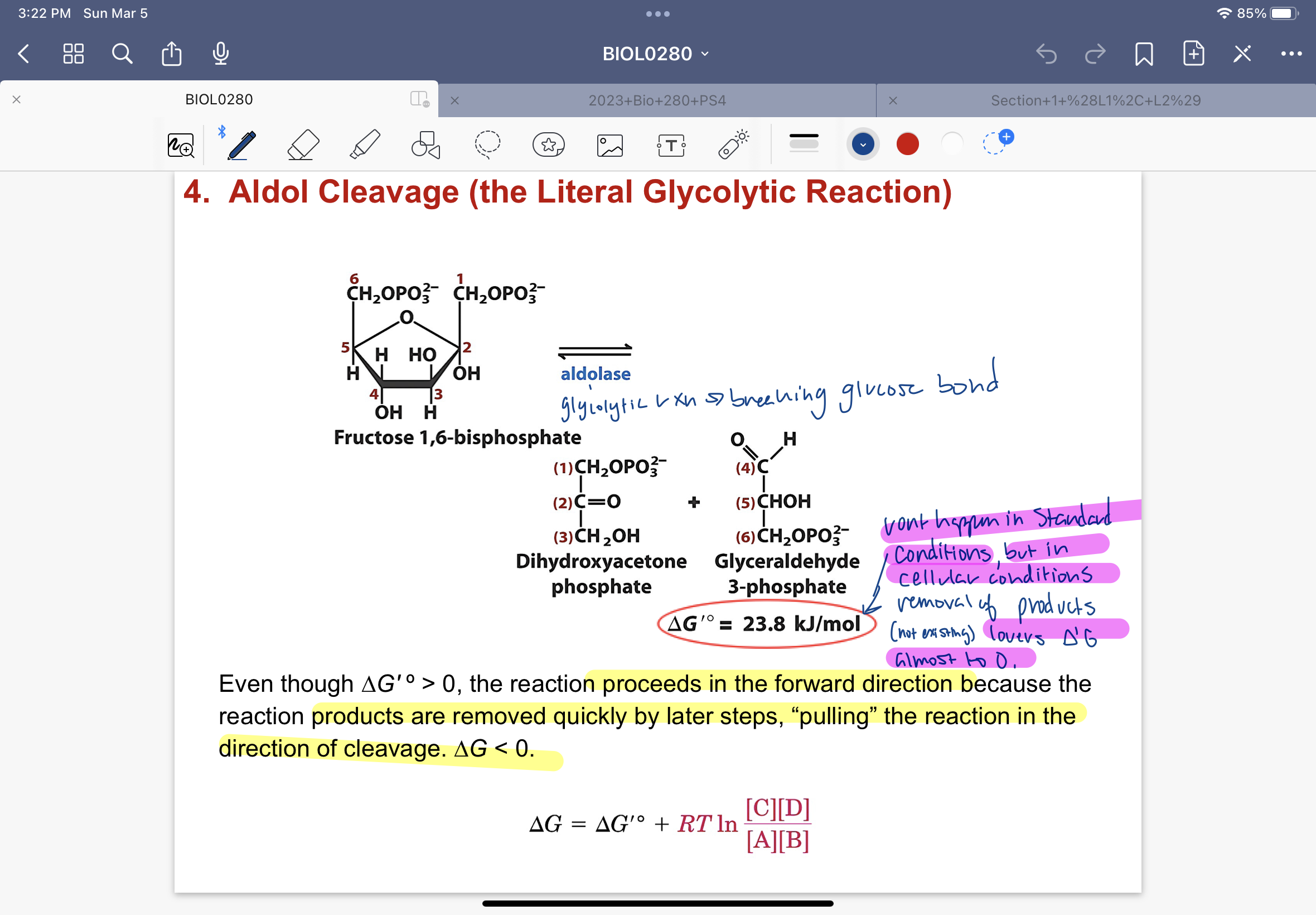
aldolase is glycolytic becuase it breaks the glucose bond. In standard conditions the reaction is not favorable but cellular conditions allow for quick removal of its products pulling the reaction in the direction of cleavage and lowering Delta G' almost to 0.
14
5. Isomerization
Delta G' at standard is one again greater than 0 but the reaction proceeds forward becuase the products are removed quickly by later steps, "pulling" the reaction in the direction of cleavage to
15
Enzyme limited vs Substrate limited reactions.
If Substrate/product ratios are near the equilibrium ratios, involved enzymes are relatively fast or abundant= meaning Flux is substrate limited. Enxyme is always there and Delta G is low. If substrate product ratio is greater than equilibrium ratio then step is catalyzed by realitvely slow or scarce enzyme = meaning flux is enzyme-limited. Delta G' is high, more scarce enzymes need ATP hydrolysis coupled to proceed.
16
Characterisitcs of enzymes that are regulated
most operate near equilibrium but some are far. characterisitcs: 1) They control the rate of the respective pathway and whther it is turned on or off. 2) They catalyze reactions that are out of equilibrium and which are enzyme limited (valve fucntion) 3) They catalyze highly exergonic (effectively irreversible) reactions, thus dirivng the pathway forward (enzyme limited and regulated case). 4) They differ in catbolic vs anabolic pathway. The two ATP requiring steps of Glycolysis are regulated (steps 1 and 3).
17
Allosteric control of enzyme activity: Hexokinase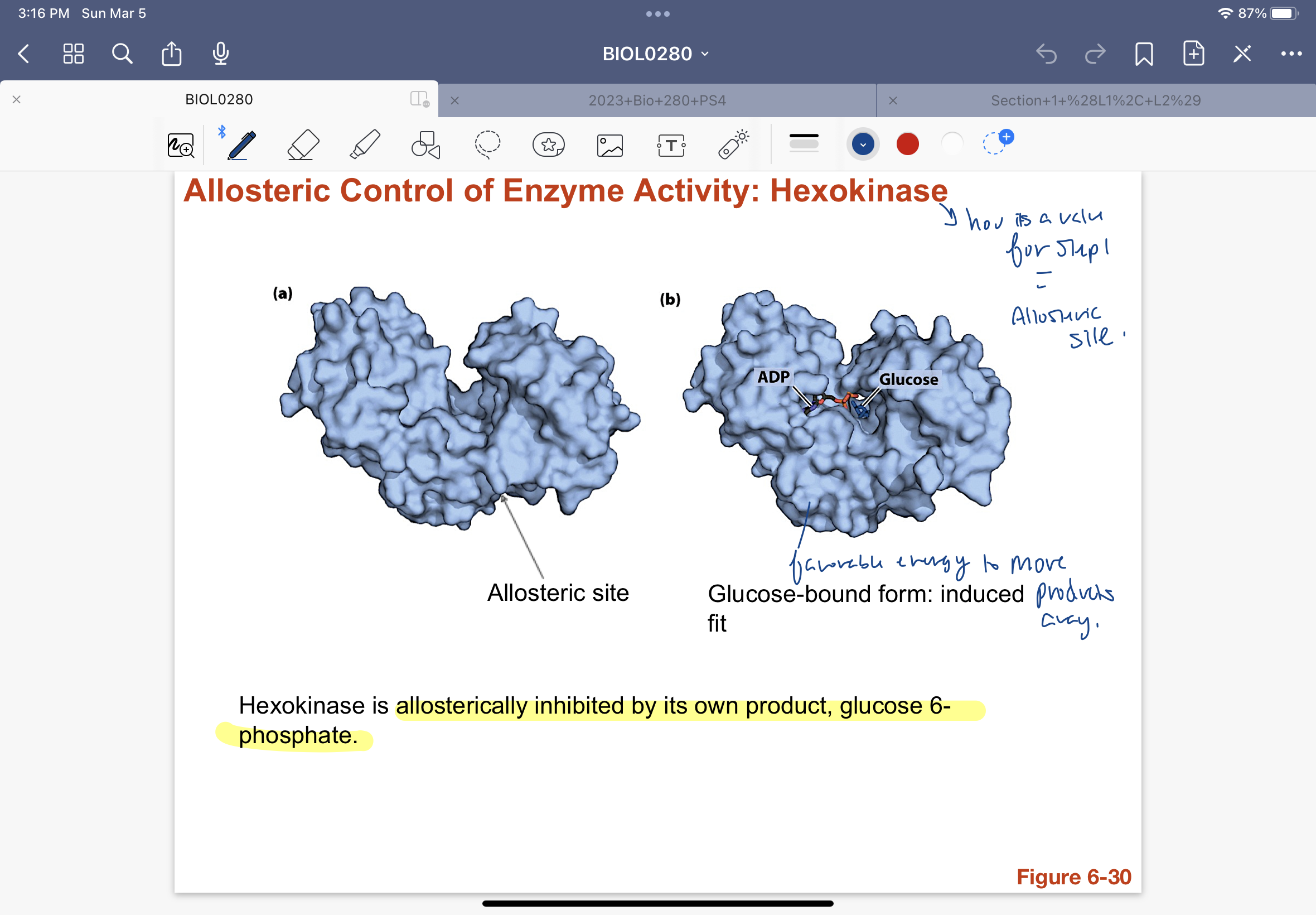
A valve for step 1 due to allosteric site. Hexokinase is allosterically inhibited by its own product glucose 6-phosphate.
18
PFK-1 regulation is complex but still allosteric 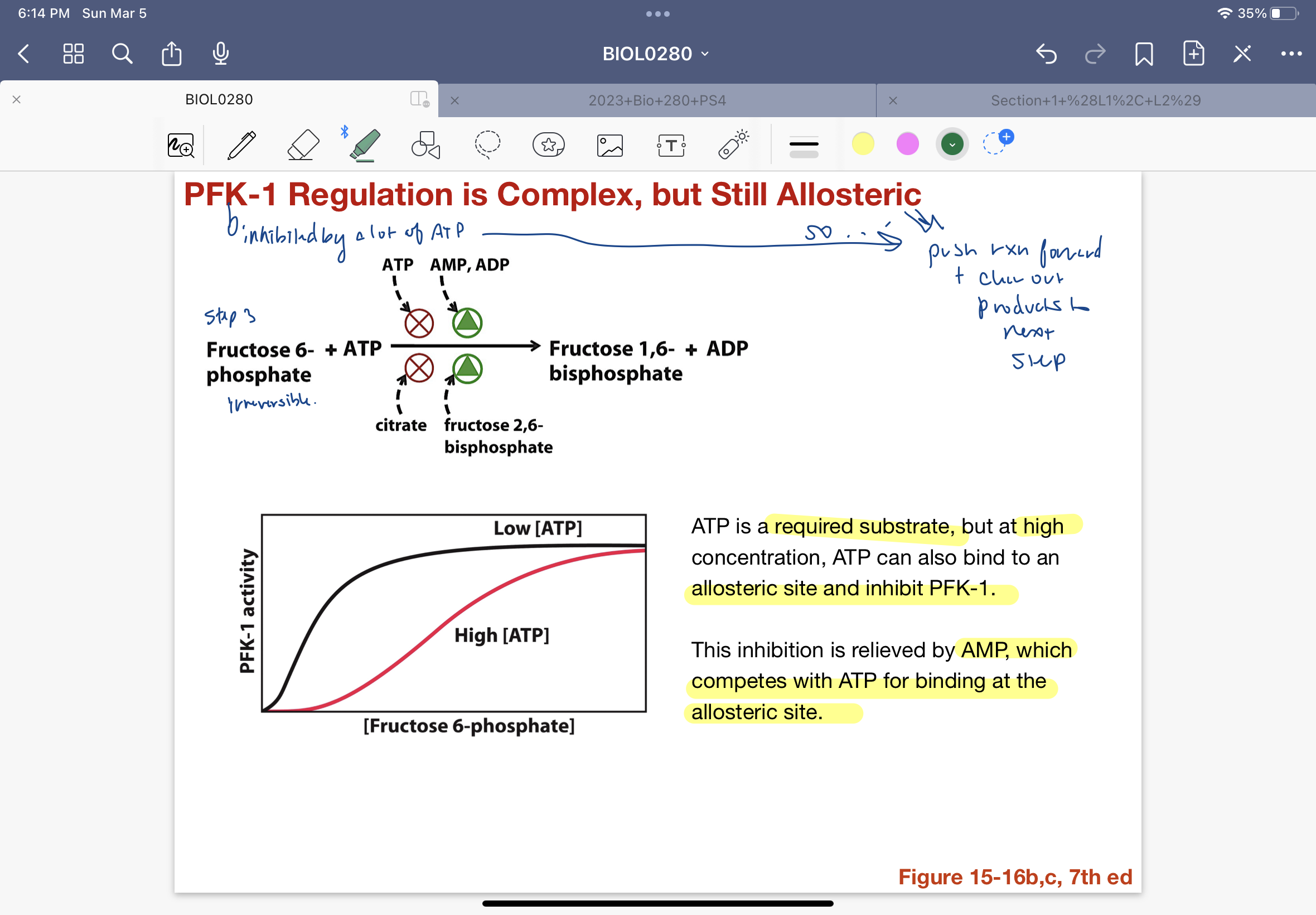
PFK-1 in step 3 is inhibited by a lot of ATP so wants to push reaction forward in order to clear out products to get to the next step. AMP competes with ATP for binding at allosteric site and can releive inhibition.
19
Triosephosphate Isomerase: A "perfect enzyme"
only one of the 2 molecules can start the payoff phase (stage 2), triosephsophate isomerase allows for interconversion between the 2 with its TIM barrel. Limitation1 a catalyst cannot affect the position of the reaction equilibirum. TIM accelerates the isomerization by a facotr of 10^10 dompared to the chemical reaction. limitation 2 a catalyst cannot catalyze an interconversion faster than the substrate can find the enzyme in the solution. the Kcat/KM ration for TIM is 2 X 10^8 1/M*S, which is close to the diffusion limit of a small molecule in solution. (near perfect enzyme).
20
The fate of Hexose Carbon atoms 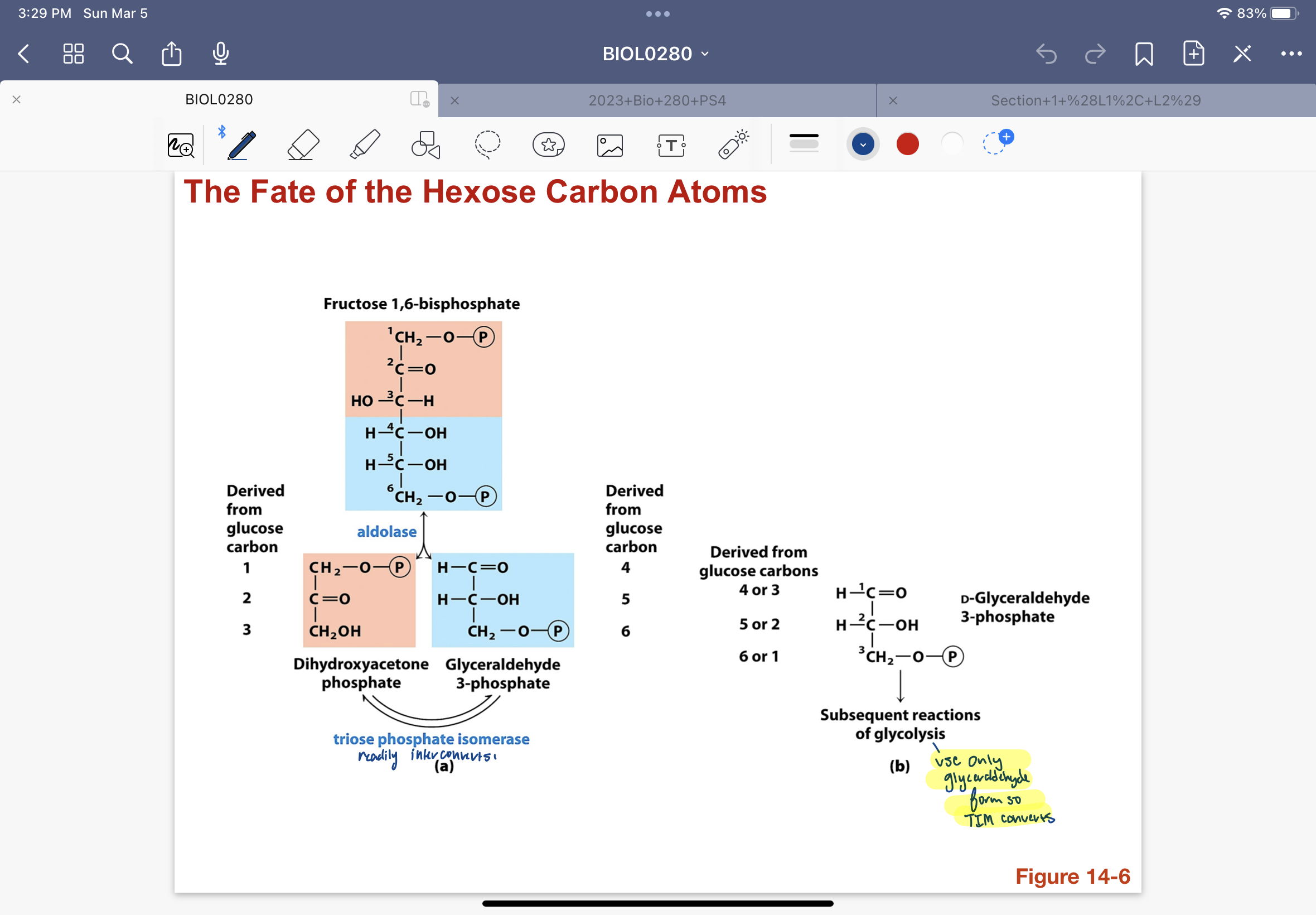
Essentially will end up as D-Glyceraldehyde 3-phosphate.
21
Steps 6 and 7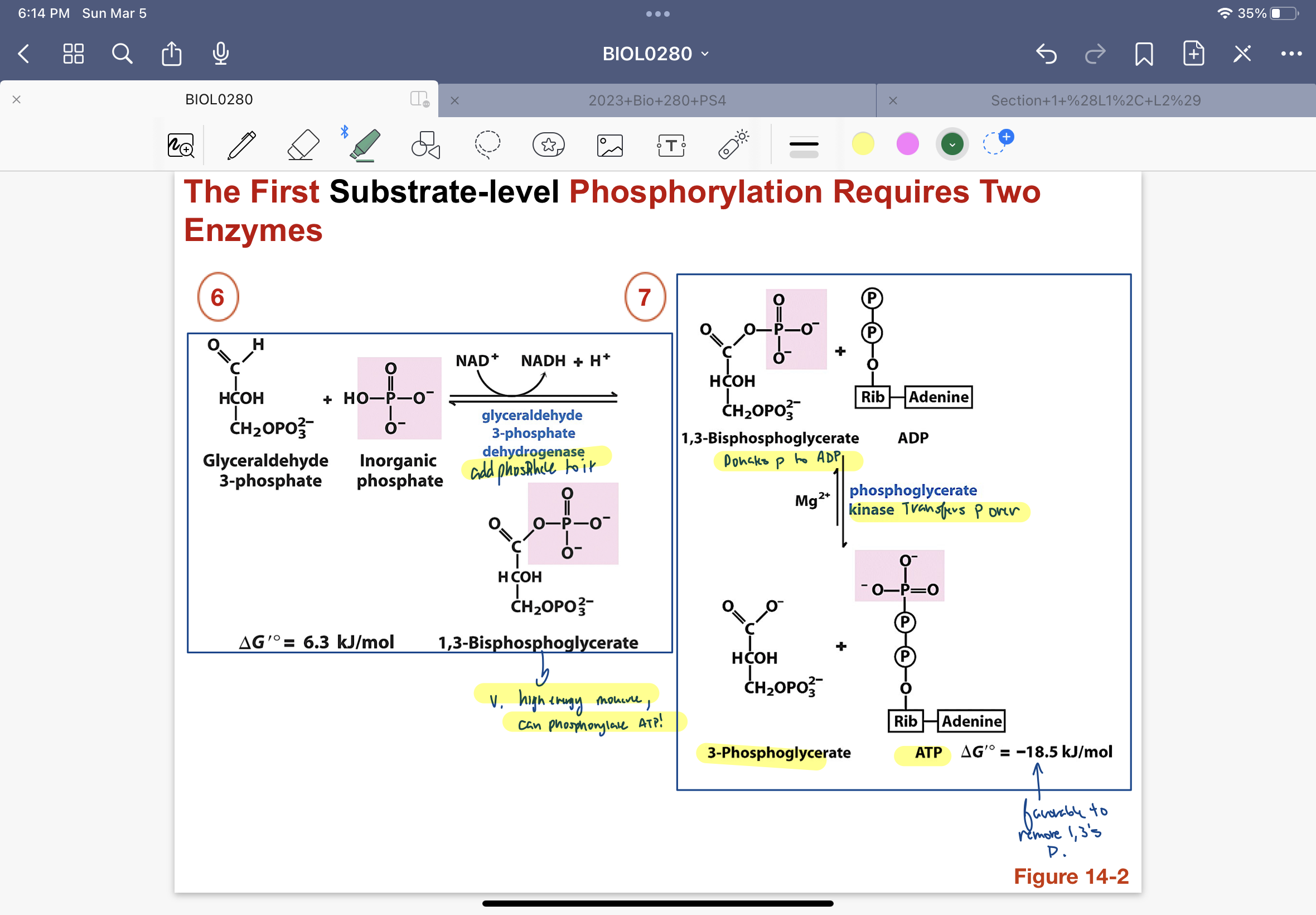
Step 6 adds phosphate to glyceraldehyde 3 phosphate, forming a very high energy molecule that is higher in energy than ATP so can phosphorylate it! Large Negative for its oxidation drive the reaction. Step 7 is with an ADP, allowing for the donation of the phosphate back to ADP to create ATP through the kinase. This is favorable becuase the previous molecule was so high energy. he large negative for 1,3-bis-P-glycerate hydrolysis drives the reaction 6 and 7 must be coupled (close in physical space) to be favorable becuase this allows for passing of substrates in between, for them to work in tandem, and allows for a faster reversible step This protexts 1,3-biphosphoglycerate from spontaneous hydrolysis and ensure that reactions 6 and 7 remain coupled becuase the intermediate is never released into the solvent. 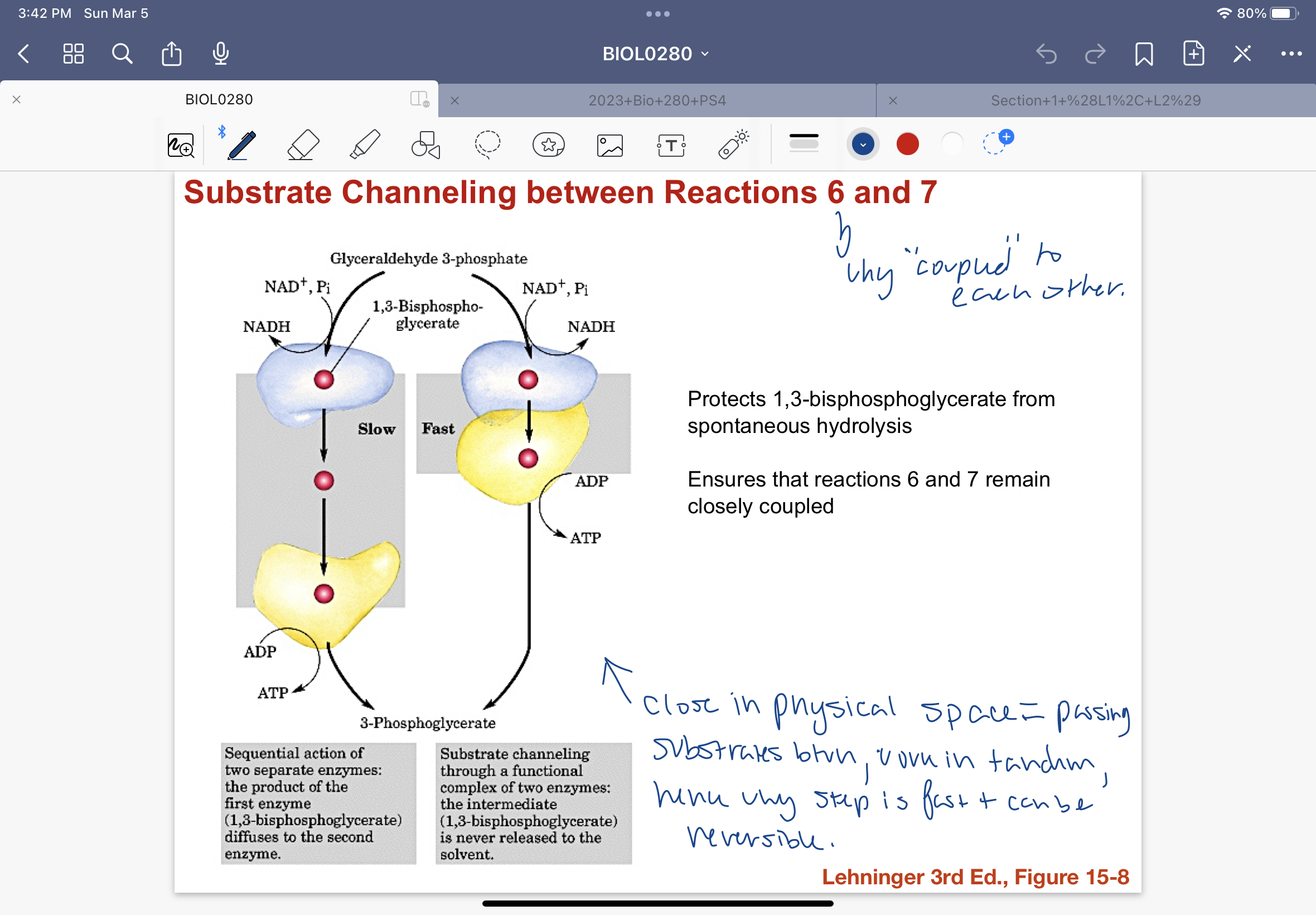
22
1,3-BPG high energy compound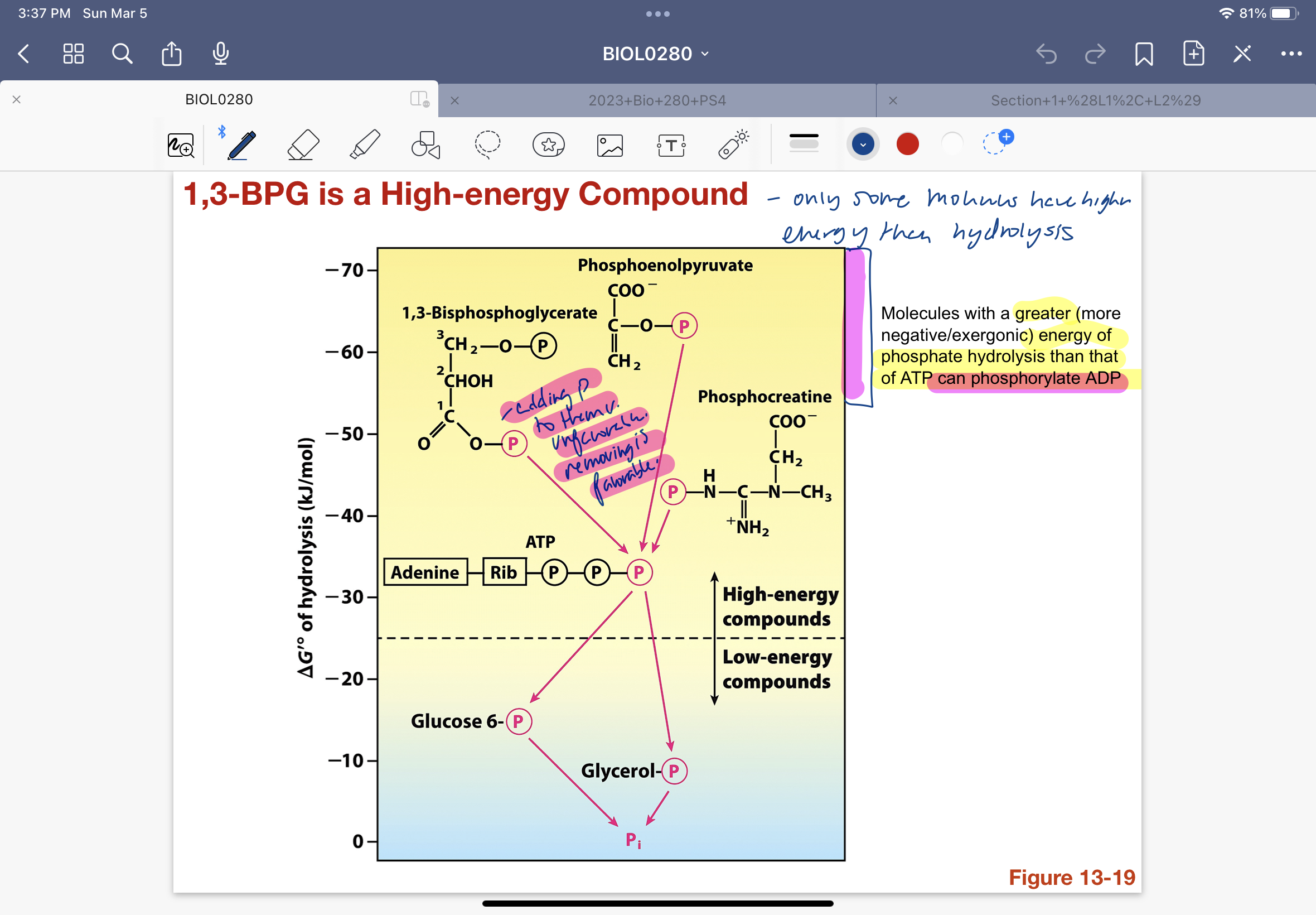
Only molcules with a higher energy than ATP hydrolysis (more engative/ exergonic) can phosphorylate ADP. Adding P to them is very unfavorable while taking it away is very favorable. when P removed from it, product is a strong acid that is immediately ionized at pH = 7, causing the H+ to go away and the negative charge to be distributed by resonance across the 2 oxygen atoms, lowering the concentration of the immediate hydrolyisis product, pulling the reaction forward. Much more exergonic becuase wihtout P, respnance creates a much more stable molecule than is allowed when P is there. 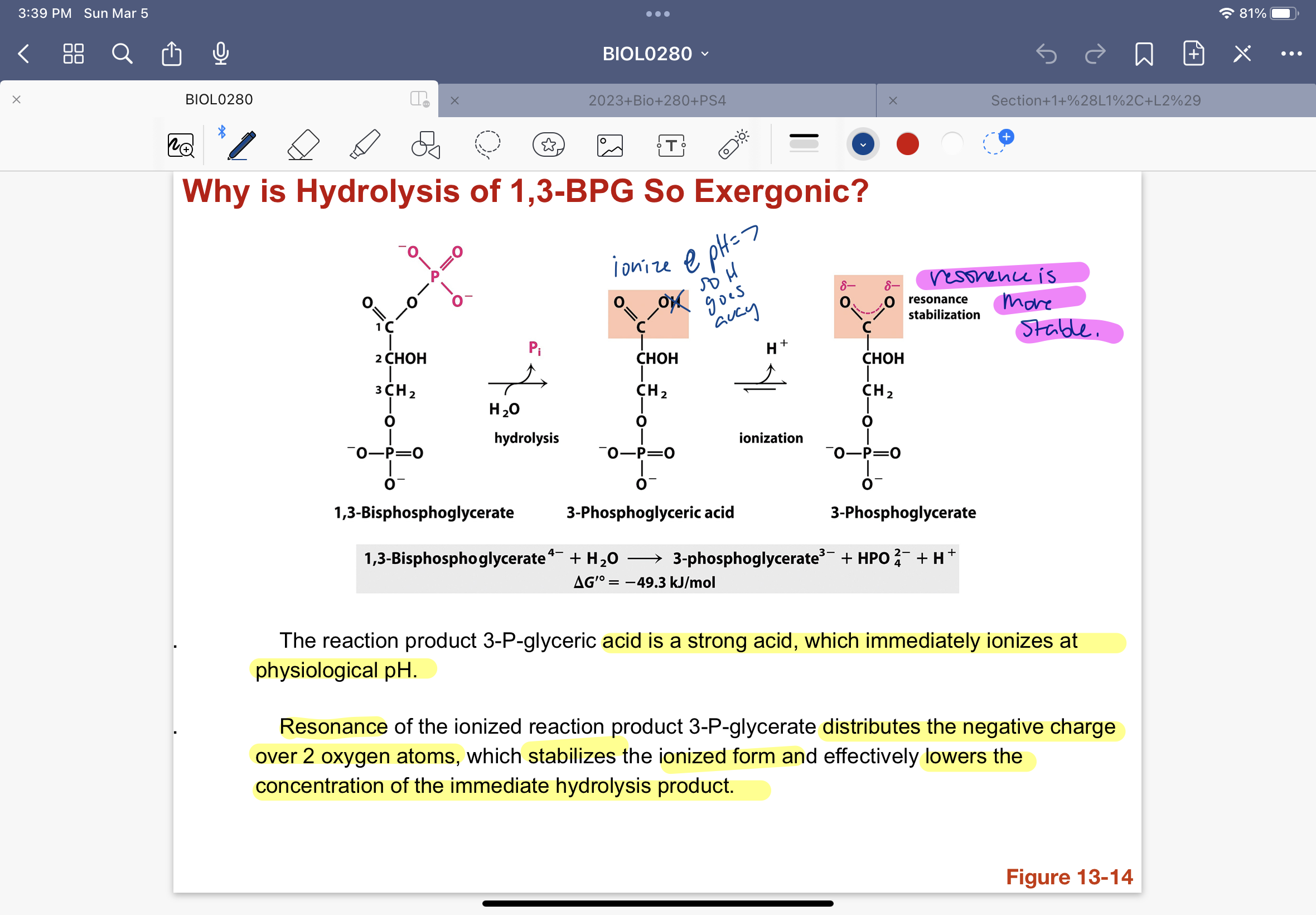
23
Steps 8 and 9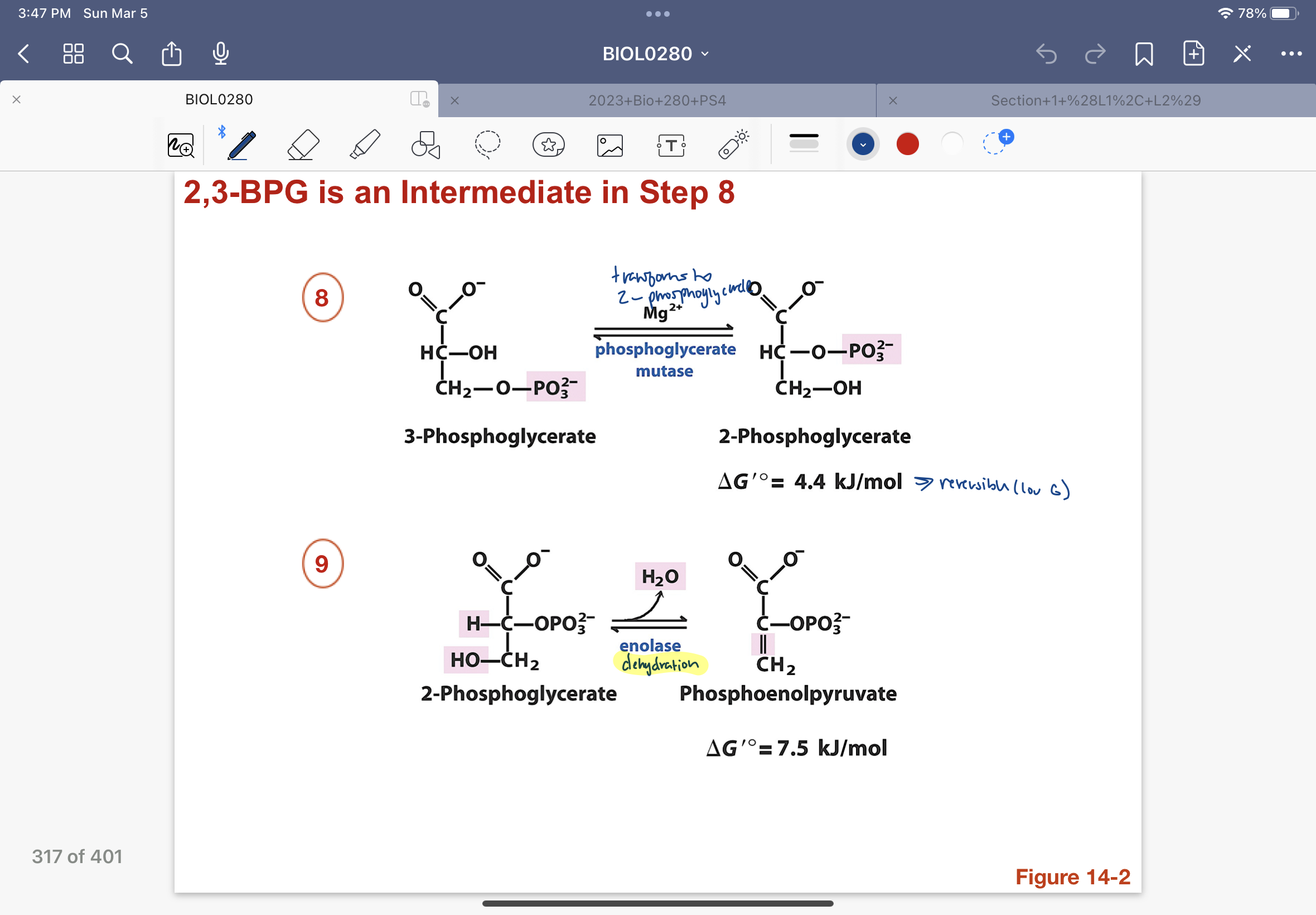
mutase switches phophate position, which has a low delta G so is reversible. Enolase dehydrates getting rid of H2O to make phosphoenolpyruvate.
24
Step 10: the second substrate level phosphorylation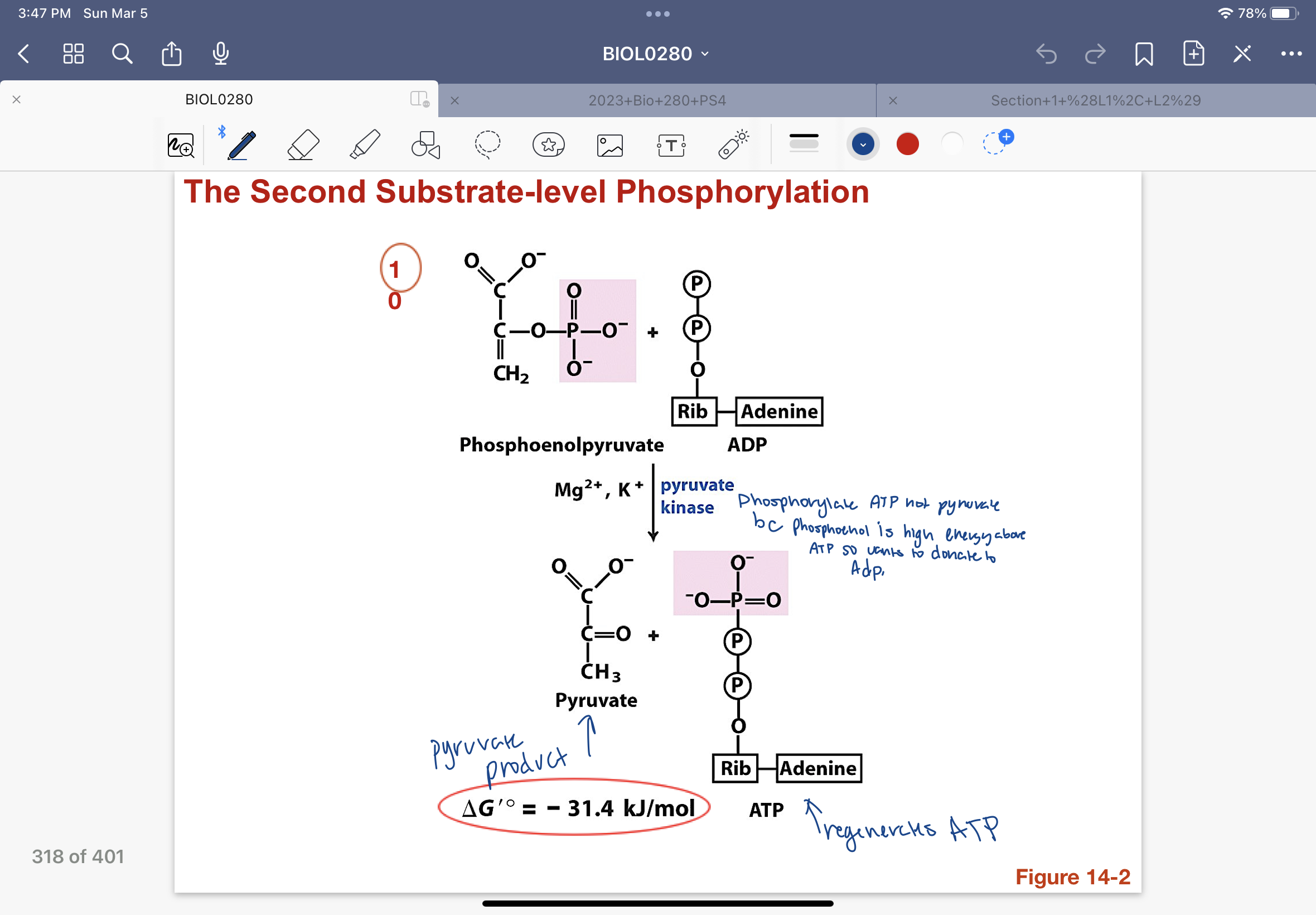
Combine product with ADP and add kinase, ADP is then phosphoryalted becuase phosphoenol is a higher energy molecule that wants to donate P to ADP. Pyruvate is leftover and ATP is regenerated. 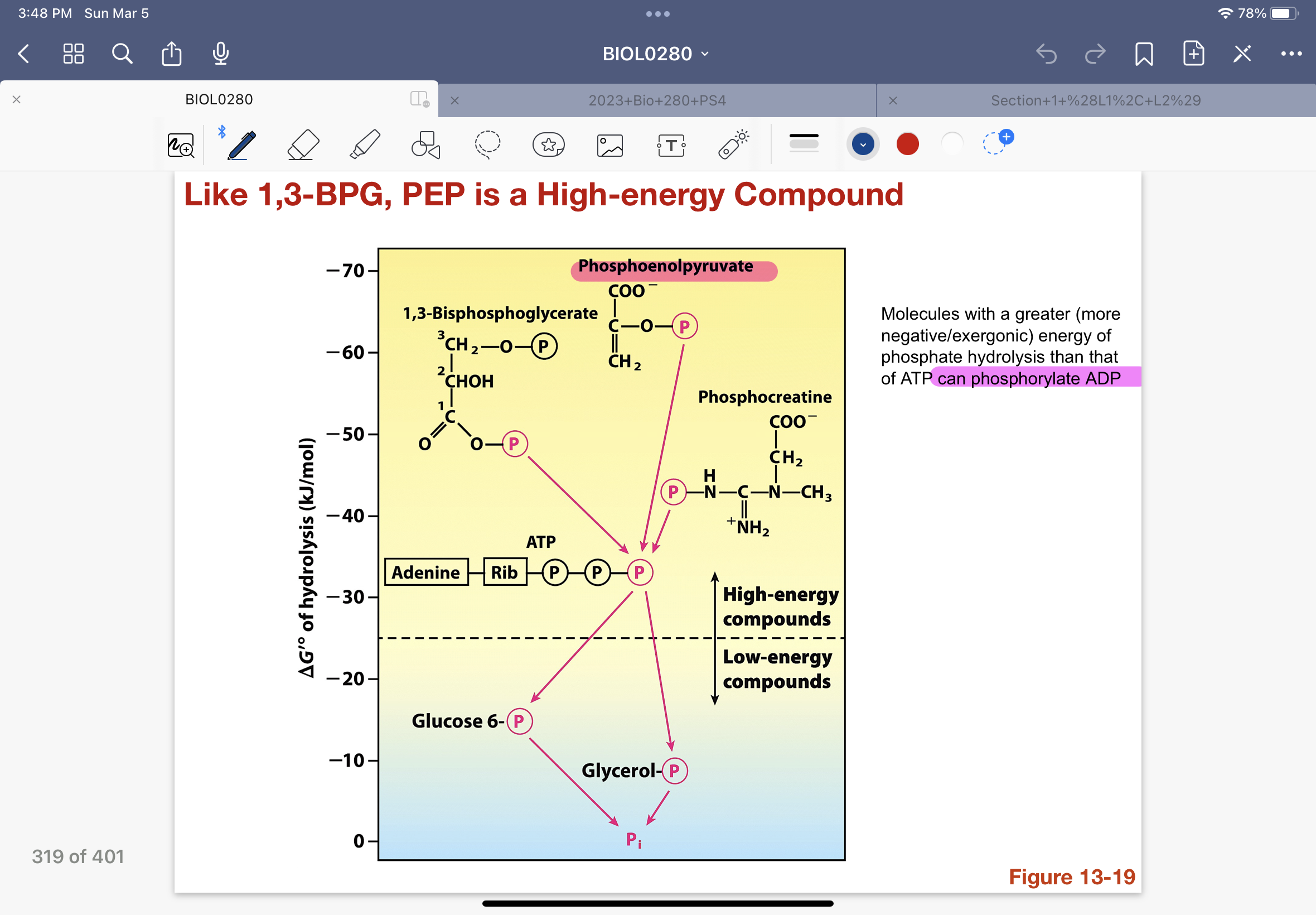
25
PEP Hydrolysis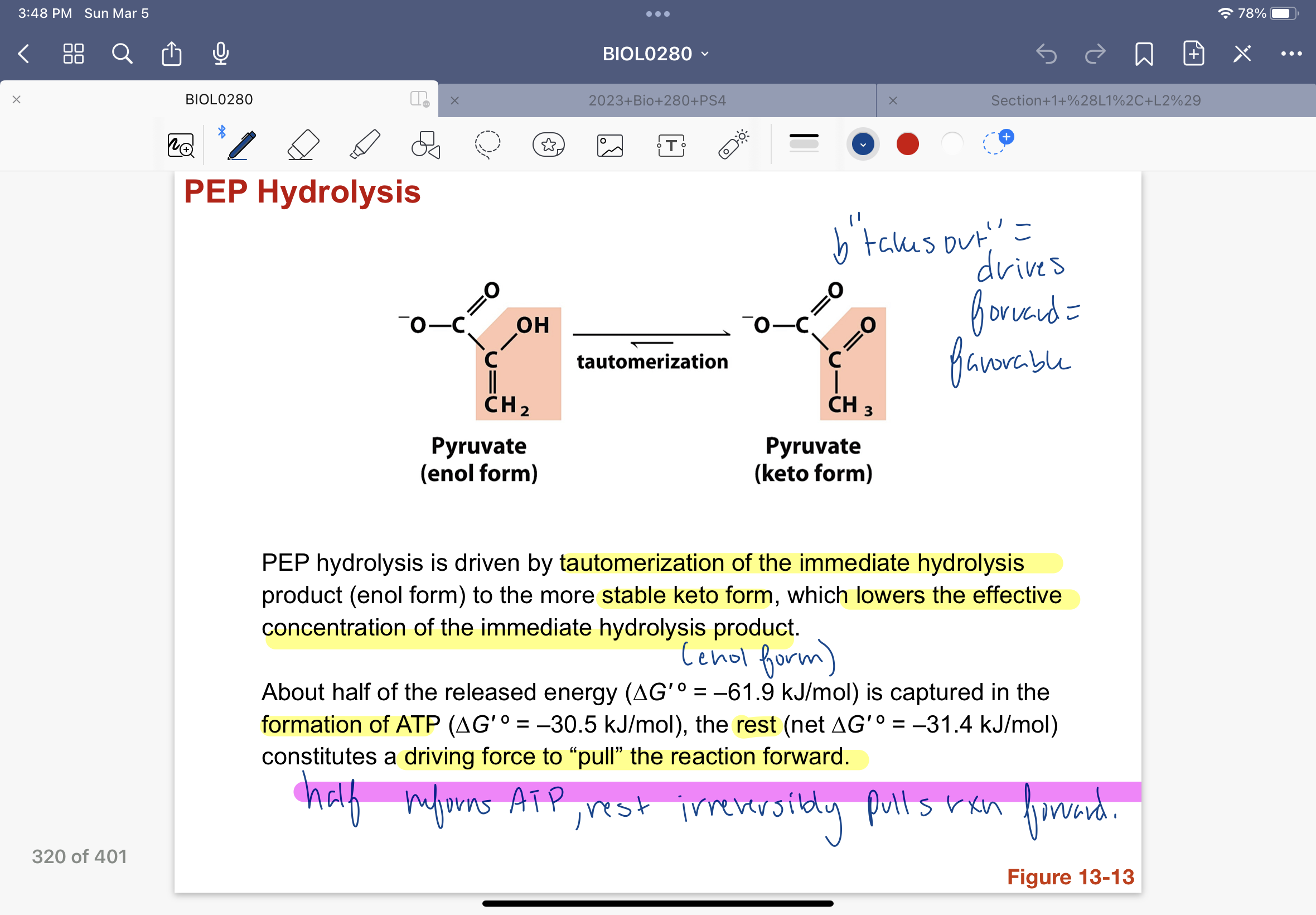
Pyruvate changing from enol form to keto form through the process of tautomerization. PEP hydrolysis is driven bu the tautomerization of the immediate hydrolysis product (enol form) to the more stable keto form, which lowers the effective concentration of the immediate hydrolysis product. Half of the released energy is captured in the formatin of ATP (~ -30.5 jK/mol), while the rest consitutes a driving force to pull the reaction forward (by becoming keto form)
26
Steady state concetrations of Glycolytic intermediates in Erthrocytes (Cells not at G" standard state, the real [] in cells). 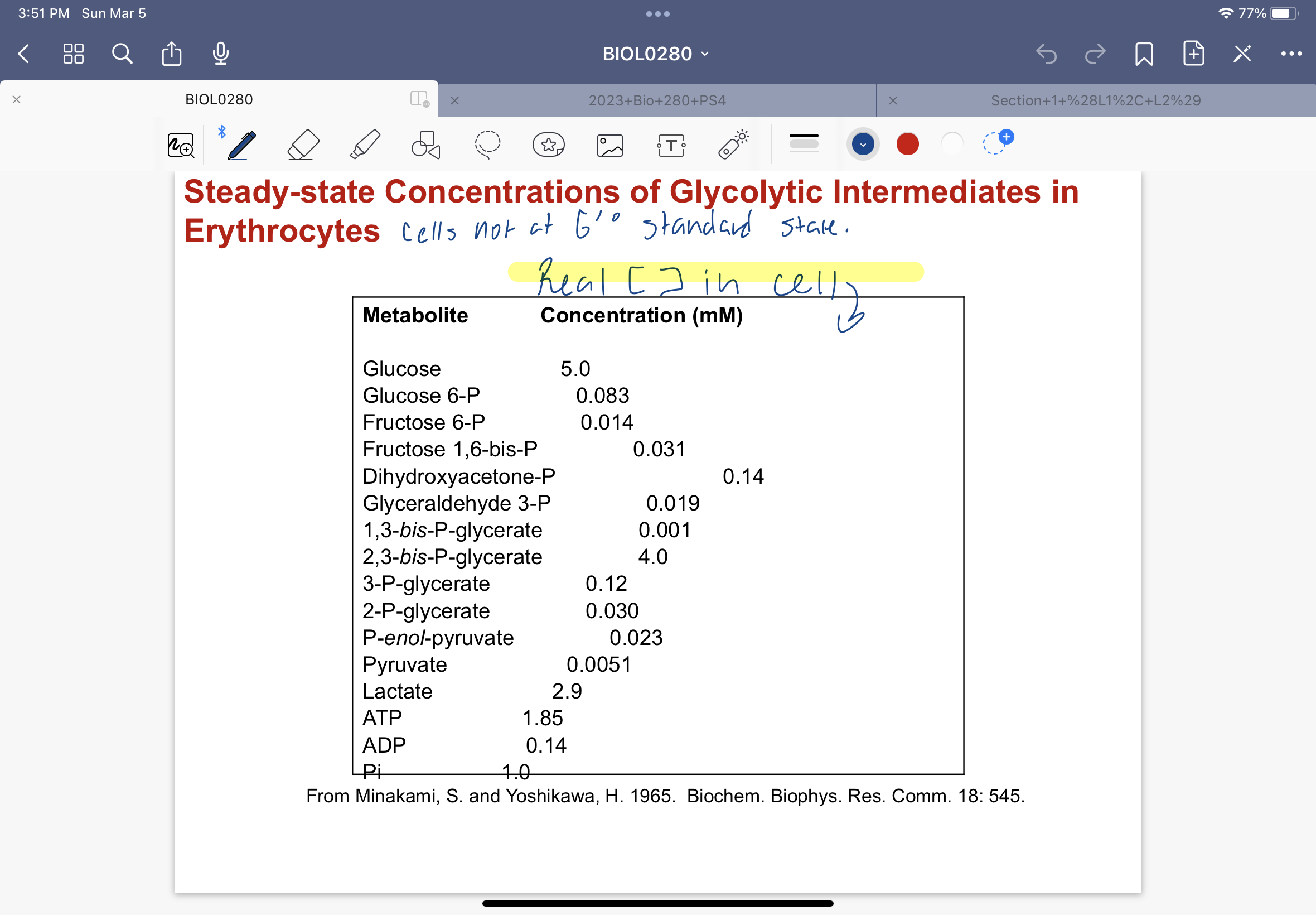
Real cell Delta G values of glycolysis intermediates shows that the free energies of all steps are either negative or close to 0 hence why glycolysis proceeds. -82 kJ/mol for glycolysis, 2.1% captured as ATP, 15.4% obtainable from re-oxidation of NADH, and 79.4% is obtainable from the complete oxidation of pyruvate. 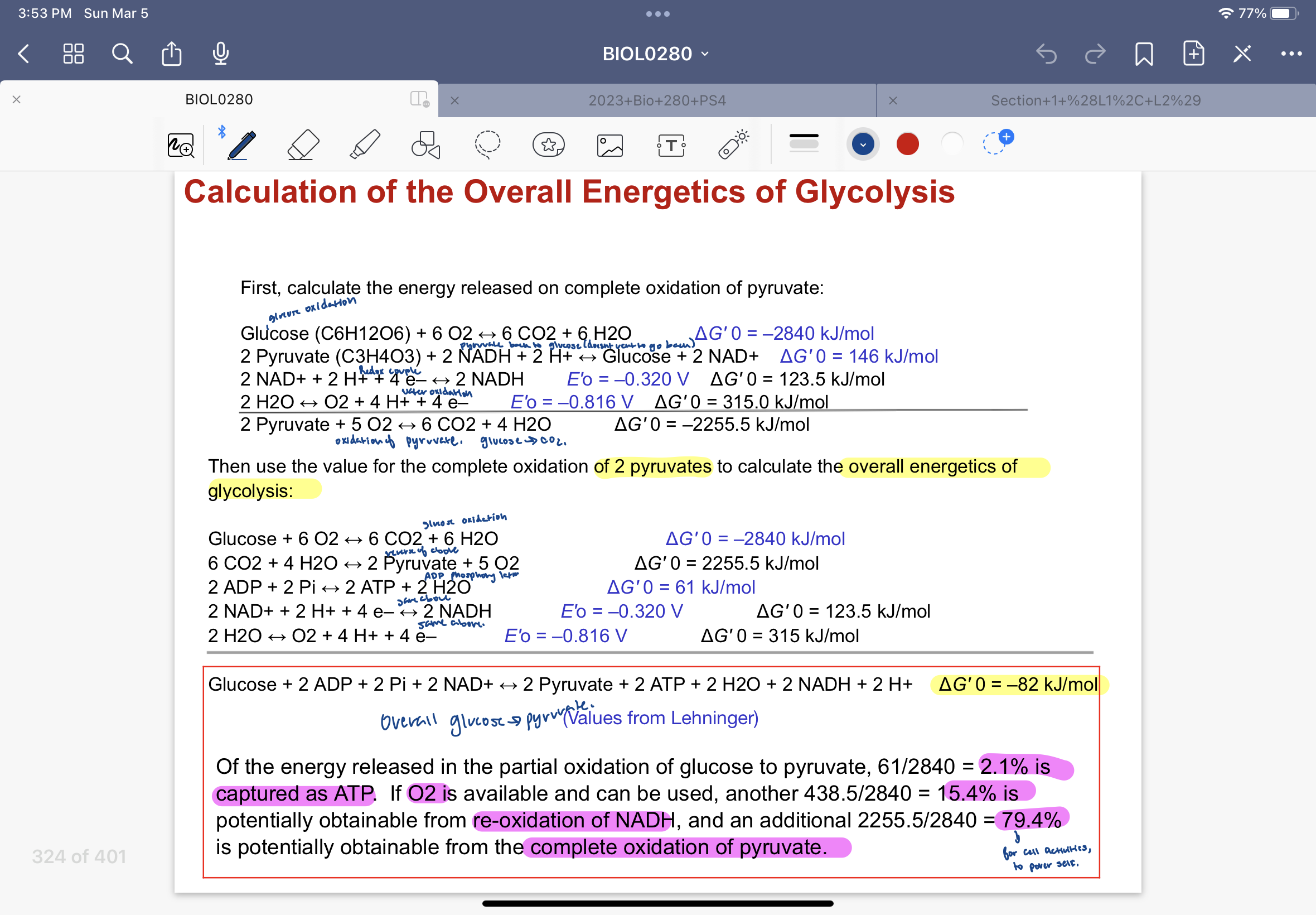
27
Reoxidation of NADH is critical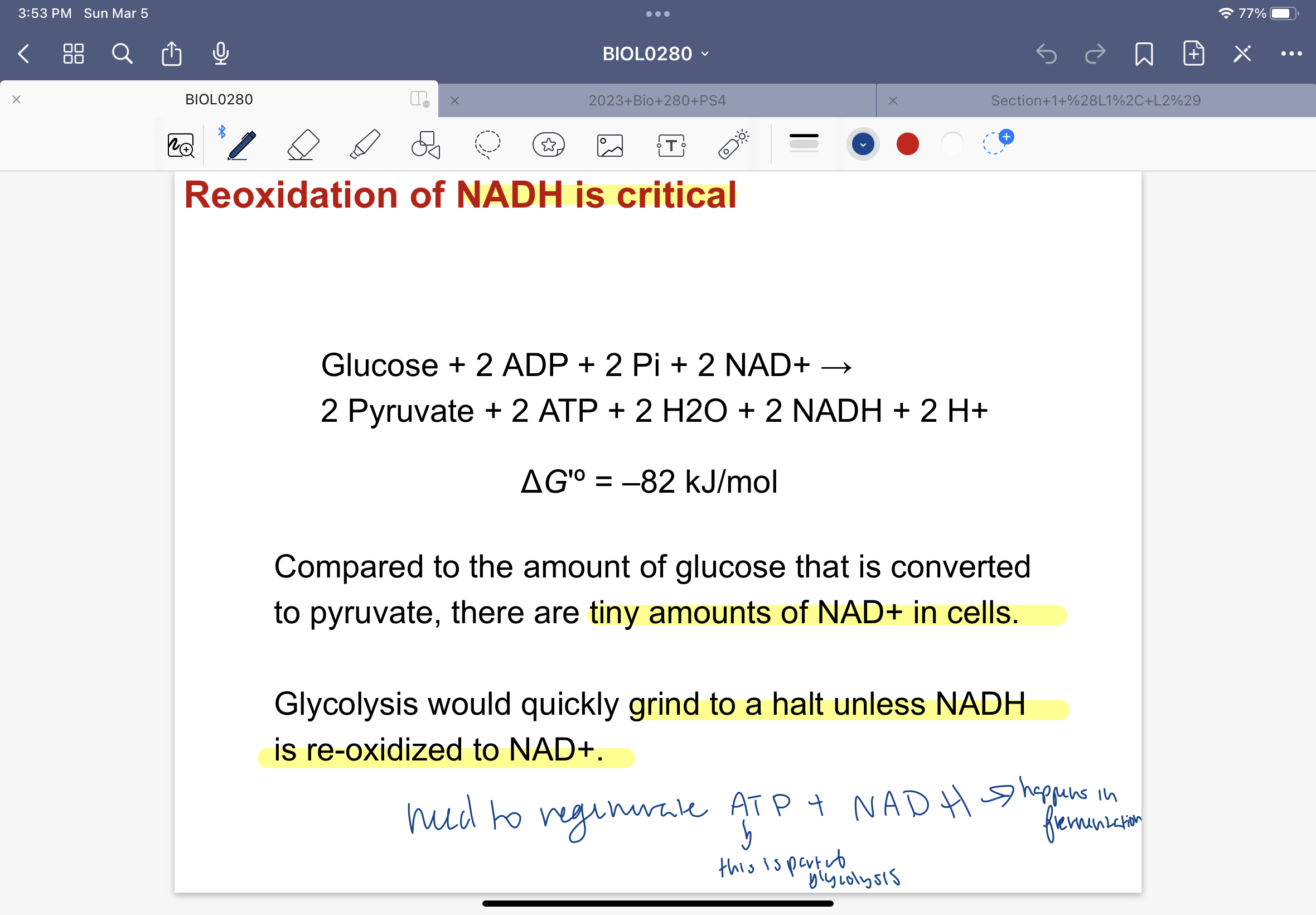
Compared to amount of glucose converted to pyrivate,there are tiny amounts of NAD+ in cells. Glycolysis would quickly halt unless NADH is re-oxidized to NAD+. Hence why we need to regenerate ATP (step 2) and NADH (in fermentation).
28
Fates of Pyruvate: Aerobic and Anaerobic pathways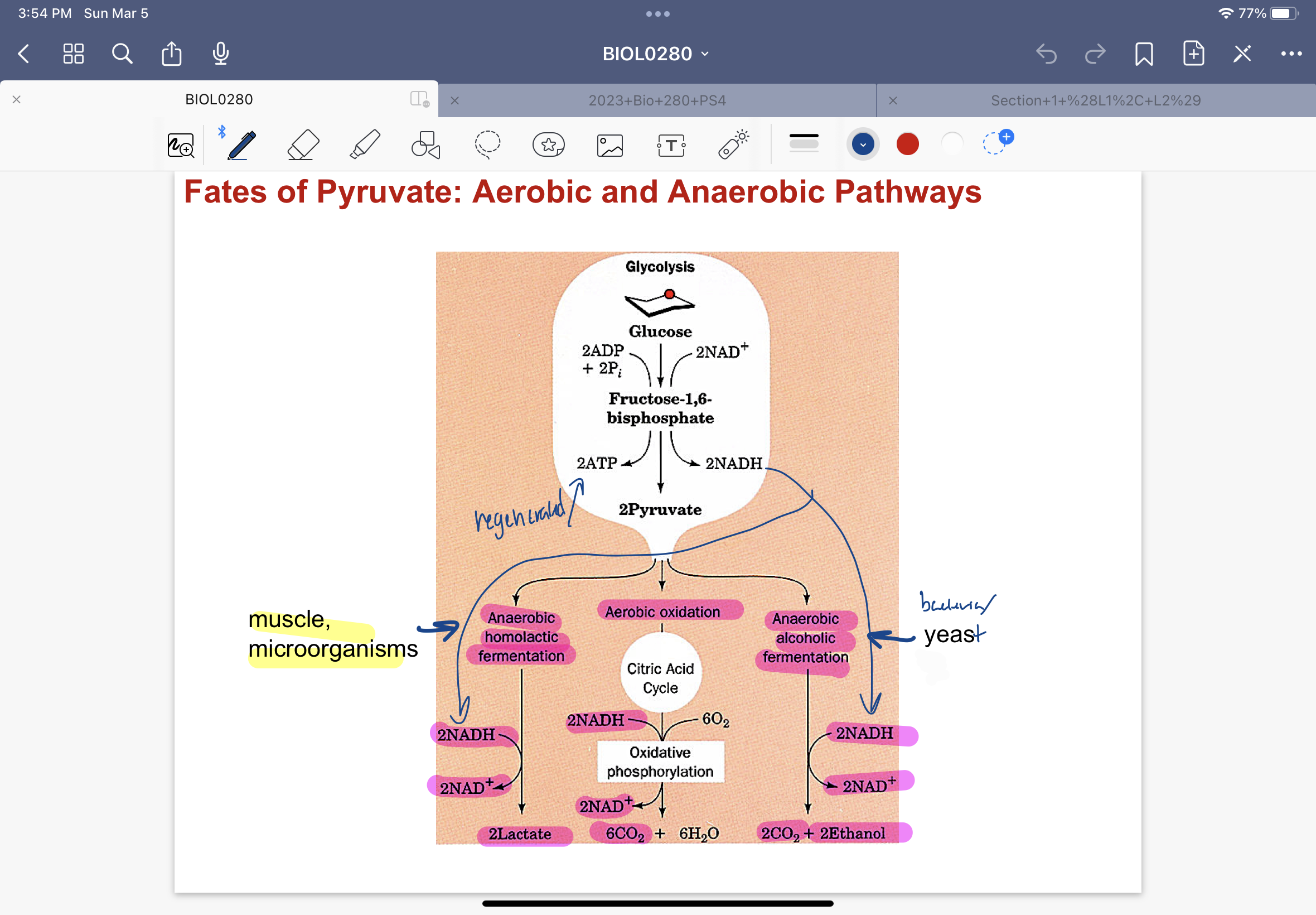
If O2 is present then will go into citric acid cycle for oxdative phosphorylation. If O2 is not available then will go to lactic acid fermnation if muscle or microorganism, or into alcohol fermentation if a bacteria or yeast: both of which will regenerate NAD+ to allow for glycolysis to continue. 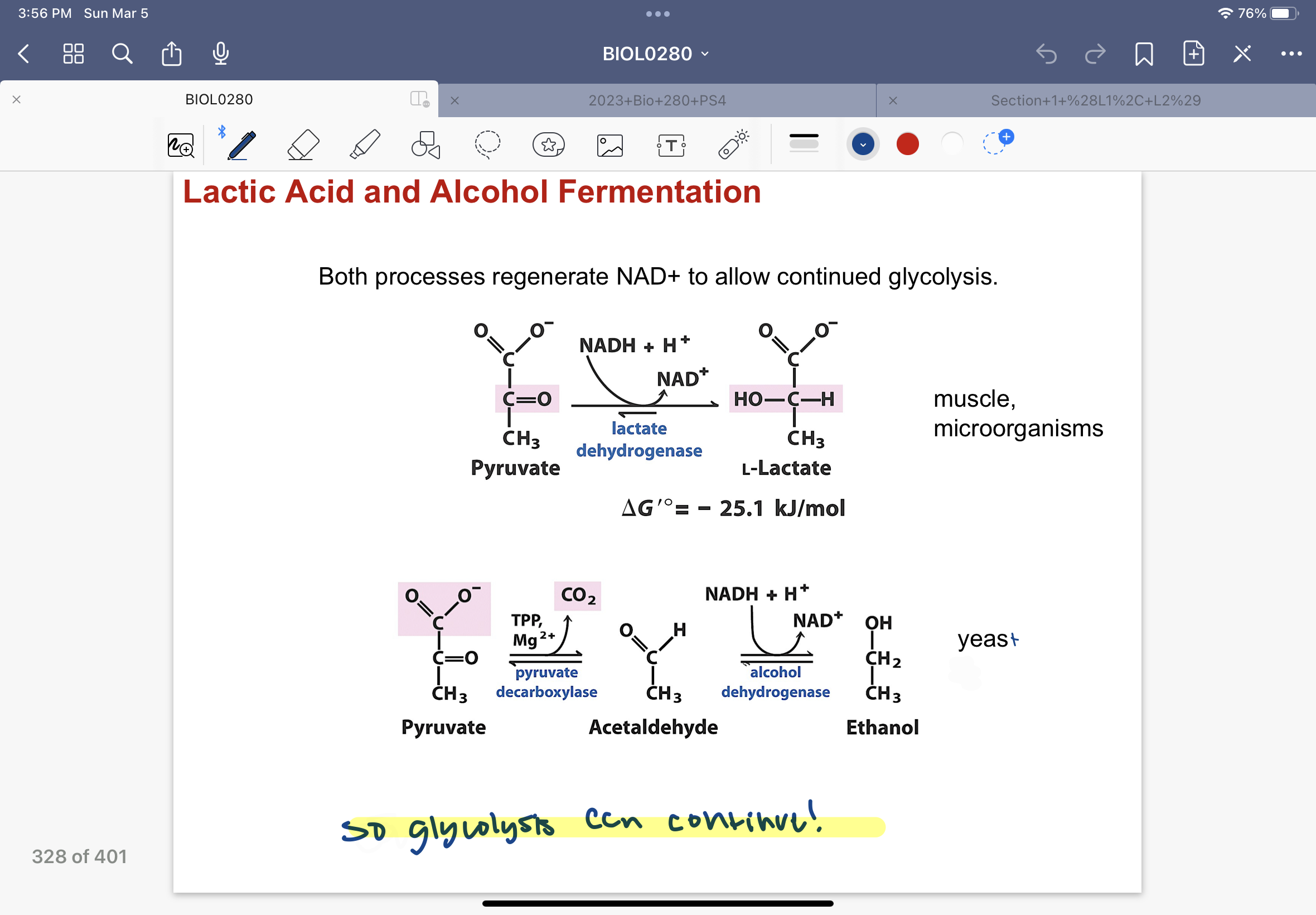
29
Fermentation and the Pasteur Effect
Without O2, ARP generated during glycolysis is the sole ebnergydervied from partial glucose oxidation to pyruvate. The prblem is that NAD+ has to be regenerated. Solution is to reduce pyruvate to lactate or ethanol using NADH that was generated furing Glycolysis that does not require or generate ATP. Fermentation foes not capture much of the nergy that is potentially available from the complete oxidation of glucose. In organisms that can ferment is the absence of O2 and respire in the presence of O2, the rate of anaerobic glucose consumption is much higher (Pasteur effect in yeast). When there is no O2 present, the only source of ATP is through glycolysis, so more glucose consumption/ glycolysis will occur in anerobic conditions than aerobic!.
30
Major Pathways of glucose utilization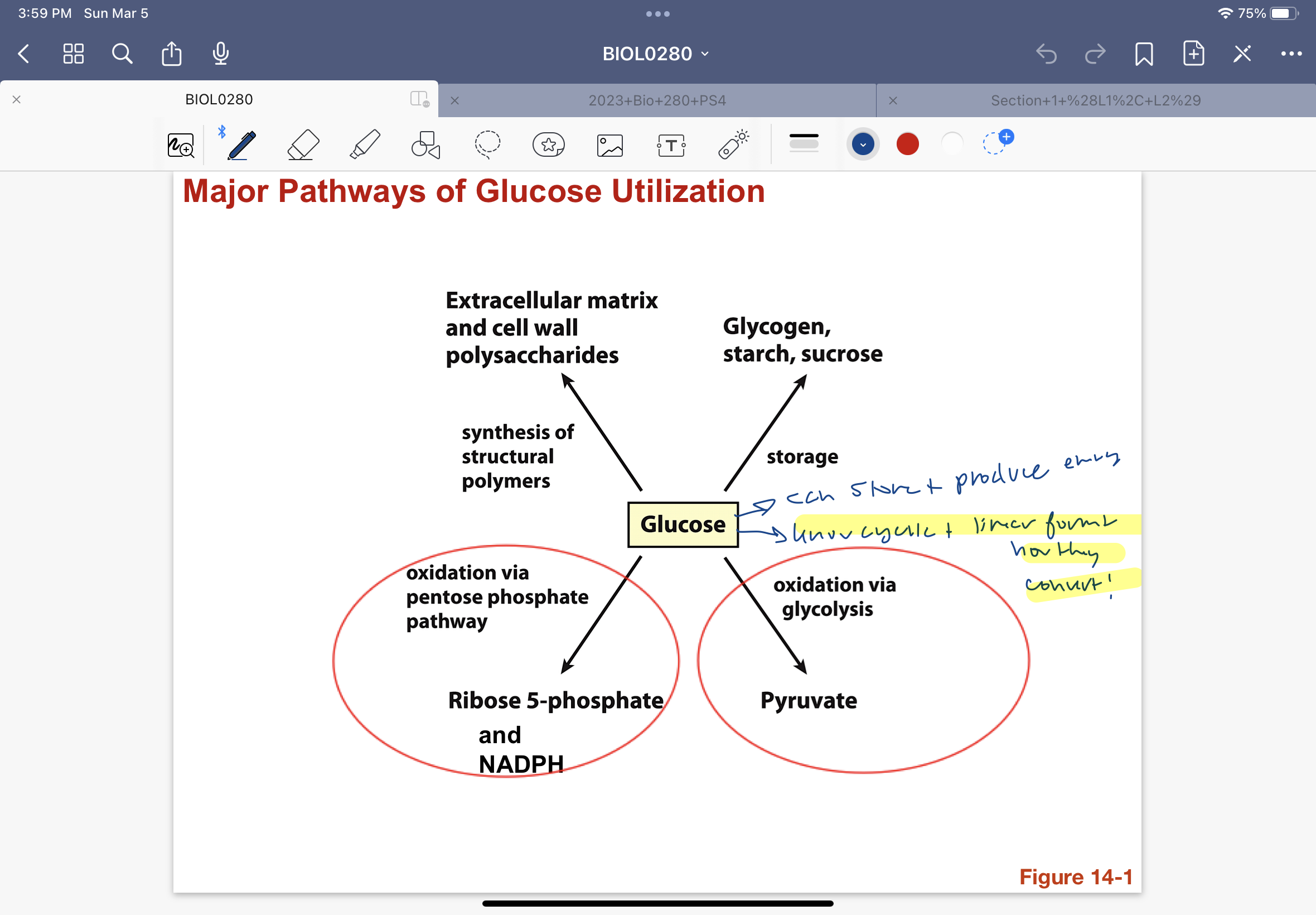
can store and produce energy, Oxidation through 2 separate pathways: glycolysis and pentose phosphate pathway.
31
Pentose Phosphate Pathway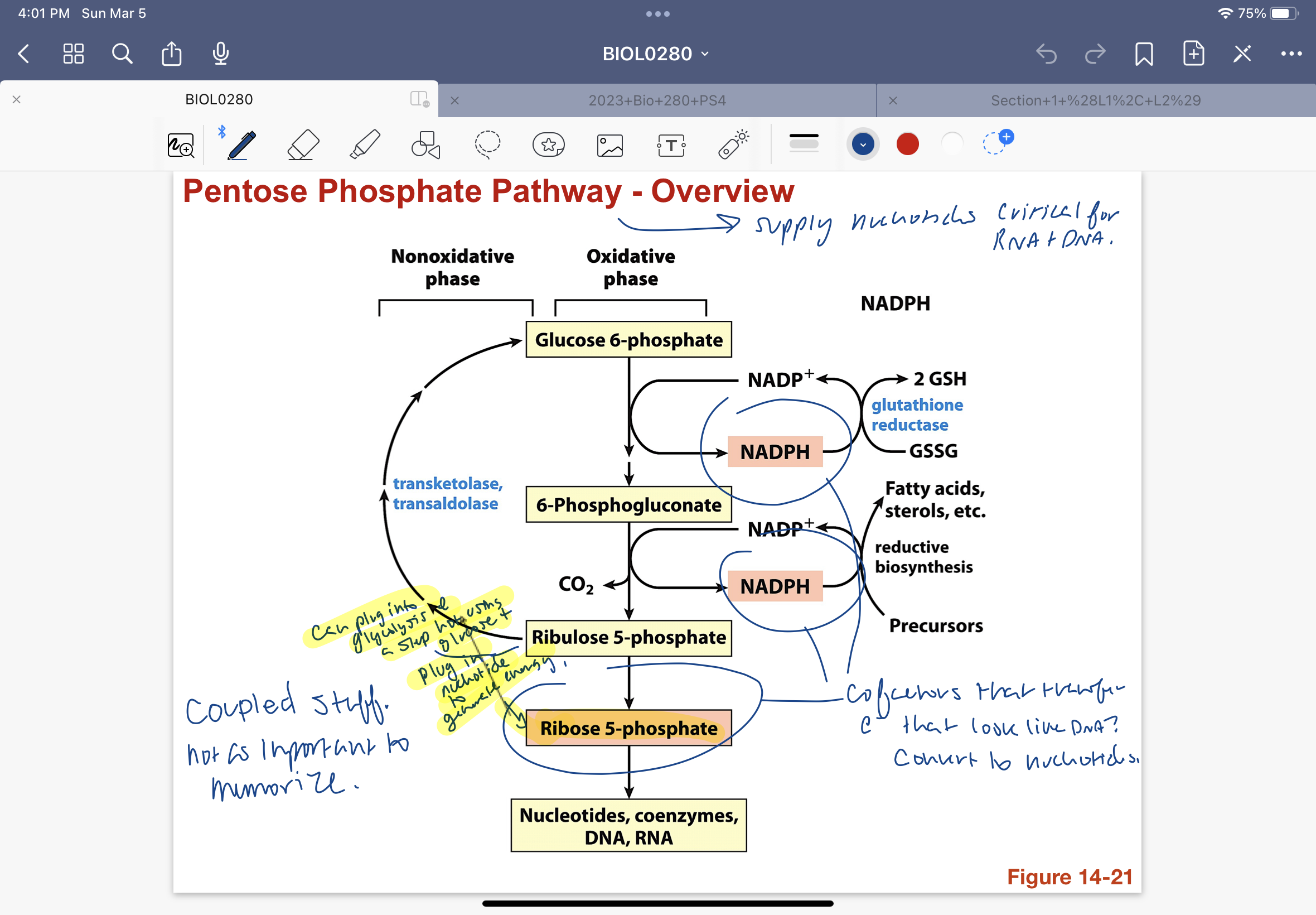
Supply nucleotides critical for RNA and DNA? Robose 5-phosphate can plug into glycolysis at a step that doesnt utilize glucose and plug in nucleotide to generate energy. 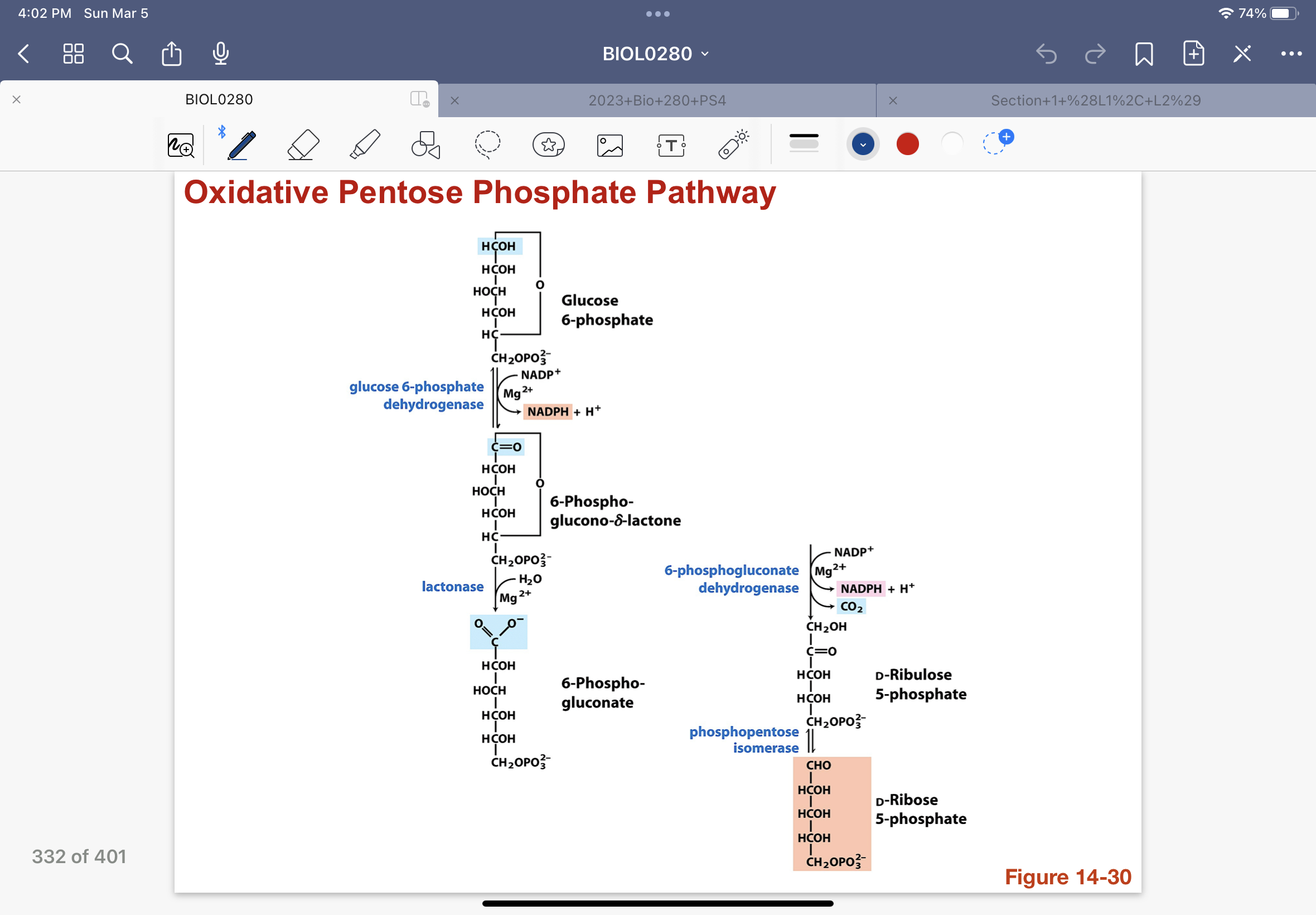
32
Recycling of Pentose Phosphates in Non-oxidative Reactions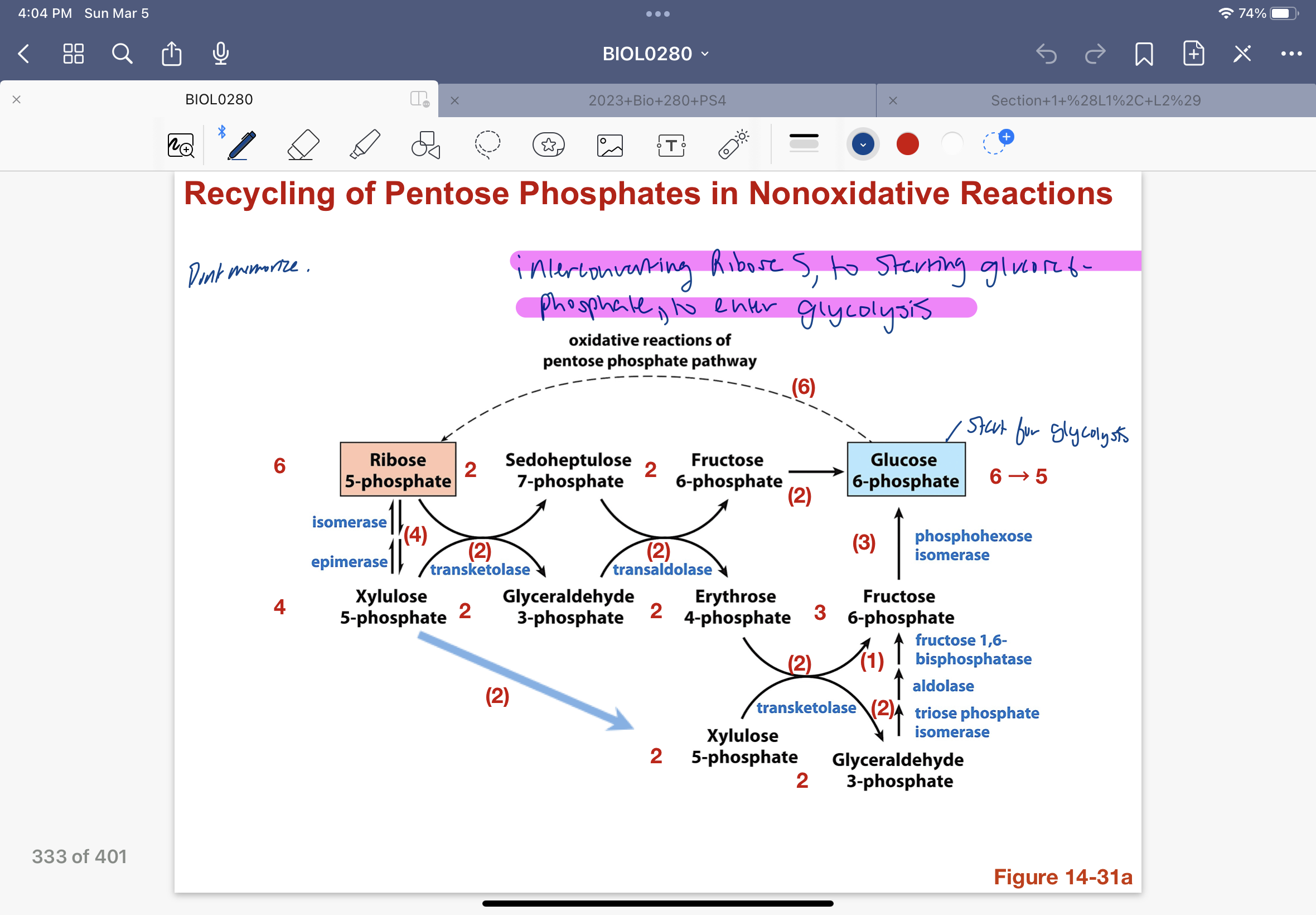
Ribose 5-phosphate can interconvert to starting glucose 6-phosphate to enter into glycolysis. There are many entry points of sugar with similar structure to be interconverted to be useful to the glycolysis pathway, so glycolysis doesnt always start eith just a glucose, can be stimulate by other parts as well.
33
fructose and Galactose Catabolism
Fructose can also stimulate glycolysis and or be stored as fats. Kinase phosphoylates galactose, which is exchanged for glucose 1-P, UDP galactose is isomerizedto UDP glucose by epimerase that contains bound NAD+ and glucose 1-p is isomerizedto glucose-6-P.