Social Media and Competitive Advantage
Study these flashcardsFree · spaced repetition · iPhone, Android, Mac & web
All cards
1
Firm value Chain/Industry Value Chain Image; supportive/primary activities: know which is support, which is primary
Supportive Activities:
Administration and Management:
-electronic scheduling and messaging systems
Human Resources:
-workforce planning systems
Technology:
-computer-aided design systems
Procurement:
-computerized ordering systems
Primary Activities:
Inbound Logistics
-automated warehousing systems
Operations
-computer controlled machining systems
Sales and Marketing
-computerized ordering systems
Service
-equipment maintenance systems
Outbound Logistics
-automated shipment scheduling systems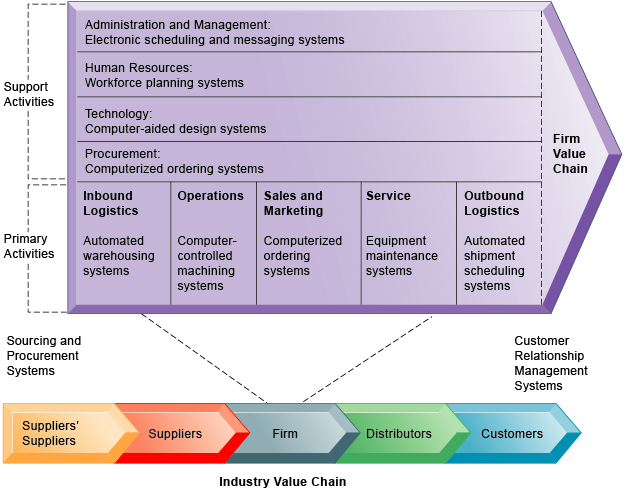
Administration and Management:
-electronic scheduling and messaging systems
Human Resources:
-workforce planning systems
Technology:
-computer-aided design systems
Procurement:
-computerized ordering systems
Primary Activities:
Inbound Logistics
-automated warehousing systems
Operations
-computer controlled machining systems
Sales and Marketing
-computerized ordering systems
Service
-equipment maintenance systems
Outbound Logistics
-automated shipment scheduling systems
2
Porter's 5 forces: be able to tell me what each does
i. Competitive Rivalry
It considers the number of existing competitors and what each one can do.
ii. Power of Suppliers
This force analyzes how much power a business’s supplier has and how much control it has over the potential to raise its prices, which, in turn, lowers a business’s profitability.
iii. Power of Customers
Consumers have power when they are fewer in number but there are plentiful sellers and it’s easy for consumers to switch.
iv. Threat of Substitute Products
This force studies how easy it is for consumers to switch from a business’s product or service to that of a competitor.
v. New Entrants into the Industry
This force considers how easy or difficult it is for competitors to join the marketplace.
It considers the number of existing competitors and what each one can do.
ii. Power of Suppliers
This force analyzes how much power a business’s supplier has and how much control it has over the potential to raise its prices, which, in turn, lowers a business’s profitability.
iii. Power of Customers
Consumers have power when they are fewer in number but there are plentiful sellers and it’s easy for consumers to switch.
iv. Threat of Substitute Products
This force studies how easy it is for consumers to switch from a business’s product or service to that of a competitor.
v. New Entrants into the Industry
This force considers how easy or difficult it is for competitors to join the marketplace.
3
Competitive Advantage--What is it? Know the definition, be able to give me an example
Competitive advantage is the favorable position an organization seeks in order to be more profitable than its rivals. To gain and maintain a competitive advantage, an organization must be able to demonstrate a greater comparative or differential value than its competitors and convey that information to its desired target market.
For example, if a company advertises a product for a price that's lower than a similar product from a competitor, that company is likely to have a competitive advantage. The same is true if the advertised product costs more, but offers unique features that customers are willing to pay for.
For example, if a company advertises a product for a price that's lower than a similar product from a competitor, that company is likely to have a competitive advantage. The same is true if the advertised product costs more, but offers unique features that customers are willing to pay for.
4
What is Social Media Information Systems? Know definition
The use of Information Technology to support the sharing of content among networks of users.
5
What are the 3 SMIS roles?
i. Social media providers
ii. Users
iii. Communities
ii. Users
iii. Communities
6
How does SMIS increase social capital? 3 types of capital?
i. Capital is the investment of resources for future profit
ii. Human capital is the investment in human knowledge and skills
for future profit.
iii. Social capital is the investment in social relations with the
expectation of returns in the marketplace.
a. Value of social capital: information, influence, social credentials, personal reinforcement
ii. Human capital is the investment in human knowledge and skills
for future profit.
iii. Social capital is the investment in social relations with the
expectation of returns in the marketplace.
a. Value of social capital: information, influence, social credentials, personal reinforcement
7
How do some companies earn money from social media?
i. Pay-per-click (advertising)
ii. Freemium
iii. Ad-blocking software
ii. Freemium
iii. Ad-blocking software
8
How do organizations develop and effective SMIS?
i. Define your goal
ii. Identify Success Metrics
iii. Identify Target Audience
iv. Define Your Value
v. Make Personal Connections
vi. Gather and Analyze Data
ii. Identify Success Metrics
iii. Identify Target Audience
iv. Define Your Value
v. Make Personal Connections
vi. Gather and Analyze Data
9
What are success metrics?
I. KPI’s
II. Leads
III. Reach
IV. Engagement
V. Conversion
II. Leads
III. Reach
IV. Engagement
V. Conversion