2.3 Amount of Substance ✓
Study these flashcardsFree · spaced repetition · iPhone, Android, Mac & web
All cards
1
What is Avogadro's constant?
$6.02x10^{23}$$mol^{-1}$
2
What is 1 mole?
amount of substance that contains $6.02x10^{23}$ particles
3
What is Avogadro's constant based on?
12g of carbon-12 is $6.02x10^{23}$ atoms (number of particles in each mole of carbon-12)
4
Is 1 mole of H and 1 mole of H2 different?
Yes, 1 mol of H is 1 mol of H atoms whereas 1 mol of H2 is 1 mol of H molecules
5
What is molar mass?
mass per mole of substance
6
What is molar mass measured in?
$gmol^{-1}$
7
What is the meaning of the molecular formula?
number of atoms of each element in a molecule
8
What is a molecule?
smallest part of covalent compound, consisting of 2+ stoms covalently bonded
9
What is the empirical formula?
simplest whole number ratio of atoms of each element in a compound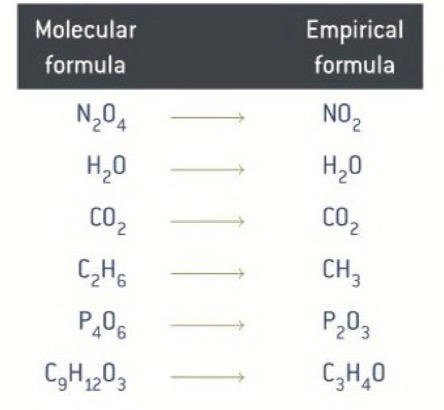
10
What is relative molecular mass (Mr)?
sum of Ar of atoms, comparing mass of a molecule with mass of an atom of carbon-12 (only for molecules)
11
How do you work out relative molecular mass?
add together relative atomic masses (Ar) of the elements making up the molecule
12
What is the relative formula mass?
sum of Ar of atoms, comparing mass of a formula unit with the mass of carbon-12 (only used for ionic/ giant structures)
13
How is relative formula mass calculated?
add together relative atomic masses of elements in empirical formula
14
What is a common feature of hydrated salts?
being coloured
15
What does it mean if a salt is hydrated?
water molecules are part of their crystalline structure
16
What is the water in a hydrated salt called?
water of crystallisation
17
What does anhydrous mean?
substance containing no water molecules
18
How can hydrated salts lose their water?
heating: breaking bonds holding the water within the crystal (leaving behind anhydrous salt)
19
How is the water of crystallisation shown in a formula?
large dot between compound and water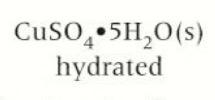
20
Why can you still see a pale colour in anhydrous salts?
difficult to remove last traces of water
21
What is the concentration of a solution?
amount of solute (mol) dissolved in each 1dm3 of solution
22
What is the volume concentration equation (inc units)?
$n(mol)=c(moldm^{-3}) x V(dm^3)$
23
What is a standard solution?
solution of a known concentration
24
How are standard solutions prepared?
by dissolving exact mass of solute in solvent and making up solution to exact volume
25
At the same temp and pressure, do equal volumes of different gases contain same number of molecule?
yes
26
What is the meaning of the molar gas volume?
volume per mole of gas molecules at stated temp and pressure
27
What 2 things does the volume of a gas depend on?
-pressure
-temp
-temp
28
What is room temp in c?
20
29
What is room pressure in kPa?
101
30
What is volume of 1 mol of gas at RTP? What does this make the molar gas volume?
$24dm^3$ so molar gas volume= $24dm^3mol^{-1}$
31
Which equation converts between mol and volume of gas?
n=volume/ molar gas volume
32
What is the ideal gas equation (inc units)?
$p(Pa) V(m^3)=n(mol) R(8.314Jmol^{-1} K^{-1})T(K)$
33
What are the assumptions for molecules making up an ideal gas? (4)
-random motion
-elastic collisions
-negligible size
-no intermolecular forces
-elastic collisions
-negligible size
-no intermolecular forces
34
What is the ideal gas constant (R)?
$8.314Jmol^{-1}K^{-1}$
35
What is absolute zero in K?
-273
36
How do you convert C to K?
+273
37
What is stoichiometry?
the ratio of amounts (mol) of each substance
38
What can balanced equations be used to find?
-quantities of reactants required to prepare required quantity of product
-quantities of products that should be formed from certain quantities of reactants
-quantities of products that should be formed from certain quantities of reactants
39
What is the theoretical yield?
maximum possible product produced from reactants
40
Why is theoretical yield difficult to actually achieve?
-reaction may not have gone to completion
-side reactions may have taken place
-purification of product may result in some loss
-side reactions may have taken place
-purification of product may result in some loss
41
What is the percentage yield?
actual yield/ theoretical yield
42
What is the limiting reagent?
reactant that isn't in excess and is completely used up first, stopping the reaction
43
What is atom economy?
measure of how well atoms have been utilised (desired product/ all products)
44
What's good about reactions with high atom economies?
-large amount desired product
-small amount waste product making it more sustainable
-small amount waste product making it more sustainable
45
What assumption is made in atom economy?
100% yield