2.5 Biological Membranes ✓
Study these flashcardsFree · spaced repetition · iPhone, Android, Mac & web
All cards
1
What is the fluid mosaic model?
-theory that fabric of membrane consists of phospholipid bilayer with proteins floating in it (mosaic)
-lipid molecules can change places with eachother and some proteins move (fluidity)
-lipid molecules can change places with eachother and some proteins move (fluidity)
2
What is a glycolipid?
lipid/ phospholipid with chain of carbohydrate molecules attached
3
What is a glycoprotein?
protein with chain of carbohydrate molecules attached
4
What is a plasma membrane?
cell surface membrane
5
What does permeability mean?
ability to let substances pass through
6
What are the 3 ways substances can travel through plasma membrane?
-very small molecules diffuse through cell membrane in between its structural molecules
-dissolve in lipid layer and pass through
-pass through protein channels or carried by carrier proteins
-dissolve in lipid layer and pass through
-pass through protein channels or carried by carrier proteins
7
Why are plasma membranes considered partially permeable?
do not let all substances through
8
What are the roles of membranes at the surface of cells? (7)
-separates cell components from external environment
-regulates transport of materials in and out cell
-contain enzymes
-has antigens so immune system recognises it as its ‘self’
-release chemicals to signal other cells
-receptors for chemical signals (hormones + drugs bind to receptors)
-site of chemical reactions
-regulates transport of materials in and out cell
-contain enzymes
-has antigens so immune system recognises it as its ‘self’
-release chemicals to signal other cells
-receptors for chemical signals (hormones + drugs bind to receptors)
-site of chemical reactions
9
What are cristae?
folded inner membranes of mitochondria
10
What is the roll of cristae?
give large SA for aerobic respiration and localise enzymes needed for it
11
What are thylakoid membranes?
inner membranes of chloroplasts
12
What is the roll of thylakoid enzymes?
house chlorophyll and on membranes some reactions of photosynthesis
13
What is the roll of digestive enzymes on plasma membrane of epithelial cells lining small intestine?
catalyse final stages in breakdown of some sugars
14
Which way do the phospholipid heads and tails face in phospholipid bilayer?
heads: contact with watery exterior and interior
tails: centre of membrane away from water
tails: centre of membrane away from water
15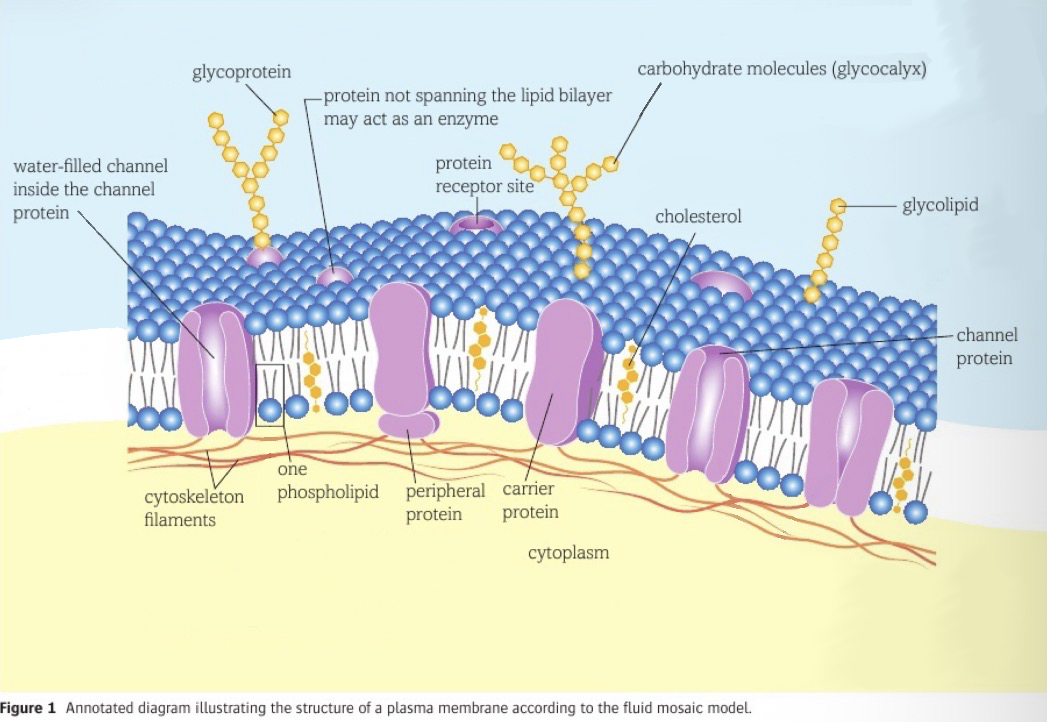
Image occlusion: name the hidden labels
16
Image occlusion: name the hidden labels
17
Image occlusion: name the hidden labels
18
Image occlusion: name the hidden labels
19
Image occlusion: name the hidden labels
20
Image occlusion: name the hidden labels
21
Image occlusion: name the hidden labels
22
Image occlusion: name the hidden labels
23
Image occlusion: name the hidden labels
24
Image occlusion: name the hidden labels
25
Image occlusion: name the hidden labels
26
Image occlusion: name the hidden labels
27
What is the water-filled channel inside the channel protein lined with?
hydrophilic amino acids
28
What is the role of cholesterol in the plasma membrane?
gives mechanical stability and flexibility and resist effects of temp changes on membrane structure
29
What is the role of the glycocalyx?
help attract water (due to being hydrophilic) with dissolved solutes so cell can interact with environment and obtain dissolved substances
30
What is an integral protein?
channel and carrier proteins which span whole lipid bilayer
31
What can integral proteins interact with?
hydrophobic region of phospholipid bilayer
32
What do proteins with pores do?
act as channels to allow ions with electrical charge and surrounded by water through
33
How do carrier proteins work?
change shape and carry specific molecules across membrane
34
What do proteins attached to carrier proteins do?
act as enzymes, antigens or receptor sites
35
Do eukaryote or prokaryote cell membranes contain cholesterol?
eukaryote
36
Why do some membranes have particular distributions of proteins?
enable specific functions
37
How do proteins in neurone cell membranes (along axon) allow conduction of electrical impulses?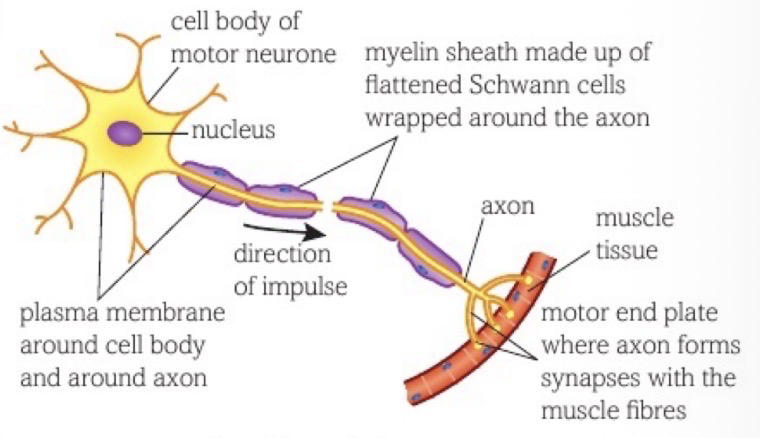
proteins allow entry and exit of ions which bring about conduction of electrical impulses
38
Is the membrane forming the myelin sheath more proteins or lipids?
more lipid
39
How is a myelin sheath formed (neurones)?
flattened cells wrapped around several time giving several layers of cell membrane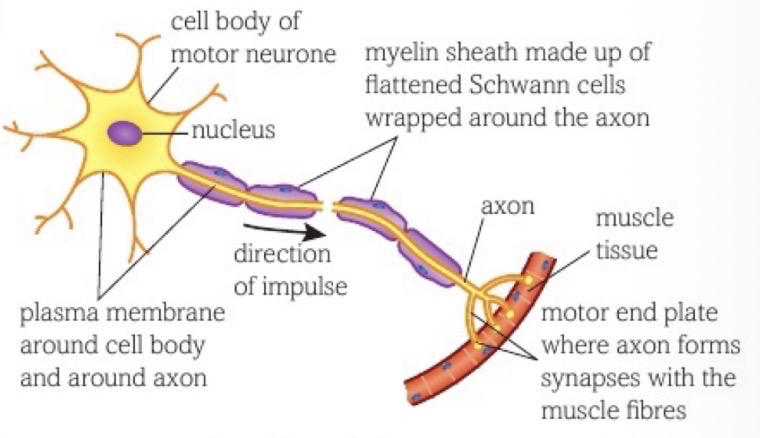
40
What do special protein receptors on WBC membrane allow them to do?
recognise antigens on foreign cells
41
Why do root hair cells have a lot of carrier proteins?
to actively transport nitrate ions from soil to cells
42
Why do the inner membranes of mitochondria contain more proteins than lipids?
contain many electron carriers made of protein and H+ ion channels associated with ATP synthase enzymes
43
What is diffusion?
movement of molecules from high concentration to low concentration of that molecule until equilibrium reached, does not require energy and may of may not pass through membrane
44
What is faccilitated diffusion?
diffusion across a partially permeable membrane via protein channels or carriers (still doesnt require energy
45
What are passive processes?
processes like diffusion that do not require energy (ATP) as they only use kinetic energy of molecules
46
How does simple diffusion work?
molecules in high concentration area bump into each other as they move randomly until spreading out further into areas of lower concentration until evely dispersed
47
Can small molecules pass through cell membranes by simple diffusion?
yes like oxygen and carbon dioxide
48
Can fat-soluble molecules pass through cell membranes by simple diffusion?
yes by dissolving in lipid bilayer like steroid hormones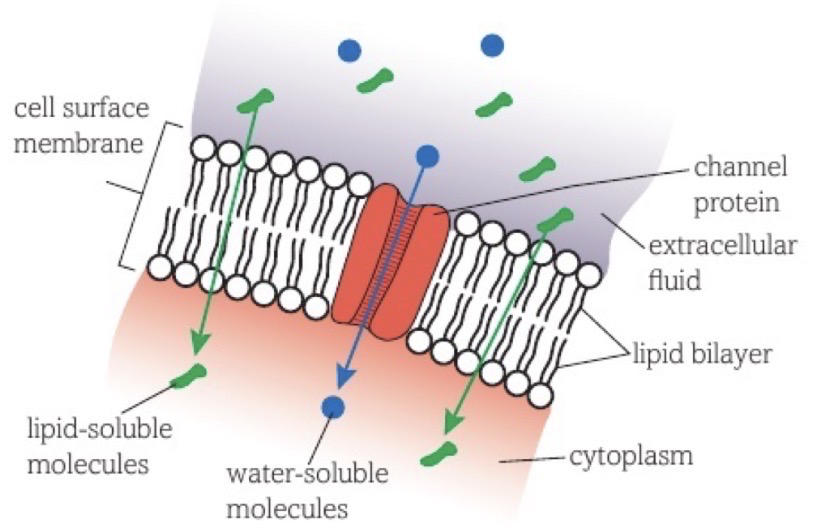
49
What properties would mean that water molecules wouldnt be able to pass through cell membranes?
polar and insoluble in lipid
50
Why can water pass through cell membrane by direct diffusion?
water present in very large concentrations
51
What are aquaporins and where are they used?
specific water channel proteins to make water movement easier present where theres a very high rate of water movement
52
How is a concentration gradient maintained in cells?
molecules pass into organelles and are used for metabolic reactions (eg photosynthesis and aerobic respiration)
53
Which factors affect rate of simple diffusion?
-temperature
-diffusion distance
-surface area
-size of diffusing molecule
-concentration gradient
-diffusion distance
-surface area
-size of diffusing molecule
-concentration gradient
54
How does temperature affect rate of simple diffusion?
as temp increases more kinetic energy so rate of diffusion increases
55
How does diffusion distance affect rate of simple diffusion?
thicker membrane means slower rate of diffusion
56
How does surface area affect rate of simple diffusion?
larger surface area means more diffusion
57
How does size of diffusing molecule affect rate of simple diffusion?
smaller ions or molecules diffuse more rapidly than larger
58
How does concentration gradient affect rate of simple diffusion?
steeper the gradient the faster the diffusion
59
Why cant small polar molecules pass through the cell membrane?
insoluble in lipid as cant interact with hydrophobic tails of bilayer
60
How can small polar molecules pass through cell membrane?
through water-filled protein channels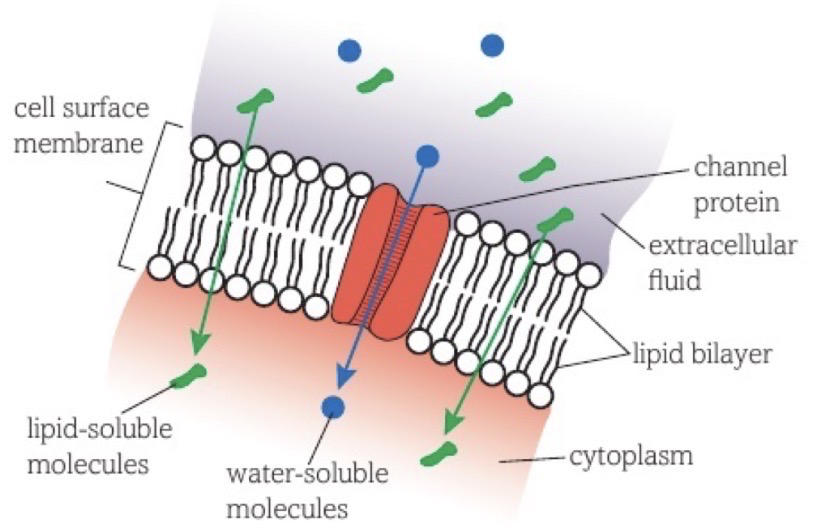
61
How does cholesterol affect cell membrane permeability?
reduce permeability of membranes to small water soluble molecules
62
How does glucose pass through cell membrane? Why?
bind to transmembrane carrier protein which opens to allow glucose to pass out other side because cant diffuse through water-filled protein channel due to size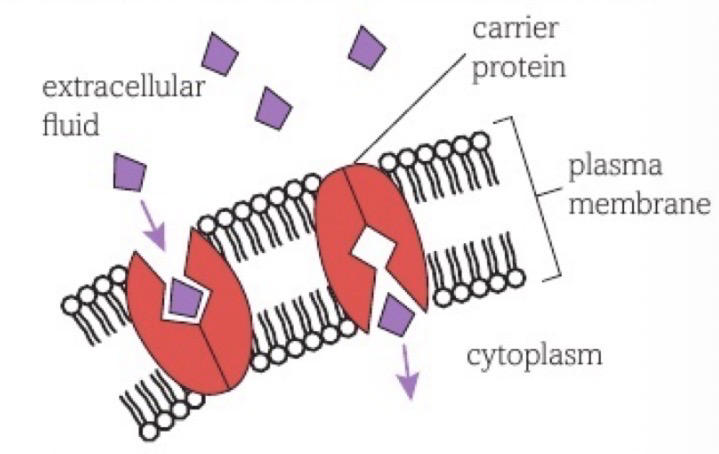
63
Why do different cell types have differing proportions of transmembrane protein channels and proteins?
control types of molecule that pass in and out of specific cell
64
Why do neurone plasma membranes have specific proportions of transmembrane protein channels and carriers?
channels specific to potassium and sodium ions (which are important for conducting nerve impulses) and calcium and chloride ion channels at synapses
65
Why do epithelial cell (airways) plasma membranes have specific proportions of transmembrane protein channels and carriers?
chloride ion channels which regulate composition of mucus
66
What is osmosis?
passage of water molecules down water potential gradient across a partially permeable membrane
67
What is water potential?
measure of tendency of water molecules to diffuse from one region to another
68
What is a solvent?
the liquid which solute molecules dissolve in, in a solution
69
Can water molecules pass directly through phospholipid bilayer?
yes
70
How can water cross membranes quicker?
aquaporins
71
What exerts more effect on relative number of water molecules: molecules dissociated into charged ions or larger non-polar molecules like glucose? Why?
molecules dissociated into ions because as molecules dissociate into ions number of particles in solution doubles
72
What is water potential measured in?
kilopascals (kPa)
73
What is cytolysis?
when a lot of water molecules enter, cell swells and bursts as plasma membrane breaks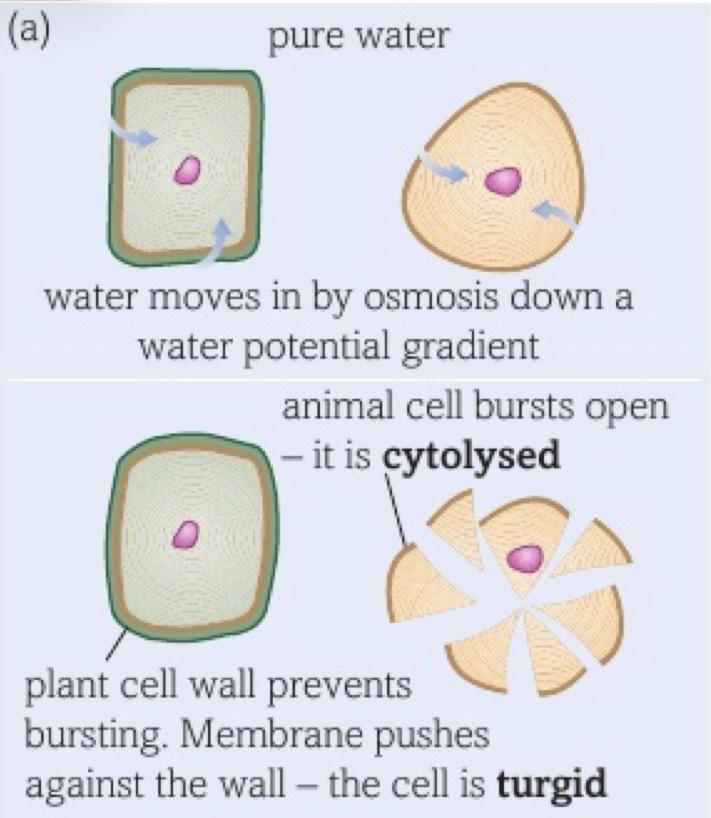
74
What does crenated mean?
when animal cells shrivel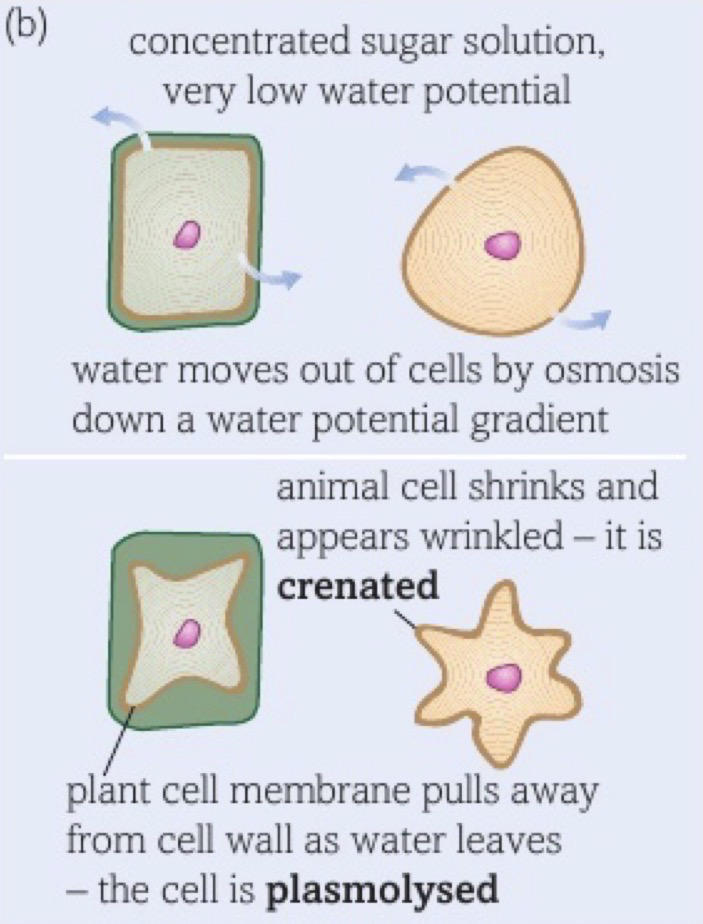
75
What happens to cell metabolism once cells are plasmolysed? Why?
metabolism cannot proceed as enzyme-catalysed reactions need to be in solution
76
What is active transport?
movement of substances against concentration gradient across a cell membrane using ATP and protein carriers
77
What is endocytosis?
bulk transport of molecules too large to pass through cell membrane via channel or carrier proteins into a cell
78
What is exocytosis?
bulk transport of molecules too large to pass through cell membrane via channel or carrier proteins out of a cell
79
How is energy provided for active transport?
hydrolysis of ATP
80
How do carrier proteins work?
-have specific regions that combine reversibly with only certain molecules or ions
-ATP binds to protein and hydrolysis happens to produce energy
-the energy causes a conformational shape change which carries ion from one side of membrane to other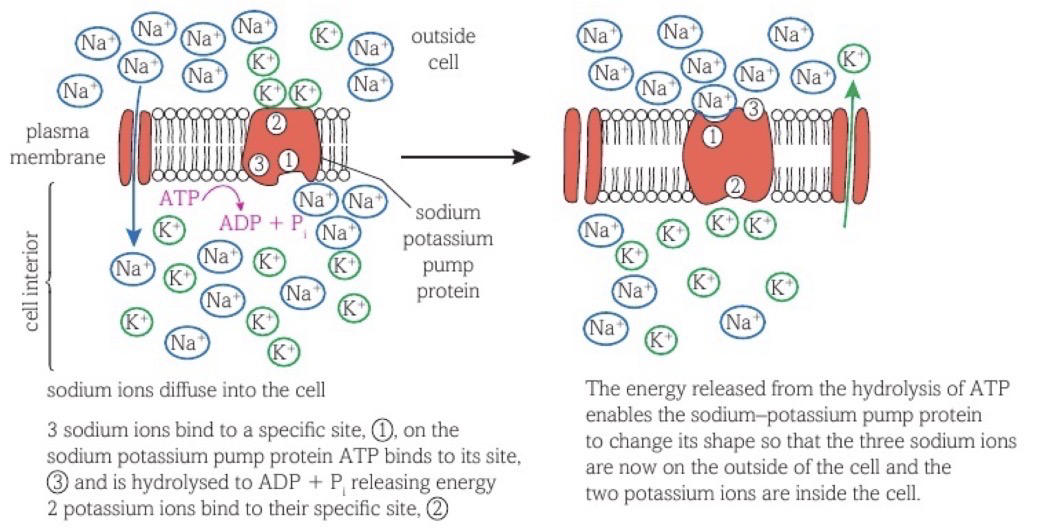
-ATP binds to protein and hydrolysis happens to produce energy
-the energy causes a conformational shape change which carries ion from one side of membrane to other
81
What is phagocytosis?
endocytosis with intake of solid matter where protrusion called pseudopodium extends and wraps around particle to create vesicle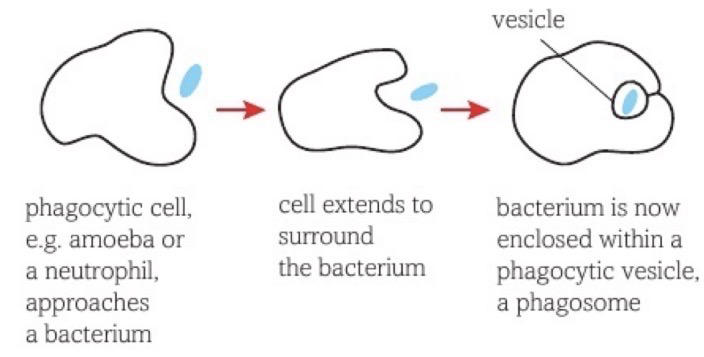
82
What is pino(endo)cytosis?
endocytosis with intake of liquids where membrane invaginates (folds inwards and forms a pocket) and fuses to create vesicle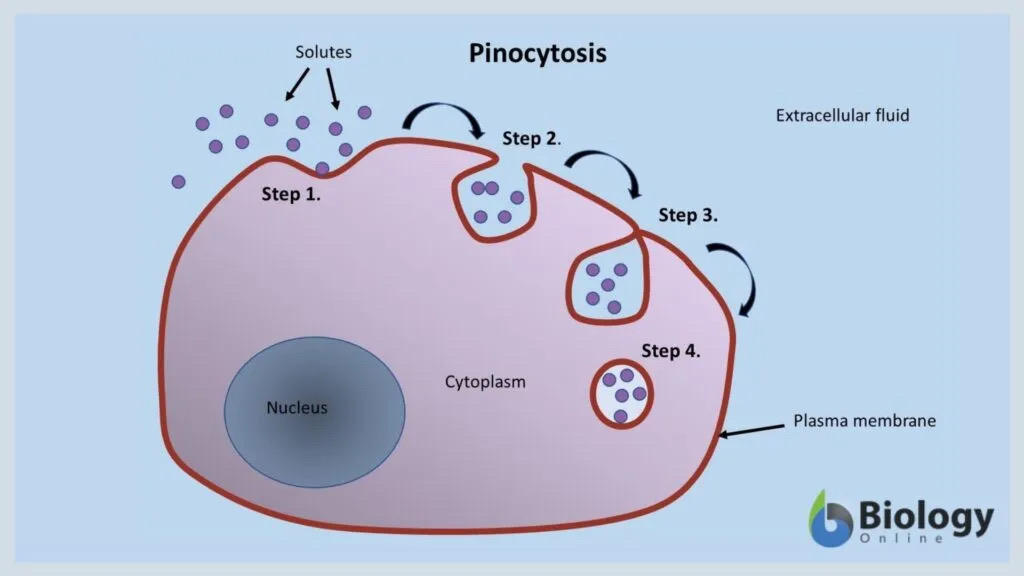
83
What is ATP used for in endocytosis?
provide energy to form vesicles and move them (using motor proteins) along cytoskeleton threads into cell interior
84
What is ATP used for in exocytosis?
to fuse membranes together and move vesicles (1 molecule ATP needed per step motor protein takes along cytoskeleton thread)
85
How does exocytosis work?
1) membrane-bound vesicle containing substance secreted moved towards cell surface membrane
2) cell surface membrane and vesicle membrane fuse
3) fused site opens releasing contents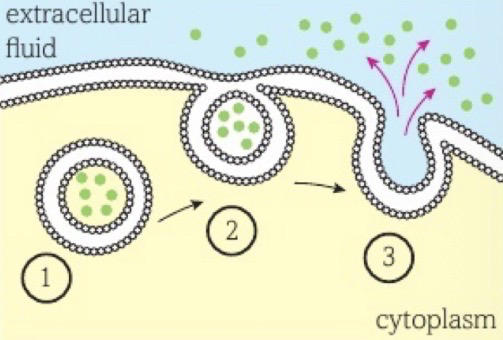
2) cell surface membrane and vesicle membrane fuse
3) fused site opens releasing contents
86
What happens to cell membrane when temp drops?
saturated fatty acids compress which reduces fluidity
87
How is a decrease in fluidity prevented in the cell membrane when temp drops?
-unsaturated fatty acids have kinks in tail which when compressed push apart phospholipids maintaining fluidity
-cholesterol prevents phospholipid molecules from packing too close together buffering effect of lowered temp on fluidity
-cholesterol prevents phospholipid molecules from packing too close together buffering effect of lowered temp on fluidity
88
What determines cell membrane’s fluidity at cold temperature?
proportions of unsaturated and saturated fatty acids
89
How do some organsims respond to lower temperatures?
change composition of fatty acids in membranes
90
What happens to cell membrane when temp increases?
-phospholipids gain kinetic energy and move around more increasing membrane fluidity
91
How does increase in temp affect cell membrane permeability?
increases
92
How are membrane-embedded proteins affected by increasing temp?
affects position and function, proteins acting as enzymes drift sideways altering rate of reaction they catalyse
93
How does an increase in cell membrane fluidity affect the cells function?
-affects infolding of plasma membrane during phagocytosis
-change ability to signal other cells by releasing chemicals by exocytosis
-change ability to signal other cells by releasing chemicals by exocytosis
94
What buffers the effect of increasing temp on cell membrane? How?
cholesterol by reducing increase in membrane fluidity
95
Does changing temperature drastically alter integral molecular structure of phospholipids?
no
96
How do high temperatures affect protein structure?
-atoms within large molecules vibrate breaking H bonds amd ionic bonds that hold structure together (unfold)
-tertiary structure changes and cannot change back once cooled (denatured)
-tertiary structure changes and cannot change back once cooled (denatured)
97
What happens when membrane-embedded proteins and cytoskeleton threads denature?
plasma membrane falls apart and holes appear making it more permeable
98
Why do organic solvents damage cell membranes? Give 2 examples
dissolve lipids, acetone amd ethanol
99
What does hypertonic mean?
having higher osmotic pressure than a particular fluid (higher concentration of solute)
100
What does hypotonic mean?
having higher osmotic pressure than a particular fluid (lower concentration of solute)