4.16 Organic Synthesis ✓
Study these flashcardsFree · spaced repetition · iPhone, Android, Mac & web
All cards
1
What is included in quickfit apparatus?
1) round-bottom or pear shaped flask
2) reciever
3) screw-tap adaptor
4) condenser
5) still head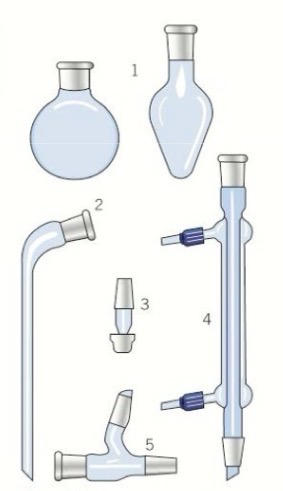
2) reciever
3) screw-tap adaptor
4) condenser
5) still head
2
Why is heating under reflux beneficial?
to provide energy needed for reaction to take place without boiling off solvent, reactants or products or letting volatile components escape
3
What does rubber tubing conect when heating under reflux?
inlet of condenser to tap and outlet to sink
4
How does water enter and leave condenser? Why?
enters at bottom leaves at top to ensure outer jacket is full
5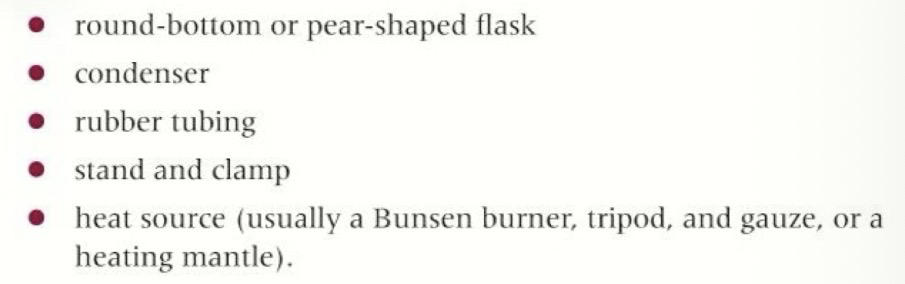
Which pieces of equipment do you need for heating under reflux?
6
What can be used instead of a bunsen burner when heating under reflux if reaction can be carried out under 100c?
water bath
7
How are anti-bumping granules used? Why?
add to liquid before flask heated so contents boil smoothly
8
What happens if you dont use anti-bumping granules?
large bubble form at bottom of liquid making glassware vibrate and jump
9
What do you grease when heating under reflux?
thin layer applied to ground-glass joint on condenser
10
Why do you grease ground-glass joint on condenser?
-to prevent glass joints from sticking together/ fusing making them easier to later remove
-to create good seal
-to create good seal
11
How do you ensure a good seal is created between condenser and flask?
gently rotate condenser back and forth when placing in flask
12
Why should condensers be clamped loosely?
glass outer jacket very fragile and easily broken
13
Why shouldnt you put a stopper in the top of a condenser?
creates closed system where pressure builds up due to heated air expanded resulting in explosion
14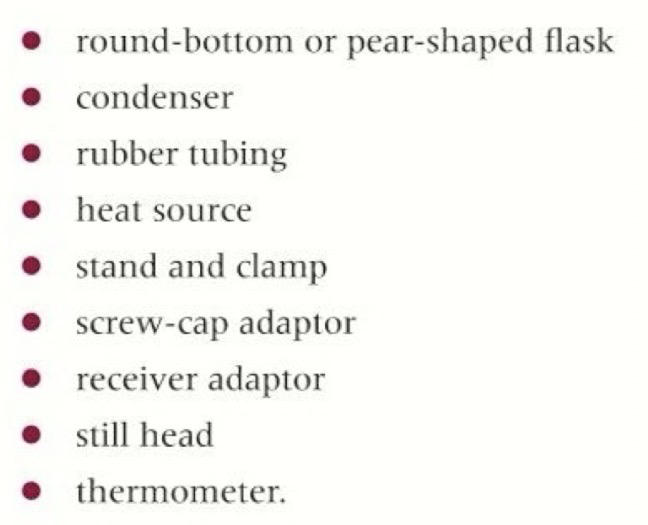
What apparatus do you need for distillation?
15
Which liquid in distillation will boil first?
lowest boiling point (most volatile)
16
How can you identify an organic layer from an aqueous/ water layer?
add water and layer that doesnt get bigger is organic layer
17
How do you use a separating funnel?
1) ensure tap is closed
2) pour mixture into separating funnel and place stopper and invert to mix
3) allow layers to settle
4) add water to identify organic layer
5) place flask under funnel, remove stopper and open tap until lower layer is removed
6) place second flask under funnel to collect other layer
2) pour mixture into separating funnel and place stopper and invert to mix
3) allow layers to settle
4) add water to identify organic layer
5) place flask under funnel, remove stopper and open tap until lower layer is removed
6) place second flask under funnel to collect other layer
18
Why add aqueous sodium carbonate to product after separating funnel?
remove acid impurities
19
Why must stopper be removed occasionally when adding aqueous sodium carbonate to separating funnel?
to avoid pressure build up
20
How do you remove aqueous sodium carbonate from organic product?
separating funnel
21
How are final traces of water removed from organic liquid?
add drying agent (anhydrous inorganic salt)
22
How do you dry an organic liquid?
1) add organic liquid to conical flask
2) use spatula to add drying agent and gently swirl to mix
3) place stopper to prevent product evaporating, leave for 10 min
4) add more drying agent until solid dispersed in solution as fine powder
5) decant liquid from solid into another flask. Liquid should be dry
2) use spatula to add drying agent and gently swirl to mix
3) place stopper to prevent product evaporating, leave for 10 min
4) add more drying agent until solid dispersed in solution as fine powder
5) decant liquid from solid into another flask. Liquid should be dry
23
What is the purpose of redistillation?
purify further/ to only collect product with boiling point of compound aimed to make
24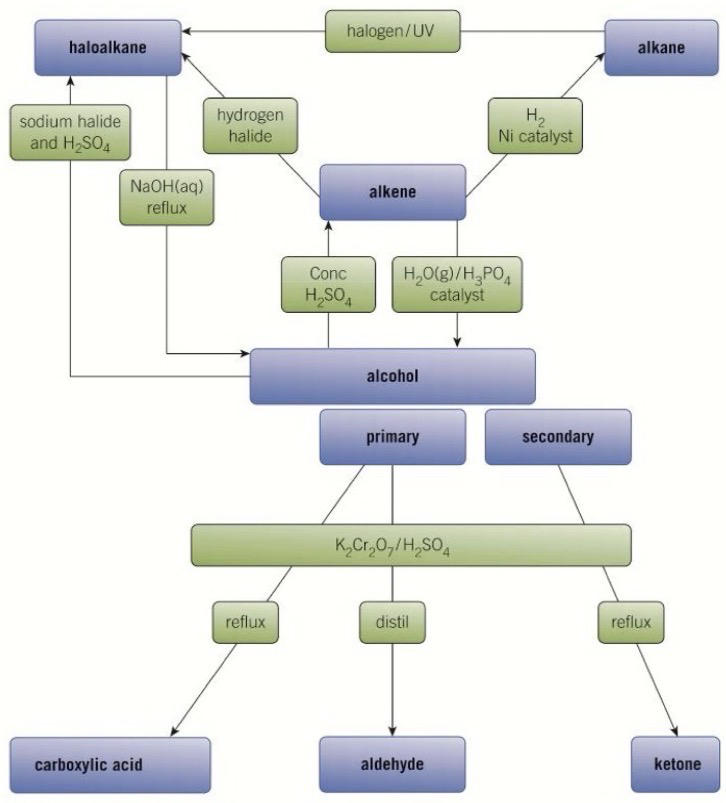
What does the organic synthesis map look like?
25
What is organic synthesis?
preparation of complex molecules from simple starting materials
26
What is a target molecule?
compound chemist is attempting to prepare by organic synthesis