2.2 Biological Molecules ✓
Study these flashcardsFree · spaced repetition · iPhone, Android, Mac & web
First 300 of 331 cards
1
What are polysaccharides?
polymers of monosaccharides
2
What is a condensation reaction?
2 molecules joined together w removal of water
3
What is a hydrolysis reaction?
2 molecules split apart w addition of water
4
What is a hydrogen bond?
weak interation which can occur where molecules contain slightly negatively charged atom bonded to slightly positively charged hydrogen atom
5
When do condensation reactions happen?
when 2 -OH groups react together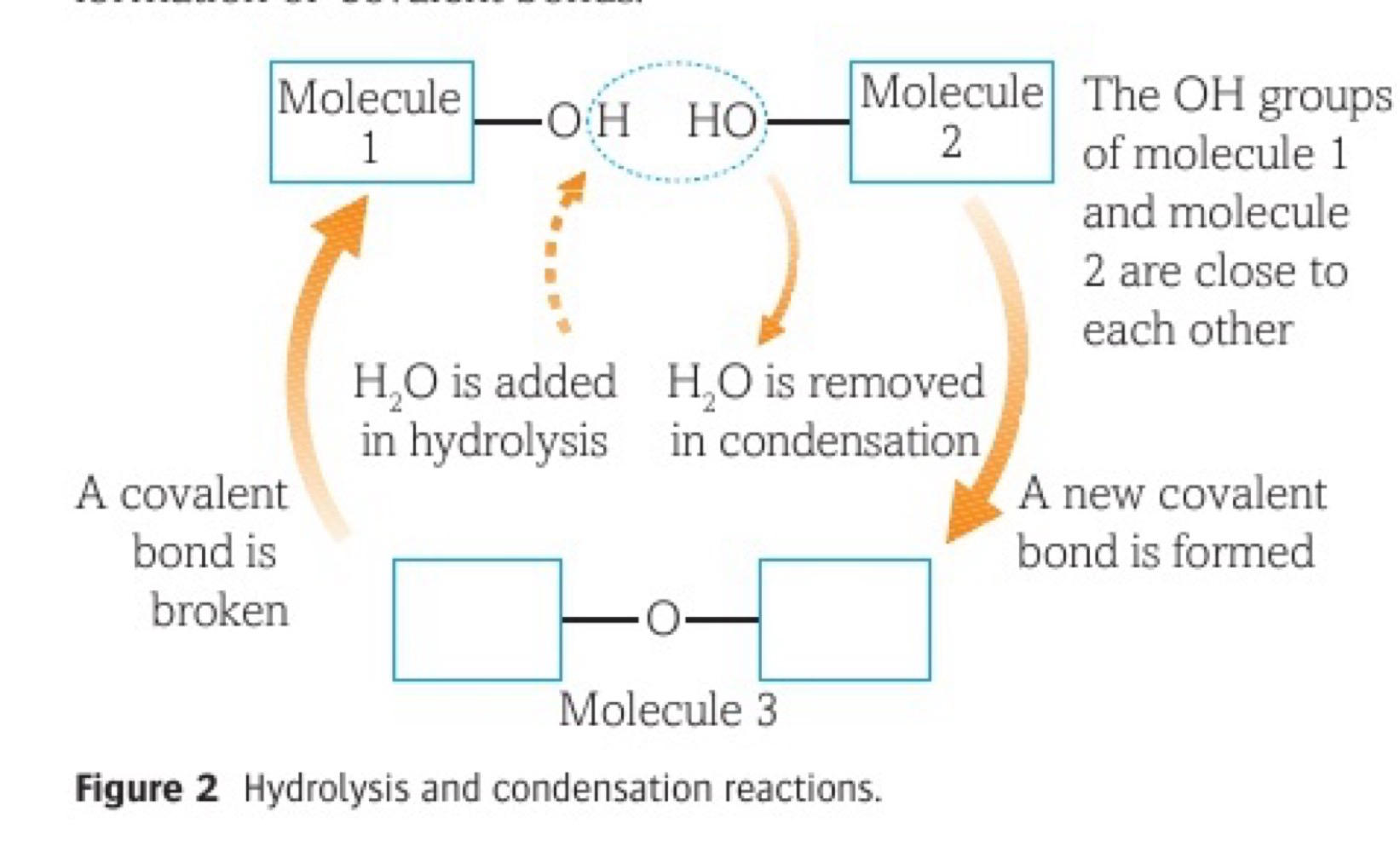
6
What is a dimer?
where 2 monomers join together
7
Whats a polymer?
lots of monomers joined together
8
What are the names of carbohydrate monomers?
monosaccharides
9
What are the names of carbohydrate polymers?
polysaccharides
10
What are the names of protein monomers?
amino acids
11
What are the names of protein polymers?
polypeptides + proteins
12
What is the name of nucleic acids monomers?
nucleotides
13
What is the name of nucleic acids polymers?
DNA + RNA
14
What is a polar molecule?
the atom with greater no. of protons exerts stronger attraction for shared electrons, this makes that atom slightly negative and the other(s) slightly positive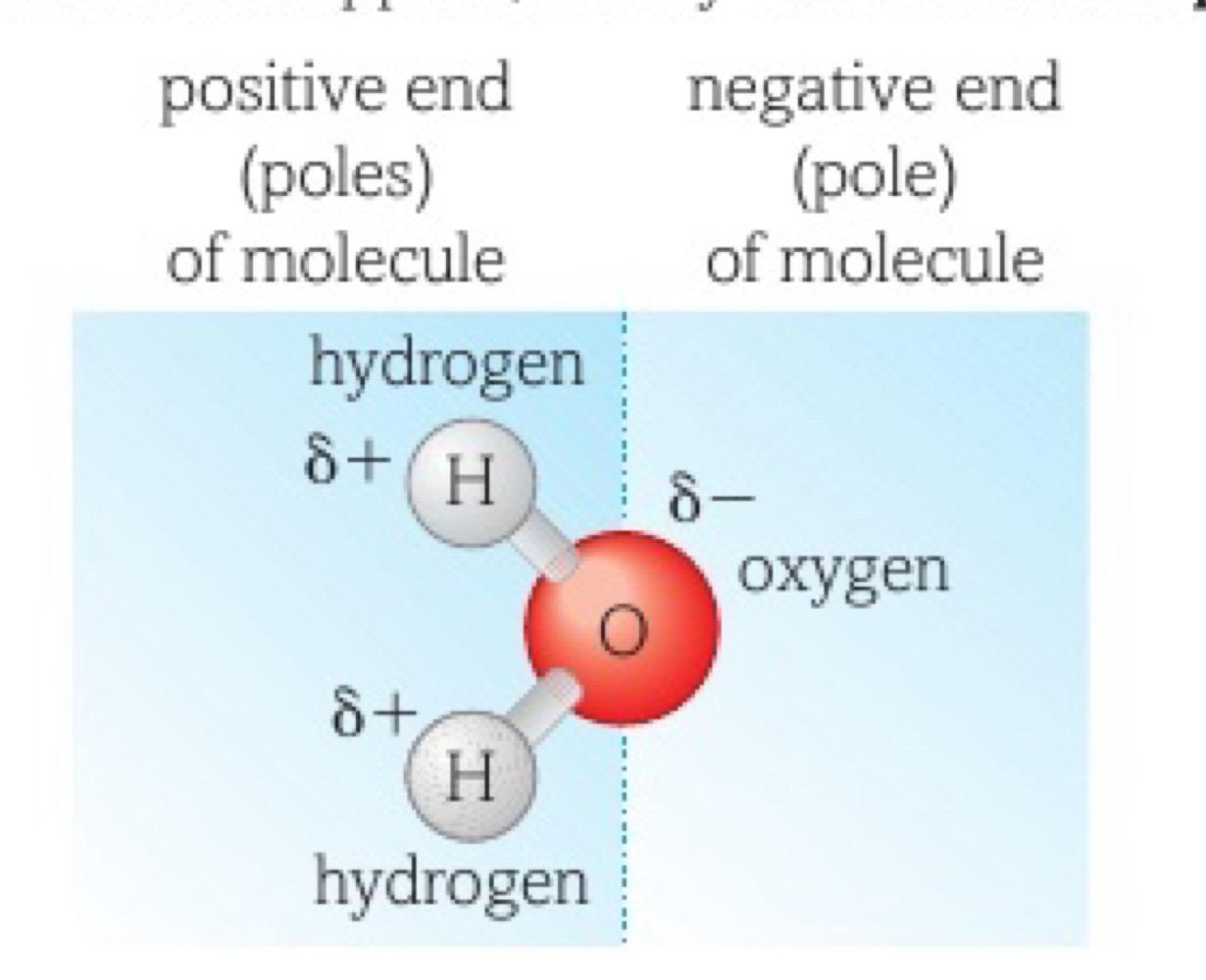
15
Is a hydrogen bond weaker or stronger than a covalent bond?
weaker
16
Why is it more difficult for water to become a gas than other molecules?
hydrogen bonds due to polarity
17
What is waters viscosity like?
low (flow easily)
18
Why is water being a liquid at room temp important? (4)
-habitats
-major component of living tissues
-reaction medium
-effective transport medium
-major component of living tissues
-reaction medium
-effective transport medium
19
Does water become more or less dense as it approaches 4C?
more
20
Does water become more or less dense going from 4C to 0C? Why?
less due to polarity causing molecules to align in structure less dense than liquid water
21
Why is water being denser as a liquid than a solid important?
-stable environment for aquatic life in winter
-bodies of water insulated against extreme cold
-bodies of water insulated against extreme cold
22
Why is water a good solvent?
-polar meaning positive and negative parts of water attracted to positive and negative parts of solute
-water molecules cluster around charged parts seperating and keeping apart solute molecules (solute now dissolved)
-water molecules cluster around charged parts seperating and keeping apart solute molecules (solute now dissolved)
23
Why is water being a good solvent important? (2)
-molecules/ ions move around and react together in water (eg cytoplasm)
-molecules and ions transported in living things
-molecules and ions transported in living things
24
What is surface tension of water?
surface of water resists force applied to it
25
What causes surface tension in water?
-water molecules at surface attracted to those beneath (hydrogen bonds)
-so more attracted to water than air causing surface to contract (molecules pulled inwards)
-so more attracted to water than air causing surface to contract (molecules pulled inwards)
26
Why is having surface tension and cohesion in water important?
-columns of water in plant vascular tissue pulled up xylem from roots
-pond-skaters walk on water
-pond-skaters walk on water
27
Why does water have a high specific heat capacity?
molecules held together tightly by hydrogen bonds
28
What does water having a high specific heat capacity mean?
water doesnt heat up or cool down easily
29
Why is water having a high specific heat capacity important?
-living things need stable temp for enzyme controlled reactions
-aquatic organisms need stable environment
-aquatic organisms need stable environment
30
Why is waters latent heat high and what does this mean?
hydrogen bonds and means large amount of energy required to change state
31
Why is water having a high latent heat important?
can cool living things down eg sweat exaporating or transpiration in leaves of plants
32
Why is water being a reactant important?
important for digestion and synthesis of large biological molecules
33
What does a carbohydrate consist of?
C, H, O
34
What is a glycosidic bond?
bond formed between 2 monosaccharides by condensation reaction
35
What do carbohydrates act as in living things?
-source of energy
-store of energy
-structural units
-store of energy
-structural units
36
Why are monosaccharides well suited as a source of energy?
large number of carbon-hydrogen bonds
37
Describe monosaccharide solubility
-soluble in water
-insoluble in non-polar solvents
-insoluble in non-polar solvents
38
Which forms do monosaccharides exist in?
straight chains or ring/ cyclic
39
What does the prefix before a sugar show? eg hexose
how many carbons there are
40
What form do triose and tetrose sugars exist as in solution?
straight chains
41
What form do pentose and hexose sugars exist as in solution?
ring/ cyclic
42
Is sucrose a non-reducing or reducing sugar?
non-reducing
43
Is maltose a non-reducing or reducing sugar?
reducing
44
Is lactose a non-reducing or reducing sugar?
reducing
45
How are disaccharides made?
2 monosaccharides joining
46
a-glucose + a-glucose ->
maltose
47
a-glucose + fructose ->
sucrose
48
ß-galactose + a-glucose ->
lactose
49
ß-glucose + ß-glucose ->
cellobiose
50
What is the molecular formula for a-glucose?
$ C_6H_{12}O_6$
51
What is the molecular formula for ß-glucose?
$ C_6H_{12}O_6$
52
What is the molecular formula for ribose?
$ C_5H_{10}O_5$
53
What is the molecular formula for deoxyribose?
$ C_5H_{10}O_4$
54
What is a-glucoses role in the body?
-energy source
-component of starch + glycogen (energy stores)
-component of starch + glycogen (energy stores)
55
What is ß-glucoses role in the body?
-energy source
-component of cellulose (structural support cell walls)
-component of cellulose (structural support cell walls)
56
What is riboses role in the body?
component of ribonucleic acid (RNA), ATP and NAD
57
What is deoxyriboses role in the body?
components of deoxyribonucleic acid (DNA)
58
What type of sugar is a-glucose?
hexose
59
What type of sugar is ß-glucose?
hexose
60
What type of sugar is ribose?
pentose
61
What type of sugar is deoxyribose?
pentose
62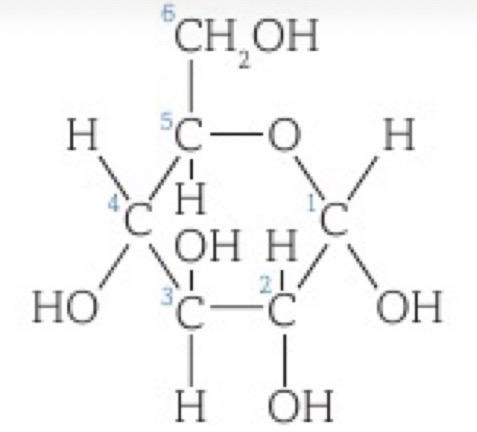
What is the structure of a-glucose?
63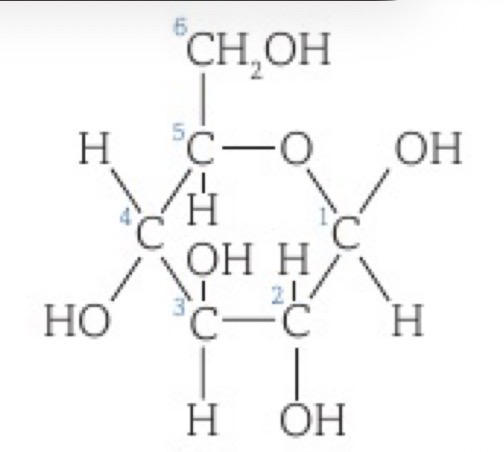
What is the structure of ß-glucose?
64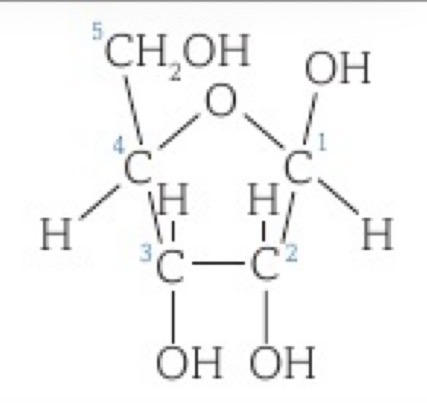
What is the structure of ribose?
65
What are homopolysaccharides?
polysaccharides made solely of one type of monosaccaride
66
Glucose is a reactant in respiration making it a...
source of energy
67
What is ATP?
energy currency of the cell
68
How does glucose become an energy store?
join lots of them together into polysaccharides
69
What is starch in plants composed of?
amylose and amylopectin
70
In what form does glycogen and starch occur in cells?
in the form of large granules
71
Why does being compact make polysaccharides good monosaccharide stores?
do not oppucy a lot of space (dense granules)
72
Why does being in chains make polysaccharides good monosaccharide stores?
easily 'snipped off' from end of chain by hydrolysis when required for respiration
73
Are hydrolysis reactions always catalysed?
yes
74
Why do chains being branched make polysaccharides good monosaccharide stores?
more compact but offer chance for lots of glucose molecules to be snipped off at the same time
75
How do plants store energy?
as starch in chloroplasts and membrane-bound starch grains
76
How do humans store energy?
as glycogen in cells of muscle and liver
77
What is a 1-4 glycosidic linkage?
linkage between carbon 1 of one glucose and carbon 4 of the other
78
Which enzyme is responsible for hydrolysing 1-4 glycosidic linkages?
amylase
79
Which enzyme is responsible for hydrolysing 1-6 glycosidic linkages?
glucosidase
80
Why does being less soluble in water than monosaccharides make polysaccharides good monosaccharide stores?
if many glucose molecules dissolve in cytoplasm, water potential reduce so excess water would dissolve in disrupting cell function
81
Why are polysaccharides less soluble than monosaccharides?
size and that regions which could hydrogen bond with water are hidden away inside molecule
82
What is an example of an unbranched polysaccharide?
amylose
83
What are some examples of a branched polysaccharide?
amylopectin and glycogen
84
Which shape does the amylose molecule sometimes form and how does this affect it?
double helix which presents hydrophobic external surface in contact with surrounding solution
85
Where are the glycosidic bonds in amylose?
between carbonds 1 and 4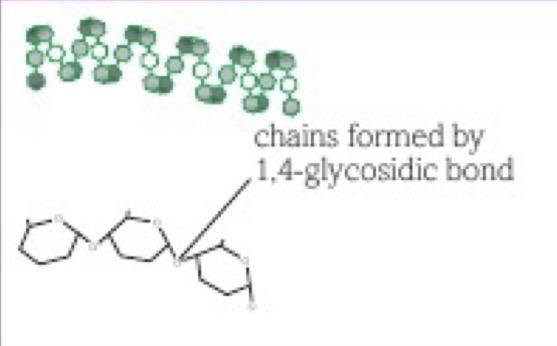
86
What is amylose made up from?
long chain of a-glucose molecules
87
What shape does amylose form and how does it maintain this?
spiral shape with H bonds holding spiral in place
88
Compare amylopectin with amylose
like amylose (glycosidic bond between C 1 + 4) BUT also has branches formed by glycosidic bonds between C 1 + 6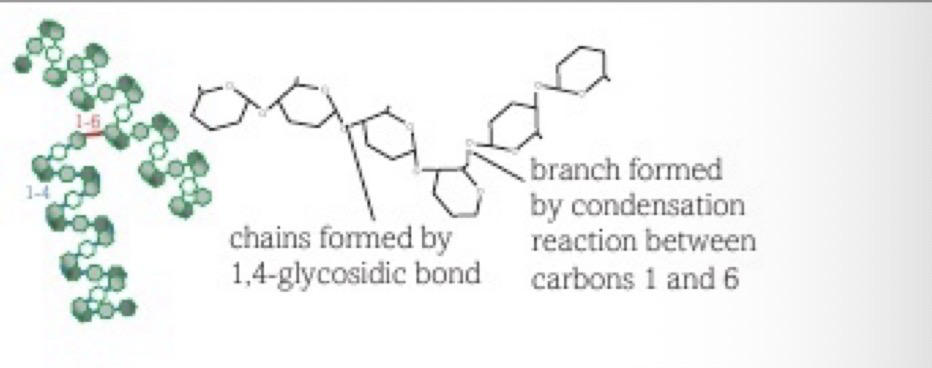
89
Compare amylopectin’s shape with amylose’s
amylopectin also coils into a spiral held together with H bonds BUT branches emerging from spiral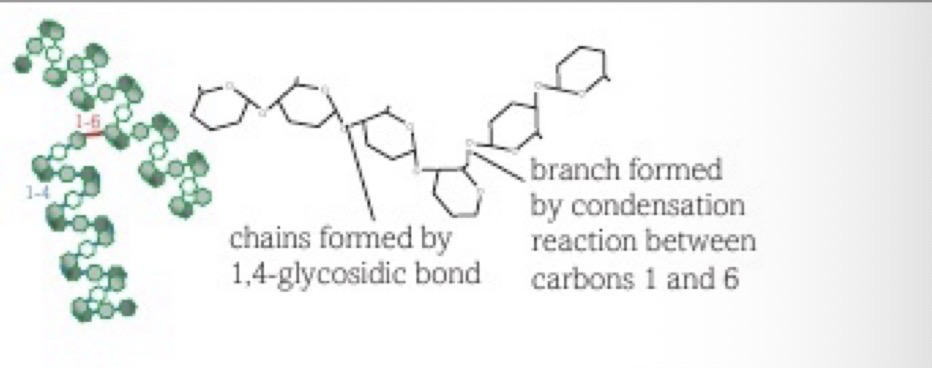
90
Which molecule is similar to amylopectin and why?
glycogen (glycosidic bond between C1-4 + branches gormed by glycosidic bonds between C1-6)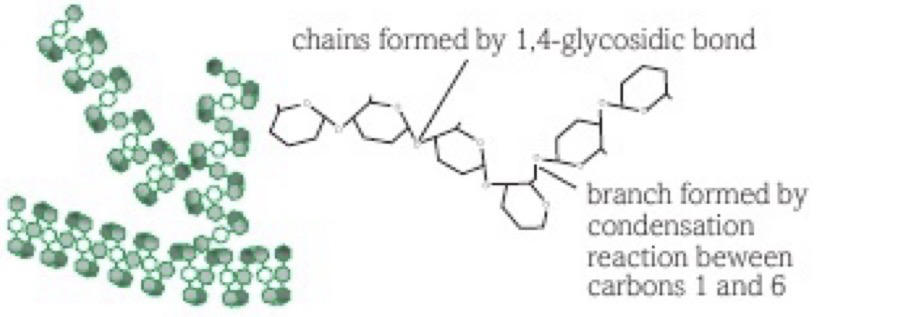
91
Compare amylopectin and glycogen
-1-4 bonded chains tend to be smaller in glycogen, so less likely to coil
-glycogen has more branches, making it more compact and easier to remove monomer units (as there are more ends)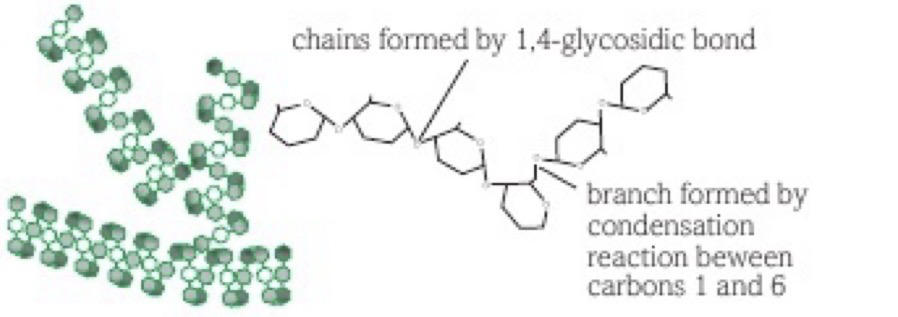
-glycogen has more branches, making it more compact and easier to remove monomer units (as there are more ends)
92
What are the properties of cellulose? (3)
tough, insoluble and fibrous
93
Is cellulose a hetero or homosaccharide?
homosaccharide
94
What is cellulose made up from?
long chains of up to 15000 beta glucose molecules
95
What kind of reaction is cellulose made through?
condensation reactions to form glycosidic bonds
96
What shape are cellulose chains?
straight and lie side by side
97
What shape are alpha glucose chains?
spirals
98
What stops cellulose chains from spiralling?
-hydrogen and hydroxyl groups on C1 inverted in beta glucose meaning every other beta glucose molecule in chain rotated by 180 degrees
-hydrogen bonding between rotated beta glucose molecules in each chain gives strength (stopping spiralling)
-hydrogen bonding between rotated beta glucose molecules in different chains gives strength to whole structure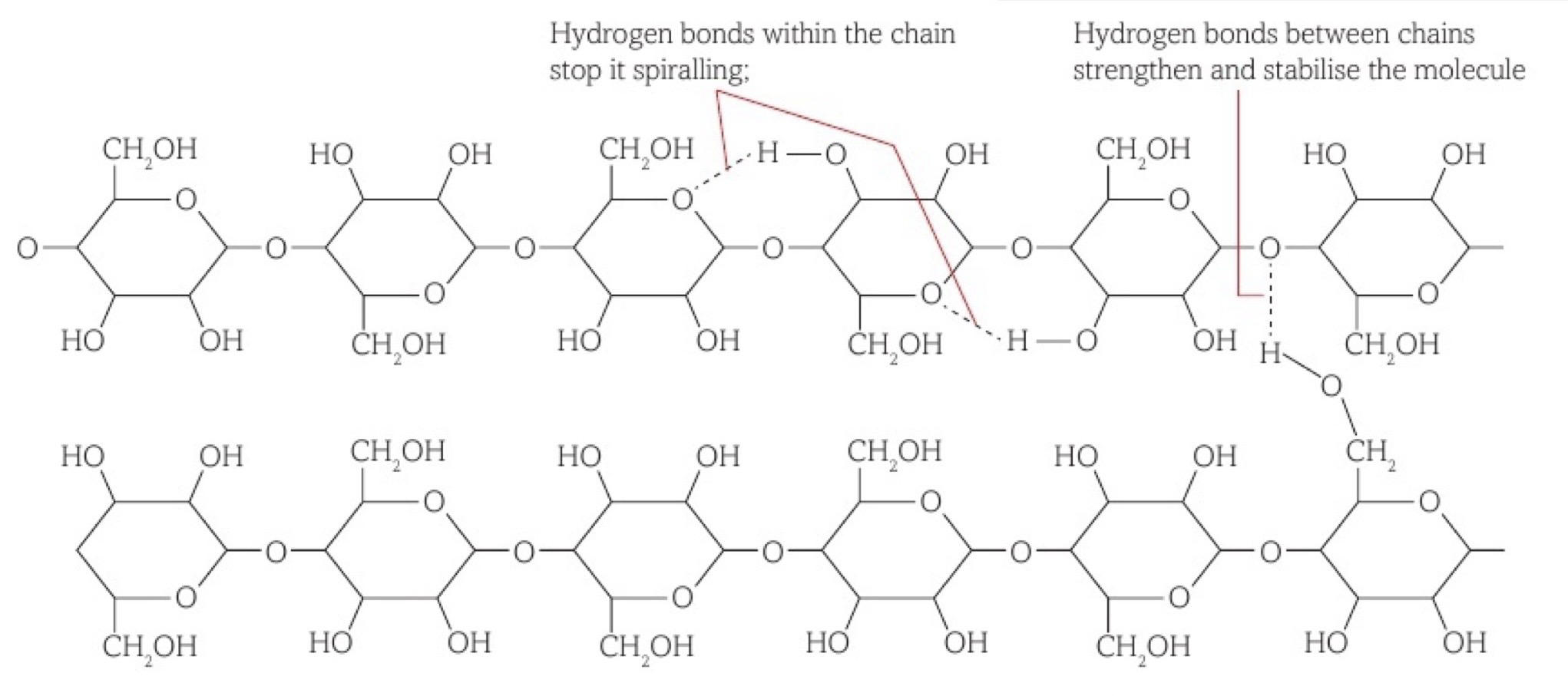
-hydrogen bonding between rotated beta glucose molecules in each chain gives strength (stopping spiralling)
-hydrogen bonding between rotated beta glucose molecules in different chains gives strength to whole structure
99
Why can hydrogen bonds be formed between cellulose chains?
hydroxyl group on C2 sticks out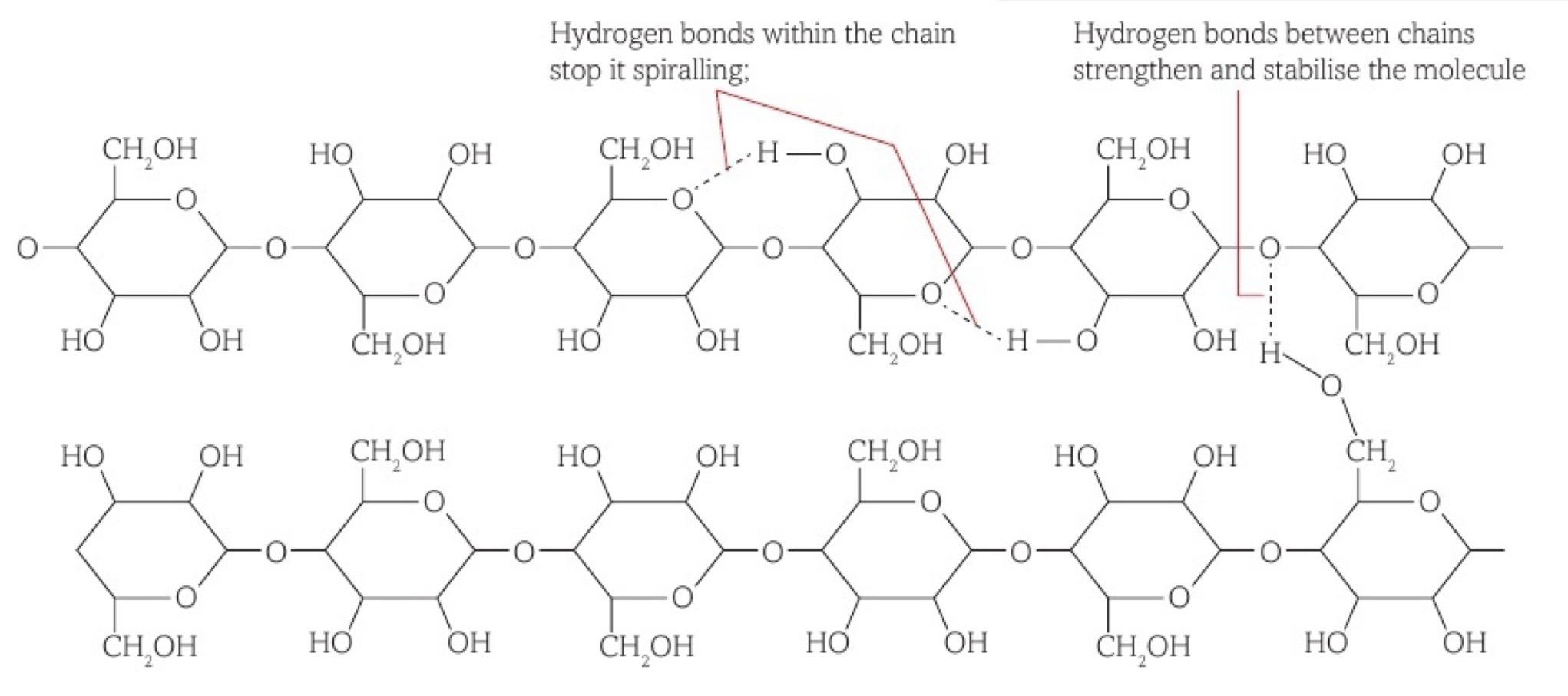
100
How are microfibrils formed?
cellulose chains bound together
101
How are macrofibrils formed?
when microfibrils bundle together
102
How are plant cell walls formed?
macrofibrils embedded in pectins (like glue)
103
Why is cellulose a good material for plant cell walls?
-microfibrils + macrofibrils have very high tensile strength
-macrofibrils run in all directions, criss-crossing wall for extra strength
-difficult to digest cellulose
-macrofibrils run in all directions, criss-crossing wall for extra strength
-difficult to digest cellulose
104
Why is it difficult to digest cellulose?
glycosidic bonds between glucose molecules less easy to break
105
Why do microfibrils and macrofibrils have high tensile strength?
hydrogen bonds between chains + strength of glycosidic bonds
106
Which key feature help the plant cell wall do its job? (4)
-strength to support whole plant (as plant has no rigid skeleton)
-space between macrofibrils
-high tensile strength
-macrofibril structure can be reinforced with other substances for extra support or to make walls waterproof
-space between macrofibrils
-high tensile strength
-macrofibril structure can be reinforced with other substances for extra support or to make walls waterproof
107
How do spaces between macrofibrils help the plant cell wall do its job?
so water and mineral ions can pass on their way into and out of cell
108
Is the cell wall partially permeable?
No, fully permeable
109
How does high tensile strength help the plant cell wall do its job?
protects delicate cell membrane + prevents cells from bursting when turgid, supporting whole plant (when turgid cells press against each other)
110
What are examples macrofibril structure being reinforced with other substances?
-cutin and suberin are waxes to block spaces in cell wall making it waterproof
-lignin performs same (as above) function for xylem
-lignin performs same (as above) function for xylem
111
What are examples of man-made uses of cellulose?
-cotton
-cellophane + celluloid (photographic film)
-a main component of paper
-rayon (semi-synthetic fibre)
-cellophane + celluloid (photographic film)
-a main component of paper
-rayon (semi-synthetic fibre)
112
What is the whole structure surrounding the bacteria cell called?
a peptidoglycan
113
What is a peptidoglycan made from?
long polysaccharide chains which lie in parallel, cross-linked by short peptide chains (made of amino acids)
114
What are insect and crustacean exoskeletons made from?
chitin
115
How does chitin differ from cellulose?
has acetylamino group (NH.OCCH3) rather than hydroxyl group on C2, which forms cross-links between long parallel chains of acetylglucosamine (like in cellulose)
116
What do lipids contain?
large amounts of carbon and hydrogen, smaller amounts oxygen
117
Why are lipids insoluble in water and what does thos mean?
not polar so dont attract water molecules
118
What are lipids?
group of substances soluble in alcohol rather than water
119
What is a macromolecule?
very large, organic molecule
120
What is a phospholipid?
molecule consisting of glycerol, 2 fatty acids and 1 phosphate group
121
What are the 3 most important lipids in living things?
-triglycerides
-phospholipids
-steroids
-phospholipids
-steroids
122
Are the triglycerides, phospholipids and steroids polymers?
no but they have different components bonded together
123
What are triglycerides, phospholipids and steroids examples of?
macromolecules
124
What substances are included in lipids?
-triglycerides
-phospholipids
-glycolipids
-cholesterol
-phospholipids
-glycolipids
-cholesterol
125
What are tryglycerides made up of?
glycerol amd fatty acids
126
What are essential fatty acids?
fatty acids that must be ingested ‘complete’
127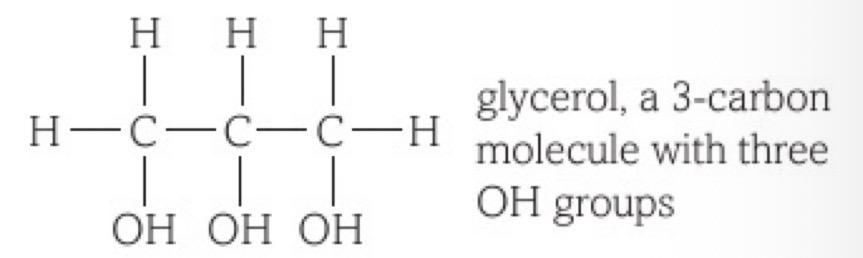
What is the structure of glycerol?
128
What is the structure of fatty acids?
on one end, carboxyl group attached to hydrocarbon tail made only of H and C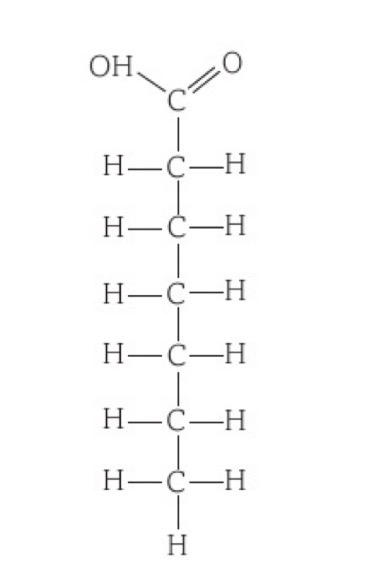
129
What does the carboxylic group in a fatty acid ionise into? What does this make the structure?
1) H+ and -COO-
2) acid
2) acid
130
What does it mean if a fatty acid is saturated?
no C=C bonds in molecule
131
What does it mean if a fatty acid is unsaturated? How does this affect amount of hydrogen bonded?
double bond between carbon atoms meaning fewer hydrogen bonded to molecule
132
What does it mean if a fatty acid is monounsaturated?
single C=C bond
133
What does it mean if a fatty acidis polyunsaturated?
more than one C=C bond
134
DELETE
oleic acid
135
DELETE
linoleic acid
136
How does having on or more C=C bonds change the chape of a hydrocarbon chain?
kink where double bond is
137
How does having one or more C=C bonds change the properties of a hydrocarbon chain?
kink pushes molecules apart slightly, making them more fluid
138
Do animal lipids contain a lot of saturated or unsaturated fatty acids?
saturated
139
Does an unsaturated or saturated fatty acid have a lower melting point?
unsaturated
140
What does a triglyceride consist of?
1 glycerol bonded to 3 fatty acids
141
What kind of reaction happens to form a triglyceride?
condensation reaction between -COOH group (fatty acid) and -OH group (glycerol)
142
What is the covalent bond formed in a triglyceride known as?
ester bond
143
In a triglyceride do the fatty acids always have to be the same type?
no
144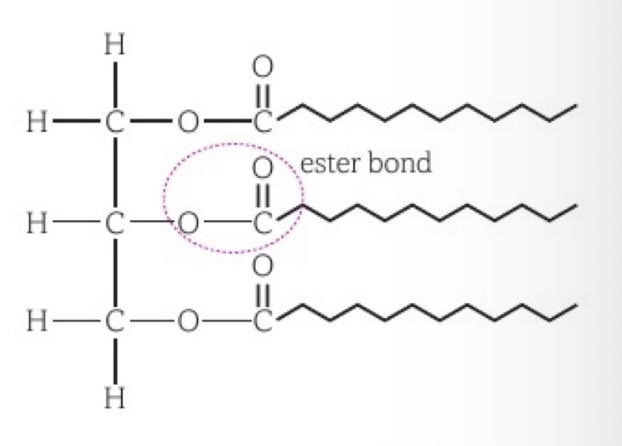
Where is the ester bond?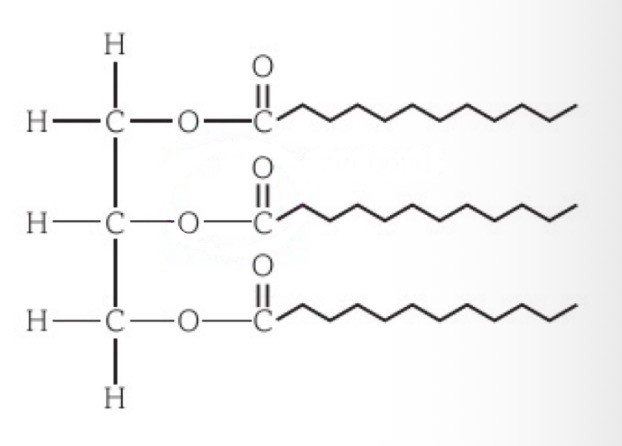
145
Does respiration of a lipid produce more or less water than glucose?
more
146
What are the 5 main functions of triglycerides?
-energy source
-energy store
-insulation
-buoyancy
-protection
-energy store
-insulation
-buoyancy
-protection
147
How does a triglyceride work as an energy source?
-broken down in respiration to release energy and generate ATP
1) ester bond hydrolysed
2) glycerol and fatty acids broken down to CO2 and H2O
1) ester bond hydrolysed
2) glycerol and fatty acids broken down to CO2 and H2O
148
Why is a triglyceride a good energy store?
insoluble in water so stored without affecting water potential of cell
149
Where do mammals store fat (triglyceride)?
in adipose cells under skin
150
1g of fat releases [twice/half] as much energy as 1g glucose. Why?
twice
-bcos lipids have higher proportion H than carbs and almost no O
-bcos lipids have higher proportion H than carbs and almost no O
151
Give 3 ways triglyceride acts as insulation.
-adipose tissue in whales (blubber) acts as heat insulator
-lipid in nerve cells act as electrical insulator
-animals store extra fat for hibernation
-lipid in nerve cells act as electrical insulator
-animals store extra fat for hibernation
152
How do triglycerides help with buoyancy?
fat less dense than water so help aquatic animals stay afloat
153
How do triglycerides act as protection in humans?
fat around delicate organs like kidneys to act as shock absorber
154
How are triglycerides used as protection in bacteria?
peptidoglycan cell walk covered in lipid-rich outer coat
155
Whats the structural difference between triglycerides and phospholipids?
One of triglycerides fatty acid replaced by phosphate group
156
Describe the reaction forming phosphate group in phospholipid. What kind of bond does it form?
condensation reaction between OH group on phosphoric acid molecule (H3PO4) and 1 of 3 -OH groups on glycerol
ester bond
ester bond
157
DELETE
yes most do
158
Is it common for one of the fatty acid chains in phospholipids to be saturated and 1 unsaturated?
yes
159
How does the phosphate group in a phospholipid behave when surrounded by water?
has negative charge, making it polar causing attraction
160
How do the fatty acid tails in a phospholipid behave when surrounded by water?
non-polar so repell water
161
What word describes how the head of a phospholipid acts around water?
hydrophillic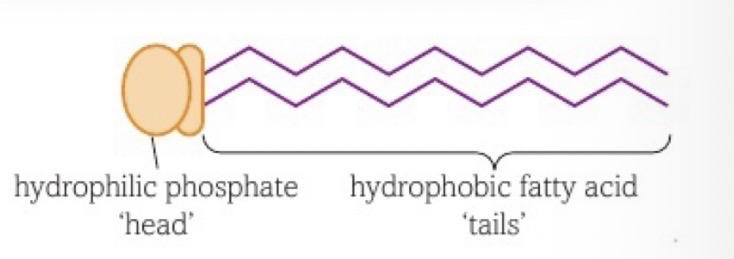
162
What word describes how the tail of a phospholipid acts around water?
hydrophobic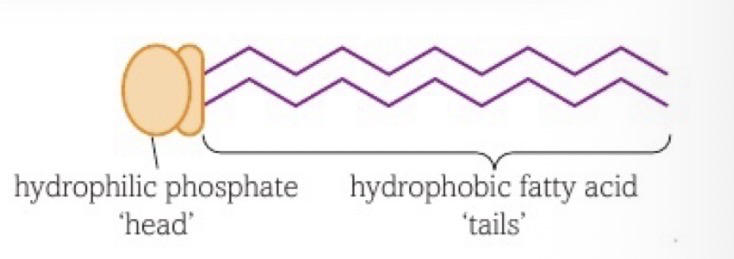
163
Why is a phospholipid molecule amphipathic?
both hydrophillic and hydrophobic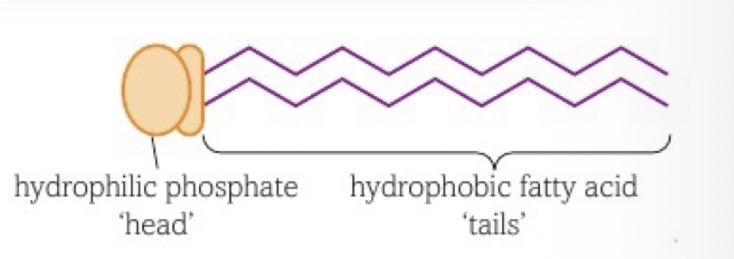
164
Do membrane lipids tend to be amphipathic?
yes
165
Do storage lipids tend to be amphipathic?
no
166
Which 2 formations may occur from phospholipids with water due to them being amphipathic?
-layer on surface if water with heads in water and tails sticking up ou of water
-micelles: tiny balls with tails tucked away inside and heads pointing outwards into water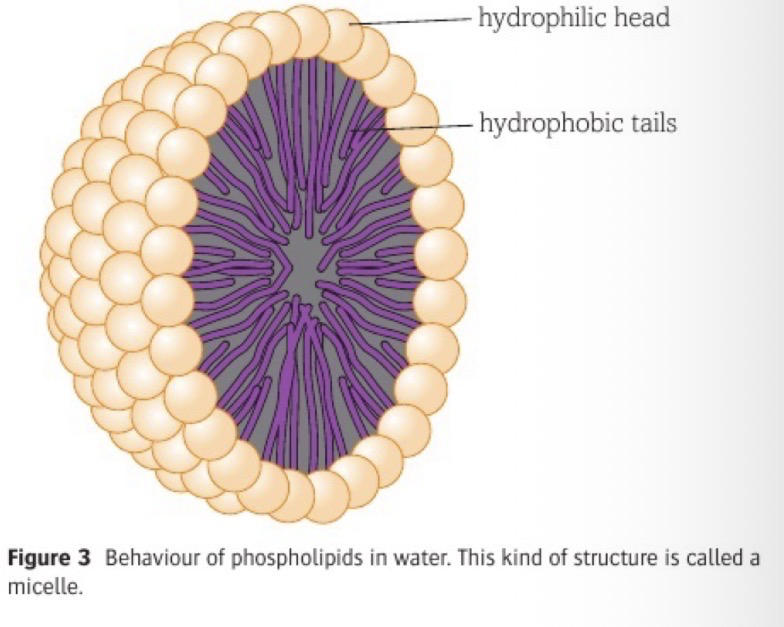
-micelles: tiny balls with tails tucked away inside and heads pointing outwards into water
167
Why do amphipathic phospholipids form an excellent membrane around cells and organelles?
form bilayer, w 2 rows of phospholipids (tails pointing in + heads pointing out to solution) 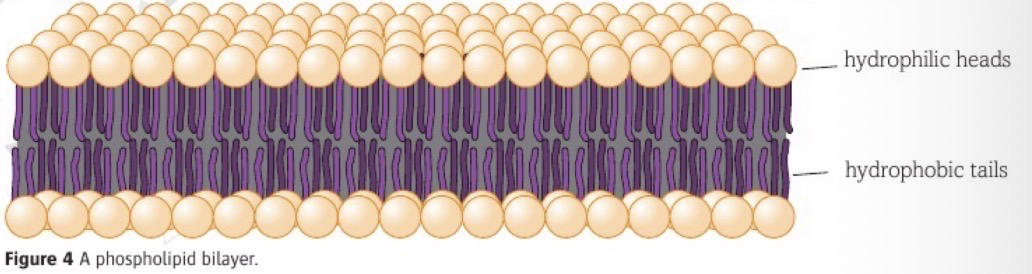
168
How do phopholipids provide stability to membrane?
individual phospholipids free to move around in layer but not into position where tail exposed to water
169
How do phospholipids help control what goes in and out cell through membrane?
membrane selctively permeable: only small and non polar molecules move through tails in bilayers (eg O and CO2)
170
What is cholesterol?
steroid alcohol: type of lipid not made of glycerol or fatty acids
171
What does cholesterol consist of?
4 carbon-based rings or isoprene units
172
Which properties allow cholesterol to sit in middle of hydrophobic part of bilayer of membrane?
small + hydrophobic
173
How is cholesterol sitting in middle of hydrophobic layer of membrane beneficial?
regulates fluidity of membrane, preventing from becoming too stiff
174
Where is cholesterol mainly made in animals?
liver
175
What is plant cholesterol derivative called?
stigmasterol
176
How is stigmasterol different from cholesterol?
stigmasterol has an extra double bond
177
Which steroid hormones are made from cholesterol? Why can they pass through cell membrane?
testosterone, oestrogen + vit D
small enough
small enough
178
What can happen to plant steroids when ingested and absorbed?
converted into animal hormones
179
What are amino acids?
monomers of all proteins that all have the same basic structure
180
What is a peptide bond?
bond formed when 2 amino scids join together
181
What is a protein?
large polymers comprised of long chains of amino acids
182
Which functions do proteins have and which properties give them those functions?
-form structural components in animals
-act as enzymes, antibodies and hormones: tendency to adopt specific shapes
-act as carriers and pores for active transport across membranes and facilitated diffusion
-act as enzymes, antibodies and hormones: tendency to adopt specific shapes
-act as carriers and pores for active transport across membranes and facilitated diffusion
183
What are essential amino acids?
amino acids animals must ingest
184
Can animals make all their needed amino acids?
no, only some
185
Can plants make all their needed amino acids?
yes
186
What do plants need to create amino acids?
access to fixed nitrogen (eg nitrate)
187
Which elements to amino acids contain?
carbon, nitrogen, hydrogen, oxygen (sometimes sulfur)
188
What does proteinogenic mean?
amino acids that are found in proteins
189
How many amino acids are there?
over 500
190
How many proteinogenic amino acids are there?
20
191
What is the structure of an amino acid?
-amino group (-NH2)
-carboxyl group (-COOH)
-R group (different in each amino acid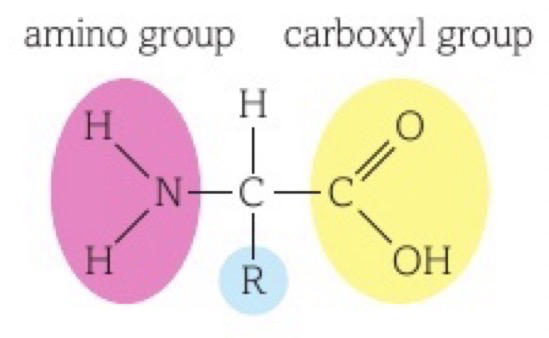
-carboxyl group (-COOH)
-R group (different in each amino acid
192
What does the name of most amino acids end in? And what are the exeptions?
-ine
exeptions: acidic R group
exeptions: acidic R group
193
Do enzymes catalyse condensation and hydrolysis reactions with peptide bonds?
yes
194
What do protease enzymes in the intestines do?
-break peptide bonds during digestion
-break down protein hormones so effects arent permanent
-break down protein hormones so effects arent permanent
195
What are 2 amino acids joined together called?
dipeptide
196
What is a polypeptide?
longer chain of amino acids joined together
197
Does a protein consist of one polypeptide chain or more than one joined together?
both
198
What is the primary structure (amino acids)?
sequence of amino acids in molecule
199
What is the quaternary structure (amino acid)?
protein structure where protein consists of more than one polypeptide chain
200
What is a secondary structure (amino acids)?
coiling or folding of amino acid chain, due to hydrogen bonding between different parts of chain (main forms are helix and pleated sheet)
201
What is a tertiary structure (amino acids)?
overall 3d shape of protein molecule caused by hydrogen bonding, disulfide bridges, ionic bonds and hydrophobic interactions (of secondary structures)
202
How long are proteins?
at least 100 amino acids
203
Does the order of amino acids in primary structure affect shape of protein molecule in other structures?
yes
204
What is an a-helix structure (secondary)?
coiled chain of amino acids with 36 amino acids per 10 turns of helix
205
How is an a-helix structure held together?
hydrogen bonds between -NH group of an amino acid and -CO group of another 4 places ahead in chain
206
What is a ß-pleated sheet structure?
amino acid chain with very slight zig zag structure
207
How are ß-pleated sheet structures held together?
hydrogen bonds between -NH group of an amino acid with -CO group of another further down strand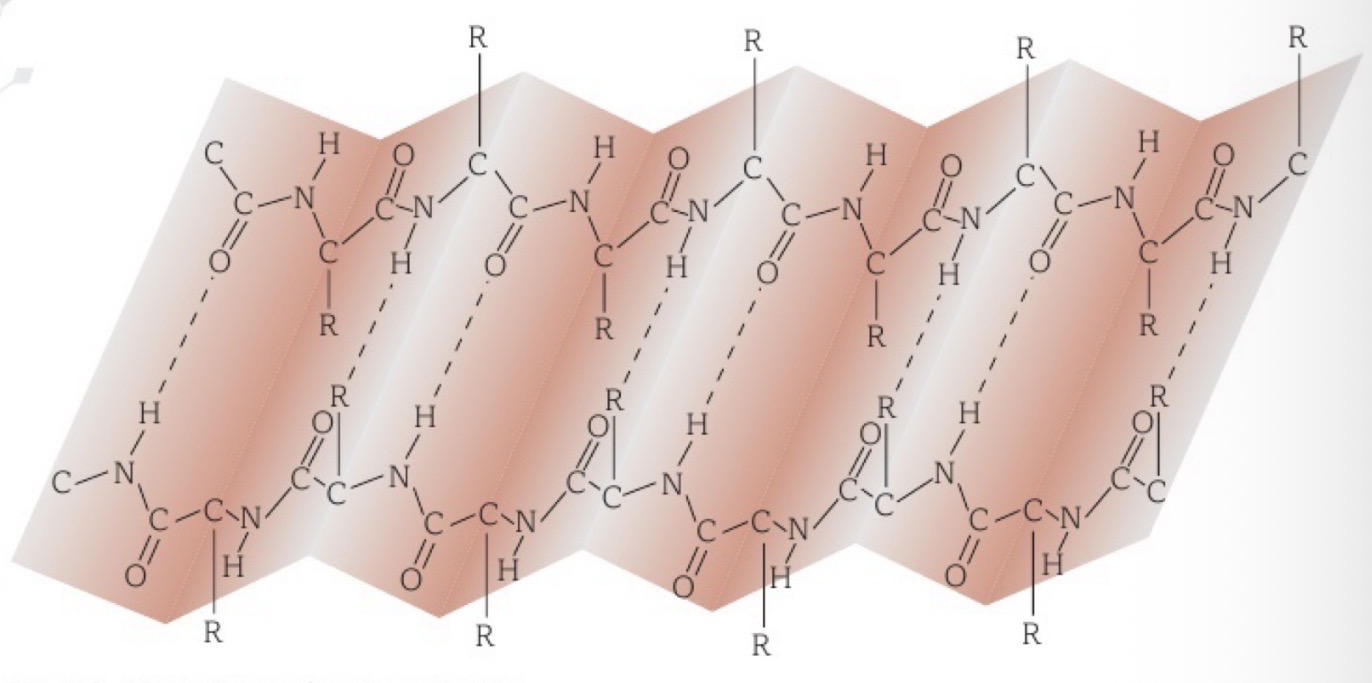
208
Why are a-helix and ß-pleated sheet structure stable at optimal temp and pH eventhough hydrogen bonds are relatively weak?
many hydrogen bonds formed
209
Are all secondary structures (amino acids) regular?
no
210
Can there only be one secondary structure in an amino acid chain?
no can be more than one eg different ends
211
What are 2 main properties of tertiary structures (amino acids)?
very precise shape, held firmly in place
212
Which 2 shapes can a tertiary structure adopt?
-supercoiled (eg fibrous proteins)
-spherical (globular proteins)
-spherical (globular proteins)
213
What type of bonds hold together primary structure?
strong covalent peptide bonds
214
What do hydrogen bonds form between within amino acids?
polar areas of R groups, hydroxyl, carboxyl and amino groups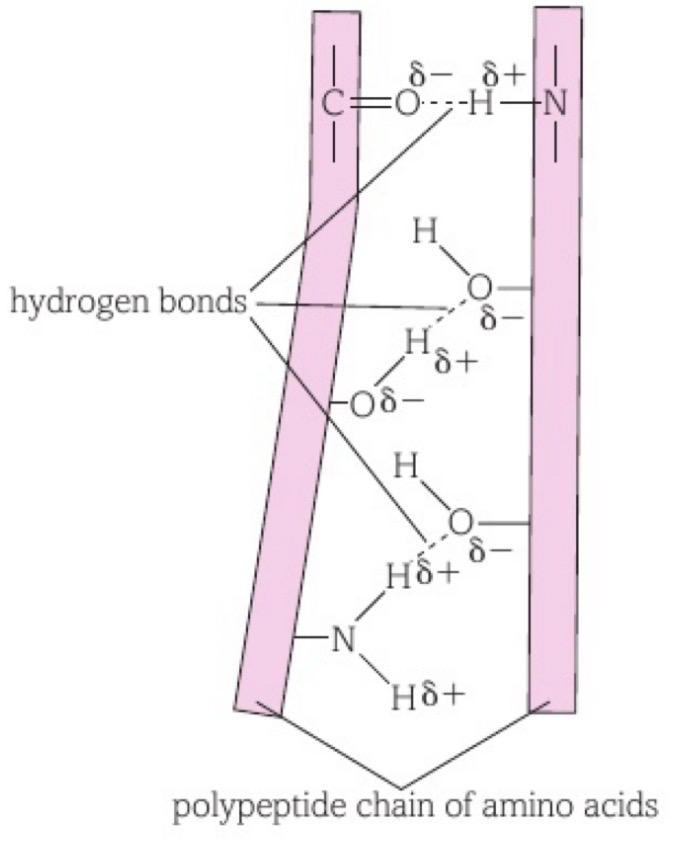
215
What do ionic bonds form between in amino acids?
carboxyl and amino groups of R groups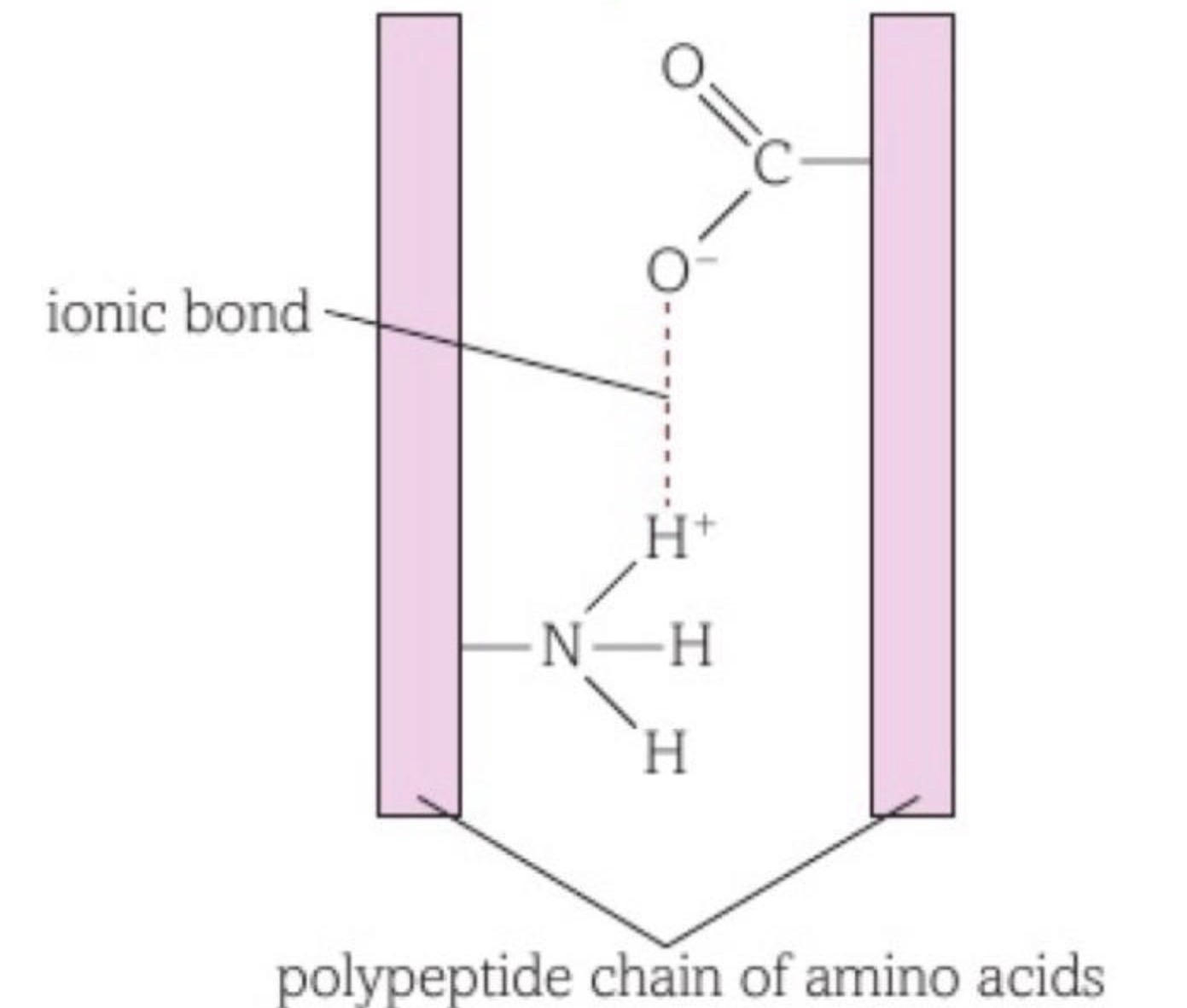
216
What does an amino group ionise into in amino acid ionic bonds?
$ NH_3^+$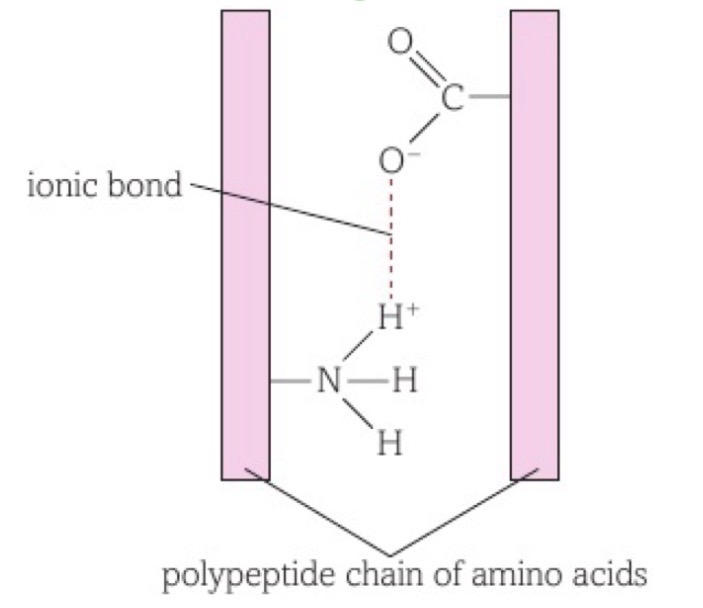
217
What does a carboxyl group ionise into in amino acid ionic bonds?
$COO^-$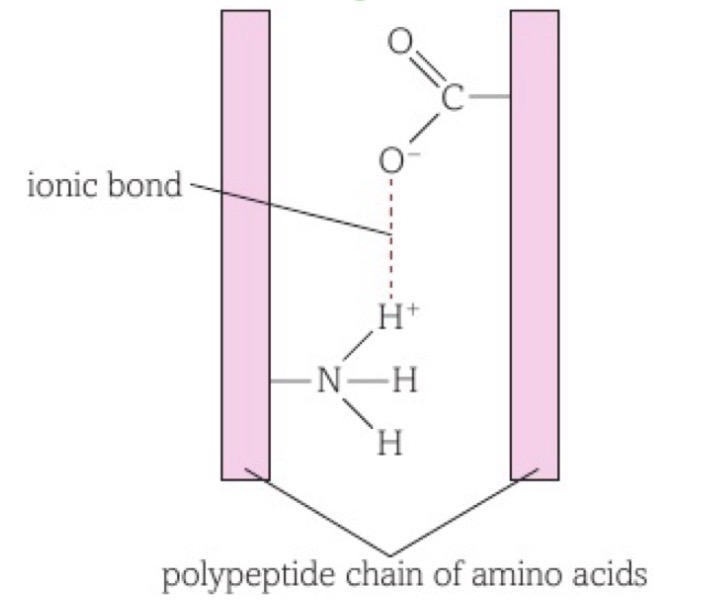
218
What type of bonds are disulfide links?
strong covalent
219
What are disulfide links formed between in cysteine?
between R groups of 2 cysteines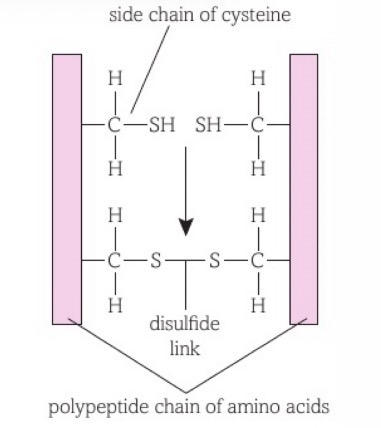
220
How do hydrophobic and hydrophillic R groups cause an amino acid chain to twist?
hydrophobic parts associate together in centre of polypeptide and opposite for hydrophillic parts
221
How does amino acid chain twisting affect the protein?
changes its shape
222
What is a fibrous protein?
regular, repetitive relatively long thin structure, insoluble in water and metabolically inactive, structural role in organism
223
What is a globular protein?
relatively spherical molecules, soluble in water often having metabolic roles in organism
224
What is a prosthetic group?
non-protein component forming permanent part of functioning protein molecule
225
How can globular proteins be soluble in water?
any hydrophobic R groups turned inward + hydrophilic groups outside so molecules easily cluster and bind to them
226
What functions can globular proteins fulfill due to having specific shapes?
enzymes, hormones, haemoglobin
227
How is collagen used in artery walls?
prevents artery bursting when withstanding high blood pressure
228
How is collagen used in tendons?
connect muscle to bones, allowing bones to be pulled
229
How is collagen used in bones?
made from collagen and reinforced with calcium phosphate making them strong
230
C________ and c_________ tissue made out of colllagen
cartilage, connective
231
What are examples of where keratin is found?
finger nails, hair, claws, hoofs, horns etc
232
How is keratin useful to an organism?
mechanical protection, impermeable barrier to infection, waterproof to prevents water-borne pollutants entering
233
What makes the structure of elastin strong and extendible?
cross-linking and coiling
234
How is elastin used in skin?
skin streches around bones and muscle
235
How is elastin used in lungs?
allows inflation and deflation
236
How is elastin used in bladder?
expand to hold urine
237
How is elastin used in blood vessel?
stretch and recoil helping maintain pressure
238
How many polypeptides make up haemoglobin and what type are they?
4: 2 a-globin chains, 2 ß-globin chains
239
What is haem an example of?
prosthetic group
240
What is a conjugated protein?
protein associated with prosthetic group
241
What is the colour change of haemoglobin after oxygen binds?
purple red to bright red
242
How many and what type of polypeptide chain does insulin have?
2: A beginning with section of a-helix, B ending with section of ß-pleat
243
Why is insulin soluble in water?
amino acids with hydrophollic R group
244
What does insulin do in the body?
binds to glycoprotein receptors on outside of muscle and fat cells to increase uptake and consumption of glucose
245
What is pepsin?
enzyme that digests protein in stomach
246
What is pepsin made up of?
single polypeptide chain
247
What structure is pepsin?
symmetrical tertiary structure
248
Why is pepsin stable in acidic stomach environment?
many acidic R groups so few can accept H+ ions which would otherwise affect enzyme structure
249
What type of bonds is pepsins tertiary structure held together by?
hydrogen bonds, 2 disulfide bridges
250
What is Ab initio protein modelling?
model built on physical and electrical properties of aroms in each amino acid in sequence providing multiple solutions to same sequence
251
What is a down side to Ab initio protein modelling?
other methods may be needed to reduce no. of solutions
252
What is comparative protein modelling?
protein threading which scans animo sequence against database of solved structure producing set of mtching possible models
253
What is a calcium ion as a symbol?
Ca 2+
254
What are the uses of calcium ions? (9)
-rigidity of bones, teeth and cartilage
-exoskeleton of crustaceans
-important in clotting blood
-important in muscle contraction
-activator for several enzymes
-regulates transmission of nerve impulses
-regulates permeability of cell membranes
-important for cell wall development in plants
-imporatant for formation of middle lamella between cell walls
-exoskeleton of crustaceans
-important in clotting blood
-important in muscle contraction
-activator for several enzymes
-regulates transmission of nerve impulses
-regulates permeability of cell membranes
-important for cell wall development in plants
-imporatant for formation of middle lamella between cell walls
255
What is a sodium ion as a symbol?
Na +
256
What are the uses of sodium ions? (8)
-involved in regulating osmotic pressure
-involved in control of water levels in body
-involved in maintenance of pH
-affects absorption of carbohydrates in intestines
-affects absorbtion of water in the kidneys
-contributes to nervous transmission
-contributes to muscle contraction
-constituent of vacuole in plants
-involved in control of water levels in body
-involved in maintenance of pH
-affects absorption of carbohydrates in intestines
-affects absorbtion of water in the kidneys
-contributes to nervous transmission
-contributes to muscle contraction
-constituent of vacuole in plants
257
What are examples of enzymes that are activated by calcium ions? (3)
-lipase
-ATPase
-cholinesterase
-ATPase
-cholinesterase
258
What is a potassium ion as a symbol?
K +
259
What are the uses of potassium ions? (9)
-involved in control of water levels in body fluid
-involved in maintenance of pH
-assists active transport across cell membrane
-involved in protein and glycogen synthesis
-involved in breakdown of glucose
-generates healthy leaves and flowers
-contrubutes to nervous transmission
-contributes to muscle contraction
-component of vacuole in plants
-involved in maintenance of pH
-assists active transport across cell membrane
-involved in protein and glycogen synthesis
-involved in breakdown of glucose
-generates healthy leaves and flowers
-contrubutes to nervous transmission
-contributes to muscle contraction
-component of vacuole in plants
260
What is a hydrogen ion as a symbol?
H +
261
What are the uses of hydrogen ions? (3)
-involved in photosynthesis and respiration
-involved in transport of oxygen and carbon dioxide in blood
-involved in regulation of blood pH
-involved in transport of oxygen and carbon dioxide in blood
-involved in regulation of blood pH
262
What is an ammonium ion as a symbol?
NH4 +
263
What are the uses of ammonium ions? (5)
-component of amino acids, proteins, vitamins, chlorophyll
-hormones made of protein
-essential component of nucleic acids
-invlolved in maintenance of pH in body
-component of nitogen cycle
-hormones made of protein
-essential component of nucleic acids
-invlolved in maintenance of pH in body
-component of nitogen cycle
264
What is a nitrate ion as a symbol?
NO3 -
265
What are the uses of nitrate ions? (4)
-component of amino acids, proteins, vitamins, chlorophyll
-essential component of nucleic acids
-hormones made of protein
-component of nitrogen cycle
-essential component of nucleic acids
-hormones made of protein
-component of nitrogen cycle
266
What is a hydrogencarbonate ion as a symbol?
HCO3 -
267
What are the uses of hydrogencarbonate ions? (2)
-involved in regulation of blood pH
-involved in transport of carbon dioxide into and out of blood
-involved in transport of carbon dioxide into and out of blood
268
What is a chloride ion as a symbol?
Cl -
269
What are the uses of chloride ions? (6)
-helps produce urine in kidney
-helps mintain water balance
-involved in transport of carbon dioxide into and out of blood
-regulates affinity of haemoglobin to oxygen through allosteric effects on haemoglobin molecule
-regulates blood pH
-produces hydrochloric acid in stomach
-helps mintain water balance
-involved in transport of carbon dioxide into and out of blood
-regulates affinity of haemoglobin to oxygen through allosteric effects on haemoglobin molecule
-regulates blood pH
-produces hydrochloric acid in stomach
270
What is a phosphate ion as a symbol?
PO4 3-
271
What are the uses of phosphate ions? (5)
- increases rigidity of bone teeth and cartilage
-component of exoskeletom of crustaceans
-component of phospholipids, ATP, nucleic acids, enzymes
-regulates blood pH
-helps plant root growth
-component of exoskeletom of crustaceans
-component of phospholipids, ATP, nucleic acids, enzymes
-regulates blood pH
-helps plant root growth
272
What is a hydroxide ion as a symbol?
OH -
273
What is the use of hydroxide ions? (1)
regulates blood pH
274
What are macronutrients?
ions required in large amounts
275
What are micronutrients?
ions required in small amount
276
What is another name for macronutrients?
main elements
277
What is another name for micronutrients?
trace elements
278
What do you add to test for starch?
iodine solution( in potassium iodide)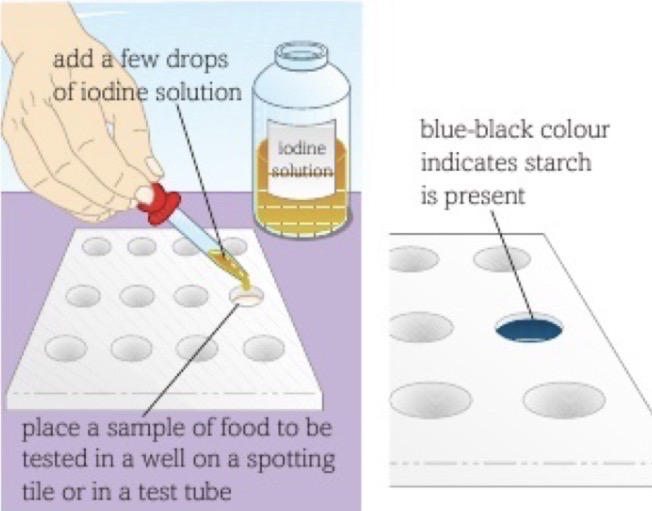
279
What colour change happens if test in positive for starch?
yellow-brown to blue-black
280
What causes colour change in starch test?
iodine forms triiodide ion (I3 -) when dissolved in potasium iodide which slips into middle of amylose helix
281
What do reducing sugars include?
monosaccharides and some disaccarides
282
Why are reducing sugars called reducing sugars?
can reduce/ give elctrons to other molecules
283
What do you add to test for reducing sugars?
benedicts solution
284
What is benedicts solution?
alkaline copper (II) sulfate
285
What is the colour change while testing for reducing sugars?
blue to green to yellow to orange-red
286
Why does the reducing sugar test change colour?
-Cu 2+ ion in benedicts solution reduced to Cu+ ions forming orange-red copper (I) oxide (Cu2O)
-this is a precipitate that is then suspended in mixture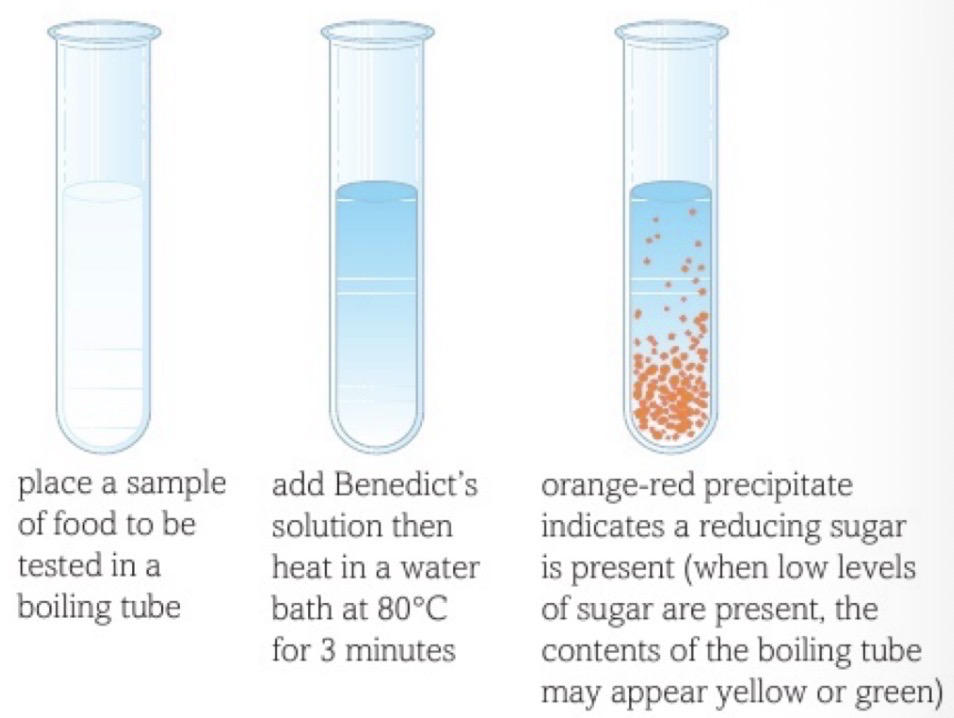
-this is a precipitate that is then suspended in mixture
287
What comditions do you test for reducing sugars in?
80C for 3 min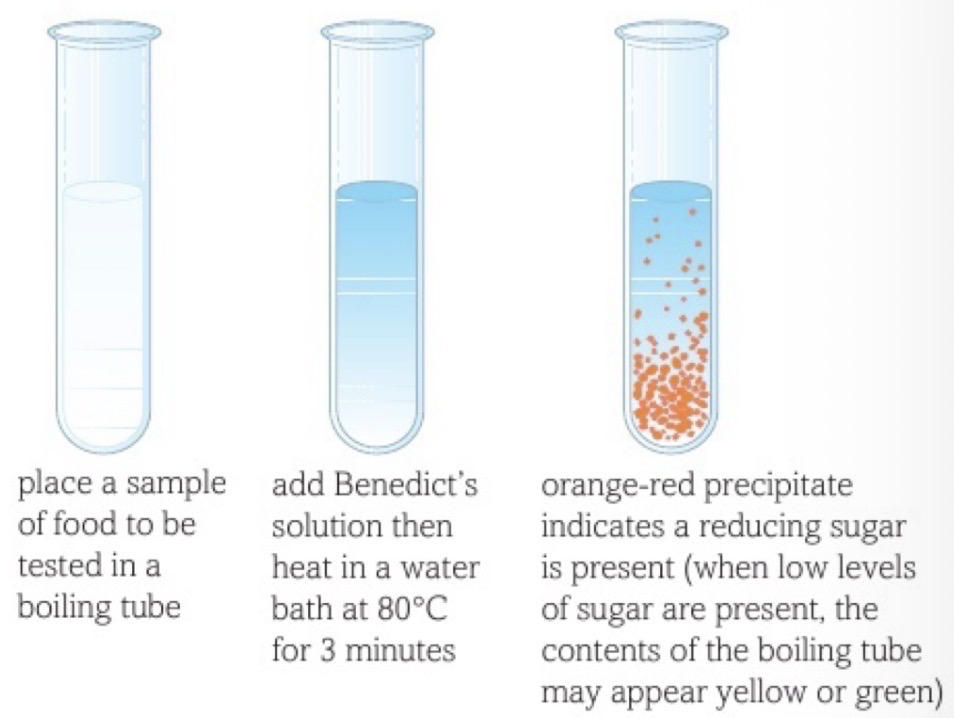
288
If benedicts solution is used in excess, the intensity of the red is proportional to what?
concentration of sugar
289
What else other than benedicts solution can be used to test for reducing sugars?
comercially manufactured test strips
290
What are commercially manufactured test strips for reducing sugars often used for?
testing glucose in urine of diabetic person
291
What do you have to do first before testing for non-reducing sugars?
hydrolyse the bond to ‘free up’ reducing groups
292
How do you test for non-reducing sugars?
-test for reducing sugars to ensure none are there
-take seperate sample and boil with hydrochloric acid to hydrolyse sucrose into glucose and fructose
-cool solutiom and use sodium hydrogencarbonate solution to neutralise
-test for reducing sugars
-take seperate sample and boil with hydrochloric acid to hydrolyse sucrose into glucose and fructose
-cool solutiom and use sodium hydrogencarbonate solution to neutralise
-test for reducing sugars
293
If first sample positive for reducing sugars, what can you do with second sample to see if theres also non reducing sugars?
-equal sized second sample tested for non reducing sugars will form precipitate with more mass than first sample
-check this by filtering precipitate
-check this by filtering precipitate
294
How do you test for lipids?
-mix sample thoroughly with ethanol
-filter
-pour solution into water in clean test tube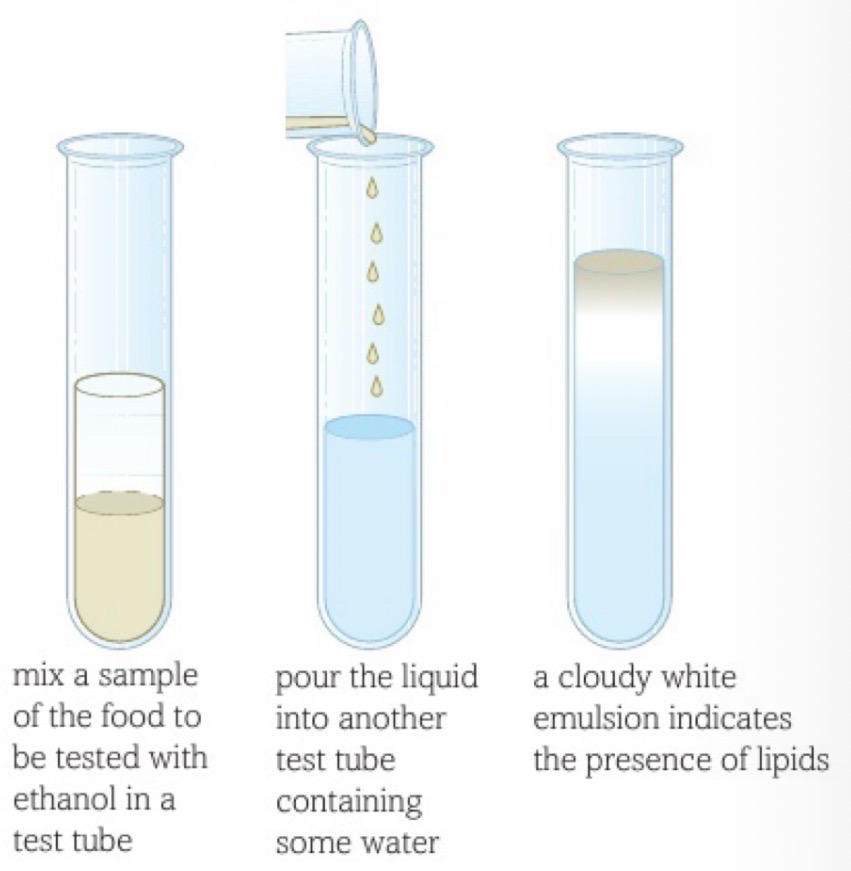
-filter
-pour solution into water in clean test tube
295
What is the positive result when testing for lipids and how is it caused?
cloudy white emulsion made of lipid droplets that come out if solution when mixed with water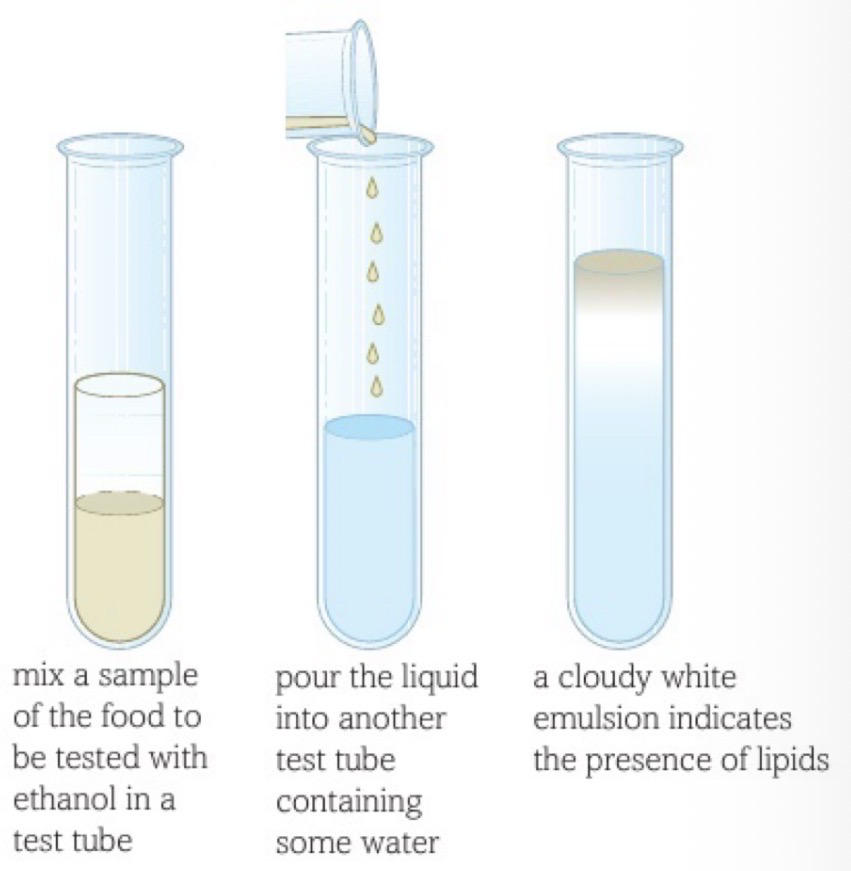
296
Why does the emulsion lipid test work?
lipids are soluble in alcohol and not water
297
What is the colour change in positive protein test?
light blue to lilac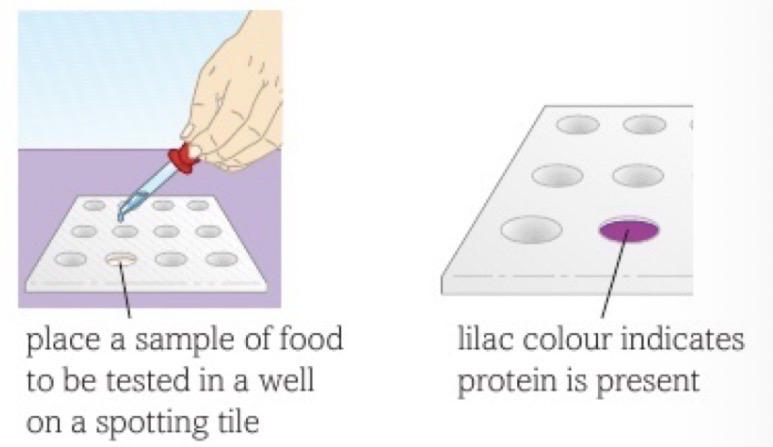
298
What are the seperate reagents used to test for proteins? What prder are they added in?
biuret A then biuret B
299
What is biuret A?
sodium hydroxide
300
What is biuret B?
copper sulfate
31 more cards in OutLearn. Open the full deck