4.13 Alkenes ✓
Study these flashcardsFree · spaced repetition · iPhone, Android, Mac & web
All cards
1
Are alkenes saturated?
no
2
What is the general formula for alkenes with one carbon double bond?
$C_nH_{2n}$
3
How many electrons from a double bonded carbon are involved in a sigma bond?
3 (1 in double bond, 2 in single bonds)
4
What is a pi bond formed from?
sideway overlap of 2 p orbitals
5
Where is pi electron density concentrated?
above and below line that joins nuclei of bonding atoms
6
Why dont alkenes rotate like alkanes?
pi bonds lock 2 carbon atoms in position
7
Why is the shape around a carbon atom in double bond trigonal planar?
3 regions of electron density around C which repel eachother as far as possible (120 bond angle) and all atoms in same plane
8
What are stereoisomers?
have same structural formula but different arrangement of atoms in space
9
What is E/Z isomerism?
only occurs in compounds with C=C
10
What is optical isomerism?
occurs in wider range of compounds (including alkanes without functional groups)
11
Why does stereoisomerism happen with double bonds?
rotation around double bond is restricted so groups attached to each C fixed relative to each other
12
Why are C=C rigid?
position of pi bonds electron density above and below sigma bond
13
Which 2 conditions must a molecule satisfy to be an E/Z isomer?
-C=C
-different groups attached to each C of double bond
-different groups attached to each C of double bond
14
Can but-1-ene form E/Z isomers? Why?
no as one side only has H and no groups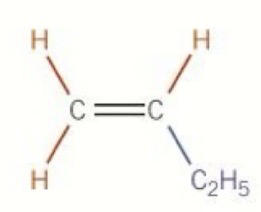
15
What type of isomerism is cis-trans isomerism?
E/Z isomerism
16
What are the comditions for cis-trans isomerism?
-same as other E/Z isomerism
-one of attached groups on each C must be H
-one of attached groups on each C must be H
17
Which isomer is cis isomer?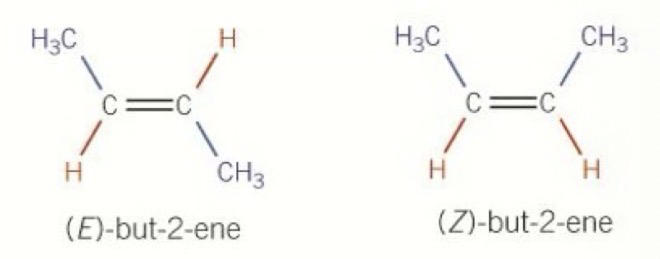
H atoms on same side of molecule
18
Which isomer is trans isomer?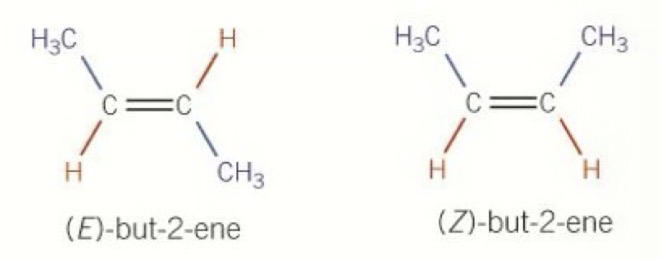
H atoms on diagonally opposite sides
19
Is cis isomer E or Z?
Z
20
Is trans isomer E or Z?
E
21
What is priority based on in Cahn-Ingold-Prelog rules?
atomic number
22
If the atomic number is higher what is its priority according to Cahn-Ingold-Prelog rules?
higher priority
23
Is it an E or Z isomer if groups of higher priority are on the same side?
Z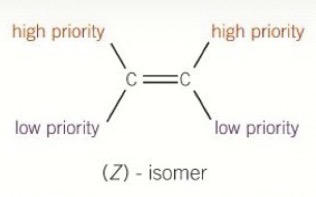
24
Is it an E or Z isomer if groups of higher priority are placed diagonally?
E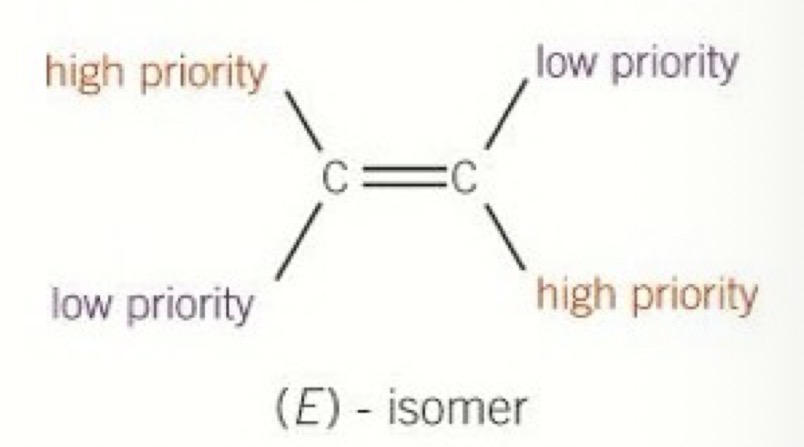
25
How do you decide whether an isomer is E or Z if atoms attached to carbon in double bond are the same?
next point of difference where one group has higher priority
26
Why do pi bonds make alkenes more reactive than alkanes?
-pi bonds are on outside of double bond so pi electrons more exposed than sigma bond electrons
-so pi bonds readily break
-so pi bonds readily break
27
What is it called when hydrogen is mixed with alkene?
hydrogenation
28
What are the conditions required for hydrogenation?
nickel catalyst at 423 K
29
What is the product of hydrogenation with an alkene?
alkane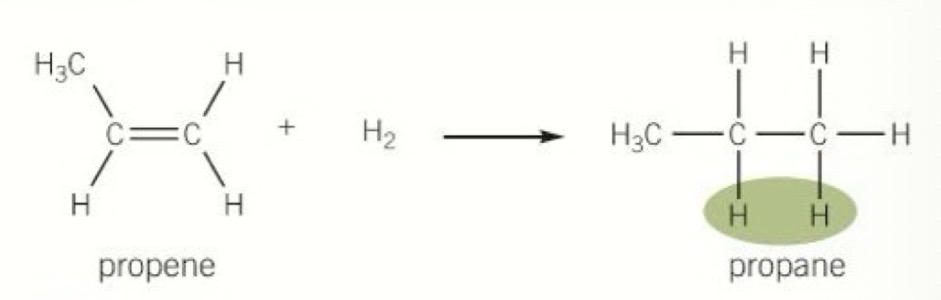
30
What is it called when alkenes react with chlorine or bromine?
halogenation
31
At what temperature does halogenation happen?
room temp
32
What is an addition reaction?
reaction where element/ group added to alkene where C=C bond is
33
What tests for an alkene?
bromine water
34
How does bromine water work as a test for alkenes?
-bromine water is orange
-when added to alkene bromine adds across double bomd
-orange disappears indicating presence of C=C bond
-when added to alkene bromine adds across double bomd
-orange disappears indicating presence of C=C bond
35
What does a reaction between alkene and hydrogen halide produce?
haloalkane
36
At what temperature do hydrogen halides react with alkenes?
room temp
37
How do alkene and hydrogen halide react when alkene is a gas?
2 gases mixed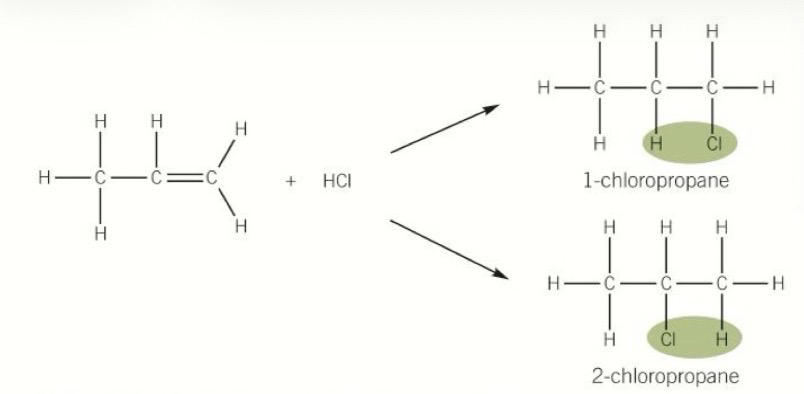
38
How do alkene and hydrogen halide react when alkene is a liquid?
hydrogen halide bubbled through alkene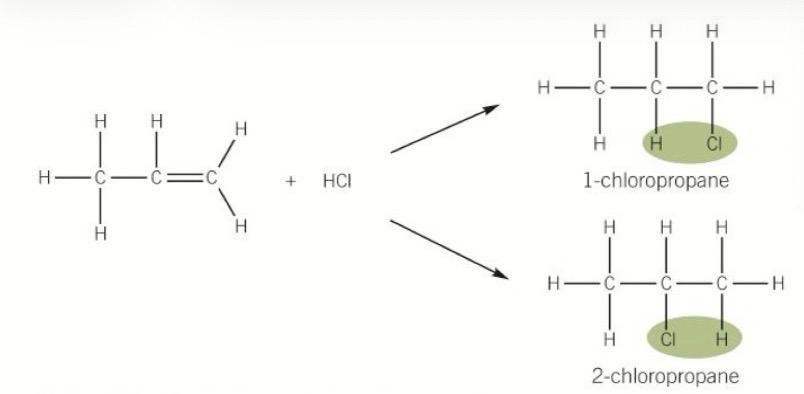
39
What is a hydration reaction of an alkene?
alkenes reacting with steam
40
What is produced in hydration reaction of alkenes?
alcohol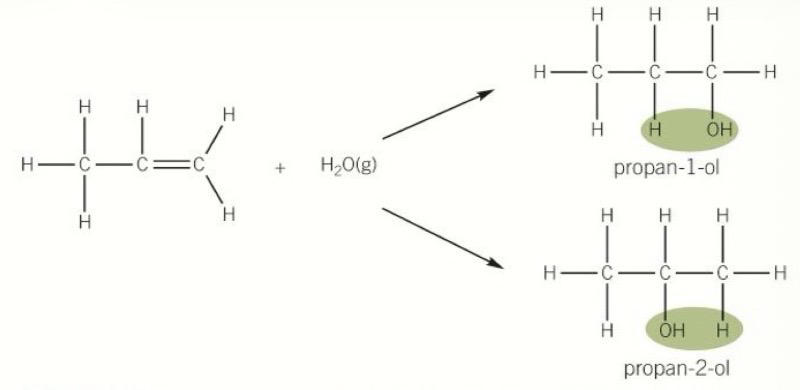
41
What condition is needed for hydration reaction of alkenes?
phosphoric acid catalyst (H3PO4)
42
What is the mechanism for alkene addition reactions called?
electrophillic addition
43
What is an electrophile?
atom/ group of atoms thats attracted to electron rich centre and accepts an electron pair
44
Why do C=C bonds attract electrophiles?
region of high electron density due to pi electrons
45
What is an electrophile usually?
positive ion or atom with partially positive charge
46
Explain the mechanism of electrophillic addition with hydrogen halide
1) halide is more electronegative than H so hydrogen halide is polar and contains dipole
2) pi electron pair attracted to partially positive H causing double bond to break
3) bond forms between hydrogen and carbon from double bond
4) hydrogen halide bond breaks by heterolytic fission and electron pair goes to halogen
5) halide ion (-) and carbocation formed (+)
6) halide ion reacts with carbocation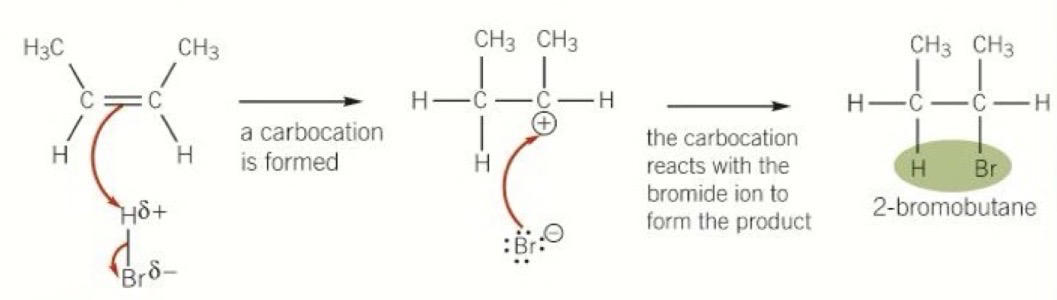
2) pi electron pair attracted to partially positive H causing double bond to break
3) bond forms between hydrogen and carbon from double bond
4) hydrogen halide bond breaks by heterolytic fission and electron pair goes to halogen
5) halide ion (-) and carbocation formed (+)
6) halide ion reacts with carbocation
47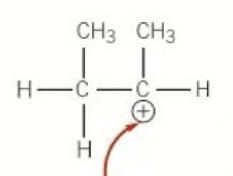
What is a carbocation?
48
Explain the mechanism of electrophillic addition with halogens
1) pi electrons interact with electrons in halogen bond (eg Br-Br)
2) halogen bond causes polarisation in the halogen resulting in induced dipoles
3) electron pair in pi bond attracted to partially positive halogen, breakinb double bond
4) bomd formed between carbom and halogen
5) halogen bond breaks by heterolytic fission with electron pair going to partially negative halogen atom
6) halogen ion and carbocation formed
7) negative halogen reacts with carbocation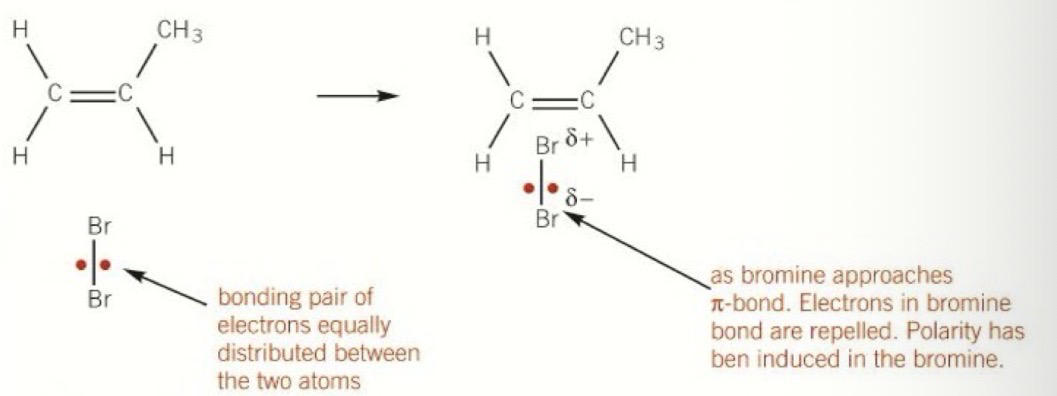
2) halogen bond causes polarisation in the halogen resulting in induced dipoles
3) electron pair in pi bond attracted to partially positive halogen, breakinb double bond
4) bomd formed between carbom and halogen
5) halogen bond breaks by heterolytic fission with electron pair going to partially negative halogen atom
6) halogen ion and carbocation formed
7) negative halogen reacts with carbocation
49
How do you know which way around hydrogen and a halogen attach in an addition reaction?
hydrogen attaches to carbon atom with greatest number of H and smallest number of C
50
Where is the positive charge in a primary carbocation of propene?
positive charge on C at end of chain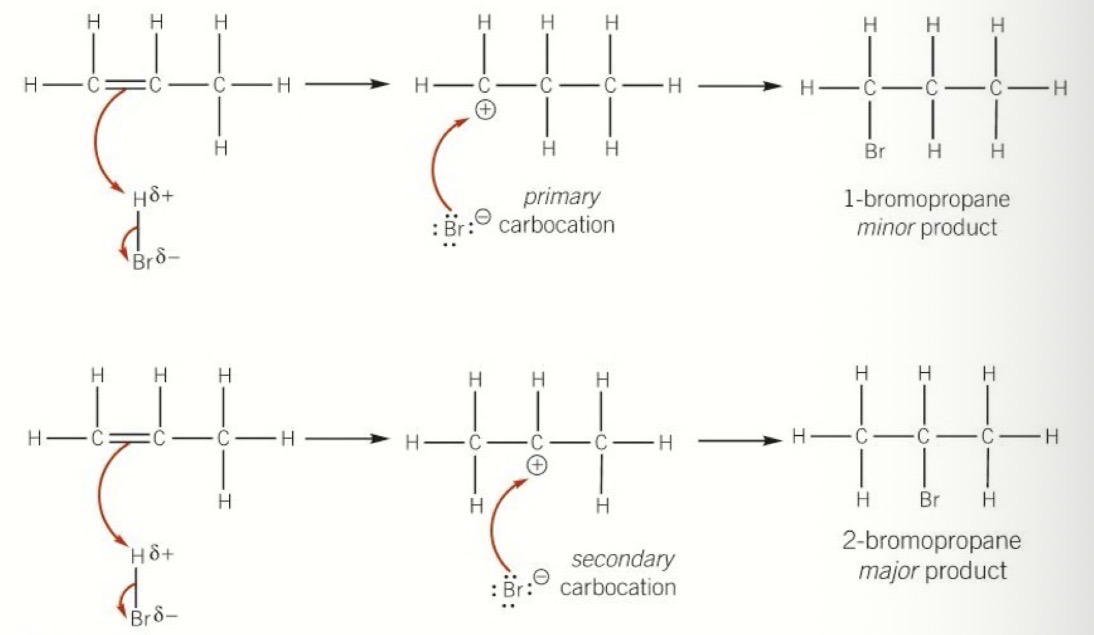
51
What is the positive charge in a secondary carbocation of propene?
positive charge on carbon with 2 C chains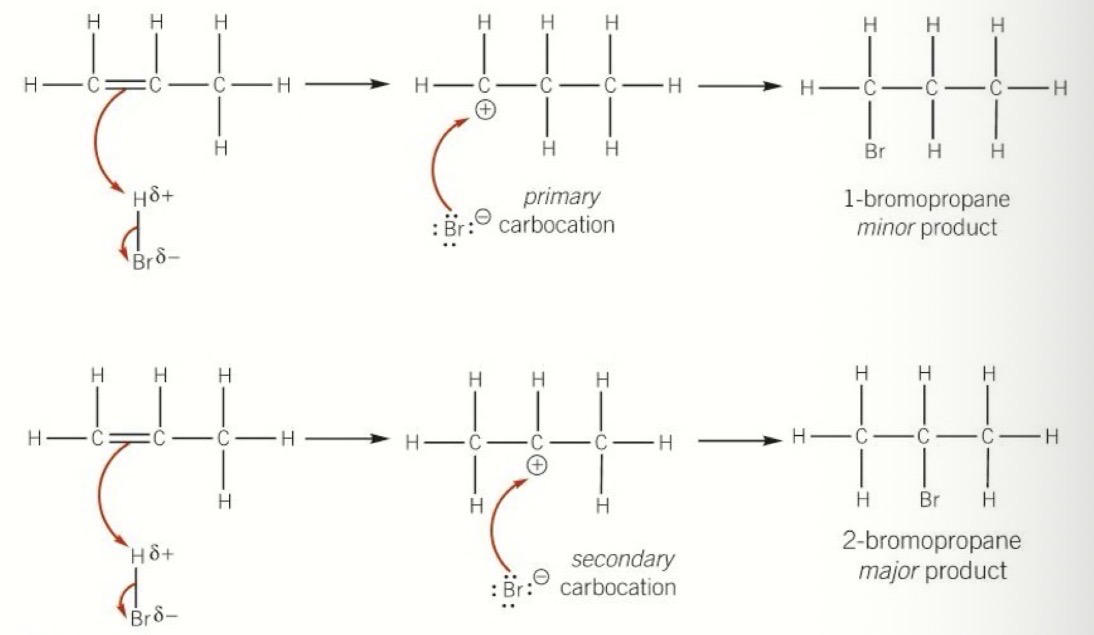
52
Whats the difference between a major amd minor product?
major is majoraty of product
minor is minority or product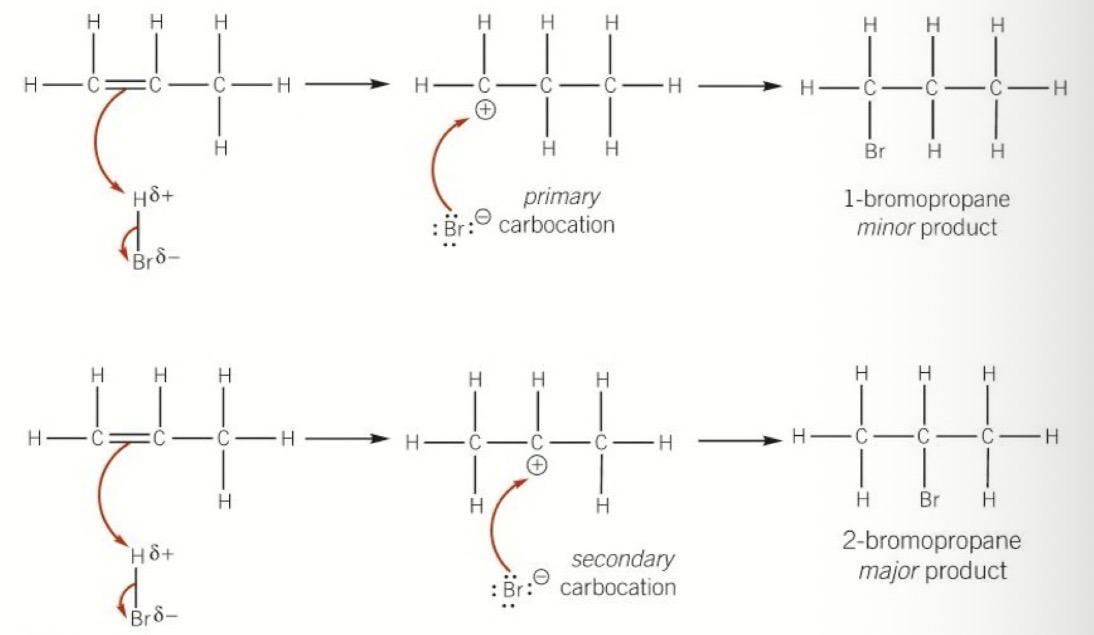
minor is minority or product
53
What is an alkyl group usually represented by?
-R
54
What is the order of stability of carbocations from most to least?
tertiary, secondary, primary
55
What is a tertiary carbocation?
carbocation with 3 alkyl groups attached to positively charged carbon
56
What is a secondary carbocation?
carbocation with 2 alkyl groups attached to positively charged carbon
57
What is a primary carbocation
carbocation with 1 alkyl groups attached to positively charged carbon
58
Why is stability of carbocations linked to electron donating ability of alkyl groups?
-each alkyl group donates and pushes electrons towards positive charge of carbocation
-positive charge spread over alkyl groups so more alkyl groups attached means more charge spread out so more stable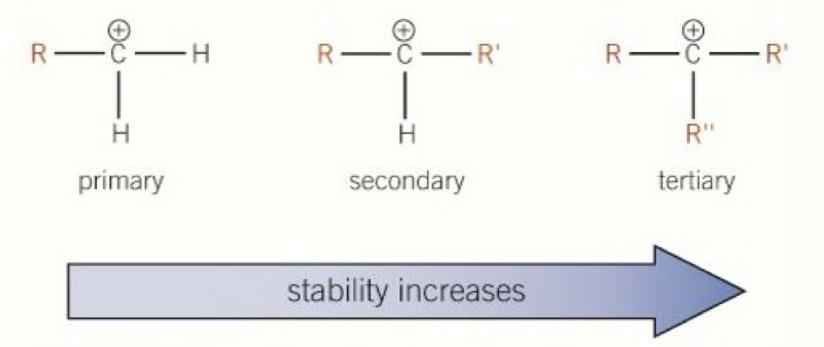
-positive charge spread over alkyl groups so more alkyl groups attached means more charge spread out so more stable
59
Do alkenes or alkanes undergo addition polymerisation?
aklenes
60
What do properties of a polymer depend on?
monomer used
61
Do addition polymers have high or low molecular masses?
high
62
How are synthetic polymers usually named?
poly(monomer)
63
What is a repeat unit?
specific arrangement of atoms repeated (monomer) in polymer
64
How is poly(ethene) made?
How is poly(ethene) made?
heat large number of ethene monomers at high pressure
65
What are common uses of poly(ethene)?
-supermaket bags
-shampoo bottles
-children’s toys
-shampoo bottles
-children’s toys
66
What is poly(chloroethene) also known as?
poly(vinyl chloride)/ PVC
67
Can PVC be flexible or rigid?
both
68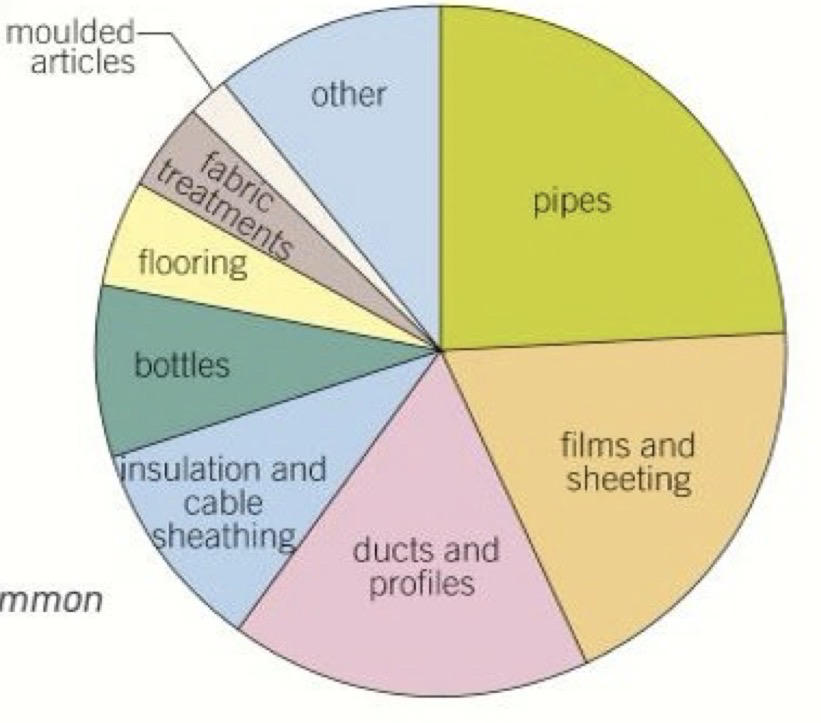
What are examples of what PVC is used for?
69
What are examples of what poly(propene) can be used for?
-children’s toys
-packing crates
-guttering
-uPVC windows
-fibre for ropes
-packing crates
-guttering
-uPVC windows
-fibre for ropes
70
What is another name for poly(phenylethene)?
poly(styrene)
71
What are examples of what poly(phenylethene) can be used for?
-packing material
-food trays
-cups
-food trays
-cups
72
What is a property of poly(styrene)?
thermally insulating
73
What are examples of what poly(tretrafluroethene) can be used for?
-coating for non-stick pans
-permeable membrane for clothing and shoes
-cable insulation
-permeable membrane for clothing and shoes
-cable insulation
74
What is a benfit of a polymer’s lack of reactivity?
suitable for storing food/ chemicals
75
What is a disadvantage of a polymer’s lack of reactivity?
challenging to dispose
76
Are alkene-based polymers usually biodegradable?
no
77
What are the benefits of recycling polymers?
-conserves finite fossil fuels
-decreases waste in landfill
-decreases waste in landfill
78
What happens if polymers are mixed during recycling?
product unusable
79
How are polymers recycled once sorted?
-chopped into flakes
-washed
-dried
-melted
-cut into pellets to be used tonmake new products
-washed
-dried
-melted
-cut into pellets to be used tonmake new products
80
Why is disposal/ recycling of PVC hazardous?
high chlorine content and additives
-not sustainable in landfill
-when burnt release hydrogen chloride (corrosive gas) and other pollutants
-not sustainable in landfill
-when burnt release hydrogen chloride (corrosive gas) and other pollutants
81
How does new technology solve disposal issues with PVC?
-solvents dissolve polymer
-high grade PVC recovered by precipitation from solvent
-solvent used again
-high grade PVC recovered by precipitation from solvent
-solvent used again
82
How are waste polymers used for fuel?
incinerated to produces heat, generating steam to drive a turbine to generate electricity
83
What is feedstock recycling?
chemical + thermal processes reclaiming monomers, gases or oil from waste polymers which can be used to produce new polymers
84
What is an advantage of feedstock recycling?
handles unsorted, unwashed polymers
85
What are bioplastics produced from?
plant starch, cellulose, plant oils, proteins
86
What are the benefits of bioplastics?
protects environment and finite fossil fuel source
87
How are biodegradable polymers broken down?
by microorganisms into water, CO2 and biological compounds
88
What are biodegradable polymers usually made from?
starch/ cellulose or contain additives
89
What do additives in biodegradable polymers do?
alter structure of traditiomal polymer so microorgansim can break them down
90
Do compostable polymers leave visible toxic residues?
no
91
What are photodegradable polymers?
have bonds that are weakened by absorbing light or light-absorbing additives used to start degradation