3.1 Exchange Surfaces and Breathing ✓
Study these flashcardsFree · spaced repetition · iPhone, Android, Mac & web
All cards
1
What are the 3 main factors affecting need for an exchange system?
-size
-SA:V
-level of activity
-SA:V
-level of activity
2
How does size affect the need for an exchange system?
Very small organisms: short diffusion pathway (cytoplasm close to environment so diffusion supply enough O and nutrients)
Large multicellular organism: long diffusion pathway (several layers of cells so diffusion can't provide O and nutrients for innermost cells sufficiently)
Large multicellular organism: long diffusion pathway (several layers of cells so diffusion can't provide O and nutrients for innermost cells sufficiently)
3
How does SA:V affect the need for an exchange system?
Very small organisms: large SA:V so SA used as exchange surface
Large multicellular organism: small SA:V so SA not large enough to be used as an exchange surface
Large multicellular organism: small SA:V so SA not large enough to be used as an exchange surface
4
How does level of activity affect the need for an exchange system?
Some organisms have higher metabolic activity than others which need more O and nutrients (especially mammals which also keep themselves warm)
5
What are the features of a good exchange surface?
-large SA for more space for molecules to pass through (often achieved by folded membrane)
-thin, permeable (to substances exchanged) barrier to reduce diffusion distance
-good blood supply: steep concentration gradient for rapid diffusion (fresh molecule supply at supply side keeping high concentration gradient or remove molecules from demand side to keep concentration low)
-thin, permeable (to substances exchanged) barrier to reduce diffusion distance
-good blood supply: steep concentration gradient for rapid diffusion (fresh molecule supply at supply side keeping high concentration gradient or remove molecules from demand side to keep concentration low)
6
What are alveoli?
tiny folds of lung epithelium to increase SA
7
What are the intercostal muscles?
muscles between ribs
8
What is ventilation?
refreshing air in lungs so higher O concentration than in blood and lower CO2 concentration
9
Flowchart for movement of air into lungs
nasal passage/ mouth cavity -> trachea -> bronchi -> bronchioles -> alveoli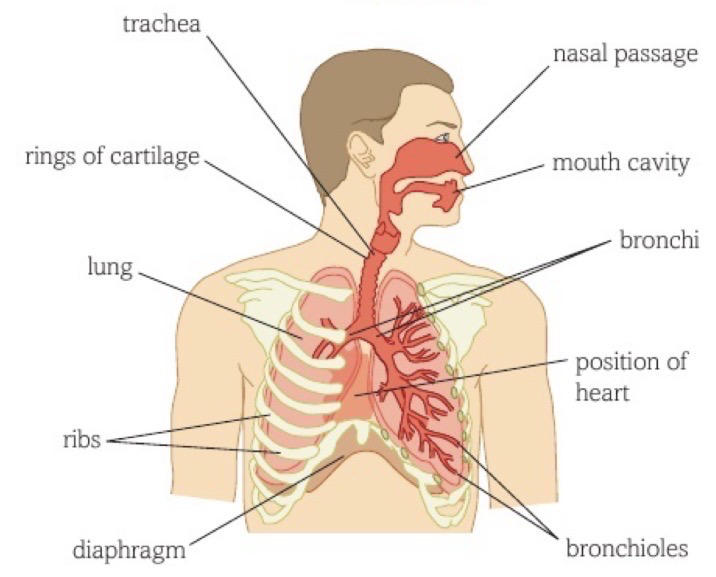
10
What are the lungs protected by?
ribcage
11
What is the diaphragm?
layer of muscle beneath lungs
12
What does the action of intercostal muscles and diaphragm produce?
breathing movements/ ventilation
13
What increases the surface area of the lungs?
alveoli
14
Why is the internal surface of the alveoli lined thinly with moisture?
to reduce cohesive forces between water molecules which otherwise collapse alveoli
15
Why can oxygen and carbon dioxide diffuse through alveolus wall and capillary wall?
small and non polar
16
How thick is the alveolus wall?
1 cell
17
How thick is the capillary wall?
1 cell
18
Which adaptations are there to reduce distance gases have to diffuse in lungs?
-thin alveolus and capillary wall
-both walls consist of squamous cells
-capillaries in close contact with alveolus wall
-capillaries narrow so red blood cell squeezed against capillary wall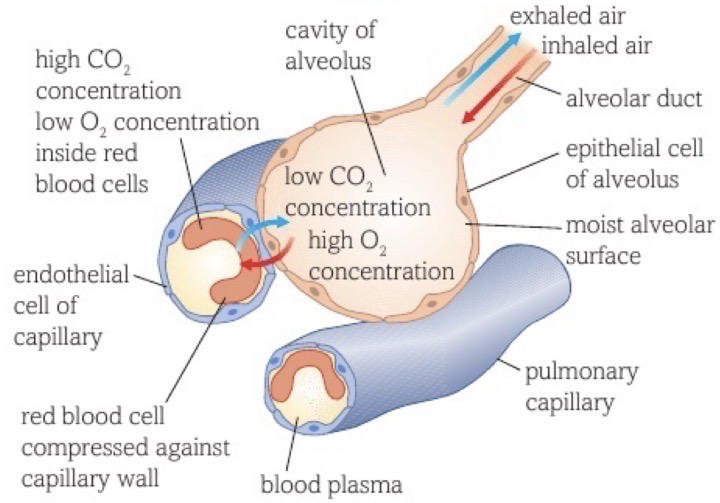
-both walls consist of squamous cells
-capillaries in close contact with alveolus wall
-capillaries narrow so red blood cell squeezed against capillary wall
19
What is a squamous cell?
flattened/ very thin cell
20
Why is it beneficial for the red blood cells to be squeezed against capillary wall?
closer to air and reduces rate of flow
21
What happens to the diaphragm during inspiration?
contracts to move down + flatten, displacing digestive organs downwards
22
What happens to the diaphragm during expiration?
relaxes and pushed up by displaced organs beneath
23
What happens to external intercostal muscles during inspiration?
contract to raise ribs
24
What happens to external intercostal muscles during expiration?
relax and ribs fall
25
What happens when internal intercostal muscles contract?
push air out more forcefully (eg sneeze)
26
What happens to volume of chest cavity during inspiration?
increases
27
What happens to volume of chest cavity during expiration?
decreases
28
What happens to pressure in chest cavity during inspiration?
drops below atmospheric pressure
29
What happens to pressure in chest cavity during expiration?
rises above pressure in surrounding atmosphere
30
What is cartillage?
form of connective tissue
31
What is the ciliated epithelium?
layer of cells that have hair like extensions called cilia
32
What are elastic fibres?
protein fibres that can deform and recoil to original size
33
What is a goblet cell?
cell that secretes mucus
34
What is smooth muscle?
involuntary muscle contracting without need for conscious thought
35
What are alveoli comprised of?
squamous epithelium
36
Which requirements must airways meet to be effective?
-large enough to allow air flow without obstruction
-supported to prevent collapse when low pressure
-felxible for movement
-supported to prevent collapse when low pressure
-felxible for movement
37
What are airways lined with?
ciliated epithelium
38
What do goblet cells in the epithelium of airways do?
release mucus to trap pathogens
39
What do the cilia do with mucus in airways?
move mucus to top of airway where it is swallowed
40
What are airways supported by?
rings of cartilage
41
What shape are rings of cartilage in trachea and why?
C-shaped to allow flexibility and space for food travelling down oesophagus
42
Do all bronchioles have same amount of cartilage?
no, larger ones have some but smaller ones dont
43
What are the walls of the bronchioles mostly comprised of?
smooth muscle and elastic fibres
44
What happens when smooth muscle in airpipes contracts?
constricts airway making lumen of airway narrower and restricting airflow
45
What might cause airflow in airways be restricted?
if harmful substances in the air or allergic reaction
46
How is the effect of the smooth muscle contracting reversed?
smooth muscle elongated by elastic fibres recoiling
47
What is breathing rate?
number of breaths per min
48
What is oxygen uptake?
volume of oxygen absorbed by lungs in one min
49
What is tidal volume?
volume of air inhaled/ exhaled in one breath 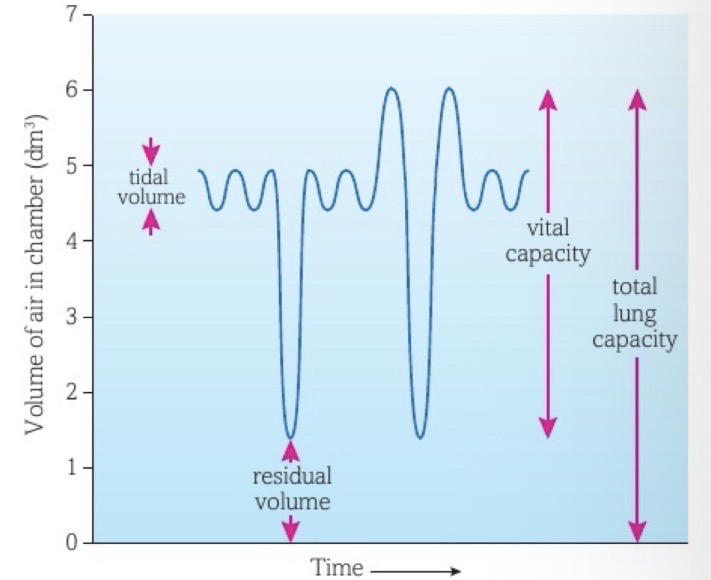
50
When is tidal volume usually measured?
at rest
51
What is a spirometer?
device that measures movement of air in and out of lungs
52
What is vital capacity?
greatest volume of air that can be expelled from lungs after taking deepest possible breath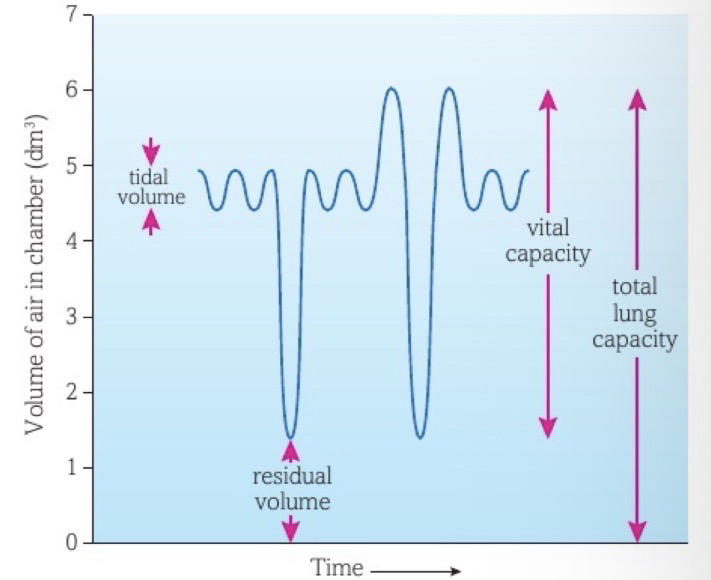
53
How does a float-chamber spirometer work?
chamber of air/ medical grade oxygen floating on tank of water where...
-inspiration: air drawn from chamber so lid moves down
-expiration: air returns to chamber raising lid
Lid movement measured on datalogger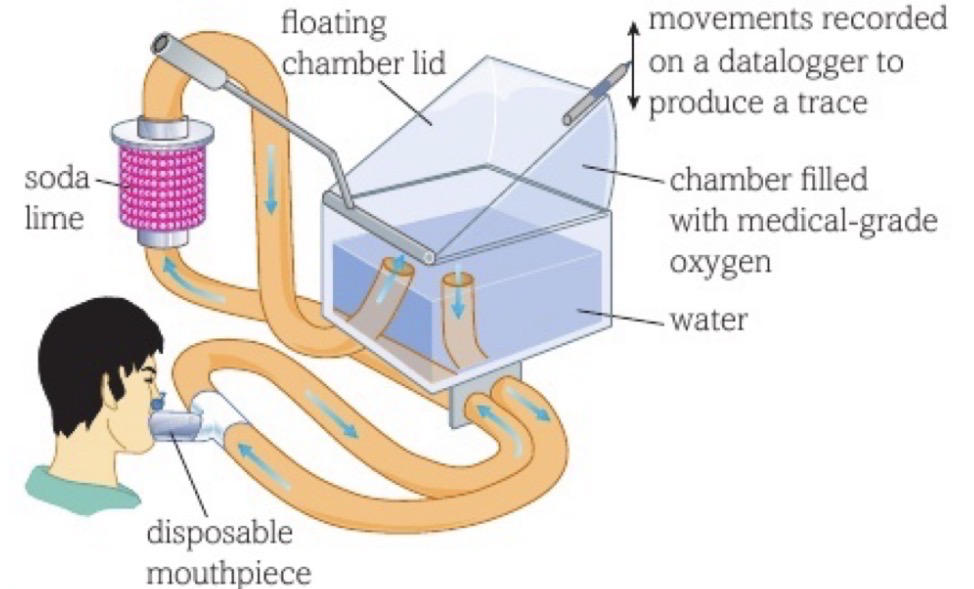
-inspiration: air drawn from chamber so lid moves down
-expiration: air returns to chamber raising lid
Lid movement measured on datalogger
54
What happens to CO2 rich air exhaled when using spirometer? Why?
passes through chamber of soda lime where CO2 absorbed to allow measurement of oxygen consumption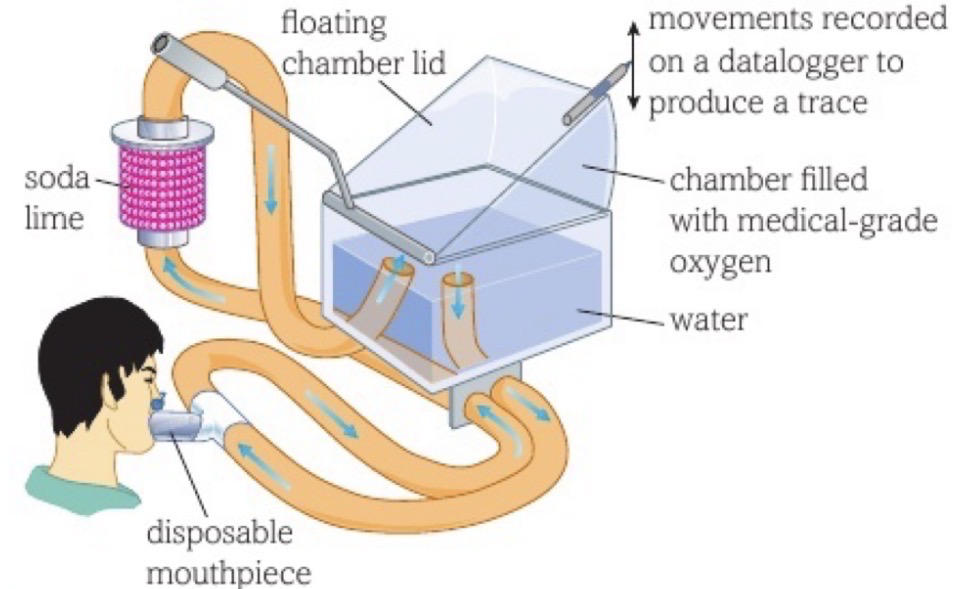
55
What precautions must be taken whilst using a spirometer? (5)
-subject should be healthy (in particular not have asthma)
-soda lime fresh and functioning
-no air leaks
-mouthpiece sterilised
-water chamber not overfilled
-soda lime fresh and functioning
-no air leaks
-mouthpiece sterilised
-water chamber not overfilled
56
Why must there be no air leaks in aspirometer?
would lead to inaccurate results
57
Why must water chamber not be overfilled in spirometer?
water may enter air tubes
58
What can't modern small hand-held spirometers measure?
rate of oxygen consumption
59
What does lung volume consist of?
vital capacity + residual volume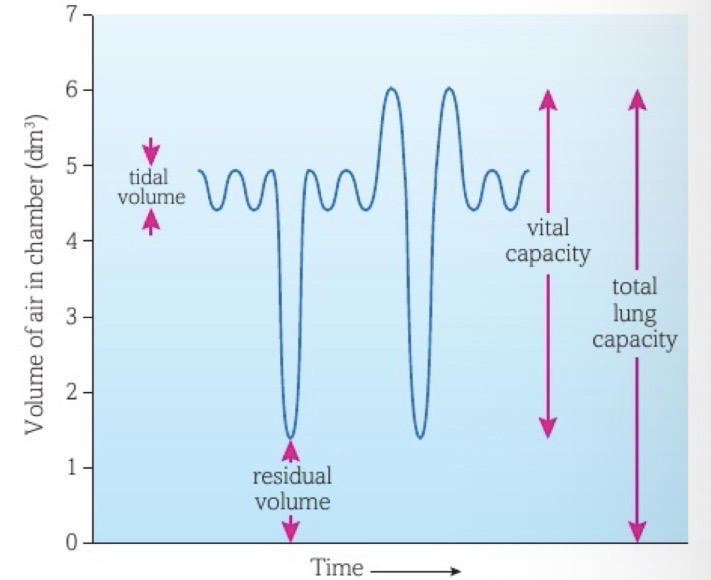
60
What does vital capacity depend on?
-size of person
-age and gender
-level of regular exercise
-age and gender
-level of regular exercise
61
What is normal vital capacity?
2.5-5dm3
62
Is vital capacity usually higher or lower in atheletes?
higher
63
What is a normal tidal volume?
0.5dm3
64
How do you work out oxygen uptake?
-CO2 absorbed by lime water causes overall decrease in volume of air chamber in spirometer
-measure gradient of decrease in volume on trace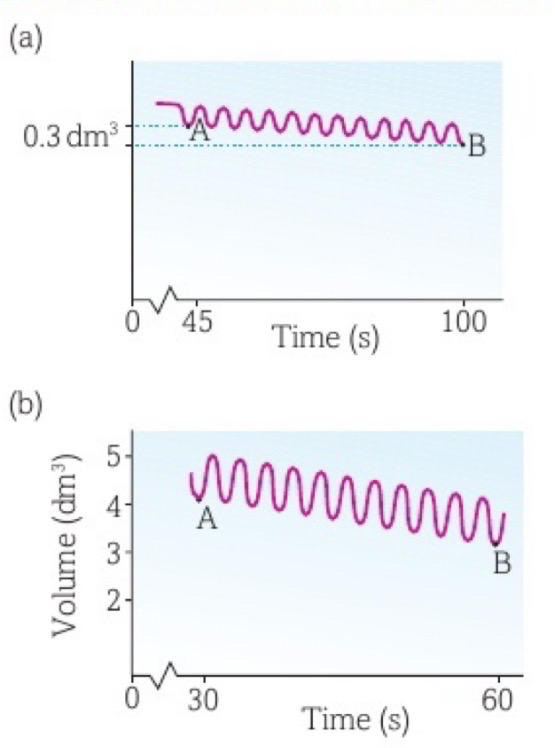
-measure gradient of decrease in volume on trace
65
What assumption do you make when working out oxygen uptake?
carbon dioxide exhaled= oxygen inhaled
66
How do you work out breathing rate from spirometer trace?
count number of peaks in each minute
67
What is breathing rate usually at rest?
12-14 breaths per min
68
How does increased demand for oxygen affect oxygen uptake?
increase
69
What 2 things increases oxygen uptake?
-increased breathing rate
-deeper breaths
-deeper breaths
70
What is the buccal cavity?
mouth
71
What is countercurrent flow?
where 2 fluids move in opposite directions
72
What are gill filaments?
slender branches of tissue making up gill
73
What are gill filaments also called?
primary lamellae
74
What are secondary lamallae also called?
gill plates
75
What are secondary lamallae?
folds of primary lamallae to increase SA
76
What is the operculum?
bony flap that covers and protects gills
77
What is a spiracle?
external opening/ pore that allows air in/ out tracheae
78
What is tracheal fluid?
fluid found at the ends of tracheoles in tracheal system
79
What is the tracheal system?
system of air-filled tubes in insects
80
How many pairs of gills do most bony fish have?
5
81
How many rows of gill filaments does each gill consist of?
2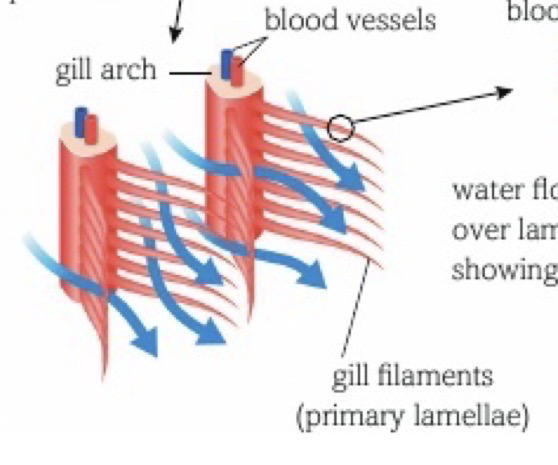
82
Blood flows in ________ direction to flow of water over lamallae
opposite
83
How does countercurrent flow ensure maximum absorbtion of oxygen in gills?
Keeps ideal concentration gradient of oxygen consistent between water and blood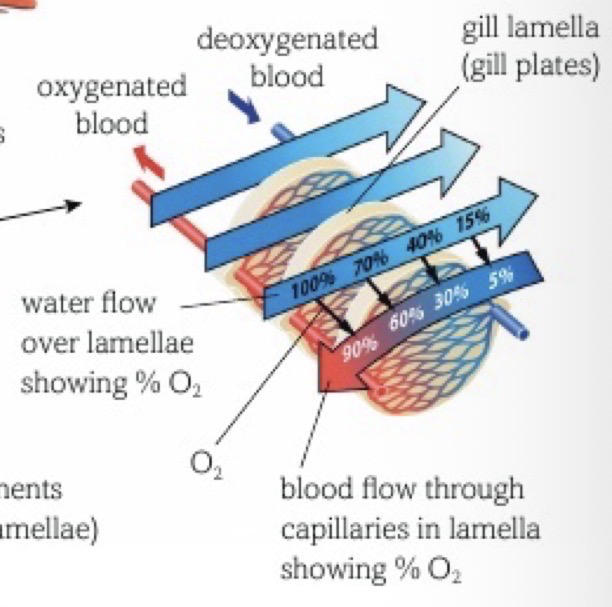
84
What is the opercular cavity?
space under operculum
85
How does a bony fish keep water flowing over gills?
buccal-opercular pump
86
How does the buccal-opercular pump work in bony fish?
-floor of mouth moves down, drawing water into buccal cavity
-mouth closes
-floor of mouth raises, pushing water through gills
-as water pushed from buccal cavity, operculum moves outwards, reducing pressure in opercular cavity helping water flow through gills
-mouth closes
-floor of mouth raises, pushing water through gills
-as water pushed from buccal cavity, operculum moves outwards, reducing pressure in opercular cavity helping water flow through gills
87
Do insects have an open or closed circulatory system?
open
88
Does an insects tracheal system supply air directly to repiring tissue?
yes
89
What does gas exchange occur between in insects?
tracheal fluid and air in tracheole (some across thin walls of tracheoles)
90
Flowchart of air going into insect
spiracle -> tracheae -> tracheoles ->tracheal fluid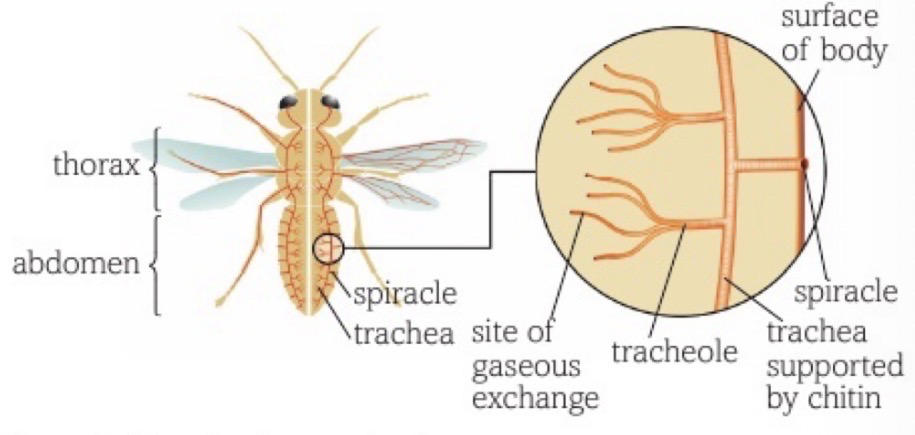
91
What are the ends of tracheoles like?
open and filled with tracheal fluid
92
What happens in an insect to cope with higher demands of oxygen?
tracheal fluid withdrawn into body fluid so SA of tracheole wall exposed to air increased so more oxygen absorbed when insect active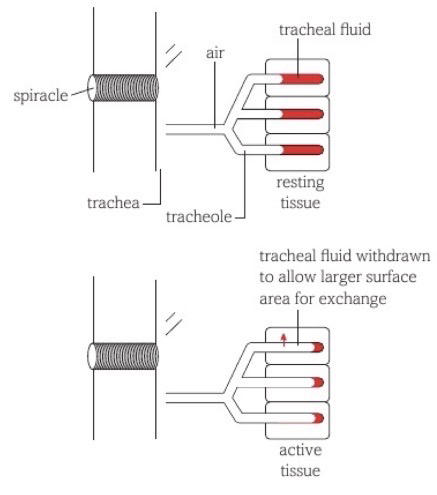
93
How does the tracheal system having flexible walls in larger insects help with ventilation?
-sections of flexible wall act as air sacs which are squeezed by action of flight muscles
-repetitive expansion and contraction causes ventilation
-repetitive expansion and contraction causes ventilation
94
How can altering thorax volume in larger insects help with ventilation?
-movement of wings alter volume of thorax
-thorax volume decreases: air in tracheal system put under pressure and pushed out
-thorax volume increases: pressure inside drops so air pushed into tracheal system
-thorax volume decreases: air in tracheal system put under pressure and pushed out
-thorax volume increases: pressure inside drops so air pushed into tracheal system
95
How can a locust ventilate its tracheal system by altering volume of abdomen?
-alter abdomen volume by specialised breathing movements
-abdomen expands: spiracles at front of body open so air enters
-abdomen volume decreases: spiracles near rear open and air leaves
-abdomen expands: spiracles at front of body open so air enters
-abdomen volume decreases: spiracles near rear open and air leaves