4.15 Haloalkanes ✓
Study these flashcardsFree · spaced repetition · iPhone, Android, Mac & web
All cards
1
What are haloalkanes?
compounds containing elements carbon, hydrogen and at least one halogen
2
Is the C-halogen bond polar?
Yes
3
What makes the carbon-halogen bond polar?
halogen more electronegative than carbon so shared electron pair closer to halogen
4
What are nucleophiles?
species that donate lone pair of electrons and is attracted to electron defficient atoms
5
What are 3 examples of nucleophiles?
6
What is hydrolysis?
chemical reaction involving water or an aqueous solution of hydroxide causing bond to break
7
What is the halogen in a haloalkane replaced by in hydrolysis?
-OH group
8
How does nucleophilic substitution work? (with OH-)
1) nucleophile OH- approaches C attached to halogen on opposite side of molecule from halogen
2) direction of attack by OH- minimises repulsion between nucleophile and partially negative halogen
3) lone pair of electrons on OH- attracted and donated to partially + C
4) new bond formed between O of OH- and C
5) product is an alcohol and halide ion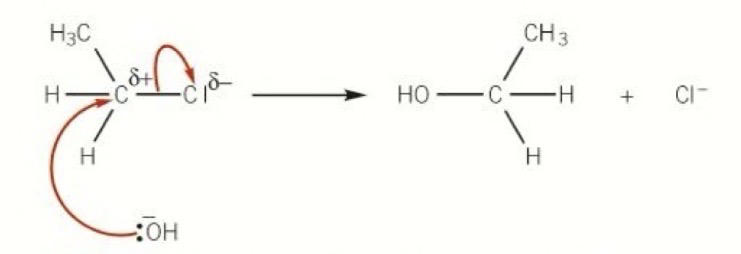
2) direction of attack by OH- minimises repulsion between nucleophile and partially negative halogen
3) lone pair of electrons on OH- attracted and donated to partially + C
4) new bond formed between O of OH- and C
5) product is an alcohol and halide ion
9
What can you add to convert a haloalkane to alcohol?
aqueous sodium hydroxide
10
Why is a haloalkane and aqueous sodium hydroxide heated during reaction?
slow at room temp so heated under reflux to obtain good yield
11
What does the rate of hydrolysis depend on?
strength of carbon-hydrogen bond
12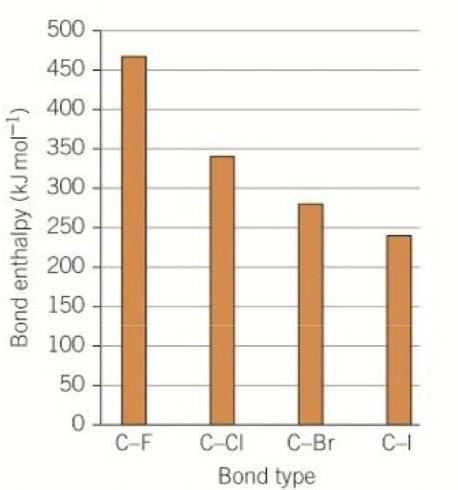
What is the trend in bond strength of C-halogen bonds?
13
Why are fluoroalkanes unreactive?
large quantity of energy required to overcome C-F
14
How can you monitor the rate of reaction between a haloalkane and water?
add aqueous silver nitrate as it will form precipitate with halide ions produced from reaction
15
Why is a reaction between a haloalkane and water carried out in the presence of an ethanol solvent?
haloalkanes are insoluble in water so ethanol allows water and haloalkane to mix and produce a single solution rather than 2
layers
layers
16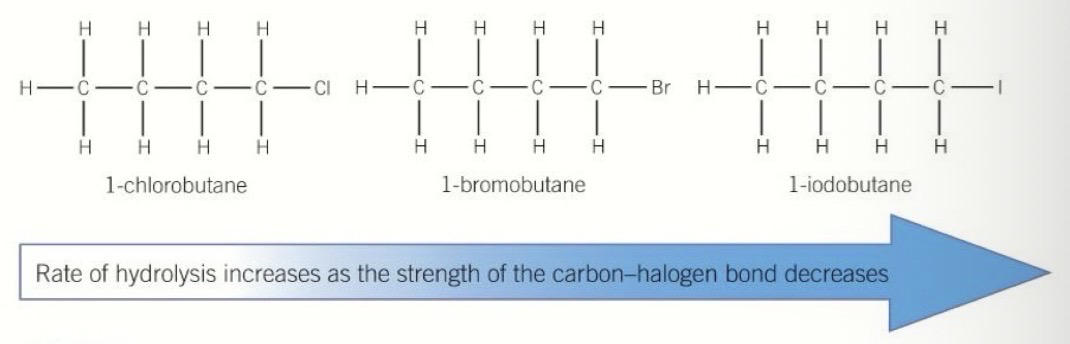
Why do different haloalkanes have different hydrolysis rates?
17
What is an organohalogen compound?
molecules containing at least one halogen atom joined to carbon chain
18
Where is the ozone layer?
outer edge of stratosphere (10km-40km above earths surface)
19
Why is the ozone layer important?
absorbs biologically damaging unltraviolet radiation (UV-B) which is linked to sunburn, genetic damage and skin cancer
20
What is the natural cycle of ozone?
1) UV breaks oxygen molecules into oxygen radicals
2) oxygen molecule + radical -> ozone
3) ozone breaks down again due to UV
rate of formation and break down of ozone is the same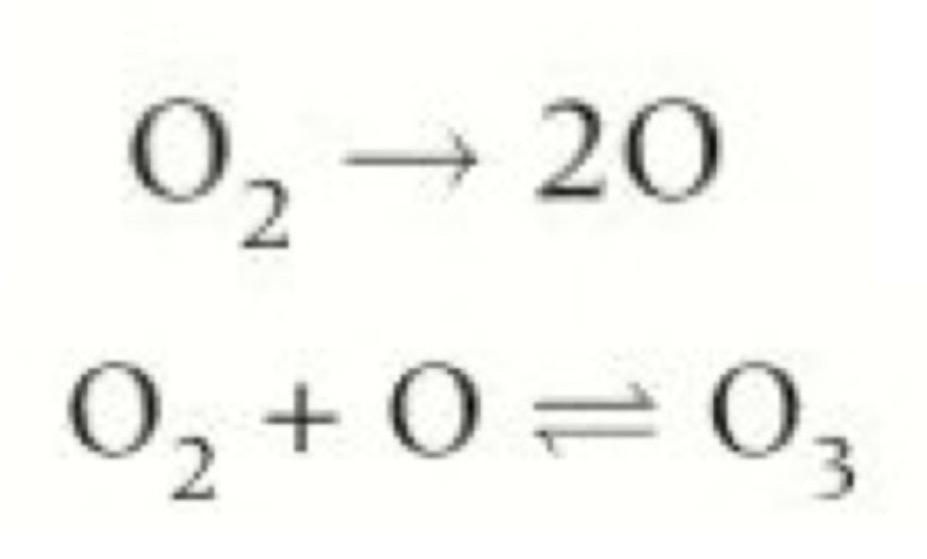
2) oxygen molecule + radical -> ozone
3) ozone breaks down again due to UV
rate of formation and break down of ozone is the same
21
Why are CFCs stable in troposphere?
strength of carbon-halogen bonds
22
Why do CFCs have long residence time in troposhere?
they are stable there
23
What happens to CFCs when they enter the stratosphere?
UV radiation provide enough energy to break carbon-halogen bond by homolytic fission forming radicals
24
What is photodissociation?
molecule breaks down after absorbing light energy (like UV)
25
How do CFCs disrupt the natural cycle of the ozone layer?
1) CFCs photodissociated into radicals
2) Cl radical formed is very reactive so reacts with ozone breaking it down into oxygen
3) process continues in a cycle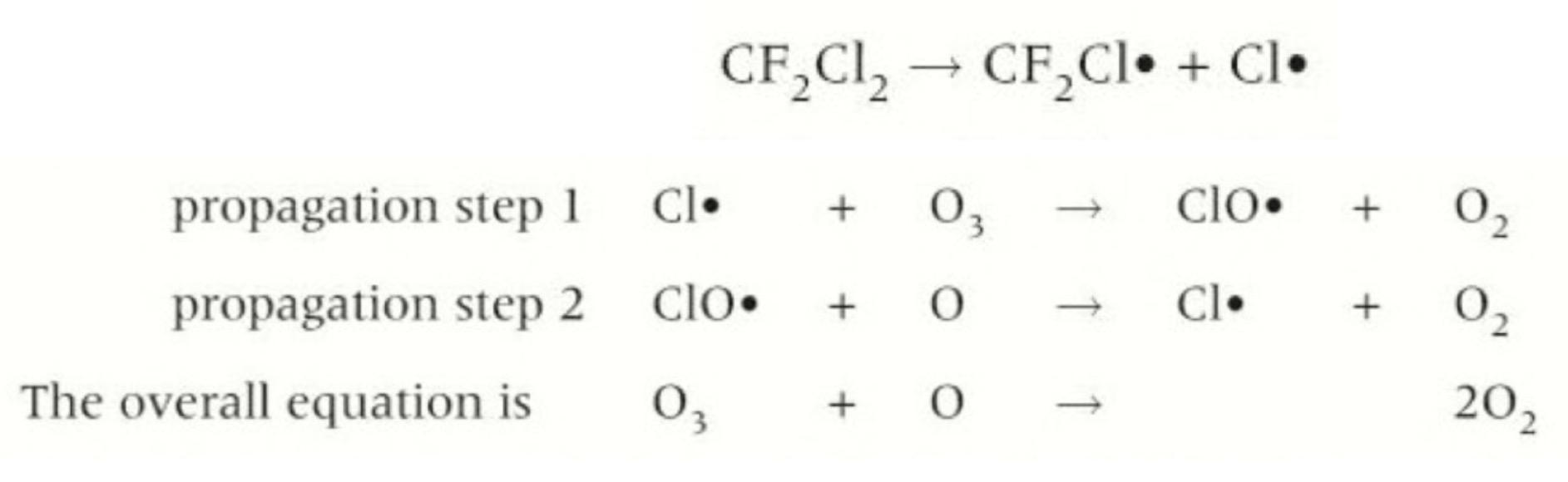
2) Cl radical formed is very reactive so reacts with ozone breaking it down into oxygen
3) process continues in a cycle
26
Which other radicals catalyse the breakdown of ozone? (other than CFCs)
nitrogen oxide radicals which are formed naturally after lightning and air travel in stratosphere
27
How do nitrogen oxide radicals disrupt the natural cycle of the ozone layer?
same as CFCs so overall equation: O3 + O -> 2O2