2.4 Enzymes
Study these flashcardsFree · spaced repetition · iPhone, Android, Mac & web
All cards
1
What is an active site?
indented area on surface of enzyme molecule with a shape complementary to shape of substrate molecule
2
What is a catalyst?
chemical that speeds up rate of reaction and remains unchanged and reusable at end of reaction
3
What does extracellular mean?
outside cell
4
What does intracellular mean?
inside the cell
5
What does metabolic/ metabolism mean?
chemical reactions that take place inside living cells/ organisms
6
What is a product?
molecule produced from substrate molecules by enzyme catalysed reaction
7
What is a substrate?
molecule altered by enzyme catalysed reaction
8
Do catalysts change after being used?
no
9
What is a turnover number?
number of reactions an enzyme molecule can catalyse per second
10
Do enzymes produce unwanted by products?
no
11
Can enzymes catalyse dormation of structural components?
yes
12
Why can an enzyme only catalyse a reaction with a particular substrate molecule?
active site determined by tertiary structure needs to match substrate
13
Why can temperature and pH alter enzymes?
affects bonds holding proteins in tertiary structure
14
What are metabolites?
reactants, intermediates and products involved with enzymes
15
What is a metabolic pathway?
series of consecutive reactions, each catalysed by specific enzyme that produces specific product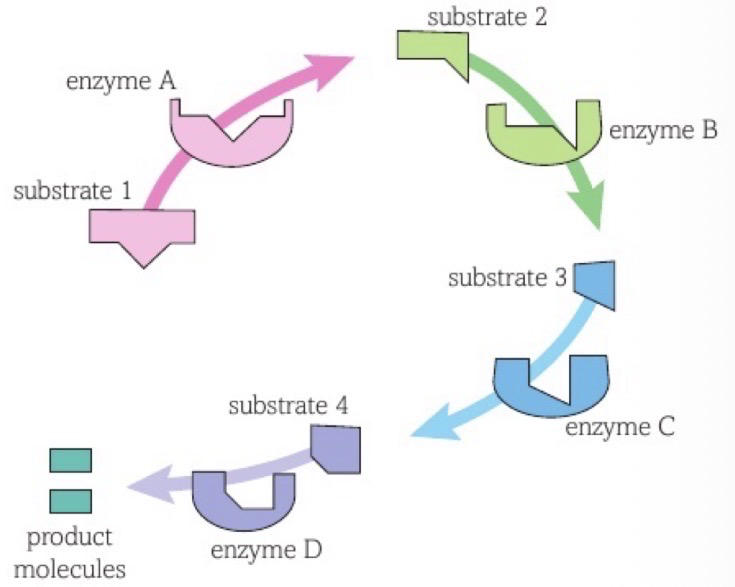
16
What are catabolic pathways?
pathway where metabolites broken down to smaller molecules and release energy
17
What are anabolic pathways?
pathway where energy used to synthesise larger molecules from smaller
18
What does catalase do?
protects cell from damage by reactive oxygen by quickly breaking down hydrogen peroxide (potential harmful by product of metabolic reactions)
19
What is the fastest acting enzyme?
catalase
20
Where is amylase produced?
salivary glands and pancreas
21
Where does amylase act?
mouth and small intestine
22
What does amylase catalyse?
digestion of polysaccharide starch into disaccharide maltose
23
Where is trypsin produced?
pancreas
24
Where does trypsin act?
small intestine
25
What does trypsin catalyse?
digestion of proteins into smaller peptides by hydrolysing peptide bonds
26
What is the optimum pH for trypsin?
7.5 and 8.5
27
What is a cofactor?
substance that has to be present to ensure an enzyme-catalysed reaction takes place at appropriate rate
28
What is an enzyme-substrate complex?
complex formed by temporary binding of enzyme and substrate molecules during enzyme-catalysed reaction with non-covalent forces
29
What is a prosthetic group?
cofactor permanently bound by covalent bonds to enzyme molecule
30
What is the cofactor in carbonic anhydrase?
prosthetic group: zinc ion
31
What does carbonic anhydrase do?
catalyses conversion of CO2 and H2O to carbonic acid (enables CO2 to be carried in blood from respiring tissues to lungs
32
How does a cofactor help a reaction?
temporary cofactors ease formation of enzyme substrate complex increasing rate of reaction
33
What are co-substrates?
cofactors that form the correct shape with the substrate to fit the enzyme active site
34
How do cofactors work using charge?
they change charge distribution on surface of substrate or active site making temporary bonds easier to form
35
What cofactor does amylase have?
chloride ions
36
What are coenzymes?
small organic non-protein molecules that temporarily bind to active site
37
What happens to coenzymes during a reaction?
chemically change so must be recycled to original state (sometimes by different enzyme)
38
coenzymes table?
39
What is an enzyme-product complex?
enzyme molecule with product molecule in its active site joined by temporary non-covalent forces
40
What is the lock and key theory?
-tertiary structure of enzyme’s active site is complimentary to substrate
-enzyme and substrate must collide due to kinetic energy to start reaction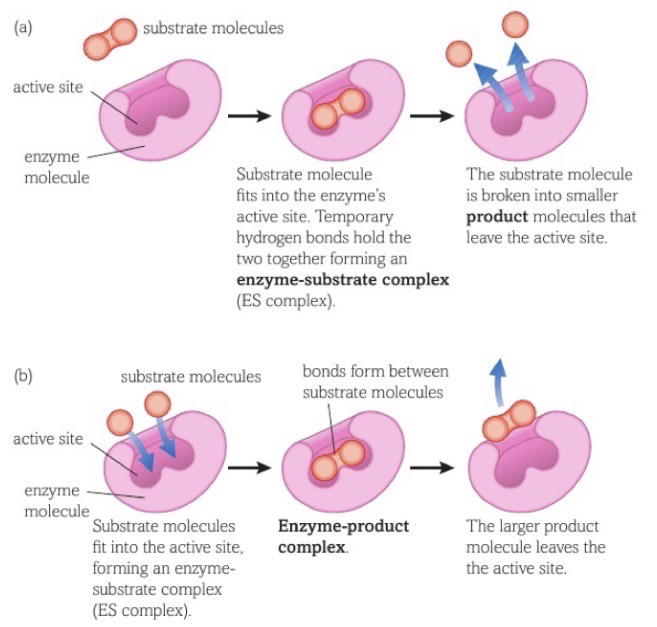
-enzyme and substrate must collide due to kinetic energy to start reaction
41
What is the induced-fit hypothesis?
-when substrate molecule fits into active site, active site changes shape slightky to mould around substrate
-shape of active site still complimentary but on binding subtle changes to 4-groups make more precise conformation
-as product molecules have slightly different shape from substrate, it detaches from active site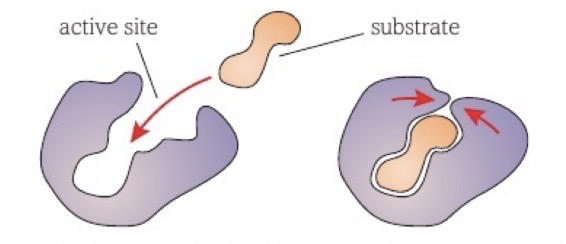
-shape of active site still complimentary but on binding subtle changes to 4-groups make more precise conformation
-as product molecules have slightly different shape from substrate, it detaches from active site
42
Why can temp not be raised too much to increase rate of reaction in body? How is this solved?
proteins would denature and lipids melt, enzymes speed up the reaction without need for high temp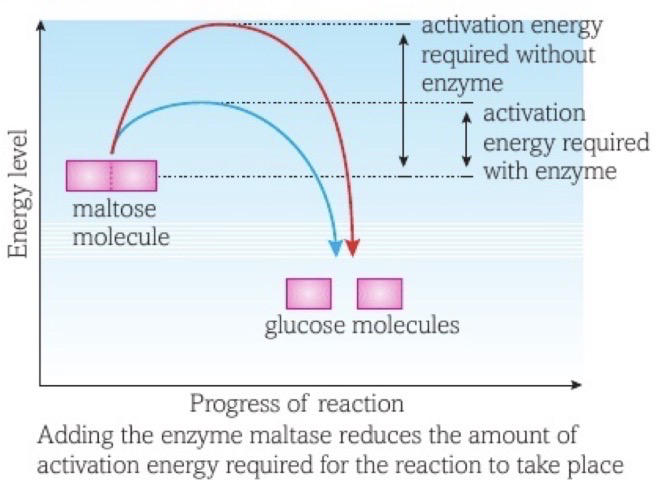
43
What is $Q_{10}$?
temp coefficient: calculated by dividing rate of reaction at (T+10)*C by rate of reaction at T*C
44
How does heating influence a reaction?
-extra thermal/ kinetic energy so molecules move faster
-increases collisions rate and force of collisions increasing ES complexes made so increasing rate of reaction
-increases collisions rate and force of collisions increasing ES complexes made so increasing rate of reaction
45
What is an enzyme optimum temp?
temp where rate of reaction is highest
46
Describe the process of an enzyme denaturing due to heat
-vibrating molecule due to higher temp breaks weak bonds (eg H and ionic) that hold tertiary structure together
-active sute changes so substrate doesnt fit and rate of reaction decreases
-more heat means active site irreversibly changed so no longer complimentary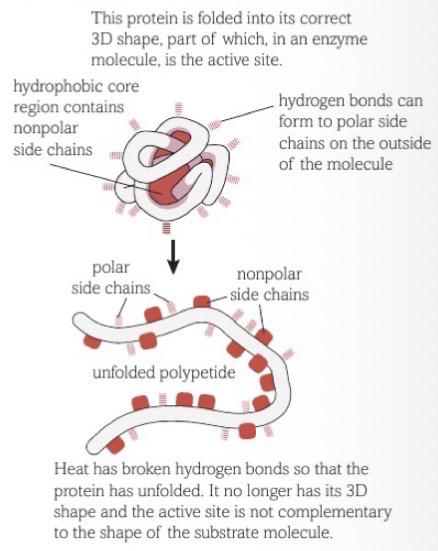
-active sute changes so substrate doesnt fit and rate of reaction decreases
-more heat means active site irreversibly changed so no longer complimentary
47
What happens to an enzymes primary structure when heated? Why?
nothing as heat doesnt break peptide bonds between amino acids
48
What are psychrophilic bacteria?
bacteria with enzymes that work at very low temp
49
What are thermophilic bacteria?
bacteria with enzymes able to work at very high temp
50
Why dont thermophilic bacteria enzymes denature at high temp?
more disulfide bonds keeping enzyme stable
51
What is the equation for rate of reaction?
52
What does it mean if Q10 is 2?
for every 10*C increase rate of reaction doubles
53
What is a buffer?
something that resists change to pH by donating or accepting H+ ions
54
How does pH affect an enzyme?
-excess H+ interfere with H bonds and ionic forces of enzymes tertiary structure changing active site
-more H+ alters charges on active site as more protons cluster around negatively charged groups, interfering with substrates binding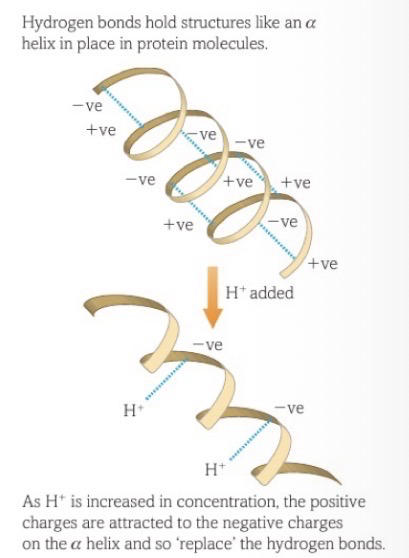
-more H+ alters charges on active site as more protons cluster around negatively charged groups, interfering with substrates binding
55
Do small changes to optimum pH cause enzyme to denature?
no actuve site is disrupted but can be restored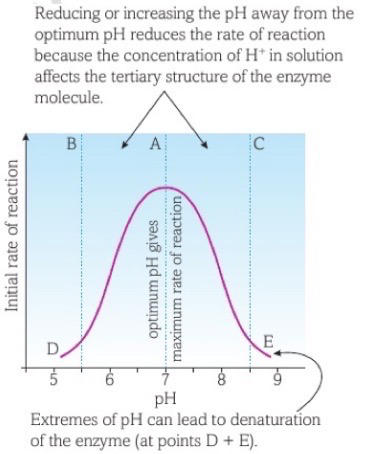
56
What is optimum pH for intracellular enzymes?
close to 7
57
What is optimum pH for amylase?
around 6.8
58
What is optimum pH for protease? Why?
1-2 due to stomach acid
59
What is optimum pH for trypsin? Why?
7.8 due to bile in small intestine
60
Why is enzyme degradation important?
-elimination of abnormally shaped proteins that could harm cell
-regulation of metabolism (eliminating excess to needs)
-regulation of metabolism (eliminating excess to needs)
61
Describe rate of reaction throughout an enzyme-catalysed reaction
-beginning: highest rate due to large concentration of substrate
-as reaction proceeds: substrate used up so concentration drops slowing rate due to less frequent successful collisions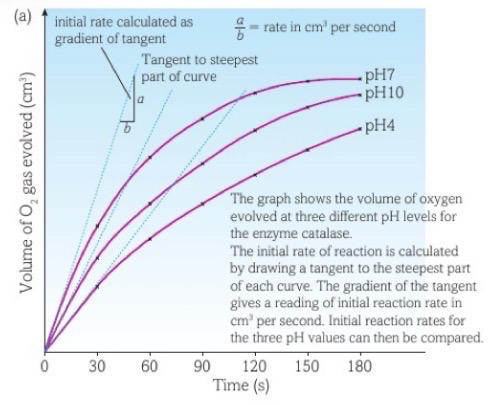
-as reaction proceeds: substrate used up so concentration drops slowing rate due to less frequent successful collisions
62
How are coenzymes supplied to body?
vitamins