Homeostasis: Biology AQA GCSE
Study these flashcardsFree · spaced repetition · iPhone, Android, Mac & web
All cards
1
What is homeostasis?
regulation of internal conditions (of a cell or organism) to maintain optimum conditions for function in response to internal/ external changes (eg best conditions for enzymes)
2
What does homeostasis include the control of? (3)
-blood glucose concentration
-body temp
-water levels
-body temp
-water levels
3
What are the 3 internal parts of an automatic control system?
-receptors, which detect stimuli/ changes in environment
-coordination centres (eg brain, spinal cord and pancreas) which receive and process info from receptors
-effectors (muscles or glands) which respond and restore optimum levels
-coordination centres (eg brain, spinal cord and pancreas) which receive and process info from receptors
-effectors (muscles or glands) which respond and restore optimum levels
4
Which 2 types of responses are involved in automatic control systems?
-nervous responses (muscle contracting)
-chemical responses (glands secrete hormones)
-chemical responses (glands secrete hormones)
5
What is the CNS?
central nervous system including brain and spinal cord
6
How does an automatic control system work? (5 stages)
1. stimulus
2. receptor
3. coordinator
4. effector
5. response
2. receptor
3. coordinator
4. effector
5. response
7
What is another way of saying nerve cells
neurones
8
How does the nervous system work?
-info from receptors passes along neurones as electrical impulses to CNS
-CNS coordinates response of effectors (muscles or glands)
-CNS coordinates response of effectors (muscles or glands)
9
Describe the reflex arc.
1) stimulus detected by receptor
2) electrical impulses pass from receptor along sensory neurone to CNS
3) at synapse, chemical released which diffuses across to relay neurone in CNS
4) triggers electrical impulse which passes across relay neurone reaching another synapse
5) at synapse, chemical released which diffuses across to motor neurone
6) triggers electrical impulse which passes down motor neurone to effector which causes response (through muscles or glands)
2) electrical impulses pass from receptor along sensory neurone to CNS
3) at synapse, chemical released which diffuses across to relay neurone in CNS
4) triggers electrical impulse which passes across relay neurone reaching another synapse
5) at synapse, chemical released which diffuses across to motor neurone
6) triggers electrical impulse which passes down motor neurone to effector which causes response (through muscles or glands)
10
What are sensory neurones connected to?
receptors
11
What is a synapse?
a junction at the end of neurone between neurone and CNS
12
What type of organ is the eye?
sense organ (containing receptors)
13
What are the receptors in the eye sensitive to?
light intensity and colour
14
What is the cornea's function?
to start focussing the light rays
15
What is A?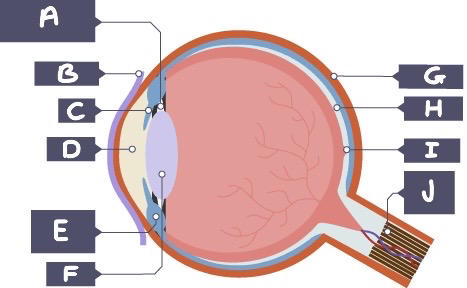
Suspensory ligament
16
What is B?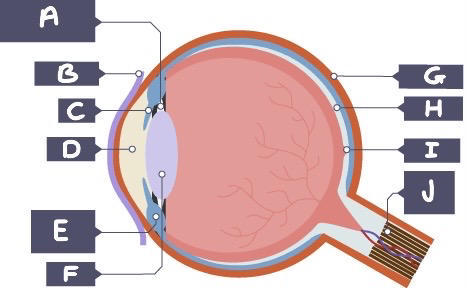
Cornea
17
What is C?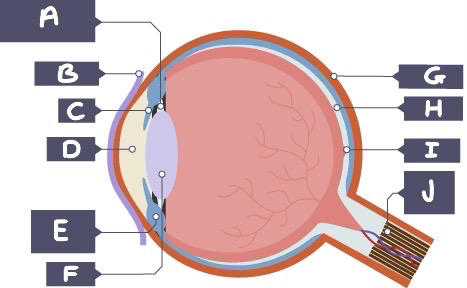
Iris
18
What is D?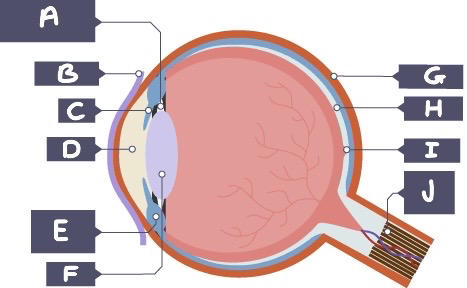
Pupil
19
What is E?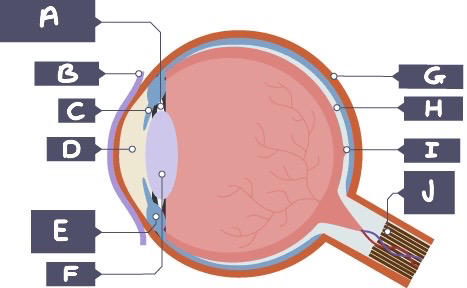
ciliary muscle
20
What is F?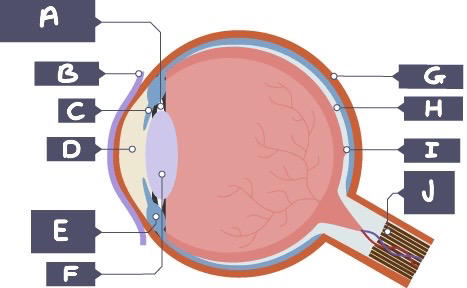
lens
21
What is G?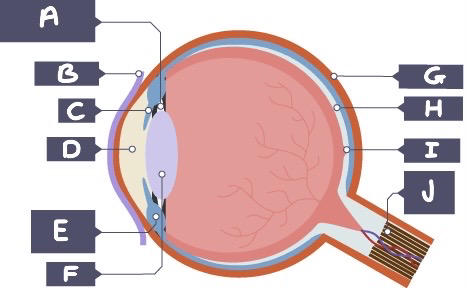
sclera
22
What is H?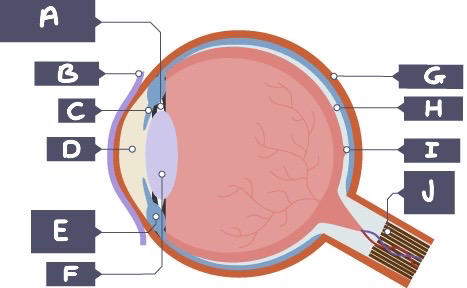
retina
23
What is J?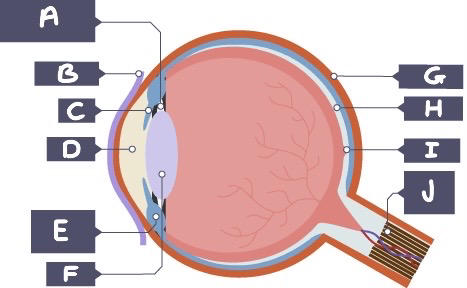
optic nerve