3.3 Transport in Plants (✓)
Study these flashcardsFree · spaced repetition · iPhone, Android, Mac & web
All cards
1
What is a dicotyledonous plant?
plants with 2 seed leaves and branching pattern of veins in leaf
2
What is the meristem?
layer of dividing cells
3
What is the role of the phloem?
to transport assimilates up and down the plant
4
What is vascular tissue?
tissue consisting of cells specialised for transporting fluids by mass flow
5
What is the role of the xylem?
transport of water and soluble mineral ions up the plant
6
Why is a plants demand for oxygen low and what does this mean for meeting this demand?
plants not very active so demand can be met by diffusion
7
What is there high demand for in plants?
water and sugars
8
How does the collenchyma and sclerenchyma benefit the plant?
provide strength and support
9
What is found in the vascular bundle?
xylem and phloem as well as other tissues like collenchyma and sclerenchyma
10
Where is vascular bundle found in young root?
at centre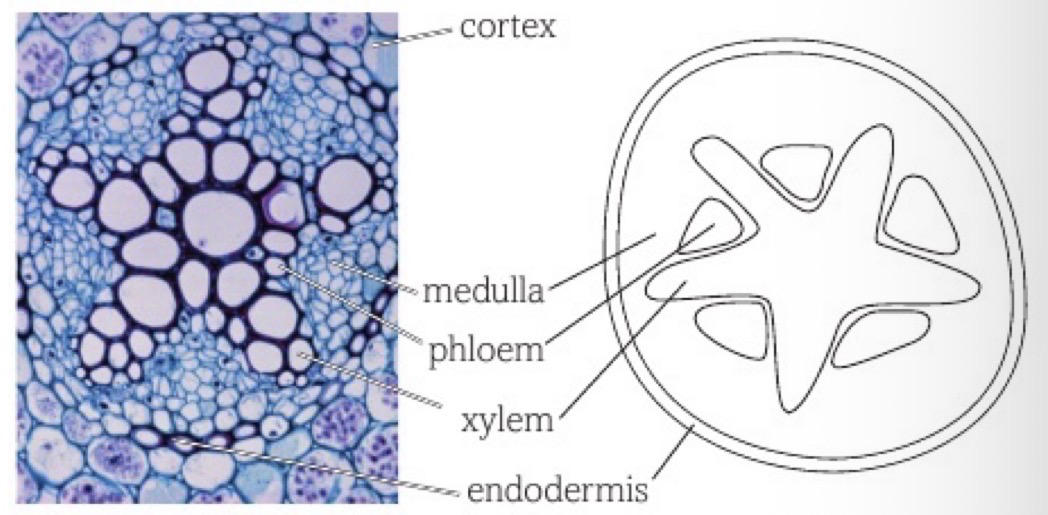
11
Where is the xylem and phloem found in young root?
xylem: X-shaped central core
phloem: between arms of X shape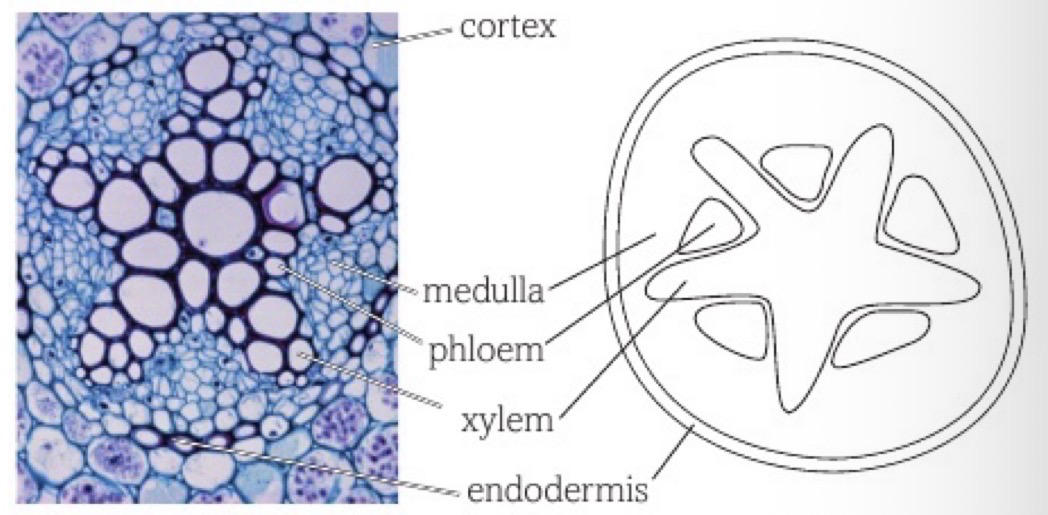
phloem: between arms of X shape
12
Why are the xylem and phloem arranged as they are in young root?
provide strength to withstand pulling forces roots are exposed to
13
What is the endodermis (young root) and what does it do?
special sheath around vascular bundle which helps get water into xylem
14
What is the pericycle?
layer of meristem cells just inside endodermis
15
Where are the vascular bundles found in the stem?
near outer edge of stem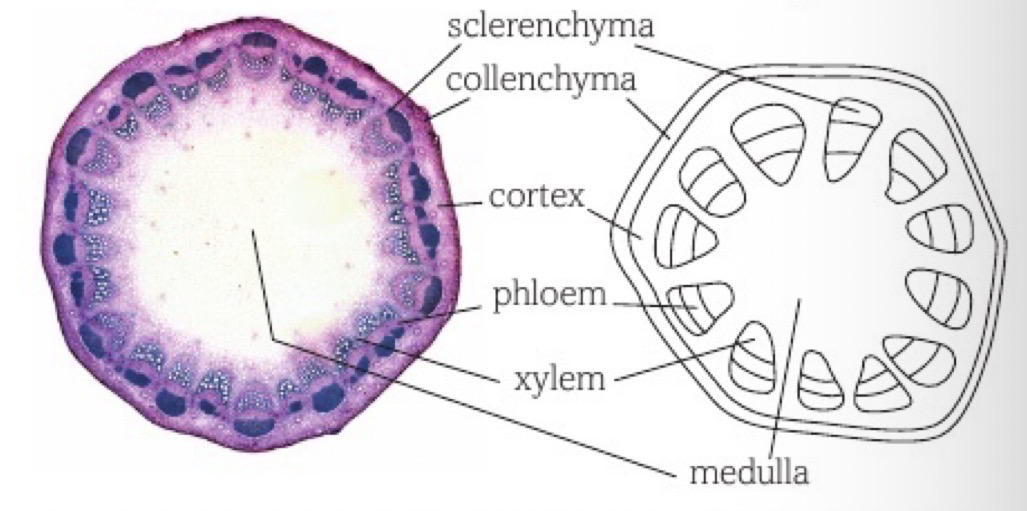
16
How are the vascular bundles arranged in the stem of a non-woody plant?
separate and discrete
17
How are the vascular bundles arranged in the stem of a woody plant?
young: separate
older: continuous ring
older: continuous ring
18
Why is a continuous ring of vascular tissue beneficial to a plant?
provides strength and flexibility to withstand forces
19
Image occlusion: name the hidden labels
20
Image occlusion: name the hidden labels
21
Image occlusion: name the hidden labels
22
Image occlusion: name the hidden labels
23
Image occlusion: name the hidden labels
24
Image occlusion: name the hidden labels
25
Image occlusion: name the hidden labels
26
Image occlusion: name the hidden labels
27
Image occlusion: name the hidden labels
28
Image occlusion: name the hidden labels
29
Image occlusion: name the hidden labels
30
Image occlusion: name the hidden labels
31
Image occlusion: name the hidden labels
32
What is the cambium?
layer of meristem cells in between xylem and phloem which can divide to produce new xylem and phloem
33
Image occlusion: name the hidden labels
34
Image occlusion: name the hidden labels
35
Image occlusion: name the hidden labels
36
Image occlusion: name the hidden labels
37
Image occlusion: name the hidden labels
38
Image occlusion: name the hidden labels
39
Where is the vascular bundle in the leaf?
midrib and veins of leaf
40
Is the xylem or phloem on top of the other in the leaf?
xylem
41
How do you examine the distribution of vascular tissue?
staining tissue, allowing coloured water to be taken up and cut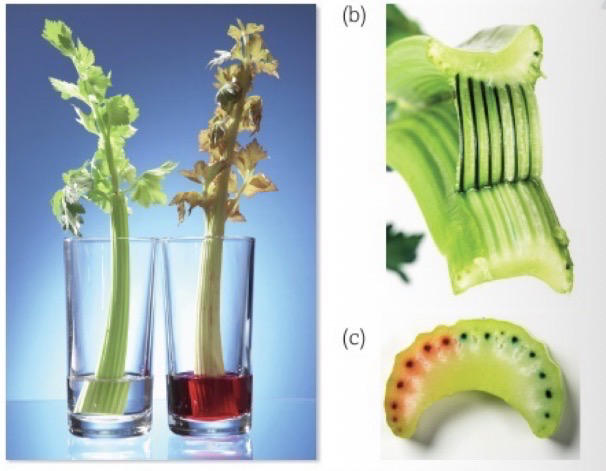
42
What are companion cells?
cells that help load sucrose into sieve tubes
43
What are sieve tube elements?
make up tubes in phloem tissue that carry sap
44
What are sieve tube elements separated by?
sieve plates
45
What does xylem tissue consist of?
-vessel to carry water and mineral ions
-fibres for support
-living parenchyma cells acting as packing tissue to separate + support vessels
-fibres for support
-living parenchyma cells acting as packing tissue to separate + support vessels
46
Describe the process of lignification
1) lignin impregnates walls making walls waterproof
2) this kills the cells
3) end walls and contents of cell decay leaving long column of dead cells w no contents
2) this kills the cells
3) end walls and contents of cell decay leaving long column of dead cells w no contents
47
How does lignin prevent xylem vessel collapse?
strengthens vessel to keep it open even when water in short supply
48
Which patterns can lignin thickening form and how do they benefit the plant?
spiral, annular (rings), reticulate (network of broken rings)
prevents vessel being too rigid and allows flexibility
prevents vessel being too rigid and allows flexibility
49
What are bordered pits and what are they for?
gaps in cell walls which align between 2 adjacent vessels allowing water to be transferred or transferred to living parts of plant
50
Where do bordered pits form?
where lignificatiom not complete
51
How do xylem vessels being narrow benefit the plant?
water column doesnt break easily and capillary action can be effective
52
How come water flow not impeded in xylem?
-no cross walls
-no cell contents
-lignin thickening preventing collapse
-no cell contents
-lignin thickening preventing collapse
53
Image occlusion: name the hidden labels
54
Image occlusion: name the hidden labels
55
Image occlusion: name the hidden labels
56
What does phloem tissue consist of?
sieve tube elements and companion cells
57
How are sieve tube elements well suited to form sieve tubes?
no nucleus and very little cytoplasm leaving space for mass flow of sap
58
Do sieve tubes have thin or thick walls?
thin
59
What are properties of companion cells?
-large nucleus
-dense cytoplasm
-numerous mitochondria
-dense cytoplasm
-numerous mitochondria
60
What are sieve plates?
perforated cross-walls allowing movement of sap from one element to next
61
Image occlusion: name the hidden labels
62
Image occlusion: name the hidden labels
63
Image occlusion: name the hidden labels
64
Image occlusion: name the hidden labels
65
What is the plasmodesmata?
gaps in the cell wall containing cytoplasm that connects 2 cells acting as special cytoplasmic bridges
66
Are cellulose cell wall fully permeable to water?
yes
67
What is the apoplast pathway?
water passing through spaces in cell walls and between cells (not through membrane)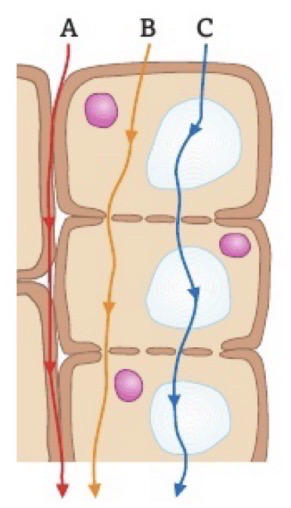
68
What causes the flow of water in the apoplast pathway?
mass flow rather than osmosis
69
Can dissolved mineral ions and salts be carried in water in the apoplast pathway?
yes
70
What is the symplast pathway?
water enters cell cytoplasm through membrane and then passes through plasmodesmata to next cell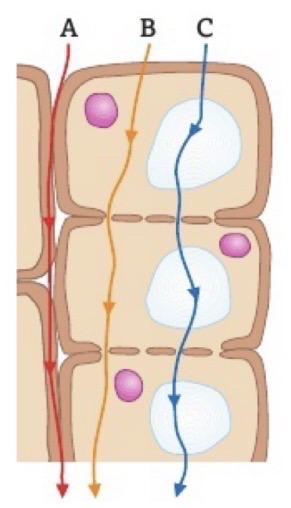
71
What is the vacuolar pathway?
water enters through membrane into cytoplasm and is able to enter and pass through vacuole before leaving to another cell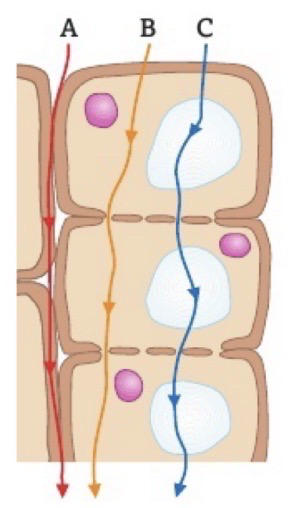
72
What is water potential?
tendency of water molecules to move from one place to another
73
What is the water potential of water?
0
74
Do mineral ions and sugars increase or decrease water potential? Why?
decrease, fewer free water molecules available
75
How does water move in a water potential gradient?
from higher water potential to lower
76
What happens if a plant cell is placed in pure water?
cell takes up water by osmosis 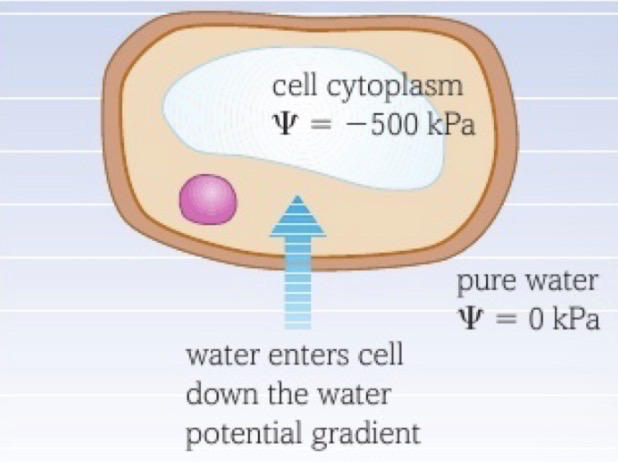
77
What does turgid mean?
when a cell is full of water
78
Why doesnt a plant cell burst?
strong cellulose wall
79
What is the pressure potential?
when the water inside the cell starts to exert pressure on the cell wall
80
What happens to water influx as pressure potential builds up?
water influx reduces
81
What happens if a plant cell is placed in salt solution with very low water potential?
lose water by osmosis
82
What happens when a plant cell loses too much water?
-cytoplasm and vacuole shrink
-cytoplasm no longer pushes against cell wall so cell no longer turgid
-plasmolysis
-tissue now flaccid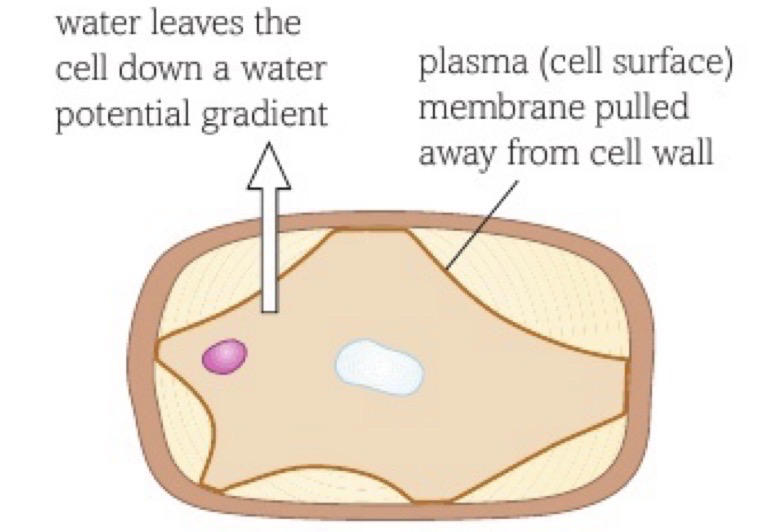
-cytoplasm no longer pushes against cell wall so cell no longer turgid
-plasmolysis
-tissue now flaccid
83
What is plasmolysis?
plasma membrane loses contact with wall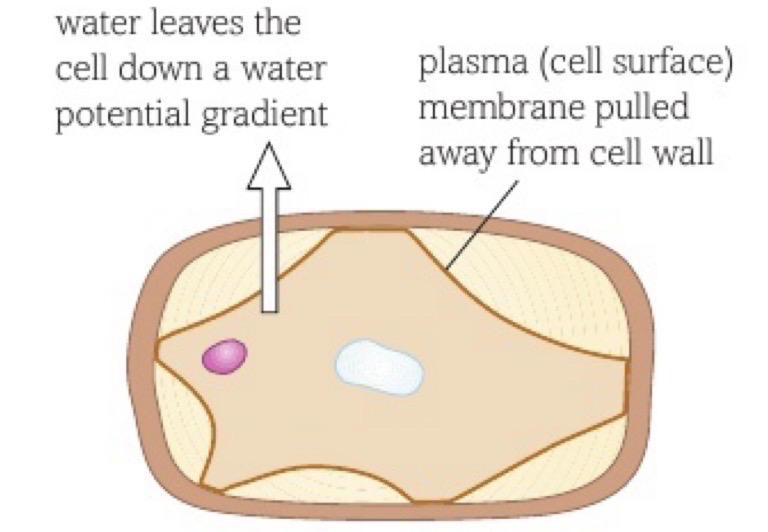
84
What is a potometer?
device that measures rate of water uptake as leafy stem transpires
85
What is transpiration?
loss of water vapour from aerial parts of plant (stomata in leaves)
86
How is water loss on the top part of a leaf limited?
waxy cuticle
87
What time of day is the majority of water in a plant lost? Why?
during day since photonsynthesis requires sufficient light
88
What is the typical pathway taken by water leaving the leaf?
1) enters leaf through xylem, moving by osmosis or apoplast pathway to spongy mesophyll cells
2) water evaporates from spongy mesophyll cell walls
3) vapour moves by diffusion out of leaf through open stomata, relying on water vapour gradient where water vapour potential must be higher inside from outside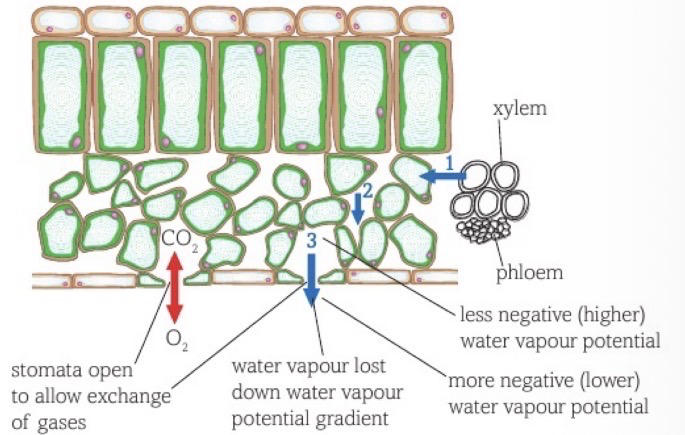
2) water evaporates from spongy mesophyll cell walls
3) vapour moves by diffusion out of leaf through open stomata, relying on water vapour gradient where water vapour potential must be higher inside from outside
89
What are the benefits of a transpiration stream?
-transports useful mineral ions up plant
-maintains cell turgidity
-supply water for growth, cell elongation and photosynthesis
-suppky water to evaporate which cools plant
-maintains cell turgidity
-supply water for growth, cell elongation and photosynthesis
-suppky water to evaporate which cools plant
90
How does light intensity affect transpiration? Why?
higher light intensity increases transpiration rate
because stomata open for gaseous exchange for photosynthesis
because stomata open for gaseous exchange for photosynthesis
91
How does temperature affect transpiration? Why?
higher temp increases rate of transpiration
because increase evaporation from cell surfaces so water-vapour potential in leaf rises
because increase rate of diffusion through stomata because water molecules have more kinetic energy
because decrease in relative water vapour potential in air allowing more rapid diffusion
because increase evaporation from cell surfaces so water-vapour potential in leaf rises
because increase rate of diffusion through stomata because water molecules have more kinetic energy
because decrease in relative water vapour potential in air allowing more rapid diffusion
92
How does relative humidity affect transpiration? Why?
Higher relative humidity in air decrease transpiration rate
because smaller water vapour potential gradient between in leaf and air
because smaller water vapour potential gradient between in leaf and air
93
How does air movement/ wind affect transpiration? Why?
more air movement increases transpiration rate
because air movement carries away water vapour maintaining high water vapour potential gradient
because air movement carries away water vapour maintaining high water vapour potential gradient
94
How does water availability affect transpiration? Why?
low water availability decreases rate of transpiration
because not enough water to replace water lost so stomata close and leaved wilt
because not enough water to replace water lost so stomata close and leaved wilt
95
What is adhesion?
attraction between water molecules and walls of xylem vessel
96
What is cohesion?
attraction between water molecules caused by hydrogen bonds
97
What is the transpiration stream?
movement of water from soil, through plant, to air surrounding leaves driven by water potential gradient between soil and air by leaves
98
How does water move across the root?
1) roots outer layer of cells (epidermis) contain root hair cells which absorb water and mineral ions
2) water moves across root cortex down water potential gradient to endodermis of vascular bundle
3) any water travelling by apoplast pathway must enter symplast pathway as apoplast pathway blocked by Casparian strip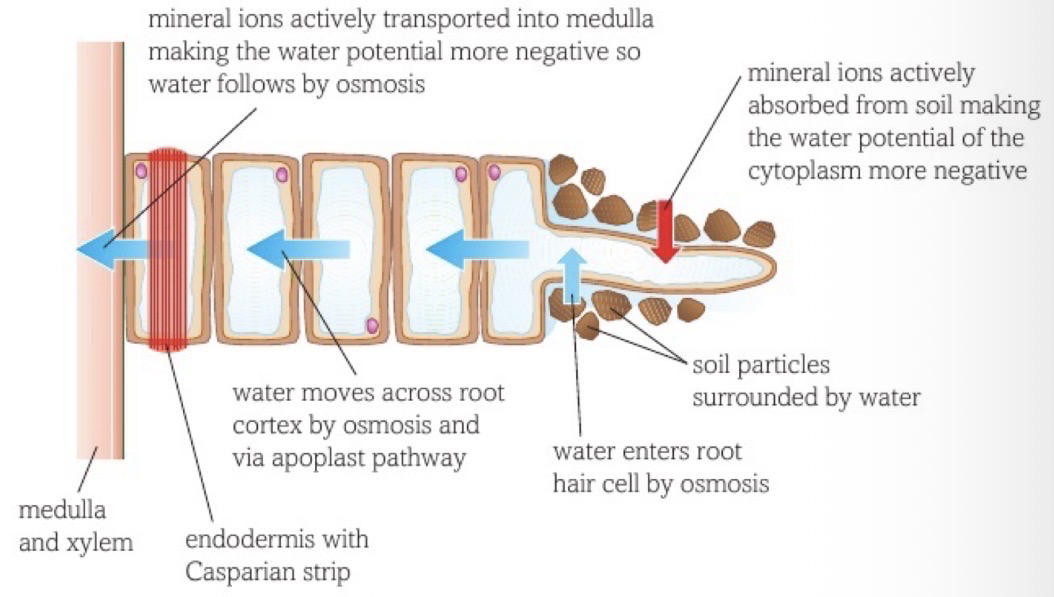
2) water moves across root cortex down water potential gradient to endodermis of vascular bundle
3) any water travelling by apoplast pathway must enter symplast pathway as apoplast pathway blocked by Casparian strip
99
What is the starch sheath also known as?
endodermis
100
What is the starch sheath?
layer of cells around medulla and xylem containing granules of starch
101
How do mineral ions eneter the xylem at the root?
dissolved in water that has to pass into cell due to casparian strip then plasma membrane transporter proteins actively pump mineral ions from cytoplasm of cortex cells into medulla+ xylem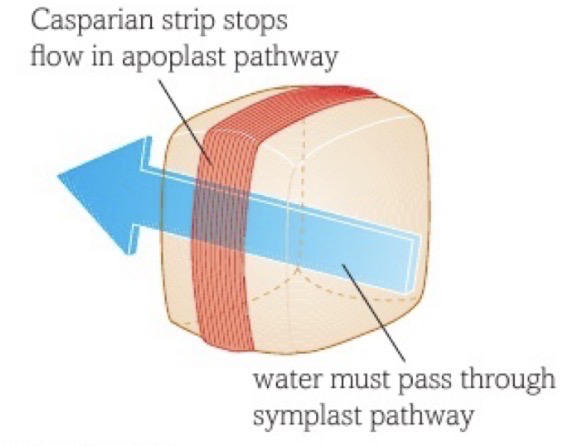
102
Why does water flow from cortex cells into medulla and xylem?
due to water potential being lower in medulla and xylem because mineral ions are pumped into xylem
103
Why cant the water enter back into the cortex from xylem and medulla in root?
apoplast pathway of endodermal cells blocked by casparian strip and water potential gradient prevents it from moving through cytoplasm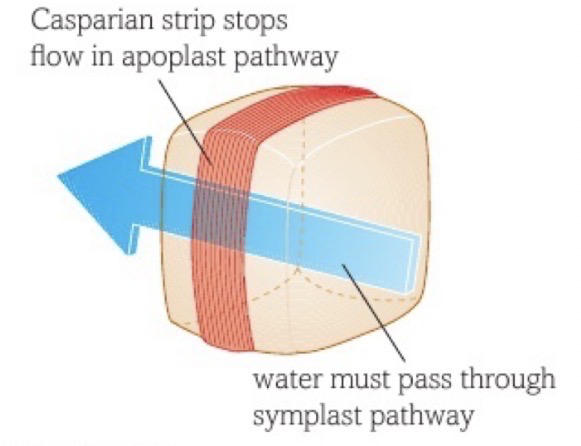
104
Does water move up the xylem by mass flow?
yes
105
How does water move from the root medulla into and up the xylem?
minerals in medulla draw water into medulla where pressure builds up so water forced into xylem, pushing it up
106
What is cohesion tension theory?
-water molecules are attracted to eachother by forces of cohesion holding them together in a long chain
-so when some are lost at the top the whole chain is pulled up
-this creates tension in column of water (why lignin strengthening is needed)
-so when some are lost at the top the whole chain is pulled up
-this creates tension in column of water (why lignin strengthening is needed)
107
How does transpiration pull work?
cohesion-tension theory
108
What happens if water column in one xylem vessel breaks?
water column maintained through another vessel via bordered pits
109
How does capillary action work?
adhesion pulls water up sides of vessel due to xylem being very narrow
110
What is a hydrophyte?
plant adapted to living in water or where ground is very wet
111
What is a xerophyte?
plant adapted to living in dry conditions
112
What must a plant living on land be adapted to?
-reduce loss of water
-replace water lost
-replace water lost
113
How are terrestrial plants adapted to reduce water loss?
-waxy cuticle
-stomata are on the under surface of leaves reducing evaporation from heat from direct sun
-stomata closed at night
-deciduous plants lose leaves in winter when ground is frozen and temp too low for photosynthesis
-stomata are on the under surface of leaves reducing evaporation from heat from direct sun
-stomata closed at night
-deciduous plants lose leaves in winter when ground is frozen and temp too low for photosynthesis
114
How is marram grass adapted?
-leaf rolled longitudinally so air trapped inside becomes humid which reduces water loss and can roll tighter in very dry conditions
-thick waxy cuticle on outer side of rolled leaf
-stomata on inner side so protected by enclosed air
-stomata in pits in lower epidermis that are folded and covered by hairs helping reduce air movement
-spongymesophyll very dense so less SA for evaporation
-thick waxy cuticle on outer side of rolled leaf
-stomata on inner side so protected by enclosed air
-stomata in pits in lower epidermis that are folded and covered by hairs helping reduce air movement
-spongymesophyll very dense so less SA for evaporation
115
How are cacti adapted?
-store water in stems which are often ribbed or fluted to allow expansion
-spines not leaves to reduce SA so less water lost
-stem green for photosynthesis
-wide spread roots
-spines not leaves to reduce SA so less water lost
-stem green for photosynthesis
-wide spread roots
116
What are example of xerophytic features?
-closing stomata when low water availability
-low water potential in leaf by maintaining high salt concentration which reduces evaporation as gradient between cells and air spaces reduced
-very long tap root to reach underground water
-low water potential in leaf by maintaining high salt concentration which reduces evaporation as gradient between cells and air spaces reduced
-very long tap root to reach underground water
117
What issues do hydrophytes face?
-getting oxygen to submerged tissue
-keeping afloat to keep leaves in sunlight
-keeping afloat to keep leaves in sunlight
118
What adaptations does a water lily have?
-large air spaces in leaf to keep afloat for sunlight
-stomata on upper epidermis for gas exchange
-leaf stem with large air spaces for buoyancy and fast diffusion of oxygen to roots for respiration
-stomata on upper epidermis for gas exchange
-leaf stem with large air spaces for buoyancy and fast diffusion of oxygen to roots for respiration
119
What are hydathodes?
structures that release water droplets which then evaporate from leaf surface
120
What is the role of hydathodes?
to maintain transpiration stream in water and humid conditions
121
What is a sink?
part of plant where materials are removed from transport system (eg roots recieving sugar)
122
What is a source?
part of plant that loads materials into transport system (eg sugar from leaves photosynthesis)
123
What is translocation?
transport of assimilates throughout plant
124
What are assimilates?
substances made by plant using substances absorbed from environment (eg sugar and amino acids)
125
Where does translocation occur?
phloem
126
Explain process of active loading
1) H+ ions actively transported out of companion cell
2) increases concentration outside cell and decreases concentration inside cell
3) H+ ions diffuse back into cell due to concentration gradient through special cotransporter proteins which only allow H+ in if accompanied by sucrose molecules
4) as concentration of sucrose in companion cell increases, it diffuses through plasmodesmata into sieve tube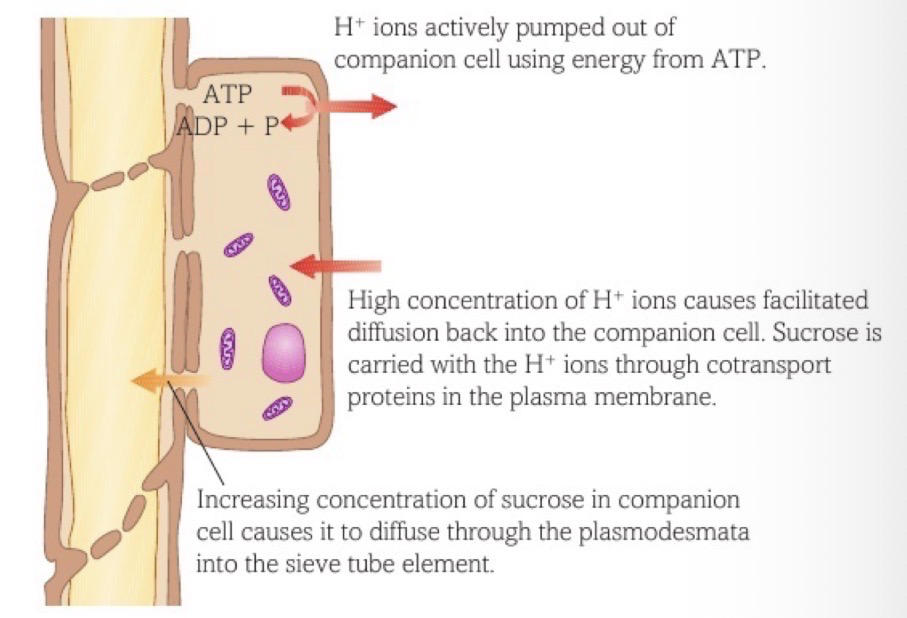
2) increases concentration outside cell and decreases concentration inside cell
3) H+ ions diffuse back into cell due to concentration gradient through special cotransporter proteins which only allow H+ in if accompanied by sucrose molecules
4) as concentration of sucrose in companion cell increases, it diffuses through plasmodesmata into sieve tube
127
What is cotransport?
Cotransporter proteins allowing only movement of H+ ions into cell if accompanied by sucrose molecules
128
What is cotransport also called and why?
secondary active transport, result of active transport of H+ out and moves sucrose against its concentration gradient
129
What is sap?
solution of assimilates
130
How does sucrose move along phloem?
by mass flow
131
What is the flow in the phloem caused by?
-difference in hydrostatic pressure between 2 ends of tube resulting in pressure gradient
-water enters at source increasing pressure and leaves at the sink reducing pressure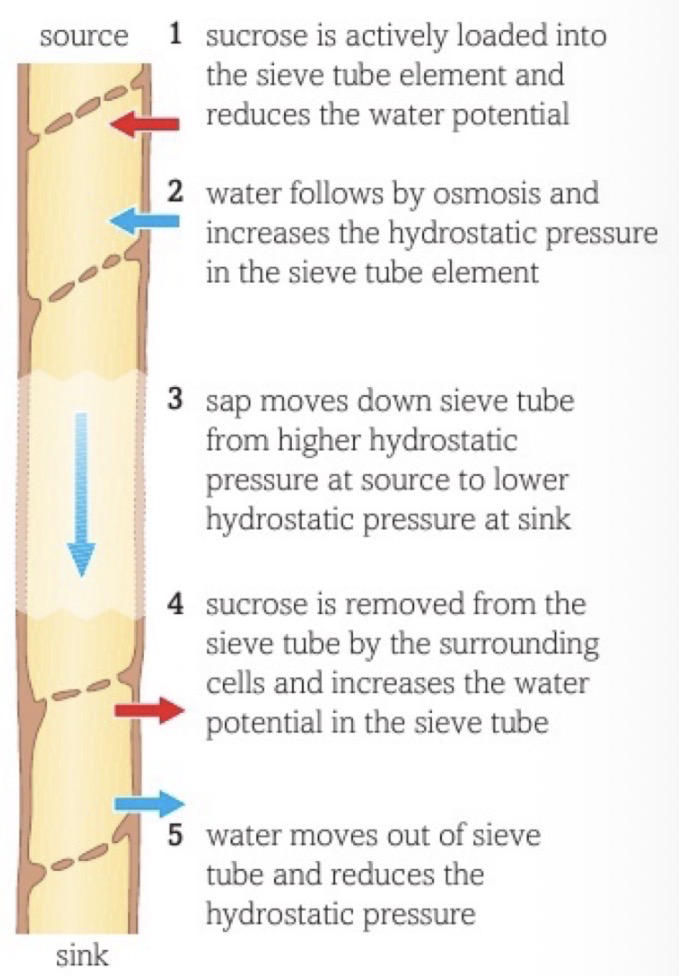
-water enters at source increasing pressure and leaves at the sink reducing pressure
132
Why does water move into sieve-tube element?
sucrose entering sieve-tube element makes water potential in sieve-tube more negative so water molecules enter by osmosis from surrounding tissue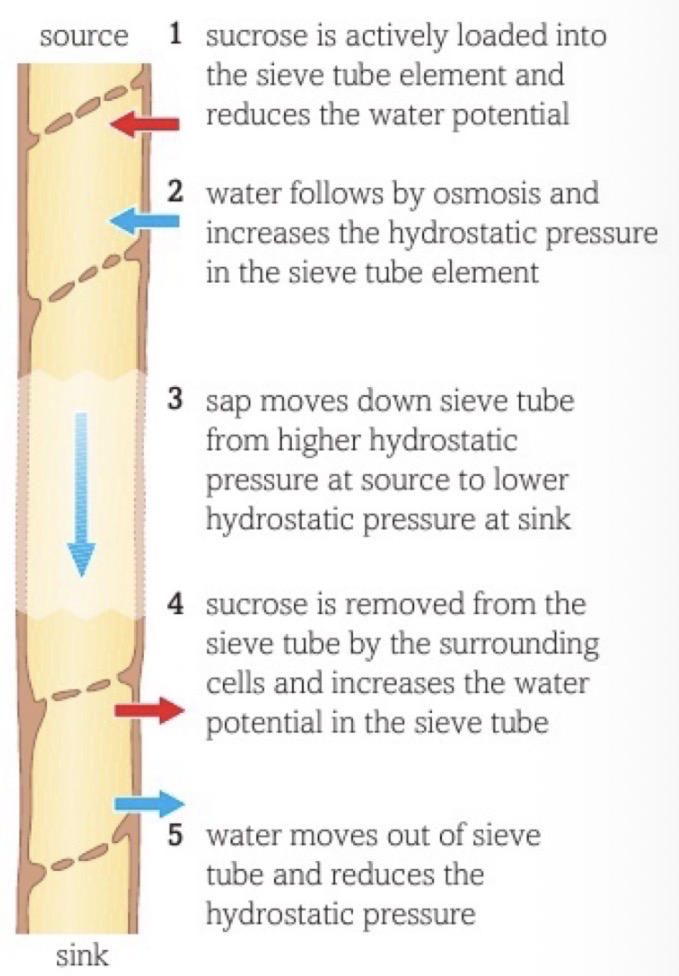
133
How can roots be a sink?
sucrose converted to starch for storage
134
How can roots be a source?
provide sucrose from stored starch
135
How are meristems sinks?
sucrose used for growth
136
How does sucrose leave sieve-tube elements at sink?
diffuse out via plasmodesmata or active transport
137
How is hydrostatic pressure reduced at sink?
removal of sucrose cause water potential in sieve tube to increase so water moves out to surrounding cells
138
Does sap flow in opposite directions in one sieve tube?
no but can flow in opposite directions in different sieve tubes at once